

Seventy-Five Trials and Eleven Systematic Reviews a Day: How Will We Ever Keep Up?
Open accessThe DOI matches its Crossref record; 32 of the 32 references it cites were found in a registry or an index.
Abstract
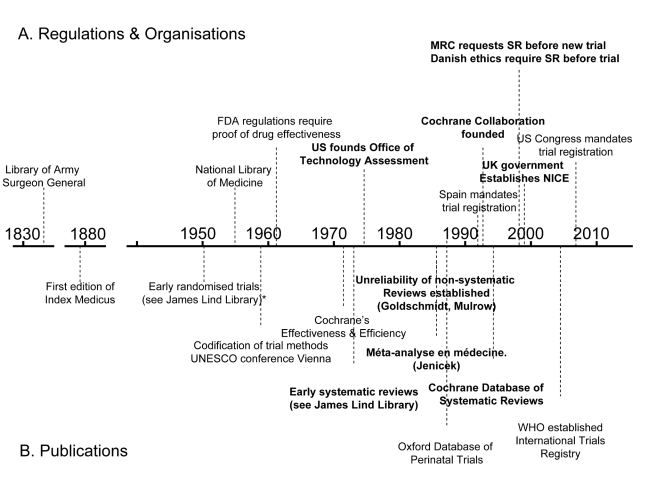
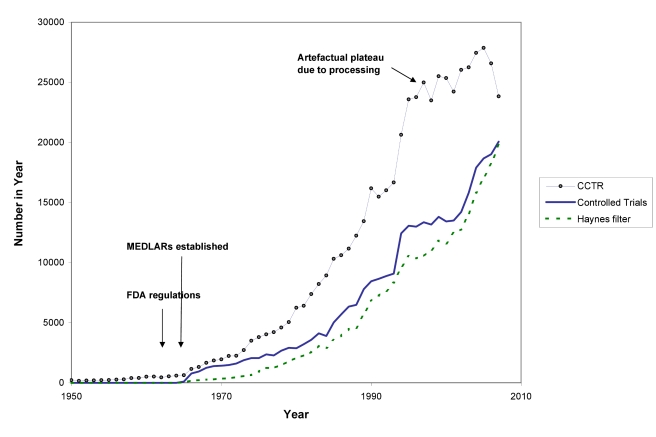
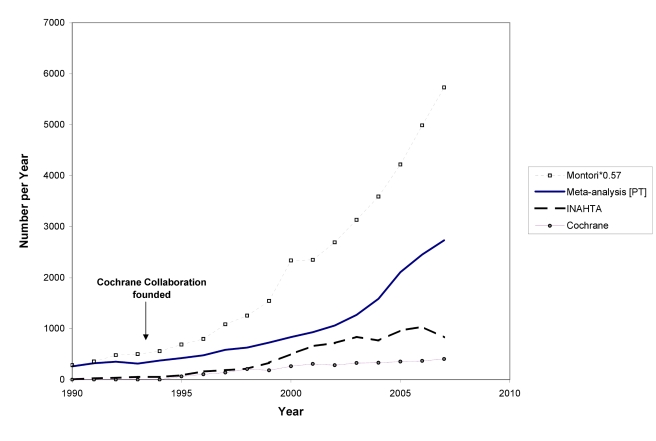
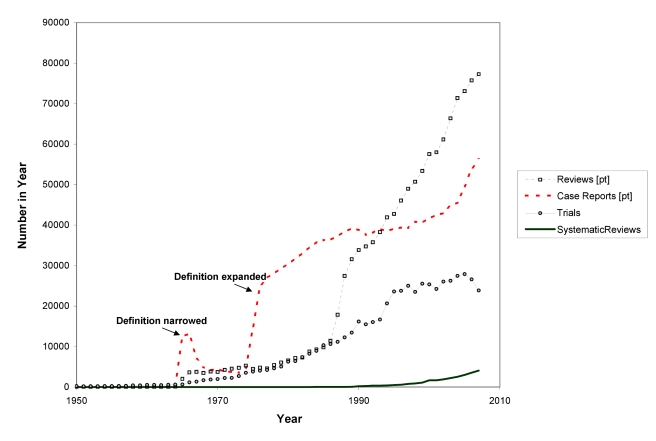
When Archie Cochrane reproached the medical profession for not having critical summaries of all randomised controlled trials, about 14 reports of trials were being published per day. There are now 75 trials, and 11 systematic reviews of trials, per day and a plateau in growth has not yet been reached. Although trials, reviews, and health technology assessments have undoubtedly had major impacts, the staple of medical literature synthesis remains the non-systematic narrative review. Only a small minority of trial reports are being analysed in up-to-date systematic reviews. Given the constraints, Archie Cochrane's vision will not be achieved without some serious changes in course. To meet the needs of patients, clinicians, and policymakers, unnecessary trials need to be reduced, and systematic reviews need to be prioritised. Streamlining and innovation in methods of systematic reviewing are necessary to enable valid answers to be found for most patient questions. Finally, clinicians and patients require open access to these important resources.
Overview
The claims and statistics of this paper haven’t been checked yet.
Free: it reads the open-access text and checks the first 5 claims that cite a source we can check. Create a free account to check every claim.
Integrity signals
Registry
Cites
Statistics
Figures
Verification
Claims the paper makes
The claims and statistics of this paper haven’t been checked yet.
Free: it reads the open-access text and checks the first 5 claims that cite a source we can check. Create a free account to check every claim.
Claims other papers make about this one
Each is checked against this paper’s own text: does it say what the citing paper says it does?
The source backs part of the claim, not all of it — or backs it for a different population, condition or comparison.
In the citing paper
“However, such reviews have become ever more complicated, due to the complexity of interventions being studied and the amount of evidence being published which needs to be incorporated [1].”
From Making progress with the automation of systematic reviews: principles of the International Collaboration for the Automation of Systematic Reviews (ICASR) (2018) · cites this paper as [1]
Experimental — accuracy not yet measuredThe source backs part of the claim, not all of it — or backs it for a different population, condition or comparison.
In the citing paper
“When the number of studies is an order of magnitude greater than that, the inability of narrative processes to adequately summarize the outcomes increases exponentially 2,3 .”
From Meta-analysis and the science of research synthesis (2018) · cites this paper as [3]
Experimental — accuracy not yet measuredThe source backs part of the claim, not all of it — or backs it for a different population, condition or comparison.
In the citing paper
“The number of RCTs published accelerates every year,3”
From Trialstreamer: A living, automatically updated database of clinical trial reports (2020) · cites this paper as [3]
Experimental — accuracy not yet measuredThe source backs part of the claim, not all of it — or backs it for a different population, condition or comparison.
In the citing paper
“Screening references is a time‐consuming step necessary for systematic reviews and guideline development.”
From Prioritising references for systematic reviews with RobotAnalyst: A user study (2018) · cites this paper as [4]
Experimental — accuracy not yet measuredThe source backs part of the claim, not all of it — or backs it for a different population, condition or comparison.
In the citing paper
“However, systematic review methodology and the language used to express that methodology, has progressed significantly since their appearance in healthcare in the 1970’s and 80’s [7, 8].”
From What kind of systematic review should I conduct? A proposed typology and guidance for systematic reviewers in the medical and health sciences (2018) · cites this paper as [7]
Experimental — accuracy not yet measured
5 more claims about this paper
Create a free account to see every claim other papers make about this one.
Self-check
Percentages, sums and reported differences re-computed from the paper’s own numbers.
The self-check needs the paper’s full text.
Citations
Cites
Avoidable waste in the production and reporting of research evidence
Chalmers, I., & Glasziou, P. (2009) · The Lancet · doi:10.1016/s0140-6736(09)60329-9 · Cited by 2,208
Self-citationMeta-Analysis in Clinical Research
L'ABBÉ, K. A., DETSKY, A. S., & O'ROURKE, K. (1987) · Annals of Internal Medicine · doi:10.7326/0003-4819-107-2-224 · Cited by 1,267 · cited 1×
“By the mid-1980s, the need to minimise the likelihood of being misled by the effects of biases and the play of chance in reviews of research evidence was being made evident in articles [10–14] and textbooks [15].”
BackgroundMeta-Analyses of Randomized Controlled Trials
Sacks, H. S., Berrier, J., Reitman, D., Ancona-Berk, V. A., & Chalmers, T. C. (1987) · New England Journal of Medicine · doi:10.1056/nejm198702193160806 · Cited by 1,250
Clinical Trial Registration: A Statement from the International Committee of Medical Journal Editors
De Angelis, C., Drazen, J. M., Frizelle, F. A., Haug, C., Hoey, J., Horton, R., Kotzin, S., Laine, C., Marusic, A., Overbeke, A. J. P. M., et al. (2004) · New England Journal of Medicine · doi:10.1056/nejme048225 · Cited by 1,241
Publication bias in clinical trials due to statistical significance or direction of trial results
Hopewell, S., Loudon, K., Clarke, M. J., Oxman, A. D., & Dickersin, K. (2009) · Cochrane Database of Systematic Reviews · doi:10.1002/14651858.mr000006.pub3 · Cited by 898
Epidemiology and reporting characteristics of systematic reviews.
Moher, D., Tetzlaff, J., Tricco, A. C., Sampson, M., & Altman, D. G. (2007) · PLoS Medicine · doi:10.1371/journal.pmed.0040078 · Cited by 891 · cited 2×
“variously estimated at between six and 16 (Cochrane reviews now include an average of over 12 trials per review [27,28]; M Clarke, personal communication), but many reviews have covered much the same territory.”
BackgroundThe Medical Review Article: State of the Science
MULROW, C. D. (1987) · Annals of Internal Medicine · doi:10.7326/0003-4819-106-3-485 · Cited by 856 · cited 1×
“By the mid-1980s, the need to minimise the likelihood of being misled by the effects of biases and the play of chance in reviews of research evidence was being made evident in articles [10–14] and textbooks [15].”
BackgroundHow Quickly Do Systematic Reviews Go Out of Date? A Survival Analysis
Shojania, K. G., Sampson, M., Ansari, M. T., Ji, J., Doucette, S., & Moher, D. (2007) · Annals of Internal Medicine · doi:10.7326/0003-4819-147-4-200708210-00179 · Cited by 838 · cited 1×
“now many years out of date [26].”
Avoidable Waste in the Production and Reporting of Research Evidence
Chalmers, I., & Glasziou, P. (2009) · Obstetrics & Gynecology · doi:10.1097/aog.0b013e3181c3020d · Cited by 600 · cited 1×
“duction and reporting of research evidence [29].”
Self-citationGuidelines for reading literature reviews.
Oxman, A. D., & Guyatt, G. H. (1988) · Europe PMC (PubMed Central) · Cited by 549
Research works printed but not linked: 3
- Duncan A 1773 Introduction. Medical and Philosophical Commentaries. Volume First, Part I. London: J Murray 6 7
- Chalmers I 1979 Randomized controlled trials of fetal monitoring 1973–1977. Thalhammer O Baumgarten K Pollak A Perinatal Medicine Stuttgart Georg Thieme 260 265
- Koch GG 2006 No improvement – still less than half of the Cochrane reviews are up to date. XIV Cochrane Colloquium, Dublin, Ireland
Cited by
Items 301–400 of 1,002
The views of health guideline developers on the use of automation in health evidence synthesis
Arno, A., Elliott, J., Wallace, B., Turner, T., & Thomas, J. (2021) · Systematic Reviews · doi:10.1186/s13643-020-01569-2 · Cited by 40
Generative Artificial Intelligence in Medicine
Shanmugam, D., Agrawal, M., Movva, R., Chen, I. Y., Ghassemi, M., Jacobs, M. L., & Pierson, E. (2025) · Annual Review of Biomedical Data Science · doi:10.1146/annurev-biodatasci-103123-095332 · Cited by 42
Lindquist, E. D., George, C. M., Perin, J., de Calani, K. J. N., Norman, W. R., Davis, T., & Perry, H. B. (2014) · American Journal of Tropical Medicine and Hygiene · doi:10.4269/ajtmh.13-0568 · Cited by 41
Sarma, H., D’Este, C. A., Ahmed, T., Bossert, T. J., & Banwell, C. L. (2020) · Public Health Nutrition · doi:10.1017/s1368980019004415 · Cited by 52
“Recently, the number of systematic reviews has increased, with an average of eleven systematic reviews of efficacy level trials published every day in various health and nutrition fields(71).”
BackgroundAn SVM-based high-quality article classifier for systematic reviews
Kim, S., & Choi, J. (2014) · Journal of Biomedical Informatics · doi:10.1016/j.jbi.2013.10.005 · Cited by 39
Systematic literature reviews over the years
Smela, B., Toumi, M., Swierk, K., Gawlik, K., Clay, E., & Boyer, L. (2023) · Journal of Market Access & Health Policy · doi:10.1080/20016689.2023.2244305 · Cited by 43
“Furthermore, SLRs and trials are lower in the number of published works than case reports [19].”
BackgroundO’Donohoe, T. J., Dhillon, R., Bridson, T. L., & Tee, J. (2019) · Neurosurgery · doi:10.1093/neuros/nyy615 · Cited by 40
Methodological approaches in conducting overviews: current state in HTA agencies
Pieper, D., Antoine, S., Morfeld, J., Mathes, T., & Eikermann, M. (2014) · Research Synthesis Methods · doi:10.1002/jrsm.1107 · Cited by 39
Ng, L., Pitt, V., Huckvale, K., Clavisi, O., Turner, T., Gruen, R., & Elliott, J. H. (2014) · Systematic Reviews · doi:10.1186/2046-4053-3-121 · Cited by 38
“The continuing exponential growth in published bio-medical research presents a daunting challenge for clinicians and others involved in health care [1].”
Grol-Prokopczyk, H., Huang, R., Yu, C., Chen, Y., Kaur, S., Limani, M., Lin, T.-H., Zajacova, A., Zimmer, Z., Cowan, P., et al. (2025) · Pain · doi:10.1097/j.pain.0000000000003676 · Cited by 43
“…qualitative reviews in pain research, 68 the greater potential for qualitative reviews to consider multifactorial, multilevel explanations for disparities, and the status of narrative reviews as “the staple of medical literature synthesis,” 4 we include both quantitative and qualitative reviews.”
Lunny, C., Neelakant, T., Chen, A., Shinger, G., Stevens, A., Tasnim, S., Sadeghipouya, S., Adams, S., Zheng, Y. W., Lin, L., et al. (2021) · Research Synthesis Methods · doi:10.1002/jrsm.1530 · Cited by 40
Funnels for publication bias – have we lost the plot?
Choi, S. W., & Lam, D. M. H. (2015) · Anaesthesia · doi:10.1111/anae.13355 · Cited by 40
“With an average of 75 trials published in peer-review journals every day [1], it can get pretty complicated even for a full-time, professional data analyst to keep up with”
BackgroundSystematic reviews: Key concepts for health professionals
Sgarbossa, N. J., Cobaisse, M. I., Cianciulli, G. G., Bracchiglione, J., & Franco, J. V. A. (2022) · Medwave · doi:10.5867/medwave.2022.09.2622 · Cited by 44
“En las últimas décadas la cantidad de evidencia científica en salud ha crecido sorprendentemente, estimándose que cada día se publican 75 ensayos clínicos y 11 revisiones sistemáticas [1].”
Quality of Rehabilitation Clinical Practice Guidelines: An Overview Study of AGREE II Appraisals
Dijkers, M. P. J. M., Ward, I., Annaswamy, T. M., Dedrick, D., Feldpausch, J., Moul, A., & Hoffecker, L. (2020) · Archives of Physical Medicine and Rehabilitation · doi:10.1016/j.apmr.2020.03.022 · Cited by 41
Kayabu, B., & Clarke, M. J. (2013) · PLoS Currents · doi:10.1371/currents.dis.ed42382881b3bf79478ad503be4693ea · Cited by 39
Catalá-López, F., Alonso‐Arroyo, A., Hutton, B., Aleixandre‐Benavent, R., & Moher, D. (2014) · BMC Medicine · doi:10.1186/1741-7015-12-15 · Cited by 40
“An obvious manifestation of this is the observed trend of 75 new randomized trials and 11 new systematic reviews being published daily, with a plateau in this growth not yet reached [24].”
BackgroundClarke, M. J. (2016) · Journal of the Royal Society of Medicine · doi:10.1177/0141076816640243 · Cited by 40
“Through an extensive programme of searching by members of Cochrane, and improved indexing, this number is now into the hundreds of thousands in MEDLINE and the Cochrane Central Register of Controlled Trials in the Cochrane Library, contains records for more than 880,000 reports.(4,24)”
BackgroundSchwingshackl, L., Schlesinger, S., Devleesschauwer, B., HOFFMANN, G. E., Bechthold, A., Schwedhelm, C., Iqbal, K., Knüppel, S., & Boeing, H. (2018) · Proceedings of The Nutrition Society · doi:10.1017/s0029665118000125 · Cited by 38
“The use of systematic reviews and meta-analyses to investigate lifestyle-related topics is also becoming increasingly popular due to the accumulation of scientific data in the course of the past years((12)).”
Jesus, T. S. (2016) · Archives of Physical Medicine and Rehabilitation · doi:10.1016/j.apmr.2016.06.017 · Cited by 36
Nama, N., Iliriani, K., Xia, M. Y., Chen, B. P., Zhou, L. L., Pojsupap, S., Kappel, C., O’Hearn, K., Sampson, M., Menon, K., et al. (2017) · Translational Pediatrics · doi:10.21037/tp.2016.12.01 · Cited by 36
“The time required to identify the eligible studies is considerable (7), and will only continue to increase given the rapid growth in scientific literature (8).”
BackgroundAli, O., Krsteska, K., Said, D. S., & Momin, M. (2023) · Cogent Business & Management · doi:10.1080/23311975.2023.2216430 · Cited by 51
Question answering systems for health professionals at the point of care—a systematic review
Kell, G., Roberts, A., Umansky, S., Qian, L., Ferrari, D., Soboczenski, F., Wallace, B., Patel, N., & Marshall, I. J. (2024) · Journal of the American Medical Informatics Association · doi:10.1093/jamia/ocae015 · Cited by 47
Romli, M. H., Yunus, F. W., & Mackenzie, L. A. (2019) · Australian Occupational Therapy Journal · doi:10.1111/1440-1630.12572 · Cited by 35
Using the Methodology of Systematic Review of Reviews for Evidence-Based Medicine
Hasanpoor, E., Hallajzadeh, J., Siraneh, Y., Hasanzadeh, E., & Haghgoshayie, E. (1970) · Ethiopian Journal of Health Sciences · doi:10.4314/ejhs.v29i6.15 · Cited by 36
A Comparison of Statistical Methods for Identifying Out-of-Date Systematic Reviews
Pattanittum, P., Laopaiboon, M., Moher, D., Lumbiganon, P., & Ngamjarus, C. (2012) · PLoS ONE · doi:10.1371/journal.pone.0048894 · Cited by 37
“Recent data suggest that 11 new SRs are published daily, while annually 5,000 SRs are indexed in Medline [4].”
BackgroundSathianathen, N. J., Lane, R., III, Murphy, D. G., Loeb, S., Bakker, C., Lamb, A. D. G., & Weight, C. (2019) · Journal of Medical Internet Research · doi:10.2196/12288 · Cited by 35
“We are, therefore, faced with the challenge of filtering signal from the noise [13].”
BackgroundLam, M. T., & McDiarmid, M. (2016) · Journal of the Medical Library Association JMLA · doi:10.3163/1536-5050.104.4.006 · Cited by 34
“In 2010, an average of eleven new SRs or MAs were published each day [7].”
BackgroundStandardized Best Practices and Individual Craft-Based Medicine: A Conversation About Quality
Goitein, L., & James, B. C. (2016) · JAMA Internal Medicine · doi:10.1001/jamainternmed.2016.1641 · Cited by 34
Price, A. I., Schroter, S., Clarke, M. J., & McAneney, H. (2018) · BMJ Open · doi:10.1136/bmjopen-2018-021753 · Cited by 37
van der Weijden, T., Dreesens, D. H. H., Faber, M. J., Bos, N., Drenthen, T., Maas, I., Kersten, S., Malanda, U. L., van der Scheur, S., Post, H., et al. (2018) · Health Expectations · doi:10.1111/hex.12843 · Cited by 35
Stylianou, N., & Vlahavas, I. P. (2021) · Journal of Biomedical Informatics · doi:10.1016/j.jbi.2021.103767 · Cited by 39
Systematic online living evidence summaries: emerging tools to accelerate evidence synthesis
Hair, K., Wilson, E., Wong, C., Tsang, A., Macleod, M. R., & Bannach‐Brown, A. (2023) · Clinical Science · doi:10.1042/cs20220494 · Cited by 39
Development of a search filter for identifying studies completed in primary care
Gill, P. J., Roberts, N. W., Wang, K. Y., & Heneghan, C. J. (2014) · Family Practice · doi:10.1093/fampra/cmu066 · Cited by 40
“This is getting harder as the volume of literature continues to increase (3,4).”
BackgroundFeyissa, G. T., Lockwood, C. S., Woldie, M. K., & Munn, Z. (2018) · Journal of Multidisciplinary Healthcare · doi:10.2147/jmdh.s170720 · Cited by 38
“Taking the increasing volume of published research evidence into account, systematic reviews are being prioritized to make policy and practice decisions.(1) Nevertheless, because of the limited time, health managers and health professionals prefer evidence in a summarized form such as guidelines and evidence summaries.”
Mapping the Future of Tech‐Infused Luxury: A Roadmap and Research Directions
Al‐Issa, N., & Thanasi-Boçe, M. (2024) · International Journal of Consumer Studies · doi:10.1111/ijcs.13103 · Cited by 40
Barnett, A. G., Mewburn, I., & Schroter, S. (2019) · BMJ · doi:10.1136/bmj.l6460 · Cited by 33
Kontonatsios, G., Spencer, S., Matthew, P. W., & Korkontzelos, I. (2020) · Expert Systems with Applications X · doi:10.1016/j.eswax.2020.100030 · Cited by 45
Mutinda, F. W., Liew, K., Yada, S., Wakamiya, S., & Aramaki, E. (2022) · BMC Medical Informatics and Decision Making · doi:10.1186/s12911-022-01897-4 · Cited by 27
“The number of research articles is increasing exponentially and it is becoming almost impossible to keep up with the high number of biomedical literature [2].”
BackgroundDavidoff, F., & Miglus, J. (2011) · JAMA · doi:10.1001/jama.2011.619 · Cited by 33
Abraha, I., Bonacini, I., Montedori, A., Renzo, G. C. D., Angelozzi, P., Micheli, M., Germani, A., Carloni, D., Scaccetti, A., Palmieri, G., et al. (2019) · Journal of Evidence-Based Medicine · doi:10.1111/jebm.12344 · Cited by 35
“Rounds of the consultationwere performed as necessary and at the final stage outcomes were rated as: critical (score 7-9), important but not critical (score 4-6), or low importance (1-3).”
BackgroundTreadwell, J. S., Wong, G., Milburn-Curtis, C., Feakins, B. G., & Greenhalgh, T. (2020) · BJGP Open · doi:10.3399/bjgpopen20x101016 · Cited by 33
Conway, A., Inglis, S. C., Chang, A. M., Horton-Breshears, M., Cleland, J. G., & Clark, R. A. (2013) · Journal of Telemedicine and Telecare · doi:10.1177/1357633x13503427 · Cited by 30
“However, in areas that have attracted a large amount of research, it is now common for there to be numerous systematic reviews and meta-analyses.(3,4) Therefore, there is also a need for critical appraisal and synthesis of systematic reviews and meta-analyses in order to ensure that decision-making is informed by the…”
BackgroundAnalgesic effect of intraperitoneal local anesthetic in surgery: an overview of systematic reviews
Hamill, J., Rahiri, J., & Hill, A. G. (2017) · Journal of Surgical Research · doi:10.1016/j.jss.2017.01.022 · Cited by 34
Systematic Reviews in Health Research
Egger, M., Higgins, J. P. T., & Smith, G. D. (2022) · Wiley eBooks · doi:10.1002/9781119099369.ch1 · Cited by 43
Decoding semi-automated title-abstract screening: findings from a convenience sample of reviews
Gates, A., Gates, M., DaRosa, D., Elliott, S. A., Pillay, J., Rahman, S., Vandermeer, B., & Hartling, L. (2020) · Systematic Reviews · doi:10.1186/s13643-020-01528-x · Cited by 31
Comparing machine and human reviewers to evaluate the risk of bias in randomized controlled trials
Armijo‐Olivo, S., Craig, R., & Campbell, S. (2020) · Research Synthesis Methods · doi:10.1002/jrsm.1398 · Cited by 31
Chen, F., Li, Y., Chen, Y., Bian, Z., Duo, L., Zhou, Q., Zhang, L., & ADVANCED Working Group (2025) · Journal of Evidence-Based Medicine · doi:10.1111/jebm.70075 · Cited by 34
“Priority should be given to high-quality systematic reviews and clinical guidelines, such as those from the World Health Organization (WHO) and the National Institute for Health and Care Excellence (NICE), while considering their evidence grading and methodological rigor [37].”
Chen, Y., Hua, F., Mei, Y., Thiruvenkatachari, B., Riley, P., & He, H. (2019) · Journal of Evidence Based Dental Practice · doi:10.1016/j.jebdp.2019.03.001 · Cited by 31
“However, the practice of EBM has been associated with challenges in all domains of healthcare because of the explosive growth of articles published.(6) Lack of time and heavy workload are also widely accepted barriers to evidence-based practice (EBP) for clinicians.”
BackgroundBuckley, P. R., Fagan, A. A., Pampel, F. C., & Hemphill, S. A. (2020) · Evaluation Review · doi:10.1177/0193841x20933776 · Cited by 31
“A Prevention Synthesis and Translation System is essential to increase public knowledge about EBIs, especially given the increasing volume and scientific complexity of literature evaluating the effectiveness of programs and practices (Bastian et al., 2010).”
MethodRedundant trials can be prevented, if the EU clinical trial regulation is applied duly
Kim, D., & Hasford, J. (2020) · BMC Medical Ethics · doi:10.1186/s12910-020-00536-9 · Cited by 33
“Besides, various analytical methods such as cumulative network meta-analysis [78–80] and analytical tools [81] can assist trialists in identifying relevant prior studies and managing exponentially growing trial data [82] and, ultimately, ‘prevent experimentation with an unnecessarily large number of participants’ ([79…”
MethodNation-scale adoption of new medicines by doctors: an application of the Bass diffusion model
Dunn, A. G., Braithwaite, J., Gallego, B., Day, R. O., Runciman, W. B., & Coiera, E. W. (2012) · BMC Health Services Research · doi:10.1186/1472-6963-12-248 · Cited by 34
“The intervening period has seen dramatic increases in the volume of published evidence [8,9], the rise of me-too drugs [10], and increasing concerns about the confluence of clinical evidence and marketing [11-15].”
BackgroundUmbrella Reviews, Overviews of Reviews, and Meta-epidemiologic Studies: Similarities and Differences
Tsagris, M., & Fragkos, K. C. (2016) · Springer eBooks · doi:10.1007/978-3-319-25655-9_4 · Cited by 37
A typology of systematic reviews for synthesising evidence on health care
MacEntee, M. I. (2019) · Gerodontology · doi:10.1111/ger.12439 · Cited by 32
Perlman‐Arrow, S., Loo, N., Bobrovitz, N., Yan, T., & Arora, R. K. (2023) · Research Synthesis Methods · doi:10.1002/jrsm.1636 · Cited by 30
“3 weeks for PROSPEROregistered reviews.(4,5) Living systematic reviews are designed to circumvent delays and provide up-to-date results,(6,7) but it is similarly laborious to update these at an adequate frequency.”
BackgroundThe medical student of the future: redefining competencies in a transformative era
Miguez-Pinto, J. P., Garcia-Rosa, B. S., Maggitti-Bezerril, M., Ramalho, C., Garcia, S. L., Pustilnik, H. N., Boczar, D., Avena, K. D. M., & Andrade, B. B. (2025) · Frontiers in Medicine · doi:10.3389/fmed.2025.1593685 · Cited by 33
van der Veer, S. N., Tomson, C., Jager, K. J., & Biesen, W. V. (2013) · Nephrology Dialysis Transplantation · doi:10.1093/ndt/gft496 · Cited by 32
“They showed an upward trend with no sign of a plateau and a curve for case reports and non-systematic narrative reviews that was even steeper [2].”
BackgroundHooper, T. D., Hibbert, P. D., Mealing, N. M., Wiles, L., Jaffé, A., White, L., Cowell, C. T. C. T., Harris, M., Runciman, W. B., Goldstein, S., et al. (2015) · BMJ Open · doi:10.1136/bmjopen-2015-007749 · Cited by 30
Three controversies in health data science
Peek, N. B., & Rodrigues, P. P. (2018) · International Journal of Data Science and Analytics · doi:10.1007/s41060-018-0109-y · Cited by 33
“The number of RCTs has grown exponentially over time, with currently 75 new trials being published every day [6].”
BackgroundEvolving Trends in Physiotherapy Research Publications between 1995 and 2015
Jesus, T. S., Gianola, S., Castellini, G., Colquhoun, H. L., & Brooks, D. (2019) · Physiotherapy Canada · doi:10.3138/ptc-2018-0065 · Cited by 32
Muthu, S., & Ramakrishnan, E. (2020) · Global Spine Journal · doi:10.1177/2192568220906810 · Cited by 31
“based health care.(6) Hence maintaining the quality of such evidences remain top priority.”
BackgroundPapadopoulos, K., Stasinopoulos, D., & Ganchev, D. (2015) · The Open Sports Medicine Journal · doi:10.2174/1874387001509010007 · Cited by 43
“started to confront an overflow of reviews [5] [6].”
AI-assisted Living Evidence Databases for Conservation SciencePreprint
Jaffer, S., Morgan, W. H., Reynolds, S., Christie, A. P., Madhavapeddy, A., & Sutherland, W. J. (2025) · doi:10.33774/coe-2025-rmsqf · Cited by 33
Steinert, C., Heim, N., & Leichsenring, F. (2021) · Frontiers in Psychiatry · doi:10.3389/fpsyt.2021.736776 · Cited by 29
Lerner, I., Créquit, P., Ravaud, P., & Atal, I. (2019) · Journal of Clinical Epidemiology · doi:10.1016/j.jclinepi.2018.12.001 · Cited by 28
Preventive Home Visits for Older People: A Systematic Review
Tourigny, A., Bédard, A., Laurin, D., Kröger, E., Durand, P. J., Bonin, L., Sévigny, A., Frappier, A., Roussel, M., & Martin, M. (2015) · Canadian Journal on Aging / La Revue canadienne du vieillissement · doi:10.1017/s0714980815000446 · Cited by 29
Turner, L., Galipeau, J., Garritty, C., Manheimer, E., Wieland, L. S., Yazdi, F., & Moher, D. (2013) · PLoS ONE · doi:10.1371/journal.pone.0053536 · Cited by 27
Yu, W., Wardrop, N. A., Bain, R., Alegana, V. A., Graham, L., & Wright, J. (2019) · PLoS ONE · doi:10.1371/journal.pone.0216923 · Cited by 31
Protogerou, C., McHugh, R. K., & Johnson, B. T. (2020) · Health Psychology Review · doi:10.1080/17437199.2019.1707104 · Cited by 30
Spineli, L. M., Kalyvas, C., Yepes-Núñez, J. J., Sierra, A. M. G., Rivera-Pinzón, D. C., Seide, S., & Papadimitropoulou, K. (2024) · BMC Medicine · doi:10.1186/s12916-024-03322-1 · Cited by 28
“The explosive rate at which systematic reviews are being published attests to the popularity of this research tool within the broad medical community [1].”
BackgroundAutomating risk of bias assessment for clinical trials
Marshall, I. J., Kuiper, J., & Wallace, B. C. (2014) · Proceedings of the 5th ACM Conference on Bioinformatics, Computational Biology, and Health Informatics · doi:10.1145/2649387.2649406 · Cited by 28
“Already the generation of primary evidence is outpacing our ability to synthesize it given pragmatic resource constraints [1, 15].”
BackgroundChen, Y., Hemming, K., Chilton, P. J., Gupta, K. K., Altman, D. G., & Lilford, R. J. (2014) · Journal of Clinical Epidemiology · doi:10.1016/j.jclinepi.2014.08.007 · Cited by 28
“Alternatively, the growing number of published systematic reviews and meta-analyses offers an opportunity to conduct multiple-indication reviews through overviews of systematic reviews [23,24].”
How to perform and write a trial sequential analysis
Clephas, P. R. D., Kranke, P., & Heesen, M. A. (2022) · Anaesthesia · doi:10.1111/anae.15811 · Cited by 28
“Introduction More than a decade ago, approximately 11 systematic reviews were being published each day, which was considered an astounding number [1].”
BackgroundThe Changing Medical Publishing Industry: Economics, Expansion, and Equity
Booth, C. M., Ross, J. S., & Detsky, A. S. (2023) · Journal of General Internal Medicine · doi:10.1007/s11606-023-08307-z · Cited by 27
“As of 2009, investigators estimated that seventy-five clinical trials and eleven systematic reviews were being published a day, 12 along with untold numbers of observational studies.”
BackgroundJohnson, A. L., Ecker, A. H., Fletcher, T. L., Hundt, N., Kauth, M. R., Martin, L. A., Curran, G. M., & Cully, J. A. (2020) · Translational Behavioral Medicine · doi:10.1093/tbm/iby116 · Cited by 27
LAIGNELOT, F., Martin, G. L., OSSMAN, M., Pingeon, O., BOUBAKER, A., PICOVSCHI, E., Jia, K. I. M., Tannier, X., Cohen, J. F., & Dechartres, A. (2026) · Journal of Clinical Epidemiology · doi:10.1016/j.jclinepi.2026.112221 · Cited by 39
Noori, A., Magdamo, C., Liu, X., Tyagi, T., Li, Z., Kondepudi, A., Alabsi, H. S., Rudmann, E. A., Wilcox, D. R., Brenner, L. N., et al. (2022) · Journal of Medical Internet Research · doi:10.2196/40384 · Cited by 27
“None of these prior efforts combined both structured and unstructured input modalities, and manual annotation by clinical experts is limited by the lack of available tools to facilitate efficient chart review [25].”
Five aspects of research waste in biomedicine: A scoping review
Rosengaard, L. O., Andersen, M. Z., Rosenberg, J., & Fonnes, S. (2024) · Journal of Evidence-Based Medicine · doi:10.1111/jebm.12616 · Cited by 28
“37”
McClurg, D., Pollock, A., Campbell, P., Hazelton, C., Elders, A., Hagen, S., & Hill, D. C. (2016) · Cochrane Database of Systematic Reviews · doi:10.1002/14651858.cd012337 · Cited by 34
Knowledge Synthesis in Evidence-Based Medicine
Garritty, C., Stevens, A., Hamel, C., Golfam, M., Hutton, B., & Wolfe, D. M. (2019) · Seminars in Nuclear Medicine · doi:10.1053/j.semnuclmed.2018.11.006 · Cited by 30
Bucknall, T. K., & Hitch, D. (2017) · International Journal of Health Policy and Management · doi:10.15171/ijhpm.2017.138 · Cited by 28
“The aims were to (1) describe and/or guide the process of KT, (2) understand and/or explain influences on KT outcomes, and (3) evaluate implementation.”
BackgroundYamada, T., Yoneoka, D., Hiraike, Y., Hino, K., Toyoshiba, H., Shishido, A., Noma, H., Shojima, N., & Yamauchi, T. (2020) · Journal of Medical Internet Research · doi:10.2196/22422 · Cited by 22
Gates, A., Gates, M., Sim, S., Elliott, S. A., Pillay, J., & Hartling, L. (2021) · BMC Medical Research Methodology · doi:10.1186/s12874-021-01354-2 · Cited by 28
“Especially in rapidly evolving fields, it is no longer feasible for traditional systematic review production to keep pace with the publication of new trial data, [2] seriously undermining the currency, validity, and utility of even the most recently published reviews.”
BackgroundJung, A., Balzer, J., Braun, T., & Luedtke, K. (2022) · BMC Medical Research Methodology · doi:10.1186/s12874-022-01561-5 · Cited by 29
“Background Systematic reviews are powerful research formats to summarize and synthesize the evidence from primary research in health sciences [1, 2].”
BackgroundArno, A., Thomas, J., Wallace, B., Marshall, I. J., McKenzie, J. E., & Elliott, J. (2022) · Annals of Internal Medicine · doi:10.7326/m22-0092 · Cited by 30
“Given the increases in the volume of research output (31), methodological expectations (15), and the demand for review currency (32), improving the efficiency of health evidence synthesis is a critical challenge for the field.”
BackgroundStarting a Fee-Based Systematic Review Service
Knehans, A. C., Dell, E. Y., & Robinson, C. K. (2016) · Medical Reference Services Quarterly · doi:10.1080/02763869.2016.1189779 · Cited by 27
“Systematic reviews assist in making clinical decisions and forming health policy, but the amount and quality of the published systematic reviews are actually making it harder to sift through the evidence since there is often poor reporting and lack of transparency of the methods.(3) Librarians have always participated…”
BackgroundDo State Continuing Medical Education Requirements for Physicians Improve Clinical Knowledge?
Vandergrift, J. L., Gray, B. M., & Weng, W. (2017) · Health Services Research · doi:10.1111/1475-6773.12697 · Cited by 27
“…participation in some form of continuing medical education (CME) in 1971 as an ongoing requirement to assure that licensure indicates physicians are keeping current with their medical knowledge (Marinopoulos et al. 2007; Bastian, Glasziou, and Chalmers 2010; Glynn et al. 2010; Vandergrift 2012).”
BackgroundAn assessment of the quality of current clinical meta-analyses
Hameed, I., Demetres, M. R., Tam, D. Y., Rahouma, M., Khan, F., Wright, D., Mages, K. C., DeRosa, A. P., Nelson, B. B., Pain, K. J., et al. (2020) · BMC Medical Research Methodology · doi:10.1186/s12874-020-00999-9 · Cited by 26
The Development of a Living Knowledge System and Implications for Future Systematic Searching
Grbin, L., Nichols, P., Russell, F., Fuller‐Tyszkiewicz, M., & Olsson, C. A. (2022) · Journal of the Australian Library and Information Association · doi:10.1080/24750158.2022.2087954 · Cited by 28
“However, ever-increasing literature volumes (Bastian et al., 2010; National Science Board.”
BackgroundBetter guidelines for better care: enhancing the implementability of clinical practice guidelines
Kastner, M., Estey, E. A., & Bhattacharyya, O. K. (2011) · Expert Review of Pharmacoeconomics & Outcomes Research · doi:10.1586/erp.11.32 · Cited by 28
Jesus, T. S., Hoenig, H., & Landry, M. D. (2020) · International Journal of Environmental Research and Public Health · doi:10.3390/ijerph17030965 · Cited by 25
Implementation of Change in Healthcare
Grol, R. P. T. M., & Wensing, M. (2020) · Wiley eBooks · doi:10.1002/9781119488620.ch1 · Cited by 27
Constructing and evaluating automated literature review systems
Portenoy, J., & West, J. D. (2020) · Scientometrics · doi:10.1007/s11192-020-03490-w · Cited by 31
“This need for efficient literature review, and especially systematic review, is strongly felt in medicine, but it is also a need for all areas of science (Bastian et al. 2010; O’Mara-Eves et al. 2015; Tsafnat et al. 2013).”
BackgroundLow methodological quality of systematic reviews on acupuncture: a cross-sectional study
Ho, L. T. F., Ke, F. Y. T., Wong, C. H. L., Wu, I. X. Y., Cheung, A. K. L., Mao, C., & Chung, V. C. (2021) · BMC Medical Research Methodology · doi:10.1186/s12874-021-01437-0 · Cited by 28
“With the increasing numbers of acupuncture trials being published, keeping up with new trial results continually has become almost impossible for clinicians, managers, and policymakers [8].”
BackgroundWorldwide trends in volume and quality of published protocols of randomized controlled trials
van Rosmalen, B. V., Alldinger, I., Cieslak, K. P., Wennink, R. A. W., Clarke, M. J., Ali, U. A., & Besselink, M. G. (2017) · PLoS ONE · doi:10.1371/journal.pone.0173042 · Cited by 31
Systematic reviews and meta-analytic techniques
Baird, R. (2018) · Seminars in Pediatric Surgery · doi:10.1053/j.sempedsurg.2018.10.009 · Cited by 25
The Benefits of Hearing Aids for Adults: A Systematic Umbrella Review
Tang, D., Tran, Y., Bennett, R. J., Lo, C., Lee, J. N., Turner, J., & Gopinath, B. (2025) · Ear and Hearing · doi:10.1097/aud.0000000000001620 · Cited by 25
“However, with the value placed on evidence-based practice, systematic reviews are being published at a rate of about 11 publications per day (Bastian et al. 2010).”
Martin, P. B., Surian, D., Bashir, R., Bourgeois, F. T., & Dunn, A. G. (2019) · JAMIA Open · doi:10.1093/jamiaopen/ooy062 · Cited by 27
Umbrella reviews: A new tool to synthesize scientific evidence in surgery
Slim, K., & Marquillier, T. (2021) · Journal of Visceral Surgery · doi:10.1016/j.jviscsurg.2021.10.001 · Cited by 24
Appraising the Potential Uses and Harms of LLMs for Medical Systematic Reviews
Yun, H., Marshall, I. J., Trikalinos, T. A., & Wallace, B. (2023) · Conference on Empirical Methods in Natural Language Processing (EMNLP) · doi:10.18653/v1/2023.emnlp-main.626 · Cited by 41
Azar, J., Adams, N., & Boustani, M. A. (2015) · Zeitschrift für Evidenz Fortbildung und Qualität im Gesundheitswesen · doi:10.1016/j.zefq.2015.03.006 · Cited by 27
Metadata
- Authors
- Bastian, H., Glasziou, P., & Chalmers, I.
- Affiliations
- Institute for Quality and Efficiency in Health Care (DE)
- Bond University (AU)
- Corresponding author
- Bastian, Hilda
- Venue
- PLoS Medicine
- Publisher
- Public Library of Science (PLoS)
- Published
- 2010-09-21
- Volume
- 7
- Issue
- 9
- Pages
- e1000326
- ISSN
- 1549-1277 (ISSN-L)
- 1549-1676
- PMC
- PMC2943439
- OpenAlex
- W2146668368
- Cited by
- 1,188
- References
- 32
- Citations by year
- 2026: 48 · 2025: 57 · 2024: 70 · 2023: 77 · 2022: 79 · 2021: 126 · 2020: 100 · 2019: 102 · 2018: 83 · 2017: 76 · 2016: 76 · 2015: 71 · 2014: 62 · 2013: 86 · 2012: 44
- FWCI
- 14.05
- Type
- journal article
- Language
- en
- Open access
- gold
- doi.org
- Locations
- PLoS Medicine (publishedVersion, cc-by)
- PubMed Central (publishedVersion, cc-by)
- PubMed (publishedVersion)
- e-publications@bond (Bond University) (submittedVersion)
- Bond University Research Portal (Bond University) (submittedVersion, cc-by)
- RePEc: Research Papers in Economics (submittedVersion)
- DOAJ (DOAJ: Directory of Open Access Journals) (submittedVersion, cc-by-sa)
- Funders
- Center for Clinical and Translational Research
- U.S. National Library of Medicine
- Topics
- Social Sciences › Decision Sciences › Statistics, Probability and Uncertainty › Meta-analysis and systematic reviews
- Social Sciences › Library and Information Sciences › Academic Publishing and Open Access
- Health Sciences › Medicine › Public Health, Environmental and Occupational Health › Clinical practice guidelines implementation
- Keywords
- systematic reviews, randomized controlled trials, health technology assessment, open access, evidence synthesis, Cochrane Collaboration
- MeSH terms
- Humans, Policy Making, Publishing, Review Literature as Topic, Randomized Controlled Trials as Topic, Evidence-Based Medicine, Biomedical Technology
About these checks
Registry, retraction, Cites and statistics results are computed, not judged, with one exception: a printed reference that no index lists is read once by a model before it counts as a citation error. Claims are extracted by a model and kept only when their quote appears verbatim in the text; each cited source is then checked, with a model’s help, for whether it says what the claim relies on. Those verdicts can be wrong — read the claim’s quote and the cited source before relying on one.
Statistics and arithmetic are recomputed, not judged.
Confidence bands are shown only for fields calibrated on our annotated test set. None is calibrated yet, so no band is shown.
What counts as a claim ›How we measure confidence ›How we check this ›
Are you an author, or do you see a problem with this page? Request a review
Data sources
Bibliographic data: Semantic Scholar, OpenAlex, Crossref.
Contains information from the Semantic Scholar Academic Graph Datasets, made available under the ODC Attribution License (ODC-BY 1.0).
Semantic Scholar’s data is described in: Kinney, R., et al. (2023). The Semantic Scholar Open Data Platform. arXiv:2301.10140.
