

The DOI matches its Crossref record; 73 of the 74 references it cites were found in a registry or an index.
APOE-related risk of mild cognitive impairment and dementia for prevention trials: An analysis of four cohorts
Open accessAbstract
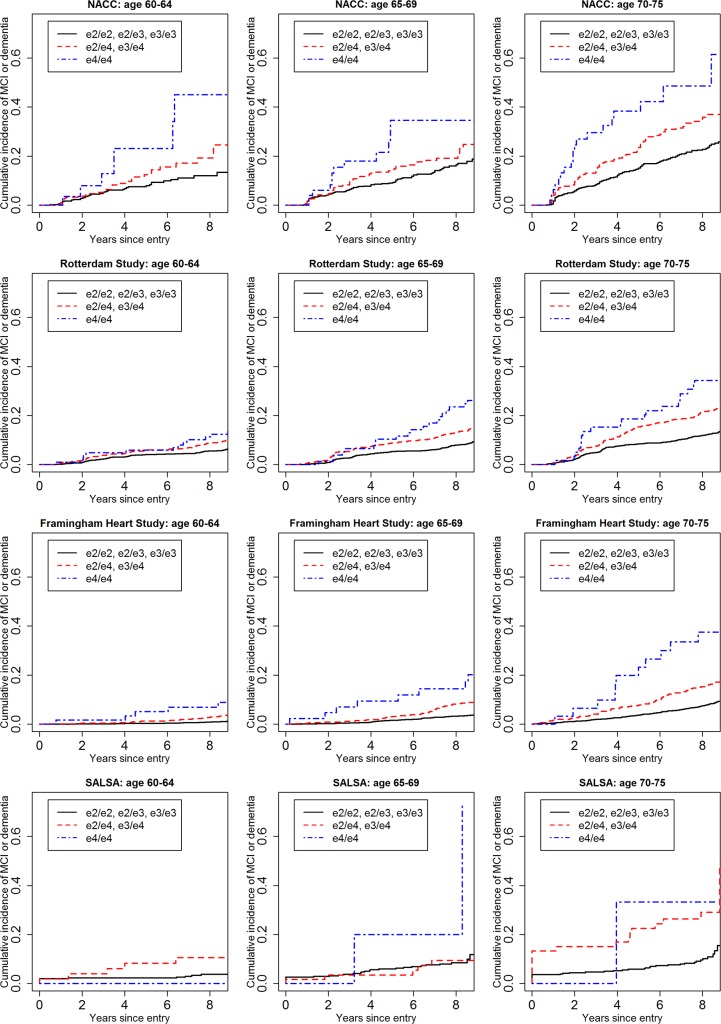
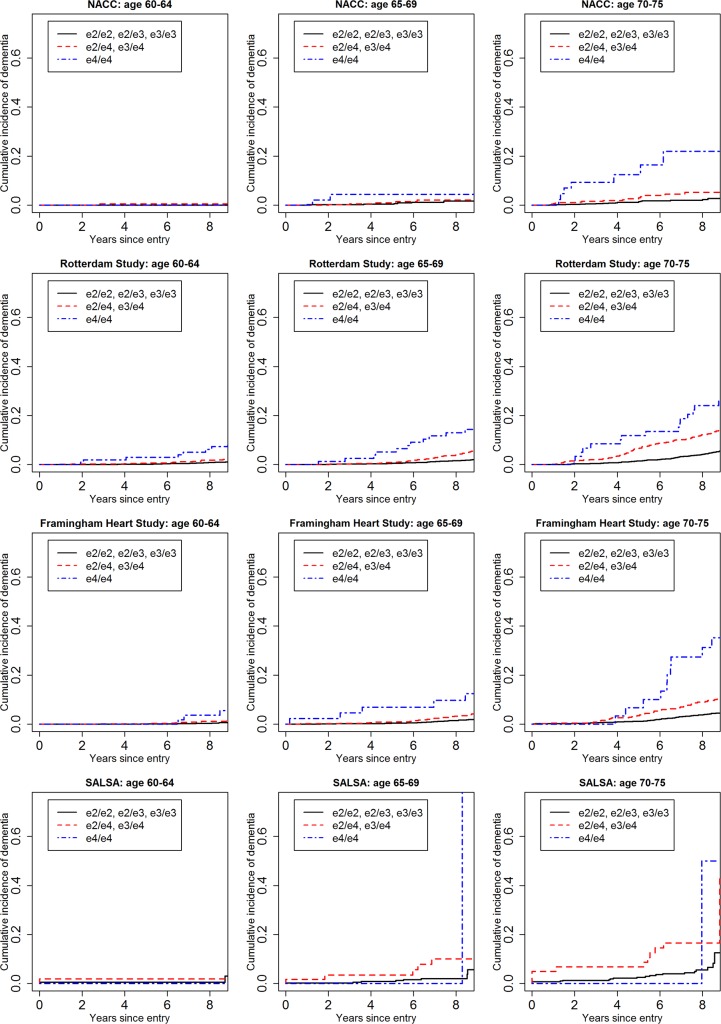
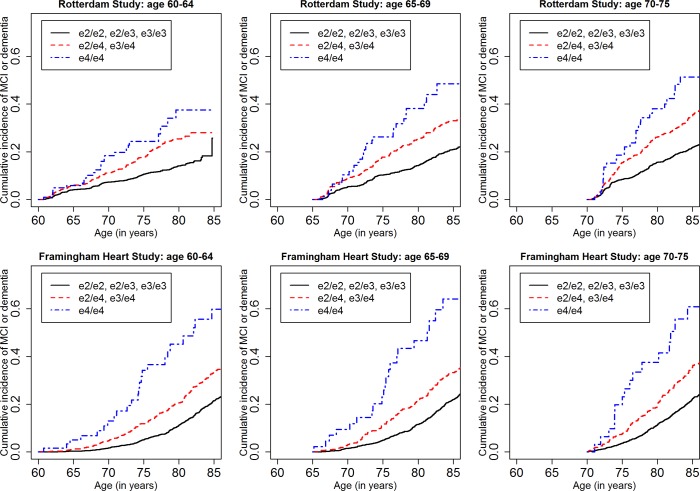
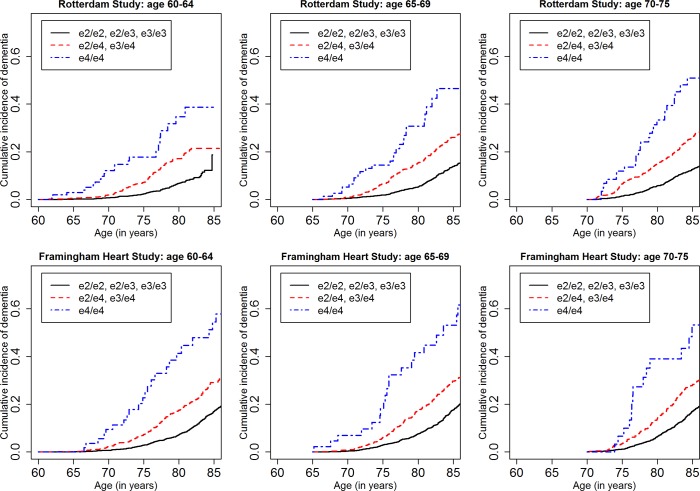
BACKGROUND: With the onset of prevention trials for individuals at high risk for Alzheimer disease, there is increasing need for accurate risk prediction to inform study design and enrollment, but available risk estimates are limited. We developed risk estimates for the incidence of mild cognitive impairment (MCI) or dementia among cognitively unimpaired individuals by APOE-e4 dose for the genetic disclosure process of the Alzheimer's Prevention Initiative Generation Study, a prevention trial in cognitively unimpaired APOE-e4/e4 homozygote individuals. METHODS AND FINDINGS: We included cognitively unimpaired individuals aged 60-75 y, consistent with Generation Study eligibility criteria, from the National Alzheimer's Coordinating Center (NACC) (n = 5,073, 158 APOE-e4/e4), the Rotterdam Study (n = 6,399, 156 APOE-e4/e4), the Framingham Heart Study (n = 4,078, 67 APOE-e4/e4), and the Sacramento Area Latino Study on Aging (SALSA) (n = 1,294, 11 APOE-e4/e4). We computed stratified cumulative incidence curves by age (60-64, 65-69, 70-75 y) and APOE-e4 dose, adjusting for the competing risk of mortality, and determined risk of MCI and/or dementia by genotype and baseline age. We also used subdistribution hazard regression to model relative hazard based on age, APOE genotype, sex, education, family history of dementia, vascular risk, subjective memory concerns, and baseline cognitive performance. The four cohorts varied considerably in age, education, ethnicity/race, and APOE-e4 allele frequency. Overall, cumulative incidence was uniformly higher in NACC than in the population-based cohorts. Among APOE-e4/e4 individuals, 5-y cumulative incidence was as follows: in the 60-64-y age stratum, it ranged from 0% to 5.88% in the three population-based cohorts versus 23.06% in NACC; in the 65-69-y age stratum, from 9.42% to 10.39% versus 34.62%; and in the 70-75-y age stratum, from 18.64% to 33.33% versus 38.34%. Five-year incidence of dementia was negligible except for APOE-e4/e4 individuals and those over 70 y. Lifetime incidence (to age 80-85 y) of MCI or dementia for the APOE-e4/e4 individuals in the long-term Framingham and Rotterdam cohorts was 34.69%-38.45% at age 60-64 y, 30.76%-40.26% at 65-69 y, and 33.3%-35.17% at 70-75 y. Confidence limits for these estimates are often wide, particularly for APOE-e4/e4 individuals and for the dementia outcome at 5 y. In regression models, APOE-e4 dose and age both consistently increased risk, as did lower education, subjective memory concerns, poorer baseline cognitive performance, and family history of dementia. We discuss several limitations of the study, including the small numbers of APOE-e4/e4 individuals, missing data and differential dropout, limited ethnic and racial diversity, and differences in definitions of exposure and outcome variables. CONCLUSIONS: Estimates of the absolute risk of MCI or dementia, particularly over short time intervals, are sensitive to sampling and a variety of methodological factors. Nonetheless, such estimates were fairly consistent across the population-based cohorts, and lower than those from a convenience cohort and those estimated in prior studies-with implications for informed consent and design for clinical trials targeting high-risk individuals.
Overview
The claims and statistics of this paper haven’t been checked yet.
Run the check — free, no account needed. It reads the open-access text and checks the sources it cites.
Integrity signals
Registry
Cites
Statistics
Figures
Verification
Claims the paper makes
The claims and statistics of this paper haven’t been checked yet.
Run the check — free, no account needed. It reads the open-access text and checks the sources it cites.
Claims other papers make about this one
Each is checked against this paper’s own text: does it say what the citing paper says it does?
The source backs part of the claim, not all of it — or backs it for a different population, condition or comparison.
In the citing paper
“For example, based on data from a study in Europe and a study in the United States, of people age 65‐69, the risk of developing dementia by the early to mid‐80s was 5% to 7% among those with no copies of the e4 form, 15% to 16% among those with one copy, and 31% to 40% among those with two copies.”
From 2024 Alzheimer's disease facts and figures (2024) · cites this paper as [82]
Experimental — accuracy not yet measuredThe source backs part of the claim, not all of it — or backs it for a different population, condition or comparison.
In the citing paper
“the lifetime risk up to age 80–85 years for mild cognitive impairment or dementia owing to AD has been estimated as 30–55% for APOEε4 homozygotes, 20–25% for APOEε3/ε4 carriers and 10–15% for APOEε3 homozygotes according to population-based studies with a majority of individuals of European ancestry17,18.”
From Multifaceted roles of APOE in Alzheimer disease (2024) · cites this paper as [17]
Experimental — accuracy not yet measured
Self-check
Percentages, sums and reported differences re-computed from the paper’s own numbers.
The self-check needs the paper’s full text.
Citations
Cites
R: A Language and Environment for Statistical Computing
R Core Team (2000) · doi:10.32614/r.manuals · Cited by 355,817
Meta-analysis in clinical trials
DerSimonian, R., & Laird, N. (1986) · Controlled Clinical Trials · doi:10.1016/0197-2456(86)90046-2 · Cited by 39,552
Hirono, N., Mori, E., Ikejiri, Y., Imamura, T., Shimomura, T., Hashimoto, M., Yamashita, H., & Ikeda, M. (1997) · PubMed · Cited by 21,010
A Proportional Hazards Model for the Subdistribution of a Competing Risk
Fine, J. P., & Gray, R. J. (1999) · Journal of the American Statistical Association · doi:10.1080/01621459.1999.10474144 · Cited by 14,290 · cited 1×
“We used subdistribution hazard regression models [50] because they directly link the regression coefficients with the cumulative incidence function (in contrast to cause-specific hazards regression [51], where the direct link cannot be made [52]; in preliminary analyses we also fit these models, and results were very…”
MethodMild Cognitive Impairment: Clinical Characterization and Outcome
Petersen, R. C., Smith, G. E., Waring, S. C., Ivnik, R. J., Tangalos, E. G., & Kokmen, E. (1999) · Archives of Neurology · doi:10.1001/archneur.56.3.303 · Cited by 8,980
A New Clinical Scale for the Staging of Dementia
Hughes, C. P., Berg, L., Danziger, W., Coben, L. A., & Martin, R. L. (1982) · British Journal of Psychiatry · doi:10.1192/bjp.140.6.566 · Cited by 7,056
A Class of $K$-Sample Tests for Comparing the Cumulative Incidence of a Competing Risk
Gray, R. J. (1988) · The Annals of Statistics · doi:10.1214/aos/1176350951 · Cited by 4,957
2013 ACC/AHA Guideline on the Assessment of Cardiovascular Risk
Goff, D. C., Lloyd-Jones, D. M., Bennett, G., Coady, S., D’Agostino, R. B., Gibbons, R., Greenland, P., Lackland, D. T., Levy, D., O’Donnell, C. J., et al. (2014) · Journal of the American College of Cardiology · doi:10.1016/j.jacc.2013.11.005 · Cited by 4,945
Goff, D. C., Lloyd-Jones, D. M., Bennett, G., Coady, S., D’Agostino, R. B., Gibbons, R., Greenland, P., Lackland, D. T., Levy, D., O’Donnell, C. J., et al. (2014) · Circulation · doi:10.1161/01.cir.0000437741.48606.98 · Cited by 3,697
Ngandu, T., Lehtisalo, J., Solomon, A., Levälahti, E., Ahtiluoto, S., Antikainen, R., Bäckman, L., Hänninen, T., Jula, A., Laatikainen, T., et al. (2015) · The Lancet · doi:10.1016/s0140-6736(15)60461-5 · Cited by 3,689
Harold, D., Abraham, R., Hollingworth, P., Sims, R., Gerrish, A., Hamshere, M. L., Pahwa, J. S., Moskvina, V., Dowzell, K., Williams, A., et al. (2009) · Nature Genetics · doi:10.1038/ng.440 · Cited by 3,326
(1987) · PubMed · Cited by 2,657
Tutorial in biostatistics: competing risks and multi‐state models
Putter, H., Fiocco, M. F., & Geskus, R. B. (2006) · Statistics in Medicine · doi:10.1002/sim.2712 · Cited by 2,458
Genome-wide association study identifies variants at CLU and CR1 associated with Alzheimer's disease
the European Alzheimer's Disease Initiative Investigators, Lambert, J.-C., Heath, S., Even, G., Campion, D., Sleegers, K., Hiltunen, M., Combarros, O., Zelenika, D., Bullido, M. J., et al. (2009) · Nature Genetics · doi:10.1038/ng.439 · Cited by 2,234
Roth, M., Tym, E., Mountjoy, C. Q., Huppert, F. A., Hendrie, H., Verma, S., & Goddard, R. (1986) · British Journal of Psychiatry · doi:10.1192/bjp.149.6.698 · Cited by 2,090
The Rotterdam Study: objectives and design update
Albert Hofman, D., Breteler, M. M. B., van Duijn, C. M., Krestin, G. P., Pols, H. A. P., Stricker, B. H. C., Tiemeier, H. W., Uitterlinden, A. G., Vingerling, J. R., & Witteman, J. C. M. (2007) · European Journal of Epidemiology · doi:10.1007/s10654-007-9199-x · Cited by 1,406
The Analysis of Failure Times in the Presence of Competing Risks
Prentice, R. L., Kalbfleisch, J. D., Peterson, A. V., Flournoy, N., Farewell, V. T., & Breslow, N. E. (1978) · Biometrics · doi:10.2307/2530374 · Cited by 1,266
Jorm, A. F., & Jacomb, P. A. (1989) · Psychological Medicine · doi:10.1017/s0033291700005742 · Cited by 1,104
Clinical epidemiology of Alzheimer’s disease: assessing sex and gender differences
Mielke, M., Vemuri, P., & Rocca, W. (2014) · Clinical Epidemiology · doi:10.2147/clep.s37929 · Cited by 1,021
Competing risks in epidemiology: possibilities and pitfalls
Andersen, P. K., Geskus, R. B., de Witte, T., & Putter, H. (2012) · International Journal of Epidemiology · doi:10.1093/ije/dyr213 · Cited by 985
Morris, J. C., Weintraub, S., Chui, H. C., Cummings, J., DeCarli, C., Ferris, S., Foster, N. L., Galasko, D., Graff-Radford, N., Peskind, E. R., et al. (2006) · Alzheimer Disease & Associated Disorders · doi:10.1097/01.wad.0000213865.09806.92 · Cited by 950
The Alzheimer's Disease Centers' Uniform Data Set (UDS)
Weıntraub, S., Salmon, D. P., Mercaldo, N. D., Ferris, S. H., Graff‐Radford, N. R., Chui, H. C., Cummings, J. L., DeCarli, C. S., Foster, N. L., Galasko, D. R., et al. (2009) · Alzheimer Disease & Associated Disorders · doi:10.1097/wad.0b013e318191c7dd · Cited by 907
The Informant Questionnaire on Cognitive Decline in the Elderly (IQCODE): a review
Jorm, A. F. (2004) · International Psychogeriatrics · doi:10.1017/s1041610204000390 · Cited by 823
The Relationships Between Age, Sex, and the Incidence of Dementia and Alzheimer Disease
Gao, S., Hendrie, H. C., Hall, K. S., & Hui, S. L. (1998) · Archives of General Psychiatry · doi:10.1001/archpsyc.55.9.809 · Cited by 782
The A4 Study: Stopping AD Before Symptoms Begin?
Sperling, R. A., Rentz, D. M., Johnson, K. A., Karlawish, J. H., Donohue, M., Salmon, D. P., & Aisen, P. S. S. (2014) · Science Translational Medicine · doi:10.1126/scitranslmed.3007941 · Cited by 773
Self-citationAPOE and Alzheimer disease: a major gene with semi-dominant inheritance
Genin, E., Hannequin, D., Wallon, D., Sleegers, K., Hiltunen, M., Combarros, O., Bullido, M. J., Engelborghs, S., De Deyn, P., Berr, C., et al. (2011) · Molecular Psychiatry · doi:10.1038/mp.2011.52 · Cited by 714
Stroke risk profile: adjustment for antihypertensive medication. The Framingham Study.
D’Agostino, R. B., Wolf, P. A., Belanger, A. J., & Kannel, W. B. (1994) · Stroke · doi:10.1161/01.str.25.1.40 · Cited by 714
Overview and Findings from the Religious Orders Study
Bennett, D. A., Schneider, J. A., Arvanitakis, Z., & Wilson, R. S. (2012) · Current Alzheimer Research · doi:10.2174/156720512801322573 · Cited by 653
Gender differences in the incidence of AD and vascular dementia: The EURODEM Studies
Andersen, K., Launer, L. J., Dewey, M. E., Letenneur, L., Ott, A., Copeland, J. R. M., Dartigues, J.-F., Kragh–Sorensen, P., Baldereschi, M., Brayne, C., et al. (1999) · Neurology · doi:10.1212/wnl.53.9.1992 · Cited by 650
Helping Patients Decide: Ten Steps to Better Risk Communication
Fagerlin, A., Zikmund‐Fisher, B. J., & Ubel, P. A. (2011) · JNCI Journal of the National Cancer Institute · doi:10.1093/jnci/djr318 · Cited by 574
ApoE-4 and Age at Onset of Alzheimer's Disease: The NIMH Genetics Initiative
Blacker, D., Haines, J. L., Rodes, L., Terwedow, H., Go, R. C. P., Harrell, L. E., Perry, R. T., Bassett, S. S., Chase, G., Meyers, D., et al. (1997) · Neurology · doi:10.1212/wnl.48.1.139 · Cited by 479
Self-citationIncidence of dementia and probable Alzheimer's disease in a general population: The Framingham Study
Bachman, D. L., Wolf, P. A., Linn, R. T., Knoefel, J. E., Cobb, J. L., Belanger, A. J., White, L. R., & D'Agostino, R. B. (1993) · Neurology · doi:10.1212/wnl.43.3_part_1.515 · Cited by 470
Haan, M. N., Mungas, D. M., Gonzalez, H. M., Ortiz, T. A., Acharya, A., & Jagust, W. J. (2003) · Journal of the American Geriatrics Society · doi:10.1046/j.1532-5415.2003.51054.x · Cited by 420
Self-citationLetenneur, L., Gilleron, V, Commenges, D., Helmer, C., Orgogozo, J. M., & Dartigues, J. F. (1999) · Journal of Neurology, Neurosurgery & Psychiatry · doi:10.1136/jnnp.66.2.177 · Cited by 406
Slooter, A. J. C., Cruts, M., Kalmijn, S., Hofman, A., Breteler, M. M. B., Van Broeckhoven, C., & van Duijn, C. M. (1998) · Archives of Neurology · doi:10.1001/archneur.55.7.964 · Cited by 399
Apolipoprotein E in Alzheimer's Disease: An Update
Yu, J.-T., Tan, L., & Hardy, J. (2014) · Annual Review of Neuroscience · doi:10.1146/annurev-neuro-071013-014300 · Cited by 394
Goldman, J. S., Hahn, S. E., Catania, J. W., Larusse-Eckert, S., Butson, M. B., Rumbaugh, M., Strecker, M. N., Roberts, J. S., Burke, W., Mayeux, R., et al. (2011) · Genetics in Medicine · doi:10.1097/gim.0b013e31821d69b8 · Cited by 393
Self-citationThe Rotterdam Study: 2016 objectives and design update
Albert Hofman, D., Brusselle, G., Murad, S. D., van Duijn, C. M., Franco, O. H., Goedegebure, A., Ikram, M. A., Klaver, C. C. W., Nijsten, T. E. C., Peeters, R. P., et al. (2015) · European Journal of Epidemiology · doi:10.1007/s10654-015-0082-x · Cited by 385
Self-citationThe National Alzheimer's Coordinating Center (NACC) Database: an Alzheimer disease database.
Beekly, D. L., Ramos, E. M., van Belle, G., Deitrich, W. D., Clark, A. D., Jacka, M. E., & Kukull, W. A. (2004) · PubMed · Cited by 347
Incidence of AD may decline in the early 90s for men, later for women
Miech, R. A., Breitner, J. C. S., Zandi, P. P., Khachaturian, A. S., Anthony, J. C., & Mayer, L. S. (2002) · Neurology · doi:10.1212/wnl.58.2.209 · Cited by 339
Cognitive Impairment in the Nondemented Elderly
Ebly, E. M. (1995) · Archives of Neurology · doi:10.1001/archneur.1995.00540300086018 · Cited by 315
Lautenschlager, N. T., Cupples, L. A., Rao, V. S., Auerbach, S. A., Becker, R., Burke, J., Chui, H., Duara, R., Foley, E. J., Glatt, S. L., et al. (1996) · Neurology · doi:10.1212/wnl.46.3.641 · Cited by 298
de Bruijn, R. F. A. G., Bos, M. J., Portegies, M. L. P., Albert Hofman, D., Franco, O. H., Koudstaal, P. J., & Ikram, M. A. (2015) · BMC Medicine · doi:10.1186/s12916-015-0377-5 · Cited by 274
Self-citationNeuropsychological Measures in Normal Individuals That Predict Subsequent Cognitive Decline
Blacker, D., Lee, H., Muzikansky, A., Martin, E. C., Tanzi, R. E., McArdle, J. J., Moss, M. B., & Albert, M. (2007) · Archives of Neurology · doi:10.1001/archneur.64.6.862 · Cited by 269
Self-citationVirgin olive oil supplementation and long-term cognition: the Predimed-Navarra randomized, trial
Martínez‐Lapiscina, E. H., Clavero, P., Toledo, E., Julian, B. S., Sánchez‐Tainta, A., Corella, D., Lamuela-Raventós, R. M., Martínez, J. A., & Martínez‐González, M. Á. (2013) · The journal of nutrition health & aging · doi:10.1007/s12603-013-0027-6 · Cited by 267
Payami, H., Zareparsi, S., Montee, K. R., Sexton, G. J., Kaye, J. A., Bird, T. D., Yu, C. E., Wijsman, E. M., Heston, L. L., Litt, M. J., et al. (1996) · PubMed Central · Cited by 248
Subjective memory complaints, education, and risk of Alzheimer's disease
van Oijen, M., de Jong, F. J., Hofman, A., Koudstaal, P. J., & Breteler, M. M. B. (2007) · Alzheimer's & Dementia · doi:10.1016/j.jalz.2007.01.011 · Cited by 238
Mungas, D., Reed, B., Crane, P. K., Haan, M. N., & González, H. M. (2004) · Psychological Assessment · doi:10.1037/1040-3590.16.4.347 · Cited by 219
Self-citationBLOOD PRESSURE AND COGNITIVE PERFORMANCE
Farmer, M. E., White, L. R., Abbott, R. D., Kittner, S. J., Kaplan, E., WOLZ, M. M., Brody, J. A., & Wolf, P. A. (1987) · American Journal of Epidemiology · doi:10.1093/oxfordjournals.aje.a114749 · Cited by 202
Clinical Prediction of Alzheimer Disease Dementia Across the Spectrum of Mild Cognitive Impairment
Dickerson, B. C., Sperling, R. A., Hyman, B. T., Albert, M., & Blacker, D. (2007) · Archives of General Psychiatry · doi:10.1001/archpsyc.64.12.1443 · Cited by 172
Self-citationCupples, L. A., Farrer, L. A., Sadovnick, A. S. D., Relkin, N. R., Whitehouse, P. J., & Green, R. C. (2004) · Genetics in Medicine · doi:10.1097/01.gim.0000132679.92238.58 · Cited by 166
Communicating Genetic Risk Information for Common Disorders in the Era of Genomic Medicine
Lautenbach, D. M., Christensen, K. D., Sparks, J. A., & Green, R. C. (2011) · Annual Review of Genomics and Human Genetics · doi:10.1146/annurev-genom-092010-110722 · Cited by 160
Reiman, E. M., Langbaum, J. B. S., & Tariot, P. N. (2010) · Biomarkers in Medicine · doi:10.2217/bmm.09.91 · Cited by 160
Self-citationRocca, W. A., Cha, R. H., Waring, S. C., & Kokmen, E. (1998) · American Journal of Epidemiology · doi:10.1093/oxfordjournals.aje.a009560 · Cited by 160
Roberts, J. S., Cupples, L. A., Relkin, N. R., Whitehouse, P. J., Green, R. C., & for the REVEAL (Risk Evaluation and Education for Alzheimer’s Disease) Study Group (2005) · Journal of Geriatric Psychiatry and Neurology · doi:10.1177/0891988705281883 · Cited by 146
Self-citationApplying competing risks regression models: an overview
Haller, B., Schmidt, G. P., & Ulm, K. (2012) · Lifetime Data Analysis · doi:10.1007/s10985-012-9230-8 · Cited by 138
Farrer, L. A. (1997) · JAMA · doi:10.1001/jama.1997.03550160069041 · Cited by 124
Brain function and cognition in a community sample of elderly Latinos
Jagust, W. J., Eberling, J. L., Wu, C. C., Finkbeiner, A., Mungas, D., Valk, P. E., & Haan, M. N. (2002) · Neurology · doi:10.1212/wnl.59.3.378 · Cited by 118
Self-citationQiu, C. (2004) · Journal of Neurology Neurosurgery & Psychiatry · doi:10.1136/jnnp.2003.021493 · Cited by 115
Primary and Secondary Prevention Trials in Alzheimer Disease: Looking Back, Moving Forward
Hsu, D. C., & Marshall, G. A. (2016) · Current Alzheimer Research · doi:10.2174/1567205013666160930112125 · Cited by 95
Kochan, N. A., Slavin, M. J., Brodaty, H., Crawford, J. D., Trollor, J. N., Draper, B., & Sachdev, P. S. (2010) · American Journal of Geriatric Psychiatry · doi:10.1097/jgp.0b013e3181d6b6a9 · Cited by 93
CAP—advancing the evaluation of preclinical Alzheimer disease treatments
Reiman, E. M., Langbaum, J. B. S., Tariot, P. N., Lopera, F. J., Bateman, R. J., Morris, J. C., Sperling, R. A., Aisen, P. S. S., Roses, A. D., Welsh-Bohmer, K. A., et al. (2015) · Nature Reviews Neurology · doi:10.1038/nrneurol.2015.177 · Cited by 92
Self-citationUsing Alzheimer's disease as a model for genetic risk disclosure: implications for personal genomics
Roberts, J., Christensen, K. D., & Green, R. C. (2011) · Clinical Genetics · doi:10.1111/j.1399-0004.2011.01739.x · Cited by 90
Self-citationBrain structure and cognition in a community sample of elderly Latinos
Wu, C. C., Mungas, D., Petkov, C. I., Eberling, J. L., Zrelak, P. A., Buonocore, M. H., Brunberg, J. A., Haan, M. N., & Jagust, W. J. (2002) · Neurology · doi:10.1212/wnl.59.3.383 · Cited by 90
Self-citationSources of Variability in Prevalence Rates of Alzheimer's Disease
Corrada, M. M., Brookmeyer, R., & Kawas, C. H. (1995) · International Journal of Epidemiology · doi:10.1093/ije/24.5.1000 · Cited by 86
Spectrum of cognition short of dementia
Knopman, D. S., Beiser, A., Machulda, M. M., Fields, J. A., Roberts, R. O., Pankratz, V. S., Aakre, J. A., Cha, R. H., Rocca, W. A., Mielke, M. M., et al. (2015) · Neurology · doi:10.1212/wnl.0000000000002100 · Cited by 85
Self-citationJarvik, G. P., Larson, E. B., Goddard, K. A. B., Schellenberg, G. D., & Wijsman, E. M. (1996) · PubMed Central · Cited by 75
Age‐dependent effects of APOE ε4 in preclinical Alzheimer's disease
Bonham, L. W., Geier, E. G., Fan, C. C., Leong, J. K., Besser, L. M., Kukull, W. A., Kornak, J., Andreassen, O. A., Schellenberg, G. D., Rosen, H. J., et al. (2016) · Annals of Clinical and Translational Neurology · doi:10.1002/acn3.333 · Cited by 65
Product-limit survival functions with correlated survival times
Williams, R. L. (1995) · Lifetime Data Analysis · doi:10.1007/bf00985768 · Cited by 59
HeartScore®: a new web-based approach to European cardiovascular disease risk management
Thomsen, T. F. (2005) · European Journal of Cardiovascular Prevention & Rehabilitation · doi:10.1097/01.hjr.0000186617.29992.11 · Cited by 32
APOE Genotype, Family History of Dementia, and Alzheimer Disease Risk
Huang, W., Qiu, C., Strauss, E. I. V., Winblad, B. G., & Fratiglioni, L. (2004) · Archives of Neurology · doi:10.1001/archneur.61.12.1930 · Cited by 4
Cited by
Sorted by citations
2024 Alzheimer's disease facts and figures
(2024) · Alzheimer's & Dementia · doi:10.1002/alz.13809 · Cited by 2,536
López, J. A., González, H. M., & Léger, G. C. (2019) · Handbook of clinical neurology · doi:10.1016/b978-0-12-804766-8.00013-3 · Cited by 884
Vermunt, L., Sikkes, S. A. M., van den Hout, A., Handels, R., Bos, I., van der Flier, W. M., Kern, S., Ousset, P., Maruff, P., Skoog, I., et al. (2019) · Alzheimer's & Dementia · doi:10.1016/j.jalz.2019.04.001 · Cited by 570
“The effects of setting on disease progression are consistent with other AD studies [40,41].”
Result2025 Alzheimer's disease facts and figures
(2025) · Alzheimer s & Dementia · doi:10.1002/alz.70235 · Cited by 602
State of the science on mild cognitive impairment (MCI)
Anderson, N. D. (2019) · CNS Spectrums · doi:10.1017/s1092852918001347 · Cited by 587
Metadata
- Authors
- Qian, J., Wolters, F. J., Beiser, A., Haan, M., Ikram, M. A., Karlawish, J., Langbaum, J. B., Neuhaus, J. M., Reiman, E. M., Roberts, J. S., Seshadri, S., Tariot, P. N., Woods, B. M., Betensky, R. A., & Blacker, D.
- Affiliations
- University of Massachusetts Amherst (US)
- Erasmus MC (NL)
- Boston University (US)
- University of California, San Francisco (US)
- University of Pennsylvania (US)
- Banner Alzheimer’s Institute (US)
- Translational Genomics Research Institute (US)
- University of Michigan (US)
- Harvard University (US)
- Corresponding author
- Blacker, Deborah
- ORCID
- Venue
- PLOS Medicine
- Publisher
- Public Library of Science (PLoS)
- Published
- 2017-03-21
- Volume
- 14
- Issue
- 3
- Pages
- e1002254
- ISSN
- 1549-1277 (ISSN-L)
- 1549-1676
- PMC
- PMC5360223
- OpenAlex
- W2600450442
- Cited by
- 169
- References
- 74
- Citations by year
- 2026: 10 · 2025: 23 · 2024: 15 · 2023: 15 · 2022: 12 · 2021: 35 · 2020: 20 · 2019: 19 · 2018: 12 · 2017: 8
- FWCI
- 13.24
- Type
- journal article
- Language
- en
- Open access
- gold
- doi.org
- Licence
- Locations
- PLoS Medicine (publishedVersion, cc-by)
- PubMed Central (publishedVersion, cc-by)
- PubMed (publishedVersion)
- EUR Research Repository (Erasmus University Rotterdam) (publishedVersion, other-oa)
- UA Campus Repository (The University of Arizona) (acceptedVersion, cc-by)
- eScholarship (California Digital Library) (submittedVersion, cc-by)
- Digital Access to Scholarship at Harvard (DASH) (Harvard University) (submittedVersion, cc-by)
- National University of Singapore (submittedVersion, cc-by)
- EUR Research Repository (Erasmus University Rotterdam) (submittedVersion, other-oa)
- RePub (Erasmus University Rotterdam) (submittedVersion, other-oa)
- RePEc: Research Papers in Economics (submittedVersion)
- DOAJ (DOAJ: Directory of Open Access Journals) (submittedVersion, cc-by-sa)
- eScholarship (California Digital Library) (submittedVersion)
- Figshare (submittedVersion, cc-by)
- Funders
- National Institute on Aging (P30AG053760, P30AG010129, R01AG012975, U01AG016976, P30AG010124, R21AG053695, UF1AG046150, P30AG019610, P50AG005134, R01AG008122, P01AG036694)
- National Institute of Neurological Disorders and Stroke (R01NS017950)
- Topics
- Health Sciences › Medicine › Psychiatry and Mental health › Dementia and Cognitive Impairment Research
- Life Sciences › Neuroscience › Cellular and Molecular Neuroscience › Alzheimer's disease research and treatments
- Social Sciences › Psychology › Experimental and Cognitive Psychology › Cognitive Abilities and Testing
- Keywords
- APOE ε4, Alzheimer's disease, mild cognitive impairment, dementia, risk prediction, cumulative incidence, cognitively unimpaired older adults, competing risk of death, family history of dementia, vascular risk
- MeSH terms
- Aged, Apolipoproteins E, Dementia, Female, Gene Frequency, Genotype, Humans, Male, Middle Aged, Netherlands, Risk Factors, United States, Cohort Studies, Cognitive Dysfunction
About these checks
Registry, retraction, Cites and statistics results are computed, not judged, with one exception: a printed reference that no index lists is read once by a model before it counts as a citation error. Claims are extracted by a model and kept only when their quote appears verbatim in the text; each cited source is then checked, with a model’s help, for whether it says what the claim relies on. Those verdicts can be wrong — read the claim’s quote and the cited source before relying on one.
Statistics and arithmetic are recomputed, not judged.
Confidence bands are shown only for fields calibrated on our annotated test set. None is calibrated yet, so no band is shown.
What counts as a claim ›How we measure confidence ›How we check this ›
Are you an author, or do you see a problem with this page? Request a review
