

The DOI matches its Crossref record; 89 of the 93 references it cites were found in a registry or an index; none of the 193 sources its claims cite is checked for support yet.
Women’s and girls’ experiences of menstruation in low- and middle-income countries: A systematic review and qualitative metasynthesis
Open accessAbstract
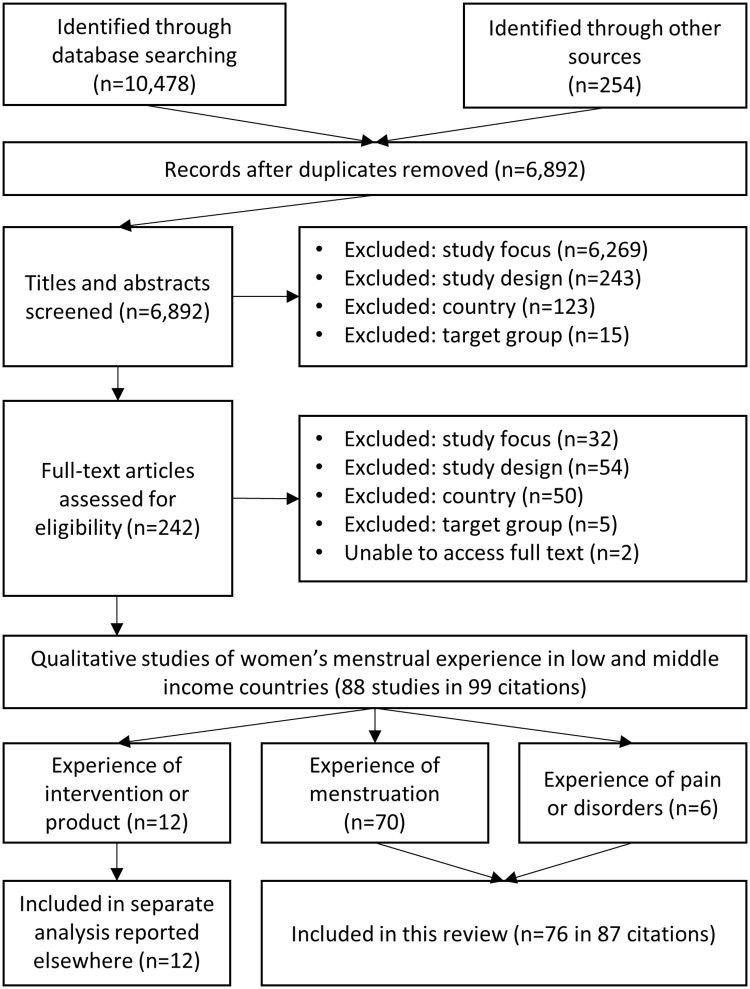
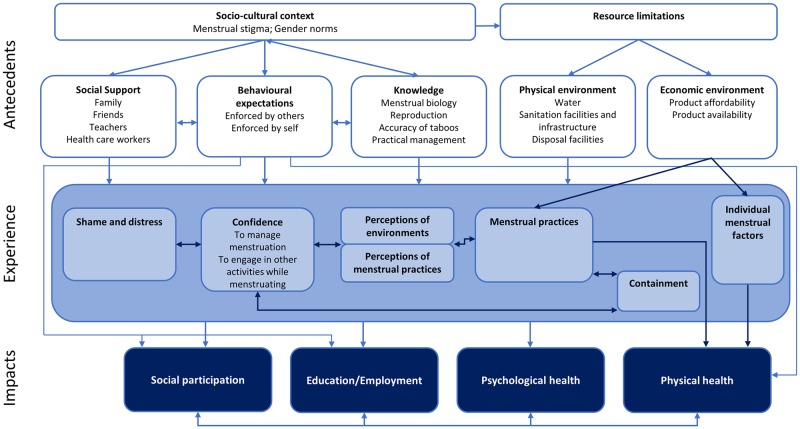
BACKGROUND: Attention to women's and girls' menstrual needs is critical for global health and gender equality. The importance of this neglected experience has been elucidated by a growing body of qualitative research, which we systematically reviewed and synthesised. METHODS AND FINDINGS: We undertook systematic searching to identify qualitative studies of women's and girls' experiences of menstruation in low- and middle-income countries (LMICs). Of 6,892 citations screened, 76 studies reported in 87 citations were included. Studies captured the experiences of over 6,000 participants from 35 countries. This included 45 studies from sub-Saharan Africa (with the greatest number of studies from Kenya [n = 7], Uganda [n = 6], and Ethiopia [n = 5]), 21 from South Asia (including India [n = 12] and Nepal [n = 5]), 8 from East Asia and the Pacific, 5 from Latin America and the Caribbean, 5 from the Middle East and North Africa, and 1 study from Europe and Central Asia. Through synthesis, we identified overarching themes and their relationships to develop a directional model of menstrual experience. This model maps distal and proximal antecedents of menstrual experience through to the impacts of this experience on health and well-being. The sociocultural context, including menstrual stigma and gender norms, influenced experiences by limiting knowledge about menstruation, limiting social support, and shaping internalised and externally enforced behavioural expectations. Resource limitations underlay inadequate physical infrastructure to support menstruation, as well as an economic environment restricting access to affordable menstrual materials. Menstrual experience included multiple themes: menstrual practices, perceptions of practices and environments, confidence, shame and distress, and containment of bleeding and odour. These components of experience were interlinked and contributed to negative impacts on women's and girls' lives. Impacts included harms to physical and psychological health as well as education and social engagement. Our review is limited by the available studies. Study quality was varied, with 18 studies rated as high, 35 medium, and 23 low trustworthiness. Sampling and analysis tended to be untrustworthy in lower-quality studies. Studies focused on the experiences of adolescent girls were most strongly represented, and we achieved early saturation for this group. Reflecting the focus of menstrual health research globally, there was an absence of studies focused on adult women and those from certain geographical areas. CONCLUSIONS: Through synthesis of extant qualitative studies of menstrual experience, we highlight consistent challenges and developed an integrated model of menstrual experience. This model hypothesises directional pathways that could be tested by future studies and may serve as a framework for program and policy development by highlighting critical antecedents and pathways through which interventions could improve women's and girls' health and well-being. REVIEW PROTOCOL REGISTRATION: The review protocol registration is PROSPERO: CRD42018089581.
Overview
AI snapshot
Written from the paper’s full text.
TL;DR
This systematic review and qualitative metasynthesis of 76 studies from 35 low- and middle-income countries found consistent menstrual stigma, resource limitations, knowledge and support gaps, and negative impacts on health, education, and social participation. It presents an integrated directional model linking sociocultural context and resource limitations to menstrual experience and downstream impacts.
Key findings
- Of 6,892 citations screened, 76 studies reported in 87 citations were included, capturing over 6,000 participants across 35 countries; most studies were from sub-Saharan Africa (n = 45), followed by South Asia (n = 21), East Asia and the Pacific (n = 8), Latin America and the Caribbean (n = 5), Middle East and North Africa (n = 5), and Europe and Central Asia (n = 1).
- Study quality was varied: 18 studies were rated high, 35 medium, and 23 low trustworthiness; lower-quality studies were characterised by poor reporting of participant selection and analysis.
- Synthesis identified antecedents (sociocultural context including menstrual stigma and gender norms; knowledge; social support; behavioural expectations; resource limitations including physical and economic environments), experience components (menstrual practices, perceptions of practices and environments, confidence, shame and distress, containment, and individual menstrual factors), and impacts (physical and psychological health, education/employment, and social participation).
- The integrated model maps distal and proximal antecedents through menstrual experience to impacts; no single included study reflected the full picture gained through metasynthesis.
Methods
- Systematic review and qualitative metasynthesis reported according to PRISMA, with protocol registered on PROSPERO (CRD42018089581); searches were undertaken in 11 databases plus grey literature and hand searching, completed in January 2019 with no language or date restrictions.
- Eligible studies reported qualitative analysis of menstrual experiences of women and girls residing in LMICs; studies exclusively on menstrual suppression, menopause, premenstrual syndrome, polycystic ovary syndrome, premenarche, key informants, or males were excluded, as were studies of menstrual interventions or products retained for analyses reported elsewhere.
- Analysis used thematic synthesis and thematic networks; quality was appraised with the EPPI-Centre checklist, with one author appraising all studies and 10% independently appraised by a second author with 100% agreement; low-quality studies were checked for fit with the proposed themes and integrated model.
Limitations
- The paper states that findings are limited by available studies; the majority came from sub-Saharan Africa, no studies were identified from China, Middle East and North African studies were more often urban and highly educated, searching was only undertaken in English, mixed-methods studies may have scored lower on the qualitative appraisal tool, and a different team may have generated different insights.
- The paper states that adolescent girls were most strongly represented and early saturation was achieved for this group, while adult women and certain geographical areas were under-researched; pain and menstrual disorders were poorly integrated and did not reach saturation.
- Evident from the text: most studies relied on focus group discussions, often capturing shared school-environment experiences rather than deep individual sociological or psychological insights, and adult women’s workplace experiences were under-researched.
Model-written summary. Check it against the paper before relying on it.
Integrity signals
Registry
Cites
Statistics
Figures
Verification
Claims the paper makes
81 No basis given · 59 Not checked yet · 36 Own interpretation · 36 Own result · 21 Own method
A result the paper reports from its own data — it cites no other source for it, so there is none to check. The quote shows it is in the paper.
In the paper
“Through synthesis, we identified overarching themes and their relationships to develop a directional model of menstrual experience.”
§ Women’s and girls’ experiences of menstruation in low- and middle-income countries: A systematic review and qualitative metasynthesis > Abstract > Methods and findings
plain- Asserted: passes — The authors put it forward as true.
- Checkable: passes — It can be checked against evidence.
- Load-bearing: passes — The paper’s conclusions depend on it.
- Based: passes — The paper gives a reason why it holds.
A result the paper reports from its own data — it cites no other source for it, so there is none to check. The quote shows it is in the paper.
In the paper
“Studies captured the experiences of over 6,000 participants from 35 countries.”
- Also stated in: § Results · plain
“Included studies captured experiences from 35 countries and over 6,000 participants.”
§ Women’s and girls’ experiences of menstruation in low- and middle-income countries: A systematic review and qualitative metasynthesis > Abstract > Methods and findings
plainn = 6,000- Asserted: passes — The authors put it forward as true.
- Checkable: passes — It can be checked against evidence.
- Load-bearing: unclear — It is unclear whether the paper’s conclusions depend on it.
- Based: passes — The paper gives a reason why it holds.
- Also stated in: § Results · plain
In the paper
“This included 45 studies from sub-Saharan Africa (with the greatest number of studies from Kenya [n = 7], Uganda [n = 6], and Ethiopia [n = 5]), 21 from South Asia (including India [n = 12] and Nepal [n = 5]), 8 from East Asia and the Pacific, 5 from Latin America and the Caribbean, 5 from the Middle East and North Africa, and 1 study from Europe and Central Asia.”
- Also stated in: § Results · plain
“Using World Bank regional groupings [24], most studies were conducted in sub-Saharan Africa (n = 45); this was followed by 21 studies undertaken in South Asia, 8 in East Asia and the Pacific, 5 in Latin America and the Caribbean, 5 in the Middle East and North Africa, and 1 study from Europe and Central Asia (Kyrgyzstan).”
§ Women’s and girls’ experiences of menstruation in low- and middle-income countries: A systematic review and qualitative metasynthesis > Abstract > Methods and findings
What the sources say
- Not checked yetcites [24] 2017, World Bank Country and Lending Groups
plainn = 45- Asserted: passes — The authors put it forward as true.
- Checkable: passes — It can be checked against evidence.
- Load-bearing: unclear — It is unclear whether the paper’s conclusions depend on it.
- Based: passes — The paper gives a reason why it holds.
- Also stated in: § Results · plain
The paper states this without a source or data behind it here, so there is nothing to check it against. The quote shows it is in the paper.
In the paper
“and shame and distress at the potential of having menses exposed”
§ Women’s and girls’ experiences of menstruation in low- and middle-income countries: A systematic review and qualitative metasynthesis > Results > Antecedents of menstrual experience
plaindirect- Asserted: passes — The authors put it forward as true.
- Checkable: passes — It can be checked against evidence.
- Load-bearing: passes — The paper’s conclusions depend on it.
- Based: passes — The paper gives a reason why it holds.
The paper states this without a source or data behind it here, so there is nothing to check it against. The quote shows it is in the paper.
In the paper
“Others did not address the impacts of menstruation on such outcomes, exploring only the experience itself.”
§ Women’s and girls’ experiences of menstruation in low- and middle-income countries: A systematic review and qualitative metasynthesis > Results > Author orientations
plain- Asserted: passes — The authors put it forward as true.
- Checkable: passes — It can be checked against evidence.
- Load-bearing: unclear — It is unclear whether the paper’s conclusions depend on it.
- Based: passes — The paper gives a reason why it holds.
A result the paper reports from its own data — it cites no other source for it, so there is none to check. The quote shows it is in the paper.
In the paper
“Focus Group Discussions (FGDs) were the most common data collection method used, particularly when working with adolescent girls.”
§ Women’s and girls’ experiences of menstruation in low- and middle-income countries: A systematic review and qualitative metasynthesis > Results
plaincorrelational- Asserted: passes — The authors put it forward as true.
- Checkable: passes — It can be checked against evidence.
- Load-bearing: unclear — It is unclear whether the paper’s conclusions depend on it.
- Based: passes — The paper gives a reason why it holds.
The paper states this without a source or data behind it here, so there is nothing to check it against. The quote shows it is in the paper.
In the paper
“Studies focused on stigma, knowledge, and social support as antecedents of experience.”
§ Women’s and girls’ experiences of menstruation in low- and middle-income countries: A systematic review and qualitative metasynthesis > Results > Author orientations
plaindirect- Asserted: passes — The authors put it forward as true.
- Checkable: passes — It can be checked against evidence.
- Load-bearing: unclear — It is unclear whether the paper’s conclusions depend on it.
- Based: passes — The paper gives a reason why it holds.
The paper states this without a source or data behind it here, so there is nothing to check it against. The quote shows it is in the paper.
In the paper
“These studies were often those using individual interviews or engaging adult women to provide reflexive insights into their experiences.”
§ Women’s and girls’ experiences of menstruation in low- and middle-income countries: A systematic review and qualitative metasynthesis > Results > Author orientations
plaincorrelational- Asserted: passes — The authors put it forward as true.
- Checkable: passes — It can be checked against evidence.
- Load-bearing: unclear — It is unclear whether the paper’s conclusions depend on it.
- Based: passes — The paper gives a reason why it holds.
A result the paper reports from its own data — it cites no other source for it, so there is none to check. The quote shows it is in the paper.
In the paper
“Study quality was varied, with 18 studies rated as high, 35 medium, and 23 low trustworthiness.”
- Also stated in: § Results · plain
“Study quality was varied, with 18 studies rated as high, 35 as medium, and 23 as low trustworthiness.”
§ Women’s and girls’ experiences of menstruation in low- and middle-income countries: A systematic review and qualitative metasynthesis > Abstract > Methods and findings
plain- Asserted: passes — The authors put it forward as true.
- Checkable: passes — It can be checked against evidence.
- Load-bearing: unclear — It is unclear whether the paper’s conclusions depend on it.
- Based: passes — The paper gives a reason why it holds.
- Also stated in: § Results · plain
The paper states this without a source or data behind it here, so there is nothing to check it against. The quote shows it is in the paper.
In the paper
“Menstrual stigma was a pervasive influence on women and girls.”
§ Women’s and girls’ experiences of menstruation in low- and middle-income countries: A systematic review and qualitative metasynthesis > Results > Antecedents of menstrual experience
plain- Asserted: passes — The authors put it forward as true.
- Checkable: passes — It can be checked against evidence.
- Load-bearing: passes — The paper’s conclusions depend on it.
- Based: passes — The paper gives a reason why it holds.
- Probably not a substantial claim. 47
- It may state two separate claims as one. 75
- The quote only partly states this claim. 1
A result the paper reports from its own data — it cites no other source for it, so there is none to check. The quote shows it is in the paper.
In the paper
“Of 6,892 citations screened, 76 studies reported in 87 citations were included.”
§ Women’s and girls’ experiences of menstruation in low- and middle-income countries: A systematic review and qualitative metasynthesis > Abstract > Methods and findings
plain- Asserted: passes — The authors put it forward as true.
- Checkable: passes — It can be checked against evidence.
- Load-bearing: fails — The paper’s conclusions may not depend on it.
- Based: passes — The paper gives a reason why it holds.
Probably not a substantial claim. The paper’s conclusions may not depend on it.
A result the paper reports from its own data — it cites no other source for it, so there is none to check. The quote shows it is in the paper.
In the paper
“Menstrual experience included multiple themes: menstrual practices, perceptions of practices and environments, confidence, shame and distress, and containment of bleeding and odour.”
§ Women’s and girls’ experiences of menstruation in low- and middle-income countries: A systematic review and qualitative metasynthesis > Abstract > Methods and findings
plain- Asserted: passes — The authors put it forward as true.
- Checkable: passes — It can be checked against evidence.
- Load-bearing: passes — The paper’s conclusions depend on it.
- Based: passes — The paper gives a reason why it holds.
It may state two separate claims as one.
A result the paper reports from its own data — it cites no other source for it, so there is none to check. The quote shows it is in the paper.
In the paper
“Studies focused on the experiences of adolescent girls were most strongly represented, and we achieved early saturation for this group.”
§ Women’s and girls’ experiences of menstruation in low- and middle-income countries: A systematic review and qualitative metasynthesis > Abstract > Methods and findings
plain- Asserted: passes — The authors put it forward as true.
- Checkable: passes — It can be checked against evidence.
- Load-bearing: unclear — It is unclear whether the paper’s conclusions depend on it.
- Based: passes — The paper gives a reason why it holds.
It may state two separate claims as one.
A result the paper reports from its own data — it cites no other source for it, so there is none to check. The quote shows it is in the paper.
In the paper
“Findings of low-quality studies were assessed for their fit with the proposed themes and integrated model. Low-quality studies supported the primary analysis, and no new constructs emerged.”
§ Women’s and girls’ experiences of menstruation in low- and middle-income countries: A systematic review and qualitative metasynthesis > Methods > Analysis
plain- Asserted: passes — The authors put it forward as true.
- Checkable: passes — It can be checked against evidence.
- Load-bearing: unclear — It is unclear whether the paper’s conclusions depend on it.
- Based: passes — The paper gives a reason why it holds.
It may state two separate claims as one.
The paper states this without a source or data behind it here, so there is nothing to check it against. The quote shows it is in the paper.
In the paper
“making it difficult to access accurate information or seek support”
§ Women’s and girls’ experiences of menstruation in low- and middle-income countries: A systematic review and qualitative metasynthesis > Results > Antecedents of menstrual experience
plaindirect- Asserted: passes — The authors put it forward as true.
- Checkable: passes — It can be checked against evidence.
- Load-bearing: passes — The paper’s conclusions depend on it.
- Based: passes — The paper gives a reason why it holds.
The quote only partly states this claim.
A result the paper reports from its own data — it cites no other source for it, so there is none to check. The quote shows it is in the paper.
In the paper
“Eleven studies reported using participatory activities such as asking groups to design an ‘ideal latrine’, or rank priorities for improvements to explore experiences and preferences.”
§ Women’s and girls’ experiences of menstruation in low- and middle-income countries: A systematic review and qualitative metasynthesis > Results
plain- Asserted: passes — The authors put it forward as true.
- Checkable: passes — It can be checked against evidence.
- Load-bearing: fails — The paper’s conclusions may not depend on it.
- Based: passes — The paper gives a reason why it holds.
Probably not a substantial claim. The paper’s conclusions may not depend on it.
The paper states this without a source or data behind it here, so there is nothing to check it against. The quote shows it is in the paper.
In the paper
“Knowledge and cultural practices were important in resource-centric studies but were more often linked with a failure to support effective management practices.”
§ Women’s and girls’ experiences of menstruation in low- and middle-income countries: A systematic review and qualitative metasynthesis > Results > Author orientations
plaincorrelational- Asserted: passes — The authors put it forward as true.
- Checkable: passes — It can be checked against evidence.
- Load-bearing: unclear — It is unclear whether the paper’s conclusions depend on it.
- Based: passes — The paper gives a reason why it holds.
It may state two separate claims as one.
A result the paper reports from its own data — it cites no other source for it, so there is none to check. The quote shows it is in the paper.
In the paper
“In identifying themes and mapping the relationships between themes as part of our analysis, differences in author orientations across the body of literature were apparent.”
§ Women’s and girls’ experiences of menstruation in low- and middle-income countries: A systematic review and qualitative metasynthesis > Results > Author orientations
plain- Asserted: passes — The authors put it forward as true.
- Checkable: passes — It can be checked against evidence.
- Load-bearing: fails — The paper’s conclusions may not depend on it.
- Based: passes — The paper gives a reason why it holds.
Probably not a substantial claim. The paper’s conclusions may not depend on it.
A result the paper reports from its own data — it cites no other source for it, so there is none to check. The quote shows it is in the paper.
In the paper
“Most studies were situated within a public health discipline and focused on cataloguing antecedents and impacts of menstruation on participants’ lives, rather than sociological analysis.”
§ Women’s and girls’ experiences of menstruation in low- and middle-income countries: A systematic review and qualitative metasynthesis > Results
plain- Asserted: passes — The authors put it forward as true.
- Checkable: passes — It can be checked against evidence.
- Load-bearing: unclear — It is unclear whether the paper’s conclusions depend on it.
- Based: passes — The paper gives a reason why it holds.
It may state two separate claims as one.
The paper states this without a source or data behind it here, so there is nothing to check it against. The quote shows it is in the paper.
In the paper
“Reflecting the focus of menstrual health research globally, there was an absence of studies focused on adult women and those from certain geographical areas.”
§ Women’s and girls’ experiences of menstruation in low- and middle-income countries: A systematic review and qualitative metasynthesis > Abstract > Methods and findings
plain- Asserted: passes — The authors put it forward as true.
- Checkable: passes — It can be checked against evidence.
- Load-bearing: passes — The paper’s conclusions depend on it.
- Based: passes — The paper gives a reason why it holds.
It may state two separate claims as one.
A result the paper reports from its own data — it cites no other source for it, so there is none to check. The quote shows it is in the paper.
In the paper
“Studies varied in their coverage of included themes, with none reflecting the full picture gained through metasynthesis.”
§ Women’s and girls’ experiences of menstruation in low- and middle-income countries: A systematic review and qualitative metasynthesis > Results > Developing an integrated model of menstrual experience
plain- Asserted: passes — The authors put it forward as true.
- Checkable: passes — It can be checked against evidence.
- Load-bearing: fails — The paper’s conclusions may not depend on it.
- Based: passes — The paper gives a reason why it holds.
Probably not a substantial claim. The paper’s conclusions may not depend on it. It may state two separate claims as one.
The paper states this without a source or data behind it here, so there is nothing to check it against. The quote shows it is in the paper.
In the paper
“These studies viewed the resources available to women and girls as inadequate to meet their basic biological needs.”
§ Women’s and girls’ experiences of menstruation in low- and middle-income countries: A systematic review and qualitative metasynthesis > Results > Author orientations
plain- Asserted: passes — The authors put it forward as true.
- Checkable: passes — It can be checked against evidence.
- Load-bearing: fails — The paper’s conclusions may not depend on it.
- Based: passes — The paper gives a reason why it holds.
Probably not a substantial claim. The paper’s conclusions may not depend on it.
A result the paper reports from its own data — it cites no other source for it, so there is none to check. The quote shows it is in the paper.
In the paper
“A total of 55 studies included adolescent girls (school aged), with only 21 studies including exclusively university students or adult women.”
§ Women’s and girls’ experiences of menstruation in low- and middle-income countries: A systematic review and qualitative metasynthesis > Results
plain- Asserted: passes — The authors put it forward as true.
- Checkable: passes — It can be checked against evidence.
- Load-bearing: unclear — It is unclear whether the paper’s conclusions depend on it.
- Based: passes — The paper gives a reason why it holds.
It may state two separate claims as one.
The paper states this without a source or data behind it here, so there is nothing to check it against. The quote shows it is in the paper.
In the paper
“Stigma-centric models of menstruation rarely elaborated on physical health consequences; rather, they detailed psychological and educational concerns and consequences for empowerment.”
§ Women’s and girls’ experiences of menstruation in low- and middle-income countries: A systematic review and qualitative metasynthesis > Results > Author orientations
plain- Asserted: passes — The authors put it forward as true.
- Checkable: passes — It can be checked against evidence.
- Load-bearing: unclear — It is unclear whether the paper’s conclusions depend on it.
- Based: passes — The paper gives a reason why it holds.
It may state two separate claims as one.
The paper states this without a source or data behind it here, so there is nothing to check it against. The quote shows it is in the paper.
In the paper
“Most studies reported undertaking a thematic approach to analysis.”
§ Women’s and girls’ experiences of menstruation in low- and middle-income countries: A systematic review and qualitative metasynthesis > Results
plain- Asserted: passes — The authors put it forward as true.
- Checkable: passes — It can be checked against evidence.
- Load-bearing: fails — The paper’s conclusions may not depend on it.
- Based: passes — The paper gives a reason why it holds.
Probably not a substantial claim. The paper’s conclusions may not depend on it.
A result the paper reports from its own data — it cites no other source for it, so there is none to check. The quote shows it is in the paper.
In the paper
“India was the country with the highest number of studies (n = 12), followed by Kenya (n = 7) and Uganda (n = 6).”
§ Women’s and girls’ experiences of menstruation in low- and middle-income countries: A systematic review and qualitative metasynthesis > Results
plainn = 12- Asserted: passes — The authors put it forward as true.
- Checkable: passes — It can be checked against evidence.
- Load-bearing: fails — The paper’s conclusions may not depend on it.
- Based: passes — The paper gives a reason why it holds.
Probably not a substantial claim. The paper’s conclusions may not depend on it. It may state two separate claims as one.
The paper states this without a source or data behind it here, so there is nothing to check it against. The quote shows it is in the paper.
In the paper
“which frequently noted concerns around infection and consequences for school attendance”
§ Women’s and girls’ experiences of menstruation in low- and middle-income countries: A systematic review and qualitative metasynthesis > Results > Author orientations
plain- Asserted: passes — The authors put it forward as true.
- Checkable: passes — It can be checked against evidence.
- Load-bearing: unclear — It is unclear whether the paper’s conclusions depend on it.
- Based: passes — The paper gives a reason why it holds.
It may state two separate claims as one.
A result the paper reports from its own data — it cites no other source for it, so there is none to check. The quote shows it is in the paper.
In the paper
“Lower-quality studies were characterised by poor reporting of participant selection and analysis, with many having no defined or described analytic approach.”
§ Women’s and girls’ experiences of menstruation in low- and middle-income countries: A systematic review and qualitative metasynthesis > Results
plaincorrelational- Asserted: passes — The authors put it forward as true.
- Checkable: passes — It can be checked against evidence.
- Load-bearing: passes — The paper’s conclusions depend on it.
- Based: passes — The paper gives a reason why it holds.
It may state two separate claims as one.
The paper states this without a source or data behind it here, so there is nothing to check it against. The quote shows it is in the paper.
In the paper
“Expectations of female propriety and the roles of women and girls over the life course as daughters, wives, and mothers restricted resource access and proscribed care-giving tasks and movement outside the home”
§ Women’s and girls’ experiences of menstruation in low- and middle-income countries: A systematic review and qualitative metasynthesis > Results > Antecedents of menstrual experience
plaindirect- Asserted: passes — The authors put it forward as true.
- Checkable: passes — It can be checked against evidence.
- Load-bearing: passes — The paper’s conclusions depend on it.
- Based: passes — The paper gives a reason why it holds.
It may state two separate claims as one.
A result the paper reports from its own data — it cites no other source for it, so there is none to check. The quote shows it is in the paper.
In the paper
“Multiple domains of knowledge were discussed across studies, including the basic biology of menstruation, reproduction and the links between menstruation and pregnancy, practical management of menses and pain, and interpreting the accuracy of local taboos around menstruation.”
§ Women’s and girls’ experiences of menstruation in low- and middle-income countries: A systematic review and qualitative metasynthesis > Results > Antecedents of menstrual experience
plain- Asserted: passes — The authors put it forward as true.
- Checkable: passes — It can be checked against evidence.
- Load-bearing: unclear — It is unclear whether the paper’s conclusions depend on it.
- Based: passes — The paper gives a reason why it holds.
It may state two separate claims as one.
The paper states this without a source or data behind it here, so there is nothing to check it against. The quote shows it is in the paper.
In the paper
“Near universally across studies, women and girls recalled experiences of intense distress and confusion if they were unaware of menstruation at menarche, with many participants reporting they thought they were sick or dying.”
§ Women’s and girls’ experiences of menstruation in low- and middle-income countries: A systematic review and qualitative metasynthesis > Results > Antecedents of menstrual experience
boosteddirect- Asserted: passes — The authors put it forward as true.
- Checkable: passes — It can be checked against evidence.
- Load-bearing: passes — The paper’s conclusions depend on it.
- Based: passes — The paper gives a reason why it holds.
It may state two separate claims as one.
None of the sources cited for this claim have been checked yet.
In the paper
“In others, girls’ post menarche and older women linked menstruation with reproduction but had other lingering questions such as why menstrual bleeding occurred”
§ Women’s and girls’ experiences of menstruation in low- and middle-income countries: A systematic review and qualitative metasynthesis > Results > Antecedents of menstrual experience
What the sources say
- Not checked yetcites [11] L Mason, 2013, 'We keep it secret so no one should know'—a qualitative study to explore young schoolgirls attitudes and experiences with menstruation in rural western Kenya, PLoS ONE source
- Not checked yetcites [15] A Parker, 2014, Menstrual management: a neglected aspect of hygiene interventions, Disaster Prevention and Management: An International Journal source
- Not checked yetcites [44] J Chinyama, 2019, Menstrual hygiene management in rural schools of Zambia: a descriptive study of knowledge, experiences and challenges faced by schoolgirls, BMC Public Health source
- Not checked yetcites [72] J Morrison, 2016, Menstrual hygiene management in Udaypur and Sindhuli districts of Nepal
- Not checked yetcites [73] Z Mumtaz, 2016, Formative Menstrual Hygiene Management Research: Adolescent Girls in Baluchistan
plaincorrelational- Asserted: passes — The authors put it forward as true.
- Checkable: passes — It can be checked against evidence.
- Load-bearing: unclear — It is unclear whether the paper’s conclusions depend on it.
- Based: passes — The paper gives a reason why it holds.
It may state two separate claims as one.
The paper states this without a source or data behind it here, so there is nothing to check it against. The quote shows it is in the paper.
In the paper
“Such beliefs translated into restrictions on women’s behaviour, including not interacting or sitting with males; touching or cooking food; having contact with crops, livestock, or farming; or having sex.”
§ Women’s and girls’ experiences of menstruation in low- and middle-income countries: A systematic review and qualitative metasynthesis > Results > Antecedents of menstrual experience
plaindirect- Asserted: passes — The authors put it forward as true.
- Checkable: passes — It can be checked against evidence.
- Load-bearing: passes — The paper’s conclusions depend on it.
- Based: passes — The paper gives a reason why it holds.
It may state two separate claims as one.
None of the sources cited for this claim have been checked yet.
In the paper
“whereas in others such as Ghana [4], Malawi [79], South Africa [84], and Tanzania [3], they were sometimes considered culturally inappropriate, and other female relatives such as aunts or grandmothers were expected to serve in this role”
§ Women’s and girls’ experiences of menstruation in low- and middle-income countries: A systematic review and qualitative metasynthesis > Results > Antecedents of menstrual experience
What the sources say
- Not checked yetcites [4] CS Dolan, 2014, A Blind Spot in Girls’ Education: Menarche and Its Webs of Exclusion in Ghana, Journal of International Development source
- Not checked yetcites [79] SP Pillitteri, 2011, School menstrual hygiene management in Malawi: More than toilets
- Not checked yetcites [84] F Scorgie, 2016, "Bitten By Shyness": Menstrual Hygiene Management, Sanitation, and the Quest for Privacy in South Africa, Med Anthropol source
hedged- Asserted: passes — The authors put it forward as true.
- Checkable: passes — It can be checked against evidence.
- Load-bearing: unclear — It is unclear whether the paper’s conclusions depend on it.
- Based: passes — The paper gives a reason why it holds.
It may state two separate claims as one.
None of the sources cited for this claim have been checked yet.
In the paper
“Healthcare providers such as nurses or community health workers were mentioned in only a few studies, and always as unsupportive”
§ Women’s and girls’ experiences of menstruation in low- and middle-income countries: A systematic review and qualitative metasynthesis > Results > Antecedents of menstrual experience
What the sources say
- Not checked yetcites [3] M Sommer, 2009, Ideologies of sexuality, menstruation and risk: girls’ experiences of puberty and schooling in northern Tanzania, Cult Health Sex source
- Not checked yetcites [84] F Scorgie, 2016, "Bitten By Shyness": Menstrual Hygiene Management, Sanitation, and the Quest for Privacy in South Africa, Med Anthropol source
- Not checked yetcites [87] M Sommer, 2013, Structural factors influencing menstruating school girls’ health and well-being in Tanzania, Compare: A Journal of Comparative and International Education source
- Not checked yetcites [101] 2009, A comparative study of four schools in different settings in Nepal
- Not checked yetcites [103] L Aziato, 2015, Dysmenorrhea Management and Coping among Students in Ghana: A Qualitative Exploration, J Pediatr Adolesc Gynecol source
- Not checked yetcites [109] LP Wong, 2011, Premenstrual syndrome and dysmenorrhea: urban-rural and multiethnic differences in perception, impacts, and treatment seeking, J Pediatr Adolesc Gynecol source
plain- Asserted: passes — The authors put it forward as true.
- Checkable: passes — It can be checked against evidence.
- Load-bearing: unclear — It is unclear whether the paper’s conclusions depend on it.
- Based: passes — The paper gives a reason why it holds.
It may state two separate claims as one.
The paper states this without a source or data behind it here, so there is nothing to check it against. The quote shows it is in the paper.
In the paper
“Adolescent girls reported distress at these changes to expected behaviour and fears that they would cause harm to themselves or others.”
§ Women’s and girls’ experiences of menstruation in low- and middle-income countries: A systematic review and qualitative metasynthesis > Results > Antecedents of menstrual experience
plain- Asserted: passes — The authors put it forward as true.
- Checkable: passes — It can be checked against evidence.
- Load-bearing: unclear — It is unclear whether the paper’s conclusions depend on it.
- Based: passes — The paper gives a reason why it holds.
It may state two separate claims as one.
The paper states this without a source or data behind it here, so there is nothing to check it against. The quote shows it is in the paper.
In the paper
“Women and girls took steps to ensure that others could not see or access their disposed menstrual blood such as washing materials prior to disposal, eschewing single-use disposable sanitary pads, or wrapping used absorbents to prevent detection.”
§ Women’s and girls’ experiences of menstruation in low- and middle-income countries: A systematic review and qualitative metasynthesis > Results > Antecedents of menstrual experience
plain- Asserted: passes — The authors put it forward as true.
- Checkable: passes — It can be checked against evidence.
- Load-bearing: unclear — It is unclear whether the paper’s conclusions depend on it.
- Based: passes — The paper gives a reason why it holds.
It may state two separate claims as one.
The paper states this without a source or data behind it here, so there is nothing to check it against. The quote shows it is in the paper.
In the paper
“Externally enforced behavioural expectations included explicit cultural or religious expectations of menstruating women as well as more implicit ideals of propriety and cleanliness placed on menstruating bodies.”
§ Women’s and girls’ experiences of menstruation in low- and middle-income countries: A systematic review and qualitative metasynthesis > Results > Antecedents of menstrual experience
plain- Asserted: passes — The authors put it forward as true.
- Checkable: passes — It can be checked against evidence.
- Load-bearing: passes — The paper’s conclusions depend on it.
- Based: passes — The paper gives a reason why it holds.
It may state two separate claims as one.
The paper states this without a source or data behind it here, so there is nothing to check it against. The quote shows it is in the paper.
In the paper
“Girls often felt more comfortable with female teachers than male teachers, who were viewed as less understanding and presented threats of sexual advances.”
§ Women’s and girls’ experiences of menstruation in low- and middle-income countries: A systematic review and qualitative metasynthesis > Results > Antecedents of menstrual experience
plain- Asserted: passes — The authors put it forward as true.
- Checkable: passes — It can be checked against evidence.
- Load-bearing: unclear — It is unclear whether the paper’s conclusions depend on it.
- Based: passes — The paper gives a reason why it holds.
It may state two separate claims as one.
The paper states this without a source or data behind it here, so there is nothing to check it against. The quote shows it is in the paper.
In the paper
“Deficits in knowledge created confusion around the accuracy of cultural restrictions and taboos, creating distress and impacting confidence.”
§ Women’s and girls’ experiences of menstruation in low- and middle-income countries: A systematic review and qualitative metasynthesis > Results > Antecedents of menstrual experience
plaindirect- Asserted: passes — The authors put it forward as true.
- Checkable: passes — It can be checked against evidence.
- Load-bearing: unclear — It is unclear whether the paper’s conclusions depend on it.
- Based: passes — The paper gives a reason why it holds.
It may state two separate claims as one.
The paper states this without a source or data behind it here, so there is nothing to check it against. The quote shows it is in the paper.
In the paper
“Partners’ perceptions of menses contributed to women’s self-conceptualisation, resource availability, and the impact of menses on daily activities.”
§ Women’s and girls’ experiences of menstruation in low- and middle-income countries: A systematic review and qualitative metasynthesis > Results > Antecedents of menstrual experience
plaindirect- Asserted: passes — The authors put it forward as true.
- Checkable: passes — It can be checked against evidence.
- Load-bearing: unclear — It is unclear whether the paper’s conclusions depend on it.
- Based: passes — The paper gives a reason why it holds.
It may state two separate claims as one.
A result the paper reports from its own data — it cites no other source for it, so there is none to check. The quote shows it is in the paper.
In the paper
“They reported great distress at males being aware of their menstrual status and bullying behaviours such as males teasing them if their status was revealed.”
§ Women’s and girls’ experiences of menstruation in low- and middle-income countries: A systematic review and qualitative metasynthesis > Results > Antecedents of menstrual experience
plain- Asserted: passes — The authors put it forward as true.
- Checkable: passes — It can be checked against evidence.
- Load-bearing: unclear — It is unclear whether the paper’s conclusions depend on it.
- Based: passes — The paper gives a reason why it holds.
It may state two separate claims as one.
The paper states this without a source or data behind it here, so there is nothing to check it against. The quote shows it is in the paper.
In the paper
“Friends and peers were critical: in school settings, they checked for stains, accompanied others to changing facilities, or provided emergency supplies.”
§ Women’s and girls’ experiences of menstruation in low- and middle-income countries: A systematic review and qualitative metasynthesis > Results > Antecedents of menstrual experience
plain- Asserted: passes — The authors put it forward as true.
- Checkable: passes — It can be checked against evidence.
- Load-bearing: unclear — It is unclear whether the paper’s conclusions depend on it.
- Based: passes — The paper gives a reason why it holds.
It may state two separate claims as one.
The paper states this without a source or data behind it here, so there is nothing to check it against. The quote shows it is in the paper.
In the paper
“In many religions, women and girls were banned from touching religious texts, praying, or entering places of worship during menstruation.”
§ Women’s and girls’ experiences of menstruation in low- and middle-income countries: A systematic review and qualitative metasynthesis > Results > Antecedents of menstrual experience
plain- Asserted: passes — The authors put it forward as true.
- Checkable: passes — It can be checked against evidence.
- Load-bearing: fails — The paper’s conclusions may not depend on it.
- Based: fails — The paper may give no reason why it holds.
Probably not a substantial claim. The paper’s conclusions may not depend on it. The paper may give no reason why it holds.
The paper states this without a source or data behind it here, so there is nothing to check it against. The quote shows it is in the paper.
In the paper
“Hot or cold foods were feared to influence blood flow or clotting, and foods of various colour or flavour groups were feared to exacerbate menstrual pain, smell, acne, or cause illness.”
§ Women’s and girls’ experiences of menstruation in low- and middle-income countries: A systematic review and qualitative metasynthesis > Results > Antecedents of menstrual experience
plain- Asserted: passes — The authors put it forward as true.
- Checkable: passes — It can be checked against evidence.
- Load-bearing: unclear — It is unclear whether the paper’s conclusions depend on it.
- Based: passes — The paper gives a reason why it holds.
It may state two separate claims as one.
The paper states this without a source or data behind it here, so there is nothing to check it against. The quote shows it is in the paper.
In the paper
“Menstrual symptoms and the presence of abnormalities or disorders moderated individuals’ experiences, exacerbating shame and reducing confidence if participants felt that their experience was abnormal and making it more difficult to conceal menses.”
§ Women’s and girls’ experiences of menstruation in low- and middle-income countries: A systematic review and qualitative metasynthesis > Results > Menstrual experience
plaindirect- Asserted: passes — The authors put it forward as true.
- Checkable: passes — It can be checked against evidence.
- Load-bearing: unclear — It is unclear whether the paper’s conclusions depend on it.
- Based: passes — The paper gives a reason why it holds.
It may state two separate claims as one.
None of the sources cited for this claim have been checked yet.
In the paper
“Two studies from Kenya and one in Ghana noted concerns that girls engaged in transactional sex to meet menstrual and other personal funding needs [4, 11, 64]; authors of a study in Ethiopia noted that this was not reported in their population [100].”
§ Women’s and girls’ experiences of menstruation in low- and middle-income countries: A systematic review and qualitative metasynthesis > Results > Resource limitations
What the sources say
- Not checked yetcites [4] CS Dolan, 2014, A Blind Spot in Girls’ Education: Menarche and Its Webs of Exclusion in Ghana, Journal of International Development source
- Not checked yetcites [11] L Mason, 2013, 'We keep it secret so no one should know'—a qualitative study to explore young schoolgirls attitudes and experiences with menstruation in rural western Kenya, PLoS ONE source
- Not checked yetcites [64] S Jewitt, 2014, It’s a girl thing: Menstruation, school attendance, spatial mobility and wider gender inequalities in Kenya, Geoforum source
plain- Asserted: passes — The authors put it forward as true.
- Checkable: passes — It can be checked against evidence.
- Load-bearing: unclear — It is unclear whether the paper’s conclusions depend on it.
- Based: passes — The paper gives a reason why it holds.
It may state two separate claims as one.
A result the paper reports from its own data — it cites no other source for it, so there is none to check. The quote shows it is in the paper.
In the paper
“For women and girls, the priority was perceived privacy, with concerns that materials would attract pests.”
§ Women’s and girls’ experiences of menstruation in low- and middle-income countries: A systematic review and qualitative metasynthesis > Results > Resource limitations
plain- Asserted: passes — The authors put it forward as true.
- Checkable: passes — It can be checked against evidence.
- Load-bearing: unclear — It is unclear whether the paper’s conclusions depend on it.
- Based: passes — The paper gives a reason why it holds.
It may state two separate claims as one.
The paper states this without a source or data behind it here, so there is nothing to check it against. The quote shows it is in the paper.
In the paper
“Women and girls internalised menstrual restrictions and stigma and sought to regulate their behaviour accordingly.”
§ Women’s and girls’ experiences of menstruation in low- and middle-income countries: A systematic review and qualitative metasynthesis > Results > Antecedents of menstrual experience
plaindirect- Asserted: passes — The authors put it forward as true.
- Checkable: passes — It can be checked against evidence.
- Load-bearing: passes — The paper’s conclusions depend on it.
- Based: passes — The paper gives a reason why it holds.
It may state two separate claims as one.
The paper states this without a source or data behind it here, so there is nothing to check it against. The quote shows it is in the paper.
In the paper
“An absence of sanitation facilities or safe spaces outside the home meant managing menstruation in these locations was more challenging, reducing confidence to travel outside the home and increasing distress and fear of shame.”
§ Women’s and girls’ experiences of menstruation in low- and middle-income countries: A systematic review and qualitative metasynthesis > Results > Resource limitations
plaindirect- Asserted: passes — The authors put it forward as true.
- Checkable: passes — It can be checked against evidence.
- Load-bearing: passes — The paper’s conclusions depend on it.
- Based: passes — The paper gives a reason why it holds.
It may state two separate claims as one.
A result the paper reports from its own data — it cites no other source for it, so there is none to check. The quote shows it is in the paper.
In the paper
“Containment was fundamental to participants across populations and included leakage, keeping materials in place, and minimising detectable odour.”
§ Women’s and girls’ experiences of menstruation in low- and middle-income countries: A systematic review and qualitative metasynthesis > Results > Menstrual experience
plain- Asserted: passes — The authors put it forward as true.
- Checkable: passes — It can be checked against evidence.
- Load-bearing: passes — The paper’s conclusions depend on it.
- Based: passes — The paper gives a reason why it holds.
It may state two separate claims as one.
The paper states this without a source or data behind it here, so there is nothing to check it against. The quote shows it is in the paper.
In the paper
“Pain directly restricted school, work, and social participation.”
§ Women’s and girls’ experiences of menstruation in low- and middle-income countries: A systematic review and qualitative metasynthesis > Results > Menstrual experience
plaindirect- Asserted: passes — The authors put it forward as true.
- Checkable: passes — It can be checked against evidence.
- Load-bearing: passes — The paper’s conclusions depend on it.
- Based: passes — The paper gives a reason why it holds.
It may state two separate claims as one.
The paper states this without a source or data behind it here, so there is nothing to check it against. The quote shows it is in the paper.
In the paper
“In schools, gender-separate latrines and locks on doors were frequently discussed as compromising privacy, as was a lack of water to wash hands and remove evidence of menstrual blood from latrines.”
§ Women’s and girls’ experiences of menstruation in low- and middle-income countries: A systematic review and qualitative metasynthesis > Results > Resource limitations
plaindirect- Asserted: passes — The authors put it forward as true.
- Checkable: passes — It can be checked against evidence.
- Load-bearing: unclear — It is unclear whether the paper’s conclusions depend on it.
- Based: passes — The paper gives a reason why it holds.
It may state two separate claims as one.
The paper states this without a source or data behind it here, so there is nothing to check it against. The quote shows it is in the paper.
In the paper
“This impacted confidence to engage in other activities during menstruation and added to experiences of shame because a failure to hide menses was viewed as a personal failure to maintain feminine standards or menstrual etiquette.”
§ Women’s and girls’ experiences of menstruation in low- and middle-income countries: A systematic review and qualitative metasynthesis > Results > Antecedents of menstrual experience
plaindirect- Asserted: passes — The authors put it forward as true.
- Checkable: passes — It can be checked against evidence.
- Load-bearing: unclear — It is unclear whether the paper’s conclusions depend on it.
- Based: passes — The paper gives a reason why it holds.
It may state two separate claims as one.
The paper states this without a source or data behind it here, so there is nothing to check it against. The quote shows it is in the paper.
In the paper
“Few women accessed healthcare, and the economic environment restricted access to pharmaceutical pain relief.”
§ Women’s and girls’ experiences of menstruation in low- and middle-income countries: A systematic review and qualitative metasynthesis > Results > Menstrual experience
plaindirect- Asserted: passes — The authors put it forward as true.
- Checkable: passes — It can be checked against evidence.
- Load-bearing: unclear — It is unclear whether the paper’s conclusions depend on it.
- Based: passes — The paper gives a reason why it holds.
It may state two separate claims as one.
None of the sources cited for this claim have been checked yet.
In the paper
“Many women and girls struggled to afford their choice of material, some studies noting that the household frequently lacked money for basic necessities and that commercial sanitary pads were considered an unaffordable luxury [5, 10, 15, 41, 43, 51, 64, 68].”
§ Women’s and girls’ experiences of menstruation in low- and middle-income countries: A systematic review and qualitative metasynthesis > Results > Resource limitations
What the sources say
- Not checked yetcites [5] SA McMahon, 2011, 'The girl with her period is the one to hang her head’ Reflections on menstrual management among schoolgirls in rural Kenya, BMC International Health And Human Rights source
- Not checked yetcites [10] J Crichton, 2013, Emotional and psychosocial aspects of menstrual poverty in resource-poor settings: a qualitative study of the experiences of adolescent girls in an informal settlement in Nairobi, Health Care Women Int source
- Not checked yetcites [15] A Parker, 2014, Menstrual management: a neglected aspect of hygiene interventions, Disaster Prevention and Management: An International Journal source
plain- Asserted: passes — The authors put it forward as true.
- Checkable: passes — It can be checked against evidence.
- Load-bearing: unclear — It is unclear whether the paper’s conclusions depend on it.
- Based: passes — The paper gives a reason why it holds.
It may state two separate claims as one.
None of the sources cited for this claim have been checked yet.
In the paper
“Lack of funds to purchase menstrual items or pain relief, and lack of affordable cloth or commercial menstrual products, was a frequent study finding.”
§ Women’s and girls’ experiences of menstruation in low- and middle-income countries: A systematic review and qualitative metasynthesis > Results > Resource limitations
plain- Asserted: passes — The authors put it forward as true.
- Checkable: passes — It can be checked against evidence.
- Load-bearing: passes — The paper’s conclusions depend on it.
- Based: passes — The paper gives a reason why it holds.
It may state two separate claims as one.
None of the sources cited for this claim have been checked yet.
In the paper
“In some studies, authors noted that teachers and NGOs provided menstrual materials, but that this was unreliable [44, 58].”
§ Women’s and girls’ experiences of menstruation in low- and middle-income countries: A systematic review and qualitative metasynthesis > Results > Resource limitations
What the sources say
- Not checked yetcites [44] J Chinyama, 2019, Menstrual hygiene management in rural schools of Zambia: a descriptive study of knowledge, experiences and challenges faced by schoolgirls, BMC Public Health source
- Not checked yetcites [58] C Girod, 2017, Physical, Social, and Political Inequities Constraining Girls’ Menstrual Management at Schools in Informal Settlements of Nairobi, Kenya, J Urban Health source
plain- Asserted: passes — The authors put it forward as true.
- Checkable: passes — It can be checked against evidence.
- Load-bearing: unclear — It is unclear whether the paper’s conclusions depend on it.
- Based: passes — The paper gives a reason why it holds.
It may state two separate claims as one.
None of the sources cited for this claim have been checked yet.
In the paper
“Authors noted the erosion of self-esteem due to menstrual experiences, the contribution of stress during menstruation to anxiety, and depression linked to reduced social participation or experiences of stigma.”
§ Women’s and girls’ experiences of menstruation in low- and middle-income countries: A systematic review and qualitative metasynthesis > Results > Impacts
plaincorrelational- Asserted: passes — The authors put it forward as true.
- Checkable: passes — It can be checked against evidence.
- Load-bearing: passes — The paper’s conclusions depend on it.
- Based: passes — The paper gives a reason why it holds.
It may state two separate claims as one.
A result the paper reports from its own data — it cites no other source for it, so there is none to check. The quote shows it is in the paper.
In the paper
“Included studies represented a broad range of contexts, although the majority attended to the experiences of school-aged girls.”
§ Women’s and girls’ experiences of menstruation in low- and middle-income countries: A systematic review and qualitative metasynthesis > Discussion
plain- Asserted: passes — The authors put it forward as true.
- Checkable: passes — It can be checked against evidence.
- Load-bearing: passes — The paper’s conclusions depend on it.
- Based: passes — The paper gives a reason why it holds.
It may state two separate claims as one.
None of the sources cited for this claim have been checked yet.
In the paper
“Women and girls reported altering movement and participation outside the household during menses, as well as restricting activities such as running or playing sports [9, 14, 15, 35, 36, 38, 41, 43, 44, 47, 51, 59, 62–64, 70, 74, 77, 85, 97, 98, 100, 103–105, 107, 109].”
§ Women’s and girls’ experiences of menstruation in low- and middle-income countries: A systematic review and qualitative metasynthesis > Results > Impacts
What the sources say
- Not checked yetcites [9] J Long, 2013, WASH in Schools Empowers Girls’ Education in Rural Cochabamba, Bolivia: An Assessment of menstrual hygiene management in schools
- Not checked yetcites [14] S Garg, 2001, Socio-cultural aspects of menstruation in an urban slum in Delhi, India, Reproductive Health Matters source
- Not checked yetcites [15] A Parker, 2014, Menstrual management: a neglected aspect of hygiene interventions, Disaster Prevention and Management: An International Journal source
plaindirect- Asserted: passes — The authors put it forward as true.
- Checkable: passes — It can be checked against evidence.
- Load-bearing: passes — The paper’s conclusions depend on it.
- Based: passes — The paper gives a reason why it holds.
It may state two separate claims as one.
The paper states this without a source or data behind it here, so there is nothing to check it against. The quote shows it is in the paper.
In the paper
“The experience of pain and menstrual disorders was poorly integrated in included studies and did not reach saturation.”
§ Women’s and girls’ experiences of menstruation in low- and middle-income countries: A systematic review and qualitative metasynthesis > Discussion
plain- Asserted: passes — The authors put it forward as true.
- Checkable: passes — It can be checked against evidence.
- Load-bearing: passes — The paper’s conclusions depend on it.
- Based: passes — The paper gives a reason why it holds.
It may state two separate claims as one.
None of the sources cited for this claim have been checked yet.
In the paper
“Authors identified health impacts resulting from adherence to taboos such as dietary restrictions on the consumption of common foods, linked to fatigue, or withholding urination for fear of others observing menstrual blood in latrines [16, 41, 56, 57].”
§ Women’s and girls’ experiences of menstruation in low- and middle-income countries: A systematic review and qualitative metasynthesis > Results > Impacts
What the sources say
- Not checked yetcites [16] BA Caruso, 2017, Understanding and defining sanitation insecurity: women’s gendered experiences of urination, defecation and menstruation in rural Odisha, India, BMJ Glob Health source
- Not checked yetcites [41] BA Caruso, 2013, WASH in Schools Empowers Girls’ Education in Freetown, Sierra Leone: An assessment of menstrual hygiene management in schools
- Not checked yetcites [56] A Ellis, 2016, WASH challenges to girls’ menstrual hygiene management in Metro Manila, Masbate, and South Central Mindanao, Philippines, Waterlines source
plaincorrelational- Asserted: passes — The authors put it forward as true.
- Checkable: passes — It can be checked against evidence.
- Load-bearing: unclear — It is unclear whether the paper’s conclusions depend on it.
- Based: passes — The paper gives a reason why it holds.
It may state two separate claims as one.
A result the paper reports from its own data — it cites no other source for it, so there is none to check. The quote shows it is in the paper.
In the paper
“Despite different settings and populations, the narratives and lived experiences that emerged reflected consistent themes, with manifestations that differed by context.”
§ Women’s and girls’ experiences of menstruation in low- and middle-income countries: A systematic review and qualitative metasynthesis > Discussion
plaincorrelational- Asserted: passes — The authors put it forward as true.
- Checkable: passes — It can be checked against evidence.
- Load-bearing: passes — The paper’s conclusions depend on it.
- Based: passes — The paper gives a reason why it holds.
It may state two separate claims as one.
None of the sources cited for this claim have been checked yet.
In the paper
“In many schools, girls reported that they had no adequate location to change absorbents, feared others seeing menstrual blood in latrines, or lacked facilities to dispose or clean absorbents [4, 5, 9, 10, 15, 41, 51, 56–58, 64, 70, 72, 74, 79, 87, 88].”
§ Women’s and girls’ experiences of menstruation in low- and middle-income countries: A systematic review and qualitative metasynthesis > Results > Impacts
What the sources say
- Not checked yetcites [4] CS Dolan, 2014, A Blind Spot in Girls’ Education: Menarche and Its Webs of Exclusion in Ghana, Journal of International Development source
- Not checked yetcites [5] SA McMahon, 2011, 'The girl with her period is the one to hang her head’ Reflections on menstrual management among schoolgirls in rural Kenya, BMC International Health And Human Rights source
- Not checked yetcites [9] J Long, 2013, WASH in Schools Empowers Girls’ Education in Rural Cochabamba, Bolivia: An Assessment of menstrual hygiene management in schools
plain- Asserted: passes — The authors put it forward as true.
- Checkable: passes — It can be checked against evidence.
- Load-bearing: passes — The paper’s conclusions depend on it.
- Based: passes — The paper gives a reason why it holds.
It may state two separate claims as one.
The paper states this without a source or data behind it here, so there is nothing to check it against. The quote shows it is in the paper.
In the paper
“This meant travelling home to change menstrual materials, often resulting in part-day absences.”
§ Women’s and girls’ experiences of menstruation in low- and middle-income countries: A systematic review and qualitative metasynthesis > Results > Impacts
plaindirect- Asserted: passes — The authors put it forward as true.
- Checkable: passes — It can be checked against evidence.
- Load-bearing: unclear — It is unclear whether the paper’s conclusions depend on it.
- Based: passes — The paper gives a reason why it holds.
It may state two separate claims as one.
The paper states this without a source or data behind it here, so there is nothing to check it against. The quote shows it is in the paper.
In the paper
“This review included a large volume of studies.”
§ Women’s and girls’ experiences of menstruation in low- and middle-income countries: A systematic review and qualitative metasynthesis > Discussion > Strengths and limitations
plain- Asserted: passes — The authors put it forward as true.
- Checkable: passes — It can be checked against evidence.
- Load-bearing: passes — The paper’s conclusions depend on it.
- Based: passes — The paper gives a reason why it holds.
Probably not a substantial claim.
A result the paper reports from its own data — it cites no other source for it, so there is none to check. The quote shows it is in the paper.
In the paper
“Social support, the physical environment, cultural restrictions, and the perception of menses as dirty and needing to be concealed were all highly salient in included studies, yet these risk factors have received limited attention in interventions.”
§ Women’s and girls’ experiences of menstruation in low- and middle-income countries: A systematic review and qualitative metasynthesis > Discussion > Implications for research and practice
plain- Asserted: passes — The authors put it forward as true.
- Checkable: passes — It can be checked against evidence.
- Load-bearing: passes — The paper’s conclusions depend on it.
- Based: passes — The paper gives a reason why it holds.
It may state two separate claims as one.
A conclusion the paper draws from its own results — it cites no other source for it, so there is none to check. The quote shows it is in the paper.
In the paper
“These components of experience were interlinked and contributed to negative impacts on women’s and girls’ lives.”
§ Women’s and girls’ experiences of menstruation in low- and middle-income countries: A systematic review and qualitative metasynthesis > Abstract > Methods and findings
plaindirect- Asserted: passes — The authors put it forward as true.
- Checkable: passes — It can be checked against evidence.
- Load-bearing: passes — The paper’s conclusions depend on it.
- Based: passes — The paper gives a reason why it holds.
It may state two separate claims as one.
A conclusion the paper draws from its own results — it cites no other source for it, so there is none to check. The quote shows it is in the paper.
In the paper
“Resource limitations underlay inadequate physical infrastructure to support menstruation, as well as an economic environment restricting access to affordable menstrual materials.”
§ Women’s and girls’ experiences of menstruation in low- and middle-income countries: A systematic review and qualitative metasynthesis > Abstract > Methods and findings
plaindirect- Asserted: passes — The authors put it forward as true.
- Checkable: passes — It can be checked against evidence.
- Load-bearing: passes — The paper’s conclusions depend on it.
- Based: passes — The paper gives a reason why it holds.
It may state two separate claims as one.
A conclusion the paper draws from its own results — it cites no other source for it, so there is none to check. The quote shows it is in the paper.
In the paper
“The sociocultural context, including menstrual stigma and gender norms, influenced experiences by limiting knowledge about menstruation, limiting social support, and shaping internalised and externally enforced behavioural expectations.”
§ Women’s and girls’ experiences of menstruation in low- and middle-income countries: A systematic review and qualitative metasynthesis > Abstract > Methods and findings
plaindirectn = 6,000- Asserted: passes — The authors put it forward as true.
- Checkable: passes — It can be checked against evidence.
- Load-bearing: passes — The paper’s conclusions depend on it.
- Based: passes — The paper gives a reason why it holds.
It may state two separate claims as one.
A conclusion the paper draws from its own results — it cites no other source for it, so there is none to check. The quote shows it is in the paper.
In the paper
“Impacts included harms to physical and psychological health as well as education and social engagement.”
§ Women’s and girls’ experiences of menstruation in low- and middle-income countries: A systematic review and qualitative metasynthesis > Abstract > Methods and findings
plaindirect- Asserted: passes — The authors put it forward as true.
- Checkable: passes — It can be checked against evidence.
- Load-bearing: passes — The paper’s conclusions depend on it.
- Based: passes — The paper gives a reason why it holds.
It may state two separate claims as one.
What the paper did — it cites no source for this, so there is none to check. The quote shows it is in the paper.
In the paper
“We undertook systematic searching to identify qualitative studies of women’s and girls’ experiences of menstruation in low- and middle-income countries (LMICs).”
§ Women’s and girls’ experiences of menstruation in low- and middle-income countries: A systematic review and qualitative metasynthesis > Abstract > Methods and findings
plain- Asserted: passes — The authors put it forward as true.
- Checkable: passes — It can be checked against evidence.
- Load-bearing: passes — The paper’s conclusions depend on it.
- Based: passes — The paper gives a reason why it holds.
Probably not a substantial claim.
What the paper did — it cites no source for this, so there is none to check. The quote shows it is in the paper.
In the paper
“The review protocol is registered on PROSPERO: CRD42018089581 and is reported according to PRISMA guidance (S1 PRISMA Checklist).”
§ Women’s and girls’ experiences of menstruation in low- and middle-income countries: A systematic review and qualitative metasynthesis > Methods
plain- Asserted: passes — The authors put it forward as true.
- Checkable: passes — It can be checked against evidence.
- Load-bearing: fails — The paper’s conclusions may not depend on it.
- Based: passes — The paper gives a reason why it holds.
Probably not a substantial claim. The paper’s conclusions may not depend on it.
None of the sources cited for this claim have been checked yet.
In the paper
“Reflecting the research questions, we employed a thematic synthesis approach [28], or an approach that seeks to describe themes as recurrent ‘units of meaning’ within and across studies, to synthesise insights from individual studies [29, 30].”
§ Women’s and girls’ experiences of menstruation in low- and middle-income countries: A systematic review and qualitative metasynthesis > Methods > Analysis
What the sources say
- Not checked yetcites [28] J Thomas, 2008, Methods for the thematic synthesis of qualitative research in systematic reviews, BMC Med Res Methodol source
- Not checked yetcites [29] J Attride-Stirling, 2001, Thematic networks: an analytic tool for qualitative research, Qualitative Research source
- Not checked yetcites [30] GJ Melendez-Torres, 2015, A systematic review and critical appraisal of qualitative metasynthetic practice in public health to develop a taxonomy of operations of reciprocal translation, Res Synth Methods source
plain- Asserted: passes — The authors put it forward as true.
- Checkable: passes — It can be checked against evidence.
- Load-bearing: passes — The paper’s conclusions depend on it.
- Based: passes — The paper gives a reason why it holds.
Probably not a substantial claim.
What the paper did — it cites no source for this, so there is none to check. The quote shows it is in the paper.
In the paper
“Emergent themes were discussed among the authorship team, and multiple mappings of the relationships between themes were generated until authors reached consensus on a representation with the greatest explanatory power.”
§ Women’s and girls’ experiences of menstruation in low- and middle-income countries: A systematic review and qualitative metasynthesis > Methods > Analysis
plain- Asserted: passes — The authors put it forward as true.
- Checkable: passes — It can be checked against evidence.
- Load-bearing: fails — The paper’s conclusions may not depend on it.
- Based: passes — The paper gives a reason why it holds.
Probably not a substantial claim. The paper’s conclusions may not depend on it.
What the paper did — it cites no source for this, so there is none to check. The quote shows it is in the paper.
In the paper
“Analysis was undertaken in 4 steps: The findings of high- and medium-quality studies were thematically coded using NVivo 12 (QSR International; https://www.qsrinternational.com/nvivo/nvivo-products) by the first author.”
§ Women’s and girls’ experiences of menstruation in low- and middle-income countries: A systematic review and qualitative metasynthesis > Methods > Analysis
plain- Asserted: passes — The authors put it forward as true.
- Checkable: passes — It can be checked against evidence.
- Load-bearing: fails — The paper’s conclusions may not depend on it.
- Based: passes — The paper gives a reason why it holds.
Probably not a substantial claim. The paper’s conclusions may not depend on it. It may state two separate claims as one.
What the paper did — it cites no source for this, so there is none to check. The quote shows it is in the paper.
In the paper
“One author (JH) appraised the quality of all studies; 10% were independently appraised by a second author (GJMT), with 100% agreement.”
§ Women’s and girls’ experiences of menstruation in low- and middle-income countries: A systematic review and qualitative metasynthesis > Methods > Study quality appraisal
plain- Asserted: passes — The authors put it forward as true.
- Checkable: passes — It can be checked against evidence.
- Load-bearing: fails — The paper’s conclusions may not depend on it.
- Based: passes — The paper gives a reason why it holds.
Probably not a substantial claim. The paper’s conclusions may not depend on it. It may state two separate claims as one.
A conclusion the paper draws from its own results — it cites no other source for it, so there is none to check. The quote shows it is in the paper.
In the paper
“This model hypothesises directional pathways that could be tested by future studies and may serve as a framework for program and policy development by highlighting critical antecedents and pathways through which interventions could improve women’s and girls’ health and well-being.”
§ Women’s and girls’ experiences of menstruation in low- and middle-income countries: A systematic review and qualitative metasynthesis > Abstract > Conclusions
hedgedconditional- Asserted: passes — The authors put it forward as true.
- Checkable: passes — It can be checked against evidence.
- Load-bearing: passes — The paper’s conclusions depend on it.
- Based: passes — The paper gives a reason why it holds.
Probably not a substantial claim. It may state two separate claims as one.
What the paper did — it cites no source for this, so there is none to check. The quote shows it is in the paper.
In the paper
“Comprehensive grey literature searching and hand searching were undertaken.”
§ Women’s and girls’ experiences of menstruation in low- and middle-income countries: A systematic review and qualitative metasynthesis > Methods > Search strategy and selection criteria
plain- Asserted: passes — The authors put it forward as true.
- Checkable: passes — It can be checked against evidence.
- Load-bearing: fails — The paper’s conclusions may not depend on it.
- Based: passes — The paper gives a reason why it holds.
Probably not a substantial claim. The paper’s conclusions may not depend on it. It may state two separate claims as one.
What the paper did — it cites no source for this, so there is none to check. The quote shows it is in the paper.
In the paper
“Using Nvivo 12, all studies were recoded against the consensus themes and integrated model for validation.”
§ Women’s and girls’ experiences of menstruation in low- and middle-income countries: A systematic review and qualitative metasynthesis > Methods > Analysis
plain- Asserted: passes — The authors put it forward as true.
- Checkable: passes — It can be checked against evidence.
- Load-bearing: fails — The paper’s conclusions may not depend on it.
- Based: passes — The paper gives a reason why it holds.
Probably not a substantial claim. The paper’s conclusions may not depend on it.
A conclusion the paper draws from its own results — it cites no other source for it, so there is none to check. The quote shows it is in the paper.
In the paper
“Through synthesis of extant qualitative studies of menstrual experience, we highlight consistent challenges and developed an integrated model of menstrual experience.”
§ Women’s and girls’ experiences of menstruation in low- and middle-income countries: A systematic review and qualitative metasynthesis > Abstract > Conclusions
plain- Asserted: passes — The authors put it forward as true.
- Checkable: passes — It can be checked against evidence.
- Load-bearing: passes — The paper’s conclusions depend on it.
- Based: passes — The paper gives a reason why it holds.
It may state two separate claims as one.
In the paper
“The use of thematic networks reflected a lines-of-argument approach to meta-ethnography [31]; that is, drawing on the synthesis of qualitative research (meta-ethnography), we sought to go beyond merely describing a phenomenon to interpreting and understanding the social processes underlying it as part of an integrated scheme, such that no one study captures the entirety of the phenomenon (lines of”
§ Women’s and girls’ experiences of menstruation in low- and middle-income countries: A systematic review and qualitative metasynthesis > Methods > Analysis
What the sources say
- Not checked yetcites [31] G Noblit, 1988, Meta-Ethnography source
plain- Asserted: passes — The authors put it forward as true.
- Checkable: passes — It can be checked against evidence.
- Load-bearing: fails — The paper’s conclusions may not depend on it.
- Based: passes — The paper gives a reason why it holds.
Probably not a substantial claim. The paper’s conclusions may not depend on it.
What the paper did — it cites no source for this, so there is none to check. The quote shows it is in the paper.
In the paper
“We then used these themes to generate thematic networks to facilitate repeated comparison of the relationships between these themes.”
§ Women’s and girls’ experiences of menstruation in low- and middle-income countries: A systematic review and qualitative metasynthesis > Methods > Analysis
plaindirect- Asserted: passes — The authors put it forward as true.
- Checkable: passes — It can be checked against evidence.
- Load-bearing: fails — The paper’s conclusions may not depend on it.
- Based: passes — The paper gives a reason why it holds.
Probably not a substantial claim. The paper’s conclusions may not depend on it.
None of the sources cited for this claim have been checked yet.
In the paper
“Included studies were appraised using the EPPI-Centre checklist [25]. This checklist assesses methodological quality across recommended domains: sampling, data collection, analysis, interpretation, and privileging of participant perspectives (see S1 Table) [26, 27].”
§ Women’s and girls’ experiences of menstruation in low- and middle-income countries: A systematic review and qualitative metasynthesis > Methods > Study quality appraisal
What the sources say
- Not checked yetcites [25] R Rees, 2009, Children’s views about obesity, body size, shape and weight: a systematic review
- Not checked yetcites [26] J Noyes, 2018, Cochrane Qualitative and Implementation Methods Group guidance series-paper 3: methods for assessing methodological limitations, data extraction and synthesis, and confidence in synthesized qualitative findings, J Clin Epidemiol source
- Not checked yetcites [27] M Santiago-Delefosse, 2016, Quality of qualitative research in the health sciences: Analysis of the common criteria present in 58 assessment guidelines by expert users, Soc Sci Med source
plain- Asserted: passes — The authors put it forward as true.
- Checkable: passes — It can be checked against evidence.
- Load-bearing: fails — The paper’s conclusions may not depend on it.
- Based: passes — The paper gives a reason why it holds.
Probably not a substantial claim. The paper’s conclusions may not depend on it.
What the paper did — it cites no source for this, so there is none to check. The quote shows it is in the paper.
In the paper
“Searches were completed in January 2019 with no language of publication or date restrictions applied.”
§ Women’s and girls’ experiences of menstruation in low- and middle-income countries: A systematic review and qualitative metasynthesis > Methods > Search strategy and selection criteria
plain- Asserted: passes — The authors put it forward as true.
- Checkable: passes — It can be checked against evidence.
- Load-bearing: fails — The paper’s conclusions may not depend on it.
- Based: passes — The paper gives a reason why it holds.
Probably not a substantial claim. The paper’s conclusions may not depend on it. It may state two separate claims as one.
What the paper did — it cites no source for this, so there is none to check. The quote shows it is in the paper.
In the paper
“Two authors (JH, AS) independently screened titles and abstracts, followed by full-text screening to determine eligibility (JH).”
§ Women’s and girls’ experiences of menstruation in low- and middle-income countries: A systematic review and qualitative metasynthesis > Methods > Search strategy and selection criteria
plain- Asserted: passes — The authors put it forward as true.
- Checkable: passes — It can be checked against evidence.
- Load-bearing: fails — The paper’s conclusions may not depend on it.
- Based: passes — The paper gives a reason why it holds.
Probably not a substantial claim. The paper’s conclusions may not depend on it. It may state two separate claims as one.
What the paper did — it cites no source for this, so there is none to check. The quote shows it is in the paper.
In the paper
“The review protocol registration is PROSPERO: CRD42018089581.”
- Also stated in: § Methods · plain
“The review protocol is registered on PROSPERO: CRD42018089581 and is reported according to PRISMA guidance (S1 PRISMA Checklist).”
§ Women’s and girls’ experiences of menstruation in low- and middle-income countries: A systematic review and qualitative metasynthesis > Abstract > Review protocol registration
plain- Asserted: passes — The authors put it forward as true.
- Checkable: passes — It can be checked against evidence.
- Load-bearing: fails — The paper’s conclusions may not depend on it.
- Based: passes — The paper gives a reason why it holds.
Probably not a substantial claim. The paper’s conclusions may not depend on it.
- Also stated in: § Methods · plain
A conclusion the paper draws from its own results — it cites no other source for it, so there is none to check. The quote shows it is in the paper.
In the paper
“Authors linked these reports to reproductive tract infections, supported by key informants such as healthcare providers.”
§ Women’s and girls’ experiences of menstruation in low- and middle-income countries: A systematic review and qualitative metasynthesis > Results > Impacts
plaincorrelational- Asserted: passes — The authors put it forward as true.
- Checkable: passes — It can be checked against evidence.
- Load-bearing: unclear — It is unclear whether the paper’s conclusions depend on it.
- Based: passes — The paper gives a reason why it holds.
It may state two separate claims as one.
A conclusion the paper draws from its own results — it cites no other source for it, so there is none to check. The quote shows it is in the paper.
In the paper
“Internalised menstrual stigma and expectations of silence on the topic resulted in negative attitudes and intense fears of shame should menstrual status be exposed.”
§ Women’s and girls’ experiences of menstruation in low- and middle-income countries: A systematic review and qualitative metasynthesis > Results > Menstrual experience
plaindirect- Asserted: passes — The authors put it forward as true.
- Checkable: passes — It can be checked against evidence.
- Load-bearing: passes — The paper’s conclusions depend on it.
- Based: passes — The paper gives a reason why it holds.
It may state two separate claims as one.
A conclusion the paper draws from its own results — it cites no other source for it, so there is none to check. The quote shows it is in the paper.
In the paper
“Resource deficits contributed to economic and physical environments that limited women’s choices for menstrual practices and shaped their experiences of menstruation.”
§ Women’s and girls’ experiences of menstruation in low- and middle-income countries: A systematic review and qualitative metasynthesis > Results > Resource limitations
plaindirect- Asserted: passes — The authors put it forward as true.
- Checkable: passes — It can be checked against evidence.
- Load-bearing: passes — The paper’s conclusions depend on it.
- Based: passes — The paper gives a reason why it holds.
It may state two separate claims as one.
A conclusion the paper draws from its own results — it cites no other source for it, so there is none to check. The quote shows it is in the paper.
In the paper
“The model presented differs from previous nonsystematic summaries that have generated lists of considerations to improve menstrual experience but have not specified directional relationships.”
§ Women’s and girls’ experiences of menstruation in low- and middle-income countries: A systematic review and qualitative metasynthesis > Discussion > Strengths and limitations
plain- Asserted: passes — The authors put it forward as true.
- Checkable: passes — It can be checked against evidence.
- Load-bearing: passes — The paper’s conclusions depend on it.
- Based: passes — The paper gives a reason why it holds.
Probably not a substantial claim.
What the paper did — it cites no source for this, so there is none to check. The quote shows it is in the paper.
In the paper
“Systematic searching identified a large body of literature, facilitating clarity in the identified themes.”
§ Women’s and girls’ experiences of menstruation in low- and middle-income countries: A systematic review and qualitative metasynthesis > Discussion > Strengths and limitations
plaindirect- Asserted: passes — The authors put it forward as true.
- Checkable: passes — It can be checked against evidence.
- Load-bearing: fails — The paper’s conclusions may not depend on it.
- Based: passes — The paper gives a reason why it holds.
Probably not a substantial claim. The paper’s conclusions may not depend on it. It may state two separate claims as one.
None of the sources cited for this claim have been checked yet.
In the paper
“Metasynthesis remains an evolving methodology for the review of qualitative literature [30, 110–112].”
§ Women’s and girls’ experiences of menstruation in low- and middle-income countries: A systematic review and qualitative metasynthesis > Discussion > Strengths and limitations
What the sources say
- Not checked yetcites [30] GJ Melendez-Torres, 2015, A systematic review and critical appraisal of qualitative metasynthetic practice in public health to develop a taxonomy of operations of reciprocal translation, Res Synth Methods source
- Not checked yetcites [110] JL Harris, 2018, Cochrane Qualitative and Implementation Methods Group guidance series-paper 2: methods for question formulation, searching, and protocol development for qualitative evidence synthesis, J Clin Epidemiol source
- Not checked yetcites [111] A Booth, 2019, Formulating questions to explore complex interventions within qualitative evidence synthesis, BMJ Global Health source
- Not checked yetcites [112] E Nye, 2016, Origins, methods and advances in qualitative meta-synthesis, Review of Education source
plain- Asserted: passes — The authors put it forward as true.
- Checkable: passes — It can be checked against evidence.
- Load-bearing: fails — The paper’s conclusions may not depend on it.
- Based: passes — The paper gives a reason why it holds.
Probably not a substantial claim. The paper’s conclusions may not depend on it.
What the paper did — it cites no source for this, so there is none to check. The quote shows it is in the paper.
In the paper
“Study quality was appraised using a tool designed for qualitative studies.”
§ Women’s and girls’ experiences of menstruation in low- and middle-income countries: A systematic review and qualitative metasynthesis > Discussion > Strengths and limitations
plain- Asserted: passes — The authors put it forward as true.
- Checkable: passes — It can be checked against evidence.
- Load-bearing: fails — The paper’s conclusions may not depend on it.
- Based: passes — The paper gives a reason why it holds.
Probably not a substantial claim. The paper’s conclusions may not depend on it.
What the paper did — it cites no source for this, so there is none to check. The quote shows it is in the paper.
In the paper
“A small number of studies in languages other than English were included; however, searching was only undertaken in English and may not have identified all available publications.”
§ Women’s and girls’ experiences of menstruation in low- and middle-income countries: A systematic review and qualitative metasynthesis > Discussion > Strengths and limitations
hedgedconditional- Asserted: passes — The authors put it forward as true.
- Checkable: passes — It can be checked against evidence.
- Load-bearing: unclear — It is unclear whether the paper’s conclusions depend on it.
- Based: passes — The paper gives a reason why it holds.
It may state two separate claims as one.
What the paper did — it cites no source for this, so there is none to check. The quote shows it is in the paper.
In the paper
“As in all reviews, the findings are limited by available studies.”
§ Women’s and girls’ experiences of menstruation in low- and middle-income countries: A systematic review and qualitative metasynthesis > Discussion > Strengths and limitations
plain- Asserted: passes — The authors put it forward as true.
- Checkable: fails — It may be too vague to check against evidence.
- Load-bearing: fails — The paper’s conclusions may not depend on it.
- Based: passes — The paper gives a reason why it holds.
Probably not a substantial claim. It may be too vague to check against evidence. The paper’s conclusions may not depend on it.
A conclusion the paper draws from its own results — it cites no other source for it, so there is none to check. The quote shows it is in the paper.
In the paper
“This presented the opportunity to draw themes and an integrated model across a broad range of contexts and populations.”
§ Women’s and girls’ experiences of menstruation in low- and middle-income countries: A systematic review and qualitative metasynthesis > Discussion > Strengths and limitations
plaindirect- Asserted: passes — The authors put it forward as true.
- Checkable: passes — It can be checked against evidence.
- Load-bearing: passes — The paper’s conclusions depend on it.
- Based: passes — The paper gives a reason why it holds.
Probably not a substantial claim.
A conclusion the paper draws from its own results — it cites no other source for it, so there is none to check. The quote shows it is in the paper.
In the paper
“The definition ‘menstrual hygiene’ outlined in the Introduction fit poorly with the integrated model resulting from this metasynthesis.”
§ Women’s and girls’ experiences of menstruation in low- and middle-income countries: A systematic review and qualitative metasynthesis > Discussion > Implications for research and practice
plain- Asserted: passes — The authors put it forward as true.
- Checkable: passes — It can be checked against evidence.
- Load-bearing: passes — The paper’s conclusions depend on it.
- Based: passes — The paper gives a reason why it holds.
Probably not a substantial claim.
What the paper did — it cites no source for this, so there is none to check. The quote shows it is in the paper.
In the paper
“However, our focus on consensus themes and auditable methods lends credibility to our results as presented.”
§ Women’s and girls’ experiences of menstruation in low- and middle-income countries: A systematic review and qualitative metasynthesis > Discussion > Strengths and limitations
plaindirect- Asserted: passes — The authors put it forward as true.
- Checkable: fails — It may be too vague to check against evidence.
- Load-bearing: fails — The paper’s conclusions may not depend on it.
- Based: passes — The paper gives a reason why it holds.
Probably not a substantial claim. It may be too vague to check against evidence. The paper’s conclusions may not depend on it.
What the paper did — it cites no source for this, so there is none to check. The quote shows it is in the paper.
In the paper
“This may have resulted in poorer scoring of mixed-methods studies that were considered only based on their qualitative components.”
§ Women’s and girls’ experiences of menstruation in low- and middle-income countries: A systematic review and qualitative metasynthesis > Discussion > Strengths and limitations
hedgedconditional- Asserted: passes — The authors put it forward as true.
- Checkable: passes — It can be checked against evidence.
- Load-bearing: fails — The paper’s conclusions may not depend on it.
- Based: passes — The paper gives a reason why it holds.
Probably not a substantial claim. The paper’s conclusions may not depend on it.
A conclusion the paper draws from its own results — it cites no other source for it, so there is none to check. The quote shows it is in the paper.
In the paper
“Interventions that focus on products may maintain menstrual stigma and reinforce behavioural expectations that concealing menses is paramount.”
§ Women’s and girls’ experiences of menstruation in low- and middle-income countries: A systematic review and qualitative metasynthesis > Discussion > Implications for research and practice
hedgedconditional- Asserted: passes — The authors put it forward as true.
- Checkable: passes — It can be checked against evidence.
- Load-bearing: passes — The paper’s conclusions depend on it.
- Based: passes — The paper gives a reason why it holds.
It may state two separate claims as one.
A conclusion the paper draws from its own results — it cites no other source for it, so there is none to check. The quote shows it is in the paper.
In the paper
“The integrated model presented advances the development of problem theory in menstrual health research and highlights important factors to consider in future research and practice.”
§ Women’s and girls’ experiences of menstruation in low- and middle-income countries: A systematic review and qualitative metasynthesis > Discussion > Conclusions
plain- Asserted: passes — The authors put it forward as true.
- Checkable: fails — It may be too vague to check against evidence.
- Load-bearing: passes — The paper’s conclusions depend on it.
- Based: passes — The paper gives a reason why it holds.
Probably not a substantial claim. It may be too vague to check against evidence. It may state two separate claims as one.
What the paper did — it cites no source for this, so there is none to check. The quote shows it is in the paper.
In the paper
“Finally, as with any systematic review of qualitative research, a different team of researchers may have generated different insights.”
§ Women’s and girls’ experiences of menstruation in low- and middle-income countries: A systematic review and qualitative metasynthesis > Discussion > Strengths and limitations
hedgedconditional- Asserted: passes — The authors put it forward as true.
- Checkable: fails — It may be too vague to check against evidence.
- Load-bearing: fails — The paper’s conclusions may not depend on it.
- Based: passes — The paper gives a reason why it holds.
Probably not a substantial claim. It may be too vague to check against evidence. The paper’s conclusions may not depend on it.
A conclusion the paper draws from its own results — it cites no other source for it, so there is none to check. The quote shows it is in the paper.
In the paper
“Through synthesis, we elucidate antecedent pathways and highlight the multiple components of menstrual experience that must be considered for effective interventions and comprehensive quantitative evaluation.”
§ Women’s and girls’ experiences of menstruation in low- and middle-income countries: A systematic review and qualitative metasynthesis > Discussion > Conclusions
plain- Asserted: passes — The authors put it forward as true.
- Checkable: passes — It can be checked against evidence.
- Load-bearing: passes — The paper’s conclusions depend on it.
- Based: passes — The paper gives a reason why it holds.
Probably not a substantial claim. It may state two separate claims as one.
A conclusion the paper draws from its own results — it cites no other source for it, so there is none to check. The quote shows it is in the paper.
In the paper
“As presently defined, ‘menstrual hygiene’ may reflect an incomplete set of menstrual rights or needs, or it could be amended to capture menstrual practices as have emerged here.”
§ Women’s and girls’ experiences of menstruation in low- and middle-income countries: A systematic review and qualitative metasynthesis > Discussion > Implications for research and practice
hedged- Asserted: passes — The authors put it forward as true.
- Checkable: fails — It may be too vague to check against evidence.
- Load-bearing: passes — The paper’s conclusions depend on it.
- Based: passes — The paper gives a reason why it holds.
Probably not a substantial claim. It may be too vague to check against evidence. It may state two separate claims as one.
None of the sources cited for this claim have been checked yet.
In the paper
“To date, developed interventions have sought to improve menstrual experience by investing in education (to improve knowledge) and menstrual products (to improve the economic environment), two of the core pillars of existing menstrual health frameworks [19, 113].”
§ Women’s and girls’ experiences of menstruation in low- and middle-income countries: A systematic review and qualitative metasynthesis > Discussion > Implications for research and practice
What the sources say
- Not checked yetcites [19] J Hennegan, 2016, Do menstrual hygiene management interventions improve education and psychosocial outcomes for women and girls in low and middle income countries? A systematic review, PLoS ONE source
- Not checked yetcites [113] C Sumpter, 2013, A systematic review of the health and social effects of menstrual hygiene management, PLoS ONE source
plaindirect- Asserted: passes — The authors put it forward as true.
- Checkable: passes — It can be checked against evidence.
- Load-bearing: passes — The paper’s conclusions depend on it.
- Based: passes — The paper gives a reason why it holds.
It may state two separate claims as one.
The paper states this without a source or data behind it here, so there is nothing to check it against. The quote shows it is in the paper.
In the paper
“This definition provides an unclear list of menstrual practices, incorporates one mention of perceptions of the menstrual environment but not practices, and refers to physical facilities for disposal only.”
§ Women’s and girls’ experiences of menstruation in low- and middle-income countries: A systematic review and qualitative metasynthesis > Discussion > Implications for research and practice
plain- Asserted: passes — The authors put it forward as true.
- Checkable: passes — It can be checked against evidence.
- Load-bearing: passes — The paper’s conclusions depend on it.
- Based: passes — The paper gives a reason why it holds.
Probably not a substantial claim. It may state two separate claims as one.
None of the sources cited for this claim have been checked yet.
In the paper
“This work draws on current best practice guidance [26, 27, 29, 30, 112].”
§ Women’s and girls’ experiences of menstruation in low- and middle-income countries: A systematic review and qualitative metasynthesis > Discussion > Strengths and limitations
What the sources say
- Not checked yetcites [26] J Noyes, 2018, Cochrane Qualitative and Implementation Methods Group guidance series-paper 3: methods for assessing methodological limitations, data extraction and synthesis, and confidence in synthesized qualitative findings, J Clin Epidemiol source
- Not checked yetcites [27] M Santiago-Delefosse, 2016, Quality of qualitative research in the health sciences: Analysis of the common criteria present in 58 assessment guidelines by expert users, Soc Sci Med source
- Not checked yetcites [29] J Attride-Stirling, 2001, Thematic networks: an analytic tool for qualitative research, Qualitative Research source
- Not checked yetcites [30] GJ Melendez-Torres, 2015, A systematic review and critical appraisal of qualitative metasynthetic practice in public health to develop a taxonomy of operations of reciprocal translation, Res Synth Methods source
- Not checked yetcites [112] E Nye, 2016, Origins, methods and advances in qualitative meta-synthesis, Review of Education source
plain- Asserted: passes — The authors put it forward as true.
- Checkable: passes — It can be checked against evidence.
- Load-bearing: fails — The paper’s conclusions may not depend on it.
- Based: passes — The paper gives a reason why it holds.
Probably not a substantial claim. The paper’s conclusions may not depend on it.
A conclusion the paper draws from its own results — it cites no other source for it, so there is none to check. The quote shows it is in the paper.
In the paper
“Furthermore, it may serve to inform measure development for identified components of menstrual experience, antecedents, and impacts.”
§ Women’s and girls’ experiences of menstruation in low- and middle-income countries: A systematic review and qualitative metasynthesis > Discussion > Implications for research and practice
hedgedconditional- Asserted: passes — The authors put it forward as true.
- Checkable: fails — It may be too vague to check against evidence.
- Load-bearing: passes — The paper’s conclusions depend on it.
- Based: passes — The paper gives a reason why it holds.
Probably not a substantial claim. It may be too vague to check against evidence.
A conclusion the paper draws from its own results — it cites no other source for it, so there is none to check. The quote shows it is in the paper.
In the paper
“The integrated model presented here offers a more nuanced framework to inform theories of change in program development and to assist evaluation strategies.”
§ Women’s and girls’ experiences of menstruation in low- and middle-income countries: A systematic review and qualitative metasynthesis > Discussion > Implications for research and practice
plain- Asserted: passes — The authors put it forward as true.
- Checkable: fails — It may be too vague to check against evidence.
- Load-bearing: passes — The paper’s conclusions depend on it.
- Based: passes — The paper gives a reason why it holds.
Probably not a substantial claim. It may be too vague to check against evidence. It may state two separate claims as one.
A conclusion the paper draws from its own results — it cites no other source for it, so there is none to check. The quote shows it is in the paper.
In the paper
“Menstrual experience is characterised not only as the hygiene practices undertaken to manage menstrual bleeding but by women’s and girls’ perceptions of these practices, their confidence to manage menses and engage in other activities while menstruating, and their experience of shame and containment.”
§ Women’s and girls’ experiences of menstruation in low- and middle-income countries: A systematic review and qualitative metasynthesis > Discussion > Conclusions
plain- Asserted: passes — The authors put it forward as true.
- Checkable: passes — It can be checked against evidence.
- Load-bearing: passes — The paper’s conclusions depend on it.
- Based: passes — The paper gives a reason why it holds.
Probably not a substantial claim. It may state two separate claims as one.
A conclusion the paper draws from its own results — it cites no other source for it, so there is none to check. The quote shows it is in the paper.
In the paper
“Findings of this review suggest that terminology and construct definition in menstrual health research may need to be expanded to recognise the many components of menstrual experience and contributing factors.”
§ Women’s and girls’ experiences of menstruation in low- and middle-income countries: A systematic review and qualitative metasynthesis > Discussion > Implications for research and practice
hedged- Asserted: passes — The authors put it forward as true.
- Checkable: fails — It may be too vague to check against evidence.
- Load-bearing: passes — The paper’s conclusions depend on it.
- Based: passes — The paper gives a reason why it holds.
Probably not a substantial claim. It may be too vague to check against evidence.
What the paper did — it cites no source for this, so there is none to check. The quote shows it is in the paper.
In the paper
“Despite extensive searching, eligible studies may have been missed.”
§ Women’s and girls’ experiences of menstruation in low- and middle-income countries: A systematic review and qualitative metasynthesis > Discussion > Strengths and limitations
hedged- Asserted: passes — The authors put it forward as true.
- Checkable: passes — It can be checked against evidence.
- Load-bearing: fails — The paper’s conclusions may not depend on it.
- Based: passes — The paper gives a reason why it holds.
Probably not a substantial claim. The paper’s conclusions may not depend on it.
A conclusion the paper draws from its own results — it cites no other source for it, so there is none to check. The quote shows it is in the paper.
In the paper
“Such interventions may have positive impacts on containment in the short term but risk greater harms if access to more reliable menstrual materials is unsustained.”
§ Women’s and girls’ experiences of menstruation in low- and middle-income countries: A systematic review and qualitative metasynthesis > Discussion > Implications for research and practice
hedgedconditional- Asserted: passes — The authors put it forward as true.
- Checkable: passes — It can be checked against evidence.
- Load-bearing: passes — The paper’s conclusions depend on it.
- Based: passes — The paper gives a reason why it holds.
It may state two separate claims as one.
In the paper
“Recent expansions on this definition to include menstrual knowledge conflates menstrual experience with antecedents [115].”
§ Women’s and girls’ experiences of menstruation in low- and middle-income countries: A systematic review and qualitative metasynthesis > Discussion > Implications for research and practice
What the sources say
- Not checked yetcites [115] M Sommer, 2017, Attention to menstrual hygiene management in schools: An analysis of education policy documents in low-and middle-income countries, International Journal of Educational Development source
plaindirect- Asserted: passes — The authors put it forward as true.
- Checkable: passes — It can be checked against evidence.
- Load-bearing: passes — The paper’s conclusions depend on it.
- Based: passes — The paper gives a reason why it holds.
Probably not a substantial claim.
A conclusion the paper draws from its own results — it cites no other source for it, so there is none to check. The quote shows it is in the paper.
In the paper
“Furthermore, these factors likely represent important covariates that should be considered when not the focus of interventions.”
§ Women’s and girls’ experiences of menstruation in low- and middle-income countries: A systematic review and qualitative metasynthesis > Discussion > Implications for research and practice
hedgedcorrelational- Asserted: passes — The authors put it forward as true.
- Checkable: fails — It may be too vague to check against evidence.
- Load-bearing: passes — The paper’s conclusions depend on it.
- Based: passes — The paper gives a reason why it holds.
Probably not a substantial claim. It may be too vague to check against evidence.
A conclusion the paper draws from its own results — it cites no other source for it, so there is none to check. The quote shows it is in the paper.
In the paper
“Awareness of multiple, interconnected constructs also aids the identification of unanticipated harms.”
§ Women’s and girls’ experiences of menstruation in low- and middle-income countries: A systematic review and qualitative metasynthesis > Discussion > Implications for research and practice
plaindirect- Asserted: passes — The authors put it forward as true.
- Checkable: fails — It may be too vague to check against evidence.
- Load-bearing: passes — The paper’s conclusions depend on it.
- Based: passes — The paper gives a reason why it holds.
Probably not a substantial claim. It may be too vague to check against evidence.
The paper relies on this without support.
The use of qualitative evidence in menstrual health programming has been anecdotal and situated, drawing on individual studies that may be restricted in scope and have limited generalizability beyond their context.
“However, this use of qualitative evidence has been anecdotal and situated, drawing on individual studies that may be restricted in scope and have limited generalizability beyond their context.”
The paper relies on this without support.
Menstrual health research has tended to draw on programmatic models rather than detailed problem theory.
“Menstrual health research has tended to draw on programmatic models rather than detailed problem theory.”
The paper relies on this without support.
Risk factors such as social support, the physical environment, cultural restrictions, and the perception of menses as dirty and needing to be concealed have received limited attention in interventions.
“Social support, the physical environment, cultural restrictions, and the perception of menses as dirty and needing to be concealed were all highly salient in included studies, yet these risk factors have received limited attention in interventions.”
The paper relies on this without support.
Models focused exclusively on menstrual practices have assessed only physical harms such as infections.
“Models focused exclusively on menstrual practices have assessed only physical harms such as infections.”
Claims other papers make about this one
Each is checked against this paper’s own text: does it say what the citing paper says it does?
In the citing paper
“With the principal focus of MHM research centered on adolescent girls in school settings, considerably less attention has been given to women’s experience of MHM at other life stages, outside of a few key papers that focus on menstruation in the workplace and in emergency contexts, along with other types of vaginal bleeding [38–43].”
From ’It’s like a burden on the head’: Redefining adequate menstrual hygiene management throughout women’s varied life stages in Odisha, India. (2019) · cites this paper as [43]
In the citing paper
“Outside of a few key papers that highlight the menstrual experiences of women in the workplace, emergency context, or vaginal bleeding throughout the life course, experiences of menstruation among adult women and outside of school settings remains underexplored [38, 39, 43, 70].”
From ’It’s like a burden on the head’: Redefining adequate menstrual hygiene management throughout women’s varied life stages in Odisha, India. (2019) · cites this paper as [43]
Self-check
Percentages, sums and reported differences re-computed from the paper’s own numbers.
Each contradiction between two passages listed here was confirmed by an independent check.
Rated minor: it would not touch a result — a value no result rests on, a p-value that stays on the same side of the significance level, or a conflict that is clerical, resolved elsewhere in the paper, or outside its own findings.
In the paper
§ Women’s and girls’ experiences of menstruation in low- and middle-income countries: A systematic review and qualitative metasynthesis > Results > Author orientations
“| (n = 3)Al-Shurbji 2017 [35]; Krishnan 2016 [66]; Sanduvac 2017 [82]; UN Women 2017 [98] |”
§ Women’s and girls’ experiences of menstruation in low- and middle-income countries: A systematic review and qualitative metasynthesis > Results > Author orientations
“Al-Shurbji 2017 [35]; Krishnan 2016 [66]; Sanduvac 2017 [82]; UN Women 2017 [98]”
Citations
Cites
Methods for the thematic synthesis of qualitative research in systematic reviews
Thomas, J., & Harden, A. (2008) · BMC Medical Research Methodology · doi:10.1186/1471-2288-8-45 · Cited by 9,312
Thematic networks: an analytic tool for qualitative research
Attride-Stirling, J. (2001) · Qualitative Research · doi:10.1177/146879410100100307 · Cited by 5,506
Noblit, G., & Hare, R. (1988) · doi:10.4135/9781412985000 · Cited by 2,723
A systematic review of the health and social effects of menstrual hygiene management
Sumpter, C., & Torondel, B. (2013) · PLoS ONE · doi:10.1371/journal.pone.0062004 · Cited by 518
Noyes, J., Booth, A., Flemming, K., Garside, R., Harden, A., Lewin, S., Pantoja, T., Hannes, K., Cargo, M., & Thomas, J. (2018) · Journal of Clinical Epidemiology · doi:10.1016/j.jclinepi.2017.06.020 · Cited by 480
Menstrual hygiene management among adolescent girls in India: a systematic review and meta-analysis
van Eijk, A. M., Sivakami, M., Thakkar, M. B., Bauman, A., Laserson, K. F., Coates, S., & Phillips-Howard, P. A. (2016) · BMJ Open · doi:10.1136/bmjopen-2015-010290 · Cited by 471
A Time for Global Action: Addressing Girls’ Menstrual Hygiene Management Needs in Schools
Sommer, M., Caruso, B. A., Sahin, M., Calderon, T., Cavill, S., Mahon, T., & Phillips-Howard, P. A. (2016) · PLOS Medicine · doi:10.1371/journal.pmed.1001962 · Cited by 435
Mason, L., Nyothach, E., Alexander, K., Odhiambo, F. O., Eleveld, A., Vulule, J., Rheingans, R., Laserson, K. F., Mohammed, A., & Phillips-Howard, P. A. (2013) · PLoS ONE · doi:10.1371/journal.pone.0079132 · Cited by 375 · cited 18×
“…1992 [96]; UN Women 2017 [98]; WSSCC 2014 [102] Sociocultural context: Gender norms (n = 7) Caruso 2017 [16]; Girod 2017 [58]; Lahme 2016 [68, 69]; Mason 2013 [11]; Rheinlander 2018 [81]; Sommer 2009 [3, 8, 87]; Sosa-Sanchez [90] (n = 8) Al-Sabir 1998 [34]; Castaneda 1996 [42]; Do Amaral 2011…”
BackgroundInfluentialOvercoming the taboo: advancing the global agenda for menstrual hygiene management for schoolgirls
Sommer, M., & Sahin, M. (2013) · American Journal of Public Health · doi:10.2105/ajph.2013.301374 · Cited by 364
Tegegne, T. K., & Sisay, M. M. (2014) · BMC Public Health · doi:10.1186/1471-2458-14-1118 · Cited by 342 · cited 14×
“…2015 Ethiopia; South Sudan; Uganda; Tanzania; Zimbabwe Girls in school Unclear, >480 IDIs; >12 FGDs (n> 500) 11+ Mixed methods; IDI; FGD Thematic Low Low Tegegne 2014 [93] 2013 Ethiopia (North East) Girls in school 9; 4 FGDs (n = NR) 12–19 Mixed methods; IDI; FGD Inductive content analysis…”
BackgroundInfluential
Cited by
Sorted by citations
Menstruation: science and society
Critchley, H., Babayev, E., Bulun, S. E., Clark, S., Garcia-Grau, I., Gregersen, P. K., Kilcoyne, A., Kim, J.-Y. J., Lavender, M. D., Marsh, E. E., et al. (2020) · American Journal of Obstetrics and Gynecology · doi:10.1016/j.ajog.2020.06.004 · Cited by 533
Menstrual health: a definition for policy, practice, and research
Hennegan, J. M., Winkler, I. T., Bobel, C., Keiser, D., Hampton, J., Larsson, G., Chandra‐Mouli, V., Plesons, M., & Mahon, T. (2021) · Sexual and Reproductive Health Matters · doi:10.1080/26410397.2021.1911618 · Cited by 517
“Research and practice have developed a nuanced understanding of menstrual experiences, and their intersections with physical, mental, and social health.(6,7) Varied terminologies have evolved, but increasingly actors are using menstrual health to evoke a holistic framework relevant to the varied objectives of policy a…”
BackgroundInfluentialSelf-citationThe State of Adolescent Sexual and Reproductive Health
Liang, M., Simelane, S., Fillo, G. F., Chalasani, S., Weny, K., Canelos, P. S., Jenkins, L., Moller, A., Chandra‐Mouli, V., Say, L., et al. (2019) · Journal of Adolescent Health · doi:10.1016/j.jadohealth.2019.09.015 · Cited by 291
“Lack of understanding coincides with stigma aroundmenstruation and a cultural perception of menstruation as dirty and taboo [66,67].”
BackgroundBarrington, D., Robinson, H. J., Wilson, E., & Hennegan, J. M. (2021) · PLoS ONE · doi:10.1371/journal.pone.0255001 · Cited by 188
Self-citationSommer, M., Caruso, B. A., Torondel, B., Warren, E. C., Yamakoshi, B., Haver, J., Long, J. L., Mahon, T., Nalinponguit, E., Okwaro, N., et al. (2021) · Health Research Policy and Systems · doi:10.1186/s12961-020-00669-8 · Cited by 169
“Background Over the last decade, evidence has accrued from around the world on the many barriers faced by schoolgirls to safe, hygienic, and dignified menstruation [1].”
BackgroundOlson, M. M., Alhelou, N., Kavattur, P. S., Rountree, L., & Winkler, I. T. (2022) · PLOS Global Public Health · doi:10.1371/journal.pgph.0000070 · Cited by 189
“It has significant impacts on all spheres of menstruators’ lives including their health, education, economic opportunities, and participation in public and social life [2, 4, 5].”
BackgroundThe COVID-19 pandemic and the menstrual cycle: research gaps and opportunities
Sharp, G. C., Fraser, A., Sawyer, G., Kountourides, G. S., Easey, K., Ford, G., Olszewska, Z., Howe, L. D., Lawlor, D. A., Alvergne, A., et al. (2021) · International Journal of Epidemiology · doi:10.1093/ije/dyab239 · Cited by 156
“In addition to affecting women’s physical health, mental well-being and quality of life,(9) menstruation-related symptoms are an important source of economic burden, through decreased productivity and increased absence from the workplace 61 and school.(62) Exacerbation of menstrual symptoms during the pandemic may be…”
BackgroundChandra‐Mouli, V., Ferguson, B. J., Plesons, M., Paul, M., Chalasani, S., Amin, A., Pallitto, C., Sommers, M., Avila, R., Biaukula, K. V. E., et al. (2019) · Journal of Adolescent Health · doi:10.1016/j.jadohealth.2019.09.011 · Cited by 142
“However, a growing body of literature has documented the menstruation-related needs of girls and women in low-resource contexts, capturing the many ways in which menstrual stigma and inadequate social and physical environments create barriers to safe and dignifiedmenstrual management [186].”
BackgroundWhither syndemics?: Trends in syndemics research, a review 2015–2019
Singer, M., Bulled, N., & Ostrach, B. (2020) · Global Public Health · doi:10.1080/17441692.2020.1724317 · Cited by 133
Adolescent Menstrual Health Literacy in Low, Middle and High-Income Countries: A Narrative Review
Holmes, K., Curry, C., Sherry, M., Ferfolja, T., Parry, K., Smith, C. A., Hyman, M. S., & Armour, M. (2021) · International Journal of Environmental Research and Public Health · doi:10.3390/ijerph18052260 · Cited by 159
“Adolescent girls are a vulnerable cohort since inadequate measures to support their menstrual health can have a profound impact on their confidence [5], education [2] and participation in daily activities [6].”
BackgroundHennegan, J. M., Nansubuga, A., Smith, C., Redshaw, M., Akullo, A., & Schwab, K. J. (2020) · BMJ Open · doi:10.1136/bmjopen-2019-034461 · Cited by 117
Self-citationMunro, A. K., Hunter, E. C., Hossain, S. Z., & Keep, M. (2021) · PLoS ONE · doi:10.1371/journal.pone.0257333 · Cited by 124
“Hennegan and colleagues’ [8] integrated model of menstrual experience highlights the multiple components of menstrual experience along with contributing factors and hypothesised impacts.”
BackgroundMethodInfluentialMacRae, E. R., Clasen, T., Dasmohapatra, M., & Caruso, B. A. (2019) · PLOS ONE · doi:10.1371/journal.pone.0220114 · Cited by 111
“Outside of a few key papers that highlight the menstrual experiences of women in the workplace, emergency context, or vaginal bleeding throughout the life course, experiences of menstruation among adult women and outside of school settings remains underexplored [38, 39, 43, 70].”
BackgroundPsaki, S. R., Haberland, N. A., Mensch, B., Woyczynski, L. P., & Chuang, E. K. (2022) · Campbell Systematic Reviews · doi:10.1002/cl2.1207 · Cited by 144
Sharma, S., Mehra, D., Brusselaers, N., & Mehra, S. (2020) · International Journal of Environmental Research and Public Health · doi:10.3390/ijerph17020647 · Cited by 109
“Other reviews have reported similar findings on one or more of the eight components of MHM friendly schools in India [15,204,205].”
ResultKansiime, C., Hytti, L., Nalugya, R., Nakuya, K., Namirembe, P., Nakalema, S., Neema, S., Tanton, C., Alezuyo, C., Musoke, S. N., et al. (2020) · BMJ Open · doi:10.1136/bmjopen-2019-031182 · Cited by 101
Measurement in the study of menstrual health and hygiene: A systematic review and audit
Hennegan, J. M., Brooks, D. J., Schwab, K. J., & Meléndez‐Torres, G. J. (2020) · PLoS ONE · doi:10.1371/journal.pone.0232935 · Cited by 100
Self-citationShah, V., Nabwera, H., Sonko, B. J., Bajo, F., Faal, F., Saidykhan, M., Jallow, Y., Keita, O., Schmidt, W., & Torondel, B. (2022) · International Journal of Environmental Research and Public Health · doi:10.3390/ijerph19063337 · Cited by 107
Henry, C. E., Ekeroma, A. J., & Filoche, S. K. (2020) · BMC Women s Health · doi:10.1186/s12905-020-00986-8 · Cited by 80
Period teasing, stigma and knowledge: A survey of adolescent boys and girls in Northern Tanzania
Benshaul-Tolonen, A., Aguilar-Gómez, S., Batzer, N. H., Cai, R., & Nyanza, E. C. (2020) · PLoS ONE · doi:10.1371/journal.pone.0239914 · Cited by 91
“This supports qualitative 358 evidence, including studies in neighboring countries, that much of girls’ anxieties 359 surrounding periods comes from the possibility of revealing their period through blood, 360 odor, or discarded sanitary products, and the social risks associated with these type of 361 incidences [2, 3…”
Patel, K., Panda, N., Sahoo, K. C., Saxena, S., Chouhan, N. S., Singh, P., Ghosh, U., & Panda, B. (2022) · Frontiers in Public Health · doi:10.3389/fpubh.2022.1018092 · Cited by 91
Mukherjee, A., Lama, M., Khakurel, U., Jha, A. N., Ajose, F., Acharya, S., Tymes-Wilbekin, K., Sommer, M., Jolly, P. E., Lhaki, P., et al. (2020) · Reproductive Health · doi:10.1186/s12978-020-00935-6 · Cited by 90
Plesons, M., Patkar, A., Babb, J., Balapitiya, A., Carson, F., Caruso, B. A., Franco, M. M., Hansen, M. M., Haver, J., Jahangir, A., et al. (2021) · Reproductive Health · doi:10.1186/s12978-021-01082-2 · Cited by 82
Holst, A. S., Jacques‐Aviñó, C., Berenguera, A., Pinzón-Sanabria, D., Valls-Llobet, C., Munrós-Feliu, J., Bueno, C. M., López‐Jiménez, T., Vicente‐Hernández, M. M., & Medina‐Perucha, L. (2022) · Reproductive Health · doi:10.1186/s12978-022-01354-5 · Cited by 92
Sommer, M., Gruer, C., Smith, R. C., Maroko, A., & Hopper, K. J. (2020) · Health & Place · doi:10.1016/j.healthplace.2020.102431 · Cited by 70
Wilbur, J., Kayastha, S., Mahon, T., Torondel, B., Hameed, S., Sigdel, A., Gyawali, A., & Kuper, H. (2021) · BMC Public Health · doi:10.1186/s12889-021-10439-y · Cited by 85
Schmitt, M. L., Hagstrom, C., Nowara, A., Gruer, C., Adenu-Mensah, N. E., Keeley, K., & Sommer, M. (2021) · International Journal of Adolescence and Youth · doi:10.1080/02673843.2020.1867207 · Cited by 70
Alomair, N., Alageel, S., Davies, N., & Bailey, J. (2021) · Ethnicity and Health · doi:10.1080/13557858.2021.1873251 · Cited by 61
Sinharoy, S. S., Chery, L., Patrick, M., Conrad, A., Ramaswamy, A., Stephen, A., Chipungu, J., Reddy, Y. M., Doma, R., Pasricha, S., et al. (2023) · The Lancet Global Health · doi:10.1016/s2214-109x(23)00416-3 · Cited by 63
Shannon, A. K., Meléndez‐Torres, G. J., & Hennegan, J. M. (2020) · Culture Health & Sexuality · doi:10.1080/13691058.2020.1718758 · Cited by 63
“Searching, title and abstract screening were undertaken as part of a review of all qualitative studies of women and girls’ menstrual experiences in low- and middle-income countries, see (Hennegan et al. 2019).”
BackgroundMethodInfluentialSelf-citationA novel banana fiber pad for menstrual hygiene in India: a feasibility and acceptability study
Achuthan, K., Muthupalani, S., Kolil, V. K., Bist, A., Sreesuthan, K., & Sreedevi, A. (2021) · BMC Women s Health · doi:10.1186/s12905-021-01265-w · Cited by 62
Hennegan, J. M., Kibira, S. P. S., Exum, N. G., Schwab, K. J., Makumbi, F. E., & Bukenya, J. N. (2020) · BMJ Global Health · doi:10.1136/bmjgh-2020-003433 · Cited by 66
“3 20 However, absenteeism was not the most common consequence of unmet menstrual needs and a holistic view of menstrual health is needed to support decent working conditions for women.”
Self-citationHennegan, J. M., Nansubuga, A., Akullo, A., Smith, C., & Schwab, K. J. (2020) · Global Health Action · doi:10.1080/16549716.2020.1829402 · Cited by 62
“Menstrual practices shape the daily experience of menstruation [1].”
BackgroundInfluentialSelf-citationTending the ‘monthly flower:’ a qualitative study of menstrual beliefs in Tigray, Ethiopia
Wall, L. L., Gebru, K. T., Desta, A., & Belay, S. (2018) · BMC Women s Health · doi:10.1186/s12905-018-0676-z · Cited by 63
Boyers, M., Garikipati, S., Biggane, A. M., Douglas, E. A., Hawkes, N., Kiely, C., Giddings, C., Kelly, J., Exley, D., Phillips‐Howard, P. A., et al. (2022) · PLoS ONE · doi:10.1371/journal.pone.0269341 · Cited by 67
MacArthur, J., Carrard, N., & Willetts, J. (2020) · Journal of Water Sanitation and Hygiene for Development · doi:10.2166/washdev.2020.232 · Cited by 63
Hennegan, J. M., OlaOlorun, F. M., Oumarou, S., Alzouma, S., Guiella, G., Omoluabi, E., & Schwab, K. J. (2021) · Sexual and Reproductive Health Matters · doi:10.1080/26410397.2021.1915940 · Cited by 58
“Further, menstrual pain and fatigue have often been identified as prominent reasons for missing school.(8,10,11) We found few quantitative studies in the published literature reporting the level of school absenteeism due to menstruation.”
BackgroundSelf-citationMaulingin-Gumbaketi, E., Larkins, S., Whittaker, M. A., Rembeck, G. I., Gunnarsson, R. K., & Redman-MacLaren, M. L. (2022) · Reproductive Health · doi:10.1186/s12978-022-01398-7 · Cited by 58
“Studies in LMICs have found significant associations between cultural beliefs and practices and the impact on women’s MHH [2, 11, 16, 17].”
BackgroundInfluentialWilson, L. C., Rademacher, K. H., Rosenbaum, J., Callahan, R. L., Nanda, G., Fry, S., & Mackenzie, A. C. L. (2021) · Sexual and Reproductive Health Matters · doi:10.1080/26410397.2021.1882791 · Cited by 51
“Adherence to these restrictive norms may also be self-imposed, as menstruators worry about their ability to contain menstrual leaks and odour, especially if they are unable to access the resources needed to confidently manage their bleeding.(77,78) These menstruation-related norms are closely linked to puberty and sex…”
BackgroundCash Flow: The businesses of menstruation
Røstvik, C. M. (2022) · UCL Press eBooks · doi:10.14324/111.9781787355385 · Cited by 60
Kpodo, L., Aberese-Ako, M., Axame, W. K., Adjuik, M., & Gyapong, M. (2022) · PLoS ONE · doi:10.1371/journal.pone.0275583 · Cited by 47
“In Zambia, girls at menarche are expected to seclude themselves from the community [22].”
BackgroundReusable period products: use and perceptions among young people in Victoria, Australia
Ramsay, C., Hennegan, J. M., Douglass, C. H., Eddy, S., Head, A., & Lim, M. S. C. (2023) · BMC Women s Health · doi:10.1186/s12905-023-02197-3 · Cited by 55
Self-citationPeriod Poverty and Promoting Menstrual Equity
Sommer, M., & Mason, D. J. (2021) · JAMA Health Forum · doi:10.1001/jamahealthforum.2021.3089 · Cited by 46
Gruer, C., Hopper, K., Smith, R. C., Kelly, E., Maroko, A., & Sommer, M. (2021) · Reproductive Health · doi:10.1186/s12978-021-01133-8 · Cited by 46
Eidenhardt, Z., Ritsert, A., Subramanian, S. S., Ebel, S., Margraf‐Stiksrud, J., & Deinzer, R. (2021) · BMC Oral Health · doi:10.1186/s12903-021-01692-z · Cited by 42
Kemigisha, E., Rai, M., Mlahagwa, W., Nyakato, V. N., & Ivanova, O. (2020) · International Journal of Environmental Research and Public Health · doi:10.3390/ijerph17186613 · Cited by 45
“A qualitative review on menstrual experiences also previously concluded the importance of promoting both physical and psychological health of adolescents [15].”
BackgroundMenstruation practice among school and out-of-school adolescent girls, Lao PDR
Sychareun, V., Chaleunvong, K., Essink, D. R., Phommavongsa, P., & Durham, J. (2020) · Global Health Action · doi:10.1080/16549716.2020.1785170 · Cited by 38
Scherer, N., Mactaggart, I., Huggett, C., Pheng, P., Rahman, M.-U., Biran, A., & Wilbur, J. (2021) · International Journal of Environmental Research and Public Health · doi:10.3390/ijerph18105087 · Cited by 39
“In a systematic review of 76 studies, women and girls in LMICs also reported restrictions on menstrual hygiene management, resulting from inadequate infrastructure and the economic environment, as well as cultural expectations and stigma [14].”
BackgroundZimmerman, L. A., Sarnak, D., Karp, C. A., Wood, S. N., Ahmed, S., Makumbi, F. E., & Kibira, S. P. S. (2021) · Reproductive Health · doi:10.1186/s12978-021-01287-5 · Cited by 47
Goli, S., Sharif, N., Paul, S., & Salve, P. S. (2020) · Children and Youth Services Review · doi:10.1016/j.childyouth.2020.105283 · Cited by 43
Åkerman, E., Wängborg, A., Persson, M., Sörensdotter, R., & Klingberg‐Allvin, M. (2024) · BMC Public Health · doi:10.1186/s12889-024-20936-5 · Cited by 43
“The participants’ behavioural adaptations related to menstrual stigmatisation and gender norms also reflected inter-nalised menstrual stigma, aligning with findings from previous studies [17, 58].”
Experiências das mulheres quanto às suas trajetórias até o diagnóstico de endometriose
Silva, C. M., Oliveira, C. F., Neves, K. R., et al. (2021) · Escola Anna Nery · doi:10.1590/2177-9465-ean-2020-0374 · Cited by 40
Wilbur, J., Scherer, N., Mactaggart, I., Shrestha, G., Mahon, T., Torondel, B., Hameed, S., & Kuper, H. (2021) · International Journal for Equity in Health · doi:10.1186/s12939-021-01463-w · Cited by 38
“Consequently grey literature were identified through an online review, reference mining of existing documents analysing MHM policies and commitments in Nepal [27, 28], and through consultation with key actors involved in influencing national MHM policy and practice.”
MethodGarg, S., Bhatnagar, N., Singh, M. M., Basu, S., Borle, A. L., Marimuthu, Y., Azmi, F., Dabi, Y., & Bala, I. (2022) · Osong Public Health and Research Perspectives · doi:10.24171/j.phrp.2022.0127 · Cited by 40
Dysmenorrhea and psychological distress: a meta-analysis
Rogers, S. K., Ahamadeen, N., Chen, C. X., Mosher, C. E., Stewart, J. C., & Rand, K. L. (2023) · Archives of Women s Mental Health · doi:10.1007/s00737-023-01365-6 · Cited by 39
“Additionally, many females report that the financial costs of menstrual products and lack of access to clean and sanitary bathrooms are significant stressors (Hennegan et al. 2020, 2019).”
BackgroundAlhelou, N., Kavattur, P. S., Rountree, L., & Winkler, I. T. (2021) · Global Public Health · doi:10.1080/17441692.2021.2011945 · Cited by 39
“In addition, studies point to deficits in access to water and sanitation infrastructure and menstrual materials, preventing people from caring for their bodies during menstruation (Hennegan et al., 2019).”
BackgroundShah, S. F., Punjani, N. S., Rizvi, S. N., Sheikh, S. S., & Jan, R. (2023) · International Journal of Environmental Research and Public Health · doi:10.3390/ijerph20146424 · Cited by 40
“The literature also shows similar findings, where girls mention stress, shame, and anxiety during menarche [3,51,52].”
ResultNalugya, R., Tanton, C., Hytti, L., Kansiime, C., Nakuya, K., Namirembe, P., Nakalema, S., Neema, S., Alezuyo, C., Musoke, S. N., et al. (2020) · Pilot and Feasibility Studies · doi:10.1186/s40814-020-00585-2 · Cited by 36
“A recent systematic review of experiences of menstruation in LMICs highlighted the relationship between sociocultural context, resources and economic environment in impacting the lives of women and girls [2].”
BackgroundTshomo, T., Gurung, M. S., Shah, S., Cuesta, J. G., Maes, P., Wangdi, R., & Tobden, J. (2021) · Frontiers in Reproductive Health · doi:10.3389/frph.2021.703978 · Cited by 48
“Studies in China, Bangladesh, and elsewhere have shown that educational sessions have enhanced knowledge, promoted a more positive attitude, and improved practices such as managing menstrual cramps (6, 15, 28).”
BackgroundMenstrual health and hygiene among Indigenous Australian girls and women: barriers and opportunities
Krusz, E., Lansbury, N., Barrington, D., Creamer, S., Anders, W., King, M., Martin, H., & Hennegan, J. M. (2019) · BMC Women s Health · doi:10.1186/s12905-019-0846-7 · Cited by 33
Self-citationMenstrual product choice and uptake among young women in Zimbabwe: a pilot study
Tembo, M., Renju, J., Weiss, H. A., Dauya, E., Bandason, T., Chikwari, C. D., Redzo, N., Mavodza, C., Losi, T., Ferrand, R. A., et al. (2020) · Pilot and Feasibility Studies · doi:10.1186/s40814-020-00728-5 · Cited by 38
“Collaborative networks such as the Menstrual Health Hub and the African Coalition for Menstrual Health Management and advocacy efforts such as the “MHM in Ten” initiative, globally recognized “Menstrual Hygiene Day”, and the annual co-hosting of the MHM in Water, Sanitation and Hygiene (WASH) in Schools virtual confer…”
BackgroundInfluentialFoster, J., & Montgomery, P. (2021) · International Journal of Environmental Research and Public Health · doi:10.3390/ijerph18189766 · Cited by 39
“However, studies conducted in East Asia, Latin America, Caribbean and the Middle East also highlight consistent challenges in women’s menstrual experience [2].”
BackgroundGold-Watts, A., Hovdenak, M., Daniel, M., Gandhimathi, S., Sudha, R., & Bastien, S. (2020) · International Journal of Qualitative Studies on Health and Well-Being · doi:10.1080/17482631.2020.1845924 · Cited by 46
“…school absenteeism (Das et al., 2015; McMahon et al., 2011; Priya et al., 2016; Ravi et al., 2016; P. Sharma et al., 2008) pertaining to insufficient puberty education, sanitation coverage, and access to menstrual absorbent materials (Hennegan et al., 2019; Sahin et al., 2015; Sommer et al., 2013).”
BackgroundInfluentialTanton, C., Nakuya, K., Kansiime, C., Hytti, L., Torondel, B., Francis, S. C., Namirembe, P., Nakalema, S., Nalugya, R., Musoke, S. N., et al. (2021) · BMC Women s Health · doi:10.1186/s12905-021-01544-6 · Cited by 36
Betsu, B. D., Medhanyie, A. A., Gebrehiwet, T. G., & Wall, L. L. (2024) · PLoS ONE · doi:10.1371/journal.pone.0302523 · Cited by 63
Wilbur, J., Morrison, C., Iakavai, J., Shem, J., Poilapa, R., Bambery, L., Baker, S. M., Tanguay, J., Sheppard, P., Banks, L. M., et al. (2021) · The Lancet Regional Health - Western Pacific · doi:10.1016/j.lanwpc.2021.100325 · Cited by 35
Caruso, B. A., Portela, G., McManus, S., & Clasen, T. (2020) · International Journal of Environmental Research and Public Health · doi:10.3390/ijerph17103468 · Cited by 32
“Many studies have concluded that girls need to understand the basic biology of menstruation and links to reproduction [8,72], but it is clear that women also need information.”
InfluentialAnaba, E. A., Udofia, E. A., Manu, A., Daniels, A. A., & Aryeetey, R. (2022) · BMC Women s Health · doi:10.1186/s12905-022-01670-9 · Cited by 31
“Evidence shows that decisions on the type of menstrual materials to use are influenced by availability, cost and cultural beliefs surrounding menstrual materials [20, 21].”
BackgroundHunter, E. C., Murray, S. M., Sultana, F., Alam, M., Sarker, S., Rahman, M. M., Akter, N., Mobashara, M., Momata, M., & WINCH, P. J. (2022) · PLoS ONE · doi:10.1371/journal.pone.0275736 · Cited by 28
Zhaunova, L., Bamford, R., Radović, T., Wickham, A. P., Peven, K., Croft, J., Klepchukova, A., & Ponzo, S. (2023) · JMIR mhealth and uhealth · doi:10.2196/40427 · Cited by 39
“…and menstrual health has started to gain increasing attention from governmental and health care authorities (eg, Women’s Health Strategy in England in 2021) [72], LMICs often lack formal menstrual health education, resulting in high levels of stigma and shame surrounding menstruation and sex [73].”
BackgroundAlam, M., Sultana, F., Hunter, E. C., WINCH, P. J., UNICOMB, L. E., Sarker, S., Mahfuz, M. T., Al‐Masud, A., Rahman, M. M., & Luby, S. P. (2022) · BMC Public Health · doi:10.1186/s12889-022-13478-1 · Cited by 34
Ghandour, R., Hammoudeh, W., Giacaman, R., Holmboe‐Ottesen, G., & Fjeld, H. (2022) · Sexual and Reproductive Health Matters · doi:10.1080/26410397.2022.2111793 · Cited by 28
“Menstruation is closely embedded in socio-cultural norms, values, attitudes, and practices,(10) where menarche and menstrual health discussions are often sensitive.(6,7,9) Even in places where sexual and reproductive health issues are no longer taboo and are publicly discussed, there are numerous examples of women con…”
BackgroundHennegan, J. M., Bukenya, J. N., Makumbi, F. E., Nakamya, P., Exum, N. G., Schwab, K. J., & Kibira, S. P. S. (2022) · PLOS Global Public Health · doi:10.1371/journal.pgph.0000589 · Cited by 32
Self-citationInserting informed choice into global menstrual product use and provision
Hennegan, J. M. (2019) · The Lancet Public Health · doi:10.1016/s2468-2667(19)30126-4 · Cited by 30
Self-citationMunro, A. K., Keep, M., Hunter, E. C., & Hossain, S. Z. (2022) · Women s Health · doi:10.1177/17455065211070666 · Cited by 29
Stoilova, D., Cai, R., Aguilar-Gómez, S., Batzer, N. H., Nyanza, E. C., & Benshaul-Tolonen, A. (2022) · PLOS Global Public Health · doi:10.1371/journal.pgph.0000110 · Cited by 34
Long, J. L., Haver, J., Mendoza, P., & Kotasek, S. M. V. (2022) · Frontiers in Global Women s Health · doi:10.3389/fgwh.2022.859797 · Cited by 45
“Over a decade of formative research in low-middle income countries (LMIC) across the world has documented girls’ hardships managing their periods in school and the negative emotions that accompany their menstrual period: feelings of anxiety, stress, confusion and stigma regarding their period (4, 5).”
BackgroundShift work and menstruation: A meta-analysis study
Hu, F., Wu, C., Jia, Y., Zhen, H., Cheng, H., Zhang, F., Wang, L., & Jiang, M. (2023) · SSM - Population Health · doi:10.1016/j.ssmph.2023.101542 · Cited by 42
“Challenges to good menstrual practices in LMICs are due to socio-economic, educational, religious, and cultural constraints (Myers et al., 2019; Sommer et al., 2016).”
BackgroundWerner, M., Punzi, M. C., & Turkenburg, A. J. K. (2023) · Journal of Management Studies · doi:10.1111/joms.12974 · Cited by 27
Smith, A. D., Muli, A., Schwab, K. J., & Hennegan, J. M. (2020) · International Journal of Environmental Research and Public Health · doi:10.3390/ijerph17082633 · Cited by 27
“A broad range of challenges for menstrual health have been reported, including access to clean absorbent materials; availability of safe, clean, and private spaces for cleaning, changing, and disposing of materials; access to adequate menstrual and reproductive health education; insufficient diagnosis and treatment of…”
BackgroundSelf-citationPower, R., Wiley, K. E., Muhit, M., et al. (2020) · BMC Women s Health · doi:10.1186/s12905-020-01032-3 · Cited by 24
Ali, S. A., Baloch, M., Riaz, L., Iqbal, A., Riaz, R., Perveen, B., Siddiqui, M., & Ali, A. A. (2020) · Cureus · doi:10.7759/cureus.9894 · Cited by 30
A Policy for Addressing Menstrual Equity in Schools: A Case Study From New York City, U.S.A.
Schmitt, M. L., Booth, K., & Sommer, M. (2022) · Frontiers in Reproductive Health · doi:10.3389/frph.2021.725805 · Cited by 30
Menstruation and social inequities in Spain: a cross-sectional online survey-based study
Medina‐Perucha, L., López‐Jiménez, T., Jacques‐Aviñó, C., Holst, A. S., Valls-Llobet, C., Munrós-Feliu, J., Bueno, C. M., Pinzón-Sanabria, D., Vicente‐Hernández, M. M., & Berenguera, A. (2023) · International Journal for Equity in Health · doi:10.1186/s12939-023-01904-8 · Cited by 31
“Research on menstrual management and menstrual poverty has also largely focused on communities from the Global South and young people [2].”
BackgroundThe COVID-19 pandemic and the menstrual cycle: research gaps and opportunitiesPreprint
Sharp, G. C., Fraser, A., Sawyer, G., et al. (2021) · doi:10.31219/osf.io/fxygt · Cited by 26
Beksinska, M. E., Nkosi, P., Zulu, B., & Smit, J. A. (2020) · The European Journal of Contraception & Reproductive Health Care · doi:10.1080/13625187.2020.1815005 · Cited by 25
Cherenack, E. M., & Sikkema, K. J. (2021) · International Journal of Behavioral Medicine · doi:10.1007/s12529-021-10005-1 · Cited by 31
“1 3 paucity of products to hygienically manage menstruation [10, 11].”
BackgroundBabagoli, M. A., Benshaul-Tolonen, A., Zulaika, G., Nyothach, E., Oduor, C., Obor, D., Mason, L., Kerubo, E., Ngere, I., Laserson, K. F., et al. (2022) · Women s Health Reports · doi:10.1089/whr.2021.0131 · Cited by 30
Wilbur, J., Poilapa, R., & Morrison, C. (2022) · International Journal of Environmental Research and Public Health · doi:10.3390/ijerph192114540 · Cited by 26
“A range of evidence shows that many women and girls living in low-and middleincome countries (LMICs) do not have menstrual health, which negatively impacts their psychological and physical health, education, social participation, and employment [2].”
BackgroundRazavi, D., Kapiriri, L., Abelson, J., & Wilson, M. G. (2020) · International Journal of Health Policy and Management · doi:10.34172/ijhpm.2020.256 · Cited by 24
“65 The Ugandan government has stated its commitment to women’s participation.”
Steinert, J., Alacevich, C., Steele, B., Hennegan, J. M., & Yakubovich, A. R. (2021) · BMJ Open · doi:10.1136/bmjopen-2020-048292 · Cited by 25
Self-citationMenstruation Hygiene Management and Work Attendance in a Developing Country
Krenz, A., & Strulik, H. (2018) · Economics & Human Biology · doi:10.1016/j.ehb.2021.101067 · Cited by 38
“However, most studies did not control for confounders properly, suffered from measurement error, and failed to establish a causal link (see Hennegan et al., 2019, Sumpter and Torondel, 2013, and Kuhlmann et al., 2017 for surveys and explanations regarding these issues). Of the rare studies using a quasi-randomized exp…”
BackgroundMethodResultInfluentialAdolescent Menstrual Health Literacy in Low, Middle and High-Income Countries: A Narrative ReviewPreprint
Holmes, K., Curry, C., Sherry, S., et al. (2021) · Preprints.org · doi:10.20944/preprints202101.0427.v1 · Cited by 24
Spanish menstrual literacy and experiences of menstruation
López, S. S., Barrington, D., Poveda-Bautista, R., & López, S. M. (2023) · BMC Women s Health · doi:10.1186/s12905-023-02293-4 · Cited by 22
“aspects, existing MHPs, and how to physically manage periods, in line with studies in other high-income countries [2, 5, 10, 11, 29, 30].”
BackgroundResultSommer, M., Lee, C., Liu, D., & Gruer, C. (2020) · Frontiers in Public Health · doi:10.3389/fpubh.2020.00442 · Cited by 19
Hasan, M., Hassan, M. N., Mita, M., Zahara, F., & Hasib, M. (2021) · Population Medicine · doi:10.18332/popmed/133641 · Cited by 23
Das, P., Lisnek, D., Sahoo, K. C., Sinha, S., Mohanty, J., Sahoo, P., Bilung, B., Panda, B., Tanton, C., & Torondel, B. (2021) · International Journal of Environmental Research and Public Health · doi:10.3390/ijerph18094778 · Cited by 24
“Socio-demographic factors included the hospital attended, age, number of family members in the household, socioeconomic status (SES), education, occupation, religion, and marital status.”
BackgroundMethodInfluentialMonitoring Menstrual Health Knowledge: Awareness of Menstruation at Menarche as an Indicator
Hennegan, J. M., Swe, Z. Y., Than, K. K., Smith, C., Sol, L., Alberda, H., Bukenya, J. N., Kibira, S. P. S., Makumbi, F. E., Schwab, K. J., et al. (2022) · Frontiers in Global Women s Health · doi:10.3389/fgwh.2022.832549 · Cited by 29
Self-citationBorg, S. A., Bukenya, J. N., Kibira, S. P. S., Nakamya, P., Makumbi, F. E., Exum, N. G., Schwab, K. J., & Hennegan, J. M. (2023) · PLoS ONE · doi:10.1371/journal.pone.0288942 · Cited by 21
Self-citationScott, K., Gupta, S., Williams, E., Arthur, M., Somayajulu, U. V., & Noguchi, L. (2020) · BMC Pregnancy and Childbirth · doi:10.1186/s12884-020-03201-6 · Cited by 22
Metadata
- Authors
- Hennegan, J., Shannon, A. K., Rubli, J., Schwab, K. J., & Melendez-Torres, G. J.
- Affiliations
- Johns Hopkins University (US)
- Corresponding author
- Hennegan, Julie
- Venue
- PLOS Medicine
- Publisher
- Public Library of Science (PLoS)
- Published
- 2019-05-16
- Volume
- 16
- Issue
- 5
- Pages
- e1002803
- ISSN
- 1549-1277 (ISSN-L)
- 1549-1676
- PMC
- PMC6521998
- OpenAlex
- W2946739594
- Cited by
- 577
- References
- 93
- Citations by year
- 2026: 123 · 2025: 101 · 2024: 101 · 2023: 69 · 2022: 65 · 2021: 69 · 2020: 39 · 2019: 8
- FWCI
- 7.40
- Type
- journal article
- Language
- en
- Open access
- gold
- doi.org
- Licence
- Locations
- PLoS Medicine (publishedVersion, cc-by)
- PubMed Central (publishedVersion, cc-by)
- PubMed (publishedVersion)
- RePEc: Research Papers in Economics (submittedVersion)
- DOAJ (DOAJ: Directory of Open Access Journals) (submittedVersion, cc-by-sa)
- Figshare (submittedVersion, cc-by)
- Topics
- Health Sciences › Medicine › Public Health, Environmental and Occupational Health › Menstrual Health and Disorders
- Health Sciences › Medicine › Reproductive Medicine › Hypothalamic control of reproductive hormones
- Health Sciences › Medicine › Public Health, Environmental and Occupational Health › Adolescent Sexual and Reproductive Health
- Keywords
- menstruation, menstrual health, low- and middle-income countries, menstrual stigma, gender norms, menstrual products access, adolescent girls, sociocultural context, gender equality, menstrual health policy, menstrual health services, menstrual health education, sub-Saharan Africa
- MeSH terms
- Adolescent, Adolescent Behavior, Adult, Child, Child Behavior, Cultural Characteristics, Developing Countries, Female, Humans, Health Knowledge, Attitudes, Practice, Menstruation, Middle Aged, Public Opinion, Social Support, Stereotyping, Women's Health, Access to Information, Young Adult, Social Stigma, Reproductive Health
About these checks
Registry, retraction, Cites and statistics results are computed, not judged, with one exception: a printed reference that no index lists is read once by a model before it counts as a citation error. Claims are extracted by a model and kept only when their quote appears verbatim in the text; each cited source is then checked, with a model’s help, for whether it says what the claim relies on. Those verdicts can be wrong — read the claim’s quote and the cited source before relying on one.
A language model drew the claims from the paper on 2026-10-08, under version 3 of the claim definition (model deepseek-v4.1-flash, prompt extract-v3).
A second model labelled each claim on 2026-10-08 (model jev-1.13-20260917, definition revision gold-guideline-v0.2).
Statistics and arithmetic are recomputed, not judged.
Confidence bands are shown only for fields calibrated on our annotated test set. None is calibrated yet, so no band is shown.
What counts as a claim ›How we measure confidence ›How we check this ›
Are you an author, or do you see a problem with this page? Request a review
