

The DOI matches its Crossref record; 37 of the 38 references it cites were found in a registry or an index.
Effects of a WHO-guided digital health intervention for depression in Syrian refugees in Lebanon: A randomized controlled trial
Open accessAbstract
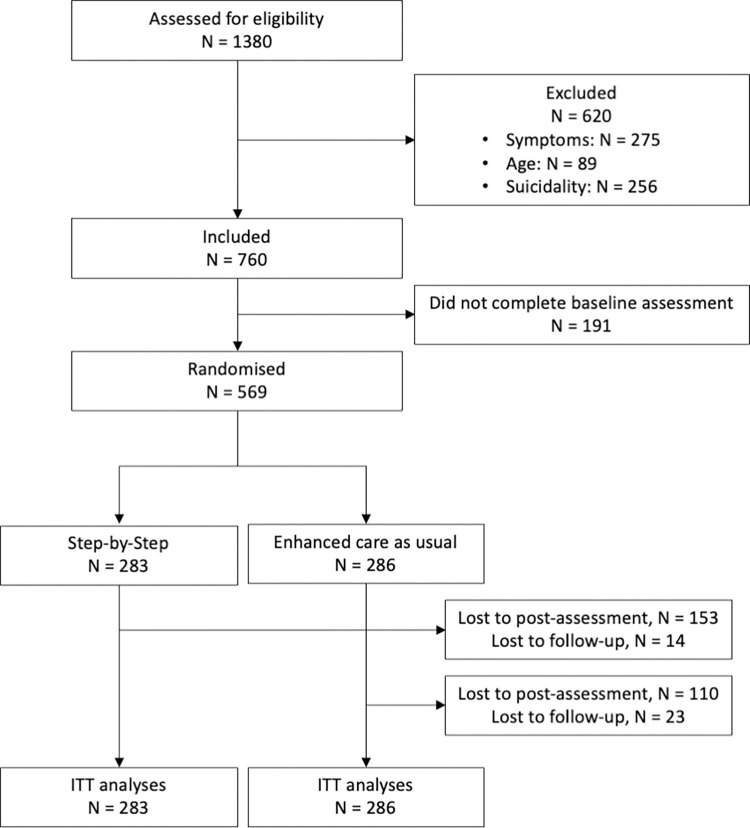
BACKGROUND: Most displaced people with mental disorders in low- and middle-income countries do not receive effective care, and their access to care has deteriorated during the Coronavirus Disease 2019 (COVID-19) pandemic. Digital mental health interventions are scalable when digital access is adequate, and they can be safely delivered during the COVID-19 pandemic. We examined whether a new WHO-guided digital mental health intervention, Step-by-Step, in which participants were supported by a nonspecialist helper, was effective in reducing depression among displaced people in Lebanon. METHODS AND FINDINGS: We conducted a single-blind, 2-arm pragmatic randomized clinical trial, comparing guided Step-by-Step with enhanced care as usual (ECAU) among displaced Syrians suffering from depression and impaired functioning in Lebanon. Primary outcomes were depression (Patient Health Questionnaire, PHQ-9) and impaired functioning (WHO Disability Assessment Schedule-12, WHODAS) at posttreatment. Secondary outcomes included subjective well-being, anxiety, post-traumatic stress, and self-described problems. A total of 569 displaced people from Syria with depression (PHQ-9 ≥ 10) and impaired functioning (WHODAS > 16) were randomized to Step-by-Step (N = 283; lost to follow-up: N = 167) or ECAU (N = 286; lost to follow-up: 133). Participants were considered to be lost to follow-up when they did not fill in the outcome measures at posttest or follow-up. Recruitment started on December 9, 2019 and was completed on July 9, 2020. The last follow-up assessments were collected in December 2020. The study team had access to the online platform, where they could see treatment arm assignment for each participant. All questionnaires were completed by participants online. Intention-to-treat (ITT) analyses showed intervention effects on depression (standardized mean differences [SMDs]: 0.48; 95% CI: 0.26; 0.70; p < 0.001), impaired functioning (SMD: 0.35; 95% CI: 0.14; 0.56; p < 0.001), post-traumatic stress (SMD: 0.36; 95% CI: 0.16; 0.56; p < 0.001), anxiety (SMD: 0.46; 95% CI: 0.24; 0.68; p < 0.001), subjective well-being (SMD: 0.47; 95% CI: 0.26; 0.68; p < 0.001), and self-identified personal problems (SMD: 0.49; 95% CI 0.28; 0.70; p < 0.001). Significant effects on all outcomes were maintained at 3 months follow-up. During the trial, one serious adverse event occurred, unrelated to the intervention. The main limitation of the current trial is the high dropout rate. CONCLUSIONS: In this study, we found that a guided, digital intervention was effective in reducing depression in displaced people in Lebanon. The guided WHO Step-by-Step intervention we examined should be made available to communities of displaced people that have digital access. TRIAL REGISTRATION: ClinicalTrials.gov NCT03720769.
Overview
The claims and statistics of this paper haven’t been checked yet.
Run the check — free, no account needed. It reads the open-access text and checks the sources it cites.
Integrity signals
Registry
Cites
Statistics
Figures
Verification
Claims the paper makes
The claims and statistics of this paper haven’t been checked yet.
Run the check — free, no account needed. It reads the open-access text and checks the sources it cites.
Claims other papers make about this one
Each is checked against this paper’s own text: does it say what the citing paper says it does?
The source backs part of the claim, not all of it — or backs it for a different population, condition or comparison.
In the citing paper
“Initial studies on a guided self-help version of SbS with weekly phone contacts in Lebanon found positive treatment effects on indicators of psychological distress and functioning in Syrian refugees and Lebanese local populations [23,37,38].”
From Effects of a self-guided digital mental health self-help intervention for Syrian refugees in Egypt: A pragmatic randomized controlled trial (2024) · cites this paper as [23]
Experimental — accuracy not yet measuredThe cited source says what the claim attributes to it.
In the citing paper
“Our trial is the first to implement SbS using a COD guidance model, as opposed to the regular (typically weekly) guidance of previous trials via phone or messaging [23].”
From Effects of a self-guided digital mental health self-help intervention for Syrian refugees in Egypt: A pragmatic randomized controlled trial (2024) · cites this paper as [23]
The cited source says what the claim attributes to it.
In the citing paper
“For Syrian refugees, there is only a small number of studies on digital interventions that find a range from small, nonsignificant effects [21,22] to medium effects [23] on mental health outcomes.”
From Effects of a self-guided digital mental health self-help intervention for Syrian refugees in Egypt: A pragmatic randomized controlled trial (2024) · cites this paper as [23]
The cited source says what the claim attributes to it.
In the citing paper
“In a previous trial using SbS among Syrian refugees, which used the same version of the SbS digital app [23], significant effects were found on symptoms of depression (g = 0.61), anxiety (g = 0.41), and PTSD (g = 0.39) as well as on functioning (g = 0.45), well-being (g = 0.51), and self-defined problems (g = 0.40).”
From Effects of a self-guided digital mental health self-help intervention for Syrian refugees in Egypt: A pragmatic randomized controlled trial (2024) · cites this paper as [23]
The cited source says what the claim attributes to it.
In the citing paper
“Recently published data on guided versions are promising (Cuijpers et al., 2022).”
From Smartphone-delivered mental health care interventions for refugees: A systematic review of the literature (2023) · cites this paper as Cuijpers et al., 2022
Self-check
Percentages, sums and reported differences re-computed from the paper’s own numbers.
The self-check needs the paper’s full text.
Citations
Cites
The PHQ-9: Validity of a brief depression severity measure
Kroenke, K., Spitzer, R. L., & Williams, J. B. W. (2001) · Journal of General Internal Medicine · doi:10.1046/j.1525-1497.2001.016009606.x · Cited by 44,910
A Brief Measure for Assessing Generalized Anxiety Disorder: The GAD-7
Spitzer, R. L., Kroenke, K., Williams, J. B. W., & Löwe, B. (2006) · Archives of Internal Medicine · doi:10.1001/archinte.166.10.1092 · Cited by 31,765
Assessment of client/patient satisfaction: development of a general scale
Larsen, D. L., Attkisson, C. C., Hargreaves, W. A., & Nguyen, T. D. (1979) · Evaluation and Program Planning · doi:10.1016/0149-7189(79)90094-6 · Cited by 2,887 · cited 1×
“Satisfaction with the intervention was measured with the Client Satisfaction Questionnaire (CSQ-3), a measure of client satisfaction with mental health services [30].”
MethodCharlson, F., van Ommeren, M., Flaxman, A., Cornett, J., Whiteford, H., & Saxena, S. (2019) · The Lancet · doi:10.1016/s0140-6736(19)30934-1 · Cited by 1,702
An Assessment of Clinically Useful Measures of the Consequences of Treatment
Laupacis, A., Sackett, D. L., & Roberts, R. S. (1988) · New England Journal of Medicine · doi:10.1056/nejm198806303182605 · Cited by 1,681
United Nations High Commissioner for Refugees
Petit, P. (2017) · Routledge eBooks · doi:10.4324/9781315129310-7 · Cited by 1,680
(2010) · Virtual Defense Library (Ministerio de Defensa) · Cited by 1,530
Training, Wages, and Sample Selection: Estimating Sharp Bounds on Treatment Effects
Lee, D. S. (2005) · National Bureau of Economic Research · doi:10.3386/w11721 · Cited by 1,519
Training, Wages, and Sample Selection: Estimating Sharp Bounds on Treatment Effects
Lee, D. S. (2009) · The Review of Economic Studies · doi:10.1111/j.1467-937x.2009.00536.x · Cited by 1,416
Undertreatment of people with major depressive disorder in 21 countries
Thornicroft, G., Chatterji, S., Evans-Lacko, S., Gruber, M., Sampson, N., Aguilar-Gaxiola, S., Al-Hamzawi, A., Alonso, J., Andrade, L., Borges, G., et al. (2017) · British Journal of Psychiatry · doi:10.1192/bjp.bp.116.188078 · Cited by 1,121
Bech, P., Olsen, L. R., Kjoller, M., & Rasmussen, N. K. (2003) · International Journal of Methods in Psychiatric Research · doi:10.1002/mpr.145 · Cited by 1,015
Andrews, G., Basu, A., Cuijpers, P., Craske, M. G., McEvoy, P., English, C. L., & Newby, J. M. (2018) · Journal of Anxiety Disorders · doi:10.1016/j.janxdis.2018.01.001 · Cited by 922
Self-citationLinardon, J., Cuijpers, P., Carlbring, P., Messer, M., & Fuller‐Tyszkiewicz, M. (2019) · World Psychiatry · doi:10.1002/wps.20673 · Cited by 860
Self-citationCuijpers, P., Noma, H., Karyotaki, E., Cipriani, A., & Furukawa, T. A. (2019) · JAMA Psychiatry · doi:10.1001/jamapsychiatry.2019.0268 · Cited by 539 · cited 1×
“While unguided interventions are less effective, guided self-help interventions are no less effective than face-to-face treatments [14].”
BackgroundSelf-citationHow Many Imputations Do You Need? A Two-stage Calculation Using a Quadratic Rule
von Hippel, P. T. (2018) · Sociological Methods & Research · doi:10.1177/0049124117747303 · Cited by 532
Sawaya, H., Atoui, M., Hamadeh, A., Zeinoun, P., & Nahas, Z. (2016) · Psychiatry Research · doi:10.1016/j.psychres.2016.03.030 · Cited by 450
van Ballegooijen, W., Cuijpers, P., van Straten, A., Karyotaki, E., Andersson, G., Smit, J. H., & Riper, H. (2014) · PLoS ONE · doi:10.1371/journal.pone.0100674 · Cited by 409 · cited 1×
“Limitations include the high level of dropout, which is inherent to e-mental health interventions and research [39], and for which we had powered the study.”
BackgroundSelf-citationJosephine, K., Josefine, L., Philipp, D., David, E., & Harald, B. (2017) · Journal of Affective Disorders · doi:10.1016/j.jad.2017.07.021 · Cited by 341
Investigation of abbreviated 4 and 8 item versions of the PTSD Checklist 5
Price, M., Szafranski, D. D., van Stolk‐Cooke, K., & Grös, D. F. (2016) · Psychiatry Research · doi:10.1016/j.psychres.2016.03.014 · Cited by 243
A client‐generated psychometric instrument: The development of ‘PSYCHLOPS’
Ashworth, M. J., Shepherd, M. A., Christey, J., Matthews, V., Wright, K. P., Parmentier, H., Robinson, S. I., & Godfrey, E. L. (2004) · Counselling and Psychotherapy Research · doi:10.1080/14733140412331383913 · Cited by 191
Farhat, J. B., Blanchet, K., Bjertrup, P. J., Veizis, A., Perrin, C., Coulborn, R. M., Mayaud, P., & Cohuet, S. (2018) · BMC Medicine · doi:10.1186/s12916-018-1028-4 · Cited by 180
Georgiadou, E., Zbidat, A., Schmitt, G. M., & Erim, Y. (2018) · Frontiers in Psychiatry · doi:10.3389/fpsyt.2018.00393 · Cited by 171
User-Centered App Adaptation of a Low-Intensity E-Mental Health Intervention for Syrian Refugees
Burchert, S., Alkneme, M. S., Bird, M., Carswell, K., Cuijpers, P., Hansen, P., Heim, E., Harper Shehadeh, M., Sijbrandij, M., van't Hof, E., et al. (2019) · Frontiers in Psychiatry · doi:10.3389/fpsyt.2018.00663 · Cited by 160 · cited 4×
“Step-by-Step was developed by WHO in collaboration with the National Mental Health Programme of the Ministry of Public Health in Lebanon, Freie Universität Berlin, and University of Zurich.”
MethodInfluentialSelf-citationPsychotherapies for depression in low- and middle-income countries: a meta-analysis
Cuijpers, P., Karyotaki, E., Reijnders, M., Purgato, M., & Barbui, C. (2018) · World Psychiatry · doi:10.1002/wps.20493 · Cited by 159 · cited 1×
“Assuming 70% dropout [31,32], we planned to recruit 568 participants to show that the intervention was effective.”
BackgroundSelf-citationKane, J. C., Ventevogel, P., Spiegel, P., Bass, J. K., van Ommeren, M., & Tol, W. A. (2014) · BMC Medicine · doi:10.1186/s12916-014-0228-9 · Cited by 141
Acarturk, C., McGrath, M., Roberts, B., Ilkkursun, Z., Cuijpers, P., Sijbrandij, M., Sondorp, E., Ventevogel, P., McKee, M., Fuhr, D. C., et al. (2021) · Social Psychiatry and Psychiatric Epidemiology · doi:10.1007/s00127-020-01941-6 · Cited by 115
Self-citationStep-by-Step: a new WHO digital mental health intervention for depression
Carswell, K., Harper-Shehadeh, M., Watts, S., van’t Hof, E., Abi Ramia, J., Heim, E., Wenger, A., & van Ommeren, M. (2018) · mHealth · doi:10.21037/mhealth.2018.08.01 · Cited by 104
Harper Shehadeh, M. J., Abi Ramia, J., Cuijpers, P., El Chammay, R., Heim, E., Kheir, W., Saeed, K., van Ommeren, M., van’t Hof, E., Watts, S., et al. (2020) · Frontiers in Psychiatry · doi:10.3389/fpsyt.2019.00986 · Cited by 75
Self-citationLebanon's humanitarian crisis escalates after the Beirut blast
Abouzeid, M., Habib, R. R., Jabbour, S., Mokdad, A. H., & Nuwayhid, I. A. (2020) · The Lancet · doi:10.1016/s0140-6736(20)31908-5 · Cited by 74
Abi Ramia, J., Harper Shehadeh, M., Kheir, W., Zoghbi, E., Watts, S., Heim, E., & El Chammay, R. (2018) · Global Mental Health · doi:10.1017/gmh.2018.29 · Cited by 65
Naal, H., Nabulsi, D., Arnaout, N. E., Abdouni, L., Dimassi, H. I., Harb, R., & Saleh, S. S. (2021) · BMC Public Health · doi:10.1186/s12889-021-10266-1 · Cited by 64
Heim, E., Ramia, J. A., Hana, R. A., Burchert, S., Carswell, K., Cornelisz, I., Cuijpers, P., El Chammay, R., Noun, P., van Klaveren, C., et al. (2021) · Internet Interventions · doi:10.1016/j.invent.2021.100380 · Cited by 61
Self-citationGuided digital health intervention for depression in Lebanon: randomised trial
Cuijpers, P., Heim, E., Ramia, J. A., Burchert, S., Carswell, K., Cornelisz, I., Knaevelsrud, C., Noun, P., van Klaveren, C., van’t Hof, E., et al. (2022) · Evidence-Based Mental Health · doi:10.1136/ebmental-2021-300416 · Cited by 60
Self-citationAddressing missing data in randomized clinical trials: A causal inference perspective
Cornelisz, I., Cuijpers, P. J., Donker, T., & van Klaveren, C. (2020) · PLoS ONE · doi:10.1371/journal.pone.0234349 · Cited by 23
Self-citationOpen access of psychological intervention manuals
Watts, S., van Ommeren, M., & Cuijpers, P. J. (2020) · World Psychiatry · doi:10.1002/wps.20756 · Cited by 20
Self-citationvan 't Hof, E., Heim, E., Abi Ramia, J., Burchert, S., Cornelisz, I., Cuijpers, P., El Chammay, R., Harper Shehadeh, M., Noun, P., Smit, F., et al. (2021) · JMIR Research Protocols · doi:10.2196/21585 · Cited by 16
Self-citationA Guided Digital Health Intervention for Depression in Lebanon: Randomized Trial
Cuijpers, P. (2022) · Data Archiving and Networked Services (DANS) · doi:10.17026/dans-xqw-xbwv · Cited by 2
Self-citation
Research works printed but not linked: 3
- Lebanese Ministry of Public Health, 2014, The Mental Health and Substance Use—Prevention, Promotion and Treatment- Situation Analysis and Strategy for Lebanon 2015–2020
- WHO, 2016, mhGAP Intervention Guide—Version 2.0 for mental, neurological and substance use disorders in non-specialized health settings
- StataCorp, 2019, Stata Statistical Software: Release 16
Cited by
Sorted by citations
Torous, J., Linardon, J., Goldberg, S. B., Sun, S., Bell, I., Nicholas, J., Hassan, L., Hua, Y., Milton, A., & Firth, J. (2025) · World Psychiatry · doi:10.1002/wps.21299 · Cited by 323
Hornstein, S., Zantvoort, K., Lueken, U., Funk, B., & Hilbert, K. (2023) · Frontiers in Digital Health · doi:10.3389/fdgth.2023.1170002 · Cited by 134
Schäfer, S. K., Thomas, L. M., Lindner, S., & Lieb, K. (2023) · World Psychiatry · doi:10.1002/wps.21129 · Cited by 115
El‐Jardali, F., Bou-Karroum, L., Jabbour, M., Bou‐Karroum, K., Aoun, A., Salameh, S., Mecheal, P., & Sinha, C. (2023) · PLoS ONE · doi:10.1371/journal.pone.0285226 · Cited by 69
“Twenty-five studies addressed clients as primary intended users [21, 22, 25, 27, 30, 32, 33, 42, 45, 60, 67, 72, 73, 77, 78, 82, 84, 86, 87, 90, 93, 95, 97, 99, 104] (S2 Table).”
BackgroundKaryotaki, E., Miguel, C., Panagiotopoulou, O. M., Harrer, M., Seward, N., Sijbrandij, M., Araya, R., Patel, V., & Cuijpers, P. (2023) · Cambridge Prisms Global Mental Health · doi:10.1017/gmh.2023.50 · Cited by 56
“…Moeini et al., 2019; Jannati et al., 2020; Salamanca-Sanabria et al., 2020; Wang et al., 2020; Araya et al., 2021; Ghosh et al., 2023; Heim et al., 2021; Latif Cambridge Prisms: Global Mental Health et al., 2021; Newman et al., 2021; Sun et al., 2021; Cuijpers et al., 2022; Zhao et al., 2022).”
BackgroundSelf-citation
Metadata
- Authors
- Cuijpers, P., Heim, E., Abi Ramia, J., Burchert, S., Carswell, K., Cornelisz, I., Knaevelsrud, C., Noun, P., van Klaveren, C., van’t Hof, E., Zoghbi, E., van Ommeren, M., & El Chammay, R.
- Affiliations
- Babeș-Bolyai University (RO)
- University of Zurich (CH)
- Freie Universität Berlin (DE)
- World Health Organization (CH)
- Vrije Universiteit Amsterdam (NL)
- University of Lausanne (CH)
- Corresponding author
- Cuijpers, Pim
- ORCID
- Venue
- PLoS Medicine
- Publisher
- Public Library of Science (PLoS)
- Published
- 2022-06-23
- Volume
- 19
- Issue
- 6
- Pages
- e1004025
- ISSN
- 1549-1277 (ISSN-L)
- 1549-1676
- PMC
- PMC9223343
- OpenAlex
- W4283376471
- Cited by
- 118
- References
- 38
- Citations by year
- 2026: 20 · 2025: 32 · 2024: 28 · 2023: 26 · 2022: 12
- FWCI
- 21.64
- Type
- journal article
- Language
- en
- Update notices
- correction (2023-04-14)
- Open access
- gold
- doi.org
- Licence
- Locations
- PLoS Medicine (publishedVersion, cc-by)
- PubMed Central (publishedVersion, cc-by)
- PubMed (publishedVersion)
- Research Publications (Maastricht University) (publishedVersion, cc-by)
- IRIS (submittedVersion, other-oa)
- DOAJ (DOAJ: Directory of Open Access Journals) (submittedVersion)
- Refubium (Universitätsbibliothek der Freien Universität Berlin) (submittedVersion, cc-by)
- VU Research Portal (submittedVersion, other-oa)
- SERVAL (Université de Lausanne) (submittedVersion, other-oa)
- Research Publications (Maastricht University) (submittedVersion, other-oa)
- Data Archiving and Networked Services (DANS) (submittedVersion, other-oa)
- Universitätsbibliothek der FU Berlin Hochschulschriftenstelle u. Dokumentenserver (cc-by)
- Funders
- Research for Health in Humanitarian Crises
- Horizon 2020 Framework Programme (733337)
- Topics
- Social Sciences › Psychology › Applied Psychology › Digital Mental Health Interventions
- Social Sciences › Psychology › Clinical Psychology › Migration, Health and Trauma
- Health Sciences › Medicine › Psychiatry and Mental health › Mental Health Treatment and Access
- Keywords
- depression, Syrian refugees, digital mental health interventions, WHO STEPwise approach, impaired functioning, post-traumatic stress, anxiety, subjective well-being, COVID-19 pandemic, displaced persons, Lebanon, access to mental health care, WHODAS, PHQ-9
- MeSH terms
- Internet-Based Intervention, COVID-19, Depression, Humans, Lebanon, Refugees, Syria, World Health Organization, Single-Blind Method, Treatment Outcome, Pandemics
About these checks
Registry, retraction, Cites and statistics results are computed, not judged, with one exception: a printed reference that no index lists is read once by a model before it counts as a citation error. Claims are extracted by a model and kept only when their quote appears verbatim in the text; each cited source is then checked, with a model’s help, for whether it says what the claim relies on. Those verdicts can be wrong — read the claim’s quote and the cited source before relying on one.
Statistics and arithmetic are recomputed, not judged.
Confidence bands are shown only for fields calibrated on our annotated test set. None is calibrated yet, so no band is shown.
What counts as a claim ›How we measure confidence ›How we check this ›
Are you an author, or do you see a problem with this page? Request a review
