

MicroRNAs: Novel Regulators Involved in the Pathogenesis of Psoriasis?
Open accessThe DOI matches its Crossref record; 24 of the 24 references it cites were found in a registry or an index.
Abstract
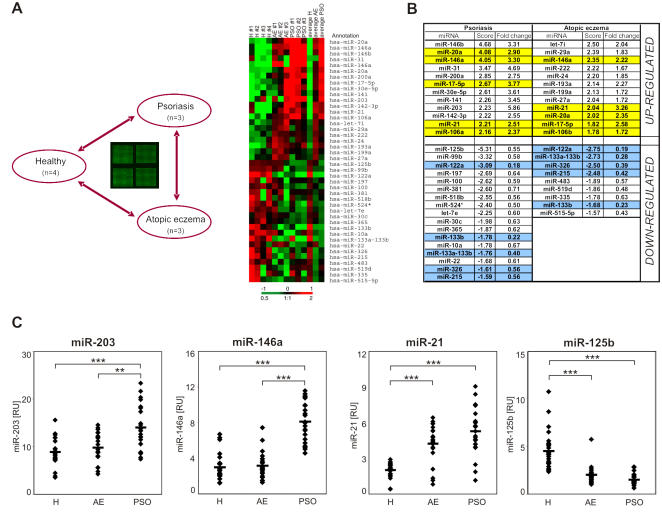
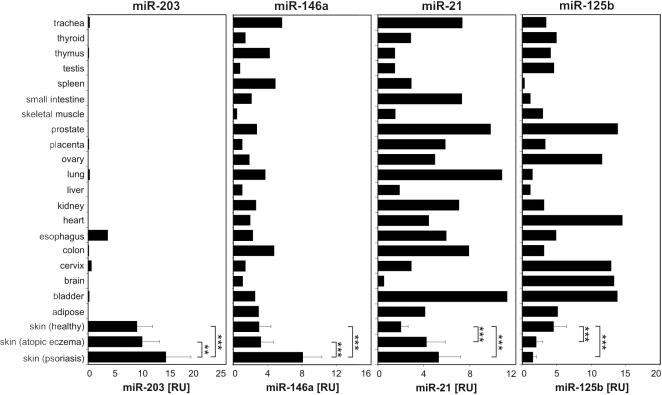
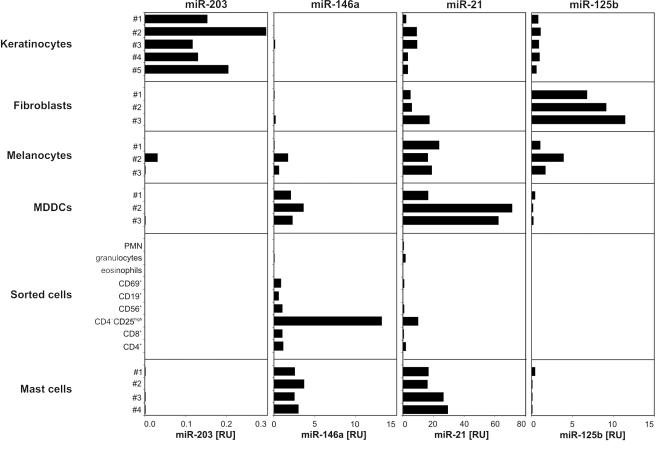
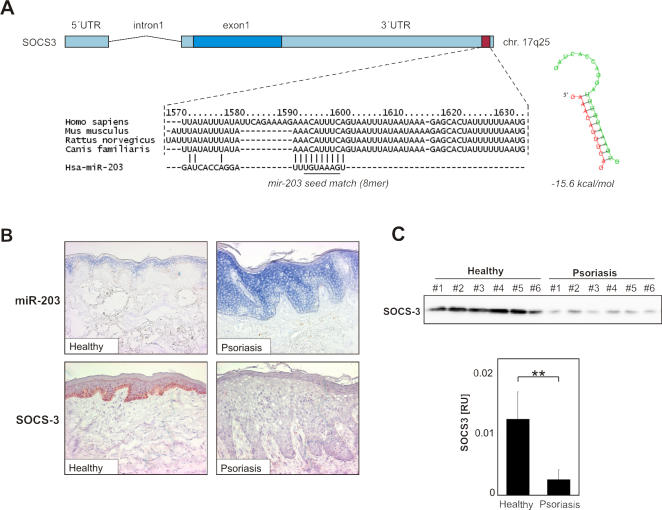
MicroRNAs are a recently discovered class of posttranscriptional regulators of gene expression with critical functions in health and disease. Psoriasis is the most prevalent chronic inflammatory skin disease in adults, with a substantial negative impact on the patients' quality of life. Here we show for the first time that psoriasis-affected skin has a specific microRNA expression profile when compared with healthy human skin or with another chronic inflammatory skin disease, atopic eczema. Among the psoriasis-specific microRNAs, we identified leukocyte-derived microRNAs and one keratinocyte-derived microRNA, miR-203. In a panel of 21 different human organs and tissues, miR-203 showed a highly skin-specific expression profile. Among the cellular constituents of the skin, it was exclusively expressed by keratinocytes. The up-regulation of miR-203 in psoriatic plaques was concurrent with the down-regulation of an evolutionary conserved target of miR-203, suppressor of cytokine signaling 3 (SOCS-3), which is involved in inflammatory responses and keratinocyte functions. Our results suggest that microRNA deregulation is involved in the pathogenesis of psoriasis and contributes to the dysfunction of the cross talk between resident and infiltrating cells. Taken together, a new layer of regulatory mechanisms is involved in the pathogenesis of chronic inflammatory skin diseases.
Overview
The claims and statistics of this paper haven’t been checked yet.
Free: it reads the open-access text and checks the first 5 claims that cite a source we can check. Create a free account to check every claim.
Integrity signals
Registry
Cites
Statistics
Figures
Verification
Claims the paper makes
The claims and statistics of this paper haven’t been checked yet.
Free: it reads the open-access text and checks the first 5 claims that cite a source we can check. Create a free account to check every claim.
Claims other papers make about this one
Each is checked against this paper’s own text: does it say what the citing paper says it does?
In the citing paper
“Its overexpression in human psoriatic skin has been suggested to reflect insufficient compensation of overt skin inflammation.91”
From The Innate Immune System in Acute and Chronic Wounds (2016) · cites this paper as [91]
Self-check
Percentages, sums and reported differences re-computed from the paper’s own numbers.
The self-check needs the paper’s full text.
Citations
Cites
Bartel (2004) · doi:10.1016/s0092-8674(04)00045-5 · Cited by 34,714
In silico prediction of protein-protein interactions in human macrophages
Souiai, O., Guerfali, F., Ben Miled, S., Brun, C., & Benkahla, A. (2014) · BMC Research Notes · doi:10.1186/1756-0500-7-157 · Cited by 10,803
The functions of animal microRNAs
Ambros, V. (2004) · Nature · doi:10.1038/nature02871 · Cited by 10,728
Significance analysis of microarrays applied to the ionizing radiation response
Tusher, V. G., Tibshirani, R., & Chu, G. (2001) · Proceedings of the National Academy of Sciences · doi:10.1073/pnas.091062498 · Cited by 10,568
Taganov, K. D., Boldin, M. P., Chang, K.-J., & Baltimore, D. (2006) · Proceedings of the National Academy of Sciences · doi:10.1073/pnas.0605298103 · Cited by 4,317 · cited 1×
“. Interestingly, a recent study showed that miR-146a, one of the psoriasis-specific miRNAs, inhibits the expression of IRAK-1 and TRAF-6 proteins both of which are regulators of the TNF-α signaling pathway”
BackgroundNon-coding RNAs and cancer: microRNAs and beyond
Raia, R. M., & Calin, G. A. (2011) · Journal of Nucleic Acids Investigation · doi:10.4081/jnai.2011.e5 · Cited by 3,382
Pathogenesis and therapy of psoriasis
Lowes, M. A., Bowcock, A. M., & Krueger, J. G. (2007) · Nature · doi:10.1038/nature05663 · Cited by 1,778 · cited 8×
“SOCS-3 deficiency leads to sustained activation of STAT3 in response to IL-6 [18], a cytokine present in the psoriasis lesions [11].”
BackgroundInfluentialmiRNAs, Cancer, and Stem Cell Division
Croce, C. M., & Calin, G. A. (2005) · Cell · doi:10.1016/j.cell.2005.06.036 · Cited by 1,329 · cited 1×
“. Indeed, miRNAs have regulatory roles in development, differentiation, organogenesis, stem cell and germline proliferation, growth control and apoptosis. Moreover, deregulation of miRNA expression may contribute to human diseases; in particular, miRNAs are often aberrantly expressed or mutated in cancer”
BackgroundPlasmacytoid predendritic cells initiate psoriasis through interferon-α production
Nestle, F. O., Conrad, C., Tun-Kyi, A., Homey, B., Gombert, M., Boyman, O., Burg, G., Liu, Y.-J., & Gilliet, M. (2005) · The Journal of Experimental Medicine · doi:10.1084/jem.20050500 · Cited by 1,124
Self-citationSOCS3 negatively regulates IL-6 signaling in vivo
Croker, B. A., Krebs, D. L., Zhang, J.-G., Wormald, S., Willson, T. A., Stanley, E. G., Robb, L., Greenhalgh, C. J., Förster, I., Clausen, B. E., et al. (2003) · Nature Immunology · doi:10.1038/ni931 · Cited by 840 · cited 1×
“SOCS-3 deficiency leads to sustained activation of STAT3 in response to IL-6 [18], a cytokine present in the psoriasis lesions [11].”
Background
Cited by
Items 701–767 of 767
Novel mechanisms for neoadjuvant chemotherapeutic response monitoring in breast cancer
Casey, M. (2016) · Arrow@dit (Dublin Institute of Technology) · doi:10.13025/17921
Alase, A. A. (2015) · Bradford Scholars (University of Bradford)
Gene regulation in psoriatic keratinocytes: microRNAs and cytokine responses
Srivastava, A. (2018) · Figshare · Cited by 1
Studies of the Systemic Inflammation in Psoriasis
Sigurdardottir, G. (2018) · Linköping University medical dissertations · doi:10.3384/diss.diva-151988
Reich, T., & Budka, M. (2019) · British Paramedic Journal · doi:10.29045/14784726.2019.09.4.2.22
miRNAs in diabetic wound healing
Pal, D. (2020) · Elsevier eBooks · doi:10.1016/b978-0-12-816413-6.00008-3 · Cited by 1
Simplicity from Complexity – MicroRNAs and the Maintenance of Skin Homeostasis
Quah, S., & Sampath, P. (2020) · COSMOS · doi:10.1142/s2591722620400086
Alataş, E. T., Kara, M., Doğan, G., & Belli, A. A. (2020) · Anais Brasileiros de Dermatologia · doi:10.1016/j.abdp.2020.04.006
Chen, H., Lu, Y. P., Tang, B., Li, X., Zhang, H., Zhang, J., Yu, J., Yan, Y., Deng, H., Li, S., et al. (2021) · Research Square · doi:10.21203/rs.3.rs-342314/v1
[Javel's ophthalmometer, modified to corneal microscope].
VARGA, B. (1951) · PubMed
Epigenetics in bone and joint disorders
Altorok, N., Nagaraja, V., & Kahaleh, B. (2021) · Elsevier eBooks · doi:10.1016/b978-0-12-823928-5.00033-5
miR ‐378a: an amplifier of the interleukin‐17A response in keratinocytes
Johansen, C. (2022) · British Journal of Dermatology · doi:10.1111/bjd.21592
Study of skin expression of Micro RNA 203 in patients with Alopecia areata
ElRafaie, A. M., Sorour, N. E., Mustafa, A. I., El-Shimi, O. S., & Alshleyan, S. F. (2019) · Benha Journal of Applied Sciences · doi:10.21608/bjas.2019.187075
“something like miR-203 prompt decay the proclamation over SOCS-3 over skin, which might make incorporated for ignitable responses Additionally keratinocyte capacities [18].”
BackgroundVisone, R., & Croce, C. M. (2008) · Wiley eBooks · doi:10.1002/9780470048672.wecb336
Molecular Mechanisms and Biomarker Perspective of MicroRNAs in Traumatic Brain Injury
Balakathiresan, N. S., Sharma, A. K., Chandran, R., Bhomia, M., Zhang, Z., Wang, K., & Maheshwari, R. K. (2014) · CRC Press eBooks · doi:10.1201/b17644-5
Investigations on cytosolic nucleic acid fragment induced innate immune functions of keratinocytes
Danis, J. (2018) · SZTE Repository of Dissertations (University of Szeged) · doi:10.14232/phd.9806
miR-203 Inhibits Cell Proliferation and ERK Pathway in Prostate Cancer by Targeting IRS-1Preprint
Hu, X., Li, S., Meng, Y., Zeng, X., Qiu, L., Wei, M., Wang, Z., & Han, J. (2019) · doi:10.21203/rs.2.12423/v1
Mechanism of cytosolic nucleic acid induced IL-23 expression of human keratinocytes
Kelemen, E. (2022) · SZTE Repository of Dissertations (University of Szeged) · doi:10.14232/phd.11290
MicroRNA regulation in autoimmune diseases
Dasgupta, I. (2022) · Elsevier eBooks · doi:10.1016/b978-0-323-91305-8.00002-8
Implications of miRNA in autoimmune and inflammatory skin diseases
Tembhre, M. K., Imran, S., & Jaiswal, K. P. (2023) · Elsevier eBooks · doi:10.1016/b978-0-323-99521-4.00008-8 · Cited by 1
Mamalis, A., & Jagdeo, J. R. (2015) · Elsevier eBooks · doi:10.1016/b978-0-12-820719-2.00018-1
MicroRNA Biogenesis in Regenerative Medicine
Ghatak, S., Watson, B., & Sen, C. K. (2023) · Elsevier eBooks · doi:10.1016/b978-0-12-820719-2.00001-6
MicroRNAs and Mesenchymal Stem Cells in Diabetic Wound Healing
Zgheib, C., Niemiec, S. M., Louiselle, A. E., Liechty, K. W., & Xu, J. (2023) · Elsevier eBooks · doi:10.1016/b978-0-12-820719-2.00004-1
OxymiRs in Regenerative Medicine
Neumann, C. R., Khan, I., Mohan, G., Ghatak, S., Sen, C. K., & Sinha, M. (2023) · Elsevier eBooks · doi:10.1016/b978-0-12-820719-2.00023-5
MicroRNA Profiles in Critically Ill Patients
Alikiaii, B., Bagherniya, M., Askari, G., Rajendram, R., & Sahebkar, A. (2023) · Current Medicinal Chemistry · doi:10.2174/0929867331666230726095222
Rolle der microRNAs in der Pathophysiologie der Bronchiolitis obliterans
Kochems, A. (2023) · Publication Server of Goethe University Frankfurt am Main (Goethe University Frankfurt) · doi:10.21248/gups.79576
Gao, X., Zhao, D., Han, J., Zhang, Z., & Wang, Z. (2022) · Figshare · doi:10.6084/m9.figshare.19572561
Gao, X., Zhao, D., Han, J., Zhang, Z., & Wang, Z. (2022) · Figshare · doi:10.6084/m9.figshare.19572543
Gao, X., Zhao, D., Han, J., Zhang, Z., & Wang, Z. (2022) · Figshare · doi:10.6084/m9.figshare.19572567
Gao, X., Zhao, D., Han, J., Zhang, Z., & Wang, Z. (2022) · Figshare · doi:10.6084/m9.figshare.19572534
Gao, X., Zhao, D., Han, J., Zhang, Z., & Wang, Z. (2022) · Figshare · doi:10.6084/m9.figshare.19572564
Gao, X., Zhao, D., Han, J., Zhang, Z., & Wang, Z. (2022) · Figshare · doi:10.6084/m9.figshare.19572549
Gao, X., Zhao, D., Han, J., Zhang, Z., & Wang, Z. (2022) · Figshare · doi:10.6084/m9.figshare.19572555
The Signature of Serum MicroRNA Folding Change in Rheumatoid Arthritis
Jawad, A., Hameed, R. M., & Al-Awadi, J. H. H. (2024) · Journal of Applied Hematology · doi:10.4103/joah.joah_104_23
The miRacle of Epidermal Homeostasis
Sonkoly, E. (2025) · Journal of Investigative Dermatology · doi:10.1016/j.jid.2025.02.003
Self-citationMenesy, D., Elgmal, E., ElGhannam, S. I., & Fouda, I. (2025) · International Journal of Medical Arts · doi:10.21608/ijma.2025.310576.2014
Zhu, Y., Wu, K., Jiang, C., & Zhu, Q. (2025) · Frontiers in Genetics · doi:10.3389/fgene.2025.1544565
“The paternal expression of MIR125B2 is ubiquitous in human tissues (Sonkoly et al., 2007).”
Non-coding RNAs in psoriasis : insights into epidermal dysregulation and inflammation
Freisenhausen, J. C. (2025) · doi:10.69622/28929614
Ohno-miRNAs: miRNA pairs derived from whole-genome duplication
Agasso, L., Molineris, I., & Caselle, M. (2025) · PLoS Computational Biology · doi:10.1371/journal.pcbi.1013766
Nakagawa, A., Nakajima, T., & Azuma, M. (2021) · Figshare · doi:10.6084/m9.figshare.16869732
Meng, Y., Hu, X., Li, S., Zeng, X., Qiu, L., Wei, M., Wang, Z., & Han, J. (2020) · Figshare · doi:10.6084/m9.figshare.13152384
Mannala, G. K., & Justus Liebig University Giessen (2016) · University writing server of the Justus Liebig University Giessen (Justus-Liebig-Universität Gießen) · doi:10.22029/jlupub-14340
Nakagawa, A., Nakajima, T., & Azuma, M. (2021) · Figshare · doi:10.6084/m9.figshare.16869730
Nakagawa, A., Nakajima, T., & Azuma, M. (2021) · Figshare · doi:10.6084/m9.figshare.16869728
Gao, X., Zhao, D., Han, J., Zhang, Z., & Wang, Z. (2022) · Figshare · doi:10.6084/m9.figshare.19572540
The Role of Epigenetics in Autoinflammatory Diseases
Mastrolia, M. V., Abu‐Rumeileh, S., Maniscalco, V., Maccora, I., Marrani, E., Pagnini, I., & Simonini, G. (2025) · Rare diseases of the immune system · doi:10.1007/978-3-032-02902-7_10
The role of microRNA-21 in cardiac macrophages
Schön, A. P., Engelhardt, S., & München, T. U. (2024)
Research Trends and Insights Regarding MicroRNAs in Psoriasis: A Comprehensive Analysis
Örs, İ., Coşansu, N. C., & Solak, B. (2025) · Cureus · doi:10.7759/cureus.100071
Pre-miRNA Sınıflandırması için Derin Öğrenme Temelli Güçlü Bir Dedektör
Taşdelen, A. (2021) · AYBU AVESIS
Présumey, J. (2011) · theses.fr (ABES) · doi:10.70675/f983b36ezf1adz41e3zb534z955da49cedea
Etude de la régulation de l’expression de PLAGL1 dans les sarcomes
Peille, A.-L. (2010) · theses.fr (ABES) · doi:10.70675/42ba149ez0da5z485fz94dcz68371a4f9b4c
Études des microARNs dans le développement des carcinomes spinocellulaires cutanés
Gastaldi, C. (2013) · theses.fr (ABES) · doi:10.70675/012524ebzf01dz4d0bzaeadz38c9f98b4bef
Régulation, par les microARNs, des gènes de prédisposition au cancer du sein BRCA
Garcia, A. I. (2011) · theses.fr (ABES) · doi:10.70675/eb066743zc747z4621z9effze5d3dbe38cf9
New roles of the Lyn tyrosine kinase in psoriasis development and cell death
Diaz, L. E. A. (2018) · theses.fr (ABES) · doi:10.70675/3deccde8zd3dez40abzbda2ze9b04bfdfd62
Modulation de la pigmentation en conditions de physioxie : effet de nouveaux phosphosaccharides
Hassanaly, S. (2017) · theses.fr (ABES) · doi:10.70675/1f5de0ebz76efz4914za358z5da2df4c8cef
OxymiRs in Regenerative Medicine
Sinha, M., & Sen, C. K. (2014) · Elsevier eBooks · doi:10.1016/b978-0-12-405544-5.00030-7
Loss of epidermal miR-149 sensitizes to skin inflammation
Luo, L., Yuan, H., Srivastava, A., Annusver, K., Khera, N., Saha, P., Prieux, R., Mahapatra, K. D., Kelemen, E., Dholakia, M., et al. (2026) · Journal of Allergy and Clinical Immunology · doi:10.1016/j.jaci.2026.06.011
Self-citationChen, L., Qiao, Z.-Z., Xu, C., Yao, Y., Yang, Y.-Y., Zhang, X.-Y., Cheng, S.-F., Zhang, B., & Yang, X.-Y. (2026) · Frontiers in Physiology · doi:10.3389/fphys.2026.1884398
MicroRNA: role in pathogenesis, problems of microRNA therapy, and future prospects
Kugaevskaya, E. V., Timoshenko, O. S., Gureeva, T. A., & Lisitsa, A. V. (2026) · Biomeditsinskaya Khimiya · doi:10.18097/pbmcr1705
Skin-Derived Non-Coding RNAs as Potential Biomarkers and Therapeutic Targets
Zen, J. L., Le, Q. M. N., Li, S., & Hanna, G. B. (2026) · Non-Coding RNA · doi:10.3390/ncrna12050038
Appolonia, C. N., Basavarajappa, S. C., Liu, A. R., Northrop, K., & Ramakrishnan, P. (2026) · bioRxiv (Cold Spring Harbor Laboratory) · doi:10.64898/2026.09.23.753219
“…miR146a levels are increased in multiple autoimmune conditions in humans, including rheumatoid arthritis (Nakasa et al. 2008), psoriasis (Sonkoly et al. 2007), and myasthenia gravis (Jiayin Lu et al. 2013). microRNA146a is also elevated in the serum of T1D patients compared to age-and…”
Developing a microRNA body fluid identification test for use in forensic casework
Uchimoto, M. L. (2014) · University of Huddersfield Repository (University of Huddersfield)
Metadata
- Authors
- Sonkoly, E., Wei, T., Janson, P. C. J., Sääf, A., Lundeberg, L., Tengvall-Linder, M., Norstedt, G., Alenius, H., Homey, B., Scheynius, A., Ståhle, M., & Pivarcsi, A.
- Affiliations
- Karolinska Institutet (SE)
- Finnish Institute of Occupational Health (FI)
- Heinrich Heine University Düsseldorf (DE)
- Corresponding author
- Sonkoly, Enikö
- Pivarcsi, Andor
- ORCID
- Venue
- PLoS ONE
- Publisher
- Public Library of Science (PLoS)
- Published
- 2007-07-11
- Volume
- 2
- Issue
- 7
- Pages
- e610
- ISSN
- 1932-6203 (ISSN-L)
- PMC
- PMC1905940
- OpenAlex
- W1991320836
- Cited by
- 754
- References
- 24
- Citations by year
- 2026: 6 · 2025: 18 · 2024: 19 · 2023: 29 · 2022: 37 · 2021: 45 · 2020: 44 · 2019: 35 · 2018: 30 · 2017: 39 · 2016: 67 · 2015: 55 · 2014: 64 · 2013: 50 · 2012: 50
- FWCI
- 12.90
- Type
- journal article
- Language
- en
- Open access
- gold
- doi.org
- Locations
- PLoS ONE (publishedVersion, cc-by)
- PubMed Central (publishedVersion, cc-by)
- PubMed (publishedVersion)
- DOAJ (DOAJ: Directory of Open Access Journals) (submittedVersion, cc-by-sa)
- Figshare (submittedVersion, cc-by)
- Funders
- Wenner-Gren Foundation
- Insamlingsstiftelsen Cancer- och Allergifonden
- Karolinska Institutet
- Stockholms Läns Landsting
- Szegedi Tudományegyetem
- Medical Research Council
- Topics
- Life Sciences › Immunology and Microbiology › Immunology › Psoriasis: Treatment and Pathogenesis
- Life Sciences › Biochemistry, Genetics and Molecular Biology › Cancer Research › MicroRNA in disease regulation
- Health Sciences › Medicine › Dermatology › Dermatology and Skin Diseases
- Keywords
- microRNA, psoriasis, miR-203, SOCS3, keratinocytes, miRNA expression profiling, atopic dermatitis, chronic inflammatory skin disease, post-transcriptional regulation, infiltrating immune cells
- MeSH terms
- Adult, Algorithms, Dermatitis, Atopic, Fibroblasts, Gene Expression Regulation, Humans, Mast Cells, Psoriasis, Quality of Life, Reference Values, Skin, Skin Physiological Phenomena, T-Lymphocytes, Blotting, Western, Keratinocytes, Gene Expression Profiling, MicroRNAs
About these checks
Registry, retraction, Cites and statistics results are computed, not judged, with one exception: a printed reference that no index lists is read once by a model before it counts as a citation error. Claims are extracted by a model and kept only when their quote appears verbatim in the text; each cited source is then checked, with a model’s help, for whether it says what the claim relies on. Those verdicts can be wrong — read the claim’s quote and the cited source before relying on one.
Statistics and arithmetic are recomputed, not judged.
Confidence bands are shown only for fields calibrated on our annotated test set. None is calibrated yet, so no band is shown.
What counts as a claim ›How we measure confidence ›How we check this ›
Are you an author, or do you see a problem with this page? Request a review
Data sources
Bibliographic data: Semantic Scholar, OpenAlex, Crossref.
Contains information from the Semantic Scholar Academic Graph Datasets, made available under the ODC Attribution License (ODC-BY 1.0).
Semantic Scholar’s data is described in: Kinney, R., et al. (2023). The Semantic Scholar Open Data Platform. arXiv:2301.10140.
