

Benefits of Stimulus Congruency for Multisensory Facilitation of Visual Learning
Open accessThe DOI matches its Crossref record; 26 of the 26 references it cites were found in a registry or an index.
Abstract
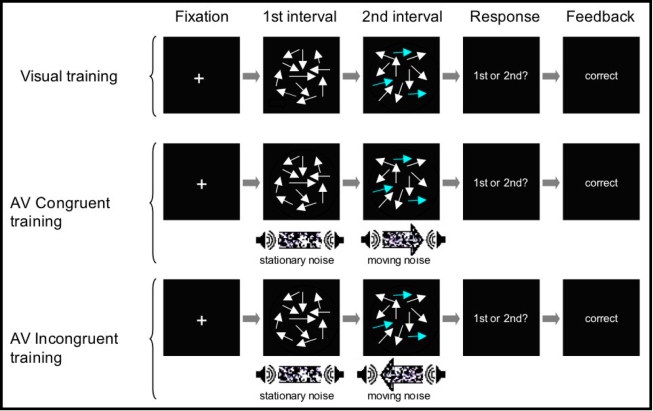
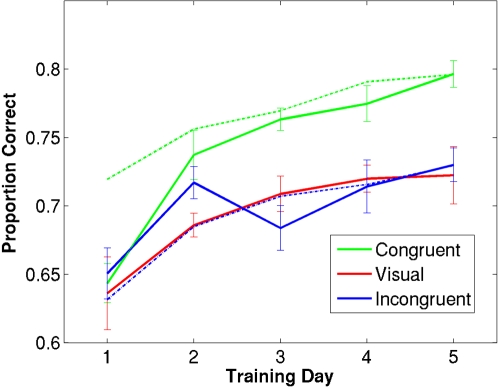
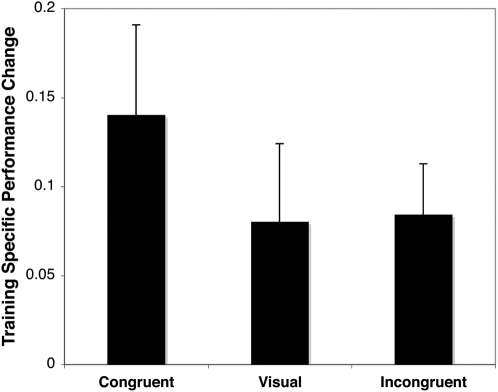
BACKGROUND: Studies of perceptual learning have largely focused on unisensory stimuli. However, multisensory interactions are ubiquitous in perception, even at early processing stages, and thus can potentially play a role in learning. Here, we examine the effect of auditory-visual congruency on visual learning. METHODOLOGY/PRINCIPLE FINDINGS: Subjects were trained over five days on a visual motion coherence detection task with either congruent audiovisual, or incongruent audiovisual stimuli. Comparing performance on visual-only trials, we find that training with congruent audiovisual stimuli produces significantly better learning than training with incongruent audiovisual stimuli or with only visual stimuli. CONCLUSIONS/SIGNIFICANCE: This advantage from stimulus congruency during training suggests that the benefits of multisensory training may result from audiovisual interactions at a perceptual rather than cognitive level.
Overview
The claims and statistics of this paper haven’t been checked yet.
Free: it reads the open-access text and checks the first 5 claims that cite a source we can check. Create a free account to check every claim.
Integrity signals
Registry
Cites
Statistics
Figures
Verification
Claims the paper makes
The claims and statistics of this paper haven’t been checked yet.
Free: it reads the open-access text and checks the first 5 claims that cite a source we can check. Create a free account to check every claim.
Claims other papers make about this one
Each is checked against this paper’s own text: does it say what the citing paper says it does?
The cited source says what the claim attributes to it.
In the citing paper
“In fact, after training with audiovisual feedback, learning of motion perception tasks was still enhanced even though auditory feedback was withdrawn (Kim, Seitz, & Shams, 2008;Seitz, Kim, & Shams, 2006).”
From Augmented visual, auditory, haptic, and multimodal feedback in motor learning: A review (2013) · cites this paper as Kim, Seitz, & Shams, 2008
The cited source says what the claim attributes to it.
In the citing paper
“Researchers have assumed that, after training with multimodal stimuli, multimodal processing is activated even if only unimodal stimuli are present (Kim et al., 2008;Seitzetal.,2006;Shams & Seitz, 2008).”
From Augmented visual, auditory, haptic, and multimodal feedback in motor learning: A review (2013) · cites this paper as Kim et al., 2008
Self-check
Percentages, sums and reported differences re-computed from the paper’s own numbers.
The self-check needs the paper’s full text.
Citations
Cites
Using confidence intervals in within-subject designs
Loftus, G. R., & Masson, M. E. J. (1994) · Psychonomic Bulletin & Review · doi:10.3758/bf03210951 · Cited by 2,448 · cited 1×
“Error bars reflect within-group standard error [19].”
The analysis of visual motion: a comparison of neuronal and psychophysical performance
Britten, K., Shadlen, M., Newsome, W., & Movshon, J. (1992) · The Journal of Neuroscience · doi:10.1523/jneurosci.12-12-04745.1992 · Cited by 1,958 · cited 1×
“A Movshon/Newsome-type motion algorithm [17] was employed with white dots (0.”
MethodIs neocortex essentially multisensory?
GHAZANFAR, A., & SCHROEDER, C. (2006) · Trends in Cognitive Sciences · doi:10.1016/j.tics.2006.04.008 · Cited by 1,463 · cited 1×
“However, crossmodal interactions are ubiquitous in human perception, and can occur even at early stages of processing in areas previously viewed as ‘‘sensory-specific’’ [5–11].”
BackgroundRecanzone, G., Schreiner, C., & Merzenich, M. (1993) · The Journal of Neuroscience · doi:10.1523/jneurosci.13-01-00087.1993 · Cited by 1,266 · cited 1×
“This type of learning is particularly interesting because it seems to demonstrate a surprising degree of cortical plasticity even in adult primary visual [1–2], auditory [3] and somotosensory areas [4].”
BackgroundActivation of Auditory Cortex During Silent Lipreading
Calvert, G. A., Bullmore, E. T., Brammer, M. J., Campbell, R., Williams, S. C. R., McGuire, P. K., Woodruff, P. W. R., Iversen, S. D., & David, A. S. (1997) · Science · doi:10.1126/science.276.5312.593 · Cited by 1,025
Anatomical evidence of multimodal integration in primate striate cortex
Falchier, A., Clavagnier, S., Barone, P., & Kennedy, H. (2002) · The Journal of Neuroscience · doi:10.1523/jneurosci.22-13-05749.2002 · Cited by 892 · cited 1×
“While these results cannot speak to the exact mechanism by which multisensory training mediates visual learning, anatomical studies have found evidence for input to lower level visual areas both directly from primary and parabelt auditory cortex [25,26], and also from the superior temporal polysensory area [25].”
ResultPractising orientation identification improves orientation coding in V1 neurons
Schoups, A., Vogels, R., Qian, N., & Orban, G. (2001) · Nature · doi:10.1038/35087601 · Cited by 856 · cited 1×
“This type of learning is particularly interesting because it seems to demonstrate a surprising degree of cortical plasticity even in adult primary visual [1–2], auditory [3] and somotosensory areas [4].”
BackgroundVisuo-haptic object-related activation in the ventral visual pathway
Amedi, A., Malach, R., Hendler, T., Peled, S., & Zohary, E. (2001) · Nature Neuroscience · doi:10.1038/85201 · Cited by 630 · cited 1×
“. To date, most studies of perceptual learning have focused on the learning of sensory features with a single modality. However, crossmodal interactions are ubiquitous in human perception, and can occur even at early stages of processing in areas previously viewed as “sensory-specific””
BackgroundSensory modalities are not separate modalities: plasticity and interactions
Shimojo, S. (2001) · Current Opinion in Neurobiology · doi:10.1016/s0959-4388(00)00241-5 · Cited by 598 · cited 1×
“Furthermore, crossmodal interactions are known to play an important role in the development of perceptual systems [12–14].”
BackgroundMultisensory convergence in calcarine visual areas in macaque monkey
Rockland, K. S., & Ojima, H. (2003) · International Journal of Psychophysiology · doi:10.1016/s0167-8760(03)00121-1 · Cited by 564 · cited 1×
“While these results cannot speak to the exact mechanism by which multisensory training mediates visual learning, anatomical studies have found evidence for input to lower level visual areas both directly from primary and parabelt auditory cortex [25,26], and also from the superior temporal polysensory area [25].”
Result
Cited by
Items 101–144 of 144
Sex Differences in Maintaining the Requested Handgrip Force Enhanced by Auditory or Visual Feedback
Tarnas, J., Stemplewski, R., & Krutki, P. (2020) · International Journal of Environmental Research and Public Health · doi:10.3390/ijerph17145158 · Cited by 6
Event-related potential correlates of visuo-tactile motion processing in congenitally deaf humans
Villwock, A., Bottari, D., & Röder, B. (2022) · Neuropsychologia · doi:10.1016/j.neuropsychologia.2022.108209 · Cited by 5
Multisensory Associative Guided Instruction Components-Spelling
Hamilton, H. (2016) · Journal of Educational Technology Systems · doi:10.1177/0047239516647368 · Cited by 6
Associative cueing of attention through implicit feature-location binding
Girardi, G., & Nico, D. (2017) · Acta Psychologica · doi:10.1016/j.actpsy.2017.07.006 · Cited by 5
Voice over: Audio-visual congruency and content recall in the gallery setting
Fairhurst, M. T., Scott, M., & Deroy, O. D. (2017) · PLoS ONE · doi:10.1371/journal.pone.0177622 · Cited by 6
Information and Communication Technology Literacy in Language Teaching and Learning
Elyıldırım, S. (2022) · International Journal of Language Education and Applied Linguistics · doi:10.15282/ijleal.v11i2.7302 · Cited by 3
Minimally disruptive auditory cues: their impact on visual performance in virtual reality
Jiménez-Navarro, D., Serrano, A., & Malpica, S. (2024) · The Visual Computer · doi:10.1007/s00371-024-03707-6 · Cited by 9
“Interactions between visual and auditory cues, when properly synchronized, tend to produce facilitatory effects that improve performance in tasks such as visual learning [30] or speech processing [3].”
Applications of Perceptual Learning to Ophthalmology
Deveau, J., Lovcik, G., & Seitz, A. R. (2014) · InTech eBooks · doi:10.5772/58364 · Cited by 3
“Recent research shows that subjects trained with auditory-visual stimuli exhibit a faster rate of learning and a higher degree of improvement than found in subjects trained in silence [124, 125].”
BackgroundSelf-citationAn open platform for full-body multisensory serious-games to teach geometry in primary school
Ghisio, S., Volta, E., Alborno, P., Gori, M., & Volpe, G. (2017) · doi:10.1145/3139513.3139523 · Cited by 3
Curry, A. E. (2017) · Nature · doi:10.1038/551s81a · Cited by 3
Helmefalk, M., & Eklund, A. A. (2018) · Journal of Interdisciplinary Studies in Education · doi:10.32674/jise.v7i1.1057 · Cited by 6
On the economic effects of the text completion interface: empirical analysis of financial markets
Rubin, E., & Rubin, A. (2021) · Electronic Markets · doi:10.1007/s12525-021-00485-0 · Cited by 3
Wibble, T. (2024) · Experimental Brain Research · doi:10.1007/s00221-024-06842-7 · Cited by 2
“The capacity to discern motion can for example be enforced through congruency between visual and auditory directional cues, while this ability instead is diminished if the two senses present diverging vectors (Kim et al. 2008).”
BackgroundGil-Guevara, O., & Riveros, A. J. (2024) · PLoS ONE · doi:10.1371/journal.pone.0309129 · Cited by 2
Congruency of multisensory olfactory stimuli
Filiz, G., & Frasnelli, J. (2025) · Chemical Senses · doi:10.1093/chemse/bjaf034 · Cited by 2
“…concentrations (Dalton et al. 2000) and more slowly (Wongtrakun et al. 2024) while congruent costimulation in other modalities leads olfactory stimuli to be perceived as more intense, faster, and more accurately (Ernst and Bulthoff 2004; Laurienti et al. 2004; Kim et al. 2008; Roberts et al. 2024).”
Response bias in numerosity perception at early judgments and systematic underestimation
Kılıç, A., & İnan, A. B. (2021) · Attention Perception & Psychophysics · doi:10.3758/s13414-021-02365-3 · Cited by 2
Bimodular continuous attractor neural networks with static and moving stimuli
Yan, M., Zhang, W., Wang, H., & Wong, K. Y. M. (2023) · Physical review. E · doi:10.1103/physreve.107.064302 · Cited by 6
“[18] Robyn S Kim, Aaron R Seitz, and Ladan Shams.”
BackgroundRegina, D.-T., & Rajasekaran, W. C. (2023) · World Journal of English Language · doi:10.5430/wjel.v13n8p446 · Cited by 13
Perceptual Learning: Learning, Memory, and Models
Dosher, B. A., & Lu, Z. (2024) · Oxford University Press eBooks · doi:10.1093/oxfordhb/9780190917982.013.11 · Cited by 2
A Neuroscience Based Approach to Game Based Learning Design
Bajaj, N., Bellotti, F., Berta, R., & Gloria, A. D. (2016) · Lecture notes in computer science · doi:10.1007/978-3-319-50182-6_41 · Cited by 2
Effect of Visual Feedback on Understanding Timbre with Shapes Based on Crossmodal Correspondences
Arai, K., Konno, M., Hirao, Y., Yoshida, S., & Narumi, T. (2021) · ACM Symposium on Virtual Reality Software and Technology (VRST) · doi:10.1145/3489849.3489912 · Cited by 2
“In addition, intuitive visualization has the advantage of enhancing "stimulus congruency," which has been shown to be effective in promoting perceptual learning [3].”
BackgroundCorrection: Neuronal Plasticity and Multisensory Integration in Filial Imprinting
Town, S. M., & McCabe, B. J. (2011) · PLoS ONE · doi:10.1371/annotation/23463d25-b95f-43cd-8e86-7db3c7ba977c · Cited by 2
The Dynamics of Bimodular Continuous Attractor Neural Networks with Static and Moving StimuliPreprint
Yan, M., Zhang, W., Wang, H., & Wong, K. Y. M. (2019) · arXiv (Cornell University) · Cited by 2
Kafadar, E., Fisher, V., Quagan, B., Hammer, A., Jaeger, H., Mourgues, C., Thomas, R., Chen, L., Imtiaz, A., Sibarium, E., et al. (2021) · doi:10.31234/osf.io/pz9fn · Cited by 2
Chen, S., Shi, Z., Vural, G., Müller, H. J., & Geyer, T. (2023) · Frontiers in Cognition · doi:10.3389/fcogn.2023.1124286 · Cited by 1
“Adopting a well-established, and demonstrably successful, multisensory learning protocol (Seitz et al., 2006; Kim et al., 2008; Shams et al., 2011; Chen et al., 2021a), observers had to search for and respond to a tactile odd-one-out target item appearing together, in a configuration, with three homogeneous tactile di…”
BackgroundImplicit or Explicit: Gaze-Based Audio Commentaries for Ancient Painting Exhibitions in VR
Ge, X., Chen, X., Tang, X., & Wang, X. (2025) · International Journal of Human-Computer Interaction · doi:10.1080/10447318.2025.2491792 · Cited by 2
“…guided the line of sight to the visual element associated with the audio commentary, optimizing the allocation of the users’ cognitive resources and enhancing multisensory learning, thereby allowing them to remember more visual information (Kim et al., 2008; Mayer, 2005; Shams & Seitz, 2008).”
EFFECTS OF MALNUTRITION AND SENSORY-MOTOR STIMULATION ON AUDITORY EVOKED POTENTIALS
Lima, J. G. D., Funayama, C. A. R., Oliveira, L. M. D., Rossato, M., & Colafêmina, J. F. (2016) · Revista Brasileira de Análise do Comportamento · doi:10.18542/rebac.v10i2.3479 · Cited by 1
Effects of External Pacing Type on the Cross-Education of Motor Skill
Andrushko, J. W., Zirk, D. T., Kurniawan, A. R., Renshaw, D. W., & Farthing, J. P. (2024) · Journal of Motor Behavior · doi:10.1080/00222895.2024.2390032 · Cited by 2
“This observation supports the hypothesis that congruency between the stimulus and pacing type may provide an advantage for motor learning (Kim et al., 2008; Silva et al., 2017).”
Enhancing children understanding of mathematics with multisensory technology
Volta, E., Alborno, P., Gori, M., Ghisio, S., Piana, S., & Volpe, G. (2018) · International Conference on Movement and Computing (MOCO) · doi:10.1145/3212721.3212889 · Cited by 5
Nazaré, C., & Oliveira, A. M. (2021) · Multisensory Research · doi:10.1163/22134808-bja10048 · Cited by 1
Fromm, C. A., Huxlin, K. R., Maddox, R. K., Polonenko, M. J., & Diaz, G. J. (2023) · bioRxiv (Cold Spring Harbor Laboratory) · doi:10.1101/2023.05.04.539103 · Cited by 1
“Multisensory audiovisual training has also been shown to generalize to visual improvements, an indication that mechanisms where multisensory integration occurs may be implicated in the learning (Seitz et al., 2006; Kim et al., 2008; Powers III et al., 2016a).”
BackgroundDeveloping a multisensory rehabilitation tool for visual neglect
Burger, M. (2013) · Utrecht University Repository (Utrecht University)
Lima, J. G. D., Araújo, C., Funayama, R., Oliveira, L. M. D., Rossato, M., & Colafêmina, J. F. (2014)
The Dynamics of Bimodular Continuous Attractor Neural Networks with Moving Stimuli
Yan, M., Zhang, W., Wang, H., & Wong, K. Y. M. (2017) · Lecture notes in computer science · doi:10.1007/978-3-319-70093-9_69 · Cited by 1
Drawing the User Experience of Young Children
Core, C. (2018) · Unitn-eprints PhD (University of Trento) · doi:10.15168/11572_368568 · Cited by 2
Bodily feelings and atmospheres the felt situational impact upon education
Feldges, T. (2020) · Phenomenology and the Cognitive Sciences · doi:10.1007/s11097-020-09675-1 · Cited by 1
“Kim et al. (2008) could establish that learning via a combination of congruent visual and audio stimuli was able to increase learning performance by approximately 60 %.”
BackgroundManual gestures facilitate learning lexical stress by modulating auditory neural responsesPreprint
Zhan, T., Yang, D., Wu, R., & Tian, X. (2023) · bioRxiv (Cold Spring Harbor Laboratory) · doi:10.1101/2023.11.14.566652 · Cited by 1
A unified theory of context-conditioned efficient and predictive codingPreprint
Tavoni, G. (2025) · bioRxiv (Cold Spring Harbor Laboratory) · doi:10.1101/2025.02.24.639817
Fromm, C. A., Maddox, R. K., Polonenko, M. J., Huxlin, K. R., & Diaz, G. J. (2025) · PLoS ONE · doi:10.1371/journal.pone.0319007 · Cited by 3
Hoarau, C., Pralus, A., Blain, S., Fornoni, L., Bouchet, P., Tillmann, B., Lévêque, Y., & Caclin, A. (2026) · Hearing Research · doi:10.1016/j.heares.2026.109639
“In addition, the congruency between the auditory and visual stimuli facilitates multisensory integration (Kim et al., 2008; La Rocca et al., 2020).”
Wang, A., Lang, J., Xing, Z., Liu, X., Zu, G., Huang, J., & Tang, X. (2026) · Psychological Research · doi:10.1007/s00426-026-02321-6
“…may have been especially effective for fission because it more directly recalibrated audiovisual temporal binding, whereas visual-only training may have been relatively more beneficial for fusion because it strengthened visual temporal discrimination (Kim et al., 2008 ; Shams & Seitz, 2008 ).”
Metadata
- Authors
- Kim, R. S., Seitz, A. R., & Shams, L.
- Affiliations
- University of California, Los Angeles (US)
- Boston University (US)
- Corresponding author
- Shams, Ladan
- Venue
- PLoS ONE
- Publisher
- Public Library of Science (PLoS)
- Published
- 2008-01-30
- Volume
- 3
- Issue
- 1
- Pages
- e1532
- ISSN
- 1932-6203 (ISSN-L)
- PMC
- PMC2211398
- OpenAlex
- W1966714841
- Cited by
- 148
- References
- 25
- Citations by year
- 2026: 2 · 2025: 6 · 2024: 8 · 2023: 13 · 2022: 9 · 2021: 14 · 2020: 7 · 2019: 9 · 2018: 11 · 2017: 10 · 2016: 8 · 2015: 8 · 2014: 6 · 2013: 7 · 2012: 7
- FWCI
- 10.45
- Type
- journal article
- Language
- en
- Open access
- gold
- doi.org
- Locations
- PLoS ONE (publishedVersion, cc-by)
- PubMed Central (publishedVersion, cc-by)
- PubMed (publishedVersion)
- DOAJ (DOAJ: Directory of Open Access Journals) (submittedVersion)
- eScholarship (California Digital Library) (submittedVersion)
- eScholarship (California Digital Library) (submittedVersion, cc-by)
- OpenBU (Boston University) (submittedVersion)
- Funders
- National Science Foundation
- Office of Naval Research
- Topics
- Social Sciences › Psychology › Experimental and Cognitive Psychology › Multisensory perception and integration
- Life Sciences › Neuroscience › Cognitive Neuroscience › Visual perception and processing mechanisms
- Life Sciences › Neuroscience › Cognitive Neuroscience › Tactile and Sensory Interactions
- Keywords
- perceptual learning, multisensory integration, audiovisual congruency, multisensory training, auditory-visual interaction
- MeSH terms
- Adult, Humans, Learning, Motion, Photic Stimulation, Task Performance and Analysis, Vision, Ocular
About these checks
Registry, retraction, Cites and statistics results are computed, not judged, with one exception: a printed reference that no index lists is read once by a model before it counts as a citation error. Claims are extracted by a model and kept only when their quote appears verbatim in the text; each cited source is then checked, with a model’s help, for whether it says what the claim relies on. Those verdicts can be wrong — read the claim’s quote and the cited source before relying on one.
Statistics and arithmetic are recomputed, not judged.
Confidence bands are shown only for fields calibrated on our annotated test set. None is calibrated yet, so no band is shown.
What counts as a claim ›How we measure confidence ›How we check this ›
Are you an author, or do you see a problem with this page? Request a review
Data sources
Bibliographic data: Semantic Scholar, OpenAlex, Crossref.
Contains information from the Semantic Scholar Academic Graph Datasets, made available under the ODC Attribution License (ODC-BY 1.0).
Semantic Scholar’s data is described in: Kinney, R., et al. (2023). The Semantic Scholar Open Data Platform. arXiv:2301.10140.
