

Benefits of Stimulus Congruency for Multisensory Facilitation of Visual Learning
Open accessThe DOI matches its Crossref record; 26 of the 26 references it cites were found in a registry or an index.
Abstract
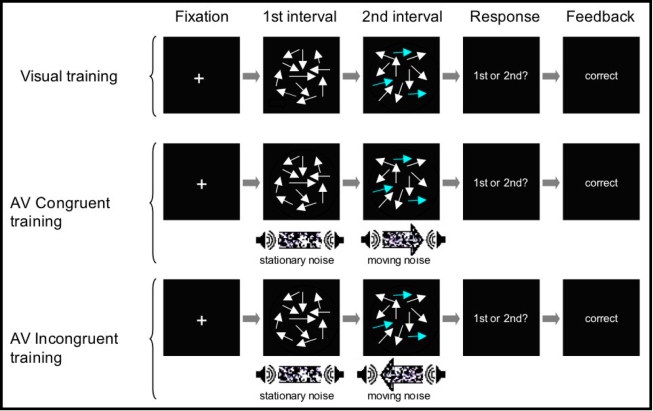
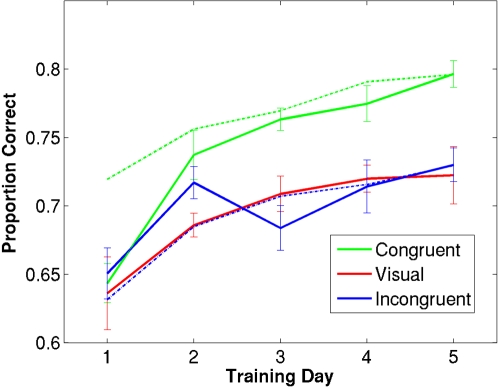
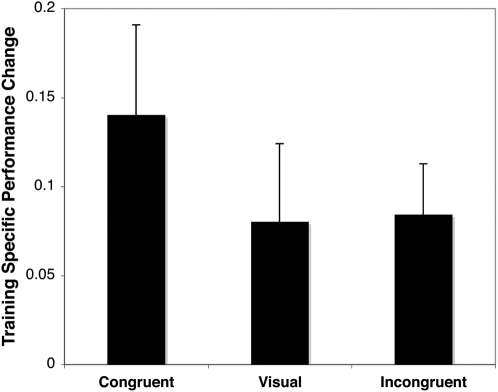
BACKGROUND: Studies of perceptual learning have largely focused on unisensory stimuli. However, multisensory interactions are ubiquitous in perception, even at early processing stages, and thus can potentially play a role in learning. Here, we examine the effect of auditory-visual congruency on visual learning. METHODOLOGY/PRINCIPLE FINDINGS: Subjects were trained over five days on a visual motion coherence detection task with either congruent audiovisual, or incongruent audiovisual stimuli. Comparing performance on visual-only trials, we find that training with congruent audiovisual stimuli produces significantly better learning than training with incongruent audiovisual stimuli or with only visual stimuli. CONCLUSIONS/SIGNIFICANCE: This advantage from stimulus congruency during training suggests that the benefits of multisensory training may result from audiovisual interactions at a perceptual rather than cognitive level.
Overview
The claims and statistics of this paper haven’t been checked yet.
Free: it reads the open-access text and checks the first 5 claims that cite a source we can check. Create a free account to check every claim.
Integrity signals
Registry
Cites
Statistics
Figures
Verification
Claims the paper makes
The claims and statistics of this paper haven’t been checked yet.
Free: it reads the open-access text and checks the first 5 claims that cite a source we can check. Create a free account to check every claim.
Claims other papers make about this one
Each is checked against this paper’s own text: does it say what the citing paper says it does?
The cited source says what the claim attributes to it.
In the citing paper
“In fact, after training with audiovisual feedback, learning of motion perception tasks was still enhanced even though auditory feedback was withdrawn (Kim, Seitz, & Shams, 2008;Seitz, Kim, & Shams, 2006).”
From Augmented visual, auditory, haptic, and multimodal feedback in motor learning: A review (2013) · cites this paper as Kim, Seitz, & Shams, 2008
The cited source says what the claim attributes to it.
In the citing paper
“Researchers have assumed that, after training with multimodal stimuli, multimodal processing is activated even if only unimodal stimuli are present (Kim et al., 2008;Seitzetal.,2006;Shams & Seitz, 2008).”
From Augmented visual, auditory, haptic, and multimodal feedback in motor learning: A review (2013) · cites this paper as Kim et al., 2008
Self-check
Percentages, sums and reported differences re-computed from the paper’s own numbers.
The self-check needs the paper’s full text.
Citations
Cites
Using confidence intervals in within-subject designs
Loftus, G. R., & Masson, M. E. J. (1994) · Psychonomic Bulletin & Review · doi:10.3758/bf03210951 · Cited by 2,448 · cited 1×
“Error bars reflect within-group standard error [19].”
The analysis of visual motion: a comparison of neuronal and psychophysical performance
Britten, K., Shadlen, M., Newsome, W., & Movshon, J. (1992) · The Journal of Neuroscience · doi:10.1523/jneurosci.12-12-04745.1992 · Cited by 1,958 · cited 1×
“A Movshon/Newsome-type motion algorithm [17] was employed with white dots (0.”
MethodIs neocortex essentially multisensory?
GHAZANFAR, A., & SCHROEDER, C. (2006) · Trends in Cognitive Sciences · doi:10.1016/j.tics.2006.04.008 · Cited by 1,463 · cited 1×
“However, crossmodal interactions are ubiquitous in human perception, and can occur even at early stages of processing in areas previously viewed as ‘‘sensory-specific’’ [5–11].”
BackgroundRecanzone, G., Schreiner, C., & Merzenich, M. (1993) · The Journal of Neuroscience · doi:10.1523/jneurosci.13-01-00087.1993 · Cited by 1,266 · cited 1×
“This type of learning is particularly interesting because it seems to demonstrate a surprising degree of cortical plasticity even in adult primary visual [1–2], auditory [3] and somotosensory areas [4].”
BackgroundActivation of Auditory Cortex During Silent Lipreading
Calvert, G. A., Bullmore, E. T., Brammer, M. J., Campbell, R., Williams, S. C. R., McGuire, P. K., Woodruff, P. W. R., Iversen, S. D., & David, A. S. (1997) · Science · doi:10.1126/science.276.5312.593 · Cited by 1,025
Anatomical evidence of multimodal integration in primate striate cortex
Falchier, A., Clavagnier, S., Barone, P., & Kennedy, H. (2002) · The Journal of Neuroscience · doi:10.1523/jneurosci.22-13-05749.2002 · Cited by 892 · cited 1×
“While these results cannot speak to the exact mechanism by which multisensory training mediates visual learning, anatomical studies have found evidence for input to lower level visual areas both directly from primary and parabelt auditory cortex [25,26], and also from the superior temporal polysensory area [25].”
ResultPractising orientation identification improves orientation coding in V1 neurons
Schoups, A., Vogels, R., Qian, N., & Orban, G. (2001) · Nature · doi:10.1038/35087601 · Cited by 856 · cited 1×
“This type of learning is particularly interesting because it seems to demonstrate a surprising degree of cortical plasticity even in adult primary visual [1–2], auditory [3] and somotosensory areas [4].”
BackgroundVisuo-haptic object-related activation in the ventral visual pathway
Amedi, A., Malach, R., Hendler, T., Peled, S., & Zohary, E. (2001) · Nature Neuroscience · doi:10.1038/85201 · Cited by 630 · cited 1×
“. To date, most studies of perceptual learning have focused on the learning of sensory features with a single modality. However, crossmodal interactions are ubiquitous in human perception, and can occur even at early stages of processing in areas previously viewed as “sensory-specific””
BackgroundSensory modalities are not separate modalities: plasticity and interactions
Shimojo, S. (2001) · Current Opinion in Neurobiology · doi:10.1016/s0959-4388(00)00241-5 · Cited by 598 · cited 1×
“Furthermore, crossmodal interactions are known to play an important role in the development of perceptual systems [12–14].”
BackgroundMultisensory convergence in calcarine visual areas in macaque monkey
Rockland, K. S., & Ojima, H. (2003) · International Journal of Psychophysiology · doi:10.1016/s0167-8760(03)00121-1 · Cited by 564 · cited 1×
“While these results cannot speak to the exact mechanism by which multisensory training mediates visual learning, anatomical studies have found evidence for input to lower level visual areas both directly from primary and parabelt auditory cortex [25,26], and also from the superior temporal polysensory area [25].”
Result
Cited by
Augmented visual, auditory, haptic, and multimodal feedback in motor learning: A review
Sigrist, R., Rauter, G., Riener, R., & Wolf, P. (2013) · Psychonomic Bulletin & Review · doi:10.3758/s13423-012-0333-8 · Cited by 1,416
“Evidence for this conclusion is given by experiments showing that congruent audiovisual feedback was effective for learning the task, whereas incongruent audiovisual feedback was not (Kim et al., 2008).”
BackgroundResultBenefits of multisensory learning
Shams, L., & Seitz, A. R. (2008) · Trends in Cognitive Sciences · doi:10.1016/j.tics.2008.07.006 · Cited by 1,178
Self-citationCrossmodal influences on visual perception
Shams, L., & Kim, R. (2010) · Physics of Life Reviews · doi:10.1016/j.plrev.2010.04.006 · Cited by 227
“Crossmodal sensory signals appear to be used to recalibrate vision [1,6,35,36,112], adjust the relative weight of visual cues [5,22], and to enhance perceptual learning in low-level visual tasks [42,78,85].”
BackgroundInfluentialSelf-citationvan Kesteren, M. T. R., Rijpkema, M., Ruiter, D. J., & Fernández, G. (2010) · The Journal of Neuroscience · doi:10.1523/jneurosci.2674-10.2010 · Cited by 229
“DOI:10.1523/JNEUROSCI.2674-10.2010 Copyright © 2010 the authors 0270-6474/10/3015888-07$15.00/0 rience (Kim et al., 2008; Yuval-Greenberg and Deouell, 2009).”
InfluentialPerspectives on sensory processing disorder: a call for translational research
Miller, L. (2009) · Frontiers in Integrative Neuroscience · doi:10.3389/neuro.07.022.2009 · Cited by 183
Sonification and haptic feedback in addition to visual feedback enhances complex motor task learning
Sigrist, R., Rauter, G., Marchal-Crespo, L., Riener, R., & Wolf, P. (2015) · Experimental Brain Research · doi:10.1007/s00221-014-4167-7 · Cited by 158
Visual influences on auditory spatial learning
King, A. J. (2009) · Philosophical Transactions of the Royal Society B: Biological Sciences · doi:10.1098/rstb.2008.0230 · Cited by 146
“Although vision is not essential for the relearning of accurate sound localization by monaurally occluded ferrets, it is certainly possible that training with congruent multisensory cues might result in faster learning than that with auditory cues alone, as recently demonstrated in humans for a motion detection task (…”
The Sensory Ecology of Ant Navigation: From Natural Environments to Neural Mechanisms
Knaden, M., & Graham, P. (2015) · Annual Review of Entomology · doi:10.1146/annurev-ento-010715-023703 · Cited by 147
“Also, in a simpler task where subjects had to learn a moving stimulus either in the presence or the absence of an auditory stimulus, bimodal training yielded better results, even in later unimodal (vision only) tests (57, 93).”
BackgroundThe effects of visual training on multisensory temporal processing
Stevenson, R. A., Wilson, M. M., Powers, A. R., & Wallace, M. T. (2013) · Experimental Brain Research · doi:10.1007/s00221-012-3387-y · Cited by 132
“1 3 While the previous studies (Kim et al. 2008; Alais and Cass 2010) have shown that audiovisual training can affect visual learning at the perceptual level, this is the first to show a reciprocal relationship in which visual training with feedback affects multisensory learning.”
BackgroundInfluences of Multisensory Experience on Subsequent Unisensory Processing
Shams, L., Wozny, D. R., Kim, R., & Seitz, A. (2011) · Frontiers in Psychology · doi:10.3389/fpsyg.2011.00264 · Cited by 111
“, 2010) is influenced by the addition of auditory information (Seitz et al., 2006a; Kim et al., 2008).”
BackgroundInfluentialSelf-citationHow to build better memory training games
Deveau, J., Jaeggi, S. M., Zordan, V. B., Phung, C., & Seitz, A. R. (2015) · Frontiers in Systems Neuroscience · doi:10.3389/fnsys.2014.00243 · Cited by 110
“For example, recent research shows that subjects trained with auditory-visual stimuli exhibit a faster rate of learning and a higher degree of improvement than found in subjects trained in silence (Seitz et al., 2006; Kim et al., 2008).”
BackgroundSelf-citationObservation of sonified movements engages a basal ganglia frontocortical network
Schmitz, G. H., Mohammadi, B., Hammer, A., Heldmann, M., Samii, A., Münte, T. F., & Effenberg, A. O. (2013) · BMC Neuroscience · doi:10.1186/1471-2202-14-32 · Cited by 102
A review: Motor rehabilitation after stroke with control based on human intent
Li, M., Xu, G., Xie, J., & Chen, C. (2018) · Proceedings of the Institution of Mechanical Engineers Part H Journal of Engineering in Medicine · doi:10.1177/0954411918755828 · Cited by 88
Shokur, S., Gallo, S., Moioli, R. C., Donati, A. R. C., Morya, E., Bleuler, H., & Nicolelis, M. A. L. (2016) · Scientific Reports · doi:10.1038/srep32293 · Cited by 74
“Moreover, the benefits of a multi-sensory training phase are maintained further than when a single modality is used 24 .”
Visual rehabilitation: visual scanning, multisensory stimulation and vision restoration trainings
Dundon, N. M., Bertini, C., Làdavas, E., Sabel, B. A., & Gall, C. (2015) · Frontiers in Behavioral Neuroscience · doi:10.3389/fnbeh.2015.00192 · Cited by 88
“When the size of the HVFD remains constant, which is the case in most VST studies, scanning more often towards the hemianopic side, e.g., to the right, results in a shift of the intact temporal visual field sector moving temporarily out of the field of view.”
BackgroundBroad-based visual benefits from training with an integrated perceptual-learning video game
Deveau, J., Lovcik, G., & Seitz, A. R. (2014) · Vision Research · doi:10.1016/j.visres.2013.12.015 · Cited by 66
Self-citationVisual Influences on Auditory Behavioral, Neural, and Perceptual Processes: A Review
Opoku-Baah, C., Schoenhaut, A. M., Vassall, S. G., Tovar, D. A., Ramachandran, R., & Wallace, M. T. (2021) · Journal of the Association for Research in Otolaryngology · doi:10.1007/s10162-021-00789-0 · Cited by 96
“…evidence that indicates that training paradigms that employ information from multiple senses yield better perceptual outcomes using fewer sessions than training paradigms using information from a single modality (Kim et al. 2008; Opoku-Baah et al. 2020; Seitz et al. 2006; Shams and Seitz 2008).”
BackgroundEffect of Audiovisual Training on Monaural Spatial Hearing in Horizontal Plane
Strelnikov, K., Rosito, M., & Barone, P. (2011) · PLoS ONE · doi:10.1371/journal.pone.0018344 · Cited by 76
“By presenting a temporally and spatially (in azimuth) congruent visual cue, subjects present a significant larger improvement in monaural localization, a result in line with the rule that multisensory perceptual learning depends on the congruency of the two sensory stimuli [41,44].”
BackgroundResultHutchinson, R. S., & Eardley, A. F. (2021) · Museum Management and Curatorship · doi:10.1080/09647775.2021.1891563 · Cited by 92
Mohammed, S., Flores, L., Deveau, J., Cohen Hoffing, R., Phung, C., M. Parlett, C., Sheehan, E., Lee, D., Au, J., Buschkuehl, M., et al. (2017) · Journal of Cognitive Enhancement · doi:10.1007/s41465-017-0047-y · Cited by 63
“Research also suggests that coordinated multisensory processing can increase engagement and lead to extended training benefits provided the stimuli facilitate each other (Kim et al. 2008).”
BackgroundSelf-citationElectrical neuroimaging of memory discrimination based on single-trial multisensory learning
Thelen, A., Cappe, C., & Murray, M. M. (2012) · NeuroImage · doi:10.1016/j.neuroimage.2012.05.027 · Cited by 74
“In addition to their immediate effects on perception, multisensory experiences at one point in time can impact unisensory processing during later encounters (Gottfried et al., 2004; Kim et al., 2008; Lehmann and Murray, 2005; Meylan and Murray, 2007; Murray et al., 2004, 2005; Shams and Seitz, 2008).”
BackgroundMezzarobba, S., Grassi, M., Pellegrini, L., Catalan, M., Krüger, B., Furlanis, G., Manganotti, P., & Bernardis, P. (2018) · Frontiers in Neurology · doi:10.3389/fneur.2017.00723 · Cited by 69
“But, to exert the most efficient facilitatory effect, pairs of stimuli composing the multisensory stimulus should be congruent, and not simply concomitant in space and/or time (18, 19).”
BackgroundThe role of cross-modal associations in statistical learning
Glicksohn, A., & Cohen, A. (2013) · Psychonomic Bulletin & Review · doi:10.3758/s13423-013-0458-4 · Cited by 58
“For adults, training with cross-modal information benefits learning of modality-specific information, as is evident in perceptual-learning tasks (Ernst, 2007; Kim et al., 2008; Shams, Wozny, Kim, & Seitz, 2011).”
BackgroundKafadar, E., Fisher, V., Quagan, B., Hammer, A., Jaeger, H., Mourgues, C., Thomas, R., Chen, L., Imtiaz, A., Sibarium, E., et al. (2021) · PsyArXiv (OSF Preprints) · doi:10.1016/j.biopsych.2022.05.007 · Cited by 63
Alais, D., & Cass, J. (2010) · PLoS ONE · doi:10.1371/journal.pone.0011283 · Cited by 56
“More recently, a number of studies have examined perceptual learning in multisensory contexts [25,26].”
BackgroundTool-use-associated sound in the evolution of language
Larsson, M. L. (2015) · Animal Cognition · doi:10.1007/s10071-015-0885-x · Cited by 51
“Kim et al. (2008) demonstrated superior learning in a visual task in subjects trained with congruent audiovisual stimuli compared to subjects trained with solely visual stimuli.”
Background0 + 1 > 1: How Adding Noninformative Sound Improves Performance on a Visual Task
Kim, R. S., Peters, M. A. K., & Shams, L. B. (2011) · Psychological Science · doi:10.1177/0956797611420662 · Cited by 56
Self-citationYu, L., Rowland, B. A., Xu, J., & Stein, B. E. (2012) · Journal of Neurophysiology · doi:10.1152/jn.00739.2012 · Cited by 51
“In this respect, the physiological response changes are not unlike those human perceptual changes associated with shifts in the “spotlight of attention” (Posner 1994) or during perceptual learning, when particular representations temporarily achieve prominence (Bolognini et al. 2005; Gilbert et al. 2001; Kim et al. 20…”
BackgroundMultisensory training reverses midbrain lesion-induced changes and ameliorates haemianopia
Jiang, H., Stein, B. E., & McHaffie, J. G. (2015) · Nature Communications · doi:10.1038/ncomms8263 · Cited by 51
Xie, Y., Xu, Y., Bian, C., & Li, M. (2017) · Scientific Reports · doi:10.1038/s41598-017-05471-1 · Cited by 53
Alwashmi, K., Meyer, G. F., Rowe, F. J., & Ward, R. J. (2023) · NeuroImage · doi:10.1016/j.neuroimage.2023.120483 · Cited by 50
“Consistent with prior work on VR training and AV learning (Seitz et al., 2006; Kim et al., 2008; Beer and Watanabe, 2009; Cooper et al., 2021; Valzolgher et al., 2020; Van den Brink et al., 2014), all participants exhibited significant improvements in behavioural performance over the course of the…”
BackgroundResultCreativity enhancement methods for adults: A meta-analysis.
Haase, J., Hanel, P. H. P., & Gronau, N. (2025) · Psychology of Aesthetics Creativity and the Arts · doi:10.1037/aca0000557 · Cited by 62
A Critical Analysis of Anesthesiology Podcasts: Identifying Determinants of Success
Singh, D., Alam, F., & Matava, C. T. (2016) · JMIR Medical Education · doi:10.2196/mededu.5950 · Cited by 32
“The development and success of a podcast series may be influenced by the availability of content that meets the target user’s needs and inclusion of various evidence-based models for knowledge transfer and retention [21-27].”
BackgroundCategorical congruence facilitates multisensory associative learning
Barenholtz, E., Lewkowicz, D. J., Davidson, M., & Mavica, L. (2014) · Psychonomic Bulletin & Review · doi:10.3758/s13423-014-0612-7 · Cited by 29
The therapeutic benefits of perceptual learning.
Deveau, J., Lovcik, G., & Seitz, A. R. (2013) · PubMed · Cited by 29
Self-citationA Multisensory Perspective on Human Auditory Communication
von Kriegstein, K. (2011) · Frontiers in neuroscience · doi:10.1201/b11092-43 · Cited by 32
Effects of grasp compatibility on long-term memory for objects
Canits, I., Pecher, D., & Zeelenberg, R. (2017) · Acta Psychologica · doi:10.1016/j.actpsy.2017.11.009 · Cited by 24
Li, J., & Deng, S. W. (2022) · Psychological Research · doi:10.1007/s00426-022-01733-4 · Cited by 41
“Consistent with previous research (Kim et al., 2008; Shams & Seitz, 2008), our meta-analysis indicates that the 1 3 facilitation effect is limited by the congruency of multisensory information, and interference occurs as cross-modal incongruency arises.”
MethodResultCrossmodal interactions in human learning and memory
Murray, C. A., & Shams, L. B. (2023) · Frontiers in Human Neuroscience · doi:10.3389/fnhum.2023.1181760 · Cited by 37
“Furthermore, a later study (Kim et al., 2008) showed that the congruence between the auditory and the visual motion during training was necessary for this multisensory training benefit.”
BackgroundSelf-citationBatson, M. A., Watanabe, T., Seitz, A. R., & Beer, A. (2011) · Seeing and Perceiving · doi:10.1163/187847611x603738 · Cited by 25
“Recent research has shown that cross-modal interactions between auditory and visual perception can be modified through cross-modal perceptual learning (Alais and Cass, 2010; Beer et al., 2011a; Kim et al., 2008).”
BackgroundSelf-citationSpatiotemporal Processing in Crossmodal Interactions for Perception of the External World: A Review
Hidaka, S., Teramoto, W., & Sugita, Y. (2015) · Frontiers in Integrative Neuroscience · doi:10.3389/fnint.2015.00062 · Cited by 26
Rabini, G., Altobelli, E., & Pavani, F. (2019) · Scientific Reports · doi:10.1038/s41598-019-44267-3 · Cited by 25
Behavioural and functional changes in neglect after multisensory stimulation
Làdavas, E., Tosatto, L., & Bertini, C. (2020) · Neuropsychological Rehabilitation · doi:10.1080/09602011.2020.1786411 · Cited by 24
“Interestingly, repeated exposure to coincident audio-visual stimulus pairs effectively facilitates visual learning (Grasso, Benassi, et al., 2016; Kim et al., 2008).”
BackgroundVisual and Auditory Information During Decision Making in Sport
Klatt, S., & Smeeton, N. J. (2019) · Journal of Sport and Exercise Psychology · doi:10.1123/jsep.2019-0107 · Cited by 32
Sound-contingent visual motion aftereffect
Hidaka, S., Teramoto, W., Kobayashi, M., & Sugita, Y. (2011) · BMC Neuroscience · doi:10.1186/1471-2202-12-44 · Cited by 19
“Moreover, a few minutes’ observation of the stimuli without any task could induce a motion aftereffect in our study, while the association learning usually needs explicit training wherein the participants are engaged in required tasks [21-23].”
BackgroundThe emergence of the multisensory brain: From the womb to the first steps
Nava, E., Giraud, M., & Bolognini, N. (2023) · iScience · doi:10.1016/j.isci.2023.108758 · Cited by 23
“25,26 For example, individuals trained with audiovisual stimuli show improvement of both visual and auditory processing alone.”
BackgroundShaping the visual system: cortical and subcortical plasticity in the intact and the lesioned brain
Grasso, P. A., Gallina, J., & Bertini, C. (2020) · Neuropsychologia · doi:10.1016/j.neuropsychologia.2020.107464 · Cited by 25
Heikkilä, J., Lonka, E., Meronen, A., Tuovinen, S., Eronen, R., Leppänen, P. H. T., Richardson, U., Ahonen, T. P. S., & Tiippana, K. M. (2018) · Child Language Teaching and Therapy · doi:10.1177/0265659018793697 · Cited by 29
“They have shown that motion perception improves more by audiovisual than visual training when motion direction is congruent in both modalities (Kim et al., 2008).”
BackgroundBiological Basis and Computer Vision Applications of Image Phase Congruency: A Comprehensive Survey
Tian, Y., Wen, M., Lu, D., Zhong, X., & Wu, Z. (2024) · Biomimetics · doi:10.3390/biomimetics9070422 · Cited by 26
“…of cortical connectivity have found evidence for direct connections between different sensory primary cortices, especially hearing and vision, which suggests that the basis for cross-modal interactions to affect perceptual processing is present at very early stages of sensory processing [37,38].”
BackgroundElectrical neuroimaging of memory discrimination based on single-trial multisensory learning
Thelen, A., Cappe, C., & Murray, M. M. (2012) · Seeing and Perceiving · doi:10.1163/187847612x648107 · Cited by 18
Rheenen, T. E. V., & Rossell, S. L. (2014) · Journal of the International Neuropsychological Society · doi:10.1017/s1355617714000253 · Cited by 19
“This occurred even though participants were instructed to attend only to information presented to the visual channel, which is consistent with previous literature suggesting that multimodal integration occurs pre-attentively (de Gelder & Jean, 2000; de Gelder, et al., 2005; Kim et al., 2008).”
ResultMultisensory Facilitation of Working Memory Training
Pahor, A., Collins, C., Smith-Peirce, R. N., Moon, A., Stavropoulos, T., Silva, I., Peng, E., Jaeggi, S. M., & Seitz, A. R. (2021) · Journal of Cognitive Enhancement · doi:10.1007/s41465-020-00196-y · Cited by 17
Self-citationA triple dissociation between learning of target, distractors, and spatial contexts
Dantec, C. C. L., Melton, E., & Seitz, A. R. (2012) · Journal of Vision · doi:10.1167/12.2.5 · Cited by 18
Self-citationLong-term memory representations for audio-visual scenes
Meyerhoff, H. S., Jaggy, O., Papenmeier, F., & Huff, M. (2022) · Memory & Cognition · doi:10.3758/s13421-022-01355-6 · Cited by 21
“, performance improvements with practice in basic perceptual tasks) is more pronounced following multimodal presentations than unimodal presentations alone (Kim et al., 2008; Seitz et al., 2006).”
BackgroundHutchinson, R. S., & Eardley, A. F. (2023) · Museum Management and Curatorship · doi:10.1080/09647775.2023.2188482 · Cited by 28
“…demonstrating that the use of multisensory stimuli enhances memory (Gottfried et al. 2004; Lehmann and Murray 2005; Nyberg et al. 2000) and that the greater the level of congruency of multisensory stimuli, the greater the bene fi ts (Kim, Seitz, and Shams 2008; von Kriegstein and Giraud 2006).”
Moonen, N., Heller, J., Hilken, T., Han, D. D., & Mahr, D. (2024) · Journal of Wine Research · doi:10.1080/09571264.2024.2310297 · Cited by 20
“North (2012) established that background music can impact the taste of wine, and Kim et al. (2008) established that congruent sounds can improve learning in multisensory environments.”
BackgroundVerbal and novel multisensory associative learning in adults
Fifer, J. M., Barutchu, A., Shivdasani, M. N., & Crewther, S. G. (2013) · F1000Research · doi:10.12688/f1000research.2-34.v1 · Cited by 24
Imashev, A., Kydyrbekova, A., Oralbayeva, N., Kenzhekhan, A., & Sandygulova, A. (2024) · Education and Information Technologies · doi:10.1007/s10639-024-12525-1 · Cited by 22
Grasso, P. A., Benassi, M., Làdavas, E., & Bertini, C. (2016) · European Journal of Neuroscience · doi:10.1111/ejn.13221 · Cited by 16
Influence of Audiovisual Training on Horizontal Sound Localization and Its Related ERP Response
Cai, Y., Chen, G., Zhong, X., Yu, G., Mo, H., Jiang, J., Chen, X., Zhao, F., & Zheng, Y. (2018) · Frontiers in Human Neuroscience · doi:10.3389/fnhum.2018.00423 · Cited by 15
Benefits of Crank Moment Sonification in Cycling
Sigrist, R., Fox, S., Riener, R., & Wolf, P. (2016) · Procedia Engineering · doi:10.1016/j.proeng.2016.06.230 · Cited by 18
Spatial and Temporal Features of Multisensory Processes: Bridging Animal and Human Studies
Sarko, D. K., Nidiffer, A. R., Powers, A. R., Ghose, D., Hillock‐Dunn, A., Fister, M. C., Krueger, J., & Wallace, M. T. (2012) · Europe PMC (PubMed Central) · Cited by 17
Neuronal Plasticity and Multisensory Integration in Filial Imprinting
Town, S. M., & McCabe, B. J. (2011) · PLoS ONE · doi:10.1371/journal.pone.0017777 · Cited by 14
“Furthermore, integrating multisensory information enhances the reliability of sensory estimates [2,3] and increases the speed of perceptual learning [4,5].”
BackgroundModality-specific and multisensory mechanisms of spatial attention and expectation
Zuanazzi, A., & Noppeney, U. (2020) · Journal of Vision · doi:10.1167/jov.20.8.1 · Cited by 12
Effects of Audiovisual Memory Cues on Working Memory Recall
Pearson, H., & Wilbiks, J. M. P. (2021) · Vision · doi:10.3390/vision5010014 · Cited by 18
“Similar results have been demonstrated by considering congruency between pictures and written words [1], effects of auditory and visual stimuli on drawings [17], and detecting the direction of motion [18].”
ResultThe Neuroscience of Learning: A New Paradigm for Corporate Education
Hollenbach, C., Marshall, D., Oughton, K., Pickthorn, T., Schilling, M. F., & Versiglia, G. (2011) · Cited by 15
Multisensory processing in event-based prospective memory
Barutchu, A., Sahu, A., Humphreys, G. W., & Spence, C. J. (2018) · Acta Psychologica · doi:10.1016/j.actpsy.2018.10.015 · Cited by 15
Multisensory Experiences in Virtual Reality and Augmented Reality Interaction Paradigms
García-Pereira, I., Vera, L., Pérez, M., Portalés, C., & Casas, S. (2020) · Advances in computational intelligence and robotics book series · doi:10.4018/978-1-7998-2112-0.ch014 · Cited by 10
Bolam, J., Boyle, S. C., Ince, R. A. A., & Delis, I. (2021) · NeuroImage · doi:10.1016/j.neuroimage.2021.118841 · Cited by 16
Cronin, S. L., Lipp, O. V., & Marinovic, W. (2023) · Biological Psychology · doi:10.1016/j.biopsycho.2023.108547 · Cited by 14
Bimodal emotion congruency is critical to preverbal infants’ abstract rule learning
Tsui, A. S. M., Ki, Y., Ho, A., Chow, H. M., & Tseng, C. (2015) · Developmental Science · doi:10.1111/desc.12319 · Cited by 11
Stimulus-locked auditory information facilitates real-time visuo-motor sequence learning
Han, Z., Sanchez, D. J., Levitan, C., & Sherman, A. (2023) · Psychonomic Bulletin & Review · doi:10.3758/s13423-023-02378-z · Cited by 8
“Auditory information also enhances task performance in perceptual learning paradigms, particularly if the additional information is task-relevant (e.g., Kim et al., 2008; Seitz et al., 2006).”
Qamar, M. T., Yasmeen, J., Malik, A., & Srikrishna Swaroop, V. T. (2025) · Business and Professional Communication Quarterly · doi:10.1177/23294906251319016 · Cited by 10
What Can Multisensory Processing Tell Us about the Functional Organization of Auditory Cortex?
Bizley, J. K., & King, R. (2011) · Frontiers in neuroscience · doi:10.1201/b11092-5 · Cited by 11
Multisensory Congruency Enhances Explicit Awareness in a Sequence Learning Task
Silva, A. E., Barakat, B. K., Jiménez, L., & Shams, L. B. (2017) · Multisensory Research · doi:10.1163/22134808-00002587 · Cited by 9
Self-citationFeierabend, M., Karnath, H., & Lewald, J. (2019) · Perception · doi:10.1177/0301006619872062 · Cited by 13
Spatial and Temporal Features of Multisensory Processes: Bridging Animal and Human Studies
Sarko, D. K., Nidiffer, A. R., Albert, I. I. I., Ghose, D., Hillock‐Dunn, A., Fister, M. C., Krueger, J., & Wallace, M. T. (2011) · Frontiers in neuroscience · doi:10.1201/9781439812174-15 · Cited by 10
Love, S., Pollick, F. E., & Petrini, K. (2012) · Lecture notes in computer science · doi:10.1007/978-3-642-34584-5_27 · Cited by 13
Varuzza, C., D’Aiello, B., Lazzaro, G., Quarin, F., Rose, P. D., Bergonzini, P., Menghini, D., Marini, A., & Vicari, S. (2022) · Brain Sciences · doi:10.3390/brainsci13010059 · Cited by 17
Audiovisual Delay as a Novel Cue to Visual Distance
Jaekl, P. M., Seidlitz, J., Harris, L. R., & Tadin, D. (2015) · PLoS ONE · doi:10.1371/journal.pone.0141125 · Cited by 9
Visual Learning in Multisensory Environments
Jacobs, R. A., & Shams, L. B. (2009) · Topics in Cognitive Science · doi:10.1111/j.1756-8765.2009.01056.x · Cited by 10
“In discussing the facilitatory effects of sound on visual learning, we presented studies employing a visual perceptual learning paradigm (Kim et al., 2008; Seitz et al., 2006) and studies employing a memory task (Lehmann & Murray, 2005; Murray et al., 2004).”
MethodSelf-citationCatching Audiovisual Interactions With a First-Person Fisherman Video Game
Sun, Y., Hickey, T. J., Shinn‐Cunningham, B. G., & Sekuler, R. (2016) · Perception · doi:10.1177/0301006616682755 · Cited by 9
Augmenting physical 3D models with projected information to support environmental knowledge exchange
Fisher, R., Heckbert, S., Villalobos, J. M. L., & Sutton, S. (2019) · Applied Geography · doi:10.1016/j.apgeog.2019.102095 · Cited by 12
Attentional focusing and filtering in multisensory categorization
Li, J., & Deng, S. W. (2023) · Psychonomic Bulletin & Review · doi:10.3758/s13423-023-02370-7 · Cited by 11
“Specifically, the multisensory facilitation has been found to be limited to cross-modal associations that are congruent (Kim et al., 2008), whereas interference effect usually stems from incongruent pairs (Diaconescu et al., 2011; Elliott et al., 2014; Laurienti et al., 2004).”
Hecht, D., Reiner, M., & Karni, A. (2008) · Brain Research · doi:10.1016/j.brainres.2008.10.062 · Cited by 10
“Laboratory-created ‘events’, in which participants were presented with a list of words, were found to be better recalled when they were initially presented bimodally (visual and auditory) than words presented unimodally (Kobus et al., 1994; Lewandowski and Kobus, 1993; Martin, 1980).”
BackgroundMultisensory contributions to object recognition and memory across the life span
Matusz, P. J., Wallace, M. T., & Murray, M. M. (2019) · Elsevier eBooks · doi:10.1016/b978-0-12-812492-5.00006-1 · Cited by 8
Designing a Multisensory Social Serious-Game for Primary School Mathematics Learning
Volta, E., Alborno, P., Gori, M., & Volpe, G. (2018) · IEEE Games, Entertainment, Media Conference (GEM) · doi:10.1109/gem.2018.8516442 · Cited by 9
Effects of malnutrition and sensory-motor stimulation on auditory evoked potentials.
Lima, J. G. D., Funayama, C. A. R., Oliveira, L. M. D., Rossato, M., & Colafêmina, J. F. (2008) · Psychology & Neuroscience · doi:10.3922/j.psns.2008.2.005 · Cited by 7
Multisensory Information Facilitates the Categorization of Untrained Stimuli
Wu, J., Li, Q., Fu, Q., Rose, M., & Jing, L. (2021) · Multisensory Research · doi:10.1163/22134808-bja10061 · Cited by 8
Academic Excellence through Multi-Sensory Approach: A Model for Classroom Teaching
Itagi, G., & D’Mello, L. (2019) · International Journal of Management Technology and Social Sciences · doi:10.47992/ijmts.2581.6012.0073 · Cited by 12
“However, Multi-Sensory-Approach strategies can even influence individual learners with their best and preferred learning style in a heterogeneous classroom [26].”
BackgroundMultisensory encoding of names via name tags facilitates remembering
Murray, C. A., Tarlow, M., Rissman, J., & Shams, L. B. (2022) · Applied Cognitive Psychology · doi:10.1002/acp.4012 · Cited by 8
Self-citationUeda, S., Mizuguchi, A., Yakushijin, R., & Ishiguchi, A. (2018) · i-Perception · doi:10.1177/2041669518815709 · Cited by 5
Using Multisensory Haptic Integration to Improve Monitoring in the Intensive Care Unit
Burdick, K. J., Bell, A. S., McCoy, M. C., Samuels, J. L., Jolly, A. S., Patel, S. S., Balas, J. B., Patten, K. J., & Schlesinger, J. J. (2019) · Auditory Perception & Cognition · doi:10.1080/25742442.2020.1773194 · Cited by 7
Visual–tactile shape perception in the visually restored with artificial vision
Stiles, N. R. B., Weiland, J. D., & Patel, V. R. (2022) · Journal of Vision · doi:10.1167/jov.22.2.14 · Cited by 5
Task-irrelevant auditory metre shapes visuomotor sequential learning
MacIntyre, A. D., Lo, H. Y. J., Cross, I. R. M., & Scott, S. K. (2022) · Psychological Research · doi:10.1007/s00426-022-01690-y · Cited by 6
Cross-Modal Learning in the Auditory System
Bruns, P., & Röder, B. (2019) · Springer handbook of auditory research · doi:10.1007/978-3-030-10461-0_11 · Cited by 6
Informative Auditory Cues Enhance Motor Sequence Learning
Leow, L., Nguyen, A. T., Corti, E. J., & Marinovic, W. (2025) · European Journal of Neuroscience · doi:10.1111/ejn.70140 · Cited by 6
“For example, multisensory information can enhance a range of learning processes, including visual learning (Seitz et al. 2006; Kim et al. 2008), language acquisition (Vigliocco et al. 2014) and mathematical skills (Baker and Jordan 2015).”
Yang, C., Lo, Y.-S., & Liu, C. (2009) · International Conference on Education Technology and Computer · doi:10.1109/icetc.2009.68 · Cited by 4
Online Information Processing of Scent-Related Words and Implications for Decision Making
Lin, M.-H., Cross, S. N. N., Jones, W., & Childers, T. L. (2017) · Annals of information systems · doi:10.1007/978-3-319-58097-5_14 · Cited by 4
Preverbal infants utilize cross-modal semantic congruency in artificial grammar acquisition
Tseng, C., Chow, H. M., Ki, Y., & Ding, J. (2018) · Scientific Reports · doi:10.1038/s41598-018-30927-3 · Cited by 5
Metadata
- Authors
- Kim, R. S., Seitz, A. R., & Shams, L.
- Affiliations
- University of California, Los Angeles (US)
- Boston University (US)
- Corresponding author
- Shams, Ladan
- Venue
- PLoS ONE
- Publisher
- Public Library of Science (PLoS)
- Published
- 2008-01-30
- Volume
- 3
- Issue
- 1
- Pages
- e1532
- ISSN
- 1932-6203 (ISSN-L)
- PMC
- PMC2211398
- OpenAlex
- W1966714841
- Cited by
- 148
- References
- 25
- Citations by year
- 2026: 2 · 2025: 6 · 2024: 8 · 2023: 13 · 2022: 9 · 2021: 14 · 2020: 7 · 2019: 9 · 2018: 11 · 2017: 10 · 2016: 8 · 2015: 8 · 2014: 6 · 2013: 7 · 2012: 7
- FWCI
- 10.45
- Type
- journal article
- Language
- en
- Open access
- gold
- doi.org
- Locations
- PLoS ONE (publishedVersion, cc-by)
- PubMed Central (publishedVersion, cc-by)
- PubMed (publishedVersion)
- DOAJ (DOAJ: Directory of Open Access Journals) (submittedVersion)
- eScholarship (California Digital Library) (submittedVersion)
- eScholarship (California Digital Library) (submittedVersion, cc-by)
- OpenBU (Boston University) (submittedVersion)
- Funders
- National Science Foundation
- Office of Naval Research
- Topics
- Social Sciences › Psychology › Experimental and Cognitive Psychology › Multisensory perception and integration
- Life Sciences › Neuroscience › Cognitive Neuroscience › Visual perception and processing mechanisms
- Life Sciences › Neuroscience › Cognitive Neuroscience › Tactile and Sensory Interactions
- Keywords
- perceptual learning, multisensory integration, audiovisual congruency, multisensory training, auditory-visual interaction
- MeSH terms
- Adult, Humans, Learning, Motion, Photic Stimulation, Task Performance and Analysis, Vision, Ocular
About these checks
Registry, retraction, Cites and statistics results are computed, not judged, with one exception: a printed reference that no index lists is read once by a model before it counts as a citation error. Claims are extracted by a model and kept only when their quote appears verbatim in the text; each cited source is then checked, with a model’s help, for whether it says what the claim relies on. Those verdicts can be wrong — read the claim’s quote and the cited source before relying on one.
Statistics and arithmetic are recomputed, not judged.
Confidence bands are shown only for fields calibrated on our annotated test set. None is calibrated yet, so no band is shown.
What counts as a claim ›How we measure confidence ›How we check this ›
Are you an author, or do you see a problem with this page? Request a review
Data sources
Bibliographic data: Semantic Scholar, OpenAlex, Crossref.
Contains information from the Semantic Scholar Academic Graph Datasets, made available under the ODC Attribution License (ODC-BY 1.0).
Semantic Scholar’s data is described in: Kinney, R., et al. (2023). The Semantic Scholar Open Data Platform. arXiv:2301.10140.
