

Individual Attachment Style Modulates Human Amygdala and Striatum Activation during Social Appraisal
Open accessThe DOI matches its Crossref record; 54 of the 57 references it cites were found in a registry or an index.
Abstract
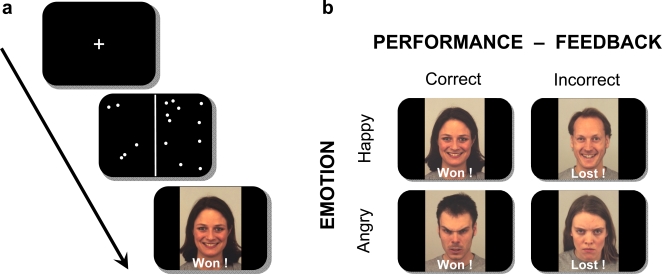
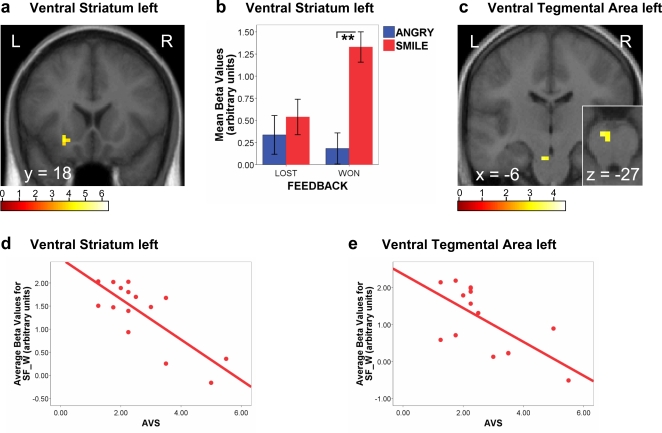
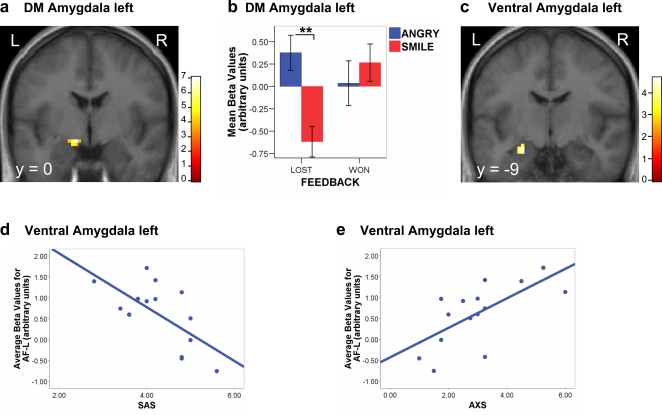
Adult attachment style refers to individual personality traits that strongly influence emotional bonds and reactions to social partners. Behavioral research has shown that adult attachment style reflects profound differences in sensitivity to social signals of support or conflict, but the neural substrates underlying such differences remain unsettled. Using functional magnetic resonance imaging (fMRI), we examined how the three classic prototypes of attachment style (secure, avoidant, anxious) modulate brain responses to facial expressions conveying either positive or negative feedback about task performance (either supportive or hostile) in a social game context. Activation of striatum and ventral tegmental area was enhanced to positive feedback signaled by a smiling face, but this was reduced in participants with avoidant attachment, indicating relative impassiveness to social reward. Conversely, a left amygdala response was evoked by angry faces associated with negative feedback, and correlated positively with anxious attachment, suggesting an increased sensitivity to social punishment. Secure attachment showed mirror effects in striatum and amygdala, but no other specific correlate. These results reveal a critical role for brain systems implicated in reward and threat processing in the biological underpinnings of adult attachment style, and provide new support to psychological models that have postulated two separate affective dimensions to explain these individual differences, centered on the ventral striatum and amygdala circuits, respectively. These findings also demonstrate that brain responses to face expressions are not driven by facial features alone but determined by the personal significance of expressions in current social context. By linking fundamental psychosocial dimensions of adult attachment with brain function, our results do not only corroborate their biological bases but also help understand their impact on behavior.
Overview
The claims and statistics of this paper haven’t been checked yet.
Free: it reads the open-access text and checks the first 5 claims that cite a source we can check. Create a free account to check every claim.
Integrity signals
Registry
Cites
Statistics
Figures
Verification
Claims the paper makes
The claims and statistics of this paper haven’t been checked yet.
Free: it reads the open-access text and checks the first 5 claims that cite a source we can check. Create a free account to check every claim.
Claims other papers make about this one
Each is checked against this paper’s own text: does it say what the citing paper says it does?
The source backs part of the claim, not all of it — or backs it for a different population, condition or comparison.
In the citing paper
“In both studies, challenges to the attachment system yielded greater ventral striatal activation in securely attached individuals, whereas in avoidant/dismissing individuals it was associated with a relative downregulation of reward-related activity.”
From A developmental, mentalization-based approach to the understanding and treatment of borderline personality disorder (2009) · cites this paper as Vrticka et al., 2008
Experimental — accuracy not yet measuredThe source backs part of the claim, not all of it — or backs it for a different population, condition or comparison.
In the citing paper
“This study reported a negative correlation between dismissing attachment scores and activation of the ventral striatum.”
From A developmental, mentalization-based approach to the understanding and treatment of borderline personality disorder (2009) · cites this paper as Vrticka et al., 2008
Experimental — accuracy not yet measuredThe source backs part of the claim, not all of it — or backs it for a different population, condition or comparison.
In the citing paper
“Individuals who use attachment deactivation strategies , typical of dismissive attached individuals, are able to keep the neural systems involved in controlled mentalization 'on-line' for longer, including neural systems involved in judging the trustworthiness of other individuals (i.e., the 'pull mechanism' associated with attachment; Vrticka et al., 2008).”
From A developmental, mentalization-based approach to the understanding and treatment of borderline personality disorder (2009) · cites this paper as Vrticka et al., 2008
Experimental — accuracy not yet measuredThe cited source says what the claim attributes to it.
In the citing paper
“Conversely, these positive responses are much weaker or even absent in individuals with an avoidant attachment style.44”
From Ventral striatum dysfunction in children and adolescents with reactive attachment disorder: functional MRI study (2015) · cites this paper as [44]
The cited source says what the claim attributes to it.
In the citing paper
“Moreover, Vrticka and colleagues also reported that secure attachment was positively related to the activation of the ventral striatum in response to positive reinforcement, but negatively with activation of the amygdala to negative reinforcement.”
From A developmental, mentalization-based approach to the understanding and treatment of borderline personality disorder (2009) · cites this paper as Vrticka et al., 2008
3 more claims about this paper
Create a free account to see every claim other papers make about this one.
Self-check
Percentages, sums and reported differences re-computed from the paper’s own numbers.
The self-check needs the paper’s full text.
Citations
Cites
Development and validation of brief measures of positive and negative affect: The PANAS scales.
Watson, D., Clark, L. A., & Tellegen, A. (1988) · Journal of Personality and Social Psychology · doi:10.1037/0022-3514.54.6.1063 · Cited by 32,433 · cited 1×
“Other personality questionnaires included STAXI [47], STAI [48], BIS-BAS [49], and PANAS [50].”
(1970) · Cited by 24,983
(1969) · Cited by 18,340
Romantic love conceptualized as an attachment process.
Hazan, C., & Shaver, P. (1987) · Journal of Personality and Social Psychology · doi:10.1037/0022-3514.52.3.511 · Cited by 11,908 · cited 4×
“Following earlier studies on children and parents, classic models have distinguished between three main prototypes of attachment style in adults: secure, anxious, and avoidant [5]; whereas subsequent work suggested the existence of four [10] or even five [11,12] distinct styles.”
InfluentialAttachment styles among young adults: A test of a four-category model.
Bartholomew, K., & Horowitz, L. M. (1991) · Journal of Personality and Social Psychology · doi:10.1037//0022-3514.61.2.226 · Cited by 8,384 · cited 8×
“However, activity in STS did not appear to subtend differences in ‘‘mental models’’ of others that are typically associated with different attachment styles [5, 10 ,25].”
InfluentialCarver, C. S., & White, T. L. (1994) · Journal of Personality and Social Psychology · doi:10.1037/0022-3514.67.2.319 · Cited by 7,306 · cited 1×
“Other personality questionnaires included STAXI [47], STAI [48], BIS-BAS [49], and PANAS [50].”
Attachment in adulthood: structure, dynamics, and change
(2008) · Choice Reviews Online · doi:10.5860/choice.45-2903 · Cited by 4,315
Does Rejection Hurt? An fMRI Study of Social Exclusion
Eisenberger, N. I., Lieberman, M. D., & Williams, K. D. (2003) · Science · doi:10.1126/science.1089134 · Cited by 3,849 · cited 4×
“SF-W), consistent with previous reports that ACC might be involved in conditions of social rejection and conflict [31–33].”
InfluentialAttachment theory and close relationships
(1998) · Choice Reviews Online · doi:10.5860/choice.35-6513 · Cited by 3,626
The amygdala: vigilance and emotion
Davis, M., & Whalen, P. J. (2001) · Molecular Psychiatry · doi:10.1038/sj.mp.4000812 · Cited by 2,882 · cited 1×
“These data reveal that processing of socially aversive situations is specifically enhanced in brain systems associated with emotional arousal and fear [41] for people with higher anxious attachment.”
Research works printed but not linked: 1
- Bouthillier D Tremblay N Hamelin F Julien D Scherzer P 1996 French translation and validation of an adult attachment styles measure. Canadian Journal of Behavioural Science-Revue Canadienne Des Sciences Du Comportement 28 74 77
Cited by
Items 201–283 of 283
Erbe, J. K., Diamond, D., & Fertuck, E. A. (2012) · Neuropsychoanalysis · doi:10.1080/15294145.2012.10773703 · Cited by 4
“In our paradigm, this is a crucial concern because, as Vrticka et al. (2008) have argued, over and above its effects on facial-feature processing, attachment status contextualizes perception of social stimuli.”
BackgroundSelf-Efficacy, Attachment, and School Counselor Service Delivery
Ernst, K. (n.d.) · ProQuest Demo Repository · Cited by 6
Neurobiology of Positive Emotion Disruption in Neurodegenerative Disease
Sturm, V. E., & LEVENSON, R. W. (2019) · Oxford University Press eBooks · doi:10.1093/oxfordhb/9780190653200.013.29 · Cited by 3
Fowler, J. C., Oldham, J. M., Hopwood, C. J., & Thomas, K. M. (2018) · Wiley eBooks · doi:10.1002/9781394258970.ch21 · Cited by 4
van Leeuwen, W. A., van der Straten, A. L., Bögemann, S. A., Luyten, P., Denys, D. A. J. P., van Wingen, G. A., & van Marle, H. J. F. (2025) · Journal of Affective Disorders · doi:10.1016/j.jad.2025.02.055 · Cited by 2
“…to exaggerate negative emotions is reflected in hyperreactivity of areas in the salience network, such as the amygdala and hippocampus, in anxiously attached individuals (DeWall et al., 2012; Gillath et al., 2005; Long et al., 2020; Redlich et al., 2015; Riem et al., 2012; Vrticka et al., 2008).”
The impact of neuroscience and artificial intelligence on feedback: a systematic review
Adıgüzel, O. C., Potvin, P., & Esen, E. (2026) · Educational Technology Research and Development · doi:10.1007/s11423-026-10589-z · Cited by 3
Lin, H.-C. K., Tsai, M.-C., & Wu, K.-H. (2020) · Electronics · doi:10.3390/electronics9122057 · Cited by 3
“[44] used the pseudo-social interactive system incorporating smiling and angry facial expressions to investigate how attachment styles modulate the brain’s responses to facial expressions and confirmed that social perception has a strong modulating effect; this response is not only driven by facial features but also r…”
BackgroundMethodInfluentialRichards, E. M., Silver, Z. A., & Santos, L. R. (2023) · Animals · doi:10.3390/ani13152480 · Cited by 2
Finke, J. B., Opdensteinen, K. D., Klucken, T., & Schächinger, H. (2023) · International Journal of Psychophysiology · doi:10.1016/j.ijpsycho.2023.08.002 · Cited by 2
Mekelburg, A., Maliske, L., Kirby, J. N., Kanske, P., & Förster, K. (2025) · Journal of Affective Disorders · doi:10.1016/j.jad.2025.05.006 · Cited by 2
The trends and issues in neuroimaging studies of counseling and psychotherapy (1992-2014)
Suh, J.-E., Kim, C.-D., & 최경환 (2015) · Korea Journal of Counseling · doi:10.15703/kjc.16.2.201504.27 · Cited by 2
Functional Brain Changes in Response to Treatment of Internet Gaming Disorder
Han, D. H., Kim, S. M., & Renshaw, P. F. (2017) · Studies in neuroscience, psychology and behavioral economics · doi:10.1007/978-3-319-46276-9_6 · Cited by 2
Erbe, J. K. (2014) · CUNY Academic Works (City University of New York) · Cited by 6
Zietlow, A., Brenner, I., Krauch, M., Gerchen, M. F., Schmitgen, M. M., Kirsch, P., Ditzen, B., & Eckstein, M. (2026) · Research Square · doi:10.21203/rs.3.rs-8166275/v1 · Cited by 2
Insecure Attachment and Related Difficulties
Venta, A. C., & Abate, A. (2021) · Wiley eBooks · doi:10.1002/9781118686089.ch4 · Cited by 2
Animal Models of Neurobehavioral Trait Dimensions
Bartling-John, E., Leong, K.-C., Ross, C. N., Colman, R. J., & Phillips, K. A. (2025) · Springer eBooks · doi:10.1007/978-3-031-77967-1_3 · Cited by 1
Mawdsley, E., McNicol, S., Rutherford, A., Symon, L., Smith, D., Elliott, H., & Simpson, S. H. (2026) · Journal of Eating Disorders · doi:10.1186/s40337-026-01704-9 · Cited by 1
“This result is somewhat surprising given that attachment characteristics are known to be relatively resistant to change [72, 73], and a 12-week programme is brief in the context of addressing these.”
Reward system atrophy relates to heightened feelings of physical closeness in Alzheimer’s disease
Wallman-Jones, A., Noohi, F., Roy, A. R. K., Zhang, B. Y., Sible, I. J., Gerenza, A. K., Martinez-Arroyo, A. I., Rocha, S., Perry, D. C., Kramer, J. H., et al. (2025) · Social Cognitive and Affective Neuroscience · doi:10.1093/scan/nsaf113 · Cited by 1
Kamza, A. (2026) · Frontiers in Psychology · doi:10.3389/fpsyg.2026.1713752 · Cited by 1
“The conscious processing of attachment-related stimuli in this study may engage different neural pathways and brain regions linked to threat (e.g., amygdala and insula) and safety processing (e.g., ventral striatum, mPFC; Vrticka et al., 2008) compared to previously used subliminal methods.”
Gillath, O., & Vrtička, P. (2026) · Cambridge University Press eBooks · doi:10.1017/9781009381949.016 · Cited by 1
Self-citationThe Different Emotion Regulation in Insecurity Attachment
杨, 青. (2015) · Advances in Psychology · doi:10.12677/ap.2015.56051 · Cited by 1
Emotions and Cognitions in Social Relationships: A Neurosociological Approach
Shkurko, Y., & Shkurko, A. (2014) · Revista Latinoamericana de Estudios sobre Cuerpos, Emociones y Sociedad ( RELACES ) · Cited by 2
NeuralMechanisms Underlying Value-Based Decision Making
O’Doherty, J. P. (2013) · Cambridge University Press eBooks · doi:10.1017/cbo9780511843716.021 · Cited by 1
Attachment Styles and the Processing of Emotion Faces
Zhong, X., & Chen, X. (2013) · Advances in Psychological Science · doi:10.3724/sp.j.1042.2013.02154 · Cited by 3
Ginman, K. (2019) · Helda - University of Helsinki Institutional Repository · Cited by 1
Individual Differences and Biohybrid Societies
Collins, E. C., & Prescott, T. J. (2014) · Lecture notes in computer science · doi:10.1007/978-3-319-09435-9_34 · Cited by 1
“A list of specific features are required for a relationship to be considered an attachment (in the psychological sense) [5], and attachment styles themselves are well defined in the literature as individual personality traits, that strongly influence emotional bonds and reactions to social partners [6].”
BackgroundJimenez, A. M., Abplanalp, S. J., Eisenberger, N. I., Horan, W. P., Lee, J., McCleery, A., Myers, A. C., Miklowitz, D. J., Reavis, E. A., Reddy, L. F., et al. (2025) · Schizophrenia Research Cognition · doi:10.1016/j.scog.2025.100367 · Cited by 4
“To achieve these aims we utilized a team-based task during fMRI that provides both positive and negative social feedback from individuals designated as “ teammates ” or “ opponents ” (Vrti ˇ cka et al., 2008).”
Conceptualizing Quality of College Life
Cardona, L. A. (2014) · University of North Texas Digital Library (University of North Texas) · doi:10.12794/metadc699982 · Cited by 2
How Do I Love Thee? Adult Attachment and Reinforcement Sensitivity
Jiang, Y. (2016) · The Sydney eScholarship Repository (The University of Sydney) · Cited by 1
Does Attachment Predict Coping Strategies? An In-Depth Look At Millennials During COVID-19
Johnson, C. (2022) · Dominican Scholar (Dominican University of California) · doi:10.33015/dominican.edu/2022.at.05 · Cited by 2
van Hoof, M., van Lang, N. D. J., Vermeiren, R. R. J. M., & van den Bulk, B. G. (2013) · Kind & Adolescent Praktijk · doi:10.1007/s12454-013-0037-x · Cited by 1
Campellone, T. R. (2015) · eScholarship (California Digital Library)
Personality Disorders: A Short Review
Lorenzini, N., & Fonagy, P. (2013)
Emotion elicitation by odors and their influence on behavior and cognitive performance
Pichon, A. M. (2015) · Archive ouverte UNIGE (University of Geneva) · doi:10.13097/archive-ouverte/unige:75411 · Cited by 1
“At the brain level, it has been shown that background information can regulate amygdala responses by modifying stimulus appraisal accordingly (de Gelder et al., 2006; Kim et al., 2004; Vrticka et al., 2008).”
BackgroundRiem, M. M. E., Bakermans‐Kranenburg, M. J., van IJzendoorn, M. H., Out, D., & Rombouts, S. A. R. B. (2016) · Dziecko Krzywdzone. Teoria, badania, praktyka
On the Road to Social Well-Being
Andrews, G., Zautra, A., & Zautra, E. K. (2017) · Springer eBooks · doi:10.1007/978-3-319-58763-9_19
Der Einfluss des Neuropeptids Oxytocin auf die Bindungsbereitschaft
Koops, E. (2014) · mediaTUM (Technical University of Munich)
Migration, Flucht und Trauma – Erkenntnisse aus psychoanalytischen Frühpräventionsprojekten
Fischmann, T. (2017) · Vandenhoeck & Ruprecht eBooks · doi:10.13109/9783666402845.235 · Cited by 1
Tizón, J. L. (2017) · FMC - Formación Médica Continuada en Atención Primaria · doi:10.1016/j.fmc.2017.03.003 · Cited by 1
Apego y rasgos límites de la personalidad: el papel mediador de la regulación emocional
Casado, M. V. (2018) · Gredos (University of Salamanca) · doi:10.14201/gredos.137558
A hipnotikus interakciók fenomenológiája: útban egy új szinkronjelenség felé
Varga, K. (2019) · Magyar Pszichológiai Szemle · doi:10.1556/0016.2019.74.1.7 · Cited by 1
From red vegetables to sexuality: Resymbolizing the meaning of concrete thought in eating disorders
Pearlman, B. (2019) · Journal of Clinical Psychology · doi:10.1002/jclp.22788
Crane, J. L. (2017) · ThinkTech (Texas Tech University)
السبیل للشعور بطیب الحال الاجتماعی
النيل, ه. ا. م. أ. (2020) · مجلة الدراسات النفسیة المعاصرة جامعة بنى سویف · doi:10.21608/bshjo.2020.91081
Προσανατολισμός δεσμού και κοινωνική αντίληψη του συναισθήματος: Ο ρόλος των κοινωνικών κινήτρων
Andriopoulou, P., & Kafetsios, K. G. (2020) · Psychology the Journal of the Hellenic Psychological Society · doi:10.12681/psy_hps.23501
Attachment style and accuracy of facial expression recognition in depression
Мельников, М. Е., Bezmaternykh, D. D., Kozlova, L. I., Natarova, K. A., & Shtark, M. V. (2021) · Bulletin of Siberian Medicine · doi:10.20538/1682-0363-2021-1-90-97
Attachment and Pain Catastrophizing From a Communal Coping Perspective in Women With Chronic Pain
Reeves, E. J. (2021) · University Libraries (University of Maryland) · doi:10.13016/c27f-uwuj · Cited by 1
(2009) · Current Opinion in Psychiatry · doi:10.1097/yco.0b013e32832ae253
(2016) · Elsevier eBooks · doi:10.1016/b978-0-12-420020-3.00013-x
Attachment Styles and Maternal Sensitivity
王, 艳. (2020) · Advances in Psychology · doi:10.12677/ap.2020.102017
Neural mechanisms of social stimulus processing in dogs
Gábor, A. (2020) · Eötvös Loránd Tudományegyetem · doi:10.15476/elte.2018.103
Harris, J. C., & Coyle, J. T. (2024) · Oxford University Press eBooks · doi:10.1093/med/9780199928118.003.0010
Neuroscientific Considerations
Bertsch, K., & Herpertz, S. C. (2025) · Oxford University Press eBooks · doi:10.1093/9780191964343.003.0036
Relational and Social-Cognitive Predictors of PTSD in U.S. Combat Veterans: A Path Analysis
Smith, J. E. (2021) · University of North Texas Digital Library (University of North Texas) · doi:10.12794/metadc1808434
Attachment: a predictive processing approachPreprint
Lin, A. (2025) · PsyArXiv (OSF Preprints) · doi:10.31234/osf.io/yqtr8_v2
Attachment: a predictive processing approachPreprint
Lin, A. (2025) · PsyArXiv (OSF Preprints) · doi:10.31234/osf.io/yqtr8_v1
Attachment: a predictive processing approachPreprint
Lin, A. (2025) · PsyArXiv (OSF Preprints) · doi:10.31234/osf.io/yqtr8_v3
Attachment: a predictive processing approachPreprint
Lin, A. (2025) · PsyArXiv (OSF Preprints) · doi:10.31234/osf.io/yqtr8_v4
Attachment: a predictive coding approachPreprint
Lin, A. (2025) · PsyArXiv (OSF Preprints) · doi:10.31234/osf.io/yqtr8_v5
Attachment: a predictive coding approachPreprint
Lin, A. (2025) · PsyArXiv (OSF Preprints) · doi:10.31234/osf.io/yqtr8_v8
Agostini, A., Ventura, S., Valenta, S. T., Rizzello, F., Gionchetti, P., Benuzzi, F., & Filippini, N. (2025) · Brain and Behavior · doi:10.1002/brb3.70620 · Cited by 1
“…related to social interactions or emotional processing in participants with either a secure or insecure attachment style (Vrtička and Vuilleumier 2012; Nolte et al. 2013; Vrtička et al. 2012; Gobbini and Haxby 2006; M. Deng et al. 2021; Rigon et al. 2016; Vrtička et al. 2012; Vrticka et al. 2008).”
Mizrahi, D., Laufer, I., & Zuckerman, I. (2025) · Applied Sciences · doi:10.3390/app15169009
Neuroznanstveni temelji privrženosti
Klarin, M. (2022) · doi:10.15291/9789533316017.02
THE EFFECTS OF ANXIETY ON VISUAL ATTENTION FOR EMOTIVE STIMULI IN PRIMARY SCHOOL CHILDREN
Kelly, L. (2014) · University of Derby Online Research Archive. (University of Derby)
Unresolved-disorganized attachment, psychopathology, and the adolescent brain
Hoof, M. J. V. (2019) · Leiden Repository (Leiden University) · Cited by 1
Labek, K. (2017) · Digital Library of the University of Innsbruck (University of Innsbruck)
Faces of Forgiveness: The Impact of Emotional Facial Expressions on the Willingness to Forgive
Skalski‐Bednarz, S. B., Toussaint, L. L., Uram, P., & Balas, R. (2025) · Advances in Cognitive Psychology · doi:10.5709/acp-0476-6
Neural Correlates of Attachment and its Relationship with Emotion Regulation in Dogs
Carrreiro, C. D. M. (2024) · Eötvös Loránd Tudományegyetem · doi:10.15476/elte.2023.285
Social and Cultural Psychoimmunology
Lázár, I. (2022) · Károli könyvek. Monográfia · doi:10.56037/978-963-646-533-9 · Cited by 1
Gralnick, T. M. (2022) · TSpace (University of Toronto)
Veneziani, G., Giraldi, E., Mazza, M., Aceto, P., Terrizzi, E., CASALE, A. D., & Lai, C. (2026) · Developmental Psychobiology · doi:10.1002/dev.70146
Brun, G. (2012) · theses.fr (ABES) · doi:10.70675/253c6efazb429z4b34zb6c9z0fc3e75cc8b6 · Cited by 1
Szymanska, M. (2016) · theses.fr (ABES) · doi:10.70675/5ebf3333z256cz402dz8340z24153a59aef8
Expressions faciales émotionnelles et Prise de décisions coopératives
Orvoen, H. (2017) · theses.fr (ABES) · doi:10.70675/3a8ea178z6f53z4e24z97bfz965c6bbad4c2 · Cited by 1
Henschel, S. (2020) · theses.fr (ABES) · doi:10.70675/a006682az0f53z439cza789z52c40dbe5d54 · Cited by 2
The modulating role of attachment system on cognitive and emotional functioning
PENSO, S. J. A. (n.d.) · Institutional Research Information System University of Turin (University of Turin)
Lozano, M. R. (2026) · Rovira & Virgili repository
Cueno, M. E., Teng, H.-T., & Imai, K. (2026) · In Silico Research in Biomedicine · doi:10.1016/j.insi.2026.100664
李, 鑫. (2026) · Advances in Psychology · doi:10.12677/ap.2026.1610483
Votinov, M. (2026) · Elsevier eBooks · doi:10.1016/b978-0-443-34080-2.00004-4
Sardroodian, M., Rahmani, H., Aboozari, N., & Behm, D. G. (2026) · Journal of Sports Sciences · doi:10.1080/02640414.2026.2757297
Lie, T. W., Linderoth, L., & Bach, B. (2025) · Oxford University Press eBooks · doi:10.1093/9780191964343.003.0029
Metadata
- Authors
- Vrtička, P., Andersson, F., Grandjean, D., Sander, D., & Vuilleumier, P.
- Affiliations
- University of Geneva (CH)
- Corresponding author
- Vrtička, Pascal
- Venue
- PLoS ONE
- Publisher
- Public Library of Science (PLoS)
- Published
- 2008-08-06
- Volume
- 3
- Issue
- 8
- Pages
- e2868
- ISSN
- 1932-6203 (ISSN-L)
- PMC
- PMC2478709
- OpenAlex
- W2163551061
- Semantic Scholar
- 9567c4e0784ac2b99a086354dac4e74d1f765e13
- Cited by
- 260
- References
- 57
- Citations by year
- 2026: 10 · 2025: 19 · 2024: 8 · 2023: 6 · 2022: 13 · 2021: 10 · 2020: 14 · 2019: 11 · 2018: 15 · 2017: 16 · 2016: 17 · 2015: 29 · 2014: 19 · 2013: 22 · 2012: 27
- FWCI
- 10.70
- Type
- journal article
- Language
- en
- Open access
- gold
- doi.org
- Locations
- PLoS ONE (publishedVersion, cc-by)
- Europe PMC (PubMed Central) (publishedVersion, cc-by)
- PubMed Central (publishedVersion, cc-by)
- PubMed (publishedVersion)
- Archive ouverte UNIGE (University of Geneva) (publishedVersion, other-oa)
- HAL (submittedVersion)
- RePEc: Research Papers in Economics (submittedVersion)
- DOAJ (DOAJ: Directory of Open Access Journals) (submittedVersion, cc-by-sa)
- Max Planck Digital Library (submittedVersion)
- mediaTUM – the media and publications repository of the Technical University Munich (Technical University Munich) (submittedVersion)
- MPG.PuRe (Max Planck Society) (submittedVersion, other-oa)
- Archive ouverte UNIGE (University of Geneva) (submittedVersion, cc-by)
- Funders
- National Science Foundation (51NF40-104897)
- Schweizerischer Nationalfonds zur Förderung der Wissenschaftlichen Forschung (104897, 51NF40)
- Université de Genève (51NF40-104897)
- Topics
- Social Sciences › Psychology › Social Psychology › Attachment and Relationship Dynamics
- Life Sciences › Neuroscience › Cognitive Neuroscience › Face Recognition and Perception
- Life Sciences › Neuroscience › Endocrine and Autonomic Systems › Neuroendocrine regulation and behavior
- Keywords
- adult attachment styles, secure attachment, attachment avoidance, attachment anxiety, amygdala, ventral striatum, ventral tegmental area, social feedback, facial expressions, social reward, social danger, individual differences, social evaluation
- MeSH terms
- Amygdala, Brain Mapping, Corpus Striatum, Emotions, Facial Expression, Feedback, Humans, Functional Laterality, Magnetic Resonance Imaging, Reaction Time, Social Behavior, Social Support
About these checks
Registry, retraction, Cites and statistics results are computed, not judged, with one exception: a printed reference that no index lists is read once by a model before it counts as a citation error. Claims are extracted by a model and kept only when their quote appears verbatim in the text; each cited source is then checked, with a model’s help, for whether it says what the claim relies on. Those verdicts can be wrong — read the claim’s quote and the cited source before relying on one.
Statistics and arithmetic are recomputed, not judged.
Confidence bands are shown only for fields calibrated on our annotated test set. None is calibrated yet, so no band is shown.
What counts as a claim ›How we measure confidence ›How we check this ›
Are you an author, or do you see a problem with this page? Request a review
Data sources
Bibliographic data: Semantic Scholar, OpenAlex, Crossref.
Contains information from the Semantic Scholar Academic Graph Datasets, made available under the ODC Attribution License (ODC-BY 1.0).
Semantic Scholar’s data is described in: Kinney, R., et al. (2023). The Semantic Scholar Open Data Platform. arXiv:2301.10140.
