

The DOI matches its Crossref record; 46 of the 46 references it cites were found in a registry or an index.
Genetic Profiling Reveals Cross-Contamination and Misidentification of 6 Adenoid Cystic Carcinoma Cell Lines: ACC2, ACC3, ACCM, ACCNS, ACCS and CAC2
Open accessAbstract
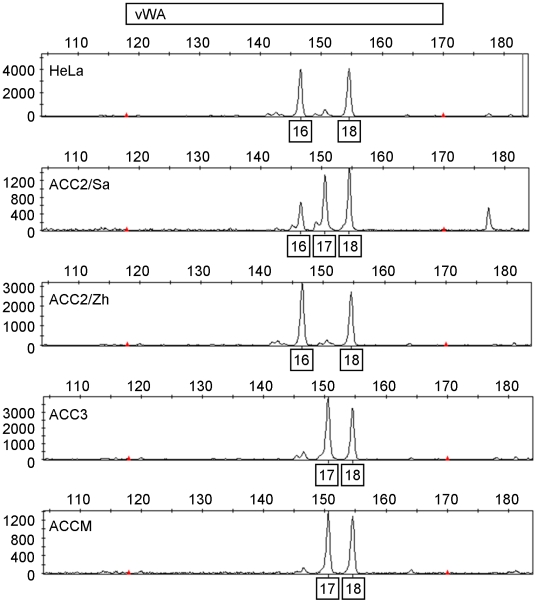
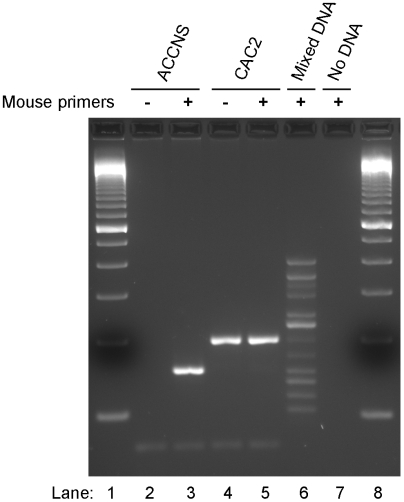
Adenoid cystic carcinoma (ACC) is the second most common malignant neoplasm of the salivary glands. Most patients survive more than 5 years after surgery and postoperative radiation therapy. The 10 year survival rate, however, drops to 40%, due to locoregional recurrences and distant metastases. Improving long-term survival in ACC requires the development of more effective systemic therapies based on a better understanding of the biologic behavior of ACC. Much preclinical research in this field involves the use of cultured cells and, to date, several ACC cell lines have been established. Authentication of these cell lines, however, has not been reported. We performed DNA fingerprint analysis on six ACC cell lines using short tandem repeat (STR) examinations and found that all six cell lines had been contaminated with other cells. ACC2, ACC3, and ACCM were determined to be cervical cancer cells (HeLa cells), whereas the ACCS cell line was composed of T24 urinary bladder cancer cells. ACCNS and CAC2 cells were contaminated with cells derived from non-human mammalian species: the cells labeled ACCNS were mouse cells and the CAC2 cells were rat cells. These observations suggest that future studies using ACC cell lines should include cell line authentication to avoid the use of contaminated or non-human cells.
Overview
The claims and statistics of this paper haven’t been checked yet.
Run the check — free, no account needed. It reads the open-access text and checks the sources it cites.
Integrity signals
Registry
Cites
Statistics
Figures
Verification
Claims the paper makes
The claims and statistics of this paper haven’t been checked yet.
Run the check — free, no account needed. It reads the open-access text and checks the sources it cites.
Claims other papers make about this one
Each is checked against this paper’s own text: does it say what the citing paper says it does?
The cited source says what the claim attributes to it.
In the citing paper
“Two adenoid cystic carcinoma, ACC-2 and ACC-M were reported as being contaminated by HeLa [22].”
From Investigation of Cross-Contamination and Misidentification of 278 Widely Used Tumor Cell Lines (2017) · cites this paper as [22]
Self-check
Percentages, sums and reported differences re-computed from the paper’s own numbers.
The self-check needs the paper’s full text.
Citations
Cites
Barcoding animal life: cytochrome c oxidase subunit 1 divergences among closely related species
Hebert, P. D. N., Ratnasingham, S., & de Waard, J. R. (2003) · Proceedings of the Royal Society of London. Series B: Biological Sciences · doi:10.1098/rsbl.2003.0025 · Cited by 4,466
(1952) · Cancer Research · Cited by 987
Schweppe, R. E., Klopper, J. P., Korch, C., Pugazhenthi, U., Benezra, M., Knauf, J. A., Fagin, J. A., Marlow, L. A., Copland, J. A., Smallridge, R. C., et al. (2008) · The Journal of Clinical Endocrinology & Metabolism · doi:10.1210/jc.2008-1102 · Cited by 563
HeLa cells 50 years on: the good, the bad and the ugly
Masters, J. R. (2002) · Nature Reviews Cancer · doi:10.1038/nrc775 · Cited by 560
Established cell line of urinary bladder carcinoma (T24) containing tumour‐specific antigen
Bubenik, J., Barešová, M., Viklický, V., Jakoubková, J., Sainerová, H., & DONNER, J. (1973) · International Journal of Cancer · doi:10.1002/ijc.2910110327 · Cited by 524
Short tandem repeat profiling provides an international reference standard for human cell lines
Masters, J. R., Thomson, J. A., Daly-Burns, B., Reid, Y. A., Dirks, W. G., Packer, P., Toji, L. H., Ohno, T., Tanabe, H., Arlett, C. F., et al. (2001) · Proceedings of the National Academy of Sciences · doi:10.1073/pnas.121616198 · Cited by 478
Validity of nucleic acid purities monitored by 260nm/280nm absorbance ratios.
Glasel, J. A. (1995) · PubMed · Cited by 437
The Costs of using Unauthenticated, Over-Passaged Cell Lines: How Much more Data do we Need?
Hughes, P., Marshall, D., Reid, Y., Parkes, H., & Gelber, C. (2007) · BioTechniques · doi:10.2144/000112598 · Cited by 434
Spontaneous transformation and immortalization of human endothelial cells
Takahashi, K., Sawasaki, Y., Hata, J., Mukai, K., & Goto, T. (1990) · In Vitro Cellular & Developmental Biology - Plant · doi:10.1007/bf02624456 · Cited by 419
Rae, J. M., Creighton, C. J., Meck, J. M., Haddad, B. R., & Johnson, M. D. (2007) · Breast Cancer Research and Treatment · doi:10.1007/s10549-006-9392-8 · Cited by 374
Cross-contamination of cells in culture
Nelson-Rees, W. A., Daniels, D. W., & Flandermeyer, R. R. (1981) · Science · doi:10.1126/science.6451928 · Cited by 329
Seifert, G., Brochériou, C., Cardesa, A., & Eveson, J. W. (1990) · Pathology - Research and Practice · doi:10.1016/s0344-0338(11)80220-7 · Cited by 302
Systemic Therapy in the Palliative Management of Advanced Salivary Gland Cancers
Laurie, S. A., & Licitra, L. F. (2006) · Journal of Clinical Oncology · doi:10.1200/jco.2005.05.3025 · Cited by 300
Adenoid cystic carcinoma of the head and neck: a review
Bradley, P. J. (2004) · Current Opinion in Otolaryngology & Head & Neck Surgery · doi:10.1097/00020840-200404000-00013 · Cited by 293
Hotte, S. J., Winquist, E., Lamont, E. B., MacKenzie, M. J., Vokes, E. E., Chen, E. X., Brown, S., Pond, G. R., Murgo, A. J., & Siu, L. L. (2005) · Journal of Clinical Oncology · doi:10.1200/jco.2005.06.125 · Cited by 277
Apparent HeLa Cell Contamination of Human Heteroploid Cell Lines
GARTLER, S. M. (1968) · Nature · doi:10.1038/217750a0 · Cited by 226
False leukemia–lymphoma cell lines: an update on over 500 cell lines
Drexler, H. G., Dirks, W. G., Matsuo, Y., & MacLeod, R. A. F. (2003) · Leukemia · doi:10.1038/sj.leu.2402799 · Cited by 202
Brown, J. A., Reading, S. J., Jones, S., Fitchett, C., Howl, J., Martin, A. Y., Longland, C. L., Michelangeli, F., Dubrova, Y. E., & Brown, C. A. (2000) · Laboratory Investigation · doi:10.1038/labinvest.3780006 · Cited by 182
Species identification in cell culture: a two-pronged molecular approach
Cooper, J. K., Sykes, G., King, S., Cottrill, K., Ivanova, N. V., Hanner, R., & Ikonomi, P. (2007) · In Vitro Cellular & Developmental Biology - Animal · doi:10.1007/s11626-007-9060-2 · Cited by 174 · cited 5×
“PCR reactions were performed using multiplex 12 speciesspecific primer sets that target the 59 variable region of the COI gene [33].”
BackgroundMethodInfluentialPossible carcinogenic effect of 6-mercaptopurine on bone marrow stem cells
Thomsen, J. B., Schr�der, H., Kristinsson, J., Madsen, B., Szumlanski, C. L., Weinshilboum, R. M., Andersen, J. B., & Schmiegelow, K. (1999) · Cancer · doi:10.1002/(sici)1097-0142(19990915)86:6 · Cited by 170
Persistent use of “false” cell lines
Lacroix, M. (2008) · International Journal of Cancer · doi:10.1002/ijc.23233 · Cited by 151
Identity of some human bladder cancer cell lines
O'Toole, C. M., Povey, S., Hepburn, P. J., & Franks, L. M. (1983) · Nature · doi:10.1038/301429a0 · Cited by 136
ECV304 (endothelial) is really T24 (bladder carcinoma): Cell line cross-contamination at source
Dirks, W. G., MacLeod, R. A. F., & Drexler, H. G. (1999) · In Vitro Cellular & Developmental Biology - Animal · doi:10.1007/s11626-999-0091-8 · Cited by 135
Cancer cell line identification by short tandem repeat profiling: power and limitations
Parson, W., Kirchebner, R., Mühlmann, R., Renner, K., Kofler, A., Schmidt, S., & Kofler, R. (2005) · The FASEB Journal · doi:10.1096/fj.04-3062fje · Cited by 129
Eradication of cross-contaminated cell lines: A call for action
Nardone, R. M. (2007) · Cell Biology and Toxicology · doi:10.1007/s10565-007-9019-9 · Cited by 126
Chen, A. M., Garcia, J., Lee, N. Y., Bucci, M. K., & Eisele, D. W. (2007) · International Journal of Radiation Oncology*Biology*Physics · doi:10.1016/j.ijrobp.2006.10.044 · Cited by 125
Self-citationAdenoid cystic carcinoma of the head and neck
Chummun, S., McLean, N. R., Kelly, C. G., Dawes, P. J. D., Fellows, S., Meikle, D., & Soames, J. V. (2001) · British Journal of Plastic Surgery · doi:10.1054/bjps.2001.3636 · Cited by 112
Cell cross-contamination in cell cultures: the silent and neglected danger
Markovic, O., & Markovic, N. (1998) · In Vitro Cellular & Developmental Biology - Animal · doi:10.1007/s11626-998-0040-y · Cited by 110
Species Identification and Confirmation of Human and Animal Cell Lines: A PCR-Based Method
Parodi, B., Aresu, O., Bini, D., Lorenzini, R., Schena, F., Visconti, P., Cesaro, M., Ferrera, D., Andreotti, V., & Ruzzon, T. (2002) · BioTechniques · doi:10.2144/02322rr05 · Cited by 90
Bailey, B., Einarson, A., & Koren, G. (2018) · The Canadian Journal of Hospital Pharmacy · doi:10.4212/cjhp.v50i2.2026 · Cited by 89
Development and Population Study of an Eight-Locus Short Tandem Repeat (STR) Multiplex System
Lins, A. M., Micka, K., Sprecher, C. J., Taylor, J. A., Bacher, J., Rabbach, D. R., Bever, R., Creacy, S., & Schumm, J. W. (1998) · Journal of Forensic Sciences · doi:10.1520/jfs14381j · Cited by 86
Adenoid Cystic Carcinoma of the Salivary Glands: A 20-year Review with Long-Term Follow-Up
Khafif, A., Anavi, Y., Haviv, J., Fienmesser, R., Calderon, S., & Marshak, G. (2005) · Ear Nose & Throat Journal · doi:10.1177/014556130508401016 · Cited by 64
Harding, M. A., Arden, K. C., Gildea, J. W., Gildea, J. J., Perlman, E. J., Viars, C. S., & Theodorescu, D. (2002) · PubMed · Cited by 58
Azari, S., Ahmadi, N., Tehrani, M. J., & Shokri, F. (2007) · Biologicals · doi:10.1016/j.biologicals.2006.10.001 · Cited by 56
Hu, Y. C., Lam, A. K.-Y., Law, S. Y.-K., Wan, T. S. K., Ma, E. S. K., Kwong, Y., Chan, L. C., Wong, J. W., & Srivastava, G. (2002) · Cancer Genetics and Cytogenetics · doi:10.1016/s0165-4608(01)00580-5 · Cited by 54
(1999) · Tissue culture research communications : the journal of experimental & applied cell culture research · doi:10.11418/jtca1981.18.4_329 · Cited by 47
Guan, X.-F., Qiu, W., He, R.-G., & Xiao-Jian, Z. (1997) · International Journal of Oral and Maxillofacial Surgery · doi:10.1016/s0901-5027(05)80830-6 · Cited by 45
Shirasuna, K., WATATANI, K., FURUSAWA, H., Saka, M., MORIOKA, S., Yoshioka, H., & MATSUYA, T. (1990) · PubMed · Cited by 44
Li, S. (1990) · PubMed · Cited by 40
França, C. M., Jaeger, M. M. M., Jaeger, R. G., & de Araújo, N. S. (2000) · Oral Oncology · doi:10.1016/s1368-8375(99)00087-1 · Cited by 32
Vandetanib Inhibits Growth of Adenoid Cystic Carcinoma in an Orthotopic Nude Mouse Model
Choi, S. W., Sano, D., Cheung, M., Zhao, M., Jasser, S. A., Ryan, A. J., Mao, L., Chen, W.-T., El‐Naggar, A. K., & Myers, J. N. (2008) · Clinical Cancer Research · doi:10.1158/1078-0432.ccr-08-0245 · Cited by 29
IMMORTALIZATION OF HUMAN HEPATOCYTES BY TEMPERATURE-SENSITIVE SV40 LARGE-T ANTIGEN
Smalley, M. J., Leiper, K. A., Tootle, R., McCloskey, P., O'Hare, M. J., & Hodgson, H. J. F. (2001) · In Vitro Cellular & Developmental Biology - Animal · doi:10.1290/1071-2690(2001)037 · Cited by 21
ADENOID CYSTIC CARCINOMA OF THE HEAD AND NECK
Ishinaga, H., Harada, T., Yuta, A., Kobayashi, M., & Majima, Y. (2001) · Japanese jornal of Head and Neck Cancer · doi:10.5981/jjhnc1974.27.121 · Cited by 17
Tanaka, N., URABE, K., Hashitani, S., Sakurai, K., & Urade, M. (2007) · Oncology Reports · doi:10.3892/or.17.2.335 · Cited by 5
Yang, M., Shen, L., & Sun, C. (2006) · PubMed · Cited by 1
Research works printed but not linked: 4
- [8]Carlson ER Kim j Mirowski GW Stewart JCB Zarbo RJ 2008 Salivary gland diseases. Oral Pathology: Clinical Pathology Correlations. Regezi JA Sciubba JJ Jordan RCK St. Louis, MI, USA Saunders 179 215
- [16]Takata T Kudo Y Zhao M Ogawa I Miyauchi M 1999 Reduced expression of p27(Kip1) protein in relation to salivary adenoid cystic carcinoma metastasis. Cancer 86 928 35 10491517
- [30]Suda K Rothen-Rutishauser B Günthert M Wunderli-Allenspach H 2001 Phenotypic characterization of human umbilical vein endothelial (ECV304) and urinary carcinoma (T24) cells: endothelial versus epithelial features. In Vitro Cell Dev Biol Anim 37 505 14 11669284
- [37]MacLeod RA Dirks WG Matsuo Y Kaufmann M Milch H 1999 Widespread intraspecies cross-contamination of human tumor cell lines arising at source. Int J Cancer 83 555 63 10508494
Cited by
Sorted by citations
Persson, M., Andrén, Y., Mark, J., Horlings, H. M., Persson, F., & Stenman, G. (2009) · Proceedings of the National Academy of Sciences · doi:10.1073/pnas.0909114106 · Cited by 803
“In the absence of t(6;9)-positive, authentic ACC cell lines (23) we used primary cultured fusion-positive ACC cells.”
The mutational landscape of adenoid cystic carcinoma
Ho, A. S., Kannan, K. S., Roy, D. M., Morris, L. G. T., Ganly, I., Katabi, N., Ramaswami, D., Walsh, L. A., Eng, S., Huse, J. T., et al. (2013) · Nature Genetics · doi:10.1038/ng.2643 · Cited by 472
Vasilevsky, N. A., Brush, M. H., Paddock, H., Ponting, L., Tripathy, S. J., LaRocca, G. M., & Haendel, M. A. (2013) · PeerJ · doi:10.7717/peerj.148 · Cited by 271
“There are increasingly documented occurrences of cell line misidentification and contamination, as highlighted by the infamous HeLa contamination statistics (Gartler, 1968) and other cell line contaminations (Phuchareon et al., 2009).”
BackgroundNasopharyngeal carcinoma: The next challenges
Razak, A. R. A., Siu, L. L., Liu, F., Ito, E., O’Sullivan, B., & Chan, K. (2010) · European Journal of Cancer · doi:10.1016/j.ejca.2010.04.004 · Cited by 212
Ye, F., Chen, C., Qin, J., Liu, J., & Zheng, C. (2015) · The FASEB Journal · doi:10.1096/fj.14-266718 · Cited by 144
“51%), affecting 30 individual cell lines, 5 of which had recently been reported as spurious (22, 23).”
Background
Metadata
- Authors
- Phuchareon, J., Ohta, Y., Woo, J. M., Eisele, D. W., & Tetsu, O.
- Affiliations
- University of California, San Francisco (US)
- Corresponding author
- Tetsu, Osamu
- Venue
- PLoS ONE
- Publisher
- Public Library of Science (PLoS)
- Published
- 2009-06-25
- Volume
- 4
- Issue
- 6
- Pages
- e6040
- ISSN
- 1932-6203 (ISSN-L)
- PMC
- PMC2698276
- OpenAlex
- W2000248995
- Cited by
- 105
- References
- 46
- Citations by year
- 2026: 4 · 2025: 4 · 2024: 2 · 2023: 5 · 2022: 3 · 2021: 3 · 2020: 4 · 2019: 2 · 2018: 10 · 2017: 14 · 2016: 10 · 2015: 5 · 2014: 7 · 2013: 10 · 2012: 9
- FWCI
- 7.44
- Type
- journal article
- Language
- en
- Open access
- gold
- doi.org
- Locations
- PLoS ONE (publishedVersion, cc-by)
- Europe PMC (PubMed Central) (publishedVersion, cc-by)
- PubMed Central (publishedVersion, cc-by)
- PubMed (publishedVersion)
- DOAJ (DOAJ: Directory of Open Access Journals) (submittedVersion)
- Figshare (submittedVersion, cc-by)
- Funders
- Adenoid Cystic Carcinoma Research Foundation
- Johns Hopkins University
- University of California, San Francisco
- Topics
- Health Sciences › Medicine › Surgery › Salivary Gland Tumors Diagnosis and Treatment
- Life Sciences › Biochemistry, Genetics and Molecular Biology › Molecular Biology › Identification and Quantification in Food
- Life Sciences › Biochemistry, Genetics and Molecular Biology › Genetics › Genetic diversity and population structure
- Keywords
- adenoid cystic carcinoma, cell line contamination, cell line authentication, short tandem repeat profiling, DNA fingerprinting, HeLa cells, T24 cells, salivary gland carcinoma
- MeSH terms
- Alleles, Animals, Urinary Bladder Neoplasms, Carcinoma, Adenoid Cystic, Electron Transport Complex IV, HeLa Cells, Humans, Salivary Gland Neoplasms, Gene Expression Regulation, Neoplastic, Gene Expression Profiling, Cell Line, Tumor, Mice, Rats
About these checks
Registry, retraction, Cites and statistics results are computed, not judged, with one exception: a printed reference that no index lists is read once by a model before it counts as a citation error. Claims are extracted by a model and kept only when their quote appears verbatim in the text; each cited source is then checked, with a model’s help, for whether it says what the claim relies on. Those verdicts can be wrong — read the claim’s quote and the cited source before relying on one.
Statistics and arithmetic are recomputed, not judged.
Confidence bands are shown only for fields calibrated on our annotated test set. None is calibrated yet, so no band is shown.
What counts as a claim ›How we measure confidence ›How we check this ›
Are you an author, or do you see a problem with this page? Request a review
