

The DOI matches its Crossref record; 70 of the 71 references it cites were found in a registry or an index.
Childhood Adversities Are Associated with Shorter Telomere Length at Adult Age both in Individuals with an Anxiety Disorder and Controls
Open accessAbstract
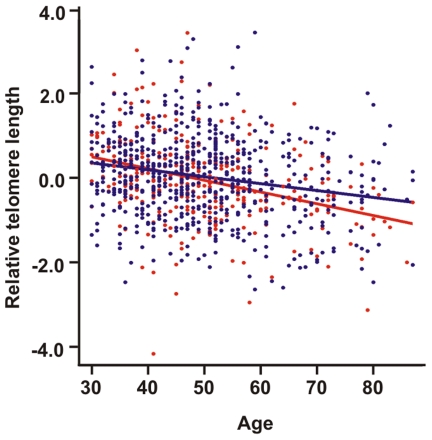
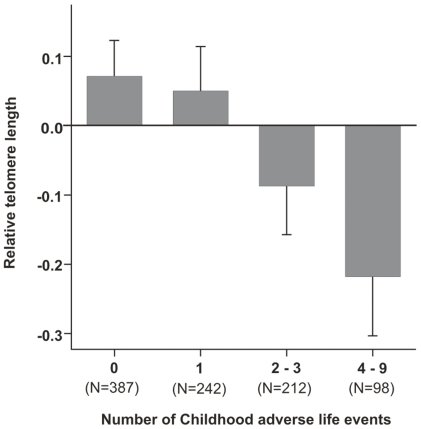
Accelerated leukocyte telomere shortening has been previously associated to self-perceived stress and psychiatric disorders, including schizophrenia and mood disorders. We set out to investigate whether telomere length is affected in patients with anxiety disorders in which stress is a known risk factor. We also studied the effects of childhood and recent psychological distress on telomere length. We utilized samples from the nationally representative population-based Health 2000 Survey that was carried out between 2000-2001 in Finland to assess major public health problems and their determinants. We measured the relative telomere length of the peripheral blood cells by quantitative real-time PCR from 321 individuals with DSM-IV anxiety disorder or subthreshold diagnosis and 653 matched controls aged 30-87 years, who all had undergone the Composite International Diagnostic Interview. While telomere length did not differ significantly between cases and controls in the entire cohort, the older half of the anxiety disorder patients (48-87 years) exhibited significantly shorter telomeres than healthy controls of the same age (P = 0.013). Interestingly, shorter telomere length was also associated with a greater number of reported childhood adverse life events, among both the anxiety disorder cases and controls (P = 0.005). Childhood chronic or serious illness was the most significantly associated single event affecting telomere length at the adult age (P = 0.004). Self-reported current psychological distress did not affect telomere length. Our results suggest that childhood stress might lead to accelerated telomere shortening seen at the adult age. This finding has potentially important implications supporting the view that childhood adversities might have a considerable impact on well being later in life.
Overview
The claims and statistics of this paper haven’t been checked yet.
Run the check — free, no account needed. It reads the open-access text and checks the sources it cites.
Integrity signals
Registry
Cites
Statistics
Figures
Verification
Claims the paper makes
The claims and statistics of this paper haven’t been checked yet.
Run the check — free, no account needed. It reads the open-access text and checks the sources it cites.
Claims other papers make about this one
Each is checked against this paper’s own text: does it say what the citing paper says it does?
In the citing paper
“However, LTL was significantly shorter among the older anxiety disorder subjects (48–87 years of age) compared to controls, and the authors suggested that more prolonged exposure to anxiety disorder-related stress might be needed for accelerated telomere shortening to be detected (Kananen et al., 2010).”
From Psychiatric disorders and leukocyte telomere length: Underlying mechanisms linking mental illness with cellular aging (2015) · cites this paper as Kananen et al., 2010
In the citing paper
“Kananen et al. (2010), found no overall significant difference in LTL between a mixed group of anxiety disorder subjects (panic disorder, generalized anxiety disorder, social phobia, agoraphobia and phobia not otherwise specified, plus cases of “sub-threshold” anxiety disorders not meeting DSM-IV criteria for anxiety disorder diagnosis) and controls.”
From Psychiatric disorders and leukocyte telomere length: Underlying mechanisms linking mental illness with cellular aging (2015) · cites this paper as Kananen et al. (2010)
Self-check
Percentages, sums and reported differences re-computed from the paper’s own numbers.
The self-check needs the paper’s full text.
Citations
Cites
Diagnostic and Statistical Manual of Mental Disorders ( DSM ‐ IV ‐ TR )
Segal, D. L. (2010) · Wiley eBooks · doi:10.1002/9780470479216.corpsy0271 · Cited by 4,687
Telomere measurement by quantitative PCR
Cawthon, R. (2002) · Nucleic Acids Research · doi:10.1093/nar/30.10.e47 · Cited by 3,538
Accelerated telomere shortening in response to life stress
Epel, E. S., Blackburn, E. H., Lin, J., Dhabhar, F. S., Adler, N. E., Morrow, J. D., & Cawthon, R. M. (2004) · Proceedings of the National Academy of Sciences · doi:10.1073/pnas.0407162101 · Cited by 3,002
Oxidative stress shortens telomeres
von Zglinicki, T. (2002) · Trends in Biochemical Sciences · doi:10.1016/s0968-0004(02)02110-2 · Cited by 2,524
Green, J. G., McLaughlin, K. A., Berglund, P. A., Gruber, M. J., Sampson, N. A., Zaslavsky, A. M., & Kessler, R. C. (2010) · Archives of General Psychiatry · doi:10.1001/archgenpsychiatry.2009.186 · Cited by 2,323
Telomeres and human disease: ageing, cancer and beyond
Blasco, M. A. (2005) · Nature Reviews Genetics · doi:10.1038/nrg1656 · Cited by 1,434
Obesity, cigarette smoking, and telomere length in women
Valdes, A., Andrew, T., Gardner, J., Kimura, M., Oelsner, E., Cherkas, L., Aviv, A., & Spector, T. (2005) · The Lancet · doi:10.1016/s0140-6736(05)66630-5 · Cited by 1,363
Leukocyte Telomere Length and Cardiovascular Disease in the Cardiovascular Health Study
Fitzpatrick, A. L., Kronmal, R. A., Gardner, J. P., Psaty, B. M., Jenny, N. S., Tracy, R. P., Walston, J., Kimura, M., & Aviv, A. (2006) · American Journal of Epidemiology · doi:10.1093/aje/kwj346 · Cited by 773
Brouilette, S., Moore, J. S., McMahon, A. D., Thompson, J. R., Ford, I., Shepherd, J., Packard, C. J., & Samani, N. J. (2007) · The Lancet · doi:10.1016/s0140-6736(07)60071-3 · Cited by 747
Genetic determination of telomere size in humans: a twin study of three age groups.
Slagboom, P. E., Droog, S., & Boomsma, D. I. (1994) · PubMed Central · Cited by 734
Cited by
Sorted by citations
Adverse childhood experiences, allostasis, allostatic load and age-related disease
Danese, A., & McEwen, B. S. (2012) · Physiology & Behavior · doi:10.1016/j.physbeh.2011.08.019 · Cited by 2,140
Paradise lost: the neurobiological and clinical consequences of child abuse and neglect
Nemeroff, C. B. (2016) · Neuron · doi:10.1016/j.neuron.2016.01.019 · Cited by 768
Shalev, I., Moffitt, T. E., Sugden, K., Williams, B., Houts, R. M., Danese, A., Mill, J., Arseneault, L., & Caspi, A. (2013) · Molecular Psychiatry · doi:10.1038/mp.2012.32 · Cited by 489
Wolkowitz, O. M., Mellon, S. H., Epel, E. S., Lin, J., Dhabhar, F. S., Su, Y., Reus, V. I., Rosser, R., Burke, H. M., Kupferman, E., et al. (2011) · PLoS ONE · doi:10.1371/journal.pone.0017837 · Cited by 421
Ageing and the telomere connection: An intimate relationship with inflammation
Zhang, J., Rane, G., Dai, X., Shanmugam, M. K., Arfuso, F., Samy, R. P., Lai, M. K. P., Kappei, D., Kumar, A. P., & Sethi, G. (2015) · Ageing Research Reviews · doi:10.1016/j.arr.2015.11.006 · Cited by 396
Metadata
- Authors
- Kananen, L., Surakka, I., Pirkola, S., Suvisaari, J., Lönnqvist, J., Peltonen, L., Ripatti, S., & Hovatta, I.
- Affiliations
- University of Helsinki (FI)
- Helsinki University Hospital (FI)
- Finnish Institute for Health and Welfare (FI)
- Broad Institute (US)
- Corresponding author
- Hovatta, Iiris
- ORCID
- Venue
- PLoS ONE
- Publisher
- Public Library of Science (PLoS)
- Published
- 2010-05-25
- Volume
- 5
- Issue
- 5
- Pages
- e10826
- ISSN
- 1932-6203 (ISSN-L)
- PMC
- PMC2876034
- OpenAlex
- W1986488389
- Cited by
- 270
- References
- 71
- Citations by year
- 2026: 2 · 2025: 6 · 2024: 3 · 2023: 7 · 2022: 6 · 2021: 13 · 2020: 7 · 2019: 16 · 2018: 15 · 2017: 28 · 2016: 25 · 2015: 32 · 2014: 25 · 2013: 27 · 2012: 33
- FWCI
- 18.42
- Type
- journal article
- Language
- en
- Open access
- gold
- doi.org
- Locations
- PLoS ONE (publishedVersion, cc-by)
- Europe PMC (PubMed Central) (publishedVersion, cc-by)
- PubMed Central (publishedVersion, cc-by)
- PubMed (publishedVersion)
- DOAJ (DOAJ: Directory of Open Access Journals) (submittedVersion, cc-by-sa)
- DSpace@MIT (Massachusetts Institute of Technology) (submittedVersion, cc-by-nc)
- Työväentutkimus Vuosikirja (submittedVersion)
- STM:n Hallinnonalan avoin julkaisuarkisto (Julkari) (submittedVersion)
- Funders
- Academy of Finland
- Topics
- Life Sciences › Biochemistry, Genetics and Molecular Biology › Cell Biology › Telomeres, Telomerase, and Senescence
- Social Sciences › Psychology › Clinical Psychology › Child Abuse and Trauma
- Life Sciences › Neuroscience › Behavioral Neuroscience › Stress Responses and Cortisol
- Keywords
- telomere length, childhood adversity, anxiety disorders, children with chronic illness, psychological distress, stress, aging, Health 2000 Survey
- MeSH terms
- Adult, Aging, Anxiety Disorders, Child, Child Abuse, Humans, Life Change Events, Socioeconomic Factors, Stress, Psychological, Case-Control Studies, Telomere
About these checks
Registry, retraction, Cites and statistics results are computed, not judged, with one exception: a printed reference that no index lists is read once by a model before it counts as a citation error. Claims are extracted by a model and kept only when their quote appears verbatim in the text; each cited source is then checked, with a model’s help, for whether it says what the claim relies on. Those verdicts can be wrong — read the claim’s quote and the cited source before relying on one.
Statistics and arithmetic are recomputed, not judged.
Confidence bands are shown only for fields calibrated on our annotated test set. None is calibrated yet, so no band is shown.
What counts as a claim ›How we measure confidence ›How we check this ›
Are you an author, or do you see a problem with this page? Request a review
