

The DOI matches its Crossref record; 45 of the 45 references it cites were found in a registry or an index.
Social Transmission of Fear in Rats: The Role of 22-kHz Ultrasonic Distress Vocalization
Open accessAbstract
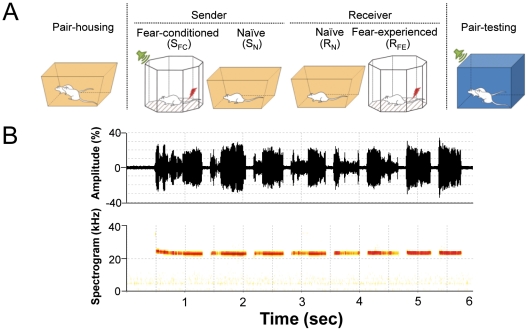
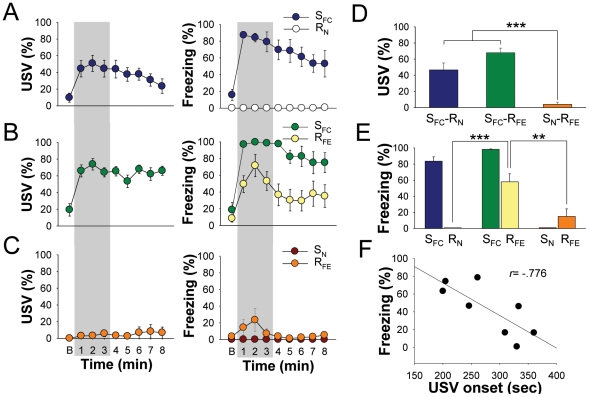
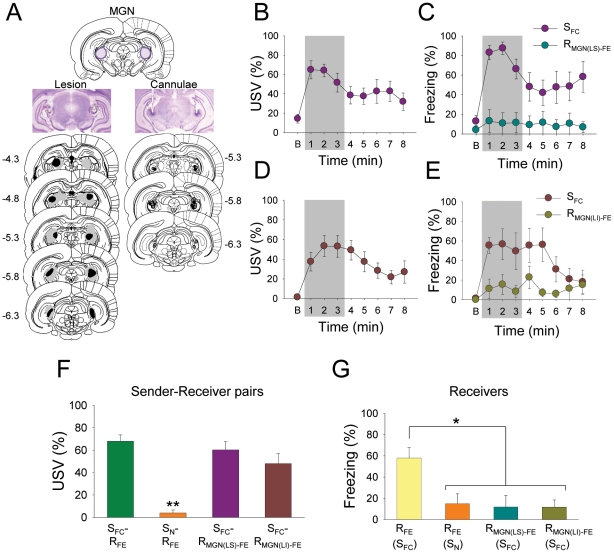
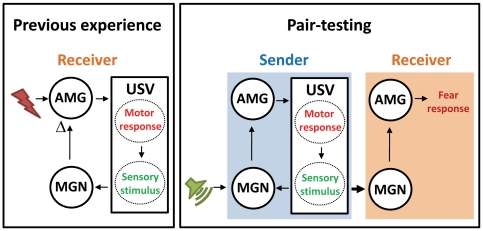
BACKGROUND: Social alarm calls alert animals to potential danger and thereby promote group survival. Adult laboratory rats in distress emit 22-kHz ultrasonic vocalization (USV) calls, but the question of whether these USV calls directly elicit defensive behavior in conspecifics is unresolved. METHODOLOGY/PRINCIPAL FINDINGS: The present study investigated, in pair-housed male rats, whether and how the conditioned fear-induced 22-kHz USVs emitted by the 'sender' animal affect the behavior of its partner, the 'receiver' animal, when both are placed together in a novel chamber. The sender rats' conditioned fear responses evoked significant freezing (an overt evidence of fear) in receiver rats that had previously experienced an aversive event but not in naïve receiver rats. Permanent lesions and reversible inactivations of the medial geniculate nucleus (MGN) of the thalamus effectively blocked the receivers' freeezing response to the senders' conditioned fear responses, and this occurred in absence of lesions/inactivations impeding the receiver animals' ability to freeze and emit 22-kHz USVs to the aversive event per se. CONCLUSIONS/SIGNIFICANCE: These results--that prior experience of fear and intact auditory system are required for receiver rats to respond to their conspecifics' conditioned fear responses--indicate that the 22-kHz USV is the main factor for social transmission of fear and that learning plays a crucial role in the development of social signaling of danger by USVs.
Overview
The claims and statistics of this paper haven’t been checked yet.
Run the check — free, no account needed. It reads the open-access text and checks the sources it cites.
Integrity signals
Registry
Cites
Statistics
Figures
Verification
Claims the paper makes
The claims and statistics of this paper haven’t been checked yet.
Run the check — free, no account needed. It reads the open-access text and checks the sources it cites.
Claims other papers make about this one
Each is checked against this paper’s own text: does it say what the citing paper says it does?
The source backs part of the claim, not all of it — or backs it for a different population, condition or comparison.
In the citing paper
“Observer mice did not have experience with foot-shock (i.e., “priming”) prior to demonstrator conditioning (cf. 7–9).”
From Oxytocin enhances observational fear in mice (2017) · cites this paper as [8]
Experimental — accuracy not yet measured
Self-check
Percentages, sums and reported differences re-computed from the paper’s own numbers.
The self-check needs the paper’s full text.
Citations
Cites
Rescorla, R. A. (1972) · Medical Entomology and Zoology · Cited by 7,268
Hölldobler, B., & Wilson, E. O. (1990) · Springer eBooks · doi:10.1007/978-3-662-10306-7 · Cited by 5,476
Crouching as an index of fear.
Blanchard, R. J., & Blanchard, D. C. (1969) · Journal of Comparative and Physiological Psychology · doi:10.1037/h0026779 · Cited by 1,077
Antipredator defensive behaviors in a visible burrow system
Blanchard, R. J., & Blanchard, D. C. (1989) · Journal of comparative psychology · doi:10.1037/0735-7036.103.1.70 · Cited by 663
Olsson, A., & Phelps, E. A. (2007) · Nature Neuroscience · doi:10.1038/nn1968 · Cited by 622
Ultrasonic vocalizations as indices of affective states in rats
Knutson, B., Burgdorf, J., & Panksepp, J. (2002) · Psychological Bulletin · doi:10.1037/0033-2909.128.6.961 · Cited by 618
Romanski, L. M., & LeDoux, J. (1992) · Journal of Neuroscience · doi:10.1523/jneurosci.12-11-04501.1992 · Cited by 470
Precise auditory–vocal mirroring in neurons for learned vocal communication
Prather, J. F., Peters, S., Nowicki, S., & Mooney, R. (2008) · Nature · doi:10.1038/nature06492 · Cited by 463 · cited 1×
“Obviously, manipulations that can selectively inhibit USVs without altering other postshock fear responses (currently unavailable) will be required to further test this notion of auto-conditioning, perhaps analogous to auditory mirroring hypothesized in birds [40].”
BackgroundBlanchard, R. J., Blanchard, D. C., Agullana, R., & Weiss, S. M. (1991) · Physiology & Behavior · doi:10.1016/0031-9384(91)90423-l · Cited by 461
Goldstein, L. E., Rasmusson, A. M., Bunney, B. S., & Roth, R. H. (1996) · The Journal of Neuroscience · doi:10.1523/jneurosci.16-15-04787.1996 · Cited by 387
Cited by
Sorted by citations
Oxytocin-dependent consolation behavior in rodents
Burkett, J. P., Andari, E., Johnson, Z. V., Curry, D. C., de Waal, F. B. M., & Young, L. J. (2016) · Science · doi:10.1126/science.aac4785 · Cited by 692
Ethotransmission: communication of emotional states through ultrasonic vocalization in rats.
Brudzynski, S. M. (2013) · Current Opinion in Neurobiology · doi:10.1016/j.conb.2013.01.014 · Cited by 416
Wöhr, M., & Schwarting, R. K. W. (2013) · Cell and Tissue Research · doi:10.1007/s00441-013-1607-9 · Cited by 371
Toward a cross-species understanding of empathy
Panksepp, J., & Panksepp, J. B. (2013) · Trends in Neurosciences · doi:10.1016/j.tins.2013.04.009 · Cited by 309
Corticoamygdala Transfer of Socially Derived Information Gates Observational Learning
Allsop, S. A., Wichmann, R., Mills, F., Burgos-Robles, A., Chang, C.-J., Felix-Ortiz, A. C., Vienne, A., Beyeler, A., Izadmehr, E. M., Glober, G., et al. (2018) · Cell · doi:10.1016/j.cell.2018.04.004 · Cited by 288
Metadata
- Authors
- Kim, E. J., Kim, E. S., Covey, E., & Kim, J. J.
- Affiliations
- University of Washington (US)
- Corresponding author
- Kim, Jeansok J.
- Venue
- PLoS ONE
- Publisher
- Public Library of Science (PLoS)
- Published
- 2010-12-01
- Volume
- 5
- Issue
- 12
- Pages
- e15077
- ISSN
- 1932-6203 (ISSN-L)
- PMC
- PMC2995742
- OpenAlex
- W1982780621
- Cited by
- 216
- References
- 44
- Citations by year
- 2026: 11 · 2025: 14 · 2024: 13 · 2023: 18 · 2022: 10 · 2021: 14 · 2020: 13 · 2019: 17 · 2018: 27 · 2017: 15 · 2016: 18 · 2015: 10 · 2014: 6 · 2013: 16 · 2012: 9
- FWCI
- 6.59
- Type
- journal article
- Language
- en
- Open access
- gold
- doi.org
- Locations
- PLoS ONE (publishedVersion, cc-by)
- PubMed Central (publishedVersion, cc-by)
- PubMed (publishedVersion)
- Digital Commons - George Fox University (George Fox University) (submittedVersion)
- DOAJ (DOAJ: Directory of Open Access Journals) (submittedVersion, cc-by-sa)
- Figshare (submittedVersion, cc-by)
- Funders
- National Institute of Mental Health (MH64457, R01 MH64457, R01MH064457)
- Topics
- Life Sciences › Agricultural and Biological Sciences › Ecology, Evolution, Behavior and Systematics › Animal Vocal Communication and Behavior
- Life Sciences › Neuroscience › Cognitive Neuroscience › Memory and Neural Mechanisms
- Life Sciences › Agricultural and Biological Sciences › Ecology, Evolution, Behavior and Systematics › Primate Behavior and Ecology
- Keywords
- distress vocalizations, fear conditioning, freezing behavior, medial geniculate body, thalamus, conspecific communication, rats
- MeSH terms
- Anesthetics, Local, Animals, Animal Communication, Behavior, Animal, Conditioning, Classical, Fear, Freezing, Geniculate Bodies, Lidocaine, Male, Social Behavior, Thalamus, Ultrasonics, Vocalization, Animal, Rats
About these checks
Registry, retraction, Cites and statistics results are computed, not judged, with one exception: a printed reference that no index lists is read once by a model before it counts as a citation error. Claims are extracted by a model and kept only when their quote appears verbatim in the text; each cited source is then checked, with a model’s help, for whether it says what the claim relies on. Those verdicts can be wrong — read the claim’s quote and the cited source before relying on one.
Statistics and arithmetic are recomputed, not judged.
Confidence bands are shown only for fields calibrated on our annotated test set. None is calibrated yet, so no band is shown.
What counts as a claim ›How we measure confidence ›How we check this ›
Are you an author, or do you see a problem with this page? Request a review
