

The Spatial Expansion and Ecological Footprint of Fisheries (1950 to Present)
Open accessThe DOI matches its Crossref record; 32 of the 35 references it cites were found in a registry or an index.
Abstract
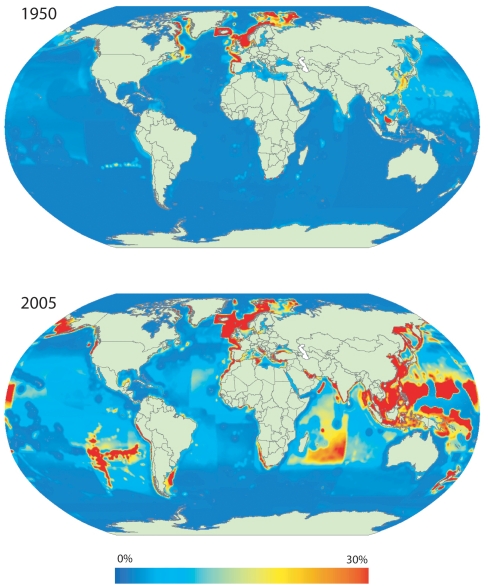
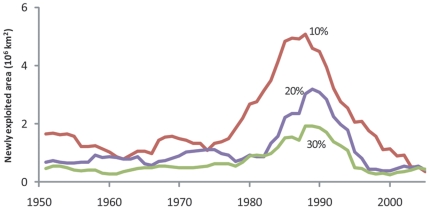
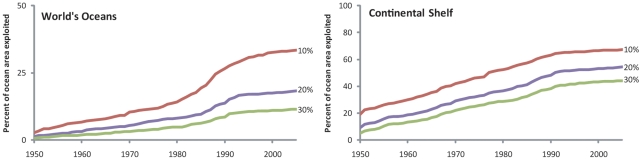
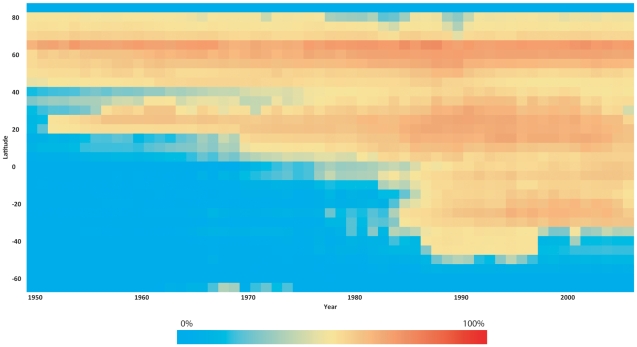
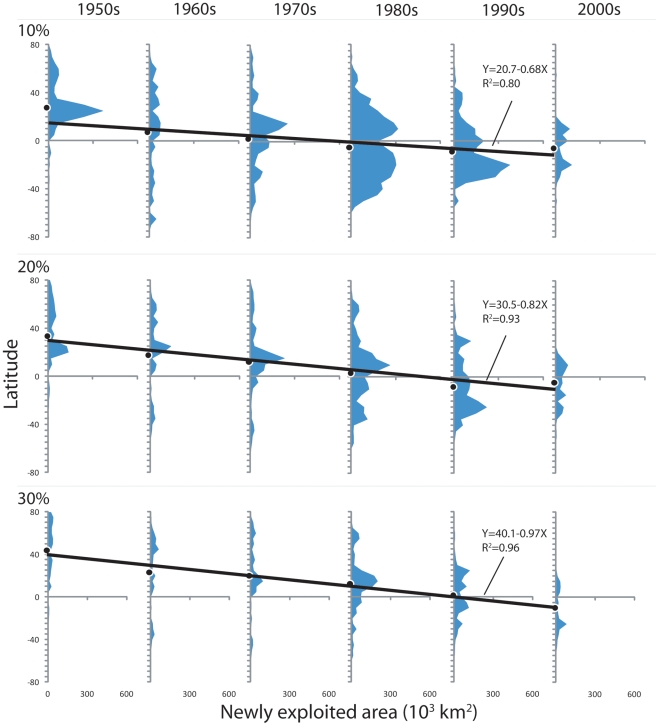
Using estimates of the primary production required (PPR) to support fisheries catches (a measure of the footprint of fishing), we analyzed the geographical expansion of the global marine fisheries from 1950 to 2005. We used multiple threshold levels of PPR as percentage of local primary production to define 'fisheries exploitation' and applied them to the global dataset of spatially-explicit marine fisheries catches. This approach enabled us to assign exploitation status across a 0.5° latitude/longitude ocean grid system and trace the change in their status over the 56-year time period. This result highlights the global scale expansion in marine fisheries, from the coastal waters off North Atlantic and West Pacific to the waters in the Southern Hemisphere and into the high seas. The southward expansion of fisheries occurred at a rate of almost one degree latitude per year, with the greatest period of expansion occurring in the 1980s and early 1990s. By the mid 1990s, a third of the world's ocean, and two-thirds of continental shelves, were exploited at a level where PPR of fisheries exceed 10% of PP, leaving only unproductive waters of high seas, and relatively inaccessible waters in the Arctic and Antarctic as the last remaining 'frontiers.' The growth in marine fisheries catches for more than half a century was only made possible through exploitation of new fishing grounds. Their rapidly diminishing number indicates a global limit to growth and highlights the urgent need for a transition to sustainable fishing through reduction of PPR.
Overview
The claims and statistics of this paper haven’t been checked yet.
Free: it reads the open-access text and checks the first 5 claims that cite a source we can check. Create a free account to check every claim.
Integrity signals
Registry
Cites
Statistics
Figures
Verification
Claims the paper makes
The claims and statistics of this paper haven’t been checked yet.
Free: it reads the open-access text and checks the first 5 claims that cite a source we can check. Create a free account to check every claim.
Claims other papers make about this one
Each is checked against this paper’s own text: does it say what the citing paper says it does?
The source backs part of the claim, not all of it — or backs it for a different population, condition or comparison.
In the citing paper
“About two-thirds of the ocean area where HANPP is >10% is found above the shallow shelf areas (38) where ecosystems are most intensely exploited.”
From Earth beyond six of nine planetary boundaries (2023) · cites this paper as [38]
Experimental — accuracy not yet measured
Self-check
Percentages, sums and reported differences re-computed from the paper’s own numbers.
The self-check needs the paper’s full text.
Citations
Cites
Historical Overfishing and the Recent Collapse of Coastal Ecosystems
Jackson, J. B. C., Kirby, M. X., Berger, W. H., Bjorndal, K. A., Botsford, L. W., Bourque, B. J., Bradbury, R. H., Cooke, R., Erlandson, J., Estes, J. A., et al. (2001) · Science · doi:10.1126/science.1059199 · Cited by 6,652 · cited 1×
“There is a wide realization that fisheries, similar to agriculture on land [1], has a tremendous impact on marine ecosystems and on the biodiversity embedded therein [2,3].”
BackgroundPauly, D., Christensen, V., Dalsgaard, J., Froese, R., & Torres, F. (1998) · Science · doi:10.1126/science.279.5352.860 · Cited by 4,743
Self-citationTowards sustainability in world fisheries.
Pauly, D., Christensen, V., Guénette, S., Pitcher, T. J., Sumaila, U. R., Walters, C. J., Watson, R., & Zeller, D. (2002) · Nature · doi:10.1038/nature01017 · Cited by 3,019 · cited 3×
“This result highlights the global scale expansion in marine fisheries, from the coastal waters off North Atlantic and West Pacific to the waters in the Southern Hemisphere and into the high seas.”
BackgroundSelf-citationThe State of World Fisheries and Aquaculture 2018: Meeting the Sustainable Development Goals
Food and Agriculture Organization of the United Nations (2018) · The State of World Fisheries and Aquaculture · doi:10.18356/8d6ea4b6-en · Cited by 2,075
Primary production required to sustain global fisheries
Pauly, D., & Christensen, V. (1995) · Nature · doi:10.1038/374255a0 · Cited by 1,888 · cited 4×
“We applied a 9:1 ratio for CR and 10% for TE [15].”
BackgroundMethodInfluentialSelf-citationHaberl, H., Erb, K. H., Krausmann, F., Gaube, V., Bondeau, A., Plutzar, C., Gingrich, S., Lucht, W., & Fischer-Kowalski, M. (2007) · Proceedings of the National Academy of Sciences · doi:10.1073/pnas.0704243104 · Cited by 1,617 · cited 1×
“8% of potential net primary productivity humans appropriate on land [21].”
BackgroundTilman, D. (1999) · Proceedings of the National Academy of Sciences · doi:10.1073/pnas.96.11.5995 · Cited by 1,406
Global phytoplankton decline over the past century
Boyce, D. G., Lewis, M. R., & Worm, B. (2010) · Nature · doi:10.1038/nature09268 · Cited by 1,363 · cited 1×
“For our analysis, we assumed primary production to be constant over the study period, due to incomplete temporal coverage in the SeaWiFS dataset. While the level of primary production may have declined over the past 50 years concomitant with an observed reduction in the global chlorophyll concentration”
MethodEstimating the Worldwide Extent of Illegal Fishing
Agnew, D. J., Pearce, J., Pramod, G., Peatman, T., Watson, R., Beddington, J. R., & Pitcher, T. J. (2009) · PLoS ONE · doi:10.1371/journal.pone.0004570 · Cited by 1,009
Self-citationThe fate of marine autotrophic production
Duarte, C. M., & Cebrián, J. (1996) · Limnology and Oceanography · doi:10.4319/lo.1996.41.8.1758 · Cited by 1,000
Research works printed but not linked: 1
- FAO 2009 The state of world fisheries and aquaculture. FAO. Rome 84
Cited by
Items 101–200 of 379
Cashion, T., Hornborg, S., Ziegler, F., Hognes, E. S., & Tyedmers, P. H. (2016) · The International Journal of Life Cycle Assessment · doi:10.1007/s11367-016-1092-y · Cited by 72
“The fractions of total productivity claimed from various LMEs to sustain inputs to Norwegian salmon feeds 2012 are within the range of rates of PPR appropriated by global fishing fleets at the individual LME level (Swartz et al. 2010; Watson et al. 2014).”
BackgroundFishing down, fishing through and fishing up: fundamental process versus technical details
Stergiou, K., & Tsikliras, A. C. (2011) · Marine Ecology Progress Series · doi:10.3354/meps09377 · Cited by 74
“Although their ana - lysis might be marred by their non-consideration of fisheries expansion, particularly evident in the Sea Around Us data they used (see Swartz et al. 2010), Branch et al. (2010) maintained that catch MTL trends do not necessarily reflect similar trends in ecosystem MTLs.”
BackgroundMobility, Expansion and Management of a Multi-Species Scuba Diving Fishery in East Africa
Eriksson, H., de la Torre‐Castro, M., & Olsson, P. (2012) · PLoS ONE · doi:10.1371/journal.pone.0035504 · Cited by 60
“The depletion of near-shore fishing grounds and technological development has driven spatial expansion [3], and fishing down marine food webs [4], predominantly to serve affluent markets [5].”
BackgroundKe, H., Yang, W., Liu, X., & Fan, F. (2020) · International Journal of Environmental Research and Public Health · doi:10.3390/ijerph17186826 · Cited by 61
“This is because the significant differences in the abundance of natural resources in different cities in China lead to a diffusion-style flow of natural resources to nearby regions [81].”
BackgroundRiver dolphins as indicators of ecosystem degradation in large tropical rivers
Gomez‐Salazar, C., Coll, M., & Whitehead, H. (2012) · Ecological Indicators · doi:10.1016/j.ecolind.2012.02.034 · Cited by 69
Modelling the effects of fishing on the biomass of the world’s oceans from 1950 to 2006
Tremblay-Boyer, L., Gascuel, D., Watson, R. A., Christensen, V., & Pauly, D. F. (2011) · Marine Ecology Progress Series · doi:10.3354/meps09375 · Cited by 82
Self-citation‘Rational use’ in Antarctic waters
Jacquet, J., Blood-Patterson, E., Brooks, C. M., & Ainley, D. G. (2015) · Marine Policy · doi:10.1016/j.marpol.2015.09.031 · Cited by 54
A Global Analysis of the Relationship between Farmed Seaweed Production and Herbivorous Fish Catch
Hehre, E. J., & Meeuwig, J. J. (2016) · PLoS ONE · doi:10.1371/journal.pone.0148250 · Cited by 60
Individual transferable quotas and conservation: a critical assessment
Acheson, J., Apollonio, S., & Wilson, J. A. (2015) · Ecology and Society · doi:10.5751/es-07912-200407 · Cited by 61
Feng, Y., Chen, X., Gao, F., & Liu, Y. (2018) · Acta Oceanologica Sinica · doi:10.1007/s13131-018-1212-6 · Cited by 54
“These patterns are usually in the form of a spatiotemporal distribution and its relationships with oceanic environments (Chen et al., 2014; Jennings et al., 2009; Swartz et al., 2010; Yu et al., 2015).”
BackgroundEvolving the narrative for protecting a rapidly changing ocean, post‐COVID‐19
Laffoley, D., Baxter, J. M., Amon, D. J., Claudet, J., Hall-Spencer, J. M., Grorud‐Colvert, K., Levin, L. A., Reid, P. C., Rogers, A. D., Taylor, M. L., et al. (2020) · Aquatic Conservation Marine and Freshwater Ecosystems · doi:10.1002/aqc.3512 · Cited by 69
“Fishing is the best-known example where technological advances since World War II have allowed expansion of such activities across the entire ocean (Swartz et al., 2010) and to increasing depths (Watson & Morato, 2013).”
Mapping the unjust global distribution of harmful fisheries subsidies
Skerritt, D. J., Schuhbauer, A., Villasante, S., Cisneros-Montemayor, A. M., Bennett, N. J., Mallory, T. G., Lam, V. W. L., Arthur, R. I., Cheung, W. W. L., Teh, L., et al. (2023) · Marine Policy · doi:10.1016/j.marpol.2023.105611 · Cited by 61
From bonito to anchovy: a reconstruction of Turkey’s marine fisheries catches (1950-2010)
Ulman, A., BEKISOGLU, S., Zengin, M., Knudsen, S., Ünal, V., Mathews, C. P., Harper, S. J., Zeller, D. C., & Pauly, D. F. (2013) · Mediterranean Marine Science · doi:10.12681/mms.414 · Cited by 66
“Many fisheries soon became over-exploited due to the development of industrial practices (Swartz et al., 2010), which initially developed in parts of Turkey in the 1950s, such as in Iskenderun Bay where a drop in catch per unit of effort (CPUE) was noticed along with the increasing effort by the bottom trawling fleet…”
BackgroundInfluentialSelf-citationWho gets what? Developing a more equitable framework for EU fishing agreements
Manach, F. L., Andriamahefazafy, M. R., Harper, S. J., Harris, A., Hosch, G., Lange, G., Zeller, D. C., & Sumaila, U. R. (2012) · Marine Policy · doi:10.1016/j.marpol.2012.06.001 · Cited by 58
“Partly as a result of declining stocks in domestic waters and increasing global demand for seafood [2–4], the European Union (EU) has developed one of the largest DWFs in the world and has established foreign fishing agreements with twenty developing”
BackgroundPope, K. L., Allen, C. R., & Angeler, D. G. (2014) · Transactions of the American Fisheries Society · doi:10.1080/00028487.2014.880735 · Cited by 57
Persistence and sustainability of fishing grounds footprint: Evidence from 89 countries
Solarin, S. A., Gil‐Alana, L. A., & Lafuente, C. (2020) · The Science of The Total Environment · doi:10.1016/j.scitotenv.2020.141594 · Cited by 54
Who is the high seas fishing industry?
Carmine, G., Mayorga, J., Miller, N. A., Park, J., Halpin, P. N., Crespo, G. O., Österblom, H., Sala, E., & Jacquet, J. (2020) · One Earth · doi:10.1016/j.oneear.2020.11.017 · Cited by 51
Self-citationPauly, D. F., & Zeller, D. C. (2017) · Marine Policy · doi:10.1016/j.marpol.2017.03.013 · Cited by 50
“operations of the world's fishing fleets [38]; C: Application to the data in A of the routine”
BackgroundSelf-citationColléter, M., Gascuel, D., Albouy, C. P., Francour, P., de Morais, L. T., Valls, A., & Loc’h, F. L. (2014) · Journal of Marine Systems · doi:10.1016/j.jmarsys.2014.07.023 · Cited by 54
Clark, T. P., & Longo, S. B. (2019) · International Journal of Comparative Sociology · doi:10.1177/0020715219869976 · Cited by 49
Using harmonized historical catch data to infer the expansion of global tuna fisheries
Coulter, A., Cashion, T., Cisneros-Montemayor, A. M., Popov, S., Tsui, G., Manach, F. L., Schiller, L., Palomares, M. L. D., Zeller, D. C., & Pauly, D. F. (2019) · Fisheries Research · doi:10.1016/j.fishres.2019.105379 · Cited by 60
“Tuna fisheries, here referring to ‘all large pelagics’ including billfishes, sharks and other large- and medium-sized scombrids, illustrate the greatest spatial expansion in global fisheries (Swartz et al., 2010) due to the highly migratory nature of tuna and other large-pelagic taxa and their wide-spread occurrence i…”
Self-citationFive centuries of cod catches in Eastern Canada
Schijns, R., Froese, R., Hutchings, J. A., & Pauly, D. F. (2021) · ICES Journal of Marine Science · doi:10.1093/icesjms/fsab153 · Cited by 53
“the deployment of large vessels fuelled by fossil energy (first coal, then diesel), however, radically changed fisheries, and made it increasingly possible to target accumulations of any desirable fish species at any distance from coastlines, depth of occurrence or season, all factors which created areas and times whe…”
BackgroundSelf-citationSustainability implications of honouring the Code of Conduct for Responsible Fisheries
Coll, M., Libralato, S., Pitcher, T. J., Solidoro, C., & Tudela, S. (2012) · Global Environmental Change · doi:10.1016/j.gloenvcha.2012.10.017 · Cited by 58
“…of the catch (TLc, Pauly et al., 1998; Pauly and Palomares, 2005; Pauly and Watson, 2005); (iv) the total amount of catch (Y); and (v) total catches expressed as units of primary production required from the ecosystem to yield that catch (%PPR, Pauly and Christensen, 1995; Swartz et al., 2011).”
BackgroundMethodInfluentialSampling mobile oceanic fishes and sharks: implications for fisheries and conservation planning
Letessier, T. B., Bouchet, P. J., & Meeuwig, J. J. (2015) · Biological reviews/Biological reviews of the Cambridge Philosophical Society · doi:10.1111/brv.12246 · Cited by 56
“…evident population declines and cases of resource mismanagement, fishing pressure continues to intensify to this day (Anticamara et al., 2011; Davidson, Krawchuk & Dulvy, 2015) as fleets supported by government subsidies venture further into the high seas and away from ports (Swartz et al., 2010).”
BackgroundDamalas, D., Maravelias, C. D., Osio, G. C., Maynou, F., Sbrana, M., & Sartor, P. (2015) · PLoS ONE · doi:10.1371/journal.pone.0119330 · Cited by 45
“Technological innovations have improved the operational capacity of the fleets allowing them to abandon their traditional shallow coastal fishing grounds and start visiting distant deeper waters, fully exploiting the water column, a pattern in accordance with a general expansion of fishing activities documented worldw…”
Background3D ocean assessments reveal that fisheries reach deep but marine protection remains shallow
Jacquemont, J., Loiseau, C., Tornabene, L. M., & Claudet, J. (2024) · Nature Communications · doi:10.1038/s41467-024-47975-1 · Cited by 60
“This is the result of decades of fi shing down the deep as shallow and coastal fi sh stocks have been depleted from over fi shing 26 – 28,43, 44 .”
BackgroundTotal marine fisheries catches in the Persian/Arabian Gulf from 1950 to 2010
Al-Abdulrazzak, D., Zeller, D. C., Belhabib, D., Tesfamichael, D., & Pauly, D. F. (2015) · Regional Studies in Marine Science · doi:10.1016/j.rsma.2015.08.003 · Cited by 44
“org), is the only global sources of time series of national fisheries landings (Garibaldi, 2012), and has provided essential data for a number of global fisheries studies (Swartz et al., 2010; Watson et al., 2012).”
BackgroundSelf-citationAccurate catches and the sustainability of coral reef fisheries
Pauly, D. F., & Zeller, D. C. (2013) · Current Opinion in Environmental Sustainability · doi:10.1016/j.cosust.2013.11.027 · Cited by 46
“Current Opinion in Environmental Sustainability 2014, 7:44–51 Such expansion is a characteristic of industrial fishing, and has led to a number of distant-water fishing nations to deploy vessels operating even in Antarctic waters [3,4 ,5].”
BackgroundSelf-citationWorldwide trends in fishing interest indicated by internet search volume
Wilde, G. R., & Pope, K. L. (2012) · Fisheries Management and Ecology · doi:10.1111/fme.12009 · Cited by 44
“K E Y W O R D S : anglers, angling, Google Insights for Search, recreational fishing, salience.”
BackgroundRegion-based MTI: resolving geographic expansion in the Marine Trophic Index
Kleisner, K. M., Mansour, H., & Pauly, D. F. (2014) · Marine Ecology Progress Series · doi:10.3354/meps10949 · Cited by 52
“…that there have been major advances in fleet technology and capacity (e.g. Pauly & Chuenpagdee 2003, Stergiou & Tsikliras 2011) and that there are multiple demonstrations that fisheries tend to expand geographically and bathymetrically (Morato et al. 2006, Swartz et al. 2010, Watson & Morato 2013).”
BackgroundMethodSelf-citationWhen ecosystems and their services are not co-located: oceans and coasts
Drakou, E. G., Pendleton, L. H., Effron, M., Ingram, J. C., & Teneva, L. T. (2017) · ICES Journal of Marine Science · doi:10.1093/icesjms/fsx026 · Cited by 50
“In our “crowded” oceans, the expansion of high seas fisheries (Swartz et al., 2010), fossil fuel extraction (including oil, gas, and possibly methane hydrates in the future), and the potential mining of seabed mineral resources will put further pressure on marine ecosystems (Merrie et al., 2014).”
BackgroundExtinction risk and conservation of the world's sharks and raysPreprint
Dulvy, N. K., Fowler, S., Musick, J. A., Cavanagh, R. D., Kyne, P. M., Harrison, L. R., Carlson, J. K., Davidson, L. N. K., Fordham, S. V., Francis, M. P., et al. (2013) · arXiv (Cornell University) · doi:10.48550/arxiv.1312.3926 · Cited by 44
“We suggest that this is because fishing activity is now widespread throughout the world’s oceans (Swartz et al., 2010), and even species with the largest ranges are exposed and often entirely encompassed by the footprint of fishing activity.”
BackgroundLink, J. S., & Marshak, A. R. (2018) · Reviews in Fish Biology and Fisheries · doi:10.1007/s11160-018-9544-z · Cited by 47
European Union’s Public Fishing Access Agreements in Developing Countries
Manach, F. L., Chaboud, C., Copeland, D., Cury, P. M., Gascuel, D., Kleisner, K. M., Standing, A., Sumaila, U. R., Zeller, D. C., & Pauly, D. F. (2013) · PLoS ONE · doi:10.1371/journal.pone.0079899 · Cited by 42
“The answer was the expansion of the EU fishing fleet further offshore and southward, often into the waters of developing countries [6–8].”
BackgroundSelf-citationA Spatially Distinct History of the Development of California Groundfish Fisheries
Miller, R. R., Field, J. C., Santora, J. A., Schroeder, I. D., Huff, D. D., Key, M., Pearson, D. E., & MacCall, A. D. (2014) · PLoS ONE · doi:10.1371/journal.pone.0099758 · Cited by 45
“Both historical data and meta-analyses of global catch data suggest a large scale geographic expansion and serial depletion of fisheries across multiple stocks and regions [7– 9], an increase in the spatial extent of the global fishing ‘‘footprint’’ [10], and a trend towards fishing greater depths over time [11], [12].”
BackgroundCetaceans Value and Conservation in the Mediterranean Sea
Pace, D. S., & Tizzi, R. (2013) · Journal of Biodiversity & Endangered Species · doi:10.4172/2332-2543.s1-004 · Cited by 45
“In addition to causing an overall decline in marine fisheries catches, the excessive effort that characterizes most fisheries has led to landings consisting increasingly of smaller fishes, a result of top predators, and the older individuals within species being targeted and depleted [128].”
BackgroundWe should not assume that fishing jellyfish will solve our jellyfish problem
Gibbons, M. J., Boero, F., & Brotz, L. (2015) · ICES Journal of Marine Science · doi:10.1093/icesjms/fsv255 · Cited by 45
“(Swartz et al., 2010) and the removal of many species of fish is”
BackgroundThe changing face of global fisheries—The 1950s vs. the 2000s
Watson, R. A., & Pauly, D. F. (2013) · Marine Policy · doi:10.1016/j.marpol.2013.01.022 · Cited by 41
“Distant-water fishing fleets now operate in more and more remote locations, notably in the southern hemisphere [17,19], all the way to the slope and shelf of the Antarctic continent [34].”
BackgroundSelf-citationViewpoint: Back to the future for fisheries, where will we choose to go?
Zeller, D. C., & Pauly, D. F. (2019) · Global Sustainability · doi:10.1017/sus.2019.8 · Cited by 47
“Therefore, in order to maintain and grow the industrial fisheries, a spatial expansion by industrial fleets occurred until essentially the majority of the world’s ocean areas were accessed or accessible (Pauly, 2018b; Swartz et al., 2010), including in the Arctic (Zeller, Booth, Pakhomov, Swartz, & Pauly, 2011) and ar…”
Self-citationAssessing progress in data reporting by tuna Regional Fisheries Management Organizations
Heidrich, K. N., Juan‐Jordá, M. J., Murua, H., Thompson, C. D. H., Meeuwig, J. J., & Zeller, D. C. (2022) · Fish and Fisheries · doi:10.1111/faf.12687 · Cited by 47
“…ecosystems and the marine biodiversity embedded therein, both within national Exclusive Economic Zones (EEZs) and Areas Beyond National Jurisdiction (ABNJ) (Bongaarts, 2019; Miyake et al., 2004; Swartz et al., 2010; Tickler, Meeuwig, Bryant et al., 2018; Tickler, Meeuwig, Palomares et al., 2018).”
BackgroundØsthagen, A., Spijkers, J., & Totland, O. A. (2020) · MAST. Maritime studies/Maritime studies · doi:10.1007/s40152-020-00172-4 · Cited by 65
McOwen, C., Cheung, W. W. L., Rykaczewski, R. R., Watson, R. A., & Wood, L. J. (2014) · Fish and Fisheries · doi:10.1111/faf.12082 · Cited by 46
“1998) means that they remained comparatively underexploited by industrialized fishing fleets for a relatively long period of time (Swartz et al. 2010).”
BackgroundSelf-citationDas, D., & Afonso, P. (2017) · Frontiers in Marine Science · doi:10.3389/fmars.2017.00354 · Cited by 48
“Expansion and mechanization of fisheries over the last half-century marked a remarkable increase in fish catches (Swartz et al., 2010), sharks, and rays being no exception (Barker and Schluessel, 2005; Ferretti et al., 2010).”
BackgroundIs the environmental Kuznets curve related to the fishing footprint? Evidence from China
Yılancı, V., Çütçü, İ., & Çayır, B. (2022) · Fisheries Research · doi:10.1016/j.fishres.2022.106392 · Cited by 38
Moutopoulos, D. K., Libralato, S., Solidoro, C., & Stergiou, K. I. (2013) · Journal of Marine Systems · doi:10.1016/j.jmarsys.2012.12.002 · Cited by 47
“Assuming that the PPR% can be a measure of the “footprint” of fisheries in the marine ecosystem (Swartz et al., 2010), then purse-seiners, beach-seiners, drifting and bottom longliners and netters have lower “footprints”, whereas trawlers have by far the highest impact (Table 5).”
BackgroundLiquid-phase electron microscopy imaging of cellular and biomolecular systems
Smith, J. W., & Chen, Q. (2020) · Journal of Materials Chemistry B · doi:10.1039/d0tb01300e · Cited by 42
Assessment of the management in Brazilian Marine Extractive Reserves
Zapelini, C., & Schiavetti, A. (2014) · Ocean & Coastal Management · doi:10.1016/j.ocecoaman.2014.03.007 · Cited by 39
“Fisheries resources have been under intense pressure in recent decades (FAO, 2012; Swartz et al., 2010).”
BackgroundA Net Energy Analysis of the Global Agriculture, Aquaculture, Fishing and Forestry System
Marshall, Z., & Brockway, P. E. (2020) · Biophysical Economics and Sustainability · doi:10.1007/s41247-020-00074-3 · Cited by 44
The evolution of the industrial trawl fishery footprint off southeastern and southern Brazil
Port, D., Pérez, J. Á. Á., & de Menezes, J. T. (2016) · Latin American Journal of Aquatic Research · doi:10.3856/vol44-issue5-fulltext-4 · Cited by 35
“…of bottom substrates, disturbance of benthic communities and addition of pollutants to the sea water and the atmosphere, are considered “outputs” of bottom fishing whose geographic spread define its “spatial footprint” (i.e., but not the “ecological footprint” sensu Swartz et al., 2010).”
BackgroundCan we meet the Target? Status and future trends for fisheries sustainability
Teh, L. S. L., Cheung, W. W. L., Christensen, V., & Sumaila, U. (2017) · Current Opinion in Environmental Sustainability · doi:10.1016/j.cosust.2018.02.006 · Cited by 47
Selgrath, J. C., Gergel, S. E., & Vincent, A. C. J. (2017) · ICES Journal of Marine Science · doi:10.1093/icesjms/fsx108 · Cited by 34
“, 2011), as well as a dramatic spatial expansion of fishing into new areas (Swartz et al., 2010), with corresponding impacts on marine life (Pauly and Zeller, 2016).”
BackgroundChrist, H. J., White, R., Hood, L., Vianna, G. M. S., & Zeller, D. C. (2020) · Frontiers in Marine Science · doi:10.3389/fmars.2020.00269 · Cited by 34
Structure and functioning of the Bay of Biscay ecosystem: A trophic modelling approach
Corrales, X., Preciado, I., Gascuel, D., de Gamiz-Zearra, A. L., Hernvann, P., Mugerza, E., Louzao, M., Velasco, F., Doray, M., López‐López, L., et al. (2021) · Estuarine Coastal and Shelf Science · doi:10.1016/j.ecss.2021.107658 · Cited by 41
Kastner, K.-H. E. M., & Haberl, K.-E. S. (2012) · Cited by 40
Global Marine Fishing across Space and Time
Carlson, A. K., Taylor, W. W. L., Rubenstein, D. I., Levin, S. A., & Liu, J. (2020) · Sustainability · doi:10.3390/su12114714 · Cited by 38
“Moreover, trends in catches relative to primary production (metric tons fish/metric kiloton carbon (C)) were evaluated in 1950–2014 to locate EEZs where fishing had a large effect on fish populations compared to the amount of inorganic carbon fixed by aquatic organisms [36].”
BackgroundFishing for ecosystem services
Pope, K. L., Pegg, M. A., Cole, N. W., Siddons, S. F., Fedele, A. D., Harmon, B. S., Ruskamp, R. L., Turner, D., & Uerling, C. C. (2016) · Journal of Environmental Management · doi:10.1016/j.jenvman.2016.04.024 · Cited by 38
Abdou, K., Gascuel, D., Aubin, J., Romdhane, M. S., Lasram, F. B. R., & Loc’h, F. L. (2017) · The Science of The Total Environment · doi:10.1016/j.scitotenv.2017.08.067 · Cited by 38
Hope or Despair Revisited: Assessing Progress and New Challenges in Global Fisheries
Cheung, W. W. L., Pauly, D. F., & Sumaila, U. R. (2024) · Fish and Fisheries · doi:10.1111/faf.12877 · Cited by 42
Self-citationTrophic indicators in fisheries: a call for re-evaluation
Hornborg, S., Belgrano, A., Bartolino, V., Valentinsson, D., & Ziegler, F. (2013) · Biology Letters · doi:10.1098/rsbl.2012.1050 · Cited by 33
“Decreases in MTL (interpreted as a negative signal by the CBD) can contribute to decreasing PPR (considered as a necessary transition towards more sustainable fisheries [12,14] and as a positive factor in the environmental systems analysis of seafood [15]).”
BackgroundAn improved methodology for calculating the nitrogen footprint of seafood
Oita, A., Nagano, I., & Matsuda, H. (2015) · Ecological Indicators · doi:10.1016/j.ecolind.2015.08.039 · Cited by 32
Piroddi, C., Coll, M., Macias, D. M., Steenbeek, J. G., García‐Górriz, E., Mannini, A., Vilas, D., & Christensen, V. (2022) · Scientific Reports · doi:10.1038/s41598-022-18017-x · Cited by 37
Marine productivity response to Heinrich events: a model-data comparison
Mariotti, V., Bopp, L., Tagliabue, A., Kageyama, M., & Swingedouw, D. (2012) · Climate of the past · doi:10.5194/cp-8-1581-2012 · Cited by 40
“Swartz et al.(2010) have shown that actual increased fishing induces a higher percentage of required PP to sustain global fish populations, with a special increase in North Atlantic Ocean.”
BackgroundKleisner, K. M., Marta Coll, M., Lynam, C. P., Bundy, A., Shannon, L. J., Shin, Y., Boldt, J. L., Borges Maria, F., Diallo, I., Fox, C., et al. (2015) · Ecosystem Services · doi:10.1016/j.ecoser.2015.02.002 · Cited by 34
“Additionally, the spatial footprint of fishing has continued to increase as fisheries have expanded offshore (Coll et al., 2008a, Swartz et al., 2010) and into deeper waters (Morato et al., 2006).”
BackgroundManaging at Maximum Sustainable Yield does not ensure economic well‐being for artisanal fishers
Girón‐Nava, A., Johnson, A. F., Cisneros-Montemayor, A. M., & Aburto‐Oropeza, O. (2018) · Fish and Fisheries · doi:10.1111/faf.12332 · Cited by 37
Aragão, G. M., Saralegui-Díez, P., Villasante, S., López‐López, L., Aguilera, E., & Moranta, J. (2022) · Journal of Cleaner Production · doi:10.1016/j.jclepro.2022.131979 · Cited by 40
Historical commercial exploitation and the current status of Hawaiian green turtles
Houtan, K. S. V., & Kittinger, J. N. (2014) · Biological Conservation · doi:10.1016/j.biocon.2013.11.011 · Cited by 35
“Pelagic fish species are uncommon on menus from 1930 to 1945, and then steadily increase, corresponding with global expansion of pelagic fisheries after World War II (Pauly et al., 2002; Swartz et al., 2010).”
BackgroundIncidental mortality of seabirds in trawl fisheries: A global review
Phillips, R. A., Fox, E., Crawford, R., Prince, S., & Yates, O. (2024) · Biological Conservation · doi:10.1016/j.biocon.2024.110720 · Cited by 33
Pita, P., & Freire, J. (2014) · Fisheries Management and Ecology · doi:10.1111/fme.12095 · Cited by 39
Pelagic fish predation is stronger at temperate latitudes than near the equator
Roesti, M., Anstett, D. N., Freeman, B. G., Lee‐Yaw, J. A., Schluter, D., Chavarie, L., Rolland, J., & Holzman, R. (2020) · Nature Communications · doi:10.1038/s41467-020-15335-4 · Cited by 30
Stenseth, N. C., Payne, M., Bonsdorff, E., Dankel, D. J., Durant, J. M., Anderson, L. G., Armstrong, C. W., Blenckner, T., Brakstad, A., Dupont, S. T., et al. (2020) · Proceedings of the National Academy of Sciences · doi:10.1073/pnas.1915352117 · Cited by 31
Marine Ecological Footprint of Italian Mediterranean Fisheries
Leo, F. D., Miglietta, P. P., & Pavlinović, S. (2014) · Sustainability · doi:10.3390/su6117482 · Cited by 31
“[30] suggest that relatively low thresholds (between 10% and 30%) of PPR are sufficient to induce, and thus also track, expansion of fisheries.”
BackgroundInfluentialSpatial valuation of California marine fisheries as an ecosystem service
Miller, R. R., Field, J. C., Santora, J. A., Monk, M., Kosaka, R., & Thomson, C. J. (2017) · Canadian Journal of Fisheries and Aquatic Sciences · doi:10.1139/cjfas-2016-0228 · Cited by 34
Unifying the catch data of a divided island: Cyprus’s marine fisheries catches, 1950–2010
Ulman, A., Çi̇çek, B. A., Salihoglu, I., Petrou, A., Patsalidou, M., Pauly, D. F., & Zeller, D. C. (2014) · Environment Development and Sustainability · doi:10.1007/s10668-014-9576-z · Cited by 28
“This was in part due to the great success of a seasonal trawling ban and the offshore expansion of fishing area, which commonly occurred across the globe during the 1980s and 1990s (Swartz et al. 2010).”
BackgroundSelf-citationGianelli, I., & Defeo, O. (2017) · Fisheries Research · doi:10.1016/j.fishres.2017.02.002 · Cited by 36
“These market trends are most profoundly felt in developing countries, where poor institutional adaptability precludes alternative trading strategies to cope with external drivers of change (Berkes et al., 2006; Swartz et al., 2010; Crona et al., 2015).”
BackgroundVilar, C. C., Magris, R. A., Loyola, R. A., & Joyeux, J. (2020) · Aquatic Conservation Marine and Freshwater Ecosystems · doi:10.1002/aqc.3269 · Cited by 31
Evidence of ecosystem overfishing in U.S. large marine ecosystems
Link, J. S. (2021) · ICES Journal of Marine Science · doi:10.1093/icesjms/fsab185 · Cited by 35
Bundy, A., Marta Coll, M., Shannon, L. J., & Shin, Y. (2012) · Current Opinion in Environmental Sustainability · doi:10.1016/j.cosust.2012.05.003 · Cited by 27
“Current Opinion in Environmental Sustainability 2012, 4:292–299 increasing alarm around the world about their status [1–3,4 ,5] culminating most recently in the Convention on Biological Diversity (CBD) and the Aichi Targets for Biodiversity, which include marine ecosystems and Target 6 for effective ecosystem-based fi…”
BackgroundHouk, P., Cuetos‐Bueno, J., Tibbatts, B., & Gutierrez, J. (2018) · Scientific Reports · doi:10.1038/s41598-018-23971-6 · Cited by 32
Yorisue, T., Iguchi, A., Yasuda, N., Yoshioka, Y., Sato, T. J., & Fujita, Y. (2020) · Scientific Reports · doi:10.1038/s41598-020-66712-4 · Cited by 31
Climate change hotspots and implications for the global subsea telecommunications network
Clare, M. A., Yeo, I., Bricheno, L., Aksenov, Y., Brown, J., Haigh, I. D., Wahl, T., Hunt, J. E., Sams, C., Chaytor, J. D., et al. (2022) · Earth-Science Reviews · doi:10.1016/j.earscirev.2022.104296 · Cited by 43
Biodiversity Loss and the Ecological Footprint of Trade
Lazarus, E., Lin, D. H., Martindill, J., Hardiman, J., Pitney, L., & Galli, A. (2015) · Diversity · doi:10.3390/d7020170 · Cited by 41
“Increasing global demand for fish products has led to overexploitation of fish species beyond the capacity for these fisheries to recover [19,58,59].”
BackgroundRandhawa, H. S., Poulin, R., & Krkošek, M. (2014) · Ecography · doi:10.1111/ecog.00793 · Cited by 28
“Furthermore, our (Roberts 2002, Morato et al. 2006, Swartz et al. 2010), thereby increasing encounter opportunities with new shark species.”
Feeding the world: what role for fisheries?
Frid, C. L. J., & Paramor, O. A. L. (2012) · ICES Journal of Marine Science · doi:10.1093/icesjms/fsr207 · Cited by 35
Trends in global shared fisheries
Teh, L., & Sumaila, U. (2014) · Marine Ecology Progress Series · doi:10.3354/meps11049 · Cited by 26
“This occurred as the major distant water fishing nations took to fishing in the territorial waters of other less developed countries in the south following the depletion of fisheries in the northern hemisphere (Swartz et al. 2010).”
BackgroundThe global network of ports supporting high seas fishing
Rodríguez, J. P., Fernández-Gracia, J., Duarte, C. M., Irigoien, X., & Eguíluz, V. M. (2021) · Science Advances · doi:10.1126/sciadv.abe3470 · Cited by 29
“While traditional practices at the artisan level are unlikely to disturb the equilibrium of fisheries stocks (5), the opposite case stands for industrial fisheries, dominated by wealthy nations (6) operating globally (7).”
BackgroundKassouri, Y. (2021) · Marine Policy · doi:10.1016/j.marpol.2021.104739 · Cited by 25
Tropical Marginal Seas: Priority Regions for Managing Marine Biodiversity and Ecosystem Function
McKinnon, A. D., Williams, A., Young, J., Ceccarelli, D. M., Dunstan, P. K., Brewin, R. J. W., Watson, R. A., Brinkman, R., Cappo, M., Duggan, S., et al. (2013) · Annual Review of Marine Science · doi:10.1146/annurev-marine-010213-135042 · Cited by 27
“Fisheries in TMSs, especially on Southeast Asian coral reefs, are either at maximum levels of exploitation or overfished (Swartz et al. 2010).”
BackgroundSelf-citationFuelling the fisheries subsidy debate: Agreements, loopholes and implications
Harper, S. J., Bevacqua, D., Chudnow, R., Giorgi, S., Guillonneau, V., Manach, F. L., Sutor, T., & Sumaila, U. R. (2011) · Fisheries Research · doi:10.1016/j.fishres.2011.10.007 · Cited by 26
Reducing Illegal Fishing in the Southern Ocean: A Global Effort
Österblom, H., Bodin, Ö., Sumaila, U. R., & Press, T. (2015) · UTAS Research Repository · Cited by 26
Marine Mammals of the Gulf of Mexico
Würsig, B. (2017) · Springer eBooks · doi:10.1007/978-1-4939-3456-0_5 · Cited by 26
Marine productivity response to Heinrich events: a model-data comparisonPreprint
Mariotti, V., Bopp, L., Tagliabue, A., Kageyama, M., & Swingedouw, D. (2012) · doi:10.5194/cpd-8-557-2012 · Cited by 26
Abdou, K., Loc’h, F. L., Gascuel, D., Romdhane, M. S., Aubin, J., & Lasram, F. B. R. (2019) · The International Journal of Life Cycle Assessment · doi:10.1007/s11367-019-01651-5 · Cited by 26
Illegal, Unreported and Unregulated Fishing in Historical Perspective
Christensen, J. (2016) · Springer eBooks · doi:10.1007/978-94-017-7496-3_8 · Cited by 25
Dolzan, M., Sartori, R., Charkhabi, M., & Paola, F. D. (2015) · Procedia - Social and Behavioral Sciences · doi:10.1016/j.sbspro.2015.09.091 · Cited by 34
Randhir, T. (2016) · International Journal of the Commons · doi:10.18352/ijc.517 · Cited by 24
Stoic Theology: Revealing or Redundant?
Whiting, K., & Konstantakos, L. (2019) · Religions · doi:10.3390/rel10030193 · Cited by 25
“Following the popularisation of the term “Anthropocene”, in the 21st century, to refer to the geological period when humankind is a significant driver of global climatic and geological change, there is an increasing consensus that the current socioeconomic system is disrupting the Earth’s delicate balance and reducing…”
BackgroundNEO-MALTHUSIAN ENVIRONMENTALISM, WORLD FISHERIES CRISIS, AND THE GLOBAL COMMONS, 1950s–1970s
Locher, F. (2019) · The Historical Journal · doi:10.1017/s0018246x19000116 · Cited by 26
Link, J. S., Watson, R. A., Pranovi, F., & Libralato, S. (2020) · Environmental Development · doi:10.1016/j.envdev.2020.100529 · Cited by 27
Self-citationThoya, P. Z., Kadagi, N. I., Wambiji, N., Williams, S. M., Pepperell, J. G., Möllmann, C., Schiele, K. S., & Maina, J. M. (2022) · Diversity and Distributions · doi:10.1111/ddi.13525 · Cited by 21
Policy and transparency gaps for oceanic shark and rays in high seas tuna fisheries
Cronin, M. R., Amaral, J. E., Jackson, A. M., Jacquet, J., Seto, K. L., & Croll, D. A. (2022) · Fish and Fisheries · doi:10.1111/faf.12710 · Cited by 24
“, the ocean area beyond national jurisdiction) and have expanded their geographic range and capacity over the past half century (Swartz et al., 2010).”
Background
Metadata
- Authors
- Swartz, W., Sala, E., Tracey, S., Watson, R., & Pauly, D.
- Affiliations
- University of British Columbia (CA)
- Consejo Superior de Investigaciones Científicas (ES)
- University of Tasmania (AU)
- Corresponding author
- Pauly, Daniel
- Venue
- PLoS ONE
- Publisher
- Public Library of Science (PLoS)
- Published
- 2010-12-02
- Volume
- 5
- Issue
- 12
- Pages
- e15143
- ISSN
- 1932-6203 (ISSN-L)
- PMC
- PMC2996307
- OpenAlex
- W2020170202
- Cited by
- 380
- References
- 35
- Citations by year
- 2026: 4 · 2025: 9 · 2024: 29 · 2023: 16 · 2022: 16 · 2021: 19 · 2020: 36 · 2019: 31 · 2018: 22 · 2017: 40 · 2016: 17 · 2015: 38 · 2014: 36 · 2013: 27 · 2012: 25
- FWCI
- 19.23
- Type
- journal article
- Language
- en
- Open access
- gold
- doi.org
- Locations
- PLoS ONE (publishedVersion, cc-by)
- PubMed Central (publishedVersion, cc-by)
- PubMed (publishedVersion)
- eCite Digital Repository (University of Tasmania) (submittedVersion, cc-by)
- DOAJ (DOAJ: Directory of Open Access Journals) (submittedVersion, cc-by-sa)
- Figshare (submittedVersion, cc-by)
- Funders
- Pew Charitable Trusts
- National Geographic Society
- Waitt Foundation
- Topics
- Life Sciences › Agricultural and Biological Sciences › Aquatic Science › Marine and fisheries research
- Physical Sciences › Environmental Science › Environmental Engineering › Sustainability and Ecological Systems Analysis
- Physical Sciences › Environmental Science › Management, Monitoring, Policy and Law › Coastal and Marine Management
- Keywords
- ecological footprint, fish catch, fisheries exploitation, high seas, continental shelf, sustainable fisheries, fishing grounds
- MeSH terms
- Animals, Antarctic Regions, Arctic Regions, Conservation of Natural Resources, Ecology, Fisheries, Fishes, Geography, Oceans and Seas, Population Dynamics, Models, Statistical, Ecosystem
About these checks
Registry, retraction, Cites and statistics results are computed, not judged, with one exception: a printed reference that no index lists is read once by a model before it counts as a citation error. Claims are extracted by a model and kept only when their quote appears verbatim in the text; each cited source is then checked, with a model’s help, for whether it says what the claim relies on. Those verdicts can be wrong — read the claim’s quote and the cited source before relying on one.
Statistics and arithmetic are recomputed, not judged.
Confidence bands are shown only for fields calibrated on our annotated test set. None is calibrated yet, so no band is shown.
What counts as a claim ›How we measure confidence ›How we check this ›
Are you an author, or do you see a problem with this page? Request a review
Data sources
Bibliographic data: Semantic Scholar, OpenAlex, Crossref.
Contains information from the Semantic Scholar Academic Graph Datasets, made available under the ODC Attribution License (ODC-BY 1.0).
Semantic Scholar’s data is described in: Kinney, R., et al. (2023). The Semantic Scholar Open Data Platform. arXiv:2301.10140.
