

The Spatial Expansion and Ecological Footprint of Fisheries (1950 to Present)
Open accessThe DOI matches its Crossref record; 32 of the 35 references it cites were found in a registry or an index.
Abstract
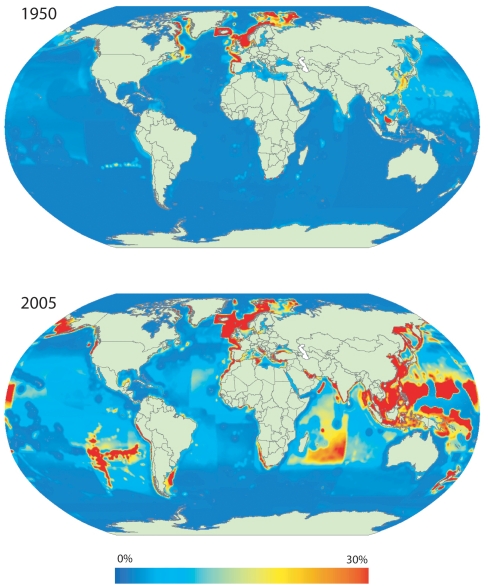
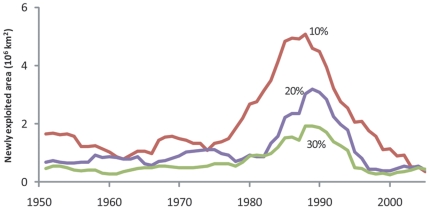
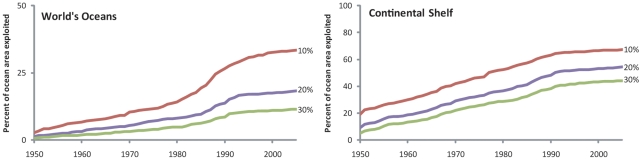
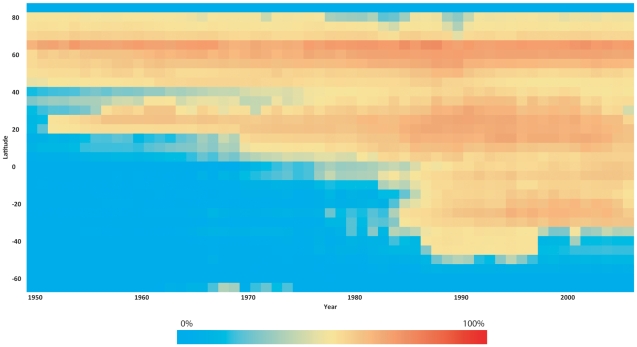
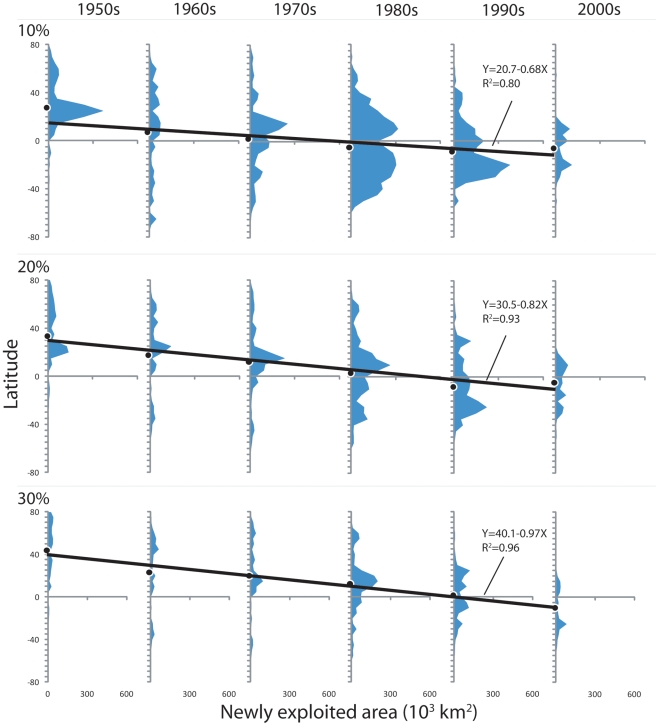
Using estimates of the primary production required (PPR) to support fisheries catches (a measure of the footprint of fishing), we analyzed the geographical expansion of the global marine fisheries from 1950 to 2005. We used multiple threshold levels of PPR as percentage of local primary production to define 'fisheries exploitation' and applied them to the global dataset of spatially-explicit marine fisheries catches. This approach enabled us to assign exploitation status across a 0.5° latitude/longitude ocean grid system and trace the change in their status over the 56-year time period. This result highlights the global scale expansion in marine fisheries, from the coastal waters off North Atlantic and West Pacific to the waters in the Southern Hemisphere and into the high seas. The southward expansion of fisheries occurred at a rate of almost one degree latitude per year, with the greatest period of expansion occurring in the 1980s and early 1990s. By the mid 1990s, a third of the world's ocean, and two-thirds of continental shelves, were exploited at a level where PPR of fisheries exceed 10% of PP, leaving only unproductive waters of high seas, and relatively inaccessible waters in the Arctic and Antarctic as the last remaining 'frontiers.' The growth in marine fisheries catches for more than half a century was only made possible through exploitation of new fishing grounds. Their rapidly diminishing number indicates a global limit to growth and highlights the urgent need for a transition to sustainable fishing through reduction of PPR.
Overview
The claims and statistics of this paper haven’t been checked yet.
Free: it reads the open-access text and checks the first 5 claims that cite a source we can check. Create a free account to check every claim.
Integrity signals
Registry
Cites
Statistics
Figures
Verification
Claims the paper makes
The claims and statistics of this paper haven’t been checked yet.
Free: it reads the open-access text and checks the first 5 claims that cite a source we can check. Create a free account to check every claim.
Claims other papers make about this one
Each is checked against this paper’s own text: does it say what the citing paper says it does?
The source backs part of the claim, not all of it — or backs it for a different population, condition or comparison.
In the citing paper
“About two-thirds of the ocean area where HANPP is >10% is found above the shallow shelf areas (38) where ecosystems are most intensely exploited.”
From Earth beyond six of nine planetary boundaries (2023) · cites this paper as [38]
Experimental — accuracy not yet measured
Self-check
Percentages, sums and reported differences re-computed from the paper’s own numbers.
The self-check needs the paper’s full text.
Citations
Cites
Historical Overfishing and the Recent Collapse of Coastal Ecosystems
Jackson, J. B. C., Kirby, M. X., Berger, W. H., Bjorndal, K. A., Botsford, L. W., Bourque, B. J., Bradbury, R. H., Cooke, R., Erlandson, J., Estes, J. A., et al. (2001) · Science · doi:10.1126/science.1059199 · Cited by 6,652 · cited 1×
“There is a wide realization that fisheries, similar to agriculture on land [1], has a tremendous impact on marine ecosystems and on the biodiversity embedded therein [2,3].”
BackgroundPauly, D., Christensen, V., Dalsgaard, J., Froese, R., & Torres, F. (1998) · Science · doi:10.1126/science.279.5352.860 · Cited by 4,743
Self-citationTowards sustainability in world fisheries.
Pauly, D., Christensen, V., Guénette, S., Pitcher, T. J., Sumaila, U. R., Walters, C. J., Watson, R., & Zeller, D. (2002) · Nature · doi:10.1038/nature01017 · Cited by 3,019 · cited 3×
“This result highlights the global scale expansion in marine fisheries, from the coastal waters off North Atlantic and West Pacific to the waters in the Southern Hemisphere and into the high seas.”
BackgroundSelf-citationThe State of World Fisheries and Aquaculture 2018: Meeting the Sustainable Development Goals
Food and Agriculture Organization of the United Nations (2018) · The State of World Fisheries and Aquaculture · doi:10.18356/8d6ea4b6-en · Cited by 2,075
Primary production required to sustain global fisheries
Pauly, D., & Christensen, V. (1995) · Nature · doi:10.1038/374255a0 · Cited by 1,888 · cited 4×
“We applied a 9:1 ratio for CR and 10% for TE [15].”
BackgroundMethodInfluentialSelf-citationHaberl, H., Erb, K. H., Krausmann, F., Gaube, V., Bondeau, A., Plutzar, C., Gingrich, S., Lucht, W., & Fischer-Kowalski, M. (2007) · Proceedings of the National Academy of Sciences · doi:10.1073/pnas.0704243104 · Cited by 1,617 · cited 1×
“8% of potential net primary productivity humans appropriate on land [21].”
BackgroundTilman, D. (1999) · Proceedings of the National Academy of Sciences · doi:10.1073/pnas.96.11.5995 · Cited by 1,406
Global phytoplankton decline over the past century
Boyce, D. G., Lewis, M. R., & Worm, B. (2010) · Nature · doi:10.1038/nature09268 · Cited by 1,363 · cited 1×
“For our analysis, we assumed primary production to be constant over the study period, due to incomplete temporal coverage in the SeaWiFS dataset. While the level of primary production may have declined over the past 50 years concomitant with an observed reduction in the global chlorophyll concentration”
MethodEstimating the Worldwide Extent of Illegal Fishing
Agnew, D. J., Pearce, J., Pramod, G., Peatman, T., Watson, R., Beddington, J. R., & Pitcher, T. J. (2009) · PLoS ONE · doi:10.1371/journal.pone.0004570 · Cited by 1,009
Self-citationThe fate of marine autotrophic production
Duarte, C. M., & Cebrián, J. (1996) · Limnology and Oceanography · doi:10.4319/lo.1996.41.8.1758 · Cited by 1,000
Research works printed but not linked: 1
- FAO 2009 The state of world fisheries and aquaculture. FAO. Rome 84
Cited by
Earth beyond six of nine planetary boundaries
Richardson, K., Steffen, W., Lucht, W., Bendtsen, J., Cornell, S. E., Donges, J. F., Drüke, M., Fetzer, I., Bala, G., von Bloh, W., et al. (2023) · Science Advances · doi:10.1126/sciadv.adh2458 · Cited by 3,311
“About twothirds of the ocean area where HANPP is >10% is found above the shallow shelf areas (38) where ecosystems are most intensely exploited.”
Extinction risk and conservation of the world’s sharks and rays
Dulvy, N. K., Fowler, S. L., Musick, J. A., Cavanagh, R. D., Kyne, P. M., Harrison, L. R., Carlson, J. K., Davidson, L. N., Fordham, S. V., Francis, M. P., et al. (2014) · eLife · doi:10.7554/elife.00590 · Cited by 2,047
“We suggest that this is because fishing activity is now widespread throughout the world’s oceans (Swartz et al., 2010), and even species with the largest ranges are exposed and often entirely encompassed by the footprint of fishing activity.”
BackgroundPauly, D., & Zeller, D. (2016) · Nature Communications · doi:10.1038/ncomms10244 · Cited by 1,313
“Ultimately, the total catch extracted from a given area, such as a given EEZ or EEZ-equivalent waters, or high seas waters within a given FAO area is computed as the sum of three data layers: (1) the reconstructed domestic catches within home EEZs ( ‘Layer 1’ data); (2) the derived catch by foreign fleets (‘Layer 2’ d…”
BackgroundMethodSelf-citationTracking the global footprint of fisheries
Kroodsma, D. A., Mayorga, J., Hochberg, T., Miller, N. A., Boerder, K., Ferretti, F., Wilson, A., Bergman, B., White, T. D., Block, B. A., et al. (2018) · Science · doi:10.1126/science.aao5646 · Cited by 1,090
Status and Solutions for the World’s Unassessed Fisheries
Costello, C., Ovando, D., Hilborn, R., Gaines, S. D., Deschenes, O., & Lester, S. E. (2012) · Science · doi:10.1126/science.1223389 · Cited by 796
Global decline in capacity of coral reefs to provide ecosystem services
Eddy, T. D., Lam, V. W. Y., Reygondeau, G., Cisneros-Montemayor, A. M., Greer, K., Palomares, M. L. D., Bruno, J. F., Ota, Y., & Cheung, W. W. L. (2021) · One Earth · doi:10.1016/j.oneear.2021.08.016 · Cited by 706
Blue growth and blue justice: Ten risks and solutions for the ocean economy
Bennett, N. J., Blythe, J., White, C. S., & Campero, C. (2021) · Marine Policy · doi:10.1016/j.marpol.2020.104387 · Cited by 526
Jellyfish and Ctenophore Blooms Coincide with Human Proliferations and Environmental Perturbations
Purcell, J. E. (2012) · Annual Review of Marine Science · doi:10.1146/annurev-marine-120709-142751 · Cited by 512
Devillers, R., Pressey, R. L., Grech, A., Kittinger, J. N., Edgar, G. J., Ward, T., & Watson, R. (2015) · Aquatic Conservation: Marine and Freshwater Ecosystems · doi:10.1002/aqc.2445 · Cited by 393
Self-citationReconciling fisheries catch and ocean productivity
Stock, C. A., John, J. G., Rykaczewski, R. R., Asch, R. G., Cheung, W. W. L., Dunne, J. P., Friedland, K. D., Lam, V. W. Y., Sarmiento, J. L., & Watson, R. A. (2017) · Proceedings of the National Academy of Sciences · doi:10.1073/pnas.1610238114 · Cited by 312
“Offshore effort and ecosystem-level exploitation per area also generally remains far less than in coastal regions (55, 56).”
BackgroundSelf-citationConservation and management of seahorses and other Syngnathidae
Vincent, A. C. J., Foster, S. J., & Koldewey, H. J. (2011) · Journal of Fish Biology · doi:10.1111/j.1095-8649.2011.03003.x · Cited by 305
Managing fisheries for human and food security
McClanahan, T., Allison, E. H., & Cinner, J. E. (2015) · Fish and Fisheries · doi:10.1111/faf.12045 · Cited by 302
“Given the considerable amount of the net primary production consumed by harvested species (Swartz et al. 2010), this lost production of the plankton will also reduce fish catch rates.”
BackgroundInfluentialTodd, P. A., Heery, E. C., Loke, L. H. L., Thurstan, R. H., Kotze, D. J., & Swan, C. (2019) · Oikos · doi:10.1111/oik.05946 · Cited by 291
Linking freshwater fishery management to global food security and biodiversity conservation
McIntyre, P. B., Reidy Liermann, C. A., & Revenga, C. (2016) · Proceedings of the National Academy of Sciences · doi:10.1073/pnas.1521540113 · Cited by 280
“Recent analyses of marine fishery sustainability in terms of embodied primary productivity indicate widespread overfishing (35), but lack of systematic data on river ecosystem energetics precludes performing a similar analysis using our map of estimated catches.”
MethodResultGlobal marine fisheries discards: A synthesis of reconstructed data
Zeller, D., Cashion, T., Palomares, M., & Pauly, D. (2018) · Fish and Fisheries · doi:10.1111/faf.12233 · Cited by 278
Self-citationMost fish destined for fishmeal production are food‐grade fish
Cashion, T., Le Manach, F., Zeller, D., & Pauly, D. (2017) · Fish and Fisheries · doi:10.1111/faf.12209 · Cited by 270
Self-citationHuman Appropriation of Net Primary Production: Patterns, Trends, and Planetary Boundaries
Haberl, H., Erb, K.-H., & Krausmann, F. (2014) · Annual Review of Environment and Resources · doi:10.1146/annurev-environ-121912-094620 · Cited by 275
“A global, spatially explicit study (149) used a NPP approach to analyze the geographic expansion of global marine fisheries from 1950 to 2005.”
Global marine yield halved as fishing intensity redoubles
Watson, R. A., Cheung, W. W. L., Anticamara, J. A., Sumaila, R. U., Zeller, D., & Pauly, D. (2013) · Fish and Fisheries · doi:10.1111/j.1467-2979.2012.00483.x · Cited by 272
“Fishing fleets have not just increased their intensity since the 1950s, but they have also expanded their reach, deploying fishing gear over an increasingly large part of the world’s oceans (Swartz et al. 2010).”
BackgroundResultInfluentialSelf-citationWorm, B., & Branch, T. A. (2012) · Trends in Ecology & Evolution · doi:10.1016/j.tree.2012.07.005 · Cited by 268
Global Priorities for Marine Biodiversity Conservation
Selig, E. R., Turner, W. R., Troëng, S., Wallace, B. P., Halpern, B. S., Kaschner, K., Lascelles, B. G., Carpenter, K. E., & Mittermeier, R. A. (2014) · PLoS ONE · doi:10.1371/journal.pone.0082898 · Cited by 257
“In both EEZs and ABNJ, areas in the Northern Hemisphere were generally more impacted than the Southern Hemisphere (Fig.”
BackgroundNavigating a just and inclusive path towards sustainable oceans
Bennett, N. J. (2018) · Marine Policy · doi:10.1016/j.marpol.2018.06.001 · Cited by 250
“, the Exclusive Economic Zones (EEZ) of countries as established under the United Nations Convention on the Law of the Sea (UNCLOS) - but also in international waters [3,10,11].”
BackgroundEcological Footprint: Implications for biodiversity
Galli, A., Wackernagel, M., Iha, K., & Lazarus, E. (2014) · Biological Conservation · doi:10.1016/j.biocon.2013.10.019 · Cited by 235
Global economic value of shark ecotourism: implications for conservation
Cisneros-Montemayor, A. M., Barnes-Mauthe, M., Al-Abdulrazzak, D., Navarro-Holm, E., & Sumaila, U. R. (2013) · Oryx · doi:10.1017/s0030605312001718 · Cited by 234
“It is important to keep in mind that global shark fishing effort has increased and expanded spatially (Myers & Worm, 2003; Swartz et al., 2010), making catch declines during the past decade of great concern.”
BackgroundMechanisms, detection and impacts of species redistributions under climate change
Lawlor, J. A., Comte, L., Grenouillet, G., Lenoir, J., Baecher, J. A., Bandara, R. M. W. J., Bertrand, R., Chen, I.-C., Diamond, S. E., Lancaster, L. T., et al. (2024) · Nature Reviews Earth & Environment · doi:10.1038/s43017-024-00527-z · Cited by 226
“In the ocean, historical patterns of human activity have expanded concurrently with warming, as fishing fleets are shifting poleward by almost 1° latitude per year 244 and trans-Arctic shipping routes have greatly expanded in navigability since the 1980s (ref.”
China's distant‐water fisheries in the 21st century
Pauly, D., Belhabib, D., Blomeyer, R., Cheung, W. W. W. L., Cisneros‐Montemayor, A. M., Copeland, D., Harper, S., Lam, V. W. Y., Mai, Y., Le Manach, F., et al. (2014) · Fish and Fisheries · doi:10.1111/faf.12032 · Cited by 202
“This decline, which appeared earlier in regions of the world where fisheries where first industrialized, for example in north-western Europe, triggered a generalized expansion of industrial fisheries (Swartz et al. 2010).”
BackgroundSelf-citationCommercial fishing patterns influence odontocete whale-longline interactions in the Southern Ocean
Tixier, P., Burch, P., Richard, G., Olsson, K., Welsford, D., Lea, M.-A., Hindell, M. A., Guinet, C., Janc, A., Gasco, N., et al. (2019) · Scientific Reports · doi:10.1038/s41598-018-36389-x · Cited by 197
Marine Social Science for the Peopled Seas
Bennett, N. J. (2019) · Coastal Management · doi:10.1080/08920753.2019.1564958 · Cited by 189
“While many fisheries within territorial waters may already be fished beyond sustainable levels, the global spatial and ecological footprint of fisheries has continued to expand (Swartz et al. 2010) and island states and developing nations often see fisheries as an area of growth (Michel 2017).”
BackgroundEnd Overfishing and Increase the Resilience of the Ocean to Climate Change
Sumaila, U. R., & Tai, T. C. (2020) · Frontiers in Marine Science · doi:10.3389/fmars.2020.00523 · Cited by 185
A century of fish biomass decline in the ocean
Christensen, V, Coll, M., Piroddi, C., Steenbeek, J., Buszowski, J., & Pauly, D. (2014) · Marine Ecology Progress Series · doi:10.3354/meps10946 · Cited by 184
Self-citationWinners and losers in a world where the high seas is closed to fishing
Sumaila, U. R., Lam, V. W. Y., Miller, D. D., Teh, L., Watson, R. A., Zeller, D., Cheung, W. W. L., Côté, I. M., Rogers, A. D., Roberts, C., et al. (2015) · Scientific Reports · doi:10.1038/srep08481 · Cited by 178
Self-citationTrophic level-based indicators to track fishing impacts across marine ecosystems
Shannon, L., Coll, M., Bundy, A., Gascuel, D., Heymans, J., Kleisner, K., Lynam, C., Piroddi, C., Tam, J., Travers-Trolet, M., et al. (2014) · Marine Ecology Progress Series · doi:10.3354/meps10821 · Cited by 166
“…Morato et al. (2006) suggest that the expansion of fisheries (‘fisheries expansion’) into deeper waters (fishing deeper in the food web) and further offshore is masking the ‘fishing down’ effect through the inclusion of new fishing grounds and new, higher TL species caught (Swartz et al. 2010).”
BackgroundInfluentialFar from home: Distance patterns of global fishing fleets
Tickler, D., Meeuwig, J. J., Palomares, M.-L., Pauly, D., & Zeller, D. (2018) · Science Advances · doi:10.1126/sciadv.aar3279 · Cited by 164
“Our findings on the spatial expansion of industrial fishing are consistent with previous estimates by the Sea Around Us using only the FAO reported landings data (6).”
BackgroundResultInfluentialSelf-citationGlobal population trajectories of tunas and their relatives
Juan-Jordá, M. J., Mosqueira, I., Cooper, A. B., Freire, J., & Dulvy, N. K. (2011) · Proceedings of the National Academy of Sciences · doi:10.1073/pnas.1107743108 · Cited by 161
“H have long exploited themargins of pelagic ecosystems, but only over the past half century has rapid technological development allowed fisheries to operate regularly beyond the sight of land and exploit vast populations of oceanic fishes that were relatively untouched (1, 2).”
BackgroundPalomares, M. L. D., Froese, R., Derrick, B., Meeuwig, J. J., Nöel, S.-L., Tsui, G., Woroniak, J., Zeller, D. C., & Pauly, D. F. (2020) · Estuarine Coastal and Shelf Science · doi:10.1016/j.ecss.2020.106896 · Cited by 191
Self-citationThe importance of migratory connectivity for global ocean policy
Dunn, D. C., Harrison, A., Curtice, C., DeLand, S. E., Donnelly, B., Fujioka, E., Heywood, E. I., Kot, C. Y., Poulin, S. K., Whitten, M., et al. (2019) · Proceedings of the Royal Society B Biological Sciences · doi:10.1098/rspb.2019.1472 · Cited by 175
“As fishing, shipping and pollution increased in ABNJ after the 1950s [12,44], the potential for negative effects on migratory species with socioeconomic or cultural significance has increased.”
BackgroundGlobal ecosystem overfishing: Clear delineation within real limits to production
Link, J. S., & Watson, R. A. (2019) · Science Advances · doi:10.1126/sciadv.aav0474 · Cited by 137
Self-citationMasked, diluted and drowned out: how global seafood trade weakens signals from marine ecosystems
Crona, B. I., Daw, T. M., Swartz, W., Norström, A. V., Nyström, M., Thyresson, M., Folke, C., Hentati‐Sundberg, J., Österblom, H., Deutsch, L., et al. (2016) · Fish and Fisheries · doi:10.1111/faf.12109 · Cited by 136
Self-citationFishing for the future: An overview of challenges and opportunities
Sumaila, U. R., Bellmann, C., & Tipping, A. (2016) · Marine Policy · doi:10.1016/j.marpol.2016.01.003 · Cited by 174
A vision for marine fisheries in a global blue economy
Pauly, D. F. (2017) · Marine Policy · doi:10.1016/j.marpol.2017.11.010 · Cited by 163
“The main response of fisheries, when viewed as a global system, however, was to expand [3,36,37].”
BackgroundSelf-citationEmpowering high seas governance with satellite vessel tracking data
Dunn, D. C., Jablonicky, C., Crespo, G. O., McCauley, D. J., Kroodsma, D. A., Boerder, K., Gjerde, K. M., & Halpin, P. N. (2018) · Fish and Fisheries · doi:10.1111/faf.12285 · Cited by 130
Lopes, C., Antelo, L. T., Franco‐Uría, A., Alonso, A. A., & Pérez‐Martín, R. I. (2015) · Waste Management · doi:10.1016/j.wasman.2015.08.017 · Cited by 163
Chinese market responses to overexploitation of sharks and sea cucumbers
Eriksson, H., & Clarke, S. (2015) · Biological Conservation · doi:10.1016/j.biocon.2015.01.018 · Cited by 126
Fishing down the deep: Accounting for within-species changes in depth of fishing
Watson, R. A., & Morato, T. (2013) · Fisheries Research · doi:10.1016/j.fishres.2012.12.004 · Cited by 124
“In general, the expansion of fisheries offshore and into more remote areas has been well documented (Swartz et al., 2010).”
BackgroundSelf-citationFilling historical data gaps to foster solutions in marine conservation
Thurstan, R. H., McClenachan, L., Crowder, L. B., Drew, J., Kittinger, J. N., Levin, P. S., Roberts, C. M., & Pandolfi, J. M. (2015) · Ocean & Coastal Management · doi:10.1016/j.ocecoaman.2015.04.019 · Cited by 145
Euros vs. Yuan: Comparing European and Chinese Fishing Access in West Africa
Belhabib, D., Sumaila, U. R., Lam, V. W. Y., Zeller, D., Le Billon, P., Abou Kane, E., & Pauly, D. (2015) · PLOS ONE · doi:10.1371/journal.pone.0118351 · Cited by 120
“It is worth noting that the situation is similar for Japan [3] and likely also for China [6].”
BackgroundSelf-citationPitcher, T. J., & Cheung, W. W. L. (2013) · Marine Pollution Bulletin · doi:10.1016/j.marpolbul.2013.05.045 · Cited by 150
“Marine fisheries catches have not increased since the 1980s (FAO, 2012) and there is evidence of episodes of serial depletion by location and depth (e.g., Morato et al., 2006; Swartz et al., 2010).”
BackgroundA review of the impacts of fisheries on open-ocean ecosystems
Crespo, G. O., & Dunn, D. C. (2017) · ICES Journal of Marine Science · doi:10.1093/icesjms/fsx084 · Cited by 143
“Historically, marine fisheries have operated near coastal areas, mainly because of the elevated biological productivity of coastal systems and our reduced ability to store and transport fish from distant waters (Pauly et al., 2005; Swartz et al., 2010).”
BackgroundInfluentialUsing global catch data for inferences on the world’s marine fisheries
Kleisner, K. M., Zeller, D. C., Froese, R., & Pauly, D. F. (2012) · Fish and Fisheries · doi:10.1111/j.1467-2979.2012.00469.x · Cited by 154
“Introduction 2 History of the stock status plots 2 Challenges, improvements and using SSPs 6 Simulations that appear to invalidate SSPs 6 Two real issues: developing and rebuilding stocks 7 Using SSPs: Acceleration of shifts in global stock status 8 Expected SSP performance under various scenarios…”
BackgroundMethodSelf-citationColl, M., Carreras, M., Ciércoles, C., Cornax, M.-J., Gorelli, G., Morote, E., & Sáez, R. (2014) · PLoS ONE · doi:10.1371/journal.pone.0085670 · Cited by 129
Effects of biological, economic and management factors on tuna and billfish stock status
Pons, M., Branch, T. A., Melnychuk, M. C., Jensen, O. P., Brodziak, J., Fromentin, J. M., Harley, S. J., Haynie, A. C., Kell, L. T., Maunder, M. N., et al. (2017) · Fish and Fisheries · doi:10.1111/faf.12163 · Cited by 107
“60 Acknowledgements 61 References 62 Supporting Information 63 64 Introduction 65 66 The oceans have been subjected to intensive fishing pressure over the past 60 years, with 67 fisheries expanding to new geographic areas, shifting from coastal to pelagic environments 68 (Swartz et al. 2010).”
BackgroundPike, E. P., MacCarthy, J. M. C., Hameed, S. O., Harasta, N., Grorud‐Colvert, K., Sullivan‐Stack, J., Claudet, J., Costa, B. H. E., Gonçalves, E. J., Villagomez, A. O., et al. (2024) · Conservation Letters · doi:10.1111/conl.13020 · Cited by 107
“In only 70 years, industrial fishing has expanded to ABNJ as a result of overfished EEZs, increased demand, government subsidies, and technological innovation making fishing possible in previously unreachable places (Milazzo, 1998; Sala et al., 2018; Swartz et al., 2010).”
Creating a Sustainable Food Future
Searchinger, T., Waite, R., Hanson, C., Ranganathan, J., & Matthews, E. (2019) · Cited by 163
Shark depredation in commercial and recreational fisheries
Mitchell, J. D., McLean, D., Collin, S. P., & Langlois, T. J. (2018) · Reviews in Fish Biology and Fisheries · doi:10.1007/s11160-018-9528-z · Cited by 107
Contagious exploitation of marine resources
Eriksson, H., Österblom, H., Crona, B., Troell, M. F., Andrew, N. L., Wilen, J. E., & Folke, C. (2015) · Frontiers in Ecology and the Environment · doi:10.1890/140312 · Cited by 113
“Over the past century, the global geographical spread of wild capture fisheries has generally followed a pattern of sequential exploitation into new areas (Berkes et al. 2006; Swartz et al. 2010; Anderson et al. 2011a; Norse et al. 2012).”
BackgroundThe global ocean is an ecosystem: simulating marine life and fisheries
Christensen, V., Coll, M., Buszowski, J., Cheung, W. W. L., Frölicher, T. L., Steenbeek, J. G., Stock, C. A. A., Watson, R. A., & Walters, C. J. (2015) · Global Ecology and Biogeography · doi:10.1111/geb.12281 · Cited by 107
“This spatial–temporal pattern is in line with the previously described expansion and ecological footprint of fisheries (Coll et al., 2008b; Swartz et al., 2010).”
ResultSelf-citationSeventy‐One Important Questions for the Conservation of Marine Biodiversity
Parsons, E. C. M., Favaro, B., Aguirre, A. A., Bauer, A., Blight, L. K., Cigliano, J. A., Coleman, M. A., Côté, I. M., Draheim, M., Fletcher, S., et al. (2014) · Conservation Biology · doi:10.1111/cobi.12303 · Cited by 109
“The global extent of fishing is increasing in terms of spatial extent and the depth at which it occurs, opening previously inaccessible refugia to exploitation (Morato et al. 2006; Swartz et al. 2010).”
BackgroundFisheries and Policy Implications for Human Nutrition
Vianna, G. M. S., Zeller, D. C., & Pauly, D. F. (2020) · Current Environmental Health Reports · doi:10.1007/s40572-020-00286-1 · Cited by 125
Self-citationSeafood substitution and mislabeling in Brussels' restaurants and canteens
Christiansen, H., Fournier, N., Hellemans, B., & VOLCKAERT, F. A. M. (2017) · Food Control · doi:10.1016/j.foodcont.2017.09.005 · Cited by 100
High seas fisheries play a negligible role in addressing global food security
Schiller, L., Bailey, M., Jacquet, J., & Sala, E. (2018) · Science Advances · doi:10.1126/sciadv.aat8351 · Cited by 102
“As inshore fish populations have been sequentially overfished and depleted, the development of industrial and technologically advanced fishing gears, storage, and processing capabilities has enabled vessels to travel farther offshore in pursuit of fish (12), and industrial fishing currently occurs in more than half of…”
BackgroundSelf-citationA coupled human-Earth model perspective on long-term trends in the global marine fishery
Galbraith, E. D., Carozza, D. A., & Bianchi, D. (2017) · Nature Communications · doi:10.1038/ncomms14884 · Cited by 100
The past and future of fish consumption: Can supplies meet healthy eating recommendations?
Thurstan, R. H., & Roberts, C. M. (2014) · Marine Pollution Bulletin · doi:10.1016/j.marpolbul.2014.09.016 · Cited by 101
Global Ex-vessel Fish Price Database Revisited: A New Approach for Estimating ‘Missing’ Prices
Swartz, W., Sumaila, R., & Watson, R. (2013) · Environmental and Resource Economics · doi:10.1007/s10640-012-9611-1 · Cited by 84
Self-citationComparing bycatch mitigation strategies for vulnerable marine megafauna
Senko, J. F., White, E. R., Heppell, S., & Gerber, L. R. (2013) · Animal Conservation · doi:10.1111/acv.12051 · Cited by 84
“Fishing effort has increased worldwide over the past few decades (Swartz et al., 2010; Anticamara et al., 2011), leading to concerns over the impacts on non-target animals and habitats (Lewison et al., 2004a, 2011).”
BackgroundRelano, V., & Pauly, D. F. (2023) · Marine Policy · doi:10.1016/j.marpol.2023.105571 · Cited by 114
Self-citationTechnical Change and The Commons
Squires, D., & Vestergaard, N. K. (2013) · The Review of Economics and Statistics · doi:10.1162/rest_a_00346 · Cited by 92
“23 Growth in global capture marine fisheries landings is driven by resource using technical change through expansion into previously unexploited ocean areas (southward, both poles, high seas, deeper in the water column) and new species (Swartz et al., 2010).”
BackgroundEwell, C., Hocevar, J., Mitchell, E. A., Snowden, S., & Jacquet, J. (2020) · Marine Policy · doi:10.1016/j.marpol.2020.103842 · Cited by 89
A critical review of fishing agreements with tropical developing countries
Gagern, A., & van den Bergh, J. C. J. M. (2012) · Marine Policy · doi:10.1016/j.marpol.2012.06.016 · Cited by 101
“Applying this indicator to historic catches of a wide range of species groups, [2] show that the overall increase in global fishing effort in the past 60 years was accompanied by a southward expansion of effort (catches corresponding to at least 10% of PPR) at a rate of almost 11 latitude per year.”
BackgroundKrüger, L., Ramos, J. A., Xavier, J. C., Grémillet, D., González‐Solís, J., Petry, M. V., Phillips, R. A., Wanless, R. M., & Paiva, V. H. (2017) · Ecography · doi:10.1111/ecog.02590 · Cited by 96
Biogeochemical control of marine productivity in the Mediterranean Sea during the last 50 years
Macias, D. M., García‐Górriz, E., Piroddi, C., & Stips, A. (2014) · Global Biogeochemical Cycles · doi:10.1002/2014gb004846 · Cited by 85
“…expansion of fishing fleets to deeper areas and to Northern African countries, where fishing resources are still abundant, is driven by declines of inshore catches and aided by improved technology and supported by subsidies [Sumaila et al., 2010; Swartz et al., 2010; Watson et al., 2011].”
BackgroundFish Farms at Sea: The Ground Truth from Google Earth
Trujillo, P., Piroddi, C., & Jacquet, J. (2012) · PLoS ONE · doi:10.1371/journal.pone.0030546 · Cited by 89
“Due to extensive and expanding overfishing of wild-caught seafood [3,4], ocean fish farming has grown to augment the supply of fresh fish to western markets.”
BackgroundGlobal fisheries losses at the exclusive economic zone level, 1950 to present
Srinivasan, U. T., Watson, R. A., & Sumaila, U. R. (2011) · Marine Policy · doi:10.1016/j.marpol.2011.10.001 · Cited by 94
“During the 1950s, most of the Northern oceans came under exploitation [12], and accordingly, 14 of the 15 EEZs registering top losses in the 1970s were Northern hemisphere countries.”
BackgroundInfluentialSelf-citationThe environmental niche of the global high seas pelagic longline fleet
Crespo, G. O., Dunn, D. C., Reygondeau, G., Boerder, K., Worm, B., Cheung, W., Tittensor, D. P., & Halpin, P. N. (2018) · Science Advances · doi:10.1126/sciadv.aat3681 · Cited by 69
Multicentury trends and the sustainability of coral reef fisheries in Hawai‘i and Florida
McClenachan, L., & Kittinger, J. N. (2012) · Fish and Fisheries · doi:10.1111/j.1467-2979.2012.00465.x · Cited by 89
“…tropical islands provides a microcosm for evaluating limits to global fisheries, as these societies were often entirely dependent on local resources with few opportunities for geographic expansion, a complicating issue in analyses of sustainability of the global fisheries (e.g. Swartz et al. 2010).”
BackgroundPrimary productivity demands of global fishing fleets
Watson, R. A., Zeller, D. C., & Pauly, D. F. (2013) · Fish and Fisheries · doi:10.1111/faf.12013 · Cited by 84
“…inshore waters, aided by improved technology and supported by subsidies (Sumaila et al. 2010a,b), resulted in few resources that are now unfished (Swartz et al. 2010a; Watson et al. in press), and fisheries now harvest even vulnerable slow-growing populations at great depths (Pauly et al. 2003;…”
BackgroundInfluentialSelf-citationSilas, M. O., Mgeleka, S. S., Polte, P., Sköld, M., Lindborg, R., de la Torre‐Castro, M., & Gullström, M. (2020) · Environmental Science & Policy · doi:10.1016/j.envsci.2020.03.012 · Cited by 105
Global seafood trade flows and developing economies: Insights from linking trade and production
Watson, R. A., Nichols, R., Lam, V. W. Y., & Sumaila, U. R. (2017) · Marine Policy · doi:10.1016/j.marpol.2017.04.017 · Cited by 96
Self-citationFishing down the food web of the Antarctic continental shelf and slope
Ainley, D. G., & Pauly, D. F. (2013) · Polar Record · doi:10.1017/s0032247412000757 · Cited by 87
Self-citationIncorporating carbon footprints into seafood sustainability certification and eco-labels
Madin, E. M. P., & Macreadie, P. I. (2015) · Marine Policy · doi:10.1016/j.marpol.2015.03.009 · Cited by 83
“, [3]) and the potential effects of future climate change on increasing variability in fisheries stocks [19] suggests that sustainability campaigns within the realm of the seafood industry have both substantial responsibility and incentive to be at the forefront of this new approach.”
Fisheries impacts on China's coastal ecosystems: Unmasking a pervasive ‘fishing down’ effect
Liang, C., & Pauly, D. F. (2017) · PLoS ONE · doi:10.1371/journal.pone.0173296 · Cited by 76
Self-citationCorrales, X., Coll, M., Tecchio, S., Bellido-Millán, J. M., Fernández, Á. M., & Palomera, I. (2015) · Journal of Marine Systems · doi:10.1016/j.jmarsys.2015.03.006 · Cited by 91
Pollution haven or pollution halo in the fishing footprint: Evidence from Indonesia
Yılancı, V., Çütçü, İ., Çayır, B., & Sağlam, M. S. (2023) · Marine Pollution Bulletin · doi:10.1016/j.marpolbul.2023.114626 · Cited by 71
Food web structure and vulnerability of a deep-sea ecosystem in the NW Mediterranean Sea
Tecchio, S., Coll, M., Christensen, V., Ramírez-Llodra, E., & Sardà, F. (2013) · Deep Sea Research Part I Oceanographic Research Papers · doi:10.1016/j.dsr.2013.01.003 · Cited by 94
“Fisheries have been expanding their footprint on marine ecosystems over the last five decades (Coll et al., 2008; Swartz et al., 2010).”
BackgroundMarine historical ecology in conservation: applying the past to manage for the future
Grossinger, R., & Brumbaugh, R. (2015) · Choice Reviews Online · doi:10.5860/choice.190255 · Cited by 71
Global networks and global change-induced tipping points
Galaz, V., Österblom, H., Bodin, Ö., & Crona, B. (2014) · International Environmental Agreements Politics Law and Economics · doi:10.1007/s10784-014-9253-6 · Cited by 85
“Such fleets will move elsewhere (further South, further offshore, and fishing at larger depths (Pauly et al. 2003; Swartz et al. 2010), which may result in IUU fishing (Agnew et al. 2009).”
BackgroundTransboundary research in fisheries
Song, A. M., Scholtens, J., Stephen, J., Bavinck, M., & Chuenpagdee, R. (2016) · Marine Policy · doi:10.1016/j.marpol.2016.10.023 · Cited by 86
Potential ecological and social benefits of a moratorium on transshipment on the high seas
Ewell, C., Cullis-Suzuki, S., Ediger, M., Hocevar, J., Miller, D. D., & Jacquet, J. (2017) · Marine Policy · doi:10.1016/j.marpol.2017.04.004 · Cited by 69
“as the high seas, to capture fish [1,2].”
BackgroundGlobal change in the trophic functioning of marine food webs
Maureaud, A. A., Gascuel, D., Colléter, M., Palomares, M. L. D., du Pontavice, H., Pauly, D. F., & Cheung, W. W. L. (2017) · PLoS ONE · doi:10.1371/journal.pone.0182826 · Cited by 85
“Ecosystems where fisheries developed more recently (cluster 2), for example in the South Hemisphere [7], also demonstrated a transition to faster biomass transfers since the 1950s.”
BackgroundSelf-citationBan, N. C., Eckert, L. E., McGreer, M. T., & Frid, A. (2017) · Ecosystem Health and Sustainability · doi:10.1080/20964129.2017.1379887 · Cited by 79
“…instance, decimated marine mammal populations (Roman and Palumbi 2003), and the advent of advanced fishing technologies such as trawling and factory freezer vessels resulted in rapid expansion of fishing footprints and reductions of many species (Pauly, Watson, and Alder 2005; Swartz et al. 2010).”
BackgroundAccounting for overfishing in life cycle assessment: new impact categories for biotic resource use
Emanuelsson, A., Ziegler, F., Pihl, L., Sköld, M., & Sonesson, U. (2014) · The International Journal of Life Cycle Assessment · doi:10.1007/s11367-013-0684-z · Cited by 82
“However, the effort spent to catch fish has steadily increased after the catches peaked (Anticamara et al. 2011), and the fishing fleets have expanded toward deeper andmore remote fishing locations (Swartz et al. 2010).”
BackgroundAnalysis of Long-Term Changes in a Mediterranean Marine Ecosystem Based on Fishery Landings
Fortibuoni, T., Giovanardi, O., Pranovi, F., Raicevich, S., Solidoro, C., & Libralato, S. (2017) · Frontiers in Marine Science · doi:10.3389/fmars.2017.00033 · Cited by 83
“, 2012); the ratio between elasmobranch and bony fish in the landings (E/B ratio; Piet and Pranovi, 2005); the Primary Production Required to sustain fishery catches (PPR; Pauly and Christensen, 1995) that is the amount of energy exported from the system by landings and can be seen as the ecological footprint of fishi…”
BackgroundKikiloi, K., Friedlander, A. M., Wilhelm, A., Lewis, N., Quiocho, K., 'Āila, W., & Kaho'ohalahala, S. (2017) · Coastal Management · doi:10.1080/08920753.2017.1373450 · Cited by 67
“Marine ecosystems are declining worldwide at an alarming rate and the footprint of modern human impacts stretches to nearly every corner of the globe (Worm et al. 2006; Halpern et al. 2008; Swartz et al. 2010).”
BackgroundXiong, X., Yao, L., Ying, X., Lu, L., Guardone, L., Armani, A., Гуиди, А., & Xiong, X. (2017) · Food Control · doi:10.1016/j.foodcont.2017.12.035 · Cited by 64
Gestation Length, Mode of Delivery, and Neonatal Line-Thickness Variation
Zanolli, C., Bondioli, L., Manni, F., Rossi, P. F., & Macchiarelli, R. (2011) · Human Biology · doi:10.1353/hub.2011.a465107 · Cited by 83
Global change in the functional diversity of marine fisheries exploitation over the past 65 years
Trindade‐Santos, I., Moyes, F., & Magurran, A. E. (2020) · Proceedings of the Royal Society B Biological Sciences · doi:10.1098/rspb.2020.0889 · Cited by 76
Thurstan, R. H. (2022) · Journal of Fish Biology · doi:10.1111/jfb.15000 · Cited by 68
Global reduction fisheries and their products in the context of sustainable limits
Cashion, T., Tyedmers, P. H., & Parker, R. W. R. (2017) · Fish and Fisheries · doi:10.1111/faf.12222 · Cited by 70
Lindkvist, E., Wijermans, N., Daw, T. M., González‐Mon, B., Girón‐Nava, A., Johnson, A. F., van Putten, I. E., Basurto, X., & Schlüter, M. (2020) · Frontiers in Marine Science · doi:10.3389/fmars.2019.00733 · Cited by 84
Batista, M. I., Henriques, S., Pais, M. P., & Cabral, H. N. (2014) · Ocean & Coastal Management · doi:10.1016/j.ocecoaman.2014.09.020 · Cited by 72
“…in most of the cases these studies evaluate the effects of individual activities (e.g. impacts of fisheries (Batista et al., 2009; Jennings and Kaiser, 1998; Swartz et al., 2010) or aquaculture (Forchino et al., 2011; Sar a et al., 2011) in different contexts and lack an holistic perspective.”
BackgroundInformation gaps limit our understanding of seabird bycatch in global fisheries
Pott, C., & Wiedenfeld, D. A. (2017) · Biological Conservation · doi:10.1016/j.biocon.2017.04.002 · Cited by 82
Lawson, J. M., Pollom, R. A., Gordon, C. A., Barker, J., Meyers, E. K. M., Zidowitz, H., Ellis, J. R., Bartolí, À., Morey, G., Fowler, S., et al. (2019) · ICES Journal of Marine Science · doi:10.1093/icesjms/fsz222 · Cited by 69
“A global increase in fishing effort occurred during the 20th century (Engelhard, 2008; Swartz et al., 2010), leading to the serial depletion of chondrichthyans (sharks, rays, and chimaeras; Ferretti et al.”
Background
Metadata
- Authors
- Swartz, W., Sala, E., Tracey, S., Watson, R., & Pauly, D.
- Affiliations
- University of British Columbia (CA)
- Consejo Superior de Investigaciones Científicas (ES)
- University of Tasmania (AU)
- Corresponding author
- Pauly, Daniel
- Venue
- PLoS ONE
- Publisher
- Public Library of Science (PLoS)
- Published
- 2010-12-02
- Volume
- 5
- Issue
- 12
- Pages
- e15143
- ISSN
- 1932-6203 (ISSN-L)
- PMC
- PMC2996307
- OpenAlex
- W2020170202
- Cited by
- 380
- References
- 35
- Citations by year
- 2026: 4 · 2025: 9 · 2024: 29 · 2023: 16 · 2022: 16 · 2021: 19 · 2020: 36 · 2019: 31 · 2018: 22 · 2017: 40 · 2016: 17 · 2015: 38 · 2014: 36 · 2013: 27 · 2012: 25
- FWCI
- 19.23
- Type
- journal article
- Language
- en
- Open access
- gold
- doi.org
- Locations
- PLoS ONE (publishedVersion, cc-by)
- PubMed Central (publishedVersion, cc-by)
- PubMed (publishedVersion)
- eCite Digital Repository (University of Tasmania) (submittedVersion, cc-by)
- DOAJ (DOAJ: Directory of Open Access Journals) (submittedVersion, cc-by-sa)
- Figshare (submittedVersion, cc-by)
- Funders
- Pew Charitable Trusts
- National Geographic Society
- Waitt Foundation
- Topics
- Life Sciences › Agricultural and Biological Sciences › Aquatic Science › Marine and fisheries research
- Physical Sciences › Environmental Science › Environmental Engineering › Sustainability and Ecological Systems Analysis
- Physical Sciences › Environmental Science › Management, Monitoring, Policy and Law › Coastal and Marine Management
- Keywords
- ecological footprint, fish catch, fisheries exploitation, high seas, continental shelf, sustainable fisheries, fishing grounds
- MeSH terms
- Animals, Antarctic Regions, Arctic Regions, Conservation of Natural Resources, Ecology, Fisheries, Fishes, Geography, Oceans and Seas, Population Dynamics, Models, Statistical, Ecosystem
About these checks
Registry, retraction, Cites and statistics results are computed, not judged, with one exception: a printed reference that no index lists is read once by a model before it counts as a citation error. Claims are extracted by a model and kept only when their quote appears verbatim in the text; each cited source is then checked, with a model’s help, for whether it says what the claim relies on. Those verdicts can be wrong — read the claim’s quote and the cited source before relying on one.
Statistics and arithmetic are recomputed, not judged.
Confidence bands are shown only for fields calibrated on our annotated test set. None is calibrated yet, so no band is shown.
What counts as a claim ›How we measure confidence ›How we check this ›
Are you an author, or do you see a problem with this page? Request a review
Data sources
Bibliographic data: Semantic Scholar, OpenAlex, Crossref.
Contains information from the Semantic Scholar Academic Graph Datasets, made available under the ODC Attribution License (ODC-BY 1.0).
Semantic Scholar’s data is described in: Kinney, R., et al. (2023). The Semantic Scholar Open Data Platform. arXiv:2301.10140.
