

The Spatial Expansion and Ecological Footprint of Fisheries (1950 to Present)
Open accessThe DOI matches its Crossref record; 32 of the 35 references it cites were found in a registry or an index.
Abstract
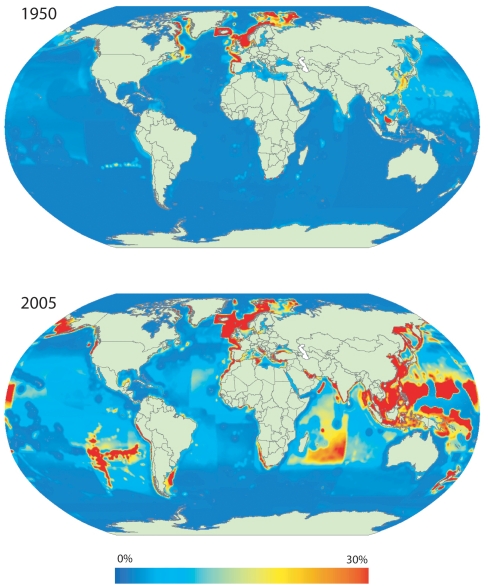
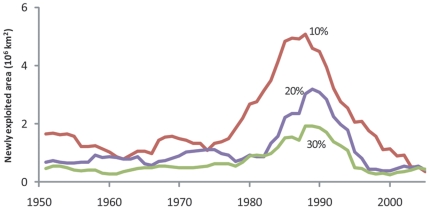
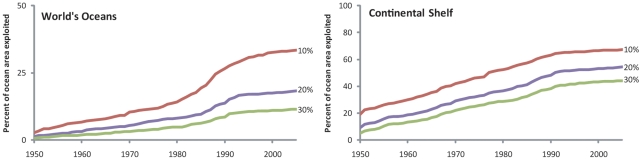
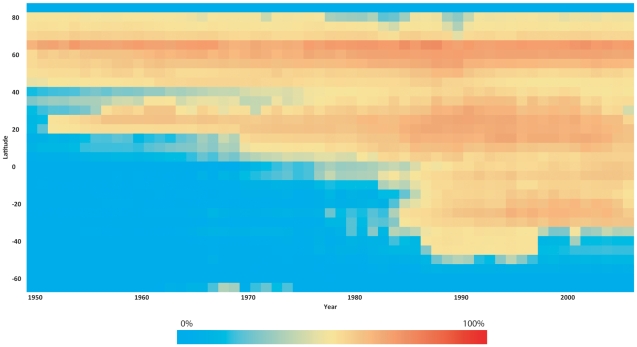
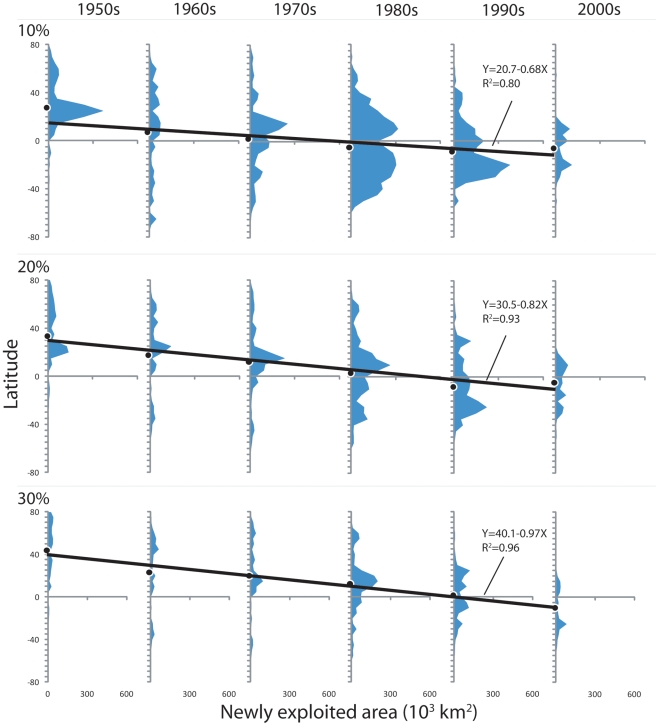
Using estimates of the primary production required (PPR) to support fisheries catches (a measure of the footprint of fishing), we analyzed the geographical expansion of the global marine fisheries from 1950 to 2005. We used multiple threshold levels of PPR as percentage of local primary production to define 'fisheries exploitation' and applied them to the global dataset of spatially-explicit marine fisheries catches. This approach enabled us to assign exploitation status across a 0.5° latitude/longitude ocean grid system and trace the change in their status over the 56-year time period. This result highlights the global scale expansion in marine fisheries, from the coastal waters off North Atlantic and West Pacific to the waters in the Southern Hemisphere and into the high seas. The southward expansion of fisheries occurred at a rate of almost one degree latitude per year, with the greatest period of expansion occurring in the 1980s and early 1990s. By the mid 1990s, a third of the world's ocean, and two-thirds of continental shelves, were exploited at a level where PPR of fisheries exceed 10% of PP, leaving only unproductive waters of high seas, and relatively inaccessible waters in the Arctic and Antarctic as the last remaining 'frontiers.' The growth in marine fisheries catches for more than half a century was only made possible through exploitation of new fishing grounds. Their rapidly diminishing number indicates a global limit to growth and highlights the urgent need for a transition to sustainable fishing through reduction of PPR.
Overview
The claims and statistics of this paper haven’t been checked yet.
Free: it reads the open-access text and checks the first 5 claims that cite a source we can check. Create a free account to check every claim.
Integrity signals
Registry
Cites
Statistics
Figures
Verification
Claims the paper makes
The claims and statistics of this paper haven’t been checked yet.
Free: it reads the open-access text and checks the first 5 claims that cite a source we can check. Create a free account to check every claim.
Claims other papers make about this one
Each is checked against this paper’s own text: does it say what the citing paper says it does?
The source backs part of the claim, not all of it — or backs it for a different population, condition or comparison.
In the citing paper
“About two-thirds of the ocean area where HANPP is >10% is found above the shallow shelf areas (38) where ecosystems are most intensely exploited.”
From Earth beyond six of nine planetary boundaries (2023) · cites this paper as [38]
Experimental — accuracy not yet measured
Self-check
Percentages, sums and reported differences re-computed from the paper’s own numbers.
The self-check needs the paper’s full text.
Citations
Cites
Historical Overfishing and the Recent Collapse of Coastal Ecosystems
Jackson, J. B. C., Kirby, M. X., Berger, W. H., Bjorndal, K. A., Botsford, L. W., Bourque, B. J., Bradbury, R. H., Cooke, R., Erlandson, J., Estes, J. A., et al. (2001) · Science · doi:10.1126/science.1059199 · Cited by 6,652 · cited 1×
“There is a wide realization that fisheries, similar to agriculture on land [1], has a tremendous impact on marine ecosystems and on the biodiversity embedded therein [2,3].”
BackgroundPauly, D., Christensen, V., Dalsgaard, J., Froese, R., & Torres, F. (1998) · Science · doi:10.1126/science.279.5352.860 · Cited by 4,743
Self-citationTowards sustainability in world fisheries.
Pauly, D., Christensen, V., Guénette, S., Pitcher, T. J., Sumaila, U. R., Walters, C. J., Watson, R., & Zeller, D. (2002) · Nature · doi:10.1038/nature01017 · Cited by 3,019 · cited 3×
“This result highlights the global scale expansion in marine fisheries, from the coastal waters off North Atlantic and West Pacific to the waters in the Southern Hemisphere and into the high seas.”
BackgroundSelf-citationThe State of World Fisheries and Aquaculture 2018: Meeting the Sustainable Development Goals
Food and Agriculture Organization of the United Nations (2018) · The State of World Fisheries and Aquaculture · doi:10.18356/8d6ea4b6-en · Cited by 2,075
Primary production required to sustain global fisheries
Pauly, D., & Christensen, V. (1995) · Nature · doi:10.1038/374255a0 · Cited by 1,888 · cited 4×
“We applied a 9:1 ratio for CR and 10% for TE [15].”
BackgroundMethodInfluentialSelf-citationHaberl, H., Erb, K. H., Krausmann, F., Gaube, V., Bondeau, A., Plutzar, C., Gingrich, S., Lucht, W., & Fischer-Kowalski, M. (2007) · Proceedings of the National Academy of Sciences · doi:10.1073/pnas.0704243104 · Cited by 1,617 · cited 1×
“8% of potential net primary productivity humans appropriate on land [21].”
BackgroundTilman, D. (1999) · Proceedings of the National Academy of Sciences · doi:10.1073/pnas.96.11.5995 · Cited by 1,406
Global phytoplankton decline over the past century
Boyce, D. G., Lewis, M. R., & Worm, B. (2010) · Nature · doi:10.1038/nature09268 · Cited by 1,363 · cited 1×
“For our analysis, we assumed primary production to be constant over the study period, due to incomplete temporal coverage in the SeaWiFS dataset. While the level of primary production may have declined over the past 50 years concomitant with an observed reduction in the global chlorophyll concentration”
MethodEstimating the Worldwide Extent of Illegal Fishing
Agnew, D. J., Pearce, J., Pramod, G., Peatman, T., Watson, R., Beddington, J. R., & Pitcher, T. J. (2009) · PLoS ONE · doi:10.1371/journal.pone.0004570 · Cited by 1,009
Self-citationThe fate of marine autotrophic production
Duarte, C. M., & Cebrián, J. (1996) · Limnology and Oceanography · doi:10.4319/lo.1996.41.8.1758 · Cited by 1,000
Research works printed but not linked: 1
- FAO 2009 The state of world fisheries and aquaculture. FAO. Rome 84
Cited by
Items 201–300 of 379
Durante, L. M., Beentjes, M. P., & Wing, S. R. (2020) · Fish and Fisheries · doi:10.1111/faf.12463 · Cited by 30
Krüger, L. (2019) · Fisheries Management and Ecology · doi:10.1111/fme.12363 · Cited by 22
Strengthening European Union fisheries by removing harmful subsidies
Villasante, S., Sumaila, U. R., Rocha, J. M. D., Carvalho, N., Skerritt, D. J., Schuhbauer, A., Cisneros-Montemayor, A. M., Bennett, N. J., Hanich, Q., & Prellezo, R. (2021) · Marine Policy · doi:10.1016/j.marpol.2021.104884 · Cited by 20
Reconstruction of Domestic Marine Fisheries Catches for Oman (1950-2015)
Khalfallah, M., Zylich, K., Zeller, D. C., & Pauly, D. F. (2016) · Frontiers in Marine Science · doi:10.3389/fmars.2016.00152 · Cited by 20
“This has severely impacted the economies and societies of maritime countries around the world, particularly in the coastal countries of the developing world (Pauly et al., 2005; Béné, 2006; Swartz et al., 2010).”
BackgroundSelf-citationReconstruction of Marine Fisheries Catches for the Republic of Malta (1950-2010)
Khalfallah, M., Dimech, M., Ulman, A., Zeller, D. C., & Pauly, D. F. (2017) · Mediterranean Marine Science · doi:10.12681/mms.1683 · Cited by 20
Self-citationEstimation of catch losses resulting from overexploitation in the global marine fisheries
Ding, Q., Chen, X., Chen, Y., & Tian, S. (2017) · Acta Oceanologica Sinica · doi:10.1007/s13131-017-1096-x · Cited by 22
“The growth in the global marine fisheries was driven through a sequential expansion, fisheries exploitation has spread from coastal waters off North Atlantic and Pacific to waters in the Southern Hemisphere and into the high seas (Swartz et al., 2010).”
BackgroundSenko, J. F., Jenkins, L. D., & Peckham, S. H. (2016) · Marine Policy · doi:10.1016/j.marpol.2016.11.017 · Cited by 19
Williams, S. M., Pepperell, J. G., Bennett, M. B., & Ovenden, J. R. (2018) · Journal of Fish Biology · doi:10.1111/jfb.13738 · Cited by 20
The race for jellyfish: Winners and losers in Mexico’s Gulf of California
Brotz, L., Cisneros-Montemayor, A. M., & Cisneros‐Mata, M. Á. (2021) · Marine Policy · doi:10.1016/j.marpol.2021.104775 · Cited by 22
Hughes, K. M., Dransfeld, L., & Johnson, M. P. (2015) · Fisheries Oceanography · doi:10.1111/fog.12128 · Cited by 22
Puffer fish and its consumption: To eat or not to eat?
Panão, I., Carrascosa, C., Jaber, J. R., & Raposo, A. (2015) · Food Reviews International · doi:10.1080/87559129.2015.1075213 · Cited by 19
“As the world population grows, the fish consumption rate will continue to rise.((3))”
BackgroundParra, H., Pham, C. K., Machete, M., Santos, M. B., Bjorndal, K. A., & Vandeperre, F. (2023) · Fisheries Research · doi:10.1016/j.fishres.2023.106730 · Cited by 18
Fishing down the food chain revisited: Modeling exploited trophic systems
Wilen, C. D., & Wilen, J. E. (2012) · Ecological Economics · doi:10.1016/j.ecolecon.2012.04.021 · Cited by 19
The impact of deep-sea fisheries and implementation of the UNGA Resolutions 61/105 and 64/72
Weaver, P. P. E., Benn, A. R., Arana, P. M., Ardron, J., Bailey, D. M., Baker, K. D., Billett, D. S. M., Clark, M. R., Davies, A. J., Durán-Muñoz, P., et al. (2011) · Helmholtz-Zentrum für Polar-und Meeresforschung (Alfred-Wegener-Institut) · Cited by 18
Fishing Impacts on Food Webs: Multiple Working Hypotheses
Branch, T. A. (2015) · Fisheries · doi:10.1080/03632415.2015.1059825 · Cited by 17
The building of a management system for marine recreational fisheries in Galicia (NW Spain)
Pita, P., & Villasante, S. (2018) · Ocean & Coastal Management · doi:10.1016/j.ocecoaman.2018.12.027 · Cited by 21
Global fishing between jurisdictions with unequal fisheries management
Klein, C. J., Kuempel, C. D., Watson, R. A., Teneva, L. T., Coll, M., & Mora, C. (2022) · Environmental Research Letters · doi:10.1088/1748-9326/ac97ab · Cited by 22
Self-citationIncorporating climate-readiness into fisheries management strategies
Talbot, E., Jontila, J. B., Gonzales, B. J., Dolorosa, R. G., Jose, E. D., Sajorne, R. E., Sailley, S. F., Kay, S., & Queirós, A. M. (2024) · The Science of The Total Environment · doi:10.1016/j.scitotenv.2024.170684 · Cited by 25
Expansion of hagfish fisheries in Atlantic Canada and worldwide
Ellis, J. E., Rowe, S., & Lotze, H. K. (2014) · Fisheries Research · doi:10.1016/j.fishres.2014.06.011 · Cited by 17
“Such spatial expansion has generally occurred in marine fisheries worldwide (Swartz et al., 2010).”
BackgroundNearshore benthic community structure at the Bounty and Antipodes Islands, Subantarctic New Zealand
Freeman, D., Cooper, S., Funnell, G. A., & Neale, D. (2011) · Polar Biology · doi:10.1007/s00300-011-1006-1 · Cited by 17
“Polar and subpolar marine ecosystems are considered to be particularly susceptible to anthropogenic-associated threats, including the expansion of fishing into higher-latitude waters such as the southern ocean (Tuck et al. 2003; Swartz et al. 2010) and climate change (Intergovernmental Panel on Climate Change 2007).”
BackgroundLanding profiles of P ortuguese fisheries: assessing the state of stocks
Leitão, F. (2015) · Fisheries Management and Ecology · doi:10.1111/fme.12112 · Cited by 21
Wehye, A. S., Danson, P. K. O., & Lamptey, A. M. (2017) · Fisheries and Aquaculture Journal · doi:10.4172/2150-3508.1000201 · Cited by 17
“Although fish are renewable resources, this huge irremediable depletion of marine biodiversity by location and depth partly due to intense fishing activities has led to decline of marine capture fisheries [2,3].”
BackgroundMurray, I. (2015) · Journal of Political Ecology · doi:10.2458/v22i1.21106 · Cited by 22
“Finally, conclusions are drawn in order to think beyond the neoliberal agenda for fishing and Blue Capitalism.”
BackgroundMethodHenriques, N. S., Russo, T., Bentes, L., Monteiro, P. P. G., Parisi, A., Magno, R., Oliveira, F., Erzini, K., & Gonçalves, J. M. S. (2023) · ICES Journal of Marine Science · doi:10.1093/icesjms/fsad092 · Cited by 16
Comparative fishery yields of African Large Marine Ecosystems
Zeller, D. C., Hood, L., Palomares, M. L. D., Sumaila, U. R., Khalfallah, M., Belhabib, D., Woroniak, J., & Pauly, D. F. (2020) · Environmental Development · doi:10.1016/j.envdev.2020.100543 · Cited by 16
“In all other LMEs the first expansion occurred earlier, in the 1960s, in line with the beginning of globally expanding industrial fisheries (Pauly et al., 2002; Swartz et al., 2010).”
BackgroundSelf-citationEcological responses to blue water MPAs
Gilman, E. L., Chaloupka, M. Y., Fitchett, M., Cantrell, D. L., & Merrifield, M. (2020) · PLoS ONE · doi:10.1371/journal.pone.0235129 · Cited by 18
Reis‐Filho, J. A. (2019) · Fisheries Management and Ecology · doi:10.1111/fme.12393 · Cited by 16
Roberts, J. M., Devey, C. W., Arne Biastoch, B., Carreiro‐Silva, M., Dohna, T. A., Dorschel, B., Gunn, V., Huvenne, V. A. I., Johnson, D. E., Jollivet, D., et al. (2023) · Communications Earth & Environment · doi:10.1038/s43247-022-00645-w · Cited by 15
“(2) Ex situ studies to assess multiple stressor effects on hardbottom species (adult and pelagic larval life stages): Studies tackling the effects of particulate plumes (from both seafloor mining and fishing) in combination with climate change stressors are urgently needed.”
BackgroundLearning, adaptation, and the complexity of human and natural interactions in the ocean
Wilson, J. A. (2017) · Ecology and Society · doi:10.5751/es-09356-220243 · Cited by 17
Effects of economics and demographics on global fisheries sustainability
Ding, Q., Wang, Y., Chen, X., & Chen, Y. (2016) · Conservation Biology · doi:10.1111/cobi.12873 · Cited by 14
Cisneros-Montemayor, A. M., & Cisneros‐Mata, M. Á. (2018) · Relaciones Estudios de Historia y Sociedad · doi:10.24901/rehs.v39i153.392 · Cited by 20
Relano, V., Palomares, M. L. D., & Pauly, D. F. (2021) · Sustainability · doi:10.3390/su13179572 · Cited by 16
“The decade-long increases in catch since the 1950s were the result of the global buildup and expansion of fishing effort throughout the world’s oceans, particularly the Pacific [61,62].”
BackgroundInfluentialSelf-citationReconstruction of Syria’s fisheries catches from 1950–2010: Signs of overexploitation
Ulman, A. (2015) · Acta Ichthyologica Et Piscatoria · doi:10.3750/aip2015.45.3.05 · Cited by 14
“The last part of this increase was due to the introduction of two dozen new large trawlers in 1994 (in addition to already active smaller trawlers), which found new grounds to exploit (i.e., spatial expansion; Swartz et al. 2010), and not due to healthier fi sh biomass (Saad 1996).”
BackgroundFisheries conservation and management: finding consensus in the midst of competing paradigms
Branch, T. A., Austin, J. D., Acevedo‐Whitehouse, K. A., Gordon, I. J., Gompper, M. E., Katzner, T. E., & Pettorelli, N. (2011) · Animal Conservation · doi:10.1111/j.1469-1795.2011.00502.x · Cited by 14
“There remain few marine systems untouched by fishing (Swartz et al., 2010).”
BackgroundLyons, D. A., Benedetti‐Cecchi, L., Frid, C. L. J., & Vinebrooke, R. D. (2015) · Cambridge University Press eBooks · doi:10.1017/cbo9781139794763.004 · Cited by 19
Daliri, M., Kamrani, E., Salarpouri, A., & Ben‐Hasan, A. (2020) · Ocean & Coastal Management · doi:10.1016/j.ocecoaman.2020.105411 · Cited by 13
Merten, W., Appeldoorn, R. S., Grove, A., Aguilar‐Perera, A., Arocha, F., & Rivera, R. (2022) · Marine Policy · doi:10.1016/j.marpol.2022.105189 · Cited by 13
Bi, M., Wei, G., & Zhang, Z. (2023) · Ocean & Coastal Management · doi:10.1016/j.ocecoaman.2023.106596 · Cited by 13
Disentangling economic, social, and environmental drivers of coral-reef fish trade in Micronesia
Cuetos‐Bueno, J., & Houk, P. (2017) · Fisheries Research · doi:10.1016/j.fishres.2017.10.010 · Cited by 13
Jefferson, T., Palomares, M. L. D., & Lundquist, C. J. (2022) · Frontiers in Marine Science · doi:10.3389/fmars.2022.826587 · Cited by 14
Durand, J.-D., Guinand, B., Dodson, J. J., & Lecomte, F. (2013) · PLoS ONE · doi:10.1371/journal.pone.0077483 · Cited by 13
“By the mid 1990s, two-thirds of all continental shelves were exploited [1].”
BackgroundInfluentialBathymetric gradients of fecundity and egg size in fishes: A Mediterranean case study
Fernández-Arcaya, U., Drazen, J. C., Murua, H., Ramírez-Llodra, E., Bahamón, N., Recasens, L., & Rotllant, G. (2016) · Deep Sea Research Part I Oceanographic Research Papers · doi:10.1016/j.dsr.2016.08.005 · Cited by 15
Bioenergetic influence on the historical development and decline of industrial fisheries
Guiet, J., Galbraith, E. D., Bianchi, D., & Cheung, W. W. L. (2020) · ICES Journal of Marine Science · doi:10.1093/icesjms/fsaa044 · Cited by 12
Wu, D., & Liu, J. (2020) · International Journal of Environmental Research and Public Health · doi:10.3390/ijerph17217833 · Cited by 13
“As an environmental model, there are criticisms on the sustainable measurement function of EF [18], however, EF has been indeed playing an important role in the sustainable evaluation in practice [15,16] and has been becoming a policy-planning tool for making ecological environmental policies [19].”
BackgroundTapeworm discovery in elasmobranch fishes: quantifying patterns and identifying their correlates
Randhawa, H. S., & Poulin, R. (2019) · Marine and Freshwater Research · doi:10.1071/mf18418 · Cited by 12
Petrolo, E., Boomer, J. J., O'Hare, J. A., Bilgmann, K., & Stow, A. (2021) · Marine Ecology Progress Series · doi:10.3354/meps13859 · Cited by 12
Serrat, A., Farriols, M. T., Ramírez‐Amaro, S., Ordines, F., Guijarro, B., Ferragut‐Perello, F., & Massutı́, E. (2023) · Fishes · doi:10.3390/fishes8050230 · Cited by 12
Global trade network patterns are coupled to fisheries sustainability
Elsler, L. G., Oostdijk, M. N. T., Gephart, J. A., Free, C. M., Zhao, J., Tekwa, E., Bochniewicz, E. M., Girón‐Nava, A., & Johnson, A. F. (2023) · PNAS Nexus · doi:10.1093/pnasnexus/pgad301 · Cited by 15
Productive Efficiency of Commercial Fishing: Evidence from the Samsun Province of Black Sea, Turkey
Ceyhan, V., & Gene, H. (2014) · Turkish Journal of Fisheries and Aquatic Sciences · Cited by 12
Ecological footprint and vulnerability of marine capture fisheries in China
Ding, Q., Shan, X., & Jin, X. (2020) · Acta Oceanologica Sinica · doi:10.1007/s13131-019-1468-y · Cited by 12
Discard mitigation – what we can learn from waste minimization practices in other natural resources?
Stockhausen, B., Officer, R., & Scott, R. I. (2011) · Marine Policy · doi:10.1016/j.marpol.2011.03.011 · Cited by 14
Increasing the accuracy of marine footprint calculations
Jóhannesson, S., Heinonen, J. T., & Davíðsdóttir, B. (2018) · Ecological Indicators · doi:10.1016/j.ecolind.2018.12.025 · Cited by 13
Marín, Y. H., Horta, S., Chocca, J. F., & Defeo, O. (2019) · Ocean & Coastal Management · doi:10.1016/j.ocecoaman.2019.104919 · Cited by 12
First assessment of the spearfishing impact in the Canary Islands
Jiménez‐Alvarado, D., Guerra‐Marrero, A., Sarmiento-Lezcano, A. N., Meyers, E. K. M., & Castro, J. J. (2020) · Regional Studies in Marine Science · doi:10.1016/j.rsma.2020.101385 · Cited by 12
Identifying predictors of international fisheries conflict
Spijkers, J., Singh, G. G., Wabnitz, C. C. C., Österblom, H., Cumming, G. S., & Morrison, T. H. (2021) · Fish and Fisheries · doi:10.1111/faf.12554 · Cited by 15
“During period 2, the number of areas open to new fisheries exploitation declined (McClanahan et al., 2015; Swartz et al., 2010) and yields from fishing started to stabilize or potentially even decrease (Pauly & Zeller, 2016 report a peak in catches in 1996).”
BackgroundVariation in behavioural responses of sub-tropical marine fishes to experimental longline capture
Talwar, B. S., Bouyoucos, I. A., Brooks, E. J., Brownscombe, J. W., Suski, C. D., Cooke, S. J., Grubbs, R. D., & Mandelman, J. W. (2020) · ICES Journal of Marine Science · doi:10.1093/icesjms/fsaa146 · Cited by 13
“, 2009) and likely involve a greater diversity of fishes than ever before because commercial fleets have expanded into pelagic (Swartz et al., 2010) and deepwater habitats (Watson and Morato, 2013).”
BackgroundCashion, T. (2015) · DalSpace (Dalhousie University) · doi:10.13140/rg.2.1.1157.8087 · Cited by 11
The Impact of Fish and the Commercial Marine Harvest on the Ocean Iron Cycle
Moreno, A. R., & Haffa, A. L. M. (2014) · PLoS ONE · doi:10.1371/journal.pone.0107690 · Cited by 13
Shifting headlines? Size trends of newsworthy fishes
Francis, F. T.-Y., Howard, B. R., Berchtold, A. E., Branch, T. A., Chaves, L. C. T., Dunic, J. C., Favaro, B., Jeffrey, K. M., Malpica‐Cruz, L., Maslowski, N., et al. (2019) · PeerJ · doi:10.7717/peerj.6395 · Cited by 11
“, 2012), by fishing in previously unexploited areas (Swartz et al., 2010), by fishing near refuges (e.”
BackgroundOperational interactions between sea lion species (Otariinae) and commercial fisheries
Ramos, K. L., Machado, R., & Schiavetti, A. (2020) · Ethnobiology and Conservation · doi:10.15451/ec2020-06-9.22-1-34 · Cited by 12
Genotype‐by‐Environment Interactions and Sexual Selection in Guppies
Kolluru, G. R. (2014) · doi:10.1002/9781118912591.ch12 · Cited by 11
Freestone, D., Bjergstrom, K. N., Gjerde, K. M., Halpin, P. N., Fleming, K., Hudson, A., Rogers, A. D., Sapsford, F., Tsontos, V. M., Vázquez, J., et al. (2024) · Frontiers in Marine Science · doi:10.3389/fmars.2024.1427099 · Cited by 10
Re-evaluating Primary Biotic Resource Use for Marine Biomass Production: A New Calculation Framework
Luong, A. D., Schaubroeck, T., Dewulf, J., & Laender, F. D. (2015) · Environmental Science & Technology · doi:10.1021/acs.est.5b02515 · Cited by 11
Clark, T. P. (2022) · Rural Sociology · doi:10.1111/ruso.12428 · Cited by 11
Agnetta, D., Badalamenti, F., Sweeting, C. J., D’Anna, G., Libralato, S., & Pipitone, C. (2024) · Philosophical Transactions of the Royal Society B Biological Sciences · doi:10.1098/rstb.2023.0167 · Cited by 9
de Nóbrega, M. F., França, L. H., dos Santos, A. R., & Oliveira, J. E. L. (2024) · Fisheries Research · doi:10.1016/j.fishres.2024.107178 · Cited by 10
BOATSv2: new ecological and economic features improve simulations of high seas catch and effort
Guiet, J., Bianchi, D., Scherrer, K., Heneghan, R., & Galbraith, E. D. (2024) · Geoscientific model development · doi:10.5194/gmd-17-8421-2024 · Cited by 11
“7) and the offshore and equatorward expansion of fish-eries (Swartz et al., 2010; Guiet et al., 2020) In the 1950s (Fig.”
InfluentialUnsettled Seas: Towards a History of Marine Animal Populations in the Central Indo-Pacific
Christensen, J. (2014) · MARE publication series · doi:10.1007/978-94-017-8727-7_2 · Cited by 9
“This growth was driven by a series of innovations in fishing vessels, gears, and fish-finding technologies, which in the case of the Asia produced a 25-fold increase in effective fishing power, and by a relentless expansion of the geographic frontiers of fishing activity that moved at an average rate of 1° of latitude…”
BackgroundMatusse, N. R., Pita, A., Pérez, M., Trucco, M. I., Peleteiro, J. B., & Presa, P. (2015) · Aquaculture · doi:10.1016/j.aquaculture.2015.09.002 · Cited by 12
Reconstructed Marine Fisheries Catches at a Remote Island Group: Pitcairn Islands (1950–2014)
Coghlan, A. R., White, R., Dawson, T. P., Irving, R. A., Zeller, D. C., & Palomares, M. L. D. (2017) · Frontiers in Marine Science · doi:10.3389/fmars.2017.00320 · Cited by 9
Dunn, D. C., Crespo, G. O., & Halpin, P. N. (2019) · Elsevier eBooks · doi:10.1016/b978-0-12-817945-1.00041-1 · Cited by 9
Lopes, C., Antelo, L. T., Franco‐Uría, A., Lagarón, C. B., & Alonso, A. A. (2013) · Ecological Indicators · doi:10.1016/j.ecolind.2013.01.040 · Cited by 9
“[6] showed that the worldwide development of marine fisheries through the past years was conducted by a continuous exploitation of new fishing sites.”
BackgroundMethodInfluentialColl, M., Carreras, M., Cornax, M.-J., Massutí, E., Morote, E., Pastor, X., Quetglas, A., Sáez, R., Silva, L., Sobrino, I., et al. (2015) · DIGITAL.CSIC (Spanish National Research Council (CSIC)) · doi:10.13140/rg.2.1.1106.3529 · Cited by 9
Self-citationTemporal and spatial variations in squid jigging catch efficiency in the Oyashio Extension region
Niu, Z., Chen, Z., Yu, W., Guo, H., Zhu, R., & Zhang, X.-M. (2024) · Fisheries Oceanography · doi:10.1111/fog.12692 · Cited by 8
AKTÜRK, E., & Gültekin, S. (2024) · Environment Development and Sustainability · doi:10.1007/s10668-024-04944-4 · Cited by 11
“Apart from this, studies on fisheries are also available in the literature (de Leo et al., 2014; Kong et al., 2021; Swartz et al., 2010).”
Schroeder, R., Petermann, A., & Correia, A. T. (2024) · Biology · doi:10.3390/biology14010013 · Cited by 8
Technological entropy and its implications to fisheries governability
Lorenzi, M. R., & Chuenpagdee, R. (2020) · The Science of The Total Environment · doi:10.1016/j.scitotenv.2020.137973 · Cited by 9
Bichler, G., Petrossian, G. A., Viramontes, K., & Marteache, N. (2024) · Frontiers in Marine Science · doi:10.3389/fmars.2024.1355481 · Cited by 8
Who owns reefer vessels? Uncovering the ecosystem of transshipment in fisheries
Bengtsson, F., Jouffray, J., Nakayama, S., Zhivkoplias, E. K., Wabnitz, C. C. C., Blasiak, R., Selig, E. R., & Österblom, H. (2024) · Science Advances · doi:10.1126/sciadv.adn3874 · Cited by 8
“It has gained prominence alongside the spatial expansion of fisheries and technological advances related to processing, freezing, and storing fish onboard fishing vessels ( 15 , 16 ).”
Quantifying the primary biotic resource use by fisheries: A global assessment
Luong, A. D., Dewulf, J. P., & Laender, F. D. (2020) · The Science of The Total Environment · doi:10.1016/j.scitotenv.2020.137352 · Cited by 8
Haberl, H., Erb, K., Gaube, V., Gingrich, S., & Singh, S. J. (2012) · Springer eBooks · doi:10.1007/978-94-007-1177-8_2 · Cited by 11
Assessing the changing biodiversity of exploited marine ecosystems
Shannon, L. J., & Coll, M. (2017) · Current Opinion in Environmental Sustainability · doi:10.1016/j.cosust.2018.01.008 · Cited by 10
Cuetos‐Bueno, J., Hernandez‐Ortiz, D., & Houk, P. (2018) · Reviews in Fish Biology and Fisheries · doi:10.1007/s11160-018-9542-1 · Cited by 7
Kinds, A., Lazzari, N., Skerritt, D. J., Ainsworth, G. B., Carvalho, A. R., Roumbedakis, K., Majluf, P., Palomares, M. L. D., Sumaila, U. R., & Villasante, S. (2024) · Marine Policy · doi:10.1016/j.marpol.2024.106474 · Cited by 8
Fishprint of Coastal Fisheries in Jalisco, Mexico
Olivas, M. L. B., Dagóstino, R. M. C., López-Fletes, C. A., & Espino‐Barr, E. (2014) · Sustainability · doi:10.3390/su6129218 · Cited by 6
Northern Shortfin Squid (Illex illecebrosus) Fishery Footprint on the Northeast US Continental Shelf
Lowman, B. A., Jones, A. W., Pessutti, J. P., Mercer, A. J. M., Manderson, J. P., & Galuardi, B. (2021) · Frontiers in Marine Science · doi:10.3389/fmars.2021.631657 · Cited by 6
“fishing effort) have been used as a means of quantifying the potential impact of fishing on a population (Swartz et al., 2010; Jennings et al., 2012; Amoroso et al., 2018; Kroodsma et al., 2018).”
MethodHaving to science the hell out of it‡
Pauly, D. F. (2016) · ICES Journal of Marine Science · doi:10.1093/icesjms/fsw045 · Cited by 8
“This general trend led to a frantic search for new fishing grounds, with industrial trawl and tuna fisheries expanding, for example, onto the previously underexploited Patagonian and Sunda shelves and the Indian Ocean, respectively (Swartz et al., 2010).”
BackgroundSelf-citationIs the Ecological Footprint Enough Science for Algerian Fisheries Management?
Akrour, S., & Grimes, S. (2022) · Sustainability · doi:10.3390/su14031418 · Cited by 6
“The EFc reflects the capacity of forest ecosystems to absorb the fraction of anthropogenic CO2 emissions generated by a product or an activity, and which has not been absorbed by oceans [28,30,31].”
BackgroundThe global biology, ecology and phylogenetic status of black marlin (Istiompax indica)
Williams, S. M. (2018) · The University of Queensland · doi:10.14264/uql.2020.482 · Cited by 8
Chlaïda, M., Quintela, M., Øyro, J., Dahle, G., Sbiba, S. E., Lemrabott, S. Y. C., Taggart, J. B., Nikolioudakis, N., & Jurado‐Ruzafa, A. (2024) · ICES Journal of Marine Science · doi:10.1093/icesjms/fsae035 · Cited by 5
Henriques, N. S., Erzini, K., Gonçalves, J. M. S., & Russo, T. (2024) · Fisheries Research · doi:10.1016/j.fishres.2024.107118 · Cited by 5
Rbiai, O., Badaoui, B., & Chlaïda, M. (2024) · Marine Environmental Research · doi:10.1016/j.marenvres.2024.106504 · Cited by 6
Bystrom, A. B., Naranjo-Madrigal, H., & Wehrtmann, I. S. (2017) · Revista de Biología Tropical · doi:10.15517/rbt.v65i2.25757 · Cited by 10
Sustainability of Capture Fisheries and SDG 14: Life Below Water
Atkinson, J., & Cools, L. (2017) · Asian international studies review · doi:10.1163/2667078x-01801002 · Cited by 5
Threshold Based Footprints (for Water)
Ruddell, B. L. (2018) · Water · doi:10.3390/w10081029 · Cited by 5
Global hotspots of coherent marine fishery catches
Ong, J. J. L., Walter, J. A., Jensen, O. P., & Pinsky, M. L. (2021) · Ecological Applications · doi:10.1002/eap.2321 · Cited by 6
“Of these, the northeast Atlantic and western central Pacific have both been intensively fished (Swartz et al. 2010, Kroodsma et al. 2018) and have high cumulative human impacts (Halpern et al. 2008).”
BackgroundSignature of climate-induced changes in seafood species served in restaurants
Ng, J.-P., & Cheung, W. W. L. (2022) · Environmental Biology of Fishes · doi:10.1007/s10641-022-01244-6 · Cited by 5
Grossowicz, M., Tchernov, D., & Gildor, H. (2017) · Frontiers in Marine Science · doi:10.3389/fmars.2017.00134 · Cited by 5
“Global marine fishing is expanding into previously unexploited areas as the fish yields in existing areas are depleted by overfishing (Jackson et al., 2001; Cheung et al., 2007; Froese et al., 2008; Swartz et al., 2010).”
BackgroundMuscolino, M. S. (2012) · Wiley eBooks · doi:10.1002/9781118279519.ch16 · Cited by 5
Making transparency work in Africa's marine fisheries
Standing, A. (2011) · BIBSYS Brage (BIBSYS (Norway)) · Cited by 8
Metadata
- Authors
- Swartz, W., Sala, E., Tracey, S., Watson, R., & Pauly, D.
- Affiliations
- University of British Columbia (CA)
- Consejo Superior de Investigaciones Científicas (ES)
- University of Tasmania (AU)
- Corresponding author
- Pauly, Daniel
- Venue
- PLoS ONE
- Publisher
- Public Library of Science (PLoS)
- Published
- 2010-12-02
- Volume
- 5
- Issue
- 12
- Pages
- e15143
- ISSN
- 1932-6203 (ISSN-L)
- PMC
- PMC2996307
- OpenAlex
- W2020170202
- Cited by
- 380
- References
- 35
- Citations by year
- 2026: 4 · 2025: 9 · 2024: 29 · 2023: 16 · 2022: 16 · 2021: 19 · 2020: 36 · 2019: 31 · 2018: 22 · 2017: 40 · 2016: 17 · 2015: 38 · 2014: 36 · 2013: 27 · 2012: 25
- FWCI
- 19.23
- Type
- journal article
- Language
- en
- Open access
- gold
- doi.org
- Locations
- PLoS ONE (publishedVersion, cc-by)
- PubMed Central (publishedVersion, cc-by)
- PubMed (publishedVersion)
- eCite Digital Repository (University of Tasmania) (submittedVersion, cc-by)
- DOAJ (DOAJ: Directory of Open Access Journals) (submittedVersion, cc-by-sa)
- Figshare (submittedVersion, cc-by)
- Funders
- Pew Charitable Trusts
- National Geographic Society
- Waitt Foundation
- Topics
- Life Sciences › Agricultural and Biological Sciences › Aquatic Science › Marine and fisheries research
- Physical Sciences › Environmental Science › Environmental Engineering › Sustainability and Ecological Systems Analysis
- Physical Sciences › Environmental Science › Management, Monitoring, Policy and Law › Coastal and Marine Management
- Keywords
- ecological footprint, fish catch, fisheries exploitation, high seas, continental shelf, sustainable fisheries, fishing grounds
- MeSH terms
- Animals, Antarctic Regions, Arctic Regions, Conservation of Natural Resources, Ecology, Fisheries, Fishes, Geography, Oceans and Seas, Population Dynamics, Models, Statistical, Ecosystem
About these checks
Registry, retraction, Cites and statistics results are computed, not judged, with one exception: a printed reference that no index lists is read once by a model before it counts as a citation error. Claims are extracted by a model and kept only when their quote appears verbatim in the text; each cited source is then checked, with a model’s help, for whether it says what the claim relies on. Those verdicts can be wrong — read the claim’s quote and the cited source before relying on one.
Statistics and arithmetic are recomputed, not judged.
Confidence bands are shown only for fields calibrated on our annotated test set. None is calibrated yet, so no band is shown.
What counts as a claim ›How we measure confidence ›How we check this ›
Are you an author, or do you see a problem with this page? Request a review
Data sources
Bibliographic data: Semantic Scholar, OpenAlex, Crossref.
Contains information from the Semantic Scholar Academic Graph Datasets, made available under the ODC Attribution License (ODC-BY 1.0).
Semantic Scholar’s data is described in: Kinney, R., et al. (2023). The Semantic Scholar Open Data Platform. arXiv:2301.10140.
