

The Spatial Expansion and Ecological Footprint of Fisheries (1950 to Present)
Open accessThe DOI matches its Crossref record; 32 of the 35 references it cites were found in a registry or an index.
Abstract
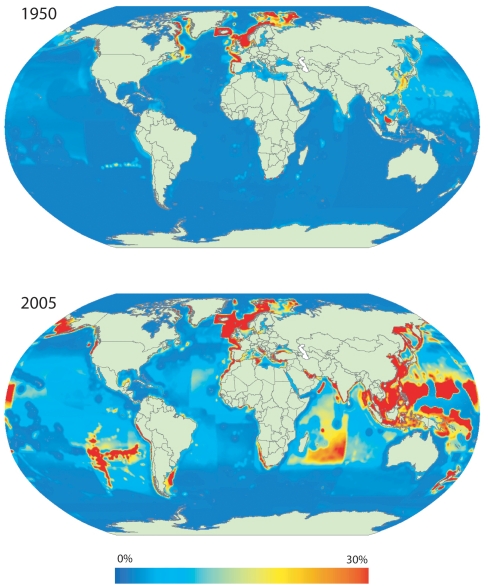
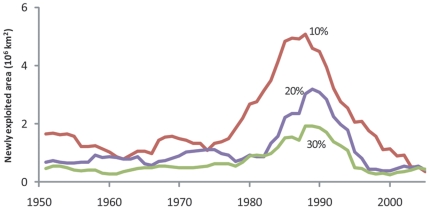
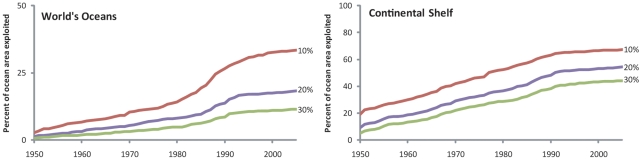
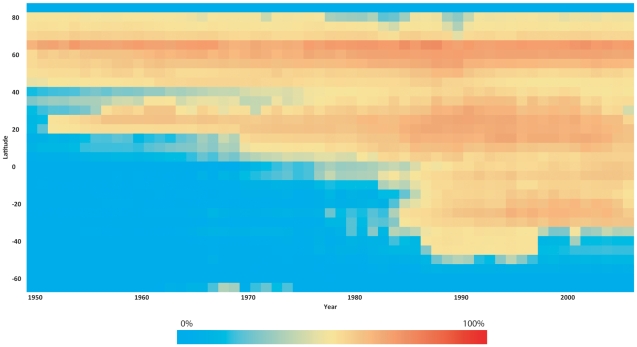
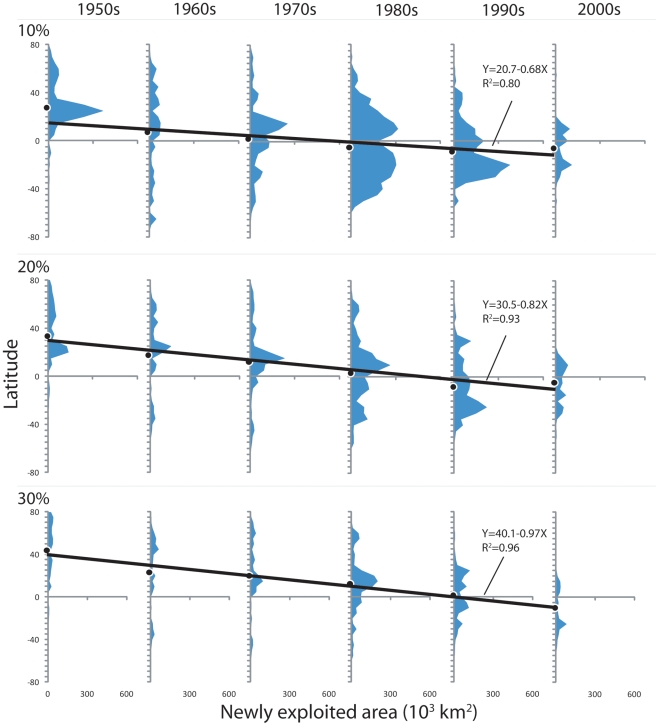
Using estimates of the primary production required (PPR) to support fisheries catches (a measure of the footprint of fishing), we analyzed the geographical expansion of the global marine fisheries from 1950 to 2005. We used multiple threshold levels of PPR as percentage of local primary production to define 'fisheries exploitation' and applied them to the global dataset of spatially-explicit marine fisheries catches. This approach enabled us to assign exploitation status across a 0.5° latitude/longitude ocean grid system and trace the change in their status over the 56-year time period. This result highlights the global scale expansion in marine fisheries, from the coastal waters off North Atlantic and West Pacific to the waters in the Southern Hemisphere and into the high seas. The southward expansion of fisheries occurred at a rate of almost one degree latitude per year, with the greatest period of expansion occurring in the 1980s and early 1990s. By the mid 1990s, a third of the world's ocean, and two-thirds of continental shelves, were exploited at a level where PPR of fisheries exceed 10% of PP, leaving only unproductive waters of high seas, and relatively inaccessible waters in the Arctic and Antarctic as the last remaining 'frontiers.' The growth in marine fisheries catches for more than half a century was only made possible through exploitation of new fishing grounds. Their rapidly diminishing number indicates a global limit to growth and highlights the urgent need for a transition to sustainable fishing through reduction of PPR.
Overview
The claims and statistics of this paper haven’t been checked yet.
Free: it reads the open-access text and checks the first 5 claims that cite a source we can check. Create a free account to check every claim.
Integrity signals
Registry
Cites
Statistics
Figures
Verification
Claims the paper makes
The claims and statistics of this paper haven’t been checked yet.
Free: it reads the open-access text and checks the first 5 claims that cite a source we can check. Create a free account to check every claim.
Claims other papers make about this one
Each is checked against this paper’s own text: does it say what the citing paper says it does?
The source backs part of the claim, not all of it — or backs it for a different population, condition or comparison.
In the citing paper
“About two-thirds of the ocean area where HANPP is >10% is found above the shallow shelf areas (38) where ecosystems are most intensely exploited.”
From Earth beyond six of nine planetary boundaries (2023) · cites this paper as [38]
Experimental — accuracy not yet measured
Self-check
Percentages, sums and reported differences re-computed from the paper’s own numbers.
The self-check needs the paper’s full text.
Citations
Cites
Historical Overfishing and the Recent Collapse of Coastal Ecosystems
Jackson, J. B. C., Kirby, M. X., Berger, W. H., Bjorndal, K. A., Botsford, L. W., Bourque, B. J., Bradbury, R. H., Cooke, R., Erlandson, J., Estes, J. A., et al. (2001) · Science · doi:10.1126/science.1059199 · Cited by 6,652 · cited 1×
“There is a wide realization that fisheries, similar to agriculture on land [1], has a tremendous impact on marine ecosystems and on the biodiversity embedded therein [2,3].”
BackgroundPauly, D., Christensen, V., Dalsgaard, J., Froese, R., & Torres, F. (1998) · Science · doi:10.1126/science.279.5352.860 · Cited by 4,743
Self-citationTowards sustainability in world fisheries.
Pauly, D., Christensen, V., Guénette, S., Pitcher, T. J., Sumaila, U. R., Walters, C. J., Watson, R., & Zeller, D. (2002) · Nature · doi:10.1038/nature01017 · Cited by 3,019 · cited 3×
“This result highlights the global scale expansion in marine fisheries, from the coastal waters off North Atlantic and West Pacific to the waters in the Southern Hemisphere and into the high seas.”
BackgroundSelf-citationThe State of World Fisheries and Aquaculture 2018: Meeting the Sustainable Development Goals
Food and Agriculture Organization of the United Nations (2018) · The State of World Fisheries and Aquaculture · doi:10.18356/8d6ea4b6-en · Cited by 2,075
Primary production required to sustain global fisheries
Pauly, D., & Christensen, V. (1995) · Nature · doi:10.1038/374255a0 · Cited by 1,888 · cited 4×
“We applied a 9:1 ratio for CR and 10% for TE [15].”
BackgroundMethodInfluentialSelf-citationHaberl, H., Erb, K. H., Krausmann, F., Gaube, V., Bondeau, A., Plutzar, C., Gingrich, S., Lucht, W., & Fischer-Kowalski, M. (2007) · Proceedings of the National Academy of Sciences · doi:10.1073/pnas.0704243104 · Cited by 1,617 · cited 1×
“8% of potential net primary productivity humans appropriate on land [21].”
BackgroundTilman, D. (1999) · Proceedings of the National Academy of Sciences · doi:10.1073/pnas.96.11.5995 · Cited by 1,406
Global phytoplankton decline over the past century
Boyce, D. G., Lewis, M. R., & Worm, B. (2010) · Nature · doi:10.1038/nature09268 · Cited by 1,363 · cited 1×
“For our analysis, we assumed primary production to be constant over the study period, due to incomplete temporal coverage in the SeaWiFS dataset. While the level of primary production may have declined over the past 50 years concomitant with an observed reduction in the global chlorophyll concentration”
MethodEstimating the Worldwide Extent of Illegal Fishing
Agnew, D. J., Pearce, J., Pramod, G., Peatman, T., Watson, R., Beddington, J. R., & Pitcher, T. J. (2009) · PLoS ONE · doi:10.1371/journal.pone.0004570 · Cited by 1,009
Self-citationThe fate of marine autotrophic production
Duarte, C. M., & Cebrián, J. (1996) · Limnology and Oceanography · doi:10.4319/lo.1996.41.8.1758 · Cited by 1,000
Research works printed but not linked: 1
- FAO 2009 The state of world fisheries and aquaculture. FAO. Rome 84
Cited by
Items 301–379 of 379
The Former Pelagic Longline Fishery of a Large‐Scale Marine Protected Area
Kerry, C., Metcalfe, K., Brown, J., Richardson, A. J., Laptikvoksky, V., Reeves, S., Weber, N. L., & Weber, S. B. (2025) · Aquatic Conservation Marine and Freshwater Ecosystems · doi:10.1002/aqc.70076 · Cited by 4
Manach, F. L., Froment, T., Andriamahefazafy, M. R., Campling, L., Haas, B., & Skerritt, D. J. (2025) · npj Ocean Sustainability · doi:10.1038/s44183-025-00149-y · Cited by 4
Ocean ecosystem degradation and human populations
Jungwiwattanaporn, M., McKinney, R., Wozniak, E., & Songco, A. (2023) · Elsevier eBooks · doi:10.1016/b978-0-323-95227-9.00006-3 · Cited by 5
Erb, K., Mayer, A., Kästner, T., Sallet, K.-E., & Haberl, H. (2012) · Cited by 11
How Might a Stoic Eat in Accordance with Nature and “Environmental Facts”?
Whiting, K., Stephens, W. O., Simpson, E., & Konstantakos, L. (2020) · Journal of Agricultural and Environmental Ethics · doi:10.1007/s10806-020-09829-w · Cited by 6
Nature reserves facilitate conservation of the Mediterranean slipper lobster Scyllarides latus
Miller, E., Spanier, E., Diamant, R., & YAHEL, R. (2023) · Marine Ecology Progress Series · doi:10.3354/meps14354 · Cited by 4
Spatial expansion of EU and non-EU fishing fleets into the global ocean, 1950 to the present
Watson, R. A., Zeller, D. C., & Pauly, D. F. (2011) · Cited by 6
Self-citation2 West Africa & the New European Common Fisheries Policy: Impacts & Implications
Seto, K. L. (2016) · Brill | Nijhoff eBooks · doi:10.1163/9789004311442_004 · Cited by 4
Hornborg, S. (2012) · RISE Research Institutes of Sweden DiVA Portal · Cited by 7
Feeding Tomorrow: A Journey into Sustainable Nutrition for Personal and Planetary Health
Marak, N. R., & Parashar, A. (2024) · European Journal of Nutrition & Food Safety · doi:10.9734/ejnfs/2024/v16i41403 · Cited by 7
García‐Santiago, X., Franco‐Uría, A., Antelo, L. T., Moreira, M. T., Feijóo, G., & Pérez‐Martín, R. I. (2020) · Fisheries · doi:10.1002/fsh.10429 · Cited by 3
Prato, J., Santos-Martı́nez, A., Cupul‐Magaña, A. L., Castaño, D., Pineda, J. E. M., Medina, J., Hudson, A., Mejía-Rentería, J. C., Velásquez-Calderón, C. S., Germán Márquez, C., et al. (2024) · Disaster risk reduction · doi:10.1007/978-981-97-6663-5_8 · Cited by 3
The Making of a Global Marine Fisheries Catch Database for Policy Development
Pauly, D. F., & Zeller, D. C. (2018) · Elsevier eBooks · doi:10.1016/b978-0-12-805052-1.00012-7 · Cited by 6
Self-citationSmith, K. L., Fearing, A., Phillips, N. M., Kroetz, A. M., Wiley, T. R., Carlson, J. K., & Taylor, S. S. (2024) · Aquatic Conservation Marine and Freshwater Ecosystems · doi:10.1002/aqc.4084 · Cited by 3
An assessment of “fishing down marine food webs” in coastal states during 1950–2010
Ding, Q., Chen, X., Yu, W., & Chen, Y. (2017) · Acta Oceanologica Sinica · doi:10.1007/s13131-017-1003-5 · Cited by 3
Eavesdropping in The Cove: Interspecies ethics, public and private space, and trauma under water
Walker, J. S. (2014) · Studies in Documentary Film · doi:10.1386/sdf.7.3.209_1 · Cited by 4
“2008) and UN Environmental Programme (UNEP) (2004) and a 2010 study by Canadian, US and Australian researchers (Swartz et al. 2010) report the dire depletion of world fish stocks and a declining global seafood catch.”
BackgroundInfluentialGoh, E. V. (2018) · Nottingham ePrints (University of Nottingham) · Cited by 9
Corrales, X. (2019) · UPCommons institutional repository (Universitat Politècnica de Catalunya) · doi:10.5821/dissertation-2117-131431 · Cited by 5
“This decline occurred despite increased fishing effort and efficiency, and the geographic and bathymetric expansion of fishing activities (Swartz et al., 2010, Watson et al., 2013).”
BackgroundLeadbitter, D., Aebischer, N. J., Auchterlonie, N. A., Benton, T. G., Froehlich, H. E., Hall, S. J., Kaiser, M. J., Palme, U., & Hilborn, R. W. (2025) · Reviews in Fisheries Science & Aquaculture · doi:10.1080/23308249.2025.2585414 · Cited by 2
“…to agri-culture of the Great Plains of the US and the Eurasian steppes (National Research Council 2005; Kamp et al. 2015), the more recent development of global large scale fisheries (Swartz et al. 2010) and aquatic farming practices, such as shrimp ponds replacing mangrove forests (Ashton 2008).”
Swartz, W. (2019) · Elsevier eBooks · doi:10.1016/b978-0-12-817945-1.00029-0 · Cited by 2
Self-citationThe road to implementing an ecosystem-based approach to high seas fisheries management
Crespo, G. O. (2019) · Elsevier eBooks · doi:10.1016/b978-0-12-817945-1.00045-9 · Cited by 2
Rivas, M. M. (2023) · InterNaciones · doi:10.32870/in.vi24.7238 · Cited by 2
Huettmann, F. (2012) · Springer eBooks · doi:10.1007/978-4-431-54006-9_12 · Cited by 2
Coastal catch transects as a tool for studying global fisheries
Watson, R. A., & Pauly, D. F. (2013) · Fish and Fisheries · doi:10.1111/faf.12025 · Cited by 2
“Here, we are only concerned with coastal waters, that is, the waters within large marine ecosystem (LME) boundaries (Sherman et al. 1990) or the Exclusive Economic Zones (EEZ) of countries (usually 200 nautical miles).”
Self-citationQ&A: The Present and the Future of World and U.S. Fisheries—Interview with Daniel Pauly
Grüss, A. (2015) · Fisheries · doi:10.1080/03632415.2014.980903 · Cited by 2
“The fact is that Branch et al. (2010), as is often the case in fisheries science, did not account for the spatial expansion of fisheries, as documented worldwide in Swartz et al. (2010).”
BackgroundTowards Assessing Gender Authorship in Aquaculture Publications
The Nature Conservancy, S., & CHOW, M. (2017) · Asian Fisheries Science · doi:10.33997/j.afs.2017.30.s1.006 · Cited by 2
“The southward expansion of intense industrial fisheries exploitation occurred at a rate of almost one degree latitude per year with the greatest expansion occurring in the mid-1980s and early 1990s (Swartz et al. 2010).”
BackgroundExploitation Indices: Developing Global and National Metrics of Wildlife Use and Trade
Almond, R. E. A., Butchart, S. H. M., Oldfield, T. E. E., McRae, L., & de Bie, S. (2013) · Wiley eBooks · doi:10.1002/9781118490747.ch8 · Cited by 2
Rare seahorses have big implications for small fishes in bycatch
Lawson, J. M. (2014) · cIRcle (University of British Columbia) · doi:10.14288/1.0166949 · Cited by 2
“…of the world’s fisheries remains under heated debate (Jackson et al., 2001; Worm et al., 2006; Worm et al., 2009; Branch et al., 2011), it appears that global catches have declined despite a global expansion of fisheries (Swartz et al., 2010) and increased fishing effort (Watson et al., 2013).”
BackgroundDo Policies with Limited Enforcement Reduce Harm? Evidence from Transshipment BansPreprint
Bastani, H., & de Zegher, J. F. (2019) · SSRN Electronic Journal · doi:10.2139/ssrn.3312963 · Cited by 2
Global fishing and seafood trade burdens places with ineffective fisheries managementPreprint
Klein, C. J., Kuempel, C. D., Watson, R. A., Marta Coll, M., Teneva, L. T., & Mora, C. (2021) · Research Square · doi:10.21203/rs.3.rs-611352/v1 · Cited by 2
Self-citationBroadening the perspective on seafood production : Life cycle thinking and fisheries management
Hornborg, S. (2014) · Gothenburg University Publications Electronic Archive (Gothenburg University) · doi:10.1007/s00267-013-0096-7 · Cited by 2
The fisheries in the South-Western Indian Ocean, with emphasis on reconstructed catches
Pauly, D. F. (2015) · Mediterránea Serie de Estudios Biológicos · doi:10.14198/mdtrra2015.esp.02 · Cited by 1
“, to the coasts off developing countries, and beyond into the southern hemisphere, all the way to Antarctica (Swartz et al. 2010a).”
BackgroundSelf-citationDesfosses, C. J., Blight, S., Denham, A. M., & Taylor, S. M. (2021) · Fisheries Research · doi:10.1016/j.fishres.2021.106042 · Cited by 1
Mini, K. G., Sathianandan, T. V., Kuriakose, S., Augustine, S. K., K., M., Manjeesh, R., Paul, S., Jayasankar, J., Varghese, E., & Gopalakrishnan, A. (2023) · Fisheries Research · doi:10.1016/j.fishres.2023.106821 · Cited by 3
The impact of economics and urbanisation on marine fisheries sustainability in West Africa
Bi, M., Ouyang, Q., Sun, Z., Yu, C., van den Bersselaar, D., & Zhang, R. (2023) · Chemistry and Ecology · doi:10.1080/02757540.2023.2271894 · Cited by 1
Renewable and Common Resources: Marine Fishery Resources
Deng, X., Song, M., Li, Z., Zhang, F., & Liu, Y. (2024) · Springer eBooks · doi:10.1007/978-981-99-9923-1_10 · Cited by 1
Ramos, J. H. P., & Pousão‐Ferreira, P. (2018) · Advances in knowledge acquisition, transfer, and management book series/Advances in knowledge acquisition, transfer and management book series · doi:10.4018/978-1-5225-5849-1.ch010 · Cited by 2
Piga, G., Orquín, R. P., Guirguis, M., Gonçalves, D., Pimenta, C. M., Tereso, J. P., & Brunetti, A. (2019) · Journal of Archaeological Science Reports · doi:10.1016/j.jasrep.2019.102095 · Cited by 1
Seafood consumption in Portugal : patterns, drivers and sustainability
Almeida, C. (2014) · Portuguese National Funding Agency for Science, Research and Technology (RCAAP Project by FCT) · Cited by 5
Colléter, M. (2015) · cIRcle (University of British Columbia) · doi:10.14288/1.0135664 · Cited by 2
Rogers, A. D., Laffoley, D., Polunin, N. V. C., & Tittensor, D. P. (2013) · Wiley eBooks · doi:10.1002/9781118520178.ch10 · Cited by 2
What has Canada caught, and how much is left? Reconstructing and assessing fisheries in three oceans
Schijns, R. (2020) · cIRcle (University of British Columbia) · doi:10.14288/1.0394806 · Cited by 1
Smith, K. L. (2021) · Louisiana State University · doi:10.31390/gradschool_dissertations.5595 · Cited by 1
Nieminen, L. K., Tupper, M. H., & Hendy, I. W. (2024) · Preprints.org · doi:10.20944/preprints202404.0373.v1 · Cited by 2
Favaro, B. (2013) · Summit (Simon Fraser University) · Cited by 3
The Potential Economic Costs of the Overuse of Marine Fish Stocks
Sumaila, U. R., Cheung, W. W. L., & Rogers, A. D. (2013) · Elsevier eBooks · doi:10.1016/b978-0-12-407668-6.00007-0
Food for Thought Feeding the world: what role for fisheries?
Frid, C. L. J., & Paramor, O. A. L. (2011)
Abalo‐Morla, S. (2015) · Hispana · Cited by 1
Científico, C., Caravello, G. U., Conard, S., Farina, A., Ferchichi, A., & Ramos, A. (2015)
Which author is which? Gender Authorship Position in Aquaculture LiteraturePreprint
Chow, M., Egna, H. S., & West, J. D. (2018) · bioRxiv (Cold Spring Harbor Laboratory) · doi:10.1101/486209
Investigating Fishing Impacts in Nigerian Coastal Waters Using Marine Trophic Index Analyses
Adebola, T., & de Mutsert, K. (2019) · Marine and Coastal Fisheries · doi:10.1002/mcf2.10077
“Fisheries research has shifted toward ecosystem‐based approaches that utilize biological indicators and multivariate analyses to measure the status of global fisheries (Branch et al. 2010; Swartz et al. 2010; Froese et al. 2012; Lietao 2015).”
BackgroundNugraha, B., Utomo, S. W., & Dewi, I. J. P. (2021) · IOP Conference Series Earth and Environmental Science · doi:10.1088/1755-1315/890/1/012046
“Fishing resources have been under fishing pressure which has caused total catches to decrease [9,10].”
BackgroundØsthagen, A. (2022) · Edward Elgar Publishing eBooks · doi:10.4337/9781802201567.00018
Overfishing, climate change, and the chance of achieving Infinity Fish
Sumaila, U. R. (2021) · Elsevier eBooks · doi:10.1016/b978-0-12-823816-5.00024-2
Biogeochemical Cycling – An Introduction
Jennerjahn, T. C. (2024) · Elsevier eBooks · doi:10.1016/b978-0-323-90798-9.00102-5
Степанова, Л. Г. (2023) · Rossiiskaia istoriia · doi:10.31857/s2949124x23010030
de Nóbrega, M. F., Lins, L. H. F. D. C., dos Santos, A. R., & Oliveira, J. E. L. (2024) · SSRN Electronic Journal · doi:10.2139/ssrn.4833194
(2024) · Geoscientific model development · doi:10.5194/gmd-2024-26-rc1
(2024) · Geoscientific model development · doi:10.5194/gmd-2024-26-rc2
Development of fisheries in the world
Слюсаренко, І., & Bezaltychna, O. (2025) · Water bioresources and aquaculture · doi:10.32782/wba.2025.1.6
Fishing Strategies and Oceanographic Drivers of Longline Fisheries in the Tropical Atlantic Ocean
França, L. H., Oliveira, J. E. L., & de Nóbrega, M. F. (2025) · Fisheries Oceanography · doi:10.1111/fog.70003
Chen, G., Li, R., Li, X., & Zhang, X. (2025) · Ocean & Coastal Management · doi:10.1016/j.ocecoaman.2025.107856
Abdulhussain, A. H., Ben‐Hasan, A., Daliri, M., Gholoum, M., Vahabnezhad, A., Qasem, H., Alajmi, A., & Soleimani, E. (2025) · Regional Studies in Marine Science · doi:10.1016/j.rsma.2025.104659
Wang, S., Song, Z., Pan, X., Xu, S., & Zhu, Z. (2025) · Ecological Indicators · doi:10.1016/j.ecolind.2025.114476
Variability of primary productivity in relation to monsoon off the south of Sri LankaPreprint
Sharma, P., & Jayasiri, H. B. (2025) · SSRN Electronic Journal · doi:10.2139/ssrn.5478033
Moullec, F. (2019) · theses.fr (ABES) · doi:10.70675/7ebe4b06zf12dz4a14zbf79z7885166a0a3d · Cited by 5
“…profondes, ciblant un nombre croissant d'espèces et de niveaux trophiques, soit de plus en plus bas dans les chaînes alimentaires (Essington et al., 2006; Galbraith et al., 2017; Gascuel et al., 2014; Morato et al., 2006; Pauly et al., 1998, 2002, 2003; Swartz et al., 2010; Tickler et al., 2018).”
BackgroundGouverner l'océan : les acteurs non étatiques dans la gestion mondiale de la surpêche
Brenne, V. L. (2022) · theses.fr (ABES) · doi:10.70675/431d0254zfbd5z4e87zaf01zdfb215c1cd7d
Une limite du Front océanique ? La construction offshore du dôme thermique du Costa Rica
Legroux, N. (2024) · theses.fr (ABES) · doi:10.70675/657a12c1z998az4fffz90f5zb770394aab86 · Cited by 2
Effects of fishing and whaling on the structure and dynamics of blue-water ecosystems
Gilman, E. L., Taylor, N., & Chaloupka, M. Y. (2026) · ICES Journal of Marine Science · doi:10.1093/icesjms/fsag055 · Cited by 1
ALTINER, A., Eren, M. V., Toktaş, Y., Çütçü, İ., Gyasi, E. A., & Nandan, S. (2026) · Sustainability · doi:10.3390/su18136459
Ruiz, N. R. (2026) · acta ethologica · doi:10.1007/s10211-026-00494-2 · Cited by 1
“…activities have a significant direct or indirect impact on all marine ecosystems, with overfishing, tourism, deep sea mining, pollution (plas - tic, chemical and noise), invasive species, habitat degradation, and climate change posing major threats (Halpern et al. 2008; Swartz et al. 2010).”
Assessing and quantifying variations in the functioning of marine food webs across scales
Preciado, I., Rabanal, I. M., Ortiz, J. J., Torres, M. Á., García, E., García-Aguilar, O., Rebollo, J. M. G., Garrido, S., Iglesias, D., Loc’h, F. L., et al. (2026) · Conservation Biology · doi:10.1111/cobi.70403
Mediterranean deep-sea ecosystems: Biodiversity, functioning and vulnerability
Tecchio, S. (2012) · DIGITAL.CSIC (Spanish National Research Council (CSIC))
Metadata
- Authors
- Swartz, W., Sala, E., Tracey, S., Watson, R., & Pauly, D.
- Affiliations
- University of British Columbia (CA)
- Consejo Superior de Investigaciones Científicas (ES)
- University of Tasmania (AU)
- Corresponding author
- Pauly, Daniel
- Venue
- PLoS ONE
- Publisher
- Public Library of Science (PLoS)
- Published
- 2010-12-02
- Volume
- 5
- Issue
- 12
- Pages
- e15143
- ISSN
- 1932-6203 (ISSN-L)
- PMC
- PMC2996307
- OpenAlex
- W2020170202
- Cited by
- 380
- References
- 35
- Citations by year
- 2026: 4 · 2025: 9 · 2024: 29 · 2023: 16 · 2022: 16 · 2021: 19 · 2020: 36 · 2019: 31 · 2018: 22 · 2017: 40 · 2016: 17 · 2015: 38 · 2014: 36 · 2013: 27 · 2012: 25
- FWCI
- 19.23
- Type
- journal article
- Language
- en
- Open access
- gold
- doi.org
- Locations
- PLoS ONE (publishedVersion, cc-by)
- PubMed Central (publishedVersion, cc-by)
- PubMed (publishedVersion)
- eCite Digital Repository (University of Tasmania) (submittedVersion, cc-by)
- DOAJ (DOAJ: Directory of Open Access Journals) (submittedVersion, cc-by-sa)
- Figshare (submittedVersion, cc-by)
- Funders
- Pew Charitable Trusts
- National Geographic Society
- Waitt Foundation
- Topics
- Life Sciences › Agricultural and Biological Sciences › Aquatic Science › Marine and fisheries research
- Physical Sciences › Environmental Science › Environmental Engineering › Sustainability and Ecological Systems Analysis
- Physical Sciences › Environmental Science › Management, Monitoring, Policy and Law › Coastal and Marine Management
- Keywords
- ecological footprint, fish catch, fisheries exploitation, high seas, continental shelf, sustainable fisheries, fishing grounds
- MeSH terms
- Animals, Antarctic Regions, Arctic Regions, Conservation of Natural Resources, Ecology, Fisheries, Fishes, Geography, Oceans and Seas, Population Dynamics, Models, Statistical, Ecosystem
About these checks
Registry, retraction, Cites and statistics results are computed, not judged, with one exception: a printed reference that no index lists is read once by a model before it counts as a citation error. Claims are extracted by a model and kept only when their quote appears verbatim in the text; each cited source is then checked, with a model’s help, for whether it says what the claim relies on. Those verdicts can be wrong — read the claim’s quote and the cited source before relying on one.
Statistics and arithmetic are recomputed, not judged.
Confidence bands are shown only for fields calibrated on our annotated test set. None is calibrated yet, so no band is shown.
What counts as a claim ›How we measure confidence ›How we check this ›
Are you an author, or do you see a problem with this page? Request a review
Data sources
Bibliographic data: Semantic Scholar, OpenAlex, Crossref.
Contains information from the Semantic Scholar Academic Graph Datasets, made available under the ODC Attribution License (ODC-BY 1.0).
Semantic Scholar’s data is described in: Kinney, R., et al. (2023). The Semantic Scholar Open Data Platform. arXiv:2301.10140.
