

Two Major Medicinal Honeys Have Different Mechanisms of Bactericidal Activity
Open accessThe DOI matches its Crossref record; 41 of the 42 references it cites were found in a registry or an index; none of the 6 sources its claims cite is checked for support yet.
Abstract
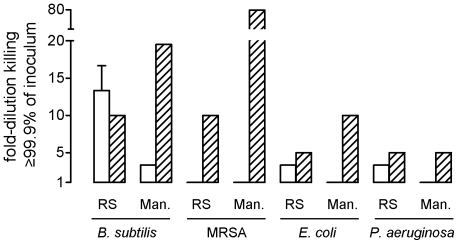
Honey is increasingly valued for its antibacterial activity, but knowledge regarding the mechanism of action is still incomplete. We assessed the bactericidal activity and mechanism of action of Revamil® source (RS) honey and manuka honey, the sources of two major medical-grade honeys. RS honey killed Bacillus subtilis, Escherichia coli and Pseudomonas aeruginosa within 2 hours, whereas manuka honey had such rapid activity only against B. subtilis. After 24 hours of incubation, both honeys killed all tested bacteria, including methicillin-resistant Staphylococcus aureus, but manuka honey retained activity up to higher dilutions than RS honey. Bee defensin-1 and H₂O₂ were the major factors involved in rapid bactericidal activity of RS honey. These factors were absent in manuka honey, but this honey contained 44-fold higher concentrations of methylglyoxal than RS honey. Methylglyoxal was a major bactericidal factor in manuka honey, but after neutralization of this compound manuka honey retained bactericidal activity due to several unknown factors. RS and manuka honey have highly distinct compositions of bactericidal factors, resulting in large differences in bactericidal activity.
Overview
CoChat Summary
TL;DR
RS and manuka honeys kill bacteria through distinct factor sets: RS relies on bee defensin-1 and H₂O₂ for rapid killing, while manuka relies heavily on high methylglyoxal for slower, dilution-resistant killing. Both killed all tested bacteria by 24 h, including MRSA, but with different potency and kinetics.
Key findings
- RS honey killed *B. subtilis*, *E. coli*, and *P. aeruginosa* within 2 h; manuka honey had such rapid activity only against *B. subtilis*. At 2 h, RS killed *B. subtilis* up to 13.3±3.3-fold dilution versus 2.5-fold for manuka; after 24 h, RS and manuka killed *B. subtilis* up to 10- and 20-fold, MRSA up to 10- and 80-fold, *E. coli* up to 5- and 10-fold, and *P. aeruginosa* up to 5- and 5-fold, respectively.
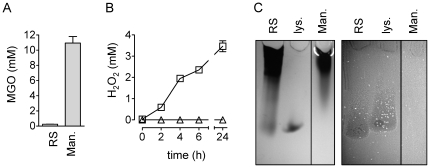
- RS and manuka differed sharply in bactericidal factors: RS contained 0.25±0.01 mM MGO and accumulated 3.47±0.25 mM H₂O₂ in 40% (v/v) solution over 24 h, while manuka contained 10.94±1.70 mM MGO (abstract: 44-fold higher; results: approximately 40-fold) and no detectable H₂O₂. Bee defensin-1 was detected in RS honey by AU-PAGE and *B. subtilis* overlay but not in manuka honey.
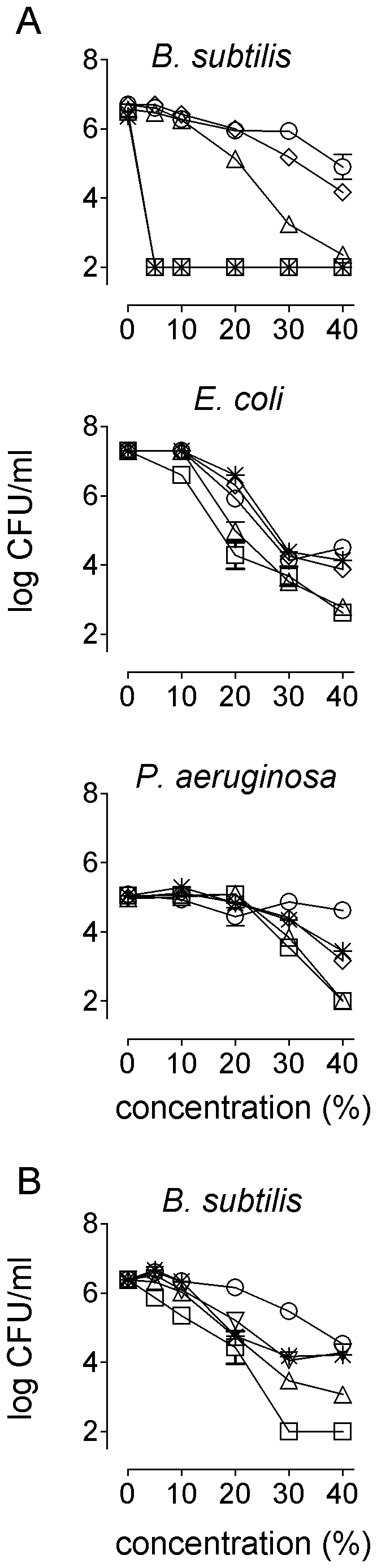
- Neutralizing MGO in manuka honey reduced activity against MRSA to sugar-solution level, required 8-fold and 2-fold higher manuka concentrations to kill *B. subtilis* and *P. aeruginosa*, and did not affect *E. coli*. Residual manuka activity involved unknown cationic and non-cationic factors; after MGO neutralization, low pH accounted for all non-cationic activity against *E. coli*, while *B. subtilis* retained substantial activity.
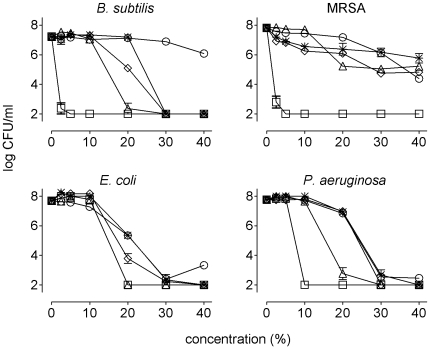
- Rapid manuka activity against *B. subtilis* required ≥30% honey; MGO neutralization reduced but did not abolish it, and the remaining activity was not affected by pH 7 or catalase but was further reduced, though not abolished, by SPS. For RS, 5% honey killed the entire *B. subtilis* inoculum within 2 h; SPS neutralization required 40% RS, and subsequent H₂O₂ neutralization reduced activity to sugar-solution level.
Methods
- Honey samples: unprocessed Revamil® source (RS) honey from Bfactory Health Products and non-sterilized UMF™ 16+ Active manuka honey from Nature’s nectar Limited; a honey-equivalent sugar solution contained 333 g/kg glucose, 385 g/kg fructose, 73 g/kg sucrose, and 62 g/kg maltose.
- Bacteria and bactericidal assay: *B. subtilis* ATCC6633, *E. coli* ML-35p, *P. aeruginosa* PAO-1 (ATCC 15692), and MRSA AMC201 were tested in 100 µl liquid assays with 50% honey stocks, final inocula of 1×10⁶ CFU/ml, incubation at 37°C and 150 rpm, and plating on blood agar; detection level was 100 CFU/ml. Neutralizers included catalase (600 U/ml), SPS (0.025%), glyoxalase I/glutathione for MGO conversion, and NaOH titration to pH 7.0.
- Factor quantification: H₂O₂ was measured by o-dianisidine/horseradish peroxidase; MGO was measured spectrophotometrically after glyoxalase I conversion to S-lactoylglutathione; bee defensin-1 was analyzed by 5 kDa ultrafiltration, native acid-urea PAGE, Coomassie staining, and *B. subtilis* overlay assay.
Limitations
- Stated: lack of standardization of antibacterial activity and incomplete knowledge of active components are major limitations for medical application of honey. The paper also states that the commonly used agar diffusion assay has limitations: activity against one species is not representative, zone size depends on diffusion, and the assay does not discriminate bacteriostatic from bactericidal activity or quantify killing kinetics.
- Stated: manuka honey has large batch-to-batch variation in antibacterial activity, and concerns about potential toxicity of dietary MGO and effects on wound healing remain to be investigated. The cationic and non-cationic factors responsible for residual manuka activity were not identified.
- Evident from the text: all experiments were in vitro with defined lab media and a limited bacterial panel; no wound exudate, clinical, or food-matrix validation was performed, and the neutralization/pH manipulations may not fully reflect native honey behavior.
Model-written summary. Check it against the paper before relying on it.
Integrity signals
Registry
Cites
Statistics
Figures
Verification
Claims the paper makes
0 Valid · 0 Not valid · 5 Not checked · 52 Own results and interpretations
A result the paper reports from its own data — it cites no other source for it, so there is none to check. The quote shows it is in the paper.
In the paper
“Subsequent neutralization of H2O2 reduced the activity of RS honey to that of a honey-equivalent sugar solution (Fig. 4A).”
§ Two Major Medicinal Honeys Have Different Mechanisms of Bactericidal Activity > Results > Factors contributing to the rapid bactericidal activity of RS and manuka honey
plainstates a cause- Asserted: passes — The authors put it forward as true.
- Checkable: passes — It can be checked against evidence.
- Load-bearing: passes — The paper’s conclusions depend on it.
- Based: passes — The paper gives a reason why it holds.
A result the paper reports from its own data — it cites no other source for it, so there is none to check. The quote shows it is in the paper.
In the paper
“MGO-neutralized manuka honey still had more activity than a sugar solution against these species”
§ Two Major Medicinal Honeys Have Different Mechanisms of Bactericidal Activity > Results > Factors contributing to the bactericidal activity of manuka honey after 24 hours
plain- Asserted: passes — The authors put it forward as true.
- Checkable: passes — It can be checked against evidence.
- Load-bearing: passes — The paper’s conclusions depend on it.
- Based: passes — The paper gives a reason why it holds.
A result the paper reports from its own data — it cites no other source for it, so there is none to check. The quote shows it is in the paper.
In the paper
“In a similar amount of manuka honey retentate no bee defensin-1 was detected either by Coomassie-staining or in a gel overlay assay (Fig. 2C).”
§ Two Major Medicinal Honeys Have Different Mechanisms of Bactericidal Activity > Results > Characterization of H2O2, MGO and bee defensin-1 in RS and manuka honey
plain- Asserted: passes — The authors put it forward as true.
- Checkable: passes — It can be checked against evidence.
- Load-bearing: passes — The paper’s conclusions depend on it.
- Based: passes — The paper gives a reason why it holds.
A result the paper reports from its own data — it cites no other source for it, so there is none to check. The quote shows it is in the paper.
In the paper
“After 2 h up to 13.3±3.3-fold diluted RS honey killed B. subtilis, whereas manuka honey could only be 2.5-fold diluted (Fig. 1).”
§ Two Major Medicinal Honeys Have Different Mechanisms of Bactericidal Activity > Results > Bactericidal activity of RS and manuka honey
plainstates a cause- Asserted: passes — The authors put it forward as true.
- Checkable: passes — It can be checked against evidence.
- Load-bearing: passes — The paper’s conclusions depend on it.
- Based: passes — The paper gives a reason why it holds.
A result the paper reports from its own data — it cites no other source for it, so there is none to check. The quote shows it is in the paper.
In the paper
“When the pH of MGO- and cationic compound-neutralized manuka honey was adjusted from 3.9 to 7.0, all remaining activity against E. coli was abolished.”
§ Two Major Medicinal Honeys Have Different Mechanisms of Bactericidal Activity > Results > Factors contributing to the bactericidal activity of manuka honey after 24 hours
plainstates a cause- Asserted: passes — The authors put it forward as true.
- Checkable: passes — It can be checked against evidence.
- Load-bearing: passes — The paper’s conclusions depend on it.
- Based: passes — The paper gives a reason why it holds.
32 more claims
Create a free account to see all 57 claims and to verify the 6 references still open.
- It may state two separate claims as one. 20
Claims other papers make about this one
Each is checked against this paper’s own text: does it say what the citing paper says it does?
The source backs part of the claim, not all of it — or backs it for a different population, condition or comparison.
In the citing paper
“The antibacterial peptide defensin-1 (Def-1) obtained from bees, is the main ingredient responsible for the antibacterial activity of honey, except for Manuka honey (Kwakman et al. 2011).”
From The antibacterial activities of honey (2021) · cites this paper as Kwakman et al. 2011
Experimental — accuracy not yet measured
Self-check
Percentages, sums and reported differences re-computed from the paper’s own numbers.
Each contradiction between two passages listed here was confirmed by an independent check.
Rated major: it would touch a result — a value a result rests on, reported and recomputed p-values on opposite sides of the significance level, two passages that conflict with no sign which is right, or a cited work retracted before this paper was published.
In the paper
§ Two Major Medicinal Honeys Have Different Mechanisms of Bactericidal Activity > Results > Factors contributing to the bactericidal activity of manuka honey after 24 hours
“| B. subtilis | rapidb | - | rapid | - | slow | rapid | slow | rapid | - | rapid | - | rapid |”
§ Two Major Medicinal Honeys Have Different Mechanisms of Bactericidal Activity > Results > Factors contributing to the rapid bactericidal activity of RS and manuka honey
“The remaining activity was not affected by titration to pH 7 (Fig. 4B) or addition of catalase (not shown), but this activity was further reduced but not abolished by addition of SPS (Fig. 4B).”
Rated minor: it would not touch a result — a value no result rests on, a p-value that stays on the same side of the significance level, or a conflict that is clerical, resolved elsewhere in the paper, or outside its own findings.
In the paper
§ Two Major Medicinal Honeys Have Different Mechanisms of Bactericidal Activity > Results > Factors contributing to the bactericidal activity of manuka honey after 24 hours
“| E. coli | rapid | - | slow | - | slow | slow | - | slow | - | slow | - | slow |”
§ Two Major Medicinal Honeys Have Different Mechanisms of Bactericidal Activity > Results > Factors contributing to the bactericidal activity of manuka honey after 24 hours
“the activity of manuka honey against E. coli was not affected by neutralization of MGO (Fig. 3).”
Rated minor: it would not touch a result — a value no result rests on, a p-value that stays on the same side of the significance level, or a conflict that is clerical, resolved elsewhere in the paper, or outside its own findings.
In the paper
§ Two Major Medicinal Honeys Have Different Mechanisms of Bactericidal Activity > Results > Factors contributing to the bactericidal activity of manuka honey after 24 hours
“| P. aeruginosa | rapid | - | slow | - | slow | slow | slow | - | - | slow | - | - |”
§ Two Major Medicinal Honeys Have Different Mechanisms of Bactericidal Activity > Results > Factors contributing to the rapid bactericidal activity of RS and manuka honey
“Titration of honey to pH 7 abolished all residual activity against P. aeruginosa (not shown).”
Citations
Cites
Antibiotics for Emerging Pathogens
Fischbach, M. A., & Walsh, C. T. (2009) · Science · doi:10.1126/science.1176667 · Cited by 1,777
Antimicrobial Use and Resistance in Animals
McEwen, S. A., & Fedorka‐Cray, P. J. (2002) · Clinical Infectious Diseases · doi:10.1086/340246 · Cited by 983
The Antibacterial Activity of Honey: 1. The nature of the antibacterial activity
Molan, P. C. (1992) · Bee World · doi:10.1080/0005772x.1992.11099109 · Cited by 822
Interaction of human defensins with Escherichia coli. Mechanism of bactericidal activity.
Lehrer, R. I., Barton, A., Daher, K. A., Harwig, S. S., Ganz, T., & Selsted, M. E. (1989) · Journal of Clinical Investigation · doi:10.1172/jci114198 · Cited by 715
Antibiotics: Actions, Origins, Resistance
Walsh, C. T. (2003) · Medical Entomology and Zoology · Cited by 675
Antibiotics: Actions, Origins, Resistance
Walsh, C. (2003) · Wiley eBooks · doi:10.1128/9781555817886 · Cited by 633
THE MECHANISM OF ACTION OF GLYOXALASE
Racker, E. (1951) · Journal of Biological Chemistry · doi:10.1016/s0021-9258(18)56017-8 · Cited by 581
A Survey of the Antibacterial Activity of Some New Zealand Honeys
Allen, K. L., Molan, P. C., & Reid, G. M. (1991) · Journal of Pharmacy and Pharmacology · doi:10.1111/j.2042-7158.1991.tb03186.x · Cited by 571
Mavric, E., Wittmann, S., Barth, G., & Henle, T. (2008) · Molecular Nutrition & Food Research · doi:10.1002/mnfr.200700282 · Cited by 545
White Jr., J. W., Subers, M. H., & Schepartz, A. I. (1963) · Biochimica et Biophysica Acta · doi:10.1016/0006-3002(63)90359-7 · Cited by 505
Cited by
Vatansever, F., de Melo, W. C. M. A., Avci, P., Vecchio, D., Sadasivam, M., Gupta, A., Chandran, R., Karimi, M., Parizotto, N. A., Yin, R., et al. (2013) · FEMS Microbiology Reviews · doi:10.1111/1574-6976.12026 · Cited by 1,127
Therapeutic Properties of Bioactive Compounds from Different Honeybee Products
Cornara, L., Biagi, M., Xiao, J., & Burlando, B. (2017) · Frontiers in Pharmacology · doi:10.3389/fphar.2017.00412 · Cited by 460
The antibacterial activities of honey
Almasaudi, S. (2021) · Saudi Journal of Biological Sciences · doi:10.1016/j.sjbs.2020.10.017 · Cited by 425
Antibacterial components of honey
Kwakman, P. H. S., & Zaat, S. A. J. (2012) · IUBMB Life · doi:10.1002/iub.578 · Cited by 425
Self-citationComposition and properties of Apis mellifera honey: A review
Machado De-Melo, A. A., Almeida-Muradian, L. B. D., Sancho, M. T., & Pascual-Maté, A. (2018) · Journal of Apicultural Research · doi:10.1080/00218839.2017.1338444 · Cited by 378
Ahmed, S., Sulaiman, S. A., Baig, A. A., Ibrahim, M., Liaqat, S., Fatima, S., Jabeen, S., Shamim, N., & Othman, N. H. (2018) · Oxidative Medicine and Cellular Longevity · doi:10.1155/2018/8367846 · Cited by 352
Oryan, A., Alemzadeh, E., & Moshiri, A. (2016) · Journal of Tissue Viability · doi:10.1016/j.jtv.2015.12.002 · Cited by 309
Alfei, S., Schito, G. C., Schito, A. M., & Zuccari, G. (2024) · International Journal of Molecular Sciences · doi:10.3390/ijms25137182 · Cited by 302
Honey and its nutritional and anti-inflammatory value
Ranneh, Y., Akim, A. M., Hamid, H. A., Khazaai, H., Fadel, A., Zakaria, Z. A., Albujja, M., & Bakar, M. F. A. (2021) · BMC Complementary Medicine and Therapies · doi:10.1186/s12906-020-03170-5 · Cited by 284
Antimicrobial Properties of Honey
Israili, Z. H. (2014) · American Journal of Therapeutics · doi:10.1097/mjt.0b013e318293b09b · Cited by 235
Dissecting the Antimicrobial Composition of Honey
Nolan, V. C., Harrison, J., & Cox, J. A. G. (2019) · Antibiotics · doi:10.3390/antibiotics8040251 · Cited by 230
Functionalized silk fibroin nanofibers as drug carriers: Advantages and challenges
Farokhi, M., Mottaghitalab, F., Reis, R. L., Ramakrishna, S., & Kundu, S. C. (2020) · Journal of Controlled Release · doi:10.1016/j.jconrel.2020.02.022 · Cited by 229
Tackling Antibiotic Resistance with Compounds of Natural Origin: A Comprehensive Review
Álvarez-Martínez, F. J., Barrajón-Catalán, E., & Micol, V. (2020) · Biomedicines · doi:10.3390/biomedicines8100405 · Cited by 217
van Hengel, I. A. J., Riool, M., Fratila-Apachitei, L. E., Witte-Bouma, J., Farrell, E., Zadpoor, A. A., Zaat, S. A. J., & Apachitei, I. (2017) · Biomaterials · doi:10.1016/j.biomaterials.2017.02.030 · Cited by 216
Self-citationEffects of Hydrogen Peroxide on Wound Healing in Mice in Relation to Oxidative Damage
Loo, A. E. K., Wong, Y. T., Ho, R., Wasser, M., Du, T., Ng, W. T., & Halliwell, B. (2012) · PLoS ONE · doi:10.1371/journal.pone.0049215 · Cited by 214
Hossain, M. L., Lim, L. Y., Hammer, K., Hettiarachchi, D., & Locher, C. (2022) · Antibiotics · doi:10.3390/antibiotics11070975 · Cited by 140
Therapeutic Manuka Honey: No Longer So Alternative
Carter, D. A., Blair, S. E., Cokcetin, N. N., Bouzo, D., Brooks, P., Schothauer, R., & Harry, E. J. (2016) · Frontiers in Microbiology · doi:10.3389/fmicb.2016.00569 · Cited by 191
Antibacterial Activity of Different Blossom Honeys: New Findings
Bučeková, M., Jardekova, L., Juricová, V., Bugárová, V., Marco, G. D., Gismondi, A., Leonardi, D., Farkasovska, J., Godočíková, J., Laho, M., et al. (2019) · Molecules · doi:10.3390/molecules24081573 · Cited by 187
Lu, J., Turnbull, L., Burke, C. M., Liu, M., Carter, D. A., Schlothauer, R. C., Whitchurch, C. B., & Harry, E. J. (2014) · PeerJ · doi:10.7717/peerj.326 · Cited by 184
Anti-influenza Viral Effects of Honey In Vitro: Potent High Activity of Manuka Honey
Watanabe, K., Rahmasari, R., Matsunaga, A., Haruyama, T., & Kobayashi, N. (2014) · Archives of Medical Research · doi:10.1016/j.arcmed.2014.05.006 · Cited by 183
Therapy of infected wounds: overcoming clinical challenges by advanced drug delivery systems
Kaiser, P., Wächter, J., & Windbergs, M. (2021) · Drug Delivery and Translational Research · doi:10.1007/s13346-021-00932-7 · Cited by 175
Honey: An Advanced Antimicrobial and Wound Healing Biomaterial for Tissue Engineering Applications
Yupanqui Mieles, J., Vyas, C., Aslan, E., Humphreys, G., Diver, C., & Bartolo, P. (2022) · Pharmaceutics · doi:10.3390/pharmaceutics14081663 · Cited by 128
Bolanos de la Torre, A. A. S., Henderson, T., Nigam, P. S., & Owusu-Apenten, R. K. (2015) · Food Chemistry · doi:10.1016/j.foodchem.2014.11.009 · Cited by 173
Ullah, A., Ullah, S., Khan, M. Q., Hashmi, M., Nam, P. D., Kato, Y., Tamada, Y., & Kim, I. S. (2020) · International Journal of Biological Macromolecules · doi:10.1016/j.ijbiomac.2020.03.237 · Cited by 171
Stagos, D., Soulitsiotis, N., Tsadila, C., Papaeconomou, S., Arvanitis, C., Ntontos, A. C., Karkanta, F. K., Adamou‐Androulaki, S., Petrotos, K., Spandidos, D. A., et al. (2018) · International Journal of Molecular Medicine · doi:10.3892/ijmm.2018.3656 · Cited by 169
Honey-Based Templates in Wound Healing and Tissue Engineering
Minden-Birkenmaier, B. A., & Bowlin, G. L. (2018) · Bioengineering · doi:10.3390/bioengineering5020046 · Cited by 166
Honey: Another Alternative in the Fight against Antibiotic-Resistant Bacteria?
Combarros‐Fuertes, P., Fresno, J. M., Estevinho, M. M., Sousa‐Pimenta, M., Tornadijo, M. E., & Estevinho, L. M. (2020) · Antibiotics · doi:10.3390/antibiotics9110774 · Cited by 167
Honey and its Anti-Inflammatory, Anti-Bacterial and Anti-Oxidant Properties
G Vallianou, N. (2014) · General Medicine: Open Access · doi:10.4172/2327-5146.1000132 · Cited by 163
Manuka honey inhibits cell division in methicillin-resistant Staphylococcus aureus
Jenkins, R., Burton, N., & Cooper, R. (2011) · Journal of Antimicrobial Chemotherapy · doi:10.1093/jac/dkr340 · Cited by 118
Green electrospun Manuka honey/silk fibroin fibrous matrices as potential wound dressing
Yang, X., Fan, L., Ma, L., Wang, Y., Lin, S., Yu, F., Pan, X., Luo, G., Zhang, D., & Wang, H. (2017) · Materials & Design · doi:10.1016/j.matdes.2017.01.023 · Cited by 160
Antimicrobial peptides: a key component of honey bee innate immunity
Danihlík, J., Aronstein, K., & Petřivalský, M. (2015) · Journal of Apicultural Research · doi:10.1080/00218839.2015.1109919 · Cited by 155
Making Weight in Combat Sports
Langan‐Evans, C., Close, G. L., & Morton, J. P. (2011) · Strength and conditioning journal · doi:10.1519/ssc.0b013e318231bb64 · Cited by 156
Bučeková, M., Valachová, I., Kohútová, L., Procházka, E., Klaudiny, J., & Majtán, J. (2014) · Die Naturwissenschaften · doi:10.1007/s00114-014-1205-z · Cited by 150
Fernández-Cabezudo, M. J., El-Kharrag, R., Torab, F. C., Bashir, G. H., George, J. A., Taji, H. E., & al-Ramadi, B. K. (2013) · PLoS ONE · doi:10.1371/journal.pone.0055993 · Cited by 150
Bučeková, M., Buriova, M., Pekárik, L., Majtan, V., & Majtán, J. (2018) · Scientific Reports · doi:10.1038/s41598-018-27449-3 · Cited by 151
Müller, P., Alber, D., Turnbull, L., Schlothauer, R. C., Carter, D. A., Whitchurch, C. B., & Harry, E. J. (2013) · PLoS ONE · doi:10.1371/journal.pone.0057679 · Cited by 150
Lu, J., Carter, D. A., Turnbull, L., Rosendale, D., Hedderley, D., Stephens, J., Gannabathula, S., Steinhorn, G., Schlothauer, R. C., Whitchurch, C. B., et al. (2013) · PLoS ONE · doi:10.1371/journal.pone.0055898 · Cited by 93
Honey as a Natural Antimicrobial
Ogwu, M. C., & Izah, S. C. (2025) · Antibiotics · doi:10.3390/antibiotics14030255 · Cited by 151
Honey: A realistic antimicrobial for disorders of the skin
McLoone, P., Warnock, M., & Fyfe, L. (2015) · Journal of Microbiology Immunology and Infection · doi:10.1016/j.jmii.2015.01.009 · Cited by 141
Identification of a Novel Glycoside, Leptosin, as a Chemical Marker of Manuka Honey
Kato, Y., Umeda, N., Maeda, A., Matsumoto, D., Kitamoto, N., & Kikuzaki, H. (2012) · Journal of Agricultural and Food Chemistry · doi:10.1021/jf300068w · Cited by 137
Honey: A Sweet Solution to the Growing Problem of Antimicrobial Resistance?
Maddocks, S., & Jenkins, R. (2013) · Future Microbiology · doi:10.2217/fmb.13.105 · Cited by 137
Effect of Honey on Streptococcus mutans Growth and Biofilm Formation
Nassar, H. M., Li, M., & Gregory, R. L. (2012) · Applied and Environmental Microbiology · doi:10.1128/aem.05538-11 · Cited by 91
Improving Antibiotic Activity against Wound Pathogens with Manuka Honey In Vitro
Jenkins, R., & Cooper, R. (2012) · PLoS ONE · doi:10.1371/journal.pone.0045600 · Cited by 122
Antibacterial activity of varying UMF-graded Manuka honeys
Girma, A., Seo, W., & She, R. C. (2019) · PLoS ONE · doi:10.1371/journal.pone.0224495 · Cited by 119
Al-Waili, N., Ghamdi, A. A. A., Ansari, M. J., Alattal, Y., Al-Mubarak, A., & Salom, K. (2013) · Archives of Medical Research · doi:10.1016/j.arcmed.2013.04.009 · Cited by 114
Chen, C., Campbell, L. T., Blair, S. E., & Carter, D. A. (2012) · Frontiers in Microbiology · doi:10.3389/fmicb.2012.00265 · Cited by 72
Butler, E. I., Alsterfjord, M., Olofsson, T. C., Karlsson, C. A. Q., Malmström, J. A., & Vásquez, A. (2013) · BMC Microbiology · doi:10.1186/1471-2180-13-235 · Cited by 114
Defining the standards for medical grade honey
Hermanns, R., Mateescu, C., Thrasyvoulou, A., Tananaki, C., Wagener, F. A. D. T. G., & Cremers, N. A. J. (2020) · Journal of Apicultural Research · doi:10.1080/00218839.2019.1693713 · Cited by 85
Beitlich, N., Kölling-Speer, I., Oelschlägel, S., & Speer, K. (2014) · Journal of Agricultural and Food Chemistry · doi:10.1021/jf501818f · Cited by 105
Recent Advances in Developing Insect Natural Products as Potential Modern Day Medicines
Ratcliffe, N. A., Azambuja, P., & Neto, C. B. D. M. (2014) · Evidence-based Complementary and Alternative Medicine · doi:10.1155/2014/904958 · Cited by 100
Jenkins, R., Burton, N., & Cooper, R. (2014) · Journal of Antimicrobial Chemotherapy · doi:10.1093/jac/dkt430 · Cited by 69
Antibiofilm efficacy of honey and bee-derived defensin-1 on multispecies wound biofilm
Sojka, M., Valachová, I., Bučeková, M., & Majtán, J. (2016) · Journal of Medical Microbiology · doi:10.1099/jmm.0.000227 · Cited by 100
Antioxidant properties and antimicrobial activity of manuka honey versus Polish honeys
Gośliński, M., Nowak, D., & Kłębukowska, L. (2019) · Journal of Food Science and Technology · doi:10.1007/s13197-019-04159-w · Cited by 97
Majtán, J., Bohová, J., Procházka, E., & Klaudiny, J. (2013) · Journal of Medicinal Food · doi:10.1089/jmf.2012.0201 · Cited by 97
Anthimidou, E., & Mossialos, D. (2013) · Journal of Medicinal Food · doi:10.1089/jmf.2012.0042 · Cited by 57
Tsang, K.-K., Kwong, E. W. Y., To, S. S. T., Chung, J. W.-Y., & Wong, T. K. S. (2017) · Evidence-based Complementary and Alternative Medicine · doi:10.1155/2017/5294890 · Cited by 99
Recent Advances in Nanozymes for Bacteria-Infected Wound Therapy
Mo, F., Zhang, M., Duan, X., Lin, C., Sun, D., & You, T. (2022) · International Journal of Nanomedicine · doi:10.2147/ijn.s382796 · Cited by 95
Cooke, J., Dryden, M., Patton, T., Brennan, J. J., & Barrett, J. (2015) · BMC Research Notes · doi:10.1186/s13104-014-0960-4 · Cited by 94
Roberts, A. E. L., Maddocks, S., & Cooper, R. A. (2012) · Microbiology · doi:10.1099/mic.0.062794-0 · Cited by 94
Bee Products: A Representation of Biodiversity, Sustainability, and Health
Durazzo, A., Lucarini, M., Plutino, M., Lucini, L., Aromolo, R., Martinelli, E., Souto, E. B., Santini, A., & Pignatti, G. (2021) · Life · doi:10.3390/life11090970 · Cited by 95
Honey-Based Medicinal Formulations: A Critical Review
Hossain, M. L., Lim, L. Y., Hammer, K. A., Hettiarachchi, D. S., & Locher, C. (2021) · Applied Sciences · doi:10.3390/app11115159 · Cited by 93
Shi, T., Wang, Y., Liu, F., Qi, L., & Yu, L. (2017) · Journal of Economic Entomology · doi:10.1093/jee/tox262 · Cited by 88
Mizzi, L., Maniscalco, D., Gaspari, S., Chatzitzika, C., Gatt, R., & Valdramidis, V. (2020) · Letters in Applied Microbiology · doi:10.1111/lam.13306 · Cited by 87
Jantakee, K., & Tragoolpua, Y. (2015) · Biological Research · doi:10.1186/0717-6287-48-4 · Cited by 85
Boateng, J., & Diunase, K. (2015) · Molecules · doi:10.3390/molecules200916068 · Cited by 47
Antimicrobial Activity of Honey
Szweda, P. (2017) · InTech eBooks · doi:10.5772/67117 · Cited by 82
Majtán, J., Klaudiny, J., Bohová, J., Kohútová, L., Dzúrová, M., Šedivá, M., Bartošová, M., & Majtan, V. (2012) · Fitoterapia · doi:10.1016/j.fitote.2012.02.002 · Cited by 82
DNA traces the origin of honey by identifying plants, bacteria and fungi
Wirta, H., Abrego, N., Miller, K. E., Roslin, T. V., & Vesterinen, E. J. (2021) · Scientific Reports · doi:10.1038/s41598-021-84174-0 · Cited by 78
Halstead, F. D., Webber, M. A., Rauf, M., Burt, R., Dryden, M., & Oppenheim, B. A. (2016) · Journal of Wound Care · doi:10.12968/jowc.2016.25.2.93 · Cited by 57
Sindi, A. S., Chawn, M. V. B., Hernandez, M. E., Green, K., Islam, M. K., Locher, C., & Hammer, K. A. (2019) · Scientific Reports · doi:10.1038/s41598-019-54217-8 · Cited by 69
Fyfe, L., Okoro, P., Paterson, E., Coyle, S., & McDougall, G. J. (2017) · LWT · doi:10.1016/j.lwt.2017.01.023 · Cited by 67
Proaño, A., Coello, D., Villacrés‐Granda, I., Ballesteros, I., Debut, A., Vizuete, K. S., Brenciani, A., & Álvarez-Suárez, J. M. (2020) · LWT · doi:10.1016/j.lwt.2020.110379 · Cited by 67
Antibiofilm Activity of Manuka Honey in Combination with Antibiotics
Campeau, M. E. M., & Patel, R. (2014) · International Journal of Bacteriology · doi:10.1155/2014/795281 · Cited by 57
Maillard, J., Kampf, G., & Cooper, R. (2021) · JAC-Antimicrobial Resistance · doi:10.1093/jacamr/dlab027 · Cited by 64
Kot, B., Sytykiewicz, H., Sprawka, I., & Witeska, M. (2020) · Scientific Reports · doi:10.1038/s41598-020-70666-y · Cited by 48
Nayaka, N. M. D. M. W., Fidrianny, I., Sukrasno, Hartati, R., & Singgih, M. (2020) · Journal of Taibah University Medical Sciences · doi:10.1016/j.jtumed.2020.04.005 · Cited by 60
Propriedades fitoterápicas do mel de abelhas
ESCOBAR, A. L. S., & XAVIER, F. B. (2013) · Revista Uningá · doi:10.46311/2318-0579.37.euj1115 · Cited by 57
Honey – a potential agent against Porphyromonas gingivalis: an in vitro study
Eick, S., Schäfer, G. M. D., Kwiecinski, J. M., Atrott, J., Henle, T., & Pfister, W. (2014) · BMC Oral Health · doi:10.1186/1472-6831-14-24 · Cited by 57
Roshan, N., Rippers, T., Locher, C., & Hammer, K. A. (2016) · Archives of Microbiology · doi:10.1007/s00203-016-1308-3 · Cited by 56
Al-Sayaghi, A. M., Al‐Kabsi, A. M., Abduh, M. S., Saghir, S. A. M., & Alshawsh, M. A. (2022) · Antibiotics · doi:10.3390/antibiotics11091182 · Cited by 54
Krishnakumar, G. S., Mahendiran, B., Gopalakrishnan, S., Muthusamy, S., & Elangovan, S. M. (2020) · Wound Medicine · doi:10.1016/j.wndm.2020.100188 · Cited by 53
Antimicrobial activity of different F innish monofloral honeys against human pathogenic bacteria
Huttunen, S., Riihinen, K., Kauhanen, J., & Tikkanen‐Kaukanen, C. (2012) · Apmis · doi:10.1111/apm.12039 · Cited by 52
Antibacterial and antimycotic activities of Slovenian honeys
Kunčič, M. K., Jaklič, D., Lapanje, A., & Gunde‐Cimerman, N. (2012) · British Journal of Biomedical Science · doi:10.1080/09674845.2012.12069144 · Cited by 52
Honey as nutrient and functional food
Saber, M. M. (2015) · Journal of Clinical & Cellular Immunology · Cited by 51
Butler, É., Öien, R. F., Lindholm, C., Olofsson, T. C., Nilson, B., & Vásquez, A. (2014) · International Wound Journal · doi:10.1111/iwj.12360 · Cited by 50
Juliano, C., & Magrini, G. (2018) · Cosmetics · doi:10.3390/cosmetics6010001 · Cited by 49
Honey: A Therapeutic Agent for Disorders of the Skin
McLoone, P., Oluwadun, A., Warnock, M., & Fyfe, L. (2016) · Central Asian Journal of Global Health · doi:10.5195/cajgh.2016.241 · Cited by 47
Honey: An Effective Regenerative Medicine Product in Wound Management
Martinotti, S., Bučeková, M., Majtán, J., & Ranzato, E. (2018) · Current Medicinal Chemistry · doi:10.2174/0929867325666180510141824 · Cited by 47
Tsang, K.-K., Kwong, E. W. Y., Woo, K. Y., To, S. S. T., Chung, J. W. Y., & Wong, T. K.-S. (2015) · Evidence-based Complementary and Alternative Medicine · doi:10.1155/2015/218283 · Cited by 46
Oelschlägel, S., Pieper, L., Staufenbiel, R., Грүнер, М., Zeippert, L., Pieper, B., Kölling-Speer, I., & Speer, K. (2012) · Journal of Agricultural and Food Chemistry · doi:10.1021/jf303699t · Cited by 46
Hydrogen peroxide-dependent antibacterial action of Melilotus albus honey
Sowa, P., Grabek-Lejko, D., Wesołowska, M., Swacha, S., & Dżugan, M. (2017) · Letters in Applied Microbiology · doi:10.1111/lam.12749 · Cited by 45
Bong, J., Middleditch, M., Loomes, K. M., & Stephens, J. M. (2020) · Food Chemistry · doi:10.1016/j.foodchem.2020.128442 · Cited by 44
Honey Health Benefits and Uses in Medicine
Scepankova, H., Saraiva, J. A., & Estevinho, L. M. (2017) · Springer eBooks · doi:10.1007/978-3-319-59689-1_4 · Cited by 43
Manuka honey and methylglyoxal increase the sensitivity of Staphylococcus aureus to linezolid
Hayes, G. W., Wright, N., Gardner, S. L., Telzrow, C. L., Wommack, A. J., & Vigueira, P. A. (2018) · Letters in Applied Microbiology · doi:10.1111/lam.12880 · Cited by 43
Valachová, I., Bučeková, M., & Majtán, J. (2016) · Czech Journal of Food Sciences · doi:10.17221/422/2015-cjfs · Cited by 43
Cremers, N., Belas, A., Santos Costa, S., Couto, I., de Rooster, H., & Pomba, C. (2020) · Veterinary Dermatology · doi:10.1111/vde.12811 · Cited by 34
Synergic Effect of Honey with Other Natural Agents in Developing Efficient Wound Dressings
Spoială, A., Ilie, C.-I., Ficai, D., Ficai, A., & Andronescu, E. (2022) · Antioxidants · doi:10.3390/antiox12010034 · Cited by 41
Feás, X., Iglesias, A., Rodrigues, S. S. Q., & Estevinho, L. M. (2013) · Molecules · doi:10.3390/molecules18044233 · Cited by 40
Antibacterial properties of honey
Gobin, I., Vučković, D., & Lušić, D. (2014) · Medicina Fluminensis · Cited by 40
Honey for wound care in the 21st century
Cooper, R. (2016) · Journal of Wound Care · doi:10.12968/jowc.2016.25.9.544 · Cited by 27
Metadata
- Authors
- Kwakman, P. H. S., te Velde, A. A., de Boer, L., Vandenbroucke-Grauls, C. M. J. E., & Zaat, S. A. J.
- Affiliations
- Amsterdam UMC Location University of Amsterdam (NL)
- Corresponding author
- Zaat, Sebastian A. J.
- Venue
- PLoS ONE
- Publisher
- Public Library of Science (PLoS)
- Published
- 2011-03-04
- Volume
- 6
- Issue
- 3
- Pages
- e17709
- ISSN
- 1932-6203 (ISSN-L)
- PMC
- PMC3048876
- OpenAlex
- W2097665122
- Cited by
- 342
- References
- 42
- Citations by year
- 2026: 12 · 2025: 15 · 2024: 22 · 2023: 28 · 2022: 25 · 2021: 30 · 2020: 37 · 2019: 23 · 2018: 21 · 2017: 16 · 2016: 16 · 2015: 27 · 2014: 29 · 2013: 22 · 2012: 15
- FWCI
- 19.41
- Type
- journal article
- Language
- en
- Open access
- gold
- doi.org
- Locations
- PLoS ONE (publishedVersion, cc-by)
- Amsterdam UMC (VU Amsterdam) - Institutional Repository (publishedVersion, other-oa)
- PubMed (publishedVersion)
- UvA-DARE (University of Amsterdam) (publishedVersion, other-oa)
- PubMed Central (publishedVersion, cc-by)
- Pure Amsterdam UMC (publishedVersion, other-oa)
- Data Archiving and Networked Services (DANS) (submittedVersion)
- Digital Academic REpository of VU University Amsterdam (Vrije Universiteit Amsterdam) (submittedVersion)
- DOAJ (DOAJ: Directory of Open Access Journals) (submittedVersion, cc-by-sa)
- Data Archiving and Networked Services (DANS) (submittedVersion, other-oa)
- Topics
- Life Sciences › Agricultural and Biological Sciences › Insect Science › Bee Products Chemical Analysis
- Health Sciences › Medicine › Pharmacology (medical) › Healthcare and Venom Research
- Life Sciences › Immunology and Microbiology › Microbiology › Antimicrobial Peptides and Activities
- Keywords
- honey, manuka honey, antibacterial activity, bactericidal mechanism, methylglyoxal, hydrogen peroxide, methicillin-resistant Staphylococcus aureus, Bacillus subtilis, Escherichia coli, Pseudomonas aeruginosa, honey composition
- MeSH terms
- Anti-Bacterial Agents, Bacteria, Honey, Hydrogen Peroxide, Microbial Sensitivity Tests, Pyruvaldehyde, Time Factors, Defensins
About these checks
Registry, retraction, Cites and statistics results are computed, not judged, with one exception: a printed reference that no index lists is read once by a model before it counts as a citation error. Claims are extracted by a model and kept only when their quote appears verbatim in the text; each cited source is then checked, with a model’s help, for whether it says what the claim relies on. Those verdicts can be wrong — read the claim’s quote and the cited source before relying on one.
A language model drew the claims from the paper on 2026-11-17, under version 3 of the claim definition (model deepseek-v4.1-flash, prompt extract-v3).
A second model labelled each claim on 2026-11-17 (model jev-1.13-20260917, definition revision gold-guideline-v0.2).
Statistics and arithmetic are recomputed, not judged.
Confidence bands are shown only for fields calibrated on our annotated test set. None is calibrated yet, so no band is shown.
What counts as a claim ›How we measure confidence ›How we check this ›
Are you an author, or do you see a problem with this page? Request a review
Data sources
Bibliographic data: Semantic Scholar, OpenAlex, Crossref.
Contains information from the Semantic Scholar Academic Graph Datasets, made available under the ODC Attribution License (ODC-BY 1.0).
Semantic Scholar’s data is described in: Kinney, R., et al. (2023). The Semantic Scholar Open Data Platform. arXiv:2301.10140.
