

Your Flaws Are My Pain: Linking Empathy To Vicarious Embarrassment
Open accessThe DOI matches its Crossref record; 44 of the 44 references it cites were found in a registry or an index.
Abstract
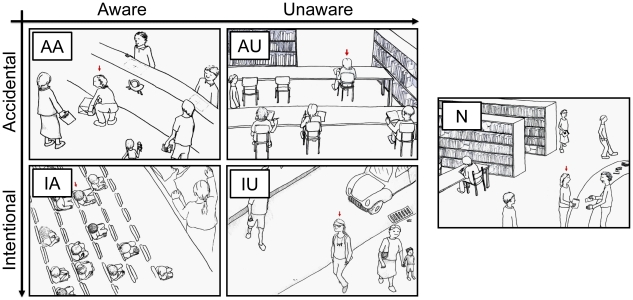
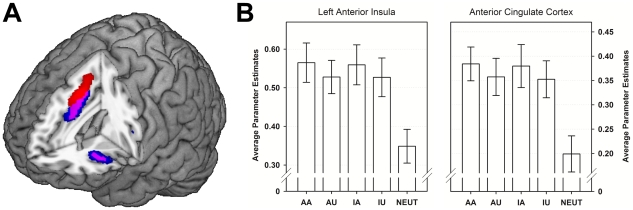
People vicariously experience embarrassment when observing others' public pratfalls or etiquette violations. In two consecutive studies we investigated the subjective experience and the neural correlates of vicarious embarrassment for others in a broad range of situations. We demonstrated, first, that vicarious embarrassment was experienced regardless of whether the observed protagonist acted accidentally or intentionally and was aware or unaware that he/she was in an embarrassing situation. Second, using functional magnetic resonance imaging (fMRI), we showed that the anterior cingulate cortex and the left anterior insula, two cortical structures typically involved in vicarious feelings of others' pain, are also strongly implicated in experiencing the 'social pain' for others' flaws and pratfalls. This holds true even for situations that engage protagonists not aware of their current predicament. Importantly, the activity in the anterior cingulate cortex and the left anterior insula positively correlated with individual differences in trait empathy. The present findings establish the empathic process as a fundamental prerequisite for vicarious embarrassment experiences, thus connecting affect and cognition to interpersonal processes."When we are living with people who have a delicate sense of propriety, we are in misery on their account when anything unbecoming is committed. So I always feel for and with Charlotte when a person is tipping his chair. She cannot endure it." [Elective Affinities, J. W. Goethe].
Overview
The claims and statistics of this paper haven’t been checked yet.
Free: it reads the open-access text and checks the first 5 claims that cite a source we can check. Create a free account to check every claim.
Integrity signals
Registry
Cites
Statistics
Figures
Verification
Claims the paper makes
The claims and statistics of this paper haven’t been checked yet.
Free: it reads the open-access text and checks the first 5 claims that cite a source we can check. Create a free account to check every claim.
Claims other papers make about this one
Each is checked against this paper’s own text: does it say what the citing paper says it does?
The cited source says what the claim attributes to it.
In the citing paper
“Apart from vicarious physical pain, the AI is also associated with feelings of embarrassment or social pain (Krach et al., 2011).”
From Connecting minds and sharing emotions through mimicry: A neurocognitive model of emotional contagion (2017) · cites this paper as Krach et al., 2011
Experimental — accuracy not yet measured
Self-check
Percentages, sums and reported differences re-computed from the paper’s own numbers.
The self-check needs the paper’s full text.
Citations
Cites
Measuring individual differences in empathy: Evidence for a multidimensional approach.
Davis, M. H. (1983) · Journal of Personality and Social Psychology · doi:10.1037/0022-3514.44.1.113 · Cited by 10,272 · cited 2×
“In line with conceptualizations of trait empathy as a multidimensional construct [27,28], the emotional facet of the E-Scale describes individual differences in the experience of another’s emotion, whereas the cognitive facet focuses on the mental act to take another’s perspective.”
Empathy for Pain Involves the Affective but not Sensory Components of Pain
Singer, T., Seymour, B., O'Doherty, J., Kaube, H., Dolan, R. J., & Frith, C. D. (2004) · Science · doi:10.1126/science.1093535 · Cited by 3,929 · cited 2×
“Based on research on empathy for pain and basic emotions we hypothesized that vicarious embarrassment would result in stronger activations in the anterior insula and the ACC as neural indicators for the ongoing empathic process [13,17].”
Moral Emotions and Moral Behavior
Tangney, J. P., Stuewig, J., & Mashek, D. J. (2007) · Annual Review of Psychology · doi:10.1146/annurev.psych.56.091103.070145 · Cited by 3,222 · cited 1×
“. However, with the presented data we show that these appeasement gestures do only partly (i.e. during AA situations) help to explain how empathic observers experience embarrassment for others' flaws or mishaps. We demonstrated that (i) even for situations in which protagonists are unaware of the embarrassing situatio…”
On Face-Work: An Analysis of Ritual Elements in Social Interaction
Goffman, E. (1955) · Psychiatry · doi:10.1080/00332747.1955.11023008 · Cited by 2,870
Psychological and neural mechanisms of the affective dimension of pain
Price, D. D. (2000) · Science · doi:10.1126/science.288.5472.1769 · Cited by 2,092 · cited 1×
“Functional magnetic resonance imaging (fMRI) studies report that affective-motivational components of the so called ‘pain matrix’ [7,8,9], the anterior insula and the anterior cingulate cortex (ACC), are most reliably involved in the compassionate feeling of pain [10,11,12,13,14,15,16,17].”
Social Cognitive Neuroscience: A Review of Core Processes
Lieberman, M. D. (2007) · Annual Review of Psychology · doi:10.1146/annurev.psych.58.110405.085654 · Cited by 2,010
The social neuroscience of empathy
Singer, T., & Lamm, C. (2009) · Annals of the New York Academy of Sciences · doi:10.1111/j.1749-6632.2009.04418.x · Cited by 1,981 · cited 2×
“The activation of both the left ACC (26 20 44) and the left anterior insula (-32 24 0) showed considerable overlap with the affective-motivational part of the ‘pain matrix’ [9,20].”
Empathic neural responses are modulated by the perceived fairness of others
Singer, T., Seymour, B., O'Doherty, J. P., Stephan, K. E., Dolan, R. J., & Frith, C. D. (2006) · Nature · doi:10.1038/nature04271 · Cited by 1,726 · cited 1×
“Recent fMRI studies could show that the neural response to another person’s physical pain was modulated by the observer’s appraisals due to prior interactions with a protagonist [31] or own professional experience [32].”
Are shame, guilt, and embarrassment distinct emotions?
Tangney, J. P., Miller, R. S., Flicker, L., & Barlow, D. H. (1996) · Journal of Personality and Social Psychology · doi:10.1037/0022-3514.70.6.1256 · Cited by 1,556
Perspective Taking as Egocentric Anchoring and Adjustment.
Epley, N., Keysar, B., Van Boven, L., & Gilovich, T. (2004) · Journal of Personality and Social Psychology · doi:10.1037/0022-3514.87.3.327 · Cited by 1,315 · cited 1×
“This process is far from perfect and rather egocentric than focused merely on the feelings of the observed person [25], and may account for situations that evoke vicarious embarrassment in observers even when the fact of the norm violating incident is not accessible to the observed protagonist himself/ herself.”
Cited by
Items 101–189 of 189
Vicarious contagion decreases differentiation – and comes with costs
Sezer, O., & Norton, M. I. (2016) · Behavioral and Brain Sciences · doi:10.1017/s0140525x15001508 · Cited by 1
Neurowissenschaftliche Sozialpsychologie oder Soziale Neurowissenschaften
Hein, G. (2018) · Springer eBooks · doi:10.1007/978-3-531-19564-3_13 · Cited by 1
Hussein, L. J. (2021) · Studies in Documentary Film · doi:10.1080/17503280.2021.1981758 · Cited by 1
Bochmann, C., & Hetze, W. (2022) · Springer eBooks · doi:10.1007/978-3-658-38016-8_2 · Cited by 1
Maibom, H. L. (2022) · Oxford University Press eBooks · doi:10.1093/oso/9780197637081.003.0010 · Cited by 1
All for one or one for all? Examining a parsing of emotion that is informed by lay people’s values
Chow, P. I., Berenbaum, H., Boden, M. T., & Flores, L. E. (2022) · Motivation and Emotion · doi:10.1007/s11031-022-10002-1 · Cited by 1
“However, the experience of vicarious embarrassment arises from observing others’ public failures independent of oneself and is related to empathy for other people’s pain (Krach et al., 2011).”
BackgroundKrivich, E., Mõttus, M., & Bauters, M. (2023) · International Academic Mindtrek Conference (Mindtrek) · doi:10.1145/3616961.3617801 · Cited by 1
“Many studies note that brain regions active during self-pain also activate when watching others in pain [22, 26], indicating a shared neural process for both experienced and observed pain.”
BackgroundDevelopment and validation of the prosocial conformity tendency scale in adolescents
Xu, Y., Zhao, X., Yu, D., & Xu, H. (2024) · Personality and Individual Differences · doi:10.1016/j.paid.2024.112932 · Cited by 1
Similar neural networks for anger and pride in older adults
Hong, J. S., Bätz, L. R., Ye, S., Reutens, D. C., Ebner, N. C., & Ziaei, M. (2025) · Neuropsychologia · doi:10.1016/j.neuropsychologia.2025.109087 · Cited by 1
Feeling emotions for others that they don’t feel: Agency appraisals and vicarious angerPreprint
Wondra, J. D. (2020) · PsyArXiv (OSF Preprints) · doi:10.31234/osf.io/m4bxz · Cited by 1
Alizadeh, A. (2021) · Otago University Research Archive (University of Otago) · Cited by 7
Approach and Avoidance Motivations in Vicarious and Individual Shame
Hildebrandt, L. K. (2013)
Retrodictive mentalising abilities of individuals with and without autism spectrum disorder
Pillai, D. (2014) · Nottingham ePrints (University of Nottingham)
Neuronale Schaltkreise des Peinlichkeitserlebens
Krach, S., Müller‐Pinzler, L., Rademacher, L., Stolz, D. S., & Paulus, F. M. (2016) · e-Neuroforum · doi:10.1007/s12269-016-0042-8
Self-citationMeaning in words - How social context amplifies processing of emotional language
Schindler, S. (2016) · PUB – Publications at Bielefeld University (Bielefeld University)
"Ich bin stolz auf dich." Über die Bedeutung und die bedingenden Faktoren von StellvertreterstolzPreprint
Horsten, L. K. (2018) · OSF Preprints (OSF Preprints) · doi:10.31219/osf.io/zwx8p
The Changing Information Ecosystem in South Korea
Seo, H. (2021) · Oxford University Press eBooks · doi:10.1093/oso/9780197538883.003.0003
Conclusion: Evolving Agent-Affordance Interactions and Information Ecosystem
Seo, H. (2021) · Oxford University Press eBooks · doi:10.1093/oso/9780197538883.003.0009
Networked Collective Action and the Impeachment of President Park
Seo, H. (2021) · Oxford University Press eBooks · doi:10.1093/oso/9780197538883.003.0006
After the Candles Were Extinguished: Post-impeachment Issues
Seo, H. (2021) · Oxford University Press eBooks · doi:10.1093/oso/9780197538883.003.0008
Candlelight Vigils and Citizen Activism
Seo, H. (2021) · Oxford University Press eBooks · doi:10.1093/oso/9780197538883.003.0004
Park’s Supporters Fight Back: Conspiracy Theories and Far-Right Groups
Seo, H. (2021) · Oxford University Press eBooks · doi:10.1093/oso/9780197538883.003.0007
Seo, H. (2021) · Oxford University Press eBooks · doi:10.1093/oso/9780197538883.003.0001
Agent-Affordance Framework of Networked Collective Actions
Seo, H. (2021) · Oxford University Press eBooks · doi:10.1093/oso/9780197538883.003.0002
Pourquoi est-on gêné pour elle ?
Paulus, F. M., & Mayer, A. V. (2021) · Cerveau & Psycho · doi:10.3917/cerpsy.135.0086
Self-citationCrowley, M. J. P. (2021) · Springer eBooks · doi:10.1007/978-3-319-91280-6_707
Maibom, H. L. (2022) · Oxford University Press eBooks · doi:10.1093/oso/9780197637081.003.0007
The Self as Agent, the Self as Observer
Maibom, H. L. (2022) · Oxford University Press eBooks · doi:10.1093/oso/9780197637081.003.0004
Maibom, H. L. (2022) · Oxford University Press eBooks · doi:10.1093/oso/9780197637081.003.0011
Maibom, H. L. (2022) · Oxford University Press eBooks · doi:10.1093/oso/9780197637081.003.0001
Maibom, H. L. (2022) · Oxford University Press eBooks · doi:10.1093/oso/9780197637081.003.0008
Maibom, H. L. (2022) · Oxford University Press eBooks · doi:10.1093/oso/9780197637081.003.0003
Maibom, H. L. (2022) · Oxford University Press eBooks · doi:10.1093/oso/9780197637081.003.0005
Maibom, H. L. (2022) · Oxford University Press eBooks · doi:10.1093/oso/9780197637081.002.0007
Maibom, H. L. (2022) · Oxford University Press eBooks · doi:10.1093/oso/9780197637081.002.0003
Maibom, H. L. (2022) · Oxford University Press eBooks · doi:10.1093/oso/9780197637081.003.0006
Maibom, H. L. (2022) · Oxford University Press eBooks · doi:10.1093/oso/9780197637081.002.0004
Maibom, H. L. (2022) · Oxford University Press eBooks · doi:10.1093/oso/9780197637081.003.0002 · Cited by 1
Maibom, H. L. (2022) · Oxford University Press eBooks · doi:10.1093/oso/9780197637081.003.0009
An Appraisal Theory of Empathy and Other Vicarious Emotional ExperiencesPreprint
Wondra, J. D., & Ellsworth, P. C. (2017) · PsyArXiv (OSF Preprints) · doi:10.31234/osf.io/ejms8
Schulze, K. (2022) · American culture studies · doi:10.14361/9783839462607-008
MALU KARENA ORANG LAIN: PERAN CITRA SOSIAL DAN KONSTRUAL DIRI RELASIONAL-INTERDEPENDEN PADA REMAJA
Oktaviani, J. I. A., & Budiarto, Y. (2022) · Jurnal Psikologi Media Ilmiah Psikologi · doi:10.47007/jpsi.v20i2.275
Kosakarn, P., & Chittham, P. (2021) · Chula Digiverse · doi:10.58837/chula.the.2021.333
Handle with care! teachers in Egyptian cringe comedies: a multimodal analysis
Youssef, A. Y. A. A. (2024) · Multimodal Communication · doi:10.1515/mc-2024-0008
Editorial: A Multifaceted and Dynamic Phenomenon Through the Lifecycle
Vanderheiden, E., & Mayer, C. (2024) · Springer eBooks · doi:10.1007/978-3-031-54585-6_1
Seo, H. (2022) · Oxford University Press eBooks · doi:10.1093/oso/9780197538883.002.0004
Timeline of Events Related to Park Geun-hye Impeachment
Seo, H. (2022) · Oxford University Press eBooks · doi:10.1093/oso/9780197538883.005.0002
Seo, H. (2022) · Oxford University Press eBooks · doi:10.1093/oso/9780197538883.002.0007
Seo, H. (2022) · Oxford University Press eBooks · doi:10.1093/oso/9780197538883.005.0001
Pradeep, A. K., Acharya, A., Chakravarty, R., & Dev, R. (2024) · Wiley eBooks · doi:10.1002/9781394310371.ref
Hermanussen, M., & Scheffler, C. (2024) · Springer eBooks · doi:10.1007/978-3-662-69580-7_50
33. Faden: Das Kuschelhormon Oxytocin
Hermanussen, M., & Scheffler, C. (2024) · Springer eBooks · doi:10.1007/978-3-662-69580-7_38
de Jongste, H. (2020) · Topics in humor research · doi:10.1075/thr.9.c10
de Jongste, H. (2020) · Topics in humor research · doi:10.1075/thr.9.c04
de Jongste, H. (2020) · Topics in humor research · doi:10.1075/thr.9.ref
de Jongste, H. (2020) · Topics in humor research · doi:10.1075/thr.9.c02
de Jongste, H. (2020) · Topics in humor research · doi:10.1075/thr.9.c03
de Jongste, H. (2020) · Topics in humor research · doi:10.1075/thr.9.index
de Jongste, H. (2020) · Topics in humor research · doi:10.1075/thr.9.c11
Playing with private mental models
de Jongste, H. (2020) · Topics in humor research · doi:10.1075/thr.9.c07
de Jongste, H. (2020) · Topics in humor research · doi:10.1075/thr.9.ack
de Jongste, H. (2020) · Topics in humor research · doi:10.1075/thr.9.c01
Playing with presenting public mental models
de Jongste, H. (2020) · Topics in humor research · doi:10.1075/thr.9.c08
Playing with negotiating public mental models
de Jongste, H. (2020) · Topics in humor research · doi:10.1075/thr.9.c09
de Jongste, H. (2020) · Topics in humor research · doi:10.1075/thr.9.toc
de Jongste, H. (2020) · Topics in humor research · doi:10.1075/thr.9.prelim
Humour theories and mental models (2)
de Jongste, H. (2020) · Topics in humor research · doi:10.1075/thr.9.c06
Humour theories and mental models (1)
de Jongste, H. (2020) · Topics in humor research · doi:10.1075/thr.9.c05
Fandom político: visión desde las neurociencias sociales
Ramírez, A. M., & Calzada‐Reyes, A. (2025) · Anagramas - Rumbos y sentidos de la comunicación · doi:10.22395/angr.v24n47a15
In a Sentimental Mood: Emotion, Evolution, and Expression
Odenbaugh, J. (2025) · doi:10.1093/9780197820469.001.0001 · Cited by 1
An Exploratory Study of Vicariously Embarrassing Classroom Incidents
Swanson, S. R. (2020) · Journal for Advancement of Marketing Education · doi:10.63963/001c.150601
“Embarrassment for others is common, and can be experienced across a variety of social situations (Krach et al., 2011).”
Psychophysiological Responses to the Distress of Others
Dimitroff, S. (2018) · Knowledge@UChicago (University of Chicago) · doi:10.6082/0scr4-kn048
“I’m proud of you”: Investigating the antecedents and functions of vicarious pride
Davies, J. (2018) · UNSWorks (University of New South Wales, Sydney, Australia) · doi:10.26190/unsworks/20867
Crossing the line? Three essays exploring moral ambiguity in the marketplace
von Schuckmann, J. (2020) · LA Referencia (Red Federada de Repositorios Institucionales de Publicaciones Científicas)
Flauhet på andres vegne: En undersøkelse av sammenhengen mellom personlighet og vikarierende flauhet
Kostøl, I. G. (2014) · NVA (Nasjonalt vitenarkiv)
Cringe nähtus sisuloojate pilgu läbi
Liiv, L. (2025) · DSpace repository (University of Tartu)
Fremdschämen bei der Polizei – wofür schämen sich Polizeibeamte?
Archipow, K. (2026) · Springer eBooks · doi:10.1007/978-3-662-71668-7_2
Linnunsalo, S., & Hietanen, J. K. (2026) · Psychophysiology · doi:10.1111/psyp.70386
“For example, people may experience embarrassment when they observe others in em-barrassing situations (Hawk et al. 2011; Krach et al. 2011; Müller-Pinzler et al. 2012) or anger when they observe others receiving unfair treatment (Hechler and Kessler 2018; Vitaglione and Barnett 2003).”
The role of emotions in consumption contexts and their influence on decision-making
Putinas, A.-C. (2021) · theses.fr (ABES) · doi:10.70675/4a2b78b1z32b3z4053z982fzdd29b90df4cf
French, R. C., Merritt, H., Hughes, C. S., Betzel, R. F., & Krendl, A. C. (2026) · Network Neuroscience · doi:10.1162/netn.a.571
“…social norms are violated even when one ’ s own social identity does not feel threatened (Kilian et al., 2018; Mayer et al., 2021; Miller, 1987; Ziegler et al., 2022), and has been linked behaviorally and neurally to measures of empathy (Krach et al., 2011; Melchers et al., 2015; Miller, 1987).”
British vs American Cringe Comedy: Cultural Differences in Embarrassment Humor
Hye‐Knudsen, M. (2026) · Springer eBooks · doi:10.1007/978-3-031-93002-7_5
Cringe Comedy as Social Horror
Strohl, M. S. (2026) · Rivista di estetica · doi:10.4000/169s0
Carving Stories at their Natural JointsPreprint
Dubourg, E., Thouzeau, V., Beuchot, T., Bonard, C., Boyer, P., Chevallier, C., Clasen, M., Boon-Falleur, M., Fiorio, G., Fitouchi, L., et al. (2026) · OSF Preprints (OSF Preprints) · doi:10.31219/osf.io/me6bz_v2
Coping with Historical Humiliation as a Means Toward Political Legitimacy in China
HÕBEPAPPEL, U. (2026) · Journal of Current Chinese Affairs · doi:10.1177/18681026261461602
Krendl, A. C., French, R. C., & Hughes, C. S. (2026) · Social Neuroscience · doi:10.1080/17470919.2026.2712228
“…adults has found that detecting social faux pas is associated with increased activity in brain regions associated with vicarious embarrassment (Krach et al., 2011) and empathy (Melchers et al., 2015), including the insula, dorsal anterior cingulate cortex, and somatosensory cortex (Fan et…”
Hoffman, L. J., Serino, N., Martinez, S., Callinan, M., Mulron, Z., Helion, C., Murty, V. P., & Olson, I. R. (2026) · Research Square · doi:10.21203/rs.3.rs-10656829/v1
Cringe Communication in Hungarian Politics
Szabó, G., & Benedek, I. (2026) · Central European Journal of Communication · doi:10.51480/1899-5101.19.2(43).1048
“Cringe involves vicarious embarrassment: a discomfort experienced in response to others’ social failures (Krach et al., 2011; Stocks et al., 2011).”
Landmann, E., & Böckler, A. (2026) · Behavior Research Methods · doi:10.3758/s13428-026-03202-x
Metadata
- Authors
- Krach, S., Cohrs, J. C., de Echeverría Loebell, N. C., Kircher, T., Sommer, J., Jansen, A., & Paulus, F. M.
- Affiliations
- Philipps University of Marburg (DE)
- Queen's University Belfast (GB)
- Corresponding author
- Krach, Sören
- Venue
- PLoS ONE
- Publisher
- Public Library of Science (PLoS)
- Published
- 2011-04-13
- Volume
- 6
- Issue
- 4
- Pages
- e18675
- ISSN
- 1932-6203 (ISSN-L)
- PMC
- PMC3076433
- OpenAlex
- W2078512233
- Cited by
- 179
- References
- 44
- Citations by year
- 2026: 10 · 2025: 8 · 2024: 12 · 2023: 7 · 2022: 26 · 2021: 27 · 2020: 26 · 2019: 4 · 2018: 5 · 2017: 10 · 2016: 8 · 2015: 9 · 2014: 8 · 2013: 12 · 2012: 6
- FWCI
- 11.75
- Type
- journal article
- Language
- en
- Open access
- gold
- doi.org
- Locations
- PLoS ONE (publishedVersion, cc-by)
- Europe PMC (PubMed Central) (publishedVersion, cc-by)
- PubMed Central (publishedVersion, cc-by)
- PubMed (publishedVersion)
- DOAJ (DOAJ: Directory of Open Access Journals) (submittedVersion)
- Figshare (submittedVersion, cc-by)
- Research Portal (Queen's University Belfast) (submittedVersion)
- Topics
- Social Sciences › Psychology › Social Psychology › Emotions and Moral Behavior
- Social Sciences › Psychology › Social Psychology › Action Observation and Synchronization
- Life Sciences › Neuroscience › Cognitive Neuroscience › Neural and Behavioral Psychology Studies
- Keywords
- empathy, social pain, anterior cingulate cortex, anterior insula, trait empathy, neural correlates of empathy, affect and cognition
- MeSH terms
- Adult, Empathy, Female, Humans, Magnetic Resonance Imaging, Male
About these checks
Registry, retraction, Cites and statistics results are computed, not judged, with one exception: a printed reference that no index lists is read once by a model before it counts as a citation error. Claims are extracted by a model and kept only when their quote appears verbatim in the text; each cited source is then checked, with a model’s help, for whether it says what the claim relies on. Those verdicts can be wrong — read the claim’s quote and the cited source before relying on one.
Statistics and arithmetic are recomputed, not judged.
Confidence bands are shown only for fields calibrated on our annotated test set. None is calibrated yet, so no band is shown.
What counts as a claim ›How we measure confidence ›How we check this ›
Are you an author, or do you see a problem with this page? Request a review
Data sources
Bibliographic data: Semantic Scholar, OpenAlex, Crossref.
Contains information from the Semantic Scholar Academic Graph Datasets, made available under the ODC Attribution License (ODC-BY 1.0).
Semantic Scholar’s data is described in: Kinney, R., et al. (2023). The Semantic Scholar Open Data Platform. arXiv:2301.10140.
