

Red and Processed Meat and Colorectal Cancer Incidence: Meta-Analysis of Prospective Studies
Open accessThe DOI matches its Crossref record; 71 of the 72 references it cites were found in a registry or an index.
Abstract
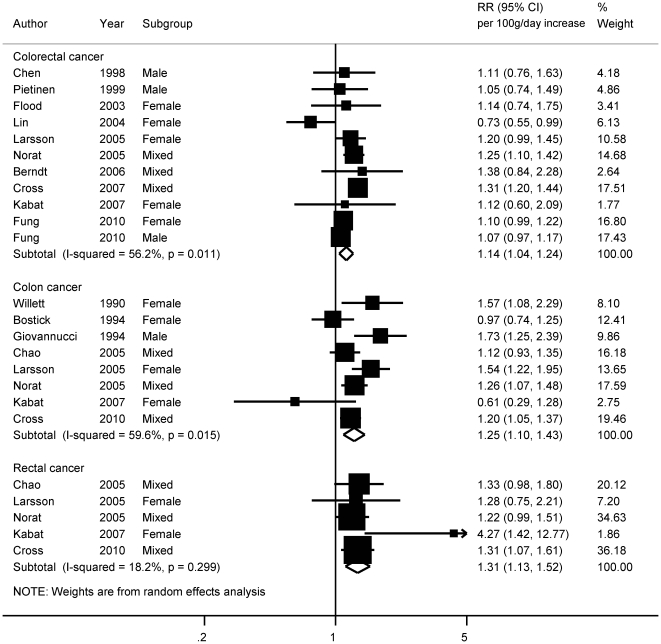
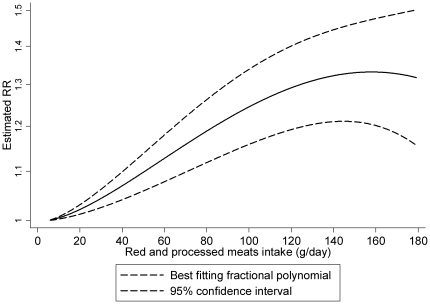
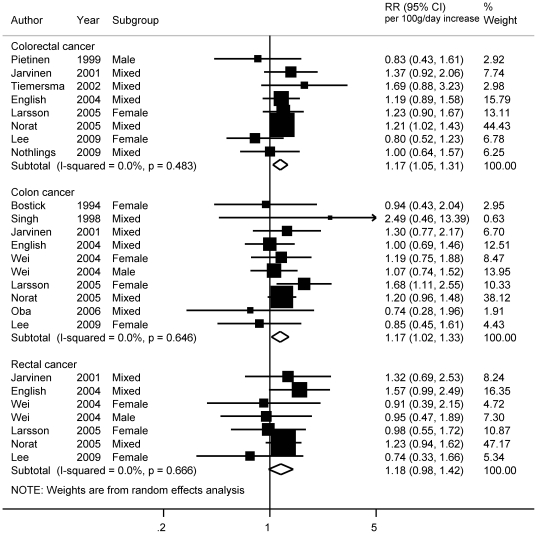
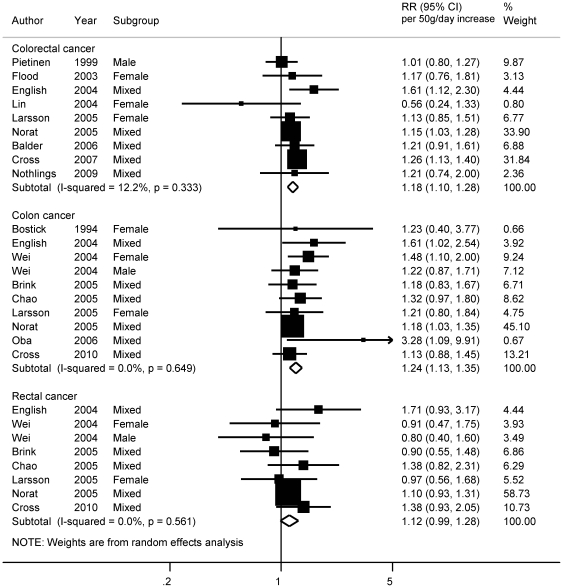
BACKGROUND: The evidence that red and processed meat influences colorectal carcinogenesis was judged convincing in the 2007 World Cancer Research Fund/American Institute of Cancer Research report. Since then, ten prospective studies have published new results. Here we update the evidence from prospective studies and explore whether there is a non-linear association of red and processed meats with colorectal cancer risk. METHODS AND FINDINGS: Relevant prospective studies were identified in PubMed until March 2011. For each study, relative risks and 95% confidence intervals (CI) were extracted and pooled with a random-effects model, weighting for the inverse of the variance, in highest versus lowest intake comparison, and dose-response meta-analyses. Red and processed meats intake was associated with increased colorectal cancer risk. The summary relative risk (RR) of colorectal cancer for the highest versus the lowest intake was 1.22 (95% CI = 1.11-1.34) and the RR for every 100 g/day increase was 1.14 (95% CI = 1.04-1.24). Non-linear dose-response meta-analyses revealed that colorectal cancer risk increases approximately linearly with increasing intake of red and processed meats up to approximately 140 g/day, where the curve approaches its plateau. The associations were similar for colon and rectal cancer risk. When analyzed separately, colorectal cancer risk was related to intake of fresh red meat (RR(for 100 g/day increase) = 1.17, 95% CI = 1.05-1.31) and processed meat (RR (for 50 g/day increase) = 1.18, 95% CI = 1.10-1.28). Similar results were observed for colon cancer, but for rectal cancer, no significant associations were observed. CONCLUSIONS: High intake of red and processed meat is associated with significant increased risk of colorectal, colon and rectal cancers. The overall evidence of prospective studies supports limiting red and processed meat consumption as one of the dietary recommendations for the prevention of colorectal cancer.
Overview
The claims and statistics of this paper haven’t been checked yet.
Free: it reads the open-access text and checks the first 5 claims that cite a source we can check. Create a free account to check every claim.
Integrity signals
Registry
Cites
Statistics
Figures
Verification
Claims the paper makes
The claims and statistics of this paper haven’t been checked yet.
Free: it reads the open-access text and checks the first 5 claims that cite a source we can check. Create a free account to check every claim.
Claims other papers make about this one
Each is checked against this paper’s own text: does it say what the citing paper says it does?
The cited source says what the claim attributes to it.
In the citing paper
“quality and obesity 54,55 , and processed meat with colorectal cancer 56 .”
From Ultra‐processed foods and the nutrition transition: global, regional and national trends, food systems transformations and political economy drivers (2020) · cites this paper as [56]
Self-check
Percentages, sums and reported differences re-computed from the paper’s own numbers.
The self-check needs the paper’s full text.
Citations
Cites
Meta-analysis in clinical trials
DerSimonian, R., & Laird, N. (1986) · Controlled Clinical Trials · doi:10.1016/0197-2456(86)90046-2 · Cited by 39,552 · cited 1×
“We present the results from the randomeffects meta-analysis that accounts for between-study heterogeneity [31] unless otherwise specified.”
MethodQuantifying heterogeneity in a meta‐analysis
Higgins, J. P. T., & Thompson, S. G. (2002) · Statistics in Medicine · doi:10.1002/sim.1186 · Cited by 36,763 · cited 1×
“To assess heterogeneity, we computed the Cochran Q test and I(2) statistic [36].”
MethodEstimates of worldwide burden of cancer in 2008: GLOBOCAN 2008
Ferlay, J., Shin, H., Bray, F., Forman, D., Mathers, C., & Parkin, D. M. (2010) · International Journal of Cancer · doi:10.1002/ijc.25516 · Cited by 21,293 · cited 1×
“Incidence rates are highest in North America, Western Europe, Australia/New Zealand, and in Asian countries that have experienced nutrition transition, such as Japan, Singapore, and North-Korea [1].”
BackgroundFood, nutrition, physical activity, and the prevention of cancer: a global perspective
(2008) · Choice Reviews Online · doi:10.5860/choice.45-5024 · Cited by 5,350
Publication and related bias in meta-analysis
Sterne, J. A. C., Gavaghan, D., & Egger, M. (2000) · Journal of Clinical Epidemiology · doi:10.1016/s0895-4356(00)00242-0 · Cited by 2,282
Lazcano-Ponce, E. C. (2009) · Salud Pública de México · Cited by 1,669
Worldwide Variations in Colorectal Cancer
Center, M. M., Jemal, A., Smith, R. A., & Ward, E. (2009) · CA: A Cancer Journal for Clinicians · doi:10.3322/caac.20038 · Cited by 1,276 · cited 1×
“carcinogenesis is indicated by the increase in colorectal cancer incidence in parallel with economic development and adoption of a western lifestyle [4], as well as by the results of migration studies that demonstrate a greater lifetime incidence of colorectal cancer among immigrants to high-incidence, industrialized…”
BackgroundWillett, W. C., Stampfer, M. J., Colditz, G. A., Rosner, B. A., & Speizer, F. E. (1990) · New England Journal of Medicine · doi:10.1056/nejm199012133232404 · Cited by 1,248 · cited 6×
“References: Chen, 1998 [51]; Pietinen, 1999 [57]; Flood, 2003 [33]; Lin, 2004 [56]; Larsson, 2005 [34]; Norat, 2005 [50]; Berndt, 2006 [19]; Cross, 2007 [22]; Kabat, 2007 [24]; Fung, 2010 [23]; Willett, 1990 [58]; Bostick, 1994 [52]; Giovannuccci, 1994 [55]; Chao, 2005 [54]; Cross, 2010 [21].”
ResultInfluentialGeneralized Least Squares for Trend Estimation of Summarized Dose–response Data
Orsini, N., Bellocco, R., & Greenland, S. (2006) · The Stata Journal: Promoting communications on statistics and Stata · doi:10.1177/1536867x0600600103 · Cited by 1,241 · cited 1×
“In linear dose-response meta-analyses, we pooled the relative risk estimates per unit of intake increase (with its standard error) reported in the studies, or computed by us from the categorical data using generalized least-squares for trend estimation [32].”
MethodCairns, S. R., Scholefield, J. H., Steele, R. J., Dunlop, M. G., Thomas, H. J. W., Evans, G. D., Eaden, J. A., Rutter, M. D., Atkin, W. P., Saunders, B. P., et al. (2010) · Gut · doi:10.1136/gut.2009.179804 · Cited by 1,141 · cited 1×
“Screening and surveillance of adenomatous polyps, a precursor of colorectal cancer, is currently the cornerstone for primary prevention of colorectal cancer [6].”
BackgroundThe use of fractional polynomials to model continuous risk variables in epidemiology
Royston, P., Ambler, G., & Sauerbrei, W. (1999) · International Journal of Epidemiology · doi:10.1093/ije/28.5.964 · Cited by 1,066 · cited 1×
“cancer using fractional polynomial models [39].”
Jemal, A., Thun, M. J., Ries, L. A. G., Howe, H. L., Weir, H. K., Center, M. M., Ward, E., Wu, X.-C., Eheman, C., Anderson, R., et al. (2008) · JNCI: Journal of the National Cancer Institute · doi:10.1093/jnci/djn389 · Cited by 957 · cited 1×
“Recent declines in mortality from colorectal cancer have been observed in North America and Japan, possibly due to primary prevention (surveillance and screening) and improved treatment [2].”
BackgroundNorat, T., Bingham, S., Ferrari, P., Slimani, N., Jenab, M., Mazuir, M., Overvad, K., Olsen, A., Tjønneland, A., Clavel, F., et al. (2005) · JNCI: Journal of the National Cancer Institute · doi:10.1093/jnci/dji164 · Cited by 862 · cited 9×
“We could not include the UK Dietary Cohort Consortium [42], as data from two of the seven component cohorts were in other cohort consortium that was included in the meta-analysis because it had more cancer cases [50].”
BackgroundMethodResultInfluentialSelf-citationPrimary Prevention of Colorectal Cancer
Chan, A. T., & Giovannucci, E. L. (2010) · Gastroenterology · doi:10.1053/j.gastro.2010.01.057 · Cited by 723
Intake of fat, meat, and fiber in relation to risk of colon cancer in men.
Giovannucci, E. L., Rimm, E. B., Stampfer, M. J., Colditz, G. A., Ascherio, A., & Willett, W. C. (1994) · PubMed · Cited by 696
Meat Consumption and Risk of Colorectal Cancer
Chao, A. (2005) · JAMA · doi:10.1001/jama.293.2.172 · Cited by 587 · cited 6×
“No significant associations were observed for proximal and distal colon cancers in the meta-analysis of the two [34,54] out of the five studies [21,34,50,54,55] identified in the search (Table 1).”
BackgroundResultInfluentialCancer mortality in Europe, 2000–2004, and an overview of trends since 1975
La Vecchia, C., Bosetti, C., Lucchini, F., Bertuccio, P., Negri, E., Boyle, P., & Levi, F. (2010) · Annals of Oncology · doi:10.1093/annonc/mdp530 · Cited by 559 · cited 1×
“. Decreasing trends in colorectal cancer mortality have also been observed in most Western European countries”
BackgroundComparison of risk factors for colon and rectal cancer
Wei, E. K., Giovannucci, E., Wu, K., Rosner, B., Fuchs, C. S., Willett, W. C., & Colditz, G. A. (2004) · International Journal of Cancer · doi:10.1002/ijc.11540 · Cited by 551 · cited 6×
“References: Pietinen, 1999 [57]; Flood, 2003 [33]; English, 2004 [60]; Lin, 2004 [56]; Larsson, 2005 [34]; Norat, 2005 [50]; Balder, 2006 [64]; Cross, 2007 [22]; Nothlings, 2009 [26]; Bostick, 1994 [52]; Wei, 2004 [18]; Brink, 2005 [49]; Chao, 2005 [54]; Oba, 2006 [27]; Cross, 2010 [21].”
BackgroundResultInfluentialBostick, R. M., Potter, J. D., Kushi, L. H., Sellers, T. A., Steinmetz, K. A., McKenzie, D. R., Gapstur, S. M., & Folsom, A. R. (1994) · Cancer Causes & Control · doi:10.1007/bf01830725 · Cited by 494
Fraser, G. E. (1999) · The American Journal of Clinical Nutrition · doi:10.1093/ajcn/70.3.532s · Cited by 489 · cited 1×
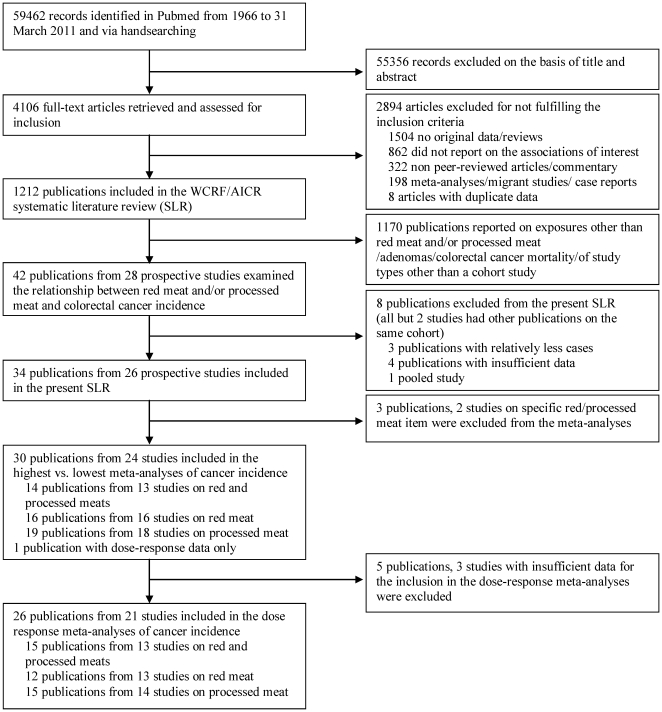
“Eight articles were excluded [41–48] because other articles of the same cohort studies with more cases [49–51] or with information required in the meta-analysis were already included [18,52,53].”
BackgroundA Prospective Study of Red and Processed Meat Intake in Relation to Cancer Risk
Cross, A. J., Leitzmann, M. F., Gail, M. H., Hollenbeck, A. R., Schatzkin, A., & Sinha, R. (2007) · PLoS Medicine · doi:10.1371/journal.pmed.0040325 · Cited by 476 · cited 4×
“Studies that required conversion from times or servings to grams per day [23,51,56] were significantly associated with a lower summary estimate than studies that did not require the conversion [19,22,24,33,34,50,57].”
MethodInfluentialCross, A. J., Ferrucci, L. M., Risch, A., Graubard, B. I., Ward, M. H., Park, Y., Hollenbeck, A. R., Schatzkin, A., & Sinha, R. (2010) · Cancer Research · doi:10.1158/0008-5472.can-09-3929 · Cited by 469 · cited 6×
“No significant associations were observed for proximal and distal colon cancers in the meta-analysis of the two [34,54] out of the five studies [21,34,50,54,55] identified in the search (Table 1).”
BackgroundResultInfluentialMeat‐related mutagens/carcinogens in the etiology of colorectal cancer
Cross, A. J., & Sinha, R. (2004) · Environmental and Molecular Mutagenesis · doi:10.1002/em.20030 · Cited by 437 · cited 1×
“Several plausible biological mechanisms have been suggested to explain the association of red and processed meats with colorectal cancer [7–9].”
BackgroundSandhu, M. S., White, I. R., & McPherson, K. (2001) · PubMed · Cited by 425
(2003) · PubMed · Cited by 381
Diet and risk of colorectal cancer in a cohort of Finnish men
Pietinen, P., Malila, N., Virtanen, M., Hartman, T. J., Tangrea, J. A., Albanes, D., & Virtamo, J. (1999) · Cancer Causes & Control · doi:10.1023/a:1008962219408 · Cited by 338 · cited 4×
“Studies that required conversion from times or servings to grams per day [23,51,56] were significantly associated with a lower summary estimate than studies that did not require the conversion [19,22,24,33,34,50,57].”
InfluentialKnekt, J�rvinen, R., Dich, J., & Hakulinen, T. (1999) · International Journal of Cancer · doi:10.1002/(sici)1097-0215(19990315)80:6<852::aid-ijc9>3.0.co;2-s · Cited by 321 · cited 2×
“Some articles [20,28,59,62,66] could not be included in the doseresponse meta-analysis because of insufficient information, but the dose-response meta-analyses were consistent with the highest versus lowest meta-analyses that included these studies that suggests that the exclusions from the dose-response meta-analyses…”
BackgroundResultDietary Risk Factors for Colon Cancer in a Low-risk Population
Singh, P. N., & Fraser, G. E. (1998) · American Journal of Epidemiology · doi:10.1093/oxfordjournals.aje.a009697 · Cited by 306 · cited 3×
“Although we cannot rule out residual confounding, most studies included in the meta-analyses adjusted results by smoking, alcohol consumption, BMI and physical activity [18,22–24,26,27, 50,51,54,56,57,64] in addition to age, sex and energy; in several cohort studies the multivariate adjusted models also included folat…”
BackgroundResultProportion of colon cancer risk that might be preventable in a cohort of middle-aged US men
Platz, E. A., Willett, W. C., Colditz, G. A., Rimm, E. B., Spiegelman, D., & Giovannucci, E. (2000) · Cancer Causes & Control · doi:10.1023/a:1008999232442 · Cited by 280 · cited 1×
“. Under different scenarios for red meat consumption, reduction of physical inactivity, obesity, alcohol consumption, early adulthood cigarette smoking, and low intake of folic acid from supplements, the population attributable risk of colon cancer for the combined modifiable risk factors ranged from 39% to 55% of can…”
BackgroundBingham, S. A., Hughes, R., & Cross, A. J. (2002) · The Journal of Nutrition · doi:10.1093/jn/132.11.3522s · Cited by 273 · cited 1×
“Red meat but not white meat intake shows a dose–response relation with the endogenous formation of nitroso compounds in humans [11].”
BackgroundBagnardi, V. (2004) · American Journal of Epidemiology · doi:10.1093/aje/kwh142 · Cited by 272 · cited 1×
“Non-linearity was tested using the likelihood ratio test [40].”
MethodProspective study of diet and female colorectal cancer: The New York university women's health study
Kato, I., Akhmedkhanov, A., Koenig, K., Toniolo, P. G., Shore, R. E., & Riboli, E. (1997) · Nutrition and Cancer · doi:10.1080/01635589709514588 · Cited by 269 · cited 3×
“Some articles [20,28,59,62,66] could not be included in the doseresponse meta-analysis because of insufficient information, but the dose-response meta-analyses were consistent with the highest versus lowest meta-analyses that included these studies that suggests that the exclusions from the dose-response meta-analyses…”
BackgroundResultA prospective cohort study on the relation between meat consumption and the risk of colon cancer.
Goldbohm, R. A., van den Brandt, P. A., Veer, P. V. ’., Brants, H. A. M., Dorant, E., STURMANS, F., & Hermus, R. J. J. (1994) · PubMed · Cited by 261
The Mediterranean and Dietary Approaches to Stop Hypertension (DASH) diets and colorectal cancer
Fung, T. T., Hu, F. B., Wu, K., Chiuve, S. E., Fuchs, C. S., & Giovannucci, E. (2010) · The American Journal of Clinical Nutrition · doi:10.3945/ajcn.2010.29242 · Cited by 238 · cited 3×
“Although we cannot rule out residual confounding, most studies included in the meta-analyses adjusted results by smoking, alcohol consumption, BMI and physical activity [18,22–24,26,27, 50,51,54,56,57,64] in addition to age, sex and energy; in several cohort studies the multivariate adjusted models also included folat…”
ResultA prospective study of N-acetyltransferase genotype, red meat intake, and risk of colorectal cancer.
Chen, J., Stampfer, M. J., Hough, H. L., García‐Closas, M., Willett, W. C., Hennekens, C. H., Kelsey, K. T., & Hunter, D. J. (1998) · PubMed · Cited by 228
Larsson, S. C., Rafter, J., Holmberg, L., Bergkvist, L., & Wolk, A. (2005) · International Journal of Cancer · doi:10.1002/ijc.20658 · Cited by 222 · cited 8×
“No significant associations were observed for proximal and distal colon cancers in the meta-analysis of the two [34,54] out of the five studies [21,34,50,54,55] identified in the search (Table 1).”
BackgroundMethodResultInfluentialHeme and Chlorophyll Intake and Risk of Colorectal Cancer in the Netherlands Cohort Study
Balder, H. F., Vogel, J., Jansen, M. C. J. F., Weijenberg, M. P., van den Brandt, P. A., Westenbrink, S., van der Meer, R., & Goldbohm, R. A. (2006) · Cancer Epidemiology, Biomarkers & Prevention · doi:10.1158/1055-9965.epi-05-0772 · Cited by 204 · cited 1×
“References: Pietinen, 1999 [57]; Flood, 2003 [33]; English, 2004 [60]; Lin, 2004 [56]; Larsson, 2005 [34]; Norat, 2005 [50]; Balder, 2006 [64]; Cross, 2007 [22]; Nothlings, 2009 [26]; Bostick, 1994 [52]; Wei, 2004 [18]; Brink, 2005 [49]; Chao, 2005 [54]; Oba, 2006 [27]; Cross, 2010 [21].”
Red Meat, Chicken, and Fish Consumption and Risk of Colorectal Cancer
English, D. R., MacInnis, R. J., Hodge, A. M., Hopper, J. L., Haydon, A. M., & Giles, G. G. (2004) · Cancer Epidemiology, Biomarkers & Prevention · doi:10.1158/1055-9965.1509.13.9 · Cited by 191 · cited 3×
“References: Pietinen, 1999 [57]; Jarvinen, 2001 [61]; Tiemersma, 2002 [63]; English, 2004 [60]; Larsson, 2005 [34]; Norat, 2005 [50]; Lee, 2009 [25]; Nothlings, 2009 [26]; Bostick, 1994 [52]; Singh, 1998 [53]; Wei, 2004 [18]; Oba, 2006 [27].”
BackgroundMa, J., Giovannucci, E., Pollak, M., Chan, J. M., Gaziano, J. M., Willett, W., & Stampfer, M. J. (2001) · JNCI Journal of the National Cancer Institute · doi:10.1093/jnci/93.17.1330 · Cited by 189 · cited 1×
“Eight articles were excluded [41–48] because other articles of the same cohort studies with more cases [49–51] or with information required in the meta-analysis were already included [18,52,53].”
BackgroundSinha, R. R., Rothman, N., Brown, E. D., Mark, S. D., Hoover, R. N., Caporaso, N. E., Levander, O. A., Knize, M. G., Lang, N. P., & Kadlubar, F. F. (1994) · PubMed · Cited by 188
Bekkering, G. E., Harris, R. J., Thomas, S., Mayer, A.-M. B., Beynon, R., Ness, A. R., Harbord, R. M., Bain, C., Smith, G. D., & Sterne, J. A. C. (2008) · American Journal of Epidemiology · doi:10.1093/aje/kwn005 · Cited by 182 · cited 1×
“To be included in the dose-response meta-analyses, the numbers of cases and the denominators in the cohort studies or the information required to derive them using standard methods”
MethodDietary Fat and Fatty Acids and Risk of Colorectal Cancer in Women
Lin, J. (2004) · American Journal of Epidemiology · doi:10.1093/aje/kwh319 · Cited by 166 · cited 3×
“Studies that required conversion from times or servings to grams per day [23,51,56] were significantly associated with a lower summary estimate than studies that did not require the conversion [19,22,24,33,34,50,57].”
Dietary fat, cholesterol and colorectal cancer in a prospective study
Järvinen, R., Knekt, P., Hakulinen, T., Rissanen, H., & Heliövaara, M. (2001) · British Journal of Cancer · doi:10.1054/bjoc.2001.1906 · Cited by 161 · cited 1×
“References: Pietinen, 1999 [57]; Jarvinen, 2001 [61]; Tiemersma, 2002 [63]; English, 2004 [60]; Larsson, 2005 [34]; Norat, 2005 [50]; Lee, 2009 [25]; Nothlings, 2009 [26]; Bostick, 1994 [52]; Singh, 1998 [53]; Wei, 2004 [18]; Oba, 2006 [27].”
Effect of processed and red meat on endogenous nitrosation and DNA damage
Joosen, A. M. C. P., Kuhnle, G. G. C., Aspinall, S. M., Barrow, T. M., Lecommandeur, E., Azqueta, A., Collins, A. R., & Bingham, S. A. (2009) · Carcinogenesis · doi:10.1093/carcin/bgp130 · Cited by 149 · cited 1×
“Nitrites or nitrates added to meat for preservation could increase exogenous exposure to nitrosamines, N-nitroso compounds, and their precursors; meats cured with nitrite have the same effect as fresh red meat on endogenous nitrosation [14].”
BackgroundOba, S., Shimizu, N., Nagata, C., Shimizu, H., KAMETANI, M., Takeyama, N., Ohnuma, T., & Matsushita, S. (2006) · Cancer Letters · doi:10.1016/j.canlet.2005.12.037 · Cited by 142 · cited 3×
“This included studies in Asian populations [20,25,27,28], a Canadian breast cancer screening cohort [24], a US multi-ethnic cohort [26], and four American cohorts [19,21– 23].”
BackgroundHigh-meat diets and cancer risk
Bingham, S. A. (1999) · Proceedings of the Nutrition Society · doi:10.1017/s0029665199000336 · Cited by 140
Gaard, M., Tretli, S., & Løken, E. B. (1996) · PubMed · Cited by 137
Bazyk, A., Olson, J. E., Sellers, T. A., Kushi, L. H., Anderson, K. E., Lazovich, D., Folsom, A. R., & Bostick, R. M. (1998) · Cancer Causes & Control · doi:10.1023/a:1008886715597 · Cited by 137 · cited 1×
“Eight articles were excluded [41–48] because other articles of the same cohort studies with more cases [49–51] or with information required in the meta-analysis were already included [18,52,53].”
BackgroundIntake of fried meat and risk of cancer: A follow‐up study in finland
Knekt, P., Steineck, G., Järvinen, R., Hakulinen, T. R., & Aromaa, A. (1994) · International Journal of Cancer · doi:10.1002/ijc.2910590608 · Cited by 133
Meat Consumption and Colorectal Cancer: A Review of Epidemiologic Evidence
Norat, T., & Riboli, E. (2009) · Nutrition Reviews · doi:10.1111/j.1753-4887.2001.tb06974.x · Cited by 131 · cited 1×
“Meta-regression analysis showed that studies adjusted for age and energy only [55,58] reported stronger associations than the more adjusted studies [9,21,24,34,52,54] (P=0.”
ResultSelf-citationWei, E. K., Colditz, G. A., Giovannucci, E. L., Fuchs, C. S., & Rosner, B. A. (2009) · American Journal of Epidemiology · doi:10.1093/aje/kwp210 · Cited by 127
Tiemersma, E. W., Kampman, E., Bueno-de-Mesquita, H. B., Bunschoten, A., van Schothorst, E. M., Kok, F. J., & Kromhout, D. (2002) · Cancer Causes & Control · doi:10.1023/a:1015236701054 · Cited by 127 · cited 2×
“References: Pietinen, 1999 [57]; Jarvinen, 2001 [61]; Tiemersma, 2002 [63]; English, 2004 [60]; Larsson, 2005 [34]; Norat, 2005 [50]; Lee, 2009 [25]; Nothlings, 2009 [26]; Bostick, 1994 [52]; Singh, 1998 [53]; Wei, 2004 [18]; Oba, 2006 [27].”
Self-citationA cohort study of dietary iron and heme iron intake and risk of colorectal cancer in women
Kabat, G. C., Miller, A. B., Jain, M., & Rohan, T. E. (2007) · British Journal of Cancer · doi:10.1038/sj.bjc.6603837 · Cited by 117 · cited 5×
“This included studies in Asian populations [20,25,27,28], a Canadian breast cancer screening cohort [24], a US multi-ethnic cohort [26], and four American cohorts [19,21– 23].”
BackgroundResultInfluentialDietary patterns and risk of colon cancer and adenoma in a cohort of men (United States)
Wu, K., Hu, F. B., Fuchs, C. S., Rimm, E. B., Willett, W. C., & Giovannucci, E. L. (2004) · Cancer Causes & Control · doi:10.1007/s10552-004-1809-2 · Cited by 107 · cited 1×
“Eight articles were excluded [41–48] because other articles of the same cohort studies with more cases [49–51] or with information required in the meta-analysis were already included [18,52,53].”
BackgroundRed meat and colorectal cancer: a critical summary of prospective epidemiologic studies
Alexander, D. D., & Cushing, C. A. (2011) · Obesity Reviews · doi:10.1111/j.1467-789x.2010.00785.x · Cited by 106 · cited 1×
“However two recent reviews of prospective studies concluded that the available epidemiologic evidence is not sufficient to support an independent positive association between red meat or processed meat consumption and colorectal cancer, because the likely influence of confounding by other dietary and lifestyle factors…”
BackgroundMeat, Fat, and Their Subtypes as Risk Factors for Colorectal Cancer in a Prospective Cohort of Women
Flood, A. (2003) · American Journal of Epidemiology · doi:10.1093/aje/kwg099 · Cited by 106 · cited 5×
“For studies reporting intakes in grams/1000 kcal/day [22,26,33], the intake in grams/day was estimated using the average energy intake reported in the article.”
MethodInfluentialNöthlings, U., Yamamoto, J. F., Wilkens, L. R., Murphy, S. P., Park, S.-Y., Henderson, B. E., Kolonel, L. N., & Le Marchand, L. (2009) · Cancer Epidemiology, Biomarkers & Prevention · doi:10.1158/1055-9965.epi-08-1218 · Cited by 99 · cited 4×
“This included studies in Asian populations [20,25,27,28], a Canadian breast cancer screening cohort [24], a US multi-ethnic cohort [26], and four American cohorts [19,21– 23].”
BackgroundMethodInfluentialAnimal Origin Foods and Colorectal Cancer Risk: A Report From the Shanghai Women's Health Study
Lee, S.-A., Shu, X. O., Yang, G., Li, H., Gao, Y.-T., & Zheng, W. (2009) · Nutrition and Cancer · doi:10.1080/01635580802419780 · Cited by 94 · cited 3×
“This included studies in Asian populations [20,25,27,28], a Canadian breast cancer screening cohort [24], a US multi-ethnic cohort [26], and four American cohorts [19,21– 23].”
BackgroundResultProspective study of dietary patterns and colorectal cancer among Singapore Chinese
Butler, L. M., Wang, R., Koh, W.-P., & Yu, M. C. (2008) · British Journal of Cancer · doi:10.1038/sj.bjc.6604678 · Cited by 94 · cited 4×
“This included studies in Asian populations [20,25,27,28], a Canadian breast cancer screening cohort [24], a US multi-ethnic cohort [26], and four American cohorts [19,21– 23].”
BackgroundResultInfluentialPolicy and action for cancer prevention
Beck, K., & Thompson, R. (2010) · Perspectives in Public Health · doi:10.1177/1757913910384051 · Cited by 91
Processed meat and colorectal cancer: a quantitative review of prospective epidemiologic studies
Alexander, D. D., Miller, A. J., Cushing, C. A., & Lowe, K. A. (2010) · European Journal of Cancer Prevention · doi:10.1097/cej.0b013e32833b48fa · Cited by 80 · cited 1×
“However two recent reviews of prospective studies concluded that the available epidemiologic evidence is not sufficient to support an independent positive association between red meat or processed meat consumption and colorectal cancer, because the likely influence of confounding by other dietary and lifestyle factors…”
BackgroundChan, A. T., Tranah, G. J., Giovannucci, E. L., Willett, W. C., Hunter, D. J., & Fuchs, C. S. (2005) · International Journal of Cancer · doi:10.1002/ijc.20890 · Cited by 70 · cited 2×
“Some articles [20,28,59,62,66] could not be included in the doseresponse meta-analysis because of insufficient information, but the dose-response meta-analyses were consistent with the highest versus lowest meta-analyses that included these studies that suggests that the exclusions from the dose-response meta-analyses…”
BackgroundResultGenetic Variation in the Nucleotide Excision Repair Pathway and Colorectal Cancer Risk
Berndt, S. I., Platz, E. A., Fallin, M. D., Thuita, L. W., Hoffman, S. C., & Helzlsouer, K. J. (2006) · Cancer Epidemiology Biomarkers & Prevention · doi:10.1158/1055-9965.epi-06-0449 · Cited by 67 · cited 3×
“Studies that required conversion from times or servings to grams per day [23,51,56] were significantly associated with a lower summary estimate than studies that did not require the conversion [19,22,24,33,34,50,57].”
Lüchtenborg, M., Weijenberg, M. P., de Goeij, A. F. P. M., Wark, P. A., Brink, M., Roemen, G. M. J. M., Lentjes, M. H. F. M., de Bruïne, A. P., Goldbohm, R. A., Veer, P. V. ’., et al. (2005) · Cancer Causes & Control · doi:10.1007/s10552-005-0239-0 · Cited by 66 · cited 1×
“Eight articles were excluded [41–48] because other articles of the same cohort studies with more cases [49–51] or with information required in the meta-analysis were already included [18,52,53].”
BackgroundSpencer, E. A., Key, T. J., Appleby, P. N., Dahm, C. C., Keogh, R. H., Fentiman, I. S., Akbaraly, T. N., Brunner, E. J., Burley, V. J., Cade, J. E., et al. (2010) · Cancer Causes & Control · doi:10.1007/s10552-010-9569-7 · Cited by 65 · cited 4×
“We could not include the UK Dietary Cohort Consortium [42], as data from two of the seven component cohorts were in other cohort consortium that was included in the meta-analysis because it had more cancer cases [50].”
MethodResultInfluentialSelf-citationBrink, M., Weijenberg, M. P., de Goeij, A. F. P. M., Roemen, G. M. J. M., Lentjes, M. H. F. M., de Bruïne, A. P., Goldbohm, R. A., & van den Brandt, P. A. (2005) · British Journal of Cancer · doi:10.1038/sj.bjc.6602491 · Cited by 61 · cited 2×
“Several potential confounders were not included in the final statistical models in some studies because, as the authors reported, their inclusion in the model did not substantially modified the relative risk estimates [19,33,49,52,60,63].”
BackgroundMeat consumption and risk of colorectal cancer in Japan: The Miyagi Cohort Study
Sato, Y., Nakaya, N., Kuriyama, S., Nishino, Y., Tsubono, Y., & Tsuji, I. (2006) · European Journal of Cancer Prevention · doi:10.1097/01.cej.0000197455.87356.05 · Cited by 52 · cited 4×
“This included studies in Asian populations [20,25,27,28], a Canadian breast cancer screening cohort [24], a US multi-ethnic cohort [26], and four American cohorts [19,21– 23].”
BackgroundResultInfluentialThe potential for prevention of colorectal cancer in the UK
Parkin, D. M., Olsen, A.-H., & Sasieni, P. D. (2009) · European Journal of Cancer Prevention · doi:10.1097/cej.0b013e32830c8d83 · Cited by 44 · cited 1×
“4% in women [15,71].”
Bonnett, R., Charalambides, A. A., Martin, R. A., Sales, K. D., & Fitzsimmons, B. W. (1975) · Journal of the Chemical Society, Chemical Communications · doi:10.1039/c39750000884 · Cited by 39 · cited 1×
“This has been explained by the abundant presence of heme in red meat that can readily become nitrosylated and act as a nitrosating agent [12,13].”
BackgroundSørensen, M., Autrup, H. N., Olsen, A., Tjønneland, A. M., Overvad, K., & Raaschou‐Nielsen, O. (2008) · Cancer Letters · doi:10.1016/j.canlet.2008.02.046 · Cited by 35 · cited 1×
“Eight articles were excluded [41–48] because other articles of the same cohort studies with more cases [49–51] or with information required in the meta-analysis were already included [18,52,53].”
BackgroundNested case-control study on the risk factors of colorectal cancer
Chen, K. (2003) · World Journal of Gastroenterology · doi:10.3748/wjg.v9.i1.99 · Cited by 23 · cited 1×
“These studies reported positive but non-significant associations between fried sausage [67] and pork [68] and colon cancer.”
Background
Research works printed but not linked: 2
- 2003, Food, Nutrition, Physical Activity, and the Prevention of Cancer: a Global Perspective, Systematic Literature Review Specification Manual
- A Tobias, 1999, Assessing the influence of a single study in meta-analysis., Stata Tech Bull, 47, 15
Cited by
Dekker, E., Tanis, P. J., Vleugels, J. L. A., Kasi, P. M., & Wallace, M. B. (2019) · The Lancet · doi:10.1016/s0140-6736(19)32319-0 · Cited by 4,974
Brenner, H., Kloor, M., & Pox, C. P. (2014) · The Lancet · doi:10.1016/s0140-6736(13)61649-9 · Cited by 2,762
Epidemiology of colorectal cancer: incidence, mortality, survival, and risk factors
Rawla, P., Sunkara, T., & Barsouk, A. (2019) · Gastroenterology Review · doi:10.5114/pg.2018.81072 · Cited by 2,323
Carcinogenicity of consumption of red and processed meat
Bouvard, V., Loomis, D., Guyton, K. Z., Grosse, Y., Ghissassi, F. E., Benbrahim-Tallaa, L., Guha, N., Mattock, H., & Straif, K. (2015) · The Lancet Oncology · doi:10.1016/s1470-2045(15)00444-1 · Cited by 1,882
Global obesity: trends, risk factors and policy implications
Malik, V. S., Willett, W. C., & Hu, F. B. (2013) · Nature Reviews Endocrinology · doi:10.1038/nrendo.2012.199 · Cited by 1,408
Metadata
- Authors
- Chan, D. S. M., Lau, R., Aune, D., Vieira, R., Greenwood, D. C., Kampman, E., & Norat, T.
- Affiliations
- Imperial College London (GB)
- University of Leeds (GB)
- Wageningen University & Research (NL)
- Corresponding author
- Norat, Teresa
- Venue
- PLoS ONE
- Publisher
- Public Library of Science (PLoS)
- Published
- 2011-06-06
- Volume
- 6
- Issue
- 6
- Pages
- e20456
- ISSN
- 1932-6203 (ISSN-L)
- PMC
- PMC3108955
- OpenAlex
- W2072090020
- Cited by
- 903
- References
- 72
- Citations by year
- 2026: 29 · 2025: 46 · 2024: 53 · 2023: 67 · 2022: 58 · 2021: 72 · 2020: 69 · 2019: 67 · 2018: 79 · 2017: 73 · 2016: 71 · 2015: 61 · 2014: 62 · 2013: 59 · 2012: 32
- FWCI
- 7.52
- Type
- journal article
- Language
- en
- Open access
- gold
- doi.org
- Locations
- PLoS ONE (publishedVersion, cc-by)
- Europe PMC (PubMed Central) (publishedVersion, cc-by)
- PubMed Central (publishedVersion, cc-by)
- PubMed (publishedVersion)
- Radboud Repository (Radboud University) (publishedVersion)
- White Rose Research Online (University of Leeds, The University of Sheffield, University of York) (acceptedVersion)
- Socio-Environmental Systems Modeling (acceptedVersion)
- RePEc: Research Papers in Economics (submittedVersion)
- DOAJ (DOAJ: Directory of Open Access Journals) (submittedVersion, cc-by-sa)
- Figshare (submittedVersion, cc-by)
- Spiral (Imperial College London) (submittedVersion, other-oa)
- Radboud Repository (Radboud University) (submittedVersion, other-oa)
- Data Archiving and Networked Services (DANS) (submittedVersion, other-oa)
- Funders
- World Cancer Research Fund International (2007/SP01)
- World Cancer Research Fund (2007/SP01)
- Wageningen University and Research
- Topics
- Health Sciences › Medicine › Public Health, Environmental and Occupational Health › Nutritional Studies and Diet
- Health Sciences › Medicine › Oncology › Colorectal Cancer Screening and Detection
- Life Sciences › Agricultural and Biological Sciences › Animal Science and Zoology › Meat and Animal Product Quality
- Keywords
- red meat, processed meat, colorectal cancer, colon cancer, rectal cancer, cancer risk, dietary intake, dose-response relationship, nonlinear relationship, colorectal cancer prevention, dietary recommendations
- MeSH terms
- Female, Food Handling, Humans, Male, Meat, Pigmentation, Prospective Studies, Colorectal Neoplasms, Publication Bias
About these checks
Registry, retraction, Cites and statistics results are computed, not judged, with one exception: a printed reference that no index lists is read once by a model before it counts as a citation error. Claims are extracted by a model and kept only when their quote appears verbatim in the text; each cited source is then checked, with a model’s help, for whether it says what the claim relies on. Those verdicts can be wrong — read the claim’s quote and the cited source before relying on one.
Statistics and arithmetic are recomputed, not judged.
Confidence bands are shown only for fields calibrated on our annotated test set. None is calibrated yet, so no band is shown.
What counts as a claim ›How we measure confidence ›How we check this ›
Are you an author, or do you see a problem with this page? Request a review
Data sources
Bibliographic data: Semantic Scholar, OpenAlex, Crossref.
Contains information from the Semantic Scholar Academic Graph Datasets, made available under the ODC Attribution License (ODC-BY 1.0).
Semantic Scholar’s data is described in: Kinney, R., et al. (2023). The Semantic Scholar Open Data Platform. arXiv:2301.10140.
