

The DOI matches its Crossref record; 72 of the 73 references it cites were found in a registry or an index.
Shortened Telomere Length Is Associated with Increased Risk of Cancer: A Meta-Analysis
Open accessAbstract
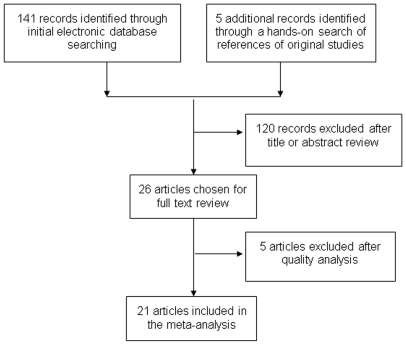
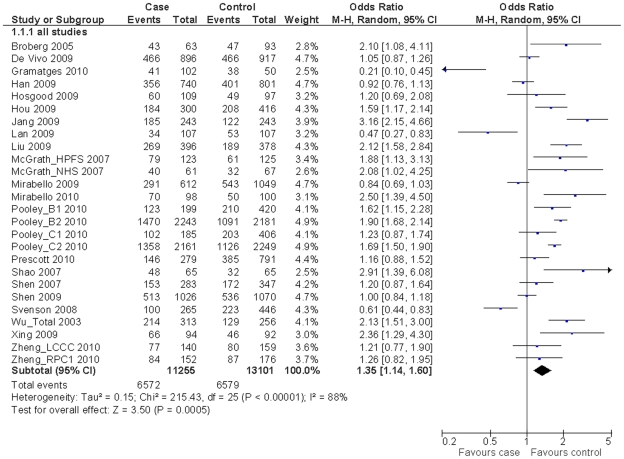
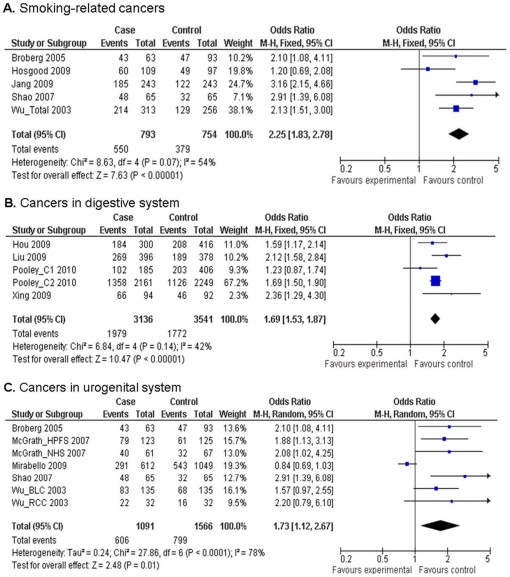
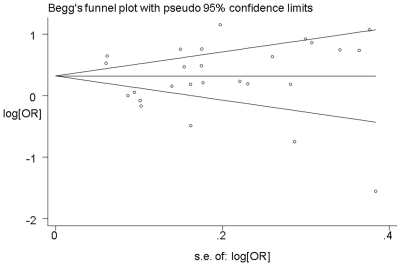
BACKGROUND: Telomeres play a key role in the maintenance of chromosome integrity and stability, and telomere shortening is involved in initiation and progression of malignancies. A series of epidemiological studies have examined the association between shortened telomeres and risk of cancers, but the findings remain conflicting. METHODS: A dataset composed of 11,255 cases and 13,101 controls from 21 publications was included in a meta-analysis to evaluate the association between overall cancer risk or cancer-specific risk and the relative telomere length. Heterogeneity among studies and their publication bias were further assessed by the χ(2)-based Q statistic test and Egger's test, respectively. RESULTS: The results showed that shorter telomeres were significantly associated with cancer risk (OR = 1.35, 95% CI = 1.14-1.60), compared with longer telomeres. In the stratified analysis by tumor type, the association remained significant in subgroups of bladder cancer (OR = 1.84, 95% CI = 1.38-2.44), lung cancer (OR = 2.39, 95% CI = 1.18-4.88), smoking-related cancers (OR = 2.25, 95% CI = 1.83-2.78), cancers in the digestive system (OR = 1.69, 95% CI = 1.53-1.87) and the urogenital system (OR = 1.73, 95% CI = 1.12-2.67). Furthermore, the results also indicated that the association between the relative telomere length and overall cancer risk was statistically significant in studies of Caucasian subjects, Asian subjects, retrospective designs, hospital-based controls and smaller sample sizes. Funnel plot and Egger's test suggested that there was no publication bias in the current meta-analysis (P = 0.532). CONCLUSIONS: The results of this meta-analysis suggest that the presence of shortened telomeres may be a marker for susceptibility to human cancer, but single larger, well-design prospective studies are warranted to confirm these findings.
Overview
The claims and statistics of this paper haven’t been checked yet.
Run the check — free, no account needed. It reads the open-access text and checks the sources it cites.
Integrity signals
Registry
Cites
Statistics
Figures
Verification
Claims the paper makes
The claims and statistics of this paper haven’t been checked yet.
Run the check — free, no account needed. It reads the open-access text and checks the sources it cites.
Claims other papers make about this one
Each is checked against this paper’s own text: does it say what the citing paper says it does?
In the citing paper
“Inter-individual variation in mean leukocyte telomere length (LTL) is associated with cancer and several age-associated diseases.”
From Identification of seven loci affecting mean telomere length and their association with disease (2013) · cites this paper as [4]
Self-check
Percentages, sums and reported differences re-computed from the paper’s own numbers.
The self-check needs the paper’s full text.
Citations
Cites
Bias in meta-analysis detected by a simple, graphical test
Egger, M., Smith, G. D., Schneider, M., & Minder, C. (1997) · BMJ · doi:10.1136/bmj.315.7109.629 · Cited by 56,722 · cited 1×
“The inverted funnel plots and Egger’s test (linear regression analysis) were used to investigate publication bias [49].”
Meta-analysis in clinical trials
DerSimonian, R., & Laird, N. (1986) · Controlled Clinical Trials · doi:10.1016/0197-2456(86)90046-2 · Cited by 39,552 · cited 1×
“The fixedeffects model and the random-effects model, based on the MantelHaenszel method [47] and the DerSimonian and Laird method [48], respectively, were used to combine values from different studies.”
Quantifying heterogeneity in a meta‐analysis
Higgins, J. P. T., & Thompson, S. G. (2002) · Statistics in Medicine · doi:10.1002/sim.1186 · Cited by 36,763 · cited 1×
“Heterogeneity was also quantified with the I(2) statistic, a value that indicates what proportion of the total variation across studies is beyond chance, where 0% indicates no observed heterogeneity and larger values show increasing heterogeneity [46].”
Statistical Aspects of the Analysis of Data From Retrospective Studies of Disease
(1959) · JNCI: Journal of the National Cancer Institute · doi:10.1093/jnci/22.4.719 · Cited by 14,689 · cited 1×
“The fixedeffects model and the random-effects model, based on the MantelHaenszel method [47] and the DerSimonian and Laird method [48], respectively, were used to combine values from different studies.”
Accelerated telomere shortening in response to life stress
Epel, E. S., Blackburn, E. H., Lin, J., Dhabhar, F. S., Adler, N. E., Morrow, J. D., & Cawthon, R. M. (2004) · Proceedings of the National Academy of Sciences · doi:10.1073/pnas.0407162101 · Cited by 3,002
Oxidative stress shortens telomeres
von Zglinicki, T. (2002) · Trends in Biochemical Sciences · doi:10.1016/s0968-0004(02)02110-2 · Cited by 2,524 · cited 1×
“Firstly, several variables may affect the length of telomeres, such as age, sex, obesity, smoking, oxidative stress and chronic inflammation [12,64,65,66].”
Quantitative Synthesis in Systematic Reviews
Lau, J., Ioannidis, J. P. A., & Schmid, C. H. (1997) · Annals of Internal Medicine · doi:10.7326/0003-4819-127-9-199711010-00008 · Cited by 2,517 · cited 1×
“05 [45].”
Telomere length predicts replicative capacity of human fibroblasts.
Allsopp, R. C., Vaziri, H., Patterson, C., Goldstein, S., Younglai, E. V., Futcher, A. B., Greider, C. W., & Harley, C. B. (1992) · Proceedings of the National Academy of Sciences · doi:10.1073/pnas.89.21.10114 · Cited by 2,200 · cited 1×
“Thus, telomere length has been suggested as a ‘‘cellular mitotic clock’’ that defines the number of cell divisions and cellular life span [1,5].”
Switching and Signaling at the Telomere
Blackburn, E. H. (2001) · Cell · doi:10.1016/s0092-8674(01)00492-5 · Cited by 2,139 · cited 2×
“Thus, telomere length has been suggested as a ‘‘cellular mitotic clock’’ that defines the number of cell divisions and cellular life span [1,5].”
Telomere Shortening and Tumor Formation by Mouse Cells Lacking Telomerase RNA
Blasco, M. A., Lee, H.-W., Hande, M. P., Samper, E., Lansdorp, P. M., DePinho, R. A., & Greider, C. W. (1997) · Cell · doi:10.1016/s0092-8674(01)80006-4 · Cited by 2,108 · cited 1×
“For example, short telomeres cause an increased risk of developing epithelial cancers by the formation of complex non-reciprocal translocations [15,16], and telomeres in tumor cells and their precursor lesions are significantly shorter than that in surrounding non-tumor cells [17,18].”
Cited by
Sorted by citations
Blackburn, E. H., Epel, E. S., & Lin, J. (2015) · Science · doi:10.1126/science.aab3389 · Cited by 1,596
Identification of seven loci affecting mean telomere length and their association with disease
CARDIoGRAM consortium, Codd, V., Nelson, C. P., Albrecht, E., Mangino, M., Deelen, J., Buxton, J. L., Hottenga, J. J., Fischer, K., Esko, T., et al. (2013) · Nature Genetics · doi:10.1038/ng.2528 · Cited by 933
Leucocyte telomere length and risk of cardiovascular disease: systematic review and meta-analysis
Haycock, P. C., Heydon, E. E., Kaptoge, S., Butterworth, A. S., Thompson, A., & Willeit, P. (2014) · BMJ · doi:10.1136/bmj.g4227 · Cited by 856
Association Between Telomere Length and Risk of Cancer and Non-Neoplastic Diseases
Haycock, P., Burgess, S., Nounu, A., Zheng, J., Okoli, G. N., Bowden, J., Wade, K. H., Timpson, N. J., Evans, D. M., Willeit, P., et al. (2017) · JAMA Oncology · doi:10.1001/jamaoncol.2016.5945 · Cited by 517
“Mechanisms of Association Our cancer findings are compatible with known biology.(127) By limiting the proliferative potential of cells, telomere shorteningmay serve as a tumor suppressor, and individualswith longer telomeres may be more likely to acquire somatic mutationsowing to increasedproliferativepotential.”
BackgroundResultInfluentialSelf-citationA systematic review of leukocyte telomere length and age in adults
Müezzinler, A., Zaineddin, A. K., & Brenner, H. (2013) · Ageing Research Reviews · doi:10.1016/j.arr.2013.01.003 · Cited by 474
“…been linked to mortality, several diseases and ageing related pathologies, including some cancers, cardiovascular diseases, obesity, Alzheimer’s disease, diabetes mellitus and osteoporosis in recent years (Jeyapalan and Sedivy, 2008; Aviv, 2002; Blasco, 2005; Ma et al., 2011; Valdes et al., 2007).”
Background
Metadata
- Authors
- Ma, H., Zhou, Z., Wei, S., Liu, Z., Pooley, K. A., Dunning, A. M., Svenson, U., Roos, G., Hosgood, H. D., Shen, M., & Wei, Q.
- Affiliations
- The University of Texas MD Anderson Cancer Center (US)
- University of Cambridge (GB)
- Umeå University (SE)
- National Institutes of Health (US)
- Corresponding author
- Wei, Qingyi
- ORCID
- Venue
- PLoS ONE
- Publisher
- Public Library of Science (PLoS)
- Published
- 2011-06-10
- Volume
- 6
- Issue
- 6
- Pages
- e20466
- ISSN
- 1932-6203 (ISSN-L)
- PMC
- PMC3112149
- OpenAlex
- W2136996519
- Cited by
- 376
- References
- 73
- Citations by year
- 2026: 6 · 2025: 10 · 2024: 21 · 2023: 16 · 2022: 19 · 2021: 24 · 2020: 25 · 2019: 32 · 2018: 34 · 2017: 27 · 2016: 33 · 2015: 34 · 2014: 35 · 2013: 36 · 2012: 18
- FWCI
- 3.27
- Type
- journal article
- Language
- en
- Open access
- gold
- doi.org
- Locations
- PLoS ONE (publishedVersion, cc-by)
- PubMed Central (publishedVersion, cc-by)
- PubMed (publishedVersion)
- DiVA at Umeå University (Umeå University) (submittedVersion, other-oa)
- RePEc: Research Papers in Economics (submittedVersion)
- DOAJ (DOAJ: Directory of Open Access Journals) (submittedVersion, cc-by-sa)
- Funders
- National Cancer Institute (R01CA131274, P30CA016672)
- National Institute of Environmental Health Sciences (R01ES011740)
- Topics
- Life Sciences › Biochemistry, Genetics and Molecular Biology › Cell Biology › Telomeres, Telomerase, and Senescence
- Life Sciences › Biochemistry, Genetics and Molecular Biology › Genetics › Genetic Associations and Epidemiology
- Life Sciences › Biochemistry, Genetics and Molecular Biology › Molecular Biology › Epigenetics and DNA Methylation
- Keywords
- telomere length, telomere shortening, cancer risk, cancer susceptibility, bladder cancer, lung cancer, tobacco-related cancer, gastrointestinal cancer, urogenital cancer, biomarkers
- MeSH terms
- Humans, Neoplasms, Risk Factors, Confidence Intervals, Odds Ratio, Telomere, Publication Bias, Genetic Predisposition to Disease
About these checks
Registry, retraction, Cites and statistics results are computed, not judged, with one exception: a printed reference that no index lists is read once by a model before it counts as a citation error. Claims are extracted by a model and kept only when their quote appears verbatim in the text; each cited source is then checked, with a model’s help, for whether it says what the claim relies on. Those verdicts can be wrong — read the claim’s quote and the cited source before relying on one.
Statistics and arithmetic are recomputed, not judged.
Confidence bands are shown only for fields calibrated on our annotated test set. None is calibrated yet, so no band is shown.
What counts as a claim ›How we measure confidence ›How we check this ›
Are you an author, or do you see a problem with this page? Request a review
