

The DOI matches its Crossref record; 62 of the 62 references it cites were found in a registry or an index.
Impairments of Social Motor Coordination in Schizophrenia
Open accessAbstract
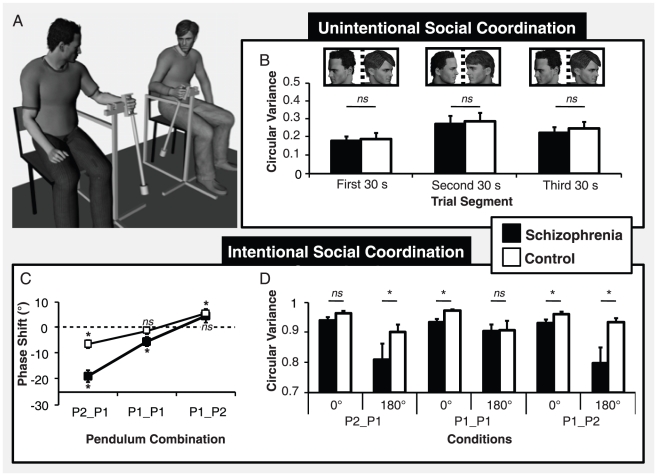
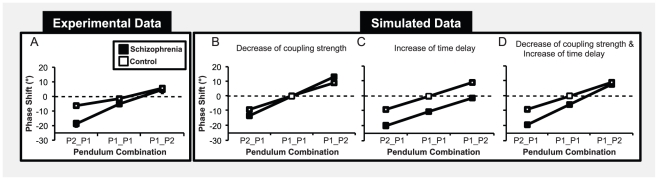
It has been demonstrated that motor coordination of interacting people plays a crucial role in the success of social exchanges. Abnormal movements have been reported during interpersonal interactions of patients suffering from schizophrenia and a motor coordination breakdown could explain this social interaction deficit, which is one of the main and earliest features of the illness. Using the dynamical systems framework, the goal of the current study was (i) to investigate whether social motor coordination is impaired in schizophrenia and (ii) to determine the underlying perceptual or cognitive processes that may be affected. We examined intentional and unintentional social motor coordination in participants oscillating hand-held pendulums from the wrist. The control group consisted of twenty healthy participant pairs while the experimental group consisted of twenty participant pairs that included one participant suffering from schizophrenia. The results showed that unintentional social motor coordination was preserved while intentional social motor coordination was impaired. In intentional coordination, the schizophrenia group displayed coordination patterns that had lower stability and in which the patient never led the coordination. A coupled oscillator model suggests that the schizophrenia group coordination pattern was due to a decrease in the amount of available information together with a delay in information transmission. Our study thus identified relational motor signatures of schizophrenia and opens new perspectives for detecting the illness and improving social interactions of patients.
Overview
The claims and statistics of this paper haven’t been checked yet.
Run the check — free, no account needed. It reads the open-access text and checks the sources it cites.
Integrity signals
Registry
Cites
Statistics
Figures
Verification
Claims the paper makes
The claims and statistics of this paper haven’t been checked yet.
Run the check — free, no account needed. It reads the open-access text and checks the sources it cites.
Claims other papers make about this one
Each is checked against this paper’s own text: does it say what the citing paper says it does?
The cited source says what the claim attributes to it.
In the citing paper
“This finding is in line with imaging and TMS studies showing intact [14][15][16][17] or even enhanced 14,24 MNS activity in patients during action observation or imitation and with work done on social motor coordination in schizophrenia, where spontaneous coordination is preserved.62”
From Enhanced Automatic Action Imitation and Intact Imitation-Inhibition in Schizophrenia (2019) · cites this paper as [62]
Self-check
Percentages, sums and reported differences re-computed from the paper’s own numbers.
The self-check needs the paper’s full text.
Citations
Cites
Diagnostic and Statistical Manual of Mental Disorders
Williams, J. B. W., & First, M. B. (2013) · Oxford University Press eBooks · doi:10.1093/acrefore/9780199975839.013.104 · Cited by 109,845
The Positive and Negative Syndrome Scale (PANSS) for schizophrenia.
Kay, S. R., Fiszbein, A., & Opler, L. A. (1987) · Schizophrenia Bulletin · doi:10.1093/schbul/13.2.261 · Cited by 21,378 · cited 5×
“These results suggest that examining intentional social motor coordination of patients might objectively and quantitatively assess abnormal social features that are not captured by the PANSS.”
MethodInfluentialSynchronization a universal concept in nonlinear sciences
PIKOVSKY, A. S., Rosenblum, M. G., & Kurths, J. (2001) · Cited by 5,640
The chameleon effect: the perception–behavior link and social interaction
Chartrand, T. L., & Bargh, J. A. (1999) · Journal of Personality and Social Psychology · doi:10.1037/0022-3514.76.6.893 · Cited by 3,674 · cited 3×
“It is however important to note that the coordination dynamics observed in this laboratory task reflect the ones observed for example between hand, arm or postural movements in more ecological situations, which have been demonstrated as directly influencing the success of our social interactions [1–7,14].”
BackgroundSpeed of processing in the human visual system
Thorpe, S., Fize, D., & Marlot, C. (1996) · Nature · doi:10.1038/381520a0 · Cited by 3,538
Neurocognitive deficit in schizophrenia: A quantitative review of the evidence.
Heinrichs, R. W., & Zakzanis, K. K. (1998) · Neuropsychology · doi:10.1037/0894-4105.12.3.426 · Cited by 2,798 · cited 2×
“More specifically, we assumed that the stability of the coordination could be decreased in schizophrenia because of either (i) a modification of their preferred frequency of movement due to their motor disorder [25–26] or (ii) a decrease in the strength of the perceptual coupling due to general impairments in attentio…”
BackgroundResultA theoretical model of phase transitions in human hand movements.
Haken, H., Kelso, J. A. S., & Bunz, H. (1985) · Biological Cybernetics · doi:10.1007/bf00336922 · Cited by 2,328 · cited 2×
“(1) to test whether a decrease of the strength or/and an increase of the time delay in the coupling function captured patients’ impairments of intentional social motor coordination [42–43].”
BackgroundResultA Systematic Review of the Prevalence of Schizophrenia
Saha, S., Chant, D., Welham, J., & McGrath, J. (2005) · PLoS Medicine · doi:10.1371/journal.pmed.0020141 · Cited by 2,168 · cited 1×
“Moreover, such abnormal movements may be the earliest sign of schizophrenia and be used as a marker for earlier diagnostics of this illness that affects almost one percent of the world population [10–13].”
BackgroundThe Functional Significance of Social Cognition in Schizophrenia: A Review
Couture, S. M. (2006) · Schizophrenia Bulletin · doi:10.1093/schbul/sbl029 · Cited by 1,363 · cited 1×
“More particularly, mirror neuron system disorders, which corresponds to the brain area that may also moderate social motor coordination [47–48], may play a crucial role in such a deficit and in social interactions deficits in general [49–50].”
BackgroundUsing nonconscious behavioral mimicry to create affiliation and rapport
Lakin, J. L., & Chartrand, T. L. (2003) · Psychological Science · doi:10.1111/1467-9280.14481 · Cited by 1,297 · cited 3×
“It is however important to note that the coordination dynamics observed in this laboratory task reflect the ones observed for example between hand, arm or postural movements in more ecological situations, which have been demonstrated as directly influencing the success of our social interactions [1–7,14].”
BackgroundDynamic Pattern Generation in Behavioral and Neural Systems
Schöner, G., & Kelso, J. A. S. (1988) · Science · doi:10.1126/science.3281253 · Cited by 1,237 · cited 1×
“To further explore these hypotheses and determine how a decrease of the strength or/and a delay in the information transmission of patients could explain their impairments of intentional social motor coordination, we compared our phase shift results with those obtained in simulations of a coupled oscillator model that…”
ResultDisorders of attention and perception in early schizophrenia
McGhie, A., & Chapman, J. (1961) · British Journal of Medical Psychology · doi:10.1111/j.2044-8341.1961.tb00936.x · Cited by 1,195 · cited 1×
“Although previously reported behavioral deficits in the schizophrenia [27–30] led to the expectation that we would see a decrease in unintentional coordination during visual interaction, our results did not show any differences between the schizophrenia group and the control group.”
ResultThe nature of rapport and its nonverbal correlates
Tickle-Degnen, L., & Rosenthal, R. (1990) · Psychological Inquiry · doi:10.1207/s15327965pli0104_1 · Cited by 960 · cited 3×
“It is however important to note that the coordination dynamics observed in this laboratory task reflect the ones observed for example between hand, arm or postural movements in more ecological situations, which have been demonstrated as directly influencing the success of our social interactions [1–7,14].”
BackgroundSchmidt, R. C., Carello, C., & Turvey, M. T. (1990) · Journal of Experimental Psychology Human Perception & Performance · doi:10.1037//0096-1523.16.2.227 · Cited by 839 · cited 16×
“Participants performed three trials for each pattern of coordination with the three different pendulum combinations (P2_P1, P1_P1 and P1_P2).”
BackgroundResultInfluentialRocking together: Dynamics of intentional and unintentional interpersonal coordination
Richardson, M. J., Marsh, K. L., Isenhower, R. W., Goodman, J. R. L., & Schmidt, R. C. (2007) · Human Movement Science · doi:10.1016/j.humov.2007.07.002 · Cited by 796 · cited 20×
“preferred frequencies are close to each other [18,22].”
BackgroundMethodResultInfluentialSpeaking while monitoring addressees for understanding
Clark, H. H., & Krych, M. A. (2004) · Journal of Memory and Language · doi:10.1016/j.jml.2003.08.004 · Cited by 739 · cited 3×
“It is however important to note that the coordination dynamics observed in this laboratory task reflect the ones observed for example between hand, arm or postural movements in more ecological situations, which have been demonstrated as directly influencing the success of our social interactions [1–7,14].”
BackgroundEvolution of behavioral attractors with learning: Nonequilibrium phase transitions.
Zanone, P., & Kelso, J. A. S. (1992) · Journal of Experimental Psychology Human Perception & Performance · doi:10.1037//0096-1523.18.2.403 · Cited by 700
Mutual interpersonal postural constraints are involved in cooperative conversation.
Shockley, K., Santana, M.-V., & Fowler, C. A. (2003) · Journal of Experimental Psychology: Human Perception and Performance · doi:10.1037/0096-1523.29.2.326 · Cited by 681 · cited 1×
“, coordination of postural sways [16,20]), deficits of the movement itself as well as at the level of the visuo-motor control may be observed.”
BackgroundCoordinated movement and rapport in teacher–student interactions
Bernieri, F. J. (1988) · Journal of Nonverbal Behavior · doi:10.1007/bf00986930 · Cited by 590 · cited 3×
“It is however important to note that the coordination dynamics observed in this laboratory task reflect the ones observed for example between hand, arm or postural movements in more ecological situations, which have been demonstrated as directly influencing the success of our social interactions [1–7,14].”
BackgroundSOUND FILM ANALYSIS OF NORMAL AND PATHOLOGICAL BEHAVIOR PATTERNS
CONDON, W. S., & Ogston, W. D. (1966) · The Journal of Nervous and Mental Disease · doi:10.1097/00005053-196610000-00005 · Cited by 578 · cited 2×
“These results extend previous research that indicates impairments of nonverbal behavior in schizophrenia and show that the movements of patients are abnormally coordinated while interacting with another individual [8–10,34].”
BackgroundResultSchmidt, R. C., Carello, C., & Turvey, M. T. (1990) · Journal of Experimental Psychology Human Perception & Performance · doi:10.1037/0096-1523.16.2.227 · Cited by 578
Self-citationThe sound of many hands clapping
Néda, Z., Ravasz, E., Brechet, Y. J. M., Vicsek, T., & Barabási, A.-Ĺ. (2000) · Nature · doi:10.1038/35002660 · Cited by 565
The Art of Conversation Is Coordination
Richardson, D. C., Dale, R. A. C., & Kirkham, N. Z. (2007) · Psychological Science · doi:10.1111/j.1467-9280.2007.01914.x · Cited by 510
Evolution of behavioral attractors with learning: Nonequilibrium phase transitions.
Zanone, P., & Kelso, J. A. S. (1992) · Journal of Experimental Psychology Human Perception & Performance · doi:10.1037/0096-1523.18.2.403 · Cited by 490
Schizophrenia and theory of mind
Frith, C. (2004) · Psychological Medicine · doi:10.1017/s0033291703001326 · Cited by 454 · cited 1×
“Additionally, such a dissociation has also been reported for impairments of social processes [37,38].”
BackgroundThe sound of many hands clapping
Néda, Z., Ravasz, E., Brechet, Y. J. M., Vicsek, T., & Barabási, A.-Ĺ. (2000) · RePEc: Research Papers in Economics · Cited by 448
Compromised White Matter Tract Integrity in Schizophrenia Inferred From Diffusion Tensor Imaging
Lim, K. O., Hedehus, M., Moseley, M. E., de Crespigny, A. J., Sullivan, E. V., & Pfefferbaum, A. (1999) · Archives of General Psychiatry · doi:10.1001/archpsyc.56.4.367 · Cited by 447 · cited 1×
“supported by previous research showing slower reaction times in schizophrenia [41] and more specifically by anatomical correlates such as a degradation of the degree of myelination [42].”
ResultNeuromotor Precursors of Schizophrenia
Walker, E. F., Savoie, T. M., & Davis, D. (1994) · Schizophrenia Bulletin · doi:10.1093/schbul/20.3.441 · Cited by 445 · cited 2×
“Furthermore, because social motor disorders may be the earliest sign of schizophrenia, such marker may allow earlier diagnostics and thus better patient management [10–12].”
BackgroundThe phi complex as a neuromarker of human social coordination
Tognoli, E., Lagarde, J., DeGuzman, G. C., & Kelso, J. A. S. (2007) · Proceedings of the National Academy of Sciences · doi:10.1073/pnas.0611453104 · Cited by 437
Dynamics of Interpersonal Coordination
Schmidt, R. C., & Richardson, M. J. (2007) · Understanding Complex Systems · doi:10.1007/978-3-540-74479-5_14 · Cited by 415
Social coordination dynamics: measuring human bonding.
Oullier, O., de Guzman, G. C., Jantzen, K. J., Lagarde, J., & Scott Kelso, J. A. (2008) · Social Neuroscience · doi:10.1080/17470910701563392 · Cited by 404 · cited 3×
“participants performed three 90 s trials each containing three 30 s segments completed continuously [15,31].”
BackgroundMethodResultEffects of Visual and Verbal Interaction on Unintentional Interpersonal Coordination.
Richardson, M. J., Marsh, K. L., & Schmidt, R. C. (2005) · Journal of Experimental Psychology Human Perception & Performance · doi:10.1037/0096-1523.31.1.62 · Cited by 363 · cited 4×
“participants performed three 90 s trials each containing three 30 s segments completed continuously [15,31].”
BackgroundMethodResultInfluentialThe role of motor contagion in the prediction of action
Blakemore, S., & Frith, C. (2005) · Neuropsychologia · doi:10.1016/j.neuropsychologia.2004.11.012 · Cited by 354 · cited 1×
“More particularly, mirror neuron system disorders, which corresponds to the brain area that may also moderate social motor coordination [47–48], may play a crucial role in such a deficit and in social interactions deficits in general [49–50].”
BackgroundEvaluating the Dynamics of Unintended Interpersonal Coordination
Schmidt, R. C., & O'BRIEN, B. A. (1997) · Ecological Psychology · doi:10.1207/s15326969eco0903_2 · Cited by 347 · cited 4×
“Higher degrees of coordination were expected during visual interaction (second segment) and when participants used the same pendulums (P1_P1) in view of previous studies [15,18,31].”
BackgroundResultInfluentialSocial brain dysfunctions in schizophrenia: A review of neuroimaging studies
Brunet-Gouet, É., & Decety, J. (2006) · Psychiatry Research Neuroimaging · doi:10.1016/j.pscychresns.2006.05.001 · Cited by 308 · cited 1×
“More particularly, mirror neuron system disorders, which corresponds to the brain area that may also moderate social motor coordination [47–48], may play a crucial role in such a deficit and in social interactions deficits in general [49–50].”
BackgroundLearning as Change of Coordination Dynamics: Theory and Experiment
Schöner, G., Zanone, P., & Kelso, J. A. S. (1992) · Journal of Motor Behavior · doi:10.1080/00222895.1992.9941599 · Cited by 296
van Ulzen, N. R., Lamoth, C. J. C., Daffertshofer, A., Semin, G. R., & Beek, P. J. (2008) · Neuroscience Letters · doi:10.1016/j.neulet.2007.11.070 · Cited by 272
Bernieri, F. J., Davis, J. M., Rosenthal, R., & Knee, C. R. (1994) · Personality and Social Psychology Bulletin · doi:10.1177/0146167294203008 · Cited by 259 · cited 3×
“It is however important to note that the coordination dynamics observed in this laboratory task reflect the ones observed for example between hand, arm or postural movements in more ecological situations, which have been demonstrated as directly influencing the success of our social interactions [1–7,14].”
BackgroundPsychomotor Slowing in Schizophrenia
Morrens, M., Hulstijn, W., & Sabbe, B. (2006) · Schizophrenia Bulletin · doi:10.1093/schbul/sbl051 · Cited by 247 · cited 2×
“More specifically, we assumed that the stability of the coordination could be decreased in schizophrenia because of either (i) a modification of their preferred frequency of movement due to their motor disorder [25–26] or (ii) a decrease in the strength of the perceptual coupling due to general impairments in attentio…”
BackgroundResultSchmidt, R. C., Bienvenu, M. J., Fitzpatrick, P., & Amazeen, P. G. (1998) · Journal of Experimental Psychology Human Perception & Performance · doi:10.1037//0096-1523.24.3.884 · Cited by 229
Motion perception in schizophrenia
Chen, Y., Palafox, G. P., Nakayama, K., Levy, D. L., Matthysse, S., & Holzman, P. S. (1999) · Archives of General Psychiatry · doi:10.1001/archpsyc.56.2.149 · Cited by 225 · cited 1×
“Although previously reported behavioral deficits in the schizophrenia [27–30] led to the expectation that we would see a decrease in unintentional coordination during visual interaction, our results did not show any differences between the schizophrenia group and the control group.”
ResultAntisaccades and smooth pursuit eye movements in schizophrenia
Sereno, A. B., & Holzman, P. S. (1995) · Biological Psychiatry · doi:10.1016/0006-3223(94)00127-o · Cited by 207 · cited 2×
“More specifically, we assumed that the stability of the coordination could be decreased in schizophrenia because of either (i) a modification of their preferred frequency of movement due to their motor disorder [25–26] or (ii) a decrease in the strength of the perceptual coupling due to general impairments in attentio…”
BackgroundResultPalmer, B. W., Dunn, L. B., Appelbaum, P. S., Mudaliar, S. R. D., Thal, L. J., Henry, R. R., Golshan, S., & Jeste, D. V. (2005) · Archives of General Psychiatry · doi:10.1001/archpsyc.62.7.726 · Cited by 196 · cited 1×
“[56] to assess capacity to consent, each participant was asked three questions about the hypothetical study: (1) ‘‘What is the purpose of the study?’’ (2) ‘‘What are the risks?’’ and (3) Figure 2.”
BackgroundEstimation de l’intelligence prémorbide chez les francophones
Mackinnon, A. J., & Mulligan, R. (2005) · L Encéphale · doi:10.1016/s0013-7006(05)82370-x · Cited by 181 · cited 1×
“The twenty patients were matched with twenty matched control participants for age, sex, education and premorbid IQ, as estimated by the French adaptation of the National Adult Reading Test (fNART) [58] (all ps.”
MethodSchmidt, R. C., Bienvenu, M., Fitzpatrick, P., et al. (1998) · Journal of Experimental Psychology Human Perception & Performance · doi:10.1037/0096-1523.24.3.884 · Cited by 172 · cited 19×
“We computed then the phase shift or the deviation of the relative phasing from the intended pattern of 0u or 180u to further explore the stability of the intentional coordination and to determine which participant of the pair led within a cycle [22,33].”
BackgroundMethodResultInfluentialSelf-citationAttention Dysfunction in Chronic Schizophrenia
Orzack, M. H. (1966) · Archives of General Psychiatry · doi:10.1001/archpsyc.1966.01730090099015 · Cited by 169 · cited 1×
“Although previously reported behavioral deficits in the schizophrenia [27–30] led to the expectation that we would see a decrease in unintentional coordination during visual interaction, our results did not show any differences between the schizophrenia group and the control group.”
ResultInterlimb coordination: Learning and transfer under different feedback conditions
Swinnen, S. P., Lee, T. D., Verschueren, S., Serrien, D. J., & Bogaerds, H. (1997) · Human Movement Science · doi:10.1016/s0167-9457(97)00020-1 · Cited by 167 · cited 1×
“For example, it has been demonstrated that motor learning can be made more efficient with real-time feedback [53–55].”
BackgroundImpaired visual recognition of biological motion in schizophrenia
Kim, J., Doop, M. L., Blake, R., & Park, S. (2005) · Schizophrenia Research · doi:10.1016/j.schres.2005.04.006 · Cited by 131 · cited 1×
“It has been demonstrated that patients suffering from schizophrenia have impairments of visual perception of biological motion that can be distinguished from their general visual perception deficits [46].”
BackgroundIntact Implicit Learning in Schizophrenia
Danion, J., Meulemans, T., Kauffmann-Muller, F., & Vermaat, H. (2001) · American Journal of Psychiatry · doi:10.1176/appi.ajp.158.6.944 · Cited by 119 · cited 1×
“compared to explicit processes [35–36].”
Movement abnormalities predict conversion to Axis I psychosis among prodromal adolescents.
Mittal, V. A., & Walker, E. F. (2007) · Journal of Abnormal Psychology · doi:10.1037/0021-843x.116.4.796 · Cited by 116 · cited 2×
“Furthermore, because social motor disorders may be the earliest sign of schizophrenia, such marker may allow earlier diagnostics and thus better patient management [10–12].”
BackgroundVisual tracking and entrainment to an environmental rhythm.
Schmidt, R. C., Richardson, M. J., Arsenault, C., & Galantucci, B. (2007) · Journal of Experimental Psychology Human Perception & Performance · doi:10.1037/0096-1523.33.4.860 · Cited by 116 · cited 2×
“[22–23].”
BackgroundVarlet, M., Marin, L., Lagarde, J., & Bardy, B. G. (2011) · Journal of Experimental Psychology: Human Perception and Performance · doi:10.1037/a0020552 · Cited by 112 · cited 1×
“, coordination of postural sways [16,20]), deficits of the movement itself as well as at the level of the visuo-motor control may be observed.”
BackgroundSelf-citationKupper, Z., Ramseyer, F., Hoffmann, H., Kalbermatten, S., & Tschacher, W. (2010) · Schizophrenia Research · doi:10.1016/j.schres.2010.03.032 · Cited by 103 · cited 4×
“These results extend previous research that indicates impairments of nonverbal behavior in schizophrenia and show that the movements of patients are abnormally coordinated while interacting with another individual [8–10,34].”
BackgroundResultInfluentialSlower and more variable reaction times in schizophrenia: what do they signify?
Vinogradov, S., Poole, J. H., Willis-Shore, J., Ober, B. A., & Shenaut, G. K. (1998) · Schizophrenia Research · doi:10.1016/s0920-9964(98)00043-7 · Cited by 86 · cited 1×
“supported by previous research showing slower reaction times in schizophrenia [41] and more specifically by anatomical correlates such as a degradation of the degree of myelination [42].”
ResultTemprado, J.-J., & Laurent, M. (2003) · Acta Psychologica · doi:10.1016/j.actpsy.2003.09.002 · Cited by 70 · cited 1×
“In addition, their stability depends also on the strength of the perceptual coupling linking two people, which is mediated by how the actors visually attend to the movements of each other [22–24].”
BackgroundRoux, P., Christophe, A., & Passerieux, C. (2010) · Neuropsychologia · doi:10.1016/j.neuropsychologia.2010.08.021 · Cited by 62 · cited 1×
“compared to explicit processes [35–36].”
Static posed and evoked facial expressions of emotions in schizophrenia
Kohler, C. G., Martin, E. A., Stolar, N., Barrett, F. S., Verma, R., Brensinger, C., Bilker, W., Gur, R. E., & Gur, R. C. (2008) · Schizophrenia Research · doi:10.1016/j.schres.2008.05.010 · Cited by 59 · cited 1×
“These results extend previous research that indicates impairments of nonverbal behavior in schizophrenia and show that the movements of patients are abnormally coordinated while interacting with another individual [8–10,34].”
ResultNonverbal Behavior During Standardized Interviews in Patients With Schizophrenia Spectrum Disorders
Brüne, M., Sonntag, C., Abdel-Hamid, M., Lehmkämper, C., Juckel, G., & Troisi, A. (2008) · Journal of Nervous and Mental Disease · doi:10.1097/nmd.0b013e31816a4922 · Cited by 55 · cited 2×
“These results extend previous research that indicates impairments of nonverbal behavior in schizophrenia and show that the movements of patients are abnormally coordinated while interacting with another individual [8–10,34].”
BackgroundResultDynamics of Learning New Postural Patterns: Influence on Preexisting Spontaneous Behaviors
Faugloire, E., Bardy, B. G., & Stoffregen, T. A. (2006) · Journal of Motor Behavior · doi:10.3200/jmbr.38.4.299-312 · Cited by 42 · cited 2×
“Although no investigations to our knowledge have yet explored the learning and rehabilitation of social motor coordination, previous research that has examined motor learning may provide interesting research directions [51– 53].”
BackgroundResultHow do neural connectivity and time delays influence bimanual coordination?
Banerjee, A., & Jirsa, V. (2006) · Biological Cybernetics · doi:10.1007/s00422-006-0114-4 · Cited by 40
Varoqui, D., Froger, J., Pélissier, J.-Y., & Bardy, B. G. (2011) · Motor Control · doi:10.1123/mcj.15.2.187 · Cited by 29
Attention to gaze and emotion in schizophrenia.
Schwartz, B. L., Vaidya, C. J., Howard, J. H., & Deutsch, S. I. (2010) · Neuropsychology · doi:10.1037/a0019562 · Cited by 17 · cited 1×
“Additionally, such a dissociation has also been reported for impairments of social processes [37,38].”
Background
Cited by
Sorted by citations
Impairments of Social Motor Synchrony Evident in Autism Spectrum Disorder
Fitzpatrick, P., Frazier, J. A., Cochran, D., Mitchell, T. V., Coleman, C., & Schmidt, R. C. (2016) · Frontiers in Psychology · doi:10.3389/fpsyg.2016.01323 · Cited by 192
“(Note: Convention comparable with Varlet et al., 2012; −0.1 indicates parent should lead, +0.1 indicates child should lead.) between groups (p = 0.4) but the slopes were significantly different (p < 0.001).”
BackgroundMethodResultInfluentialInviting affordances and agency
Withagen, R., Araújo, D., & de Poel, H. J. (2017) · New Ideas in Psychology · doi:10.1016/j.newideapsych.2016.12.002 · Cited by 160
“…þ u22x2 ¼ h2ðA2 þ B2½x2 x1 Þð _x2 _x1Þ (3b) Parameter hi (for the present purposes we take 0<hi <1) serves to scale the coupling strength inflicted on component i (for related modeling strategies in this context, see De Poel, 2016; Kelso, de Guzman, Reveley, & Tognoli, 2009; Varlet et al., 2012).”
Measuring the Dynamics of Interactional Synchrony
Schmidt, R. C., Morr, S., Fitzpatrick, P., & Richardson, M. J. (2012) · Journal of Nonverbal Behavior · doi:10.1007/s10919-012-0138-5 · Cited by 136
“2012; Trevarthen and Daniel 2005), and schizophrenia (Condon and Ogston 1967; Varlet et al. 2012).”
Kupper, Z., Ramseyer, F., Hoffmann, H., & Tschacher, W. (2015) · PLoS ONE · doi:10.1371/journal.pone.0145882 · Cited by 136
“experimental setting [22], and with unintentional social coordination in a triadic setting involving one patient and two healthy interactants [36,53].”
BackgroundA comprehensive review of the functions of YB-1 in cancer stemness, metastasis and drug resistance
Alkrekshi, A., Wang, W., Rana, P. S., Marković, V. G., & Sossey‐Alaoui, K. (2021) · Cellular Signalling · doi:10.1016/j.cellsig.2021.110073 · Cited by 104
Metadata
- Authors
- Varlet, M., Marin, L., Raffard, S., Schmidt, R. C., Capdevielle, D., Boulenger, J.-P., Del-Monte, J., & Bardy, B. G.
- Affiliations
- Université Montpellier 1 (FR)
- Université de Montpellier (FR)
- College of the Holy Cross (US)
- Inserm (FR)
- Corresponding author
- Varlet, Manuel
- ORCID
- Venue
- PLoS ONE
- Publisher
- Public Library of Science (PLoS)
- Published
- 2012-01-17
- Volume
- 7
- Issue
- 1
- Pages
- e29772
- ISSN
- 1932-6203 (ISSN-L)
- PMC
- PMC3260163
- OpenAlex
- W2119382114
- Cited by
- 127
- References
- 60
- Citations by year
- 2026: 4 · 2025: 7 · 2024: 10 · 2023: 6 · 2022: 5 · 2021: 16 · 2020: 7 · 2019: 6 · 2018: 10 · 2017: 12 · 2016: 12 · 2015: 9 · 2014: 10 · 2013: 7 · 2012: 6
- FWCI
- 15.40
- Type
- journal article
- Language
- en
- Open access
- gold
- doi.org
- Locations
- PLoS ONE (publishedVersion, cc-by)
- Europe PMC (PubMed Central) (publishedVersion, cc-by)
- PubMed Central (publishedVersion, cc-by)
- PubMed (publishedVersion)
- HAL (submittedVersion, other-oa)
- RePEc: Research Papers in Economics (submittedVersion)
- DOAJ (DOAJ: Directory of Open Access Journals) (submittedVersion, cc-by-sa)
- Funders
- Agence Nationale de la Recherche (ANR-09-BLAN-0405)
- Topics
- Social Sciences › Psychology › Social Psychology › Action Observation and Synchronization
- Health Sciences › Medicine › Psychiatry and Mental health › Schizophrenia research and treatment
- Life Sciences › Neuroscience › Cognitive Neuroscience › Motor Control and Adaptation
- Keywords
- schizophrenia, interpersonal coordination, coupled oscillators, dynamical systems, coordination stability, information transmission delay, social interaction deficits
- MeSH terms
- Adult, Algorithms, Analysis of Variance, Female, Humans, Male, Middle Aged, Models, Biological, Movement, Musculoskeletal Physiological Phenomena, Neuropsychological Tests, Psychomotor Performance, Schizophrenia, Social Behavior, Young Adult
About these checks
Registry, retraction, Cites and statistics results are computed, not judged, with one exception: a printed reference that no index lists is read once by a model before it counts as a citation error. Claims are extracted by a model and kept only when their quote appears verbatim in the text; each cited source is then checked, with a model’s help, for whether it says what the claim relies on. Those verdicts can be wrong — read the claim’s quote and the cited source before relying on one.
Statistics and arithmetic are recomputed, not judged.
Confidence bands are shown only for fields calibrated on our annotated test set. None is calibrated yet, so no band is shown.
What counts as a claim ›How we measure confidence ›How we check this ›
Are you an author, or do you see a problem with this page? Request a review
