

The DOI matches its Crossref record; 53 of the 53 references it cites were found in a registry or an index.
Circadian Desynchrony Promotes Metabolic Disruption in a Mouse Model of Shiftwork
Open accessAbstract
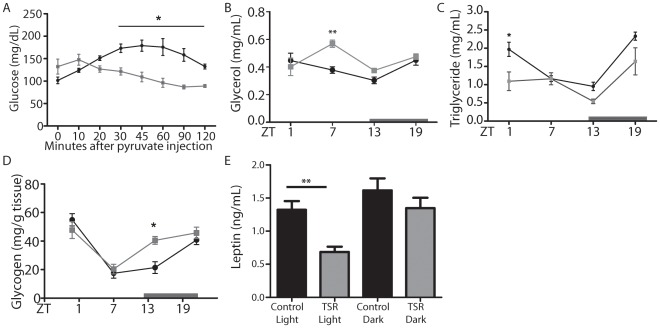
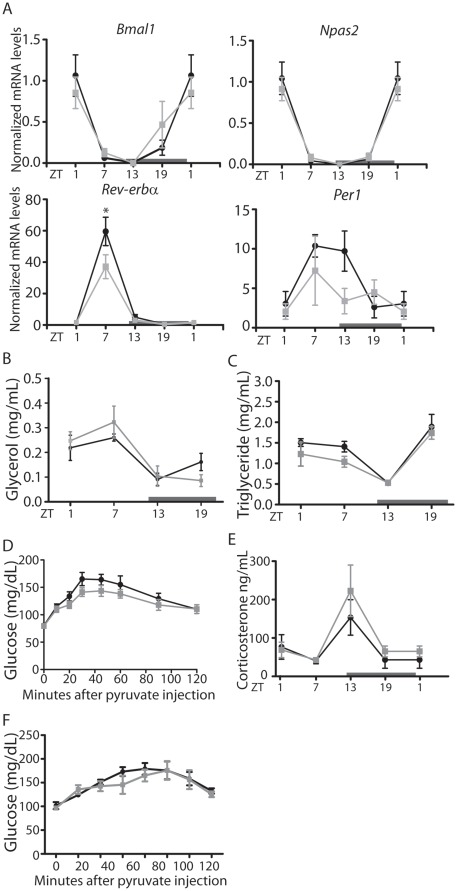
Shiftwork is associated with adverse metabolic pathophysiology, and the rising incidence of shiftwork in modern societies is thought to contribute to the worldwide increase in obesity and metabolic syndrome. The underlying mechanisms are largely unknown, but may involve direct physiological effects of nocturnal light exposure, or indirect consequences of perturbed endogenous circadian clocks. This study employs a two-week paradigm in mice to model the early molecular and physiological effects of shiftwork. Two weeks of timed sleep restriction has moderate effects on diurnal activity patterns, feeding behavior, and clock gene regulation in the circadian pacemaker of the suprachiasmatic nucleus. In contrast, microarray analyses reveal global disruption of diurnal liver transcriptome rhythms, enriched for pathways involved in glucose and lipid metabolism and correlating with first indications of altered metabolism. Although altered food timing itself is not sufficient to provoke these effects, stabilizing peripheral clocks by timed food access can restore molecular rhythms and metabolic function under sleep restriction conditions. This study suggests that peripheral circadian desynchrony marks an early event in the metabolic disruption associated with chronic shiftwork. Thus, strengthening the peripheral circadian system by minimizing food intake during night shifts may counteract the adverse physiological consequences frequently observed in human shift workers.
Overview
The claims and statistics of this paper haven’t been checked yet.
Run the check — free, no account needed. It reads the open-access text and checks the sources it cites.
Integrity signals
Registry
Cites
Statistics
Figures
Verification
Claims the paper makes
The claims and statistics of this paper haven’t been checked yet.
Run the check — free, no account needed. It reads the open-access text and checks the sources it cites.
Claims other papers make about this one
Each is checked against this paper’s own text: does it say what the citing paper says it does?
The cited source says what the claim attributes to it.
In the citing paper
“The night eating syndrome in humans (33,34) and a shift of food intake from the active phase to the rest phase in laboratory rodents (35,36) have been associated with adverse metabolic consequences.”
From Circadian Misalignment Augments Markers of Insulin Resistance and Inflammation, Independently of Sleep Loss (2014) · cites this paper as [36]
Self-check
Percentages, sums and reported differences re-computed from the paper’s own numbers.
The self-check needs the paper’s full text.
Citations
Cites
Systematic and integrative analysis of large gene lists using DAVID bioinformatics resources
Huang, D. W., Sherman, B. T., & Lempicki, R. A. (2009) · Nature Protocols · doi:10.1038/nprot.2008.211 · Cited by 35,890
Huang, D. W., Sherman, B. T., & Lempicki, R. A. (2009) · Nucleic Acids Research · doi:10.1093/nar/gkn923 · Cited by 14,108
Bioconductor: open software development for computational biology and bioinformatics
Gentleman, R. C., Carey, V. J., Bates, D. M., Bolstad, B., Dettling, M., Dudoit, S., Ellis, B., Gautier, L., Ge, Y., Gentry, J., et al. (2004) · Genome biology · doi:10.1186/gb-2004-5-10-r80 · Cited by 12,082
Model-based analysis of oligonucleotide arrays: Expression index computation and outlier detection.
Li, C., & Wong, W. H. (2001) · Proceedings of the National Academy of Sciences · doi:10.1073/pnas.98.1.31 · Cited by 3,133
More powerful procedures for multiple significance testing
Hochberg, Y., & Benjamini, Y. (1990) · Statistics in Medicine · doi:10.1002/sim.4780090710 · Cited by 2,715
Obesity and Metabolic Syndrome in Circadian Clock Mutant Mice
Turek, F. W., Joshu, C., Kohsaka, A., Lin, E., Ivanova, G., McDearmon, E., Laposky, A., Losee-Olson, S., Easton, A., Jensen, D. R., et al. (2005) · Science · doi:10.1126/science.1108750 · Cited by 2,485
Spiegel, K., Tasali, E., Penev, P., & Cauter, E. V. (2004) · Annals of Internal Medicine · doi:10.7326/0003-4819-141-11-200412070-00008 · Cited by 2,459
Damiola, F., Le Minh, N., Preitner, N., Kornmann, B., Fleury-Olela, F., & Schibler, U. (2000) · Genes & Development · doi:10.1101/gad.183500 · Cited by 2,394
Yoo, S.-H., Yamazaki, S., Lowrey, P. L., Shimomura, K., Ko, C. H., Buhr, E. D., Siepka, S. M., Hong, H.-K., Oh, W. J., Yoo, O. J., et al. (2004) · Proceedings of the National Academy of Sciences · doi:10.1073/pnas.0308709101 · Cited by 2,329
Coordinated Transcription of Key Pathways in the Mouse by the Circadian Clock
Panda, S., Antoch, M. P., Miller, B. H., Su, A. I., Schook, A. C., Straume, M., Schultz, P. G., Kay, S. A., Takahashi, J. S., & Hogenesch, J. B. (2002) · Cell · doi:10.1016/s0092-8674(02)00722-5 · Cited by 2,310
Research works printed but not linked: 1
- RD Rudic, 2004, BMAL1 and CLOCK, Two Essential Components of the Circadian Clock, Are Involved in Glucose Homeostasis., PLoS Biol, 2, e377, 10.1371/journal.pbio.0020377 · DOI · Paper page
Cited by
Sorted by citations
Items 101–104 of 104
Laing, E. E., Johnston, J. D., Möller‐Levet, C. S., Bucca, G., Smith, C. P., Dijk, D., & Archer, S. N. (2015) · BioEssays · doi:10.1002/bies.201400193 · Cited by 37
Spichiger, C., Torres-Farfan, C., Galdames, H. A., Mendez, N., Alonso-Vazquez, P., & Richter, H. G. (2015) · Physiological Genomics · doi:10.1152/physiolgenomics.00023.2015 · Cited by 34
Larsen, S. C., Horgan, G., Mikkelsen, M.-L. K., Palmeira, A. L., Scott, S., Duarte, C., Santos, I., Encantado, J., O'Driscoll, R., Turicchi, J., et al. (2020) · PLOS Medicine · doi:10.1371/journal.pmed.1003168 · Cited by 17
Meyhöfer, S., Chamorro, R., Hallschmid, M., Spyra, D., Klinsmann, N., Schultes, B., Lehnert, H., Meyhöfer, S. M., & Wilms, B. (2023) · Nutrients · doi:10.3390/nu15092035 · Cited by 12
Self-citation
Metadata
- Authors
- Barclay, J. L., Husse, J., Bode, B., Naujokat, N., Meyer-Kovac, J., Schmid, S. M., Lehnert, H., & Oster, H.
- Affiliations
- Max Planck Institute for Biophysical Chemistry (DE)
- University of Lübeck (DE)
- Corresponding author
- Oster, Henrik
- Venue
- PLoS ONE
- Publisher
- Public Library of Science (PLoS)
- Published
- 2012-05-21
- Volume
- 7
- Issue
- 5
- Pages
- e37150
- ISSN
- 1932-6203 (ISSN-L)
- PMC
- PMC3357388
- OpenAlex
- W2104310168
- Cited by
- 259
- References
- 53
- Citations by year
- 2026: 9 · 2025: 11 · 2024: 15 · 2023: 13 · 2022: 15 · 2021: 19 · 2020: 19 · 2019: 18 · 2018: 21 · 2017: 21 · 2016: 20 · 2015: 24 · 2014: 26 · 2013: 24 · 2012: 4
- FWCI
- 11.13
- Type
- journal article
- Language
- en
- Open access
- gold
- doi.org
- Locations
- PLoS ONE (publishedVersion, cc-by)
- Europe PMC (PubMed Central) (publishedVersion, cc-by)
- PubMed Central (publishedVersion, cc-by)
- PubMed (publishedVersion)
- MPG.PuRe (Max Planck Society) (submittedVersion, other-oa)
- DOAJ (DOAJ: Directory of Open Access Journals) (submittedVersion, cc-by-sa)
- Figshare (submittedVersion, cc-by)
- Funders
- Deutsche Forschungsgemeinschaft (SFB654)
- Volkswagen Foundation
- Topics
- Life Sciences › Neuroscience › Endocrine and Autonomic Systems › Circadian rhythm and melatonin
- Social Sciences › Psychology › Experimental and Cognitive Psychology › Sleep and Work-Related Fatigue
- Health Sciences › Medicine › Physiology (medical) › Dietary Effects on Health
- Keywords
- shift work, circadian desynchrony, metabolic disruption, sleep restriction, peripheral circadian clock, suprachiasmatic nucleus, glucose metabolism, lipid metabolism, metabolic syndrome, obesity, nocturnal light exposure, feeding behavior
- MeSH terms
- Animals, Biological Clocks, Circadian Rhythm, Disease Models, Animal, Eating, Gene Expression Regulation, Liver, Male, Suprachiasmatic Nucleus, Sleep Disorders, Circadian Rhythm, Mice, Transcriptome
About these checks
Registry, retraction, Cites and statistics results are computed, not judged, with one exception: a printed reference that no index lists is read once by a model before it counts as a citation error. Claims are extracted by a model and kept only when their quote appears verbatim in the text; each cited source is then checked, with a model’s help, for whether it says what the claim relies on. Those verdicts can be wrong — read the claim’s quote and the cited source before relying on one.
Statistics and arithmetic are recomputed, not judged.
Confidence bands are shown only for fields calibrated on our annotated test set. None is calibrated yet, so no band is shown.
What counts as a claim ›How we measure confidence ›How we check this ›
Are you an author, or do you see a problem with this page? Request a review
