

Adjusted Light and Dark Cycles Can Optimize Photosynthetic Efficiency in Algae Growing in Photobioreactors
Open accessThe DOI matches its Crossref record; 54 of the 54 references it cites were found in a registry or an index.
Abstract
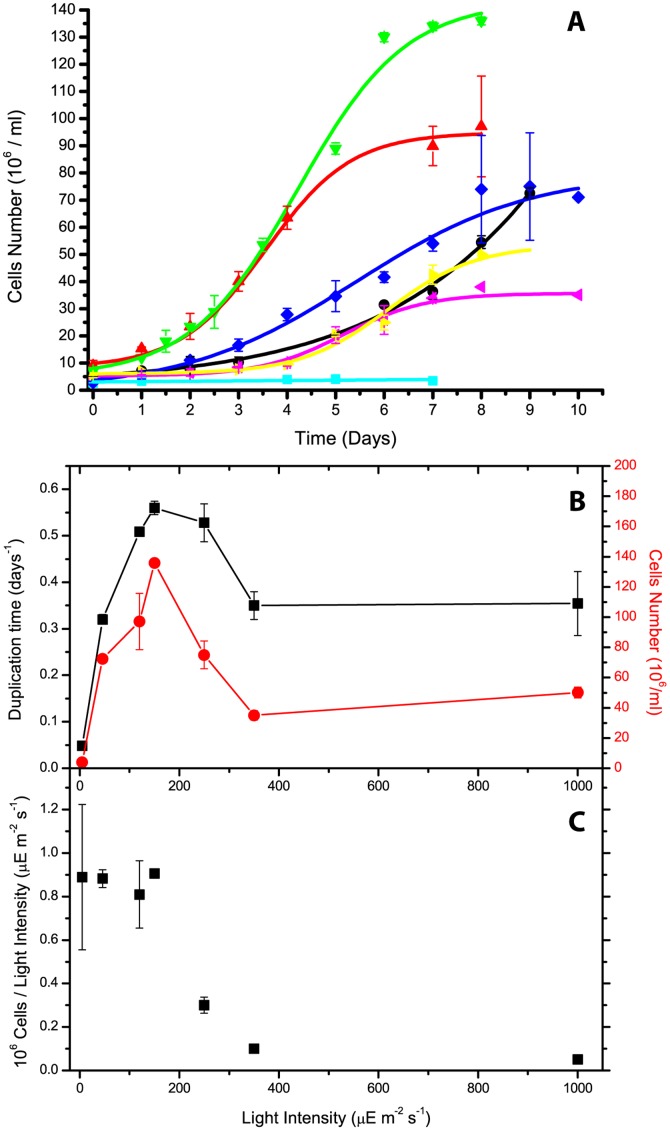
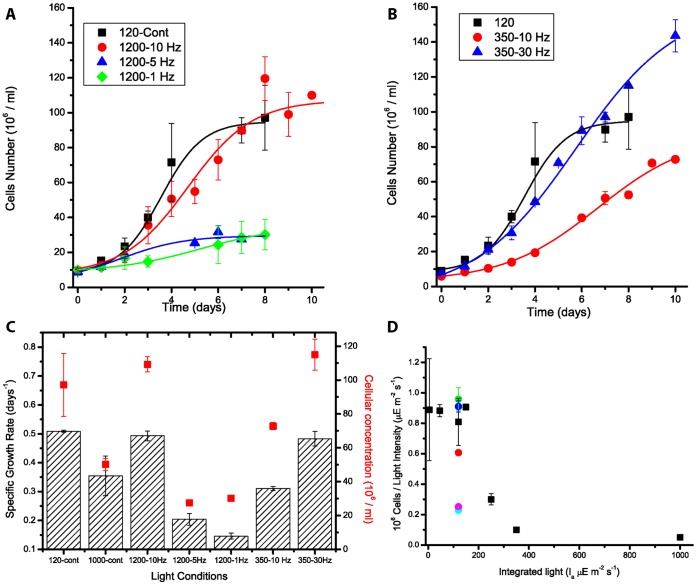
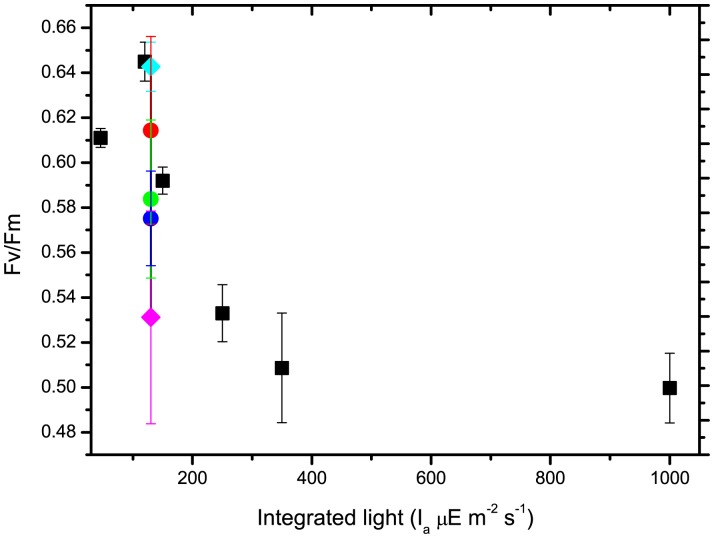
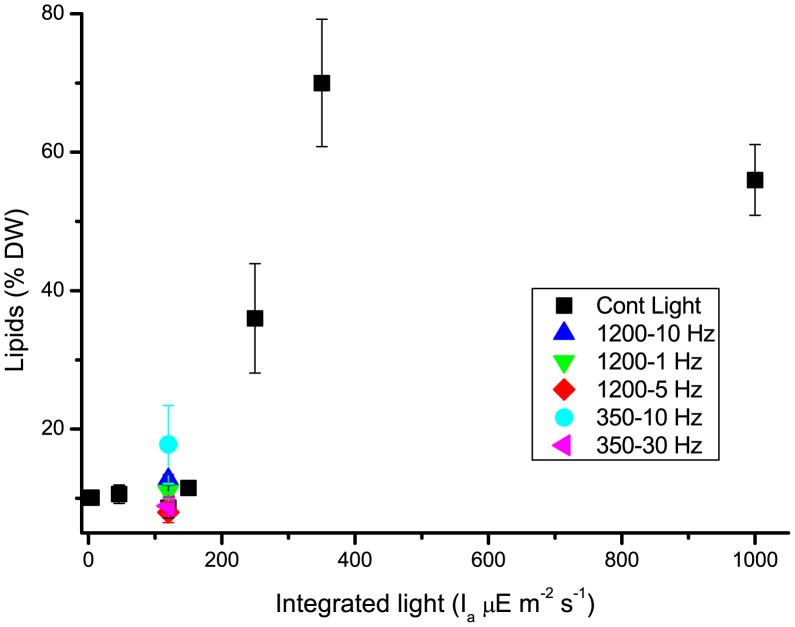
Biofuels from algae are highly interesting as renewable energy sources to replace, at least partially, fossil fuels, but great research efforts are still needed to optimize growth parameters to develop competitive large-scale cultivation systems. One factor with a seminal influence on productivity is light availability. Light energy fully supports algal growth, but it leads to oxidative stress if illumination is in excess. In this work, the influence of light intensity on the growth and lipid productivity of Nannochloropsis salina was investigated in a flat-bed photobioreactor designed to minimize cells self-shading. The influence of various light intensities was studied with both continuous illumination and alternation of light and dark cycles at various frequencies, which mimic illumination variations in a photobioreactor due to mixing. Results show that Nannochloropsis can efficiently exploit even very intense light, provided that dark cycles occur to allow for re-oxidation of the electron transporters of the photosynthetic apparatus. If alternation of light and dark is not optimal, algae undergo radiation damage and photosynthetic productivity is greatly reduced. Our results demonstrate that, in a photobioreactor for the cultivation of algae, optimizing mixing is essential in order to ensure that the algae exploit light energy efficiently.
Overview
The claims and statistics of this paper haven’t been checked yet.
Free: it reads the open-access text and checks the first 5 claims that cite a source we can check. Create a free account to check every claim.
Integrity signals
Registry
Cites
Statistics
Figures
Verification
Claims the paper makes
The claims and statistics of this paper haven’t been checked yet.
Free: it reads the open-access text and checks the first 5 claims that cite a source we can check. Create a free account to check every claim.
Claims other papers make about this one
Each is checked against this paper’s own text: does it say what the citing paper says it does?
The cited source says what the claim attributes to it.
In the citing paper
“If the frequency is not optimized, a decrease in biomass formation can occur [218].”
From Lab-scale photobioreactor systems: principles, applications, and scalability (2022) · cites this paper as [218]
Self-check
Percentages, sums and reported differences re-computed from the paper’s own numbers.
The self-check needs the paper’s full text.
Citations
Cites
Chlorophyll fluorescence—a practical guide
Maxwell, K., & Johnson, G. N. (2000) · Journal of Experimental Botany · doi:10.1093/jexbot/51.345.659 · Cited by 9,347 · cited 1×
“efficiency in algae and plants and, in particular, to highlight photoinhibition due to excess illumination [40].”
BackgroundGuillard, R. R. L., & Ryther, J. H. (1962) · Canadian Journal of Microbiology · doi:10.1139/m62-029 · Cited by 7,685
Porra, R. J., Thompson, W. A., & Kriedemann, P. E. (1989) · Biochimica et Biophysica Acta (BBA) - Bioenergetics · doi:10.1016/s0005-2728(89)80347-0 · Cited by 5,992 · cited 1×
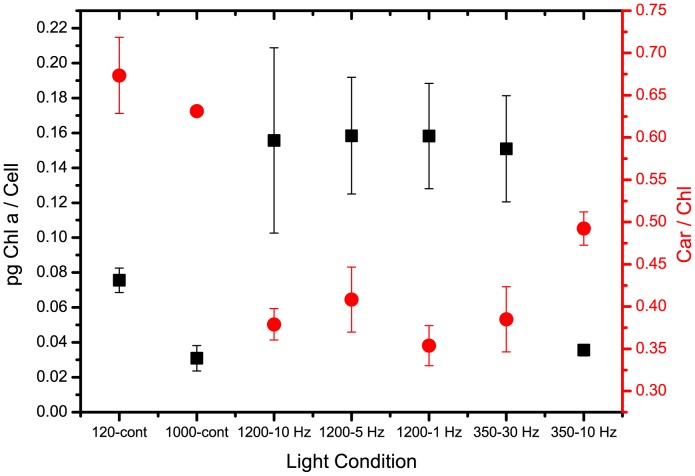
“Pigment concentrations were determined spectrophotometrically with specific extinction coefficients [50,51].”
MethodWellburn, A. R. (1994) · Journal of Plant Physiology · doi:10.1016/s0176-1617(11)81192-2 · Cited by 5,820
Microalgal triacylglycerols as feedstocks for biofuel production: perspectives and advances
Hu, Q., Sommerfeld, M., Jarvis, E., Ghirardi, M., Posewitz, M., Seibert, M., & Darzins, A. (2008) · The Plant Journal · doi:10.1111/j.1365-313x.2008.03492.x · Cited by 3,745 · cited 1×
“Light intensity has been suggested to influence algal lipid synthesis, with strong illumination inducing their accumulation [1,42].”
BackgroundRodolfi, L., Chini Zittelli, G., Bassi, N., Padovani, G., Biondi, N., Bonini, G., & Tredici, M. R. (2009) · Biotechnology and Bioengineering · doi:10.1002/bit.22033 · Cited by 2,879 · cited 2×
“Such massive accumulation of lipids has been shown to be activated in response to stresses such as nitrogen or phosphorus starvation or exposure to excess light [10–14].”
BackgroundNile red: a selective fluorescent stain for intracellular lipid droplets.
Greenspan, P., Mayer, E. P., & Fowler, S. D. (1985) · The Journal of cell biology · doi:10.1083/jcb.100.3.965 · Cited by 2,543 · cited 1×
“Fluorescence was measured on a spectrofluorometer (OLIS DM45), with excitation wavelength at 488 nm and emission at 58065 nm [53].”
MethodPhotoinhibition of photosystem II under environmental stress
Murata, N., Takahashi, S., Nishiyama, Y., & Allakhverdiev, S. I. (2007) · Biochimica et Biophysica Acta (BBA) - Bioenergetics · doi:10.1016/j.bbabio.2006.11.019 · Cited by 1,583
Microalgae as a raw material for biofuels production
Gouveia, L., & Oliveira, A. C. (2009) · Journal of Industrial Microbiology & Biotechnology · doi:10.1007/s10295-008-0495-6 · Cited by 1,284 · cited 1×
“Such massive accumulation of lipids has been shown to be activated in response to stresses such as nitrogen or phosphorus starvation or exposure to excess light [10–14].”
BackgroundSensing and Responding to Excess Light
Li, Z., Wakao, S., Fischer, B. B., & Niyogi, K. K. (2009) · Annual Review of Plant Biology · doi:10.1146/annurev.arplant.58.032806.103844 · Cited by 992 · cited 3×
“Among the several possibilities, light is a major factor, because it provides all the energy necessary to support metabolism but, if present in excess, may lead to the formation of harmful reactive oxygen species (ROS) and oxidative stress [15].”
BackgroundInfluential
Research works printed but not linked: 1
- Nedbal L Tichy V Xiong FH Grobbelaar JU 1996 Microscopic green algae and cyanobacteria in high-frequency intermittent light. Journal of Applied Phycology 8 325 333 · DOI · Paper page
Cited by
Items 301–329 of 329
Singh, N., Chetty, M., & Rathilal, S. (2025) · Results in Engineering · doi:10.1016/j.rineng.2025.107841
Effect of Chemical and Physical Factors on Microalgae Metabolism
Golub, N., & Kovalova, S. (2025) · Innovative Biosystems and Bioengineering · doi:10.20535/ibb.2025.9.3.306265
“Therefore, achieving an optimal balance between their growth rate and the accumulation of biochemically valuable compounds is a crucial task [53, 58, 59].”
Zhan, L., Tu, L., Xu, Y., Wang, P., & Tong, M. (2025) · Marine Pollution Bulletin · doi:10.1016/j.marpolbul.2025.119055
(2019) · Arizona State University Library Digital Repository (Arizona State University)
Design and Planning of Biofuels Produced from Algae
Persson Yng, A. (2024) · Lund University Publications Student Papers (Lund University)
(n.d.) · Research Publication Repository of King Fahd University of Petroleum and Minerals (King Fahd University of Petroleum and Minerals)
Lucato, V. (n.d.) · Padua Research Archive (University of Padova) · Cited by 2
Arbeláez, A. (2018) · Institutional Repository University of Antioquia (University of Antioquia)
Phototrophic microalgal cultivation in cold and light-limited environments
Schulze, P. S. C. (2019) · NVA (Nasjonalt vitenarkiv)
Anini Baah, D. (2018) · RIT Scholar Works (Rochester Institute of Technology)
Conceição, G. R., da Silva, C. S., Andrade, I. D. S., Sacramento, R. V., Costa, L. F. D. M., & Chinalia, F. A. (2026) · Revista de Ciências Médicas e Biológicas · doi:10.9771/cmbio.v24i4.67592
Nouveau système de contrôle Radiofréquence de micro-algues pour la santé et le bien-être
Zhou, X. (2016) · theses.fr (ABES) · doi:10.70675/70b212c9z956cz4652zb585z2765e532e7e3 · Cited by 2
Combe, C. (2016) · theses.fr (ABES) · doi:10.70675/907047e7z2f22z4fdez87bfz9feb8acfe8d7 · Cited by 2
Optimisation de la croissance de microalgues en façade de bâtiment
Eglantine, T. (2019) · theses.fr (ABES) · doi:10.70675/76574859z009dz445ez929ez3b6d86e1da00
Modélisation multi-échelle de la culture de microalgues
Gernigon, V. (2020) · theses.fr (ABES) · doi:10.70675/37586e25z840dz47f8z97e2zdeabc3b09b64 · Cited by 1
Mangi, K. H. (2021) · theses.fr (ABES) · doi:10.70675/0450e274zb9c3z4b69z980fz9c235629af8b · Cited by 1
Optimisation of microalgae biofilms as a future source of biomolecules
Yan, G. (2023) · theses.fr (ABES) · doi:10.70675/68193749zd83cz4e0ezb803zcb2fe456d0e0
Microalgal Biofilms : An Experimental, Monitoring and Modeling Approach
Pereira, D. M. (2025) · theses.fr (ABES) · doi:10.70675/39584f0dza802z449azb515z0097f8282711
Innovative cultivation solutions and technologies
Marchese, D., & Sforza, E. (2026) · Elsevier eBooks · doi:10.1016/b978-0-443-33492-4.00004-8 · Cited by 1
Self-citationDesign and Analysis of Macroalgae-Based Biorefineries
Golberg, A. (2026) · Methods in molecular biology · doi:10.1007/978-1-0716-5031-8_28
Temperature modulates the response of Tetradesmus obliquus to high-frequency pulsed light
Torrisi, A., Bezzo, F., Trivellin, N., & Sforza, E. (2026) · Journal of Applied Phycology · doi:10.1007/s10811-026-03861-5
“Originally, pulsed light was successfully used to simulate the light–dark cycles caused by turbulent mixing, using low frequencies and high duty cycles (Sforza et al. 2012; Simion-ato et al. 2013; Vejrazka et al. 2013).”
Self-citationde Mello, B. S., Vargas-Estrada, L., Sarti, A., & Muñoz, R. (2026) · BioEnergy Research · doi:10.1007/s12155-026-11018-y
“The photosynthetic activity (F v /F m ) is a useful parameter for assessing photosynthetic efficiency in microalgae and cyanobacterial cultures [25].”
Integration of algal systems with traditional remediation technologies
Kumar, C., Kaur, M., Kaur, A., Arya, S. K., Puri, S., & Khatri, M. (2026) · Elsevier eBooks · doi:10.1016/b978-0-443-36656-7.00008-4
ILYAS, M. (2014) · Research Publication Repository of King Fahd University of Petroleum and Minerals (King Fahd University of Petroleum and Minerals)
Xia, Y., Chen, Y., Ye, Q., Ji, X., Zhu, X., Du, J., Hu, Z., Cai, Q., & Wu, X. (2026) · Bioprocess and Biosystems Engineering · doi:10.1007/s00449-026-03392-w
“Under iso-actinic conditions, microalgae may respond primarily to the time-averaged irradiance, and inappropriate frequencies or duty cycles may result in growth performance comparable to or lower than that under continuous illumination [6, 9].”
InfluentialMicroalgal–bacterial consortia for wastewater treatment
Zhang, J., Zhou, Q., Wang, R., Wang, H., Zeng, H., Wu, K., Zhou, R., & Ouyang, S. (2026) · Nature Reviews Clean Technology · doi:10.1038/s44359-026-00212-y
Lim, H.-J., Lee, Y.-J., Kim, M.-S., Rögner, M., & Kwon, J.-H. (2026) · Microorganisms · doi:10.3390/microorganisms14092044
“Sforza et al. demonstrated that appropriately adjusted L/D cycles improved photosynthetic efficiency in photobioreactors by allowing re-oxidation of components of the photosynthetic electron transport chain and reducing damage associated with excessive excitation [46].”
Physics approach to the Photosynthetic process in unicellular algae – A review
Zarmi, Y. (2026) · London Journal of Research in Science Natural & Formal · doi:10.34257/ljrs235733uk
Advances in microalgal CO 2 fixation and biogas production: toward sustainable bioenergy system
Haoujar, I., Mrabet, A., & Cacciola, F. (2026) · Biofuels · doi:10.1080/17597269.2026.2742670
Metadata
- Authors
- Sforza, E., Simionato, D., Giacometti, G. M., Bertucco, A., & Morosinotto, T.
- Affiliations
- University of Padua (IT)
- Corresponding author
- Morosinotto, Tomas
- Venue
- PLoS ONE
- Publisher
- Public Library of Science (PLoS)
- Published
- 2012-06-20
- Volume
- 7
- Issue
- 6
- Pages
- e38975
- ISSN
- 1932-6203 (ISSN-L)
- PMC
- PMC3380057
- OpenAlex
- W2043003528
- Cited by
- 313
- References
- 54
- Citations by year
- 2026: 13 · 2025: 25 · 2024: 21 · 2023: 21 · 2022: 26 · 2021: 25 · 2020: 24 · 2019: 22 · 2018: 23 · 2017: 23 · 2016: 34 · 2015: 20 · 2014: 22 · 2013: 12 · 2012: 1
- FWCI
- 6.74
- Type
- journal article
- Language
- en
- Open access
- gold
- doi.org
- Locations
- PLoS ONE (publishedVersion, cc-by)
- Europe PMC (PubMed Central) (publishedVersion, cc-by)
- PubMed Central (publishedVersion, cc-by)
- PubMed (publishedVersion)
- DOAJ (DOAJ: Directory of Open Access Journals) (submittedVersion, cc-by-sa)
- Figshare (submittedVersion, cc-by)
- Padua Research Archive (University of Padova) (submittedVersion, cc-by)
- Topics
- Physical Sciences › Energy › Renewable Energy, Sustainability and the Environment › Algal biology and biofuel production
- Life Sciences › Biochemistry, Genetics and Molecular Biology › Molecular Biology › Photosynthetic Processes and Mechanisms
- Physical Sciences › Environmental Science › Environmental Chemistry › Aquatic Ecosystems and Phytoplankton Dynamics
- Keywords
- Nannochloropsis salina, photobioreactors, light intensity, photosynthetic efficiency, lipid productivity, oxidative stress, radiation damage, algal growth, mixing
- MeSH terms
- Light, Photosynthesis, Photoperiod, Oxidative Stress, Stramenopiles, Microalgae, Photobioreactors
About these checks
Registry, retraction, Cites and statistics results are computed, not judged, with one exception: a printed reference that no index lists is read once by a model before it counts as a citation error. Claims are extracted by a model and kept only when their quote appears verbatim in the text; each cited source is then checked, with a model’s help, for whether it says what the claim relies on. Those verdicts can be wrong — read the claim’s quote and the cited source before relying on one.
Statistics and arithmetic are recomputed, not judged.
Confidence bands are shown only for fields calibrated on our annotated test set. None is calibrated yet, so no band is shown.
What counts as a claim ›How we measure confidence ›How we check this ›
Are you an author, or do you see a problem with this page? Request a review
Data sources
Bibliographic data: Semantic Scholar, OpenAlex, Crossref.
Contains information from the Semantic Scholar Academic Graph Datasets, made available under the ODC Attribution License (ODC-BY 1.0).
Semantic Scholar’s data is described in: Kinney, R., et al. (2023). The Semantic Scholar Open Data Platform. arXiv:2301.10140.
