

Adjusted Light and Dark Cycles Can Optimize Photosynthetic Efficiency in Algae Growing in Photobioreactors
Open accessThe DOI matches its Crossref record; 54 of the 54 references it cites were found in a registry or an index.
Abstract
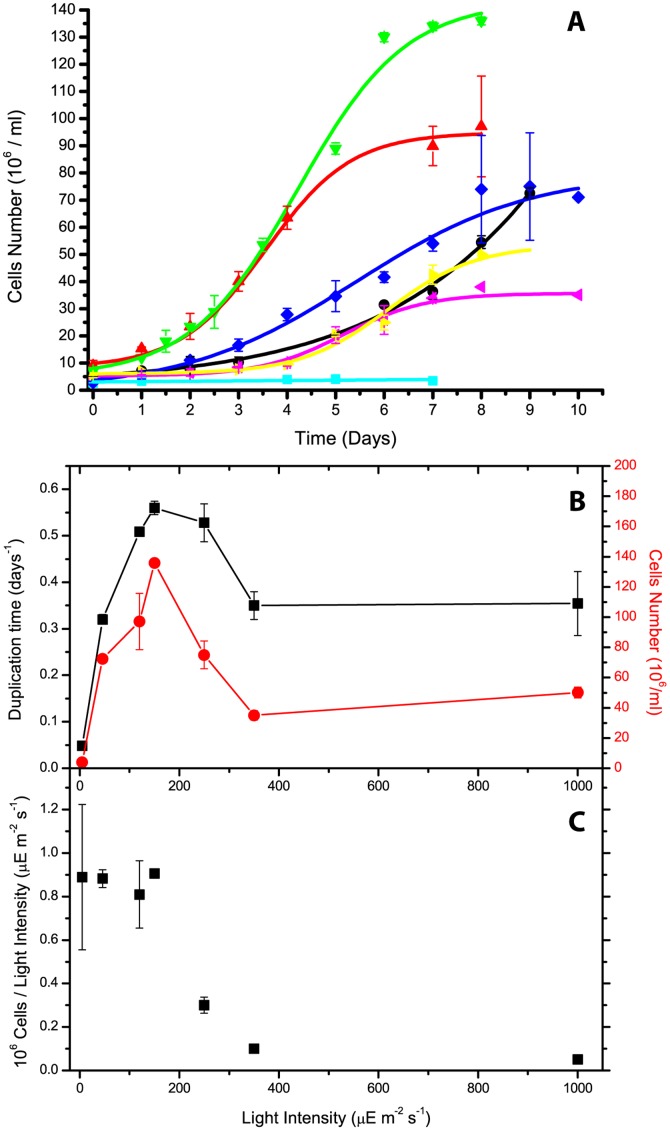
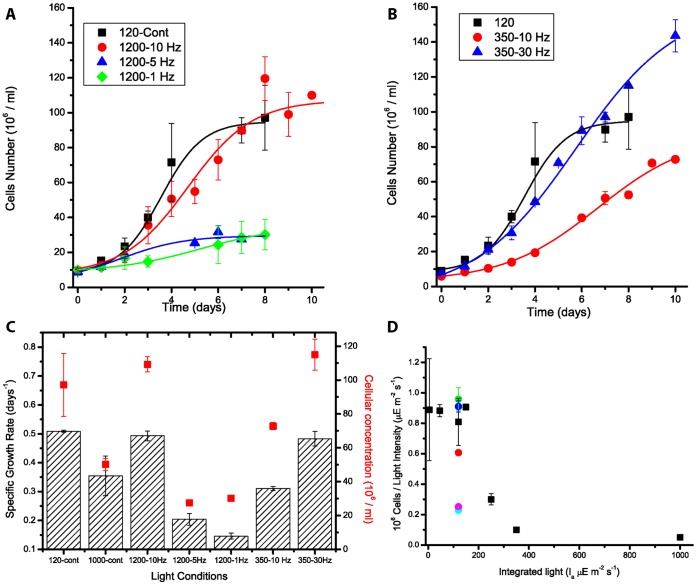
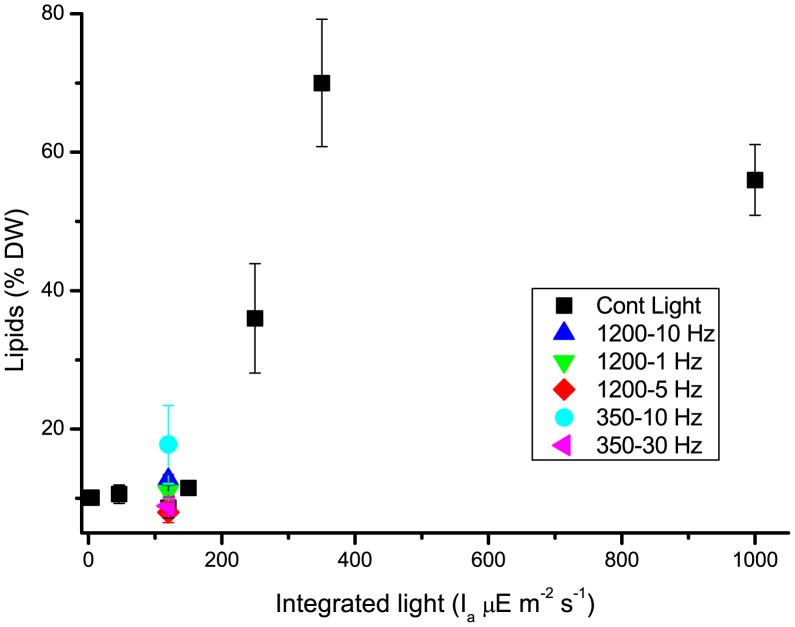
Biofuels from algae are highly interesting as renewable energy sources to replace, at least partially, fossil fuels, but great research efforts are still needed to optimize growth parameters to develop competitive large-scale cultivation systems. One factor with a seminal influence on productivity is light availability. Light energy fully supports algal growth, but it leads to oxidative stress if illumination is in excess. In this work, the influence of light intensity on the growth and lipid productivity of Nannochloropsis salina was investigated in a flat-bed photobioreactor designed to minimize cells self-shading. The influence of various light intensities was studied with both continuous illumination and alternation of light and dark cycles at various frequencies, which mimic illumination variations in a photobioreactor due to mixing. Results show that Nannochloropsis can efficiently exploit even very intense light, provided that dark cycles occur to allow for re-oxidation of the electron transporters of the photosynthetic apparatus. If alternation of light and dark is not optimal, algae undergo radiation damage and photosynthetic productivity is greatly reduced. Our results demonstrate that, in a photobioreactor for the cultivation of algae, optimizing mixing is essential in order to ensure that the algae exploit light energy efficiently.
Overview
The claims and statistics of this paper haven’t been checked yet.
Free: it reads the open-access text and checks the first 5 claims that cite a source we can check. Create a free account to check every claim.
Integrity signals
Registry
Cites
Statistics
Figures
Verification
Claims the paper makes
The claims and statistics of this paper haven’t been checked yet.
Free: it reads the open-access text and checks the first 5 claims that cite a source we can check. Create a free account to check every claim.
Claims other papers make about this one
Each is checked against this paper’s own text: does it say what the citing paper says it does?
The cited source says what the claim attributes to it.
In the citing paper
“If the frequency is not optimized, a decrease in biomass formation can occur [218].”
From Lab-scale photobioreactor systems: principles, applications, and scalability (2022) · cites this paper as [218]
Self-check
Percentages, sums and reported differences re-computed from the paper’s own numbers.
The self-check needs the paper’s full text.
Citations
Cites
Chlorophyll fluorescence—a practical guide
Maxwell, K., & Johnson, G. N. (2000) · Journal of Experimental Botany · doi:10.1093/jexbot/51.345.659 · Cited by 9,347 · cited 1×
“efficiency in algae and plants and, in particular, to highlight photoinhibition due to excess illumination [40].”
BackgroundGuillard, R. R. L., & Ryther, J. H. (1962) · Canadian Journal of Microbiology · doi:10.1139/m62-029 · Cited by 7,685
Porra, R. J., Thompson, W. A., & Kriedemann, P. E. (1989) · Biochimica et Biophysica Acta (BBA) - Bioenergetics · doi:10.1016/s0005-2728(89)80347-0 · Cited by 5,992 · cited 1×
“Pigment concentrations were determined spectrophotometrically with specific extinction coefficients [50,51].”
MethodWellburn, A. R. (1994) · Journal of Plant Physiology · doi:10.1016/s0176-1617(11)81192-2 · Cited by 5,820
Microalgal triacylglycerols as feedstocks for biofuel production: perspectives and advances
Hu, Q., Sommerfeld, M., Jarvis, E., Ghirardi, M., Posewitz, M., Seibert, M., & Darzins, A. (2008) · The Plant Journal · doi:10.1111/j.1365-313x.2008.03492.x · Cited by 3,745 · cited 1×
“Light intensity has been suggested to influence algal lipid synthesis, with strong illumination inducing their accumulation [1,42].”
BackgroundRodolfi, L., Chini Zittelli, G., Bassi, N., Padovani, G., Biondi, N., Bonini, G., & Tredici, M. R. (2009) · Biotechnology and Bioengineering · doi:10.1002/bit.22033 · Cited by 2,879 · cited 2×
“Such massive accumulation of lipids has been shown to be activated in response to stresses such as nitrogen or phosphorus starvation or exposure to excess light [10–14].”
BackgroundNile red: a selective fluorescent stain for intracellular lipid droplets.
Greenspan, P., Mayer, E. P., & Fowler, S. D. (1985) · The Journal of cell biology · doi:10.1083/jcb.100.3.965 · Cited by 2,543 · cited 1×
“Fluorescence was measured on a spectrofluorometer (OLIS DM45), with excitation wavelength at 488 nm and emission at 58065 nm [53].”
MethodPhotoinhibition of photosystem II under environmental stress
Murata, N., Takahashi, S., Nishiyama, Y., & Allakhverdiev, S. I. (2007) · Biochimica et Biophysica Acta (BBA) - Bioenergetics · doi:10.1016/j.bbabio.2006.11.019 · Cited by 1,583
Microalgae as a raw material for biofuels production
Gouveia, L., & Oliveira, A. C. (2009) · Journal of Industrial Microbiology & Biotechnology · doi:10.1007/s10295-008-0495-6 · Cited by 1,284 · cited 1×
“Such massive accumulation of lipids has been shown to be activated in response to stresses such as nitrogen or phosphorus starvation or exposure to excess light [10–14].”
BackgroundSensing and Responding to Excess Light
Li, Z., Wakao, S., Fischer, B. B., & Niyogi, K. K. (2009) · Annual Review of Plant Biology · doi:10.1146/annurev.arplant.58.032806.103844 · Cited by 992 · cited 3×
“Among the several possibilities, light is a major factor, because it provides all the energy necessary to support metabolism but, if present in excess, may lead to the formation of harmful reactive oxygen species (ROS) and oxidative stress [15].”
BackgroundInfluential
Research works printed but not linked: 1
- Nedbal L Tichy V Xiong FH Grobbelaar JU 1996 Microscopic green algae and cyanobacteria in high-frequency intermittent light. Journal of Applied Phycology 8 325 333 · DOI · Paper page
Cited by
Khan, M. I., Shin, J. H., & Kim, J. D. (2018) · Microbial Cell Factories · doi:10.1186/s12934-018-0879-x · Cited by 2,082
Maltsev, Y., Maltseva, K., Kulikovskiy, M., & Maltseva, S. (2021) · Biology · doi:10.3390/biology10101060 · Cited by 511
“This issue is discussed in detail in several research works [43,45,56].”
BackgroundDesign of Photobioreactors for Mass Cultivation of Photosynthetic Organisms
Huang, Q., Jiang, F., Wang, L., & Yang, C. (2017) · Engineering · doi:10.1016/j.eng.2017.03.020 · Cited by 487
“However, it was also observed that the flashing light could decrease the production of microalgae when the L/D cycle or the frequency of the flashes was not optimized [40,58,60,61].”
BackgroundPhoton management for augmented photosynthesis
Ooms, M. D., Dinh, C. T., Sargent, E. H., & Sinton, D. (2016) · Nature Communications · doi:10.1038/ncomms12699 · Cited by 305
Luo, Y., Le-Clech, P., & Henderson, R. K. (2017) · Algal Research · doi:10.1016/j.algal.2016.10.026 · Cited by 231
Corteggiani Carpinelli, E., Telatin, A., Vitulo, N., Forcato, C., D’Angelo, M., Schiavon, R., Vezzi, A., Giacometti, G. M., Morosinotto, T., & Valle, G. (2014) · Molecular Plant · doi:10.1093/mp/sst120 · Cited by 219
Self-citationFlashing light in microalgae biotechnology
Abu-Ghosh, S., Fixler, D., Dubinsky, Z., & Iluz, D. (2016) · Bioresource Technology · doi:10.1016/j.biortech.2015.12.057 · Cited by 204
Lab-scale photobioreactor systems: principles, applications, and scalability
Benner, P., Meier, L., Pfeffer, A., Krüger, K., Oropeza Vargas, J. E., & Weuster-Botz, D. (2022) · Bioprocess and Biosystems Engineering · doi:10.1007/s00449-022-02711-1 · Cited by 215
“If the frequency is not optimized, a decrease in biomass formation can occur [218].”
BackgroundRecent progress in genetically modified microalgae for enhanced carbon dioxide sequestration
Barati, B., Zeng, K., Baeyens, J., Wang, S., Addy, M., Gan, S.-Y., & El-Fatah Abomohra, A. (2021) · Biomass and Bioenergy · doi:10.1016/j.biombioe.2020.105927 · Cited by 186
Sutherland, D. L., Howard-Williams, C., Turnbull, M. H., Broady, P. A., & Craggs, R. J. (2015) · Bioresource Technology · doi:10.1016/j.biortech.2014.10.074 · Cited by 174
“Several studies have successfully demonstrated that increased vertical mixing increased microalgal photosynthesis and productivity, due to increased light / dark cycles, termed the “flashing light effect” (Grobbelaar 1994, Sforza et al. 2012, Vejrazka et al. 2013).”
BackgroundProgress in Microalgae Application for CO2 Sequestration
Ighalo, J. O., Dulta, K., Kurniawan, S. B., Omoarukhe, F. O., Ewuzie, U., Eshiemogie, S. O., Ojo, A. U., & Abdullah, S. R. S. (2022) · Cleaner Chemical Engineering · doi:10.1016/j.clce.2022.100044 · Cited by 180
Light enhancement strategies improve microalgal biomass productivity
Ramanna, L., Rawat, I., & Bux, F. (2017) · Renewable and Sustainable Energy Reviews · doi:10.1016/j.rser.2017.05.202 · Cited by 178
Chua, E. T., & Schenk, P. M. (2017) · Bioresource Technology · doi:10.1016/j.biortech.2017.05.124 · Cited by 170
“The same photoinhibition effect was observed by Sforza et al. (2012).”
BackgroundOptimization of light use efficiency for biofuel production in algae
Simionato, D., Basso, S., Giacometti, G. M., & Morosinotto, T. (2013) · Biophysical Chemistry · doi:10.1016/j.bpc.2013.06.017 · Cited by 175
“250 μmol of photons m−2 s−1 shows that while growth rate is similar, light use efficiency in the latter is already ≈50% less [29].”
BackgroundMethodInfluentialSelf-citationAlgal Green Energy – R&D and technological perspectives for biodiesel production
Rastogi, R. P., Pandey, A., Larroche, C., & Madamwar, D. (2017) · Renewable and Sustainable Energy Reviews · doi:10.1016/j.rser.2017.10.038 · Cited by 164
Food waste compost as an organic nutrient source for the cultivation of Chlorella vulgaris
Chew, K. W., Chia, S. R., Show, P. L., Ling, T. C., Arya, S. S., & Chang, J.-S. (2018) · Bioresource Technology · doi:10.1016/j.biortech.2018.07.069 · Cited by 135
Alboresi, A., Perin, G., Vitulo, N., Diretto, G., Block, M., Jouhet, J., Meneghesso, A., Valle, G., Giuliano, G., Maréchal, E., et al. (2016) · Plant Physiology · doi:10.1104/pp.16.00599 · Cited by 131
“This result is consistent 138 with the literature showing enhanced TAG accumulation for Nannochloropsis in response to 139 increased light intensity if CO2 is not limiting (Pal et al., 2011; Sforza et al., 2012; Teo et al., 2014).”
BackgroundSelf-citationZhang, B., Guo, Y., Lens, P. N. L., Zhang, Z., Shi, W., Cui, F., & Tay, J. H. (2018) · The Science of The Total Environment · doi:10.1016/j.scitotenv.2018.12.250 · Cited by 142
Gris, B., Morosinotto, T., Giacometti, G. M., Bertucco, A., & Sforza, E. (2013) · Applied Biochemistry and Biotechnology · doi:10.1007/s12010-013-0679-z · Cited by 150
Self-citationUmamaheswari, J., & Shanthakumar, S. (2016) · Reviews in Environmental Science and Bio/Technology · doi:10.1007/s11157-016-9397-7 · Cited by 145
“Direct sunlight or the light supplied by the fluorescent tubes are well enough for the growth of algae nevertheless the higher in light may support the overheating which inhibits the photosynthesis processes which is nothing but photo inhibition (Sforza et al. 2012).”
BackgroundGlemser, M., Heining, M., Schmidt, J., Becker, A., Garbe, D., Buchholz, R., & Brück, T. (2016) · Applied Microbiology and Biotechnology · doi:10.1007/s00253-015-7144-6 · Cited by 135
del Rio‐Chanona, E. A., Wagner, J. L., Ali, H., Fiorelli, F., Zhang, D., & Hellgardt, K. (2019) · AIChE Journal · doi:10.1002/aic.16473 · Cited by 123
Antibiotic removal by microalgae-bacteria consortium: Metabolic pathways and microbial responses
Eheneden, I., Wang, R., & Zhao, J. (2023) · The Science of The Total Environment · doi:10.1016/j.scitotenv.2023.164489 · Cited by 126
A novel photobioreactor generating the light/dark cycle to improve microalgae cultivation
Liao, Q., Li, L., Chen, R., & Zhu, X. (2014) · Bioresource Technology · doi:10.1016/j.biortech.2014.02.119 · Cited by 125
Factors Affecting Growth of Various Microalgal Species
Gatamaneni, B. L., Orsat, V., & Lefsrud, M. (2018) · Environmental Engineering Science · doi:10.1089/ees.2017.0521 · Cited by 115
“In fact, sunlight provides the light required for supporting metabolism, but if present in excess, it leads to oxidative stress and photo inhibition, thereby reducing photosynthetic efficiency (Sforza et al. , 2012).”
Multilateral Approach on Enhancing Economic Viability of Lipid Production from Microalgae: A Review
Shin, Y. S., Choi, H. I., Choi, J. W., Lee, J. S., Sung, Y. J., & Sim, S. J. (2018) · Bioresource Technology · doi:10.1016/j.biortech.2018.03.002 · Cited by 122
Schulze, P. S. C., Pereira, H., Santos, T., Schüler, L., Guerra, R., Barreira, L. A., Perales, J. A., & Varela, J. C. S. (2016) · Algal Research · doi:10.1016/j.algal.2016.03.034 · Cited by 133
“Therefore, aflashing light effectmay also be at play, favouring growth by limiting non-photochemical quenching (NPQ) and selfshading [37,38].”
BackgroundAlgal Physiology and Large-Scale Outdoor Cultures of Microalgae
Borowitzka, M. A. (2016) · Springer eBooks · doi:10.1007/978-3-319-24945-2_23 · Cited by 138
Abiusi, F., Sampietro, G., Marturano, G., Biondi, N., Rodolfi, L., D'Ottavio, M., & Tredici, M. R. (2014) · Biotechnology and Bioengineering · doi:10.1002/bit.25014 · Cited by 112
“Many studies have been focused on light regime (Carvalho et al., 2011; Sforza et al., 2012), nutrient manipulation (Mandalam and Palsson, 1998) and cellular engineering (Beckmann et al., 2009) to optimize microalgal growth and increase the conversion of light into biomass, while the influence of…”
BackgroundKim, E. J., Kim, S., Choi, H.-G., & Han, S. J. (2020) · Biotechnology for Biofuels · doi:10.1186/s13068-020-1660-z · Cited by 113
Eroğlu, E., Eggers, P. K., Winslade, M., Smith, S. M., & Raston, C. L. (2013) · Green Chemistry · doi:10.1039/c3gc41291a · Cited by 115
Bose, A., Lin, R., Rajendran, K., O'Shea, R., Xia, A., & Murphy, J. D. (2019) · Biotechnology Advances · doi:10.1016/j.biotechadv.2019.107444 · Cited by 107
Flashing LEDs for microalgal production
Schulze, P. S. C., Guerra, R., Pereira, H., Schüler, L. M., & Varela, J. C. S. (2017) · Trends in Biotechnology · doi:10.1016/j.tibtech.2017.07.011 · Cited by 103
Barra, L., Chandrasekaran, R., Corato, F., & Brunet, C. (2014) · Marine Drugs · doi:10.3390/md12031641 · Cited by 98
“microalgal growth and photosynthetic rate [20,261].”
BackgroundSeyed Hosseini, N., Shang, H., & Scott, J. A. (2018) · Renewable and Sustainable Energy Reviews · doi:10.1016/j.rser.2018.04.086 · Cited by 94
Hülsen, T., Hsieh, K., Tait, S., Barry, E. M., Puyol, D., & Batstone, D. J. (2018) · Water Research · doi:10.1016/j.watres.2018.07.040 · Cited by 93
Behl, K., SeshaCharan, P., Joshi, M., Sharma, M., Mathur, A., Kareya, M. S., Jutur, P. P., Bhatnagar, A., & Nigam, S. (2020) · Bioresource Technology · doi:10.1016/j.biortech.2020.122993 · Cited by 88
Shekh, A., Sharma, A., Schenk, P. M., Kumar, G., & Mudliar, S. (2022) · Journal of Chemical Technology & Biotechnology · doi:10.1002/jctb.6902 · Cited by 90
Wan, C., Bai, F., & Zhao, X. (2013) · Biochemical Engineering Journal · doi:10.1016/j.bej.2013.04.014 · Cited by 95
Membrane technologies for microalgal cultivation and dewatering: Recent progress and challenges
Zhang, M., Yao, L., Maleki, E., Liao, B., & Lin, H. (2019) · Algal Research · doi:10.1016/j.algal.2019.101686 · Cited by 91
Abomohra, A., Shang, H., El-Sheekh, M. M., Eladel, H., Ebaid, R., Wang, S., & Wang, Q. (2019) · Bioresource Technology · doi:10.1016/j.biortech.2019.121514 · Cited by 85
Liu, X., Hong, Y., Zhao, G., Zhang, H., Zhai, Q.-Y., & Wang, Q. (2021) · The Science of The Total Environment · doi:10.1016/j.scitotenv.2021.151008 · Cited by 90
Arias, D. M., Uggetti, E., García-Galán, M. J., & García, J. (2018) · New Biotechnology · doi:10.1016/j.nbt.2018.01.001 · Cited by 85
Khalid, A. A. H., Yaakob, Z., Abdullah, S. R. S., & Takriff, M. S. (2019) · Journal of Cleaner Production · doi:10.1016/j.jclepro.2018.11.095 · Cited by 74
Production of chemicals from microalgae lipids – status and perspectives
Hess, S. K., Lepetit, B., Kroth, P. G., & Mecking, S. (2018) · European Journal of Lipid Science and Technology · doi:10.1002/ejlt.201700152 · Cited by 74
“Applying fluctuating light with high maximum intensities may also improve lipid productivity for certain species [86], however, apparently not for Nannochloropsis sp [87].”
BackgroundOrefice, I., Chandrasekaran, R., Smerilli, A., Corato, F., Caruso, T., Casillo, A., Corsaro, M. M., Piaz, F. D., Ruban, A. V., & Brunet, C. (2016) · Algal Research · doi:10.1016/j.algal.2016.04.013 · Cited by 80
Toward Enhanced Fixation of CO2 in Aquatic Biomass: Focus on Microalgae
Gerotto, C., Norici, A., & Giordano, M. (2020) · Frontiers in Energy Research · doi:10.3389/fenrg.2020.00213 · Cited by 69
Hovde, B. T., Deodato, C. R., Hunsperger, H. M., Ryken, S. A., Yost, W., Jha, R. K., Patterson, J., Monnat, R. J., Barlow, S. B., Starkenburg, S. R., et al. (2015) · PLoS Genetics · doi:10.1371/journal.pgen.1005469 · Cited by 76
Sforza, E., Enzo, M., & Bertucco, A. (2013) · Chemical Engineering Research and Design · doi:10.1016/j.cherd.2013.08.017 · Cited by 72
Self-citationHigh-throughput optimisation of light-driven microalgae biotechnologies
Sivakaminathan, S., Hankamer, B., Wolf, J., & Yarnold, J. (2018) · Scientific Reports · doi:10.1038/s41598-018-29954-x · Cited by 61
Abu-Ghosh, S., Fixler, D., Dubinsky, Z., & Iluz, D. (2015) · Bioresource Technology · doi:10.1016/j.biortech.2015.03.119 · Cited by 63
Combe, C., Hartmann, P., Rabouille, S., Talec, A., Bernard, O., & Sciandra, A. (2015) · Biotechnology and Bioengineering · doi:10.1002/bit.25526 · Cited by 58
“, 2011), in particular when in short-term batch cultures are used (Sforza et al., 2012).”
BackgroundPatelou, M., Infante, C., Dardelle, F., Randewig, D., Kouri, E. D., Udvardi, M. K., Tsiplakou, E., Mantecón, L., & Flemetakis, E. (2020) · Algal Research · doi:10.1016/j.algal.2019.101735 · Cited by 63
A systems approach for CO2 fixation from flue gas by microalgae—theory review
Kroumov, A. D., Módenes, A. N., Trigueros, D. E. G., Espinoza-Quiñones, F. R., Borba, C. E., Scheufele, F. B., & Hinterholz, C. L. (2016) · Process Biochemistry · doi:10.1016/j.procbio.2016.05.019 · Cited by 62
Enhanced biofuel production using optimality, pathway modification and waste minimization
Raven, J. A., & Ralph, P. J. (2014) · Journal of Applied Phycology · doi:10.1007/s10811-014-0323-5 · Cited by 64
“Using solar radiation for the light periods, the optimal dark period is around 10– 50 ms (Williams and Laurens 2010; Iluz et al. 2012; Sforza et al. 2012) with about a 10:1 ratio dark to light, while flash periods shorter than 10 ms are less photosynthetically effective, presumably because not all…”
BackgroundFattore, N., Bellan, A., Pedroletti, L., Vitulo, N., & Morosinotto, T. (2021) · Algal Research · doi:10.1016/j.algal.2021.102368 · Cited by 65
Self-citationBasso, S., Simionato, D., Gerotto, C., Segalla, A., Giacometti, G. M., & Morosinotto, T. (2013) · Biochimica et Biophysica Acta (BBA) - Bioenergetics · doi:10.1016/j.bbabio.2013.11.019 · Cited by 72
Self-citationSforza, E., Calvaruso, C., Rocca, N. L., & Bertucco, A. (2018) · Biochemical Engineering Journal · doi:10.1016/j.bej.2018.03.008 · Cited by 64
Self-citationYe, J., Liang, J., Wang, L., Μάρκου, Γ., & Jia, Q. (2017) · Bioresource Technology · doi:10.1016/j.biortech.2017.12.086 · Cited by 62
Abu-Ghosh, S., Fixler, D., Dubinsky, Z., Solovchenko, A., Zigman, M., Yehoshua, Y., & Iluz, D. (2015) · European Journal of Phycology · doi:10.1080/09670262.2015.1069404 · Cited by 59
“sion was constantly bubbled with a CO2 (5% v/v):air mixture (Sforza et al., 2012) at a rate of 70 ml min.”
MethodJeong, S. W., Nam, S. W., Hwangbo, K., Jeong, W.-J., Jeong, B., Chang, Y. K., & Park, Y. (2017) · Scientific Reports · doi:10.1038/s41598-017-05684-4 · Cited by 66
Avinash, A., Sasikumar, P., & Pugazhendhi, A. (2020) · Renewable and Sustainable Energy Reviews · doi:10.1016/j.rser.2020.110250 · Cited by 59
The potential of quantitative models to improve microalgae photosynthetic efficiency
Perin, G., Bellan, A., Bernardi, A., Bezzo, F., & Morosinotto, T. (2019) · Physiologia Plantarum · doi:10.1111/ppl.12915 · Cited by 56
Self-citationKhajepour, F., Hosseini, S. A., Ghorbani, R., & Μάρκου, Γ. (2015) · Applied Biochemistry and Biotechnology · doi:10.1007/s12010-015-1717-9 · Cited by 64
“Moreover, due to their antioxidant properties, carotenoids are believed to protect organisms against oxidative stress caused by excess light [34].”
BackgroundFlashing light does not improve photosynthetic performance and growth of green microalgae
Schulze, P. S. C., Brindley, C., Fernández, J. M., Rautenberger, R., Pereira, H., Wijffels, R. H., & Kiron, V. (2020) · Bioresource Technology Reports · doi:10.1016/j.biteb.2019.100367 · Cited by 56
Tamburic, B., Guruprasad, S., Radford, D. T., Szabó, M., Lilley, R. M., Larkum, A. W. D., Franklin, J. B., Kramer, D. M., Blackburn, S. I., Raven, J. A., et al. (2014) · PLoS ONE · doi:10.1371/journal.pone.0086047 · Cited by 53
“[23] found overnight estimates of maximum quantum yield of PSII to average 0.”
BackgroundInfluentialImproving the sunlight-to-biomass conversion efficiency in microalgal biofactories
Wobbe, L., & Remacle, C. (2014) · Journal of Biotechnology · doi:10.1016/j.jbiotec.2014.08.021 · Cited by 61
Iluz, D., & Abu‐Ghosh, S. (2016) · Energy Conversion and Management · doi:10.1016/j.enconman.2016.08.045 · Cited by 58
Flashing light effects on CO2 absorption by microalgae grown on a biofilm photobioreactor
Martín‐Girela, I., Curt, M. D., & Fernández, J. (2017) · Algal Research · doi:10.1016/j.algal.2017.06.008 · Cited by 56
Model-based optimization of microalgae areal productivity in flat-plate gas-lift photobioreactors
Pfaffinger, C. E., Schöne, D., Trunz, S., Löwe, H., & Weuster-Botz, D. (2016) · Algal Research · doi:10.1016/j.algal.2016.10.002 · Cited by 52
Gracioso, L. H., Bellan, A., Karolski, B., Cardoso, L. O. B., Perpetuo, E. A., do Nascimento, C. A. O., Giudici, R., Pizzocchero, V., Basaglia, M., & Morosinotto, T. (2020) · Bioresource Technology · doi:10.1016/j.biortech.2020.124379 · Cited by 52
Self-citationPatidar, S. K., Mitra, M., George, B., Soundarya, R., & Mishra, S. (2014) · Bioresource Technology · doi:10.1016/j.biortech.2014.08.070 · Cited by 53
Photoacclimation of photosynthesis in the Eustigmatophycean Nannochloropsis gaditana
Meneghesso, A., Simionato, D., Gerotto, C., Rocca, N. L., Finazzi, G., & Morosinotto, T. (2016) · Photosynthesis Research · doi:10.1007/s11120-016-0297-z · Cited by 55
“In recent years, species belonging to the Nannochloropsis genus have gained increasing interest for their potential exploitation for biodiesel production, reflecting the rapid growth rate and accumulation of lipids in these species (Rodolfi et al. 2009; Sforza et al. 2012; Bondioli et al. 2012).”
BackgroundSelf-citationYarnold, J., Ross, I. L., & Hankamer, B. (2016) · Algal Research · doi:10.1016/j.algal.2015.11.001 · Cited by 50
Scenedesmus dimorphus biofilm: Photoefficiency and biomass production under intermittent lighting
Toninelli, A. E., Wang, J., Liu, M., Wu, H., & Liu, T. (2016) · Scientific Reports · doi:10.1038/srep32305 · Cited by 49
Modulation of xanthophyll cycle impacts biomass productivity in the marine microalga Nannochloropsis
Perin, G., Bellan, A., Michelberger, T., Lyska, D., Wakao, S., Niyogi, K., & Morosinotto, T. (2023) · Proceedings of the National Academy of Sciences · doi:10.1073/pnas.2214119120 · Cited by 48
“It is worth noting that even when grown in limiting light conditions [i.e., 150 μ mol photons m −2 s −1 , (19)], Nannochloropsis cells showed a small but detectable presence of zeaxanthin (>2%, Fig.”
Self-citationMicroalgae on display: a microfluidic pixel-based irradiance assay for photosynthetic growth
Graham, P. J., Riordon, J., & Sinton, D. (2015) · Lab on a Chip · doi:10.1039/c5lc00527b · Cited by 47
Choi, Y., Kumaran, R. S., Jeon, H. J., Song, H. J., Yang, Y., Lee, S. H., Song, K. G., Kim, K. J., Singh, V., & Kim, H. J. (2015) · Spectrochimica Acta Part A Molecular and Biomolecular Spectroscopy · doi:10.1016/j.saa.2015.03.035 · Cited by 56
Sutherland, D. L., Montemezzani, V., Howard‐Williams, C., Turnbull, M. H., Broady, P. A., & Craggs, R. J. (2014) · Water Research · doi:10.1016/j.watres.2014.11.050 · Cited by 51
“The rate of light/dark turnover has been intensely studied in both photobioreactors and HRAPs (e.g. Grobbelaar et al., 1996; Richmond, 1996; Sforza et al., 2012; Vejrazka et al., 2013 and references within).”
BackgroundFeedback-controlled LED photobioreactor for photophysiological studies of cyanobacteria
Melnicki, M. R., Pinchuk, G. E., Hill, E. A., Kucek, L. A., Stolyar, S. M., Fredrickson, J. K., Konopka, A. E., & Beliaev, A. S. (2013) · Bioresource Technology · doi:10.1016/j.biortech.2013.01.079 · Cited by 52
Carbonera, D., Agostini, A., Valentin, M. D., Gerotto, C., Basso, S., Giacometti, G. M., & Morosinotto, T. (2014) · Biochimica et Biophysica Acta (BBA) - Bioenergetics · doi:10.1016/j.bbabio.2014.03.014 · Cited by 47
“gaditana photosynthetic apparatus is not well characterized although interest in this organism is increasing owing to its high rate of lipid productivity, which suggests that it could be a valuable candidate for biofuel production [10–12].”
Self-citationSforza, E., Gris, B., Silva, C. E. D. F., Morosinotto, T., & Bertucco, A. (2014) · Chemical engineering transactions · doi:10.3303/cet1438036 · Cited by 64
Self-citationHow do microalgae perceive light in a high-rate pond? Towards more realistic Lagrangian experiments
Demory, D., Combe, C., Hartmann, P., Talec, A., Pruvost, É., Hamouda, R., Souillé, F., Lamare, P.-O., Bristeau, M.-O., Sainte-Marie, J., et al. (2018) · Royal Society Open Science · doi:10.1098/rsos.180523 · Cited by 49
Azizi, S., Bayat, B., Tayebati, H., Hashemi, A., & Pajoum Shariati, F. (2021) · Environmental Progress & Sustainable Energy · doi:10.1002/ep.13519 · Cited by 45
“the continuous light or a mixture of the light-off regime would have a better impact on biomass production and nutrients removal.(7,15,35,36) It would be noteworthy to mention that an increase in the light intensity can be possible until the light saturation point where the microalgae”
BackgroundSforza, E., Barbera, E., & Bertucco, A. (2015) · Algal Research · doi:10.1016/j.algal.2015.05.005 · Cited by 48
Self-citationPilot scale flat panel photobioreactor system for mass production of Ulva lactuca (Chlorophyta)
Mhatre, A., Navale, M., Trivedi, N., Pandit, R. A., & Lali, A. M. (2017) · Bioresource Technology · doi:10.1016/j.biortech.2017.10.058 · Cited by 46
A photosynthetic toxicity biosensor for water
Chouler, J., Monti, M. D., Morgan, W. J., Cameron, P. J., & Lorenzo, M. D. (2019) · Electrochimica Acta · doi:10.1016/j.electacta.2019.04.061 · Cited by 45
Nikolaou, A., Bernardi, A., Meneghesso, A., Bezzo, F., Morosinotto, T., & Chachuat, B. (2015) · Journal of Biotechnology · doi:10.1016/j.jbiotec.2014.12.001 · Cited by 39
Self-citationEnhancing the Bio-Prospective of Microalgae by Different Light Systems and Photoperiods
Parveen, A., Bhatnagar, P., Gautam, P., Bisht, B., Nanda, M., Kumar, S., Vlaskin, M. S., & Kumar, V. (2023) · Photochemical & Photobiological Sciences · doi:10.1007/s43630-023-00471-9 · Cited by 44
Impact of inorganic contaminants on microalgae productivity and bioremediation potential
Torres, E. M., Hess, D., McNeil, B. T., Guy, T., & Quinn, J. C. (2017) · Ecotoxicology and Environmental Safety · doi:10.1016/j.ecoenv.2017.01.034 · Cited by 51
Ruas, G., Serejo, M. L., Farias, S. L., Scarcelli, P. G., & Boncz, M. Á. (2021) · International Journal of Environmental Science and Technology · doi:10.1007/s13762-021-03820-2 · Cited by 46
Chen, W., Zhang, S., Rong, J., Li, X., Chen, H., He, C., & Wang, Q. (2016) · Environmental Science & Technology · doi:10.1021/acs.est.5b04696 · Cited by 44
Light-emitting diodes (LEDs) for culturing microalgae and cyanobacteria
Mahari, W. A. W., Razali, W. A. W., Waiho, K., Wong, K. Y., Foo, S., Kamaruzzan, A. S., Chan, D. J. C., Ling, N., Chang, J., Dong, C., et al. (2024) · Chemical Engineering Journal · doi:10.1016/j.cej.2024.149619 · Cited by 58
Kareya, M. S., Mariam, I., Shaikh, K. M., Nesamma, A. A., & Jutur, P. P. (2020) · Frontiers in Plant Science · doi:10.3389/fpls.2020.00981 · Cited by 45
Tamburic, B., Szabó, M., Tran, N.-A. T., Larkum, A. W. D., Suggett, D. J., & Ralph, P. J. (2014) · Bioresource Technology · doi:10.1016/j.biortech.2014.07.008 · Cited by 48
“Flexibility of the photosynthetic apparatus for light harvesting and light utilisation via photo-acclimation, as observed in Nannochloropsis (Sforza et al., 2012), is thus a key attribute for large scale culturing.”
BackgroundPhotosynthetic performance of two Nannochloropsis spp. under different filtered light spectra
Vadiveloo, A., Moheimani, N. R., Kosterink, N. R., Cosgrove, J. J., Parlevliet, D. A., González‐García, C., & Lubián, L. M. (2016) · Algal Research · doi:10.1016/j.algal.2016.08.014 · Cited by 45
Enhanced lipid production in thermo-tolerant mutants of Chlorella pyrenoidosa NCIM 2738
Sachdeva, N., Gupta, R. P., Mathur, A. S., & Tuli, D. K. (2016) · Bioresource Technology · doi:10.1016/j.biortech.2016.09.049 · Cited by 45
The influence of day/night cycles on biomass yield and composition of Neochloris oleoabundans
de Winter, L., Cabanelas, I. T. D., Martens, D. E., Wijffels, R. H., & Barbosa, M. J. (2017) · Biotechnology for Biofuels · doi:10.1186/s13068-017-0762-8 · Cited by 42
Szabó, M., Parker, K., Guruprasad, S., Kuzhiumparambil, U., Lilley, R. M., Tamburic, B., Schliep, M., Larkum, A. W. D., Schreiber, U., Raven, J. A., et al. (2014) · Bioresource Technology · doi:10.1016/j.biortech.2014.06.046 · Cited by 43
“The acclimation potential of Nannochloropsis spp. to highly variable light environments has been the subject of many laboratory studies, including recent investigations by Kromkamp et al. (2009) and Sforza et al. (2012).”
BackgroundBergmann, P. G., & Trösch, W. (2016) · Algal Research · doi:10.1016/j.algal.2016.03.040 · Cited by 39
Metadata
- Authors
- Sforza, E., Simionato, D., Giacometti, G. M., Bertucco, A., & Morosinotto, T.
- Affiliations
- University of Padua (IT)
- Corresponding author
- Morosinotto, Tomas
- Venue
- PLoS ONE
- Publisher
- Public Library of Science (PLoS)
- Published
- 2012-06-20
- Volume
- 7
- Issue
- 6
- Pages
- e38975
- ISSN
- 1932-6203 (ISSN-L)
- PMC
- PMC3380057
- OpenAlex
- W2043003528
- Cited by
- 313
- References
- 54
- Citations by year
- 2026: 13 · 2025: 25 · 2024: 21 · 2023: 21 · 2022: 26 · 2021: 25 · 2020: 24 · 2019: 22 · 2018: 23 · 2017: 23 · 2016: 34 · 2015: 20 · 2014: 22 · 2013: 12 · 2012: 1
- FWCI
- 6.74
- Type
- journal article
- Language
- en
- Open access
- gold
- doi.org
- Locations
- PLoS ONE (publishedVersion, cc-by)
- Europe PMC (PubMed Central) (publishedVersion, cc-by)
- PubMed Central (publishedVersion, cc-by)
- PubMed (publishedVersion)
- DOAJ (DOAJ: Directory of Open Access Journals) (submittedVersion, cc-by-sa)
- Figshare (submittedVersion, cc-by)
- Padua Research Archive (University of Padova) (submittedVersion, cc-by)
- Topics
- Physical Sciences › Energy › Renewable Energy, Sustainability and the Environment › Algal biology and biofuel production
- Life Sciences › Biochemistry, Genetics and Molecular Biology › Molecular Biology › Photosynthetic Processes and Mechanisms
- Physical Sciences › Environmental Science › Environmental Chemistry › Aquatic Ecosystems and Phytoplankton Dynamics
- Keywords
- Nannochloropsis salina, photobioreactors, light intensity, photosynthetic efficiency, lipid productivity, oxidative stress, radiation damage, algal growth, mixing
- MeSH terms
- Light, Photosynthesis, Photoperiod, Oxidative Stress, Stramenopiles, Microalgae, Photobioreactors
About these checks
Registry, retraction, Cites and statistics results are computed, not judged, with one exception: a printed reference that no index lists is read once by a model before it counts as a citation error. Claims are extracted by a model and kept only when their quote appears verbatim in the text; each cited source is then checked, with a model’s help, for whether it says what the claim relies on. Those verdicts can be wrong — read the claim’s quote and the cited source before relying on one.
Statistics and arithmetic are recomputed, not judged.
Confidence bands are shown only for fields calibrated on our annotated test set. None is calibrated yet, so no band is shown.
What counts as a claim ›How we measure confidence ›How we check this ›
Are you an author, or do you see a problem with this page? Request a review
Data sources
Bibliographic data: Semantic Scholar, OpenAlex, Crossref.
Contains information from the Semantic Scholar Academic Graph Datasets, made available under the ODC Attribution License (ODC-BY 1.0).
Semantic Scholar’s data is described in: Kinney, R., et al. (2023). The Semantic Scholar Open Data Platform. arXiv:2301.10140.
