

I Should but I Won’t: Why Young Children Endorse Norms of Fair Sharing but Do Not Follow Them
Open accessThe DOI matches its Crossref record; 49 of the 49 references it cites were found in a registry or an index.
Abstract
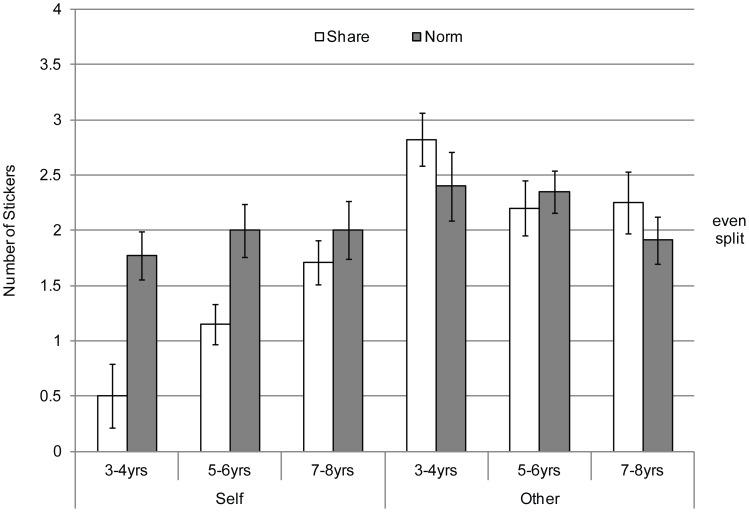
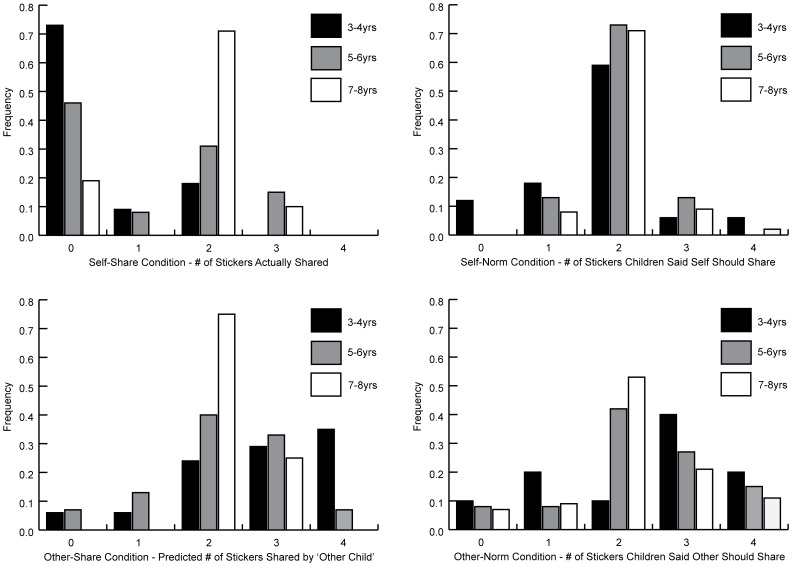
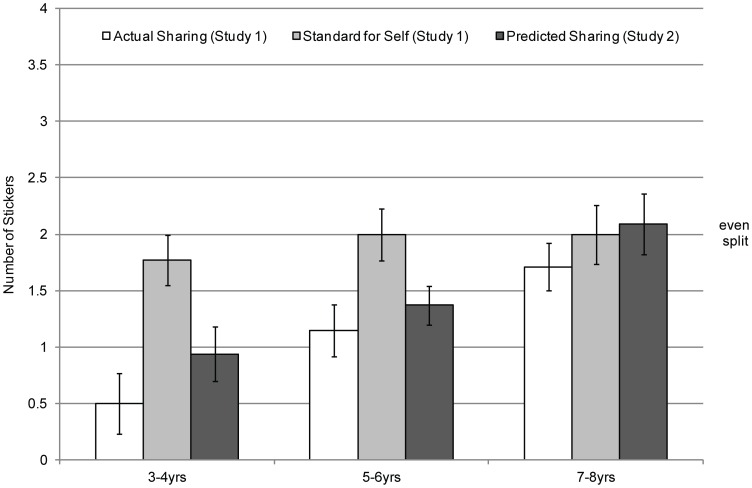
Young children endorse fairness norms related to sharing, but often act in contradiction to those norms when given a chance to share. This phenomenon has rarely been explored in the context of a single study. Using a novel approach, the research presented here offers clear evidence of this discrepancy and goes on to examine possible explanations for its diminution with age. In Study 1, 3-8-year-old children readily stated that they themselves should share equally, asserted that others should as well, and predicted that others had shared equally with them. Nevertheless, children failed to engage in equal sharing until ages 7-8. In Study 2, 7-8-year-olds correctly predicted that they would share equally, and 3-6-year-olds correctly predicted that they would favor themselves, ruling out a failure-of-willpower explanation for younger children's behavior. Similarly, a test of inhibitory control in Study 1 also failed to explain the shift with age toward adherence to the endorsed norm. The data suggest that, although 3-year-olds know the norm of equal sharing, the weight that children attach to this norm increases with age when sharing involves a cost to the self.
Overview
The claims and statistics of this paper haven’t been checked yet.
Free: it reads the open-access text and checks the first 5 claims that cite a source we can check. Create a free account to check every claim.
Integrity signals
Registry
Cites
Statistics
Figures
Verification
Claims the paper makes
The claims and statistics of this paper haven’t been checked yet.
Free: it reads the open-access text and checks the first 5 claims that cite a source we can check. Create a free account to check every claim.
Claims other papers make about this one
Each is checked against this paper’s own text: does it say what the citing paper says it does?
The source backs part of the claim, not all of it — or backs it for a different population, condition or comparison.
In the citing paper
“With increasing age, children typically share equally and sharing equally becomes affectively rewarding (Kogut, 2012; Smith, Blake, & Harris, 2013).”
From Emotion understanding and the moral self-concept as motivators of prosocial behavior in middle childhood (2020) · cites this paper as Smith et al., 2013
Experimental — accuracy not yet measuredThe cited source says what the claim attributes to it.
In the citing paper
“With increasing age, children typically share equally and sharing equally becomes affectively rewarding (Kogut, 2012; Smith, Blake, & Harris, 2013).”
From Emotion understanding and the moral self-concept as motivators of prosocial behavior in middle childhood (2020) · cites this paper as Smith et al., 2013
The cited source says what the claim attributes to it.
In the citing paper
“Our finding corresponds to work by Smith and colleagues (2013) who reported that younger children knew that sharing equally would be required, but actually shared less than half.”
From Emotion understanding and the moral self-concept as motivators of prosocial behavior in middle childhood (2020) · cites this paper as Smith et al., 2013
Self-check
Percentages, sums and reported differences re-computed from the paper’s own numbers.
The self-check needs the paper’s full text.
Citations
Cites
Baron, R. M., & Kenny, D. A. (1986) · Journal of Personality and Social Psychology · doi:10.1037/0022-3514.51.6.1173 · Cited by 91,532 · cited 1×
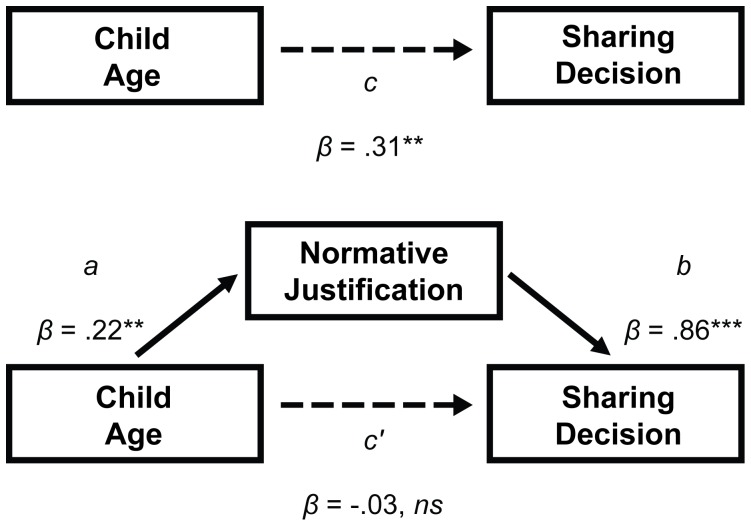
“Following Baron and Kenny [33], we tested the possibility that inhibitory control mediated the link between age and sharing.”
MethodThe emotional dog and its rational tail: A social intuitionist approach to moral judgment.
Haidt, J. (2001) · Psychological Review · doi:10.1037/0033-295x.108.4.814 · Cited by 8,048
Behavioral Game Theory: Experiments in Strategic Interaction
Camerer, C. F. (2003) · Cited by 3,722
Estimating Mediated Effects in Prevention Studies
Mackinnon, D. P., & Dwyer, J. H. (1993) · Evaluation Review · doi:10.1177/0193841x9301700202 · Cited by 1,937 · cited 1×
“Again, a series of regression models (see Figure 3) was calculated using equations designed for testing mediation models containing dichotomous mediators [34].”
MethodPreferences, property rights, and anonymity in bargaining games.
Hoffman, E., McCabe, K., Shachat, K., & Smith, V. (1994) · Games and Economic Behavior · doi:10.1006/game.1994.1056 · Cited by 1,674
Gerstadt, C. L., Hong, Y. J., & Diamond, A. (1994) · Cognition · doi:10.1016/0010-0277(94)90068-x · Cited by 1,598
Egalitarianism in young children
Fehr, E., Bernhard, H., & Rockenbach, B. (2008) · Nature · doi:10.1038/nature07155 · Cited by 1,475 · cited 4×
“Inhibitory control cannot fully explain age-related increases in fair sharing, because positive age-sharing associations are observed even when sharing is not costly for children [16,26].”
BackgroundInfluentialGod Is Watching You: Priming God Concepts Increases Prosocial Behavior in an Anonymous Economic Game
Shariff, A. F., & Norenzayan, A. (2007) · Psychological Science · doi:10.1111/j.1467-9280.2007.01983.x · Cited by 1,136
Inhibitory Control in Young Children and Its Role in Emerging Internalization
Kochanska, G., Murray, K. T., Jacques, T. Y., Koenig, A. L., & Vandegeest, K. A. (1996) · Child Development · doi:10.1111/j.1467-8624.1996.tb01747.x · Cited by 940 · cited 4×
“Next, children in the Self-Share/Other-Norm group received two measures of inhibitory control: the Day-Night Task [29] and the Bear-Dragon Task [30].”
MethodInfluentialNicholas Epley, A., & Dunning, D. A. (2000) · Journal of Personality and Social Psychology · doi:10.1037//0022-3514.79.6.861 · Cited by 820 · cited 1×
“, [43,44]).”
Damon, W. (1977) · Cited by 771
Moral cognition and moral action: A theoretical perspective
Blasi, A. (1983) · Developmental Review · doi:10.1016/0273-2297(83)90029-1 · Cited by 657 · cited 2×
“First, young children may believe that a norm of fairness applies to others, but may not believe that the same norm applies to themselves Although this idea has been proposed as a possible explanation for the gap between judgment and behavior in development [9,19], surprisingly it has never been tested for norms of fa…”
BackgroundDo Infants Have a Sense of Fairness?
Sloane, S., Baillargeon, R., & Premack, D. (2012) · Psychological Science · doi:10.1177/0956797611422072 · Cited by 635 · cited 1×
“following unequal effort [1,2].”
Children's altruistic behavior in the dictator game
Benenson, J. F., Pascoe, J., & Radmore, N. (2007) · Evolution and Human Behavior · doi:10.1016/j.evolhumbehav.2006.10.003 · Cited by 633 · cited 3×
“Adaptations of this task have been used with children between 3 and 9 years of age, using stickers as currency [14,15,24].”
BackgroundMethodInhibitory Control in Young Children and Its Role in Emerging Internalization
Kochanska, G., Murray, K., Jacques, T. Y., Koenig, A. L., & Vandegeest, K. A. (1996) · Child Development · doi:10.2307/1131828 · Cited by 615
Carlson, S. M., Moses, L. J., & Claxton, L. J. (2004) · Journal of Experimental Child Psychology · doi:10.1016/j.jecp.2004.01.002 · Cited by 614 · cited 1×
“Only the dragon trials were used in the analyses presented below [31].”
MethodFoundations of cooperation in young children
Olson, K. R., & Spelke, E. S. (2008) · Cognition · doi:10.1016/j.cognition.2007.12.003 · Cited by 584 · cited 2×
“, [12]), we predicted that children of all ages would endorse the norm of equal sharing for the other child.”
Background“I had so much it didn’t seem fair”: Eight-year-olds reject two forms of inequity
Blake, P. R., & McAuliffe, K. (2011) · Cognition · doi:10.1016/j.cognition.2011.04.006 · Cited by 504
Self-citationFairness in Children's Resource Allocation Depends on the Recipient
Moore, C. (2009) · Psychological Science · doi:10.1111/j.1467-9280.2009.02378.x · Cited by 375 · cited 1×
“Further, in standardized sharing paradigms, preschool-aged children endorse and create allocations of candy and stickers that favor themselves [14,15,16,17], even when the peer who will receive the lesser amount is sitting in front of them [18].”
BackgroundFairness in Distributive Justice by 3- and 5-Year-Olds Across Seven Cultures
Rochat, P., Dias, M. D. G., Liping, G., Broesch, T., Passos-Ferreira, C., Winning, A., & Berg, B. (2009) · Journal of Cross-Cultural Psychology · doi:10.1177/0022022109332844 · Cited by 351
Children’s understanding of moral emotions
Nunner-Winkler, G., & Sodian, B. (1988) · Child Development · doi:10.2307/1130495 · Cited by 347 · cited 2×
“, [27,28]) even when they are not being asked to offer a retrospective explanation of their own behavior.”
BackgroundMoral Development, Self, and Identity
(2004) · Psychology Press eBooks · doi:10.4324/9781410610256 · Cited by 321
In a very different voice: Unmasking moral hypocrisy.
Batson, C. D., Kobrynowicz, D., Dinnerstein, J. L., Kampf, H. C., & Wilson, A. D. (1997) · Journal of Personality and Social Psychology · doi:10.1037/0022-3514.72.6.1335 · Cited by 317 · cited 1×
“This line of explanation parallels research on moral hypocrisy in adults, showing that many adults want to be moral but succumb to temptation when the costs are high [37,38].”
ResultHughes, C., White, A., Sharpen, J., & Dunn, J. (2000) · Journal of Child Psychology and Psychiatry · doi:10.1017/s0021963099005193 · Cited by 310 · cited 1×
“, [25]), this is, to best of our knowledge, the first test of the potential association between inhibitory control and the prosocial behavior of sharing.”
BackgroundFive-Year Olds, but Not Chimpanzees, Attempt to Manage Their Reputations
Engelmann, J. M., Herrmann, E., & Tomasello, M. (2012) · PLoS ONE · doi:10.1371/journal.pone.0048433 · Cited by 290 · cited 1×
“Additionally, recent research has demonstrated that young children are more generous when their sharing behavior is visible to others [39,40], and it is plausible that this sensitivity to the eyes of others becomes more pronounced with age.”
BackgroundPreschoolers’ allocations in the dictator game: The role of moral emotions
Gummerum, M., Hanoch, Y., Keller, M., Parsons, K., & Hummel, A. (2010) · Journal of Economic Psychology · doi:10.1016/j.joep.2009.09.002 · Cited by 287 · cited 2×
“Adaptations of this task have been used with children between 3 and 9 years of age, using stickers as currency [14,15,24].”
BackgroundMethodPreschoolers are able to take merit into account when distributing goods.
Baumard, N., Mascaro, O., & Chevallier, C. (2012) · Developmental Psychology · doi:10.1037/a0026598 · Cited by 274 · cited 2×
“By 3 years of age, children apply principles of equality and merit in appropriate situations [3,4].”
BackgroundThe Development of Fairness Expectations and Prosocial Behavior in the Second Year of Life
Sommerville, J. A., Schmidt, M. F. H., Yun, J., & Burns, M. (2013) · Infancy · doi:10.1111/j.1532-7078.2012.00129.x · Cited by 273
Currency value moderates equity preference among young children
Blake, P. R., & Rand, D. G. (2010) · Evolution and Human Behavior · doi:10.1016/j.evolhumbehav.2009.06.012 · Cited by 269 · cited 3×
“Adaptations of this task have been used with children between 3 and 9 years of age, using stickers as currency [14,15,24].”
BackgroundMethodSelf-citationPreferences, Property Rights, and Anonymity in Bargaining Games
Hoffman, E., McCabe, K. A., Shachat, K., & Smith, V. L. (2000) · Bargaining and Market Behavior · doi:10.1017/cbo9780511528347.008 · Cited by 265 · cited 1×
“The DG has been particularly useful for studying the cognitive mechanisms that influence giving behavior in adults [22,23].”
BackgroundEquity theory and the cognitive ability of children.
Hook, J. G., & Cook, T. D. (1979) · Psychological Bulletin · doi:10.1037//0033-2909.86.3.429 · Cited by 242 · cited 1×
“Inhibitory control cannot fully explain age-related increases in fair sharing, because positive age-sharing associations are observed even when sharing is not costly for children [16,26].”
BackgroundYoung Children Are More Generous When Others Are Aware of Their Actions
Leimgruber, K. L., Shaw, A., Santos, L. R., & Olson, K. R. (2012) · PLoS ONE · doi:10.1371/journal.pone.0048292 · Cited by 237 · cited 1×
“Additionally, recent research has demonstrated that young children are more generous when their sharing behavior is visible to others [39,40], and it is plausible that this sensitivity to the eyes of others becomes more pronounced with age.”
BackgroundMoral Hypocrisy: Social Groups and the Flexibility of Virtue
Valdesolo, P., & DeSteno, D. (2007) · Psychological Science · doi:10.1111/j.1467-9280.2007.01961.x · Cited by 236
Why Don't Moral People Act Morally? Motivational Considerations
Batson, C. D., & Thompson, E. R. (2001) · Current Directions in Psychological Science · doi:10.1111/1467-8721.00114 · Cited by 220 · cited 1×
“This line of explanation parallels research on moral hypocrisy in adults, showing that many adults want to be moral but succumb to temptation when the costs are high [37,38].”
ResultThe Relationship of Preschoolers' Reasoning about Prosocial Moral Conflicts to Prosocial Behavior
Eisenberg-Berg, N., & Hand, M. (1979) · Child Development · doi:10.1111/j.1467-8624.1979.tb04116.x · Cited by 207 · cited 2×
“However, despite this early understanding of fairness, young children have a self-interested bias when they themselves stand to benefit in resource allocation situations [5,6,7].”
BackgroundYoung Children Consider Merit when Sharing Resources with Others
Kanngiesser, P., & Warneken, F. (2012) · PLoS ONE · doi:10.1371/journal.pone.0043979 · Cited by 201 · cited 1×
“By 3 years of age, children apply principles of equality and merit in appropriate situations [3,4].”
BackgroundPreschool Children's Food Sharing with Friends and Acquaintances
Birch, L. L., & Billman, J. (1986) · Child Development · doi:10.1111/j.1467-8624.1986.tb00038.x · Cited by 170 · cited 3×
“However, despite this early understanding of fairness, young children have a self-interested bias when they themselves stand to benefit in resource allocation situations [5,6,7].”
BackgroundThe multifaceted phenomenon of “happy victimizers”: A cross-cultural comparison of moral emotions
Keller, M., Lourenço, O., Malti, T., & Saalbach, H. (2003) · British Journal of Developmental Psychology · doi:10.1348/026151003321164582 · Cited by 164 · cited 1×
“Third, consistent with research showing that young children often focus on desires when norms and desires are at odds [20], young children may feel obliged to follow a fairness norm, but fail to inhibit powerful desires that conflict with such fair sharing when it involves a cost to the self.”
ResultArsenio, W. F., & Kramer, R. (1992) · Child Development · doi:10.1111/j.1467-8624.1992.tb01671.x · Cited by 134 · cited 1×
“, [27,28]) even when they are not being asked to offer a retrospective explanation of their own behavior.”
BackgroundSimple Heuristics in a Social World
(2012) · Oxford University Press eBooks · doi:10.1093/acprof:oso/9780195388435.001.0001 · Cited by 113
McGuire, S. A., Manke, B., Eftekhari, A., & Dunn, J. (2000) · Social Development · doi:10.1111/1467-9507.00118 · Cited by 107 · cited 2×
“However, despite this early understanding of fairness, young children have a self-interested bias when they themselves stand to benefit in resource allocation situations [5,6,7].”
BackgroundGus in the Gap: Bridging the Judgment-Action Gap in Moral Functioning.
Walker, L. J. (2004) · Cited by 94
Arsenio, W. F., & Kramer, R. (1992) · Child Development · doi:10.2307/1131243 · Cited by 87
The development of hypothetical reference in the speech of young children
Kuczaj, S. A., & Daly, M. J. (1979) · Journal of Child Language · doi:10.1017/s0305000900002543 · Cited by 80 · cited 1×
“, [35,36]).”
Moral understanding and children's conduct
Gerson, R., & Damon, W. (1978) · New Directions for Child and Adolescent Development · doi:10.1002/cd.23219780205 · Cited by 61 · cited 1×
“Early work on distributive justice found a judgment-behavior gap when comparing children’s responses to hypothetical resource allocation scenarios and actual allocation tasks [9,10,11].”
BackgroundPreschoolers’ talk about future situations
Atance, C. M., & O’Neill, D. K. (2005) · First Language · doi:10.1177/0142723705045678 · Cited by 46 · cited 1×
“, [35,36]).”
Factors Affecting Reward Allocation by Preschool Children
Peterson, C. C., Peterson, J. L., & McDonald, N. (1975) · Child Development · doi:10.1111/j.1467-8624.1975.tb04041.x · Cited by 35
The Is and Ought of Sharing: The Equality Heuristic Across the Lifespan
Keller, M., Gummerum, M., Canz, T., Gigerenzer, G., & Takezawa, M. (2012) · Oxford University Press eBooks · doi:10.1093/acprof:oso/9780195388435.003.0006 · Cited by 20
Factors Affecting Reward Allocation by Preschool Children
Peterson, C., Peterson, J., & McDonald, N. (1975) · Child Development · doi:10.2307/1128401
Research works printed but not linked: 1
- Burford HC, Foley LA, Rollins PG, Rosario KS (1996) Gender differences in preschoolers' sharing behavior. J Soc Behav Pers 11: 17– 25.
Cited by
Two new Later Stone Age sites from the Final Pleistocene in the Falémé Valley, eastern Senegal
Ndiaye, M., Lespez, L., Tribolo, C., Rassé, M., Hadjas, I., Davidoux, S., Huysecom, É., & Douze, K. (2024) · Monash University Research Portal (Monash University) · doi:10.3929/ethz-b-000667478 · Cited by 23,868
Why people prefer unequal societies
Starmans, C., Sheskin, M., & Bloom, P. (2017) · Nature Human Behaviour · doi:10.1038/s41562-017-0082 · Cited by 508
The ontogeny of fairness in seven societies
Blake, P. R., McAuliffe, K., Corbit, J., Callaghan, T. C., Barry, O., Bowie, A., Kleutsch, L., Kramer, K. L., Ross, E., Vongsachang, H., et al. (2015) · Nature · doi:10.1038/nature15703 · Cited by 534
Self-citationOntogeny of prosocial behavior across diverse societies
House, B. R., Silk, J. B., Henrich, J., Barrett, H. C., Scelza, B. A., Boyette, A. H., Hewlett, B. S., McElreath, R., & Laurence, S. (2013) · Proceedings of the National Academy of Sciences · doi:10.1073/pnas.1221217110 · Cited by 457
A construct divided: prosocial behavior as helping, sharing, and comforting subtypes
Dunfield, K. A. (2014) · Frontiers in Psychology · doi:10.3389/fpsyg.2014.00958 · Cited by 396
“Indeed, multiple studies, conducted across a variety of labs, confirm this tendency (Geraci and Surian, 2011; Schmidt and Sommerville, 2011; Sommerville et al., 2013).”
Metadata
- Authors
- Smith, C. E., Blake, P. R., & Harris, P. L.
- Affiliations
- University of Michigan (US)
- Boston University (US)
- Harvard University (US)
- Corresponding author
- Smith, Craig E.
- Venue
- PLoS ONE
- Publisher
- Public Library of Science (PLoS)
- Published
- 2013-03-20
- Volume
- 8
- Issue
- 3
- Pages
- e59510
- ISSN
- 1932-6203 (ISSN-L)
- PMC
- PMC3603928
- OpenAlex
- W1965699991
- Semantic Scholar
- 6d59a9f7bcfc05d46d6df3cc23213408ce0137cc
- Cited by
- 482
- References
- 49
- Citations by year
- 2026: 30 · 2025: 31 · 2024: 73 · 2023: 41 · 2022: 42 · 2021: 40 · 2020: 40 · 2019: 30 · 2018: 40 · 2017: 36 · 2016: 28 · 2015: 26 · 2014: 21 · 2013: 4
- FWCI
- 54.44
- Type
- journal article
- Language
- en
- Update notices
- correction (2013-08-21)
- Open access
- gold
- doi.org
- Locations
- PLoS ONE (publishedVersion, cc-by)
- Europe PMC (PubMed Central) (publishedVersion, cc-by)
- PubMed Central (publishedVersion, cc-by)
- PubMed (publishedVersion)
- RePEc: Research Papers in Economics (submittedVersion)
- DOAJ (DOAJ: Directory of Open Access Journals) (submittedVersion)
- Funders
- John Templeton Foundation
- Topics
- Social Sciences › Psychology › Developmental and Educational Psychology › Child and Animal Learning Development
- Life Sciences › Neuroscience › Cognitive Neuroscience › Psychology of Moral and Emotional Judgment
- Social Sciences › Economics, Econometrics and Finance › Economics and Econometrics › Experimental Behavioral Economics Studies
- Keywords
- fair sharing, fairness norms, rule compliance, young children, age differences, self-other bias, self-serving bias, inhibitory control, willpower, moral development, prosocial behavior
- MeSH terms
- Age Factors, Analysis of Variance, Child, Child Development, Child, Preschool, Cooperative Behavior, Games, Experimental, Humans, Interpersonal Relations, Massachusetts, Surveys and Questionnaires, Social Behavior, Moral Development
About these checks
Registry, retraction, Cites and statistics results are computed, not judged, with one exception: a printed reference that no index lists is read once by a model before it counts as a citation error. Claims are extracted by a model and kept only when their quote appears verbatim in the text; each cited source is then checked, with a model’s help, for whether it says what the claim relies on. Those verdicts can be wrong — read the claim’s quote and the cited source before relying on one.
Statistics and arithmetic are recomputed, not judged.
Confidence bands are shown only for fields calibrated on our annotated test set. None is calibrated yet, so no band is shown.
What counts as a claim ›How we measure confidence ›How we check this ›
Are you an author, or do you see a problem with this page? Request a review
Data sources
Bibliographic data: Semantic Scholar, OpenAlex, Crossref.
Contains information from the Semantic Scholar Academic Graph Datasets, made available under the ODC Attribution License (ODC-BY 1.0).
Semantic Scholar’s data is described in: Kinney, R., et al. (2023). The Semantic Scholar Open Data Platform. arXiv:2301.10140.
