

The DOI matches its Crossref record; 44 of the 44 references it cites were found in a registry or an index.
Low- and High-Volume of Intensive Endurance Training Significantly Improves Maximal Oxygen Uptake after 10-Weeks of Training in Healthy Men
Open accessAbstract
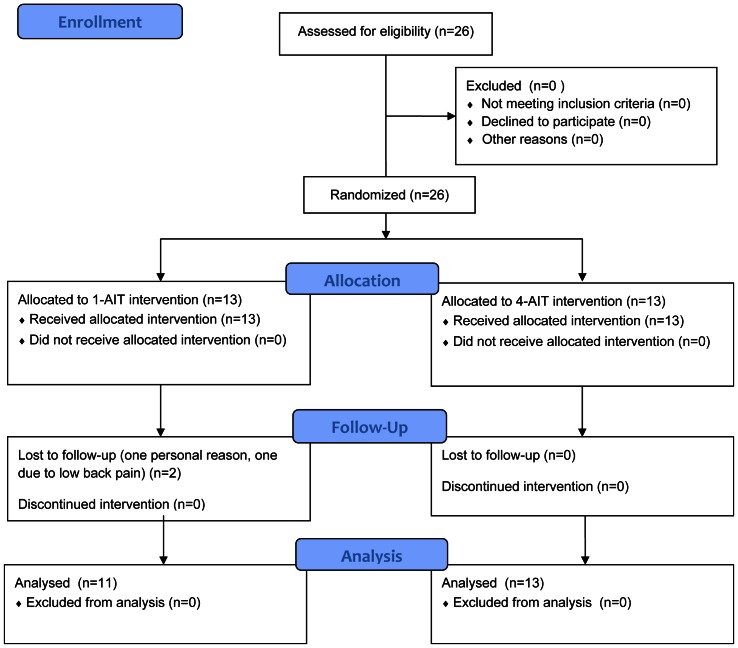
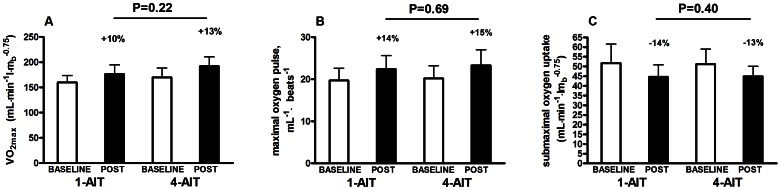
UNLABELLED: Regular exercise training improves maximal oxygen uptake (VO2max), but the optimal intensity and volume necessary to obtain maximal benefit remains to be defined. A growing body of evidence suggests that exercise training with low-volume but high-intensity may be a time-efficient means to achieve health benefits. In the present study, we measured changes in VO2max and traditional cardiovascular risk factors after a 10 wk. training protocol that involved three weekly high-intensity interval sessions. One group followed a protocol which consisted of 4×4 min at 90% of maximal heart rate (HRmax) interspersed with 3 min active recovery at 70% HRmax (4-AIT), the other group performed a single bout protocol that consisted of 1×4 min at 90% HRmax (1-AIT). Twenty-six inactive but otherwise healthy overweight men (BMI: 25-30, age: 35-45 y) were randomized to either 1-AIT (n = 11) or 4-AIT (n = 13). After training, VO2max increased by 10% (∼5.0 mL⋅kg(-1)⋅min(-1)) and 13% (∼6.5 mL⋅kg(-1)⋅min(-1)) after 1-AIT and 4-AIT, respectively (group difference, p = 0.08). Oxygen cost during running at a sub-maximal workload was reduced by 14% and 13% after 1-AIT and 4-AIT, respectively. Systolic blood pressure decreased by 7.1 and 2.6 mmHg after 1-AIT and 4-AIT respectively, while diastolic pressure decreased by 7.7 and 6.1 mmHg (group difference, p = 0.84). Both groups had a similar ∼5% decrease in fasting glucose. Body fat, total cholesterol, LDL-cholesterol, and ox-LDL cholesterol only were significantly reduced after 4-AIT. Our data suggest that a single bout of AIT performed three times per week may be a time-efficient strategy to improve VO2max and reduce blood pressure and fasting glucose in previously inactive but otherwise healthy middle-aged individuals. The 1-AIT type of exercise training may be readily implemented as part of activities of daily living and could easily be translated into programs designed to improve public health. TRIAL REGISTRATION: ClinicalTrials.govNCT00839579.
Overview
The claims and statistics of this paper haven’t been checked yet.
Run the check — free, no account needed. It reads the open-access text and checks the sources it cites.
Integrity signals
Registry
Cites
Statistics
Figures
Verification
Claims the paper makes
The claims and statistics of this paper haven’t been checked yet.
Run the check — free, no account needed. It reads the open-access text and checks the sources it cites.
Claims other papers make about this one
Each is checked against this paper’s own text: does it say what the citing paper says it does?
In the citing paper
“The present work, and recent studies by others [10]–[12], [27], confirm that very brief bouts of all-out exercise, performed a few times per week, is a very time efficient strategy to improve VO2 peak”
From Three minutes of all-out intermittent exercise per week increases skeletal muscle oxidative capacity and improves cardiometabolic health (2014) · cites this paper as [27]
Self-check
Percentages, sums and reported differences re-computed from the paper’s own numbers.
The self-check needs the paper’s full text.
Citations
Cites
Diagnosis and Classification of Diabetes Mellitus
American Diabetes Association (2010) · Diabetes Care · doi:10.2337/dc11-s062 · Cited by 14,094
(2014) · Medical Entomology and Zoology · Cited by 9,400
Corretti, M. C., Anderson, T. J., Benjamin, E. J., Celermajer, D. S., Charbonneau, F., Creager, M. A., Deanfield, J. E., Drexler, H., Gerhard‐Herman, M. D., Herrington, D. M., et al. (2002) · Journal of the American College of Cardiology · doi:10.1016/s0735-1097(01)01746-6 · Cited by 4,606
Exercise capacity and mortality among men referred for exercise testing
Myers, J., Prakash, M., Froelicher, V., Do, D., Partington, S., & Atwood, J. E. (2002) · New England Journal of Medicine · doi:10.1056/nejmoa011858 · Cited by 4,114
Correlates of adults??? participation in physical activity: review and update
TROST, S. G., OWEN, N., BAUMAN, A. E., SALLIS, J. F., & BROWN, W. (2002) · Medicine & Science in Sports & Exercise · doi:10.1097/00005768-200212000-00020 · Cited by 3,040
Endothelial Function and Dysfunction: Testing and Clinical Relevance
Deanfield, J. E., Halcox, J. P., & Rabelink, T. J. (2007) · Circulation · doi:10.1161/circulationaha.106.652859 · Cited by 2,710
Wisløff, U., Støylen, A., Loennechen, J. P., Bruvold, M., Rognmo, Ø., Haram, P. M., Tjønna, A. E., Helgerud, J., Slørdahl, S. A., Lee, S. J., et al. (2007) · Circulation · doi:10.1161/circulationaha.106.675041 · Cited by 1,996
Self-citationFletcher, G. F., Balady, G. J., Amsterdam, E. A., Chaitman, B., Eckel, R., Fleg, J., Froelicher, V. F., Leon, A. S., Piña, I. L., Rodney, R., et al. (2001) · Circulation · doi:10.1161/hc3901.095960 · Cited by 1,923
Wen, C. P., Wai, J. P. M., Tsai, M. K., Yang, Y. C., Cheng, T. Y. D., Lee, M.-C., Chan, H. T., Tsao, C. K., Tsai, S. P., & Wu, X. (2011) · The Lancet · doi:10.1016/s0140-6736(11)60749-6 · Cited by 1,908
Cited by
Sorted by citations
Physiological adaptations to interval training and the role of exercise intensity
MacInnis, M. J., & Gibala, M. J. (2017) · The Journal of Physiology · doi:10.1113/jp273196 · Cited by 1,124
Batacan, R. B., Duncan, M. J., Dalbo, V. J., Tucker, P. S., & Fenning, A. S. (2017) · British Journal of Sports Medicine · doi:10.1136/bjsports-2015-095841 · Cited by 799
Jelleyman, C., Yates, T., O'Donovan, G., Gray, L. J., King, J. A., Khunti, K., & Davies, M. J. (2015) · Obesity Reviews · doi:10.1111/obr.12317 · Cited by 588
Physical Activity and the Prevention of Hypertension
Diaz, K. M., & Shimbo, D. (2013) · Current Hypertension Reports · doi:10.1007/s11906-013-0386-8 · Cited by 528
Maillard, F., Pereira, B., & Boisseau, N. (2017) · Sports Medicine · doi:10.1007/s40279-017-0807-y · Cited by 379
Metadata
- Authors
- Tjønna, A. E., Leinan, I. M., Bartnes, A. T., Jenssen, B. M., Gibala, M. J., Winett, R. A., & Wisløff, U.
- Affiliations
- Norwegian University of Science and Technology (NO)
- McMaster University (CA)
- Virginia Tech (US)
- Corresponding author
- Tjønna, Arnt Erik
- Venue
- PLoS ONE
- Publisher
- Public Library of Science (PLoS)
- Published
- 2013-05-29
- Volume
- 8
- Issue
- 5
- Pages
- e65382
- ISSN
- 1932-6203 (ISSN-L)
- PMC
- PMC3667025
- OpenAlex
- W2045717221
- Cited by
- 167
- References
- 44
- Citations by year
- 2026: 3 · 2025: 5 · 2024: 10 · 2023: 12 · 2022: 17 · 2021: 18 · 2020: 9 · 2019: 12 · 2018: 14 · 2017: 12 · 2016: 19 · 2015: 16 · 2014: 16 · 2013: 4
- FWCI
- 43.48
- Type
- journal article
- Language
- en
- Open access
- gold
- doi.org
- Locations
- PLoS ONE (publishedVersion, cc-by)
- Europe PMC (PubMed Central) (publishedVersion, cc-by)
- PubMed Central (publishedVersion, cc-by)
- PubMed (publishedVersion)
- BIBSYS Brage (BIBSYS (Norway)) (acceptedVersion)
- DOAJ (DOAJ: Directory of Open Access Journals) (submittedVersion)
- Figshare (submittedVersion, cc-by)
- NORA - Norwegian Open Research Archives (submittedVersion, cc-by)
- VTechWorks (Virginia Tech) (submittedVersion, cc-by)
- Funders
- Norges Forskningsråd
- St. Olavs Hospital Universitetssykehuset i Trondheim
- Topics
- Health Sciences › Medicine › Physiology (medical) › Cardiovascular and exercise physiology
- Health Sciences › Medicine › Orthopedics and Sports Medicine › Sports Performance and Training
- Health Sciences › Medicine › Public Health, Environmental and Occupational Health › Physical Activity and Health
- Keywords
- high-intensity interval training, VO2max, training volume, cardiovascular risk factors, blood pressure, fasting blood glucose, oxidized LDL, fat mass, overweight men, time-efficient exercise
- MeSH terms
- Adipose Tissue, Adult, Blood Glucose, Blood Pressure, Cholesterol, Exercise Therapy, Fasting, Humans, Cholesterol, LDL, Male, Middle Aged, Oxygen Consumption, Running, Time Factors, Exercise, Treatment Outcome, Overweight
About these checks
Registry, retraction, Cites and statistics results are computed, not judged, with one exception: a printed reference that no index lists is read once by a model before it counts as a citation error. Claims are extracted by a model and kept only when their quote appears verbatim in the text; each cited source is then checked, with a model’s help, for whether it says what the claim relies on. Those verdicts can be wrong — read the claim’s quote and the cited source before relying on one.
Statistics and arithmetic are recomputed, not judged.
Confidence bands are shown only for fields calibrated on our annotated test set. None is calibrated yet, so no band is shown.
What counts as a claim ›How we measure confidence ›How we check this ›
Are you an author, or do you see a problem with this page? Request a review
