

The DOI matches its Crossref record; 21 of the 23 references it cites were found in a registry or an index.
Chronic Intermittent Fasting Improves Cognitive Functions and Brain Structures in Mice
Open accessAbstract
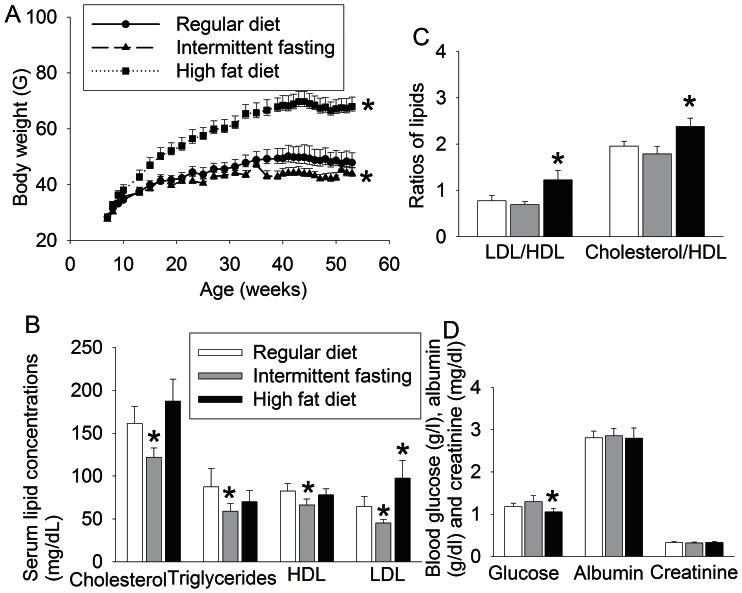
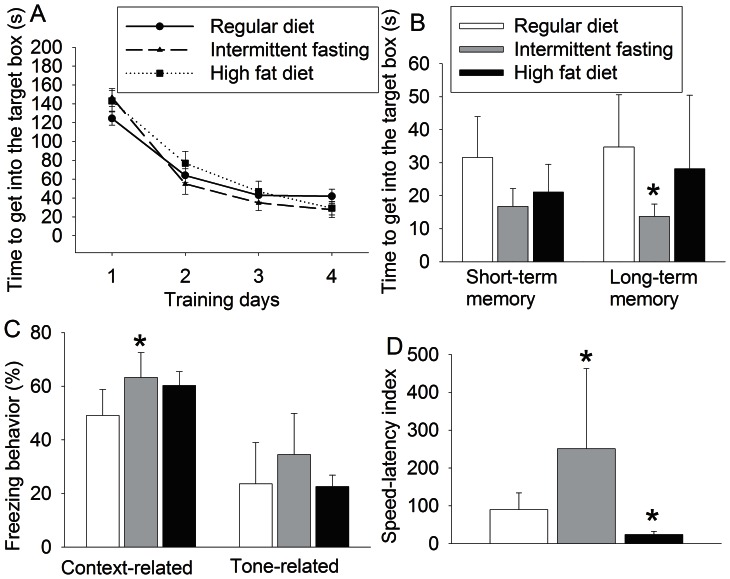
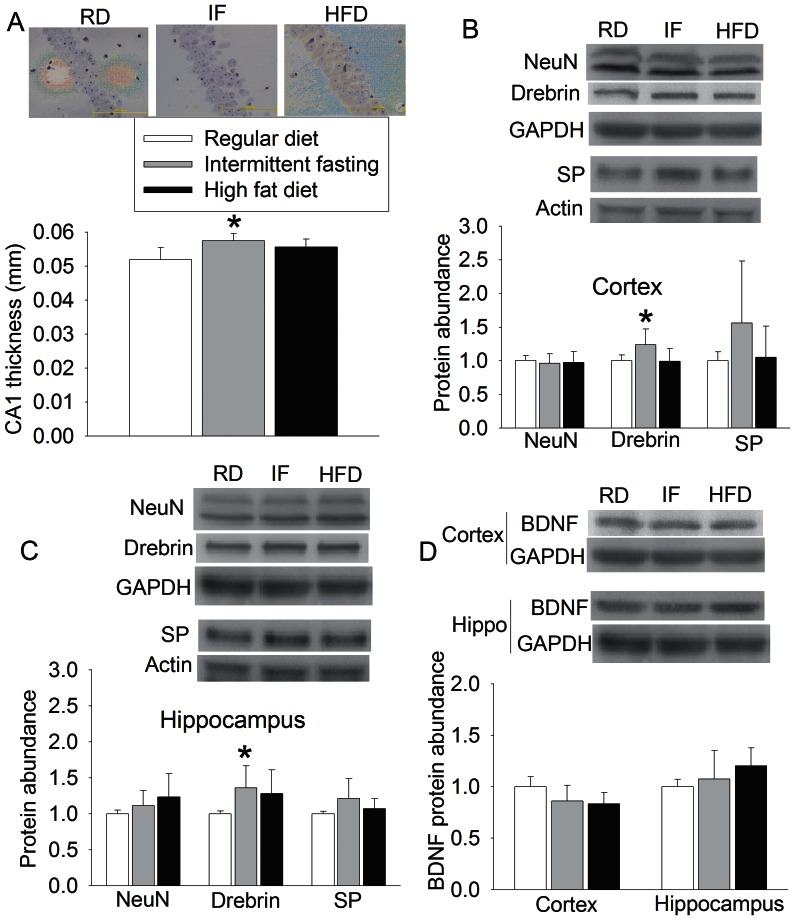
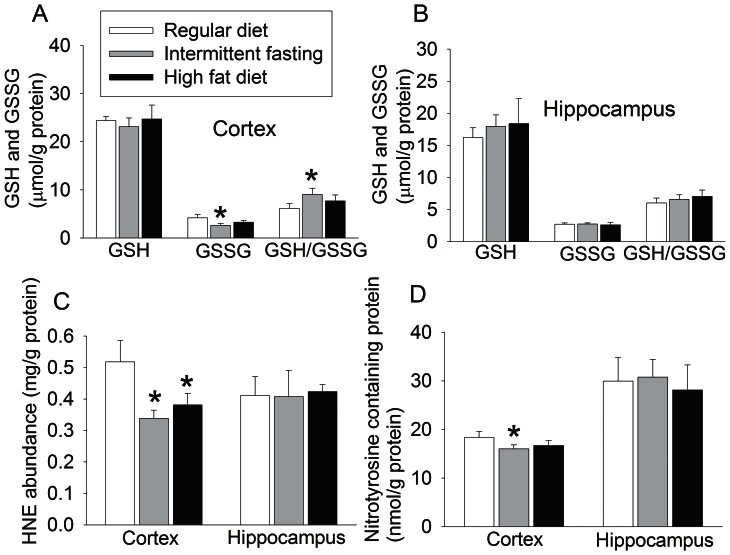
Obesity is a major health issue. Obesity started from teenagers has become a major health concern in recent years. Intermittent fasting increases the life span. However, it is not known whether obesity and intermittent fasting affect brain functions and structures before brain aging. Here, we subjected 7-week old CD-1 wild type male mice to intermittent (alternate-day) fasting or high fat diet (45% caloric supplied by fat) for 11 months. Mice on intermittent fasting had better learning and memory assessed by the Barnes maze and fear conditioning, thicker CA1 pyramidal cell layer, higher expression of drebrin, a dendritic protein, and lower oxidative stress than mice that had free access to regular diet (control mice). Mice fed with high fat diet was obese and with hyperlipidemia. They also had poorer exercise tolerance. However, these obese mice did not present significant learning and memory impairment or changes in brain structures or oxidative stress compared with control mice. These results suggest that intermittent fasting improves brain functions and structures and that high fat diet feeding started early in life does not cause significant changes in brain functions and structures in obese middle-aged animals.
Overview
The claims and statistics of this paper haven’t been checked yet.
Run the check — free, no account needed. It reads the open-access text and checks the sources it cites.
Integrity signals
Registry
Cites
Statistics
Figures
Verification
Claims the paper makes
The claims and statistics of this paper haven’t been checked yet.
Run the check — free, no account needed. It reads the open-access text and checks the sources it cites.
Claims other papers make about this one
Each is checked against this paper’s own text: does it say what the citing paper says it does?
The source backs part of the claim, not all of it — or backs it for a different population, condition or comparison.
In the citing paper
“Intermittent fasting (IF) is a diet with salutary effects on cognitive aging, Alzheimer’s disease (AD), and stroke.”
From 2-Deoxyglucose drives plasticity via an adaptive ER stress-ATF4 pathway and elicits stroke recovery and Alzheimer’s resilience (2023) · cites this paper as [6]
Experimental — accuracy not yet measured
Self-check
Percentages, sums and reported differences re-computed from the paper’s own numbers.
The self-check needs the paper’s full text.
Citations
Cites
Prevalence and Trends in Obesity Among US Adults, 1999-2008
Flegal, K. M. (2010) · JAMA · doi:10.1001/jama.2009.2014 · Cited by 7,580 · cited 1×
“About one third of American adults and 20% teenagers now are obese [1,2].”
BackgroundPrevalence of High Body Mass Index in US Children and Adolescents, 2007-2008
Ogden, C. L. (2010) · JAMA · doi:10.1001/jama.2009.2012 · Cited by 3,200 · cited 2×
“About one third of American adults and 20% teenagers now are obese [1,2].”
BackgroundThe NLRP3 inflammasome instigates obesity-induced inflammation and insulin resistance
Vandanmagsar, B., Youm, Y.-H., Ravussin, A., Galgani, J. E., Stadler, K., Mynatt, R. L., Ravussin, E., Stephens, J. M., & Dixit, V. D. (2011) · Nature Medicine · doi:10.1038/nm.2279 · Cited by 2,655
The immunology of stroke: from mechanisms to translation
Iadecola, C., & Anrather, J. (2011) · Nature Medicine · doi:10.1038/nm.2399 · Cited by 2,596 · cited 1×
“In addition to oxidative stress, various other insults/factors, such as immune and inflammatory responses, can harm brain functions and structures [16,17].”
BackgroundCaloric Restriction Delays Disease Onset and Mortality in Rhesus Monkeys
Colman, R. J., Anderson, R. M., Johnson, S. C., Kastman, E. K., Kosmatka, K. J., Beasley, T. M., Allison, D. B., Cruzen, C., Simmons, H. A., Kemnitz, J. W., et al. (2009) · Science · doi:10.1126/science.1173635 · Cited by 2,277 · cited 2×
“A recent study showed that caloric restriction attenuates aging-related brain atrophy in monkeys [6].”
BackgroundThe importance of glutathione in human disease
Townsend, D. M., Tew, K. D., & Tapiero, H. (2003) · Biomedicine & Pharmacotherapy · doi:10.1016/s0753-3322(03)00043-x · Cited by 2,009 · cited 1×
“Since oxidative stress is a known factor contributing to brain aging [15] and can induce cell injury and impairment of learning and memory [12,13], our results indicate that reduced oxidative stress may be a mechanism for the improved brain functions and structures in the intermittent fasting mice.”
BackgroundAllan Butterfield, D. (2002) · Free Radical Research · doi:10.1080/1071576021000049890 · Cited by 786 · cited 2×
“Since oxidative stress is a known factor contributing to brain aging [15] and can induce cell injury and impairment of learning and memory [12,13], our results indicate that reduced oxidative stress may be a mechanism for the improved brain functions and structures in the intermittent fasting mice.”
BackgroundWeindruch, R. H., & Sohal, R. S. (1997) · New England Journal of Medicine · doi:10.1056/nejm199710023371407 · Cited by 743
Anson, R. M., Guo, Z., de Cabo, R., Iyun, T., Rios, M., Hagepanos, A., Ingram, D. K., Lane, M. A., & Mattson, M. P. (2003) · Proceedings of the National Academy of Sciences · doi:10.1073/pnas.1035720100 · Cited by 732 · cited 2×
“This method is called caloric restriction and will usually result in significant decrease of body weight [10].”
BackgroundMethodCaloric restriction improves memory in elderly humans
Witte, A. V., Fobker, M., Gellner, R., Knecht, S., & Flöel, A. (2009) · Proceedings of the National Academy of Sciences · doi:10.1073/pnas.0808587106 · Cited by 574
Duan, W., Guo, Z., Jiang, H., Ware, M., Li, X.-J., & Mattson, M. P. (2003) · Proceedings of the National Academy of Sciences · doi:10.1073/pnas.0536856100 · Cited by 428 · cited 2×
“in the brain of Huntingtin mutant mice after caloric restriction [14].”
BackgroundLiu, R., Liu, I. Y., Bi, X., Thompson, R. F., Doctrow, S. R., Malfroy, B., & Baudry, M. (2003) · Proceedings of the National Academy of Sciences · doi:10.1073/pnas.1332809100 · Cited by 365 · cited 2×
“Since oxidative stress is a known factor contributing to brain aging [15] and can induce cell injury and impairment of learning and memory [12,13], our results indicate that reduced oxidative stress may be a mechanism for the improved brain functions and structures in the intermittent fasting mice.”
BackgroundDietary Restriction Benefits Learning and Motor Performance of Aged Mice
Ingram, D. K., Weindruch, R., Spangler, E. L., Freeman, J. R., & Walford, R. L. (1987) · Journal of Gerontology · doi:10.1093/geronj/42.1.78 · Cited by 342 · cited 1×
“It also decreases aging-related learning and memory impairments in animals and human [7,8].”
BackgroundMetformin attenuates Alzheimer’s disease-like neuropathology in obese, leptin-resistant mice
Li, J., Deng, J., Sheng, W., & Zuo, Z. (2012) · Pharmacology Biochemistry and Behavior · doi:10.1016/j.pbb.2012.03.002 · Cited by 260 · cited 1×
“After being on the corresponding feeding protocols for 11 months, mice were then subjected to Barnes maze as we described before [20].”
MethodSelf-citationAction of food restriction in delaying the aging process
Masoro, E. J., Yu, B. P., & Bertrand, H. A. (1982) · Proceedings of the National Academy of Sciences · doi:10.1073/pnas.79.13.4239 · Cited by 247 · cited 1×
“Dietary restriction increases average and maximum life span [5,6].”
BackgroundHypercholesterolaemia and its management
Bhatnagar, D., Soran, H., & Durrington, P. N. (2008) · BMJ · doi:10.1136/bmj.a993 · Cited by 187 · cited 1×
“It is known that obesity and its associated metabolic disturbance including hyperlipidemia have been identified as risk factors for cardiovascular diseases, diabetes and many other diseases [4].”
BackgroundGoodrick, C. L., Ingram, D. K., Reynolds, M. A., Freeman, J. R., & Cider, N. L. (1983) · Experimental Aging Research · doi:10.1080/03610738308258453 · Cited by 97 · cited 1×
“Intermittent fasting is known to decrease food intake and body weight over time [11].”
BackgroundStudzinski, C. M., Li, F., Bruce‐Keller, A. J., Fernandez‐Kim, S. O., Zhang, L., Weidner, A. M., Markesbery, W. R., Murphy, M. P., & Keller, J. N. (2008) · Journal of Neurochemistry · doi:10.1111/j.1471-4159.2008.05798.x · Cited by 94 · cited 1×
“We choose to use 45% fat diet because this composition represents a typical Western diet [19].”
MethodLidocaine attenuates cognitive impairment after isoflurane anesthesia in old rats
Lin, D., Cao, L., Wang, Z., Li, J., Washington, J. M., & Zuo, Z. (2011) · Behavioural Brain Research · doi:10.1016/j.bbr.2011.12.010 · Cited by 87 · cited 1×
“In addition to oxidative stress, various other insults/factors, such as immune and inflammatory responses, can harm brain functions and structures [16,17].”
BackgroundSelf-citationGlutamate Transporter Type 3 Knockout Reduces Brain Tolerance to Focal Brain Ischemia in MICE
Li, L., & Zuo, Z. (2010) · Journal of Cerebral Blood Flow & Metabolism · doi:10.1038/jcbfm.2010.222 · Cited by 47 · cited 1×
“Motor coordination and exercise tolerance were evaluated two days after fear conditioning as we did before [21].”
MethodSelf-citationMladenović, A., Perović, M., Tešić, V., Tanić, N., Rakić, L., Ruždijić, S., & Kanazir, S. (2009) · Neurochemistry International · doi:10.1016/j.neuint.2009.10.008 · Cited by 43 · cited 1×
“In addition, dietary restriction can stabilize the expression of synaptic protein expression to avoid aging-related changes [9].”
Background
Cited by
Sorted by citations
Impact of intermittent fasting on health and disease processes
Mattson, M. P., Longo, V. D., & Harvie, M. (2017) · Ageing Research Reviews · doi:10.1016/j.arr.2016.10.005 · Cited by 1,187
“The latter metabolic adaptations of neurons may contribute to the improvement in cognitive function of rodents maintained on ADF compared to those fed ad libitum (Li et al., 2013).”
Flipping the Metabolic Switch: Understanding and Applying the Health Benefits of Fasting
Anton, S. D., Moehl, K., Donahoo, W. T., Marosi, K., Lee, S. A., Mainous, A. G., Leeuwenburgh, C., & Mattson, M. P. (2017) · Obesity · doi:10.1002/oby.22065 · Cited by 818
“Similarly, mice maintained on ADF for 11 months exhibited superior cognitive ability in the Barnes maze test of spatial memory (107).”
BackgroundCatenacci, V. A., Pan, Z., Ostendorf, D., Brannon, S., Gozansky, W. S., Mattson, M. P., Martin, B., MacLean, P. S., Melanson, E. L., & Troy Donahoo, W. (2016) · Obesity · doi:10.1002/oby.21581 · Cited by 332
“Fasting has been suggested to improve cognitive function, possibly mediated by brain-derived neurotrophic factor (BDNF) (19); BDNF has also been implicated in the regulation of energy balance (20-22).”
BackgroundInfluentialMarzia Perluigi, A., Domenico, F. D., & Butterfield, D. A. (2023) · Physiological Reviews · doi:10.1152/physrev.00030.2022 · Cited by 316
Aging and Rejuvenation of Neural Stem Cells and Their Niches
Navarro Negredo, P., Yeo, R. W., & Brunet, A. (2020) · Cell Stem Cell · doi:10.1016/j.stem.2020.07.002 · Cited by 246
Metadata
- Authors
- Li, L., Wang, Z., & Zuo, Z.
- Affiliations
- University of Virginia (US)
- Sun Yat-sen University (CN)
- Corresponding author
- Zuo, Zhiyi
- Venue
- PLoS ONE
- Publisher
- Public Library of Science (PLoS)
- Published
- 2013-06-03
- Volume
- 8
- Issue
- 6
- Pages
- e66069
- ISSN
- 1932-6203 (ISSN-L)
- PMC
- PMC3670843
- OpenAlex
- W1974661288
- Cited by
- 147
- References
- 23
- Citations by year
- 2026: 7 · 2025: 15 · 2024: 13 · 2023: 13 · 2022: 19 · 2021: 14 · 2020: 19 · 2019: 9 · 2018: 6 · 2017: 9 · 2016: 9 · 2015: 8 · 2014: 6
- FWCI
- 5.34
- Type
- journal article
- Language
- en
- Open access
- gold
- doi.org
- Locations
- PLoS ONE (publishedVersion, cc-by)
- Europe PMC (PubMed Central) (publishedVersion, other-oa)
- PubMed Central (publishedVersion, cc-by)
- PubMed (publishedVersion)
- DOAJ (DOAJ: Directory of Open Access Journals) (submittedVersion, cc-by-sa)
- Funders
- American Heart Association (10GRNT3900019)
- International Anesthesia Research Society (R01 GM065211)
- National Institutes of Health (GM098308)
- National Institute of General Medical Sciences (R01GM065211, R01GM098308)
- Topics
- Health Sciences › Medicine › Physiology (medical) › Dietary Effects on Health
- Life Sciences › Biochemistry, Genetics and Molecular Biology › Aging › Genetics, Aging, and Longevity in Model Organisms
- Life Sciences › Neuroscience › Neurology › Neurological Disease Mechanisms and Treatments
- Keywords
- intermittent fasting, alternate-day fasting, cognitive function, learning and memory, brain aging, high-fat diet, obesity, drebrin, oxidative stress, hyperlipidemia, exercise tolerance, Barnes maze, fear conditioning, middle-aged mice
- MeSH terms
- Aging, Animals, Cerebral Cortex, Cognition, Dietary Fats, Fasting, Male, Memory, Mice, Obese, Neuropeptides, Obesity, Exercise Tolerance, Oxidative Stress, Maze Learning, Mice, CA1 Region, Hippocampal, Diet, High-Fat
About these checks
Registry, retraction, Cites and statistics results are computed, not judged, with one exception: a printed reference that no index lists is read once by a model before it counts as a citation error. Claims are extracted by a model and kept only when their quote appears verbatim in the text; each cited source is then checked, with a model’s help, for whether it says what the claim relies on. Those verdicts can be wrong — read the claim’s quote and the cited source before relying on one.
Statistics and arithmetic are recomputed, not judged.
Confidence bands are shown only for fields calibrated on our annotated test set. None is calibrated yet, so no band is shown.
What counts as a claim ›How we measure confidence ›How we check this ›
Are you an author, or do you see a problem with this page? Request a review
