

The Musicality of Non-Musicians: An Index for Assessing Musical Sophistication in the General Population
Open accessThe DOI matches its Crossref record; 141 of the 147 references it cites were found in a registry or an index.
Abstract
Musical skills and expertise vary greatly in Western societies. Individuals can differ in their repertoire of musical behaviours as well as in the level of skill they display for any single musical behaviour. The types of musical behaviours we refer to here are broad, ranging from performance on an instrument and listening expertise, to the ability to employ music in functional settings or to communicate about music. In this paper, we first describe the concept of 'musical sophistication' which can be used to describe the multi-faceted nature of musical expertise. Next, we develop a novel measurement instrument, the Goldsmiths Musical Sophistication Index (Gold-MSI) to assess self-reported musical skills and behaviours on multiple dimensions in the general population using a large Internet sample (n = 147,636). Thirdly, we report results from several lab studies, demonstrating that the Gold-MSI possesses good psychometric properties, and that self-reported musical sophistication is associated with performance on two listening tasks. Finally, we identify occupation, occupational status, age, gender, and wealth as the main socio-demographic factors associated with musical sophistication. Results are discussed in terms of theoretical accounts of implicit and statistical music learning and with regard to social conditions of sophisticated musical engagement.
Overview
The claims and statistics of this paper haven’t been checked yet.
Free: it reads the open-access text and checks the first 5 claims that cite a source we can check. Create a free account to check every claim.
Integrity signals
Registry
Cites
Statistics
Figures
Verification
Claims the paper makes
The claims and statistics of this paper haven’t been checked yet.
Free: it reads the open-access text and checks the first 5 claims that cite a source we can check. Create a free account to check every claim.
Claims other papers make about this one
Each is checked against this paper’s own text: does it say what the citing paper says it does?
The source backs part of the claim, not all of it — or backs it for a different population, condition or comparison.
In the citing paper
“all score 75% and over indicating their strong musical skills”
From Reflection Across AI-based Music Composition (2024) · cites this paper as [74]
Experimental — accuracy not yet measured
Self-check
Percentages, sums and reported differences re-computed from the paper’s own numbers.
The self-check needs the paper’s full text.
Citations
Cites
R: A Language and Environment for Statistical Computing
R Core Team (2025) · doi:10.32614/r.manuals · Cited by 352,181
Breiman, L. (2001) · Machine Learning · doi:10.1023/a:1010933404324 · Cited by 133,538
The Elements of Statistical Learning
Hastie, T., Tibshirani, R., & Friedman, J. (2009) · Springer Series in Statistics · doi:10.1007/978-0-387-84858-7 · Cited by 25,970
Classification and Regression by randomForest
Liaw, A. I., & Wiener, M. C. (2007) · Cited by 18,594
The Scree Test For The Number Of Factors
Cattell, R. B. (1966) · Multivariate Behavioral Research · doi:10.1207/s15327906mbr0102_10 · Cited by 13,554 · cited 1×
“We used different factor extraction methods (maximum likelihood factor analysis, principal axis factoring using an iterative least squares optimisation, minimum residual factor analysis) and as criteria employed the screeplot [67], Kaiser’s criterion of eigenvalues .”
MethodA very brief measure of the Big-Five personality domains
Gosling, S. D., Rentfrow, P. J., & Swann, W. B. (2003) · Journal of Research in Personality · doi:10.1016/s0092-6566(03)00046-1 · Cited by 8,307 · cited 7×
“The pattern of correlations between the five GoldMSI subscales/general factor and the ‘Big Five’ from the TIPI is given in Table 5.”
MethodInfluentialStatistical learning by 8-month-old infants
Saffran, J. R., Aslin, R. N., & Newport, E. L. (1996) · Science · doi:10.1126/science.274.5294.1926 · Cited by 5,659 · cited 1×
“Implicit learning of this sort relies upon the brain’s ability to internalise statistical regularities from its exposure to auditory stimuli [51–56].”
BackgroundCategorization and Representation of Physics Problems by Experts and Novices*
Chi, M. T. H., Feltovich, P. J., & Glaser, R. (1981) · Cognitive Science · doi:10.1207/s15516709cog0502_2 · Cited by 5,248 · cited 1×
“physics [27]; wine [28– 29]; computer programming [31]; badminton [32]).”
BackgroundStatistical Modeling: The Two Cultures (with comments and a rejoinder by the author)
Breiman, L. (2001) · Statistical Science · doi:10.1214/ss/1009213726 · Cited by 4,340 · cited 1×
“They also have the additional advantage that results can be generalised to new datasets, because they do not tend to overfit on training data [134].”
Background(1999) · Cited by 2,653
Research works printed but not linked: 5
- Merriam AP (1964) The anthropology of music. Chicago: Northwestern University Press.
- Ericsson KA, Smith J (1991) Toward a general theory of exercise: Prospects and limits. Cambridge - England: Cambridge University Press.
- Gordon EE (1975) Fourth year and fifth year results of a longitudinal study of the musical achievement of culturally disadvantaged students. Research in the Psychology of Music 10 (Iowa City: University of Iowa Press, 1975), 24.
- Kemp AE (1981) Personality differences between the players of string, woodwind, brass and keyboard instruments, and singers. Bulletin of the Council for Research in Music Education 66–67: 33– 38.
- Hargreaves D, North A (2002) Musical development and learning - Response. Br J Educ Psychol 72: 139– 140.
Cited by
Items 401–500 of 1,000
Mehrabinejad, M.-M., Rafei, P., Moghaddam, H. S., Sinaeifar, Z., & Aarabi, M. H. (2021) · Frontiers in Neuroscience · doi:10.3389/fnins.2021.622053 · Cited by 11
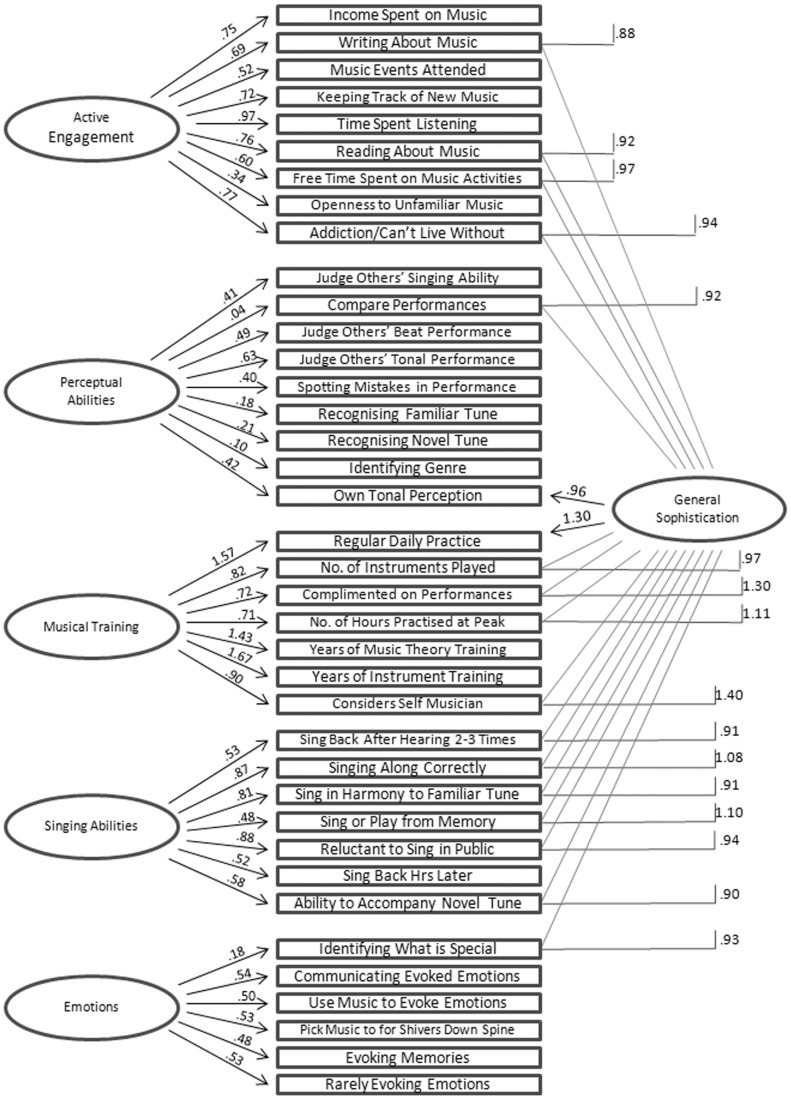
“Five subscales of musical sophistication consist of active musical engagement, selfreported perceptual abilities, musical training, self-reported singing abilities, and sophisticated emotional engagement with music (Müllensiefen et al., 2014).”
BackgroundMethodInfluentialAssessing room acoustic listening expertise
von Berg, M., Steffens, J., Weinzierl, S., & Müllensiefen, D. (2021) · The Journal of the Acoustical Society of America · doi:10.1121/10.0006574 · Cited by 11
Self-citationSchaal, N. K., Marina, K., Keitel, A., Krause, V., Pfeifer, J., & Pollok, B. (2017) · Frontiers in Neuroscience · doi:10.3389/fnins.2017.00677 · Cited by 11
“The sample displayed a mean Musical Training Score of the GoldsmithsMusical Sophistication Index (Gold-MSI) of 11.7 ± 4.2 points, confirming that nonmusicians took part (Mullensiefen et al., 2014; Schaal et al., 2014).”
BackgroundInfluentialWhen Is A Guitar Not A Guitar? Cultural Form, Input Modality And Expertise
Harrison, J., Jack, R. H., Morreale, F., & McPherson, A. (2018) · ResearchSpace (University of Auckland) · doi:10.5281/zenodo.1302588 · Cited by 16
Eiksund, Ø. J., & Reistadbakk, E. (2020) · doi:10.23865/noasp.108.ch7 · Cited by 12
Pounder, Z., Eardley, A. F., Loveday, C., & Evans, S. (2024) · PLoS ONE · doi:10.1371/journal.pone.0300219 · Cited by 13
Stefano, N. D., Ansani, A., Schiavio, A., Saarikallio, S. H., & Spence, C. J. (2025) · Empirical Studies of the Arts · doi:10.1177/02762374241308810 · Cited by 10
“The participants ’ musical expertise and their emotional usage of music were measured by means of the Musical Training and Emotions factors of the Goldsmiths Musical Sophistication Index (Gold-MSI: Müllensiefen et al., 2014).”
Beta oscillations predict the envelope sharpness in a rhythmic beat sequence
Leske, S. L., Endestad, T., Volehaugen, V., Foldal, M. D., Blenkmann, A. O., Solbakk, A., & Danielsen, A. (2025) · Scientific Reports · doi:10.1038/s41598-025-86895-y · Cited by 15
PAGURI: A User Experience Study of Creative Interaction with Text-to-Music Models
Ronchini, F., Comanducci, L., Perego, G., & Antonacci, F. (2025) · Electronics · doi:10.3390/electronics14173379 · Cited by 20
“To frame the knowledge of participants concerning TTM models, we asked them to answer a second questionnaire regarding their musical knowledge and experiences with AI tools, using questions partially taken from the Goldsmith Musical Sophistication Index (Gold-MSI) (Müllensiefen et al., 2014).”
Is musical expertise associated with self-reported foreign-language ability?
Schellenberg, E. G., Correia, A. I., & Lima, C. F. (2023) · Journal of Experimental Psychology Human Perception & Performance · doi:10.1037/xhp0001116 · Cited by 15
Kobayashi, K., Shiba, Y., Honda, S., Nakajima, S., Fujii, S., Mimura, M., & Noda, Y. (2024) · Brain Sciences · doi:10.3390/brainsci14020131 · Cited by 16
“They observed that the differences among participant groups trained with three different tasks were maintained for thirty days for steady-state visually evoked potentials, but not for ASSR.”
BackgroundA Survey on Hearing Health of Musicians in Professional and Amateur Orchestras
Hake, R., Kreutz, G., Frischen, U., Schlender, M., Rois-Merz, E., Meis, M., Wagener, K. C., & Siedenburg, K. (2024) · Trends in Hearing · doi:10.1177/23312165241293762 · Cited by 11
“Amateur musicians were asked to complete the short version of the GMSI (Müllensiefen et al., 2014).”
Singing and Accompaniment Support the Processing of Song Lyrics and Change the Lyrics' Meaning
Schotanus, Y. (2020) · Empirical Musicology Review · doi:10.18061/emr.v15i1-2.6863 · Cited by 13
Song Is More Memorable Than Speech Prosody: Discrete Pitches Aid Auditory Working Memory
Haiduk, F., Quigley, C., & Fitch, W. T. (2020) · Frontiers in Psychology · doi:10.3389/fpsyg.2020.586723 · Cited by 16
“Part four of the study consisted of the Gold-MSI test to assess musicality of the participants (Müllensiefen et al., 2014), and a post-experimental questionnaire asking about strategies the participants used, any speculations about the purpose of the study and the languages they spoke (including level of proficiency).”
MethodEstablishing the Reliability and Validity of Web-based Singing Research
Tan, Y. T., Peretz, I., McPherson, G. E., & Wilson, S. J. (2021) · Music Perception An Interdisciplinary Journal · doi:10.1525/mp.2021.38.4.386 · Cited by 12
Musical and linguistic syntactic processing in agrammatic aphasia: An ERP study
Chiappetta, B., Patel, A. D., & Thompson, C. K. (2021) · Journal of Neurolinguistics · doi:10.1016/j.jneuroling.2021.101043 · Cited by 10
Alam, T. A., & Dibben, N. (2021) · Future Directions of Music Cognition · doi:10.18061/fdmc.2021.0017 · Cited by 11
Right parietal cortex mediates recognition memory for melodies
Schaal, N. K., Javadi, A., Halpern, A. R., Pollok, B., & Banissy, M. J. (2015) · European Journal of Neuroscience · doi:10.1111/ejn.12943 · Cited by 15
“The German version of the Goldsmiths Musical Sophistication Index questionnaire (M€ullensiefen et al., 2014; Schaal et al., 2014a) was used to evaluate musical sophistication and engagement.”
MethodCameron, D. J., Potter, K., Wiggins, G. A., & Pearce, M. T. (2017) · Timing & Time Perception · doi:10.1163/22134468-00002085 · Cited by 10
“…membership (musician or nonmusician) was confirmed by scores on the musical training subscale of the Goldsmiths Musical Sophistication Index (GMSI, Müllensiefen et al., 2014): Musicians had a mean score of 50.95 (SD = 6.90) and nonmusicians a mean score of 25.70 (SD = 6.04), out of a maximum of…”
MethodInfluentialLearning a well-formed microtonal scale: Pitch intervals and event frequencies
Leung, Y., & Dean, R. T. (2018) · Journal of New Music Research · doi:10.1080/09298215.2018.1432060 · Cited by 14
“Two indices were used to measure their level of musical sophistication: the Ollen Musical Sophistication Index (OMSI) (Ollen, 2006) and the Goldsmiths Musical Sophistication Index (Gold-MSI) (Müllensiefen, Gingras, Musil, & Stewart, 2014).”
BackgroundInfluentialNegishi, K., & Sekiguchi, T. (2020) · PLoS ONE · doi:10.1371/journal.pone.0234111 · Cited by 12
“, 24], the Goldsmith Musical Sophistication Index (Gold-MSI) [34] was used.”
MethodMultisensory integration of musical emotion perception in singingPreprint
Lange, E. B., Fünderich, J., & Grimm, H. (2021) · doi:10.17605/osf.io/nf9g4 · Cited by 10
Li, J., Lin, H.-R., Wolf, A. D., & Lothwesen, K. (2023) · Musicae Scientiae · doi:10.1177/10298649231183264 · Cited by 13
“…“upper range of what is usually reported as the correlation between a paper-based self-report measure and actual perceptual or cognitive ability tests” (Müllensiefen et al., 2014, Gold-MSI-SC = simplified Chinese translation of Goldsmiths Musical Sophistication Index; SD = standard deviation; Min.”
BackgroundMethodResultInfluentialGamma music: a new acoustic stimulus for gamma-frequency auditory steady-state response
Yokota, Y., Tanaka, K., Chang, M., Naruse, Y., Imamura, Y., & Fujii, S. (2024) · Frontiers in Human Neuroscience · doi:10.3389/fnhum.2023.1287018 · Cited by 14
“…completed a self-report inventory using the Goldsmiths Musical Sophistication Index (GMSI) to assess individual differences in musical sophistication (Müllensiefen et al., 2014; Sadakata et al., 2022) and the Barcelona Music Reward Questionnaire (BMRQ) to assess the global sensitivity of the…”
MethodMeasuring the Just Noticeable Difference for Audio Latency
Schmid, A., Ambros, M., Bogon, J., & Wimmer, R. (2024) · Audio Mostly Conference (AM) · doi:10.1145/3678299.3678331 · Cited by 17
“We used Goldsmiths Musical Sophistication Index (Gold-MSI) to determine participants’ musical sophistication [10, 26].”
Platz, F., Kopiez, R., Lehmann, A. C., & Wolf, A. D. (2022) · Music & Science · doi:10.1177/20592043221105270 · Cited by 9
Derks‐Dijkman, M. W., Schaefer, R., Stegeman, M. L., van Tilborg, I. A. D. A., & Kessels, R. P. C. (2022) · Experimental Aging Research · doi:10.1080/0361073x.2022.2104061 · Cited by 9
“0 (Gold-MSI, Müllensiefen et al., 2014).”
MethodResultInfluentialBurger, B., & Wöllner, C. (2023) · Music & Science · doi:10.1177/20592043231186870 · Cited by 14
“…regarding their musical background (Factor 3 “ Musical training ” plus “ best played instrument ” from the Goldsmiths Musical Sophistication Index, Müllensiefen et al., 2014) – if they chose “ Drums (percussion instruments) ” for the instrument they know best, further questions regarding their…”
BackgroundMethodInfluentialCatronas, D., Sousa, J., Batista, A. R., Torres, N. L., Mesquita, A., Folia, V., & Silva, S. (2023) · Scientific Reports · doi:10.1038/s41598-023-40081-0 · Cited by 10
The neuro-oscillatory profiles of static and dynamic music-induced visual imagery
Hashim, S., Küssner, M. B., Weinreich, A., & Omigie, D. (2024) · International Journal of Psychophysiology · doi:10.1016/j.ijpsycho.2024.112309 · Cited by 11
“The 7-item Musical Training subscale of the Goldsmiths Musical Sophistication Index (Gold-MSI; Müllensiefen et al., 2014) was included to gauge prior training in music.”
Lam, C., Moore, B. C. J., Salorio‐Corbetto, M., & Vickers, D. (2022) · Trends in Hearing · doi:10.1177/23312165221143902 · Cited by 14
“More sophisticated demographics will be explored with the Goldsmiths Musical Sophistication Index (Gold-MSI) to identify more specific factors that might lead to enhanced music enjoyment (Müllensiefen et al., 2014).”
MethodTemporal and spectral audiotactile interactions in musicians
Landry, S. P., Sharp, A., Pagé, S., & Champoux, F. (2016) · Experimental Brain Research · doi:10.1007/s00221-016-4813-3 · Cited by 11
The relationship between musical training and musical empathizing and systemizing traits
Dahary, H., Fernandes, T. P., & Quintin, E. (2018) · Musicae Scientiae · doi:10.1177/1029864918779636 · Cited by 11
“Further, it lends credence to the argument that musical expertise encompasses more than just technical training or abilities in playing instruments (Levitin, 2012; Müllensiefen et al., 2014a).”
BackgroundMethodDüvel, N., Kopiez, R., Wolf, A. D., & Weihe, P. (2020) · Music & Science · doi:10.1177/2059204320901952 · Cited by 9
James, C. E., Stucker, C. L., Tschopp, C., Fernandes, A., Revol, A., Mili, I., Kliegel, M., Frisoni, G. B., Guevara, A. B., & Marié, D. (2023) · BMC Geriatrics · doi:10.1186/s12877-022-03678-0 · Cited by 12
“The Amsterdam Instrumental Activity of the Daily Living Questionnaire (Short Version; (A-IADL-Q(SV)) [97] – 25 min. f. Music education questionnaires, one elaborated in the GEMMI lab (Geneva Musical Minds lab) & the validated Gold-MSI (Goldsmiths Musical Sophistication Index) [137] g. Godin-Shephard leisure-time physi…”
MethodBüdenbender, N., & Kreutz, G. (2015) · Musicae Scientiae · doi:10.1177/1029864915613390 · Cited by 9
Fernholz, I., Menzel, J., Jabusch, H., Gembris, H., Fischer, F. H., Kendel, F., Kreutz, G., Schmidt, A., Willich, S. N., & Weikert, C. (2018) · Das Gesundheitswesen · doi:10.1055/s-0044-101143 · Cited by 10
Sivathasan, S., Philibert-Lignières, G., & Quintin, E. (2021) · Musicae Scientiae · doi:10.1177/1029864920988160 · Cited by 11
“The Gold-MSI (Müllensiefen et al., 2014) is a self-report questionnaire designed to assess levels of musical abilities, expertise, and sophistication of musical behaviors.”
BackgroundMethodInfluentialLin, H.-R., Kopiez, R., Müllensiefen, D., & Hasselhorn, J. (2022) · Psychology of Music · doi:10.1177/03057356211073479 · Cited by 9
“00), slightly lower than the mean score of the adult sample reported in Müllensiefen et al. (2014). Hence, it was assumed that participants in general received a large part of their musical education through the schools (see Table S1 in the Supplement Materials for more detailed demographic information of the sample.”
MethodResultSelf-citationAre Musical Autobiographical Memories Special? It Ain’t Necessarily So
Halpern, A. R., Talarico, J. M., Gouda, N., & Williamson, V. J. (2018) · Music Perception An Interdisciplinary Journal · doi:10.1525/mp.2018.35.5.561 · Cited by 11
Audiovisual integration in the McGurk effect is impervious to music training
Lee, H.-H., Groves, K., Ripollés, P., & Carrasco, M. (2024) · Scientific Reports · doi:10.1038/s41598-024-53593-0 · Cited by 9
“The norms (mean) for people in the United States (n = 147,633) in each subscale are: active engagement (42), perceptual abilities (50), music training (27), singing skills (32), emotions (35) and general sophistication (82) 26 .”
InfluentialListening habits and subjective effects of background music in young adults with and without ADHD
Lachance, K.-A., Pelland-Goulet, P., & Gosselin, N. H. (2025) · Frontiers in Psychology · doi:10.3389/fpsyg.2024.1508181 · Cited by 12
Wang, C., Lu, P. C., Cheng, Y.-T., & Chen, M. Y. (2025) · CHI Conference on Human Factors in Computing Systems · doi:10.1145/3706598.3714156 · Cited by 10
Musical Potential, Giftedness, and Talent Development
McPherson, G. E., Blackwell, J., & Hallam, S. (2022) · Oxford University Press eBooks · doi:10.1093/oxfordhb/9780190056285.013.3 · Cited by 13
The Relationship of Musical Expertise, Working Memory, and Intelligence
Arndt, C., Schlemmer, K., & van der Meer, E. E. (2023) · Music Perception An Interdisciplinary Journal · doi:10.1525/mp.2023.40.4.334 · Cited by 12
Eye blinking, musical processing, and subjective states—A methods account
Lange, E. B., & Fink, L. (2023) · Psychophysiology · doi:10.1111/psyp.14350 · Cited by 12
“Participants showed a medium level of musical sophistication, M = 74, SD = 15, range: 53– 112 (Gold- MSI, Müllensiefen et al., 2014).”
Exploring level- and spectrum-based music mixing transforms for hearing-impaired listeners
Benjamin, A. J., & Siedenburg, K. (2023) · The Journal of the Acoustical Society of America · doi:10.1121/10.0020269 · Cited by 8
Resting-state brain connectivity correlates of musical sophistication
Cui, A., Kraeutner, S. N., Yeganeh, N. M., Hermiston, N., Werker, J. F., & Boyd, L. A. (2023) · Frontiers in Human Neuroscience · doi:10.3389/fnhum.2023.1195996 · Cited by 8
“These results thus help further delineate between music training and musical sophistication which are overlapping but not identical concepts (Müllensiefen et al., 2014).”
BackgroundMethodInfluentialThe perceived catchiness of music affects the experience of groove
Bechtold, T., Curry, B., & Witek, M. A. G. (2024) · PLoS ONE · doi:10.1371/journal.pone.0303309 · Cited by 11
Temporal Structure of Music Improves the Cortical Encoding of Speech
Fernández‐Merino, L., Lizarazu, M., Molinaro, N., & Kalashnikova, M. (2025) · Human Brain Mapping · doi:10.1002/hbm.70199 · Cited by 9
“Participants' musical background was assessed using the Goldsmiths Musical Sophistication Index (Gold MSI) self-report questionnaire (Müllensiefen et al. 2014), which measures different aspects of musical sophistication, such as active musical engagement, perceptual abilities, musical training,…”
Parenting style as a predictor of music preference
Warrener, E., Krause, A. E., & North, A. C. (2018) · Psychology of Music · doi:10.1177/0305735618816173 · Cited by 11
“We note also that the TIPI has been used to measure personality in a number of recent studies concerning music (e.g., C. Gold, Saarikallio, Crooke, & McFerran, 2017; Hallett & Lamont, 2016; Müllensiefen, Gingras, Musil, & Stewart, 2014; Schedl et al., 2016).”
MethodAudio Feedback for Device-Supported Balance Training: Parameter Mapping and Influencing Factors
Fuchs, D., Knauer, M., Egger, M., & Friedrich, P. (2020) · Acoustics · doi:10.3390/acoustics2030034 · Cited by 12
“A fruitful approach for future measurements of musicianship may be the use of a brief, reliable, and valid measure of musical ability for research purposes along the lines of prior research into musical abilities [46,47].”
BackgroundGraf, M., & Barthet, M. (2022) · New Interfaces for Musical Expression · doi:10.21428/92fbeb44.56ba9b93 · Cited by 10
Smetana, M., Stepniczka, I., & Bishop, L. (2022) · Nordic Journal of Music Therapy · doi:10.1080/08098131.2022.2084638 · Cited by 10
“…active engagement, perceptual activities, musical training, singing abilities, and emotions which all result in a general musical sophistication (Müllensiefen et al., 2014; Schaal et al., 2014), showed that within our sample the mean of general musical sophistication in P was at M = 83.33 (Mdn…”
BackgroundInfluentialPrediction of Eudaimonic and Hedonic Orientation of Movie Watchers
Motamedi, E., Barile, F., & Tkalčič, M. (2022) · Applied Sciences · doi:10.3390/app12199500 · Cited by 13
Generalization of auditory expertise in audio engineers and instrumental musicians
Caprini, F., Zhao, S., Chait, M., Agus, T. R., Pomper, U., Tierney, A. T., & Dick, F. (2023) · Cognition · doi:10.1016/j.cognition.2023.105696 · Cited by 10
Ellis, B. K., Hwang, H., Savage, P. E., Pan, B.-Y., Cohen, A. J., & Brown, S. (2018) · Psychology of Aesthetics Creativity and the Arts · doi:10.1037/aca0000072 · Cited by 8
Musical Sophistication and the Effect of Complexity on Auditory Discrimination in Finnish Speakers
Dawson, C., Aalto, D., Šimko, J., Vainio, M., & Tervaniemi, M. H. (2017) · Frontiers in Neuroscience · doi:10.3389/fnins.2017.00213 · Cited by 15
“Musical sophistication scores were gathered according to the self-report musicality questionnaire from the Goldsmiths Musical Sophistication Index (Gold-MSI) (Müllensiefen et al., 2014).”
BackgroundMethodResultInfluentialPassoni, E., Mehrabi, A., Levon, E., & de Leeuw, E. (2018) · Speech prosody · doi:10.21437/speechprosody.2018-78 · Cited by 9
“[17], enquiring about general information which could be a source of potential variation and confounds in this study.”
Anglada-Tort, M., Baker, T., & Müllensiefen, D. (2018) · Memory · doi:10.1080/09658211.2018.1545858 · Cited by 9
“Participants’ mean score in the Gold-MSI musical training factor (Müllensiefen, Gingras, Musil, & Stewart, 2014) was 25.42 (SD = 11.36), which indicates an overall average level of musical training, corresponding to the 44th percentile of the data norms reported in Müllensiefen et al. (2014).”
MethodInfluentialSelf-citationIntonation trajectories within tones in unaccompanied soprano, alto, tenor, bass quartet singing
Dai, J., & Dixon, S. (2019) · The Journal of the Acoustical Society of America · doi:10.1121/1.5120483 · Cited by 8
“Since training is a crucial factor for intonation accuracy, all the participants were given a questionnaire based on the Goldsmiths Musical Sophistication Index (Müllensiefen et al., 2014) to test the effect of training.”
MethodAlessandri, E., Rose, D., Senn, O., Szamatulski, K., Baldassarre, A., & Williamson, V. J. (2020) · Music & Science · doi:10.1177/2059204320931337 · Cited by 9
“…were the sub-scales ‘Demographics’, ‘Training’, and ‘Active Engagement’, as well as the General factor (for the reliability of the GoldMSI scales, see Müllensiefen et al., 2014 and Schaal et al., 2014). b) Music consumption habits were divided into listen- ing habits (use and preference for…”
BackgroundMethodInfluentialKalustian, K. K., & Ruth, N. (2021) · Jahrbuch der Deutschen Gesellschaft für Musikpsychologie/Jahrbuch Musikpsychologie · doi:10.5964/jbdgm.95 · Cited by 11
“, 2008), or musical sophistication (Müllensiefen et al., 2014)—are represented on the levels of those audio features.”
BackgroundPleasantness Ratings of Musical Dyads in Cochlear Implant Users
Camarena, A., Manchala, G. S., Papadopoulos, J., O’Connell, S. R., & Goldsworthy, R. L. (2021) · Brain Sciences · doi:10.3390/brainsci12010033 · Cited by 8
Tuning the mind: Exploring the connections between musical ability and executive functionsPreprint
Slevc, L. R. (2017) · PsyArXiv (OSF Preprints) · doi:10.31234/osf.io/jqe8a · Cited by 8
Armitage, J. O., Eerola, T., & Halpern, A. R. (2024) · Memory & Cognition · doi:10.3758/s13421-024-01614-8 · Cited by 8
“Two musical expertise questions (musical training Questions 3 and 4) were derived from Goldsmiths Musical Sophistication Index (Müllensiefen et al., 2014), and the rest of the questions asked about how many years they had engaged in instrument training, how many hours per day this practice took at its peak, the number…”
InfluentialRhythm-based Temporal Expectations: Unique Contributions of Predictability and Periodicity
Solli, S., Danielsen, A., Leske, S. L., Blenkmann, A. O., Doelling, K. B., Solbakk, A., & Endestad, T. (2025) · Journal of Cognitive Neuroscience · doi:10.1162/jocn_a_02261 · Cited by 10
Møller, C. M., Hansen, N. C., Vuust, P., & Müllensiefen, D. (2024) · Music & Science · doi:10.1177/20592043241289087 · Cited by 9
“All estimates of the factor General Musical Sophistication were computed based on the 18 items with the highest loading in the original English study (Müllensiefen et al., 2014). en : For comparison, summary statistics and reliability estimates from the English study are included in italics.”
InfluentialSelf-citationWorschech, F., Marié, D., Sinke, C., Kliegel, M., Jünemann, K., Scholz, D. S., Krüger, T. H., James, C. E., & ALTENMÜLLER, E. O. (2025) · Annals of the New York Academy of Sciences · doi:10.1111/nyas.15397 · Cited by 10
Understanding individual differences to specific rewards through music
Herrero, E. M., Zatorre, R. J., & Marco‐Pallarés, J. (2025) · Trends in Cognitive Sciences · doi:10.1016/j.tics.2025.06.015 · Cited by 56
Attentional modulation of beta-power aligns with the timing of behaviorally relevant rhythmic sounds
Foldal, M. D., Leske, S. L., Blenkmann, A. O., Endestad, T., & Solbakk, A. (2022) · Cerebral Cortex · doi:10.1093/cercor/bhac179 · Cited by 8
“As the current study involved rhythmic stimuli, the Goldsmiths Musical Sophistication Index (Gold-MSI) questionnaire (Müllensiefen et al. 2014) was used to assess individual differences in the participants’ level of musical experience.”
MethodResultInfluentialDisembodied Timbres: A Study on Semantically Prompted FM Synthesis
Hayes, B., Saitis, C., & Fazekas, G. (2022) · Journal of the Audio Engineering Society · doi:10.17743/jaes.2022.0006 · Cited by 7
The effects of aging and musicianship on the use of auditory streaming cues
Sauvé, S. A., Marozeau, J., & Zendel, B. R. (2022) · PLoS ONE · doi:10.1371/journal.pone.0274631 · Cited by 8
“The Goldsmiths Musical Sophistication Index (Gold-MSI) [63] musical training sub-scale consisted of 7 questions, each answered on a 7-point Likert scale, for a total score out of 49.”
MethodTesting beat perception without sensory cues to the beat: the Beat-Drop Alignment Test (BDAT)
Cinelytė, U., Cannon, J. J., Patel, A. D., & Müllensiefen, D. (2022) · Attention Perception & Psychophysics · doi:10.3758/s13414-022-02592-2 · Cited by 7
“…training in music or dance will show superior performance on the BDAT task compared with the general public, and that performance on the BDAT will be associated with the level of musical experience (i.e., general musical sophistication; GMS) asmeasured by the Gold-MSI (Müllensiefen et al., 2014).”
MethodSelf-citationElectrophysiological Correlates of Vocal Emotional Processing in Musicians and Non-Musicians
Nussbaum, C., Schirmer, A., & Schweinberger, S. R. (2023) · Brain Sciences · doi:10.3390/brainsci13111563 · Cited by 7
Santangelo, M., Persici, V., Caricati, L., Corsano, P., Gordon, R. L., & Majorano, M. (2023) · Psychology of Music · doi:10.1177/03057356231204855 · Cited by 11
“Indeed, in the English (Müllensiefen et al., 2014), German (Schaal et al., 2014), and Portuguese (Lima et al., 2020) samples, higher musical sophistication was found for the younger, more educated, and more socio-economically advantaged participants.”
Persici, V., Santangelo, M., Guerzoni, L., Cuda, D., Gordon, R. L., & Majorano, M. (2024) · Music Perception An Interdisciplinary Journal · doi:10.1525/mp.2024.41.4.240 · Cited by 8
Customizing ICU patient monitoring: a user-centered approach informed by nurse profiles
Bostan, I., van Egmond, R., Gommers, D. A. M. P. J., & Özcan, E. (2024) · Cognition Technology & Work · doi:10.1007/s10111-024-00763-9 · Cited by 9
“MSI measures musical involvement, ability, and knowledge of non-musicians on several dimensions (Müllensiefen et al. 2014).”
Perception of Leitmotives in Richard Wagner's Der Ring des Nibelungen
Baker, D. J., & Müllensiefen, D. (2017) · Frontiers in Psychology · doi:10.3389/fpsyg.2017.00662 · Cited by 10
“Self-report Measures The self-report measures filled out at the end of each experimental session required participants to rate the familiarity with the passage in the exposure phase on a 7-point scale, their German speaking and writing abilities on 7-point scales, the amount of musical training they had received via t…”
BackgroundMethodInfluentialSelf-citationExploring the Music Perception Skills of Crowd Workers
Samiotis, I. P., Qiu, S., Lofi, C., Yang, J., Gadiraju, U., & Bozzon, A. (2021) · Proceedings of the AAAI Conference on Human Computation and Crowdsourcing · doi:10.1609/hcomp.v9i1.18944 · Cited by 8
“Even though our results are based on a population of crowd workers that have received less formal musical training than the average population used in similar studies (M¨ullensiefen et al. 2014), the use of standardised and validate tests, lend confidence to the reliability of our findings.”
BackgroundMethodResultInfluentialAn Embodied Sonification Model for Sit-to-Stand Transfers
Kantan, P. R., Spaich, E. G., & Dahl, S. (2022) · Frontiers in Psychology · doi:10.3389/fpsyg.2022.806861 · Cited by 7
“The questionnaire consists of 29 items targeting self-reported music training, melodic and rhythmic ability7, yielding a score between 18 and 126 (Müllensiefen et al., 2014).”
BackgroundMethodInfluentialReduced cross-modal affective priming in the L2 of late bilinguals depends on L2 exposure.
Tenderini, M. S., de Leeuw, E., Eilola, T. M., & Pearce, M. T. (2022) · Journal of Experimental Psychology Learning Memory and Cognition · doi:10.1037/xlm0000889 · Cited by 12
Smit, E. A., Rathcke, T. V., & Keller, P. E. (2023) · Music & Science · doi:10.1177/20592043231175251 · Cited by 8
“…questionnaires) to measure musical sophistication, training, and auditory skills — for example, the Goldsmiths ’ Musical Sophistication Index (GMSI) (Müllensiefen et al., 2014); the Music Use and Background Questionnaire (MUSEBAQ) (Chin & Rickard, 2012; Rickard et al., 2015); Ollen Musical…”
BackgroundExpectation adaptation for rare cadences in music: Item order matters in repetition priming
Chander, A., & Aslin, R. Ν. (2023) · Cognition · doi:10.1016/j.cognition.2023.105601 · Cited by 8
“Their scores on the combined Musical Training, Perceptual Abilities and Singing Abilities subscales of the Goldsmiths Musical Sophistication Index (GMSI; Müllensiefen, Gingras, Musil, & Stewart, 2014) ranged from 23 to 86 ( M = 48.7, SD = 12.3) out of a maximum of 89.”
BackgroundInfluentialKorte, M., Cerci, D., Wehry, R., Timmers, R., & Williamson, V. J. (2023) · Frontiers in Pain Research · doi:10.3389/fpain.2023.1194934 · Cited by 7
Cochlear Implant Users can Effectively Combine Place and Timing Cues for Pitch Perception
Goldsworthy, R. L., & Bissmeyer, S. R. S. (2023) · Ear and Hearing · doi:10.1097/aud.0000000000001383 · Cited by 7
The Experience of Music in Aphantasia: Emotion, Reward, and Everyday Functions
Hashim, S., Pulcini, C., Jansari, A. S., Küssner, M. B., & Omigie, D. (2024) · Music & Science · doi:10.1177/20592043231216259 · Cited by 13
“Finally, we explored whether different dimensions of musical sophistication might be affected by aphantasia when compared to a control group, measured using the Goldsmiths Musical Sophistication Index (Gold-MSI; Müllensiefen et al., 2014) ( Aim 5 ).”
Mednicoff, S. D., Barashy, S., Vollweiler, D. J., Benning, S. D., Snyder, J. S., & Hannon, E. E. (2024) · Philosophical Transactions of the Royal Society B Biological Sciences · doi:10.1098/rstb.2023.0253 · Cited by 8
“Participants filled out a misophonia self-report scale, questions about ASMR and a musical sophistication scale with a sub-factor measuring emotional engagement with music [78,79].”
Lepa, S., Hoklas, A.-K., Egermann, H., & Weinzierl, S. (2015) · Convergence The International Journal of Research into New Media Technologies · doi:10.1177/1354856515579837 · Cited by 9
“…track of music and events, spending money on records or downloads) or the acquired habit of intentionally using music to regulate one’s own emotions (Müllensiefen et al., 2014), we nevertheless believe that there are several other important dimensions of ‘informal musical expertise’ that are…”
BackgroundA personality-based adaptive system for visualizing classical music performances
Schedl, M., Melenhorst, M., Liem, C. C. S., Martorell, A., Mayor, Ó., & Tkalčič, M. (2016) · ACM Multimedia Systems Conference (MMSys) · doi:10.1145/2910017.2910604 · Cited by 7
“In addition, we plan to extend the degree of personalization of our system to factors other than personality, such as musical education, experience, and knowledge, musical preferences beyond classical music, or music sophistication [15].”
BackgroundNo Evidence for an Auditory Attentional Blink for Voices Regardless of Musical Expertise
Akça, M., Laeng, B., & Godøy, R. I. (2020) · Frontiers in Psychology · doi:10.3389/fpsyg.2019.02935 · Cited by 11
“…abilities, 0.903 for musical training, 0.870 for singing abilities, 0.791 for Frontiers in Psychology | www.frontiersin.org 4 January 2020 | Volume 10 | Article 2935 emotions; Müllensiefen et al., 2014) a very high re-test reliability (ranging between 0.857 and 0.972; Müllensiefen et al., 2014).”
BackgroundMethodInfluentialThe Idiosyncrasy of Involuntary Musical Imagery Repetition (IMIR) Experiences
Liptak, T. A., Omigie, D., & Floridou, G. A. (2022) · Music Perception An Interdisciplinary Journal · doi:10.1525/mp.2022.39.3.320 · Cited by 10
Musical Garden Paths: Evidence for Syntactic Revision Beyond the Linguistic Domain
Cecchetti, G., Herff, S. A., & Rohrmeier, M. (2022) · Cognitive Science · doi:10.1111/cogs.13165 · Cited by 10
“Following the memory task, participants took part in the main revision experiment described above and finally answered the Goldsmith Music Sophistication Index (MSI) questionnaire (Müllensiefen et al., 2014).”
MethodLooperGP: A Loopable Sequence Model for Live Coding Performance Using GuitarPro Tablature
Adkins, S., Sarmento, P., & Barthet, M. (2023) · Lecture notes in computer science · doi:10.1007/978-3-031-29956-8_1 · Cited by 7
Tendency Towards the Average? The Aesthetic Evaluation of a Quantitatively Average Music Performance
Wolf, A. D., Kopiez, R., Platz, F., Lin, H.-R., & Mütze, H. (2018) · Music Perception An Interdisciplinary Journal · doi:10.1525/mp.2018.36.1.98 · Cited by 8
Distortion and Rock Guitar Harmony
Herbst, J.-P. (2019) · Music Perception An Interdisciplinary Journal · doi:10.1525/mp.2019.36.4.335 · Cited by 7
Vocal-motor interference eliminates the memory advantage for vocal melodies
Wood, E. A., Rovetti, J., & Russo, F. (2020) · Brain and Cognition · doi:10.1016/j.bandc.2020.105622 · Cited by 9
Hallam, S., & Himonides, E. (2022) · Open Book Publishers · doi:10.11647/obp.0292.14 · Cited by 8
Kleber, B., Sitges, C., Brattico, E., Vuust, P., & Zamorano, A. M. (2025) · European Journal of Pain · doi:10.1002/ejp.70012 · Cited by 7
“To compare music aptitudes and behaviours across groups, all participants completed the Goldsmith Musical Sophistication Index (Gold-MSI; Mullensiefen et al. 2014).”
How strong is the rhythm of perception? A registered replication of Hickok et al . (2015)
Henry, M. J., Obleser, J., Crusey, M. R., Fuller, E. R., Lee, Y. S., Meyer, M. E., Acosta, E. A. M., Hedger, S. C. V., Inbar, M., Oderbolz, C., et al. (2025) · Royal Society Open Science · doi:10.1098/rsos.220497 · Cited by 10
“…information (e.g. age, sex) and complete a measure of self-reported hearing ability, namely the 15-item Speech, Spatial and Qualities of Hearing scale (15iSSQ) [27], as well as an assessment of musical abilities and training, namely the Goldsmiths Musical Sophistication Index (MSI) [28].”
Metadata
- Authors
- Müllensiefen, D., Gingras, B., Musil, J., & Stewart, L.
- Affiliations
- Goldsmiths University of London (GB)
- University of Vienna (AT)
- Corresponding author
- Müllensiefen, Daniel
- Venue
- PLoS ONE
- Publisher
- Public Library of Science (PLoS)
- Published
- 2014-02-26
- Volume
- 9
- Issue
- 2
- Pages
- e89642
- ISSN
- 1932-6203 (ISSN-L)
- PMC
- PMC3935919
- OpenAlex
- W1981455444
- Cited by
- 1,155
- References
- 147
- Citations by year
- 2026: 106 · 2025: 150 · 2024: 124 · 2023: 134 · 2022: 153 · 2021: 130 · 2020: 81 · 2019: 78 · 2018: 77 · 2017: 41 · 2016: 35 · 2015: 28 · 2014: 14
- FWCI
- 21.94
- Type
- journal article
- Language
- en
- Update notices
- correction (2014-06-24)
- Open access
- gold
- doi.org
- Locations
- PLoS ONE (publishedVersion, cc-by)
- Europe PMC (PubMed Central) (publishedVersion, other-oa)
- PubMed Central (publishedVersion, cc-by)
- PubMed (publishedVersion)
- Goldsmiths (University of London) (acceptedVersion)
- Phaidra (Universität Wien) (submittedVersion, cc-by-nc-nd)
- DOAJ (DOAJ: Directory of Open Access Journals) (submittedVersion, cc-by-sa)
- Figshare (submittedVersion, cc-by)
- Topics
- Life Sciences › Neuroscience › Cognitive Neuroscience › Neuroscience and Music Perception
- Social Sciences › Arts and Humanities › Music › Diverse Music Education Insights
- Life Sciences › Neuroscience › Cognitive Neuroscience › Aesthetic Perception and Analysis
- Keywords
- musical sophistication, non-musicians, musicianship, Goldsmiths Musical Sophistication Index, music listening, statistical learning, sociodemographic factors, occupational status, scale development
- MeSH terms
- Adult, Aptitude Tests, Auditory Perception, Female, Humans, Male, Memory, Music, Self Report
About these checks
Registry, retraction, Cites and statistics results are computed, not judged, with one exception: a printed reference that no index lists is read once by a model before it counts as a citation error. Claims are extracted by a model and kept only when their quote appears verbatim in the text; each cited source is then checked, with a model’s help, for whether it says what the claim relies on. Those verdicts can be wrong — read the claim’s quote and the cited source before relying on one.
Statistics and arithmetic are recomputed, not judged.
Confidence bands are shown only for fields calibrated on our annotated test set. None is calibrated yet, so no band is shown.
What counts as a claim ›How we measure confidence ›How we check this ›
Are you an author, or do you see a problem with this page? Request a review
Data sources
Bibliographic data: Semantic Scholar, OpenAlex, Crossref.
Contains information from the Semantic Scholar Academic Graph Datasets, made available under the ODC Attribution License (ODC-BY 1.0).
Semantic Scholar’s data is described in: Kinney, R., et al. (2023). The Semantic Scholar Open Data Platform. arXiv:2301.10140.
