

The DOI matches its Crossref record; 42 of the 42 references it cites were found in a registry or an index.
The Acute Satellite Cell Response and Skeletal Muscle Hypertrophy following Resistance Training
Open accessAbstract
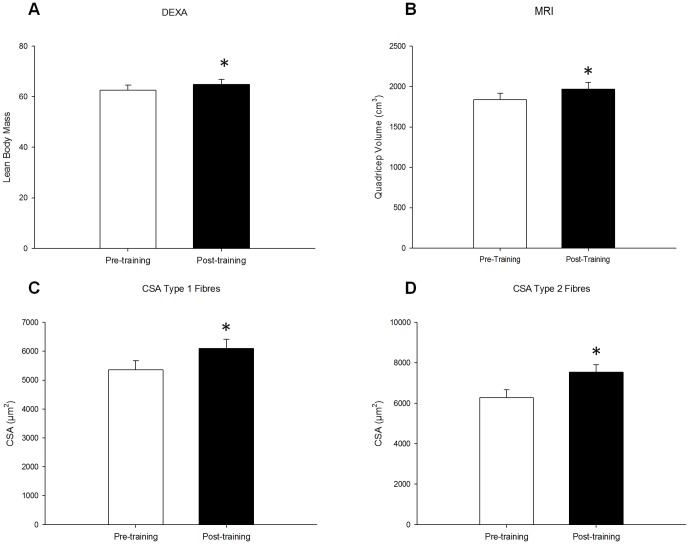
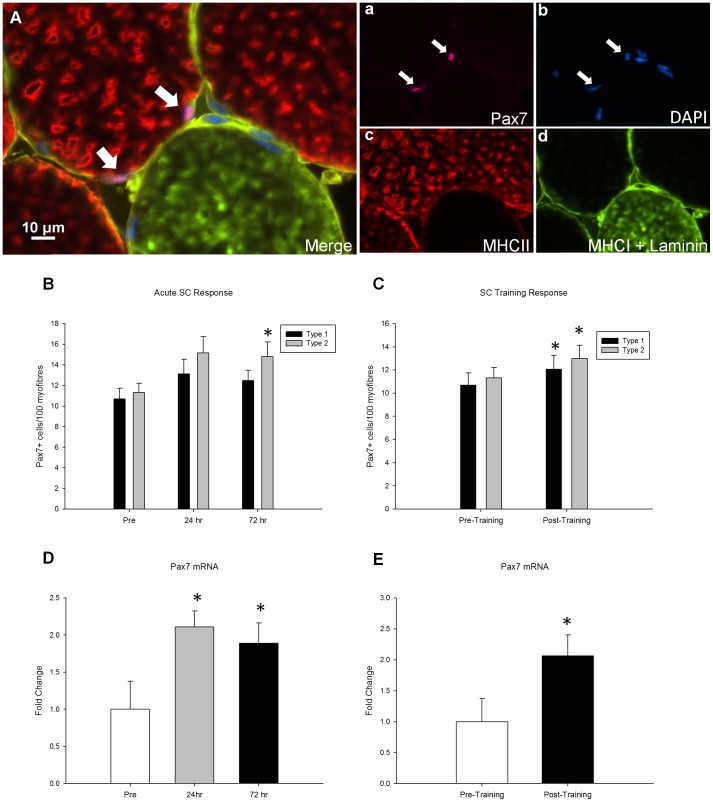
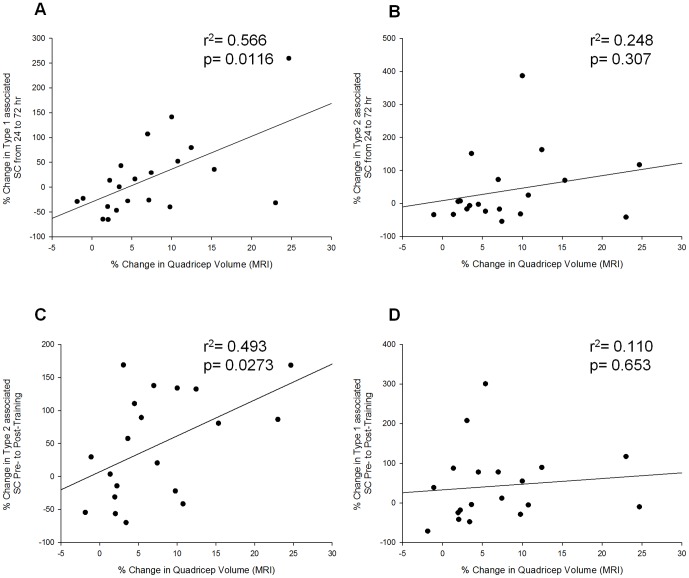
The extent of skeletal muscle hypertrophy in response to resistance training is highly variable in humans. The main objective of this study was to explain the nature of this variability. More specifically, we focused on the myogenic stem cell population, the satellite cell (SC) as a potential mediator of hypertrophy. Twenty-three males (aged 18-35 yrs) participated in 16 wk of progressive, whole body resistance training, resulting in changes of 7.9±1.6% (range of -1.9-24.7%) and 21.0±4.0% (range of -7.0 to 51.7%) in quadriceps volume and myofibre cross-sectional area (CSA), respectively. The SC response to a single bout of resistance exercise (80% 1RM), analyzed via immunofluorescent staining resulted in an expansion of type II fibre associated SC 72 h following exercise (pre: 11.3±0.9; 72 h: 14.8±1.4 SC/type II fibre; p<0.05). Training resulted in an expansion of the SC pool associated with type I (pre: 10.7±1.1; post: 12.1±1.2 SC/type I fibre; p<0.05) and type II fibres (pre: 11.3±0.9; post: 13.0±1.2 SC/type II fibre; p<0.05). Analysis of individual SC responses revealed a correlation between the relative change in type I associated SC 24 to 72 hours following an acute bout of resistance exercise and the percentage increase in quadriceps lean tissue mass assessed by MRI (r2 = 0.566, p = 0.012) and the relative change in type II associated SC following 16 weeks of resistance training and the percentage increase in quadriceps lean tissue mass assessed by MRI (r2 = 0.493, p = 0.027). Our results suggest that the SC response to resistance exercise is related to the extent of muscular hypertrophy induced by training.
Overview
The claims and statistics of this paper haven’t been checked yet.
Run the check — free, no account needed. It reads the open-access text and checks the sources it cites.
Integrity signals
Registry
Cites
Statistics
Figures
Verification
Claims the paper makes
The claims and statistics of this paper haven’t been checked yet.
Run the check — free, no account needed. It reads the open-access text and checks the sources it cites.
Claims other papers make about this one
Each is checked against this paper’s own text: does it say what the citing paper says it does?
The source backs part of the claim, not all of it — or backs it for a different population, condition or comparison.
In the citing paper
“The different exercise modes also appear to generate a fibre type specific satellite cell response which may also increase the complexity in delineating its role in the specificity of adaptation and any incompatibility with concurrent training (Babcock et al., 2012;Joanisse et al., 2013;Bellamy et al., 2014).”
From Concurrent exercise training: do opposites distract? (2017) · cites this paper as Bellamy et al., 2014
Experimental — accuracy not yet measuredThe source backs part of the claim, not all of it — or backs it for a different population, condition or comparison.
In the citing paper
“It should be noted that resistance and aerobic exercise independently have the potential to induce satellite cell responses for skeletal muscle remodelling”
From Concurrent exercise training: do opposites distract? (2017) · cites this paper as Bellamy et al., 2014
Experimental — accuracy not yet measured
Self-check
Percentages, sums and reported differences re-computed from the paper’s own numbers.
The self-check needs the paper’s full text.
Citations
Cites
Satellite Cells and the Muscle Stem Cell Niche
Yin, H., Price, F., & Rudnicki, M. A. (2013) · Physiological Reviews · doi:10.1152/physrev.00043.2011 · Cited by 2,166
Double muscling in cattle due to mutations in the myostatin gene
McPherron, A. C., & Lee, S.-J. (1997) · Proceedings of the National Academy of Sciences · doi:10.1073/pnas.94.23.12457 · Cited by 2,039
Myostatin Inhibits Myoblast Differentiation by Down-regulating MyoD Expression
Langley, B. C., Thomas, M., Bishop, A., Sharma, M., Gilmour, S., & Kambadur, R. (2002) · Journal of Biological Chemistry · doi:10.1074/jbc.m204291200 · Cited by 910
Myostatin negatively regulates satellite cell activation and self-renewal
McCroskery, S., Thomas, M., Maxwell, L., Sharma, M., & Kambadur, R. (2003) · The Journal of Cell Biology · doi:10.1083/jcb.200207056 · Cited by 784
Effective fiber hypertrophy in satellite cell-depleted skeletal muscle
McCarthy, J. J., Mula, J., Miyazaki, M., Erfani, R., Garrison, K., Farooqui, A. B., Srikuea, R., Lawson, B. A., Grimes, B., Keller, C., et al. (2011) · Development · doi:10.1242/dev.068858 · Cited by 616
Petrella, J. K., Kim, J.-S., Mayhew, D. L., Cross, J. M., & Bamman, M. M. (2008) · Journal of Applied Physiology · doi:10.1152/japplphysiol.01215.2007 · Cited by 435 · cited 1×
“exposure to exercise of the same relative intensity [1,2].”
BackgroundJones, S. W., Hill, R. J. W., Krasney, P. A., O'Conner, B., Peirce, N. S., & Greenhaff, P. L. (2004) · The FASEB Journal · doi:10.1096/fj.03-1228fje · Cited by 422
Davidsen, P. K., Gallagher, I. J., Hartman, J. W., Tarnopolsky, M. A., Dela, F., Helge, J. W., Timmons, J. A., & Phillips, S. M. (2011) · Journal of Applied Physiology · doi:10.1152/japplphysiol.00901.2010 · Cited by 385
Self-citationVerdijk, L. B., Gleeson, B. G., Jonkers, R. A. M., Meijer, K., Savelberg, H. H. C. M., Dendale, P., & van Loon, L. J. C. (2009) · The Journals of Gerontology Series A: Biological Sciences and Medical Sciences · doi:10.1093/gerona/gln050 · Cited by 372
Petrella, J. K., Kim, J.-S., Cross, J. M., Kosek, D. J., & Bamman, M. M. (2006) · American Journal of Physiology-Endocrinology and Metabolism · doi:10.1152/ajpendo.00190.2006 · Cited by 356
Cited by
Sorted by citations
Items 101–148 of 148
Ageing of human myofibres in the Vastus Lateralis muscle: A narrative review
Granic, A., Simoes, D. C. M., Bowen, T. S., Almaghtuf, N., Richardson, G. D., & Sayer, A. A. (2026) · Ageing Research Reviews · doi:10.1016/j.arr.2026.103022 · Cited by 9
The Influence and Delivery of Cytokines and their Mediating Effect on Muscle Satellite Cells
Nederveen, J. P., Joanisse, S., Snijders, T., & Parise, G. (2017) · Current Stem Cell Reports · doi:10.1007/s40778-017-0089-1 · Cited by 10
Self-citationShamim, B., Camera, D. M., & Whitfield, J. (2021) · Frontiers in Physiology · doi:10.3389/fphys.2021.625044 · Cited by 8
Exercise-Induced Circulating microRNAs: Potential Key Factors in the Control of Breast Cancer
Telles, G. D., Conceição, M. S., VECHIN, F. C., Libardi, C. A., Mori, M. A., Derchain, S., & Ugrinowitsch, C. (2022) · Frontiers in Physiology · doi:10.3389/fphys.2022.800094 · Cited by 8
Heidari, D., Shirvani, H., Bazgir, B., & Shamsoddini, A. (2023) · PubMed Central · doi:10.22074/cellj.2023.1986679.1206 · Cited by 7
Chi, C.-P., Hou, C.-W., Wu, Y.-Y., Wang, T., & Yu, S.-H. (2020) · General Physiology and Biophysics · doi:10.4149/gpb_2019047 · Cited by 8
Deloading Practices in Strength and Physique Sports: A Cross-sectional Survey
Rogerson, D., Nolan, D., Androulakis‐Korakakis, P., Immonen, V., Wolf, M., & Bell, L. (2024) · Sports Medicine - Open · doi:10.1186/s40798-024-00691-y · Cited by 9
Is the myonuclear domain ceiling hypothesis dead?
Aman, F. I., Khatib, E., AlNeaimi, A., Mohamed, A. A. M., Almulla, A. S., Zaidan, A. I., Alshafei, J., Habbal, O., Eldesouki, S., & Qaisar, R. (2021) · Singapore Medical Journal · doi:10.11622/smedj.2021103 · Cited by 6
Gaulton, N., Wakelin, G., Young, L. V., Wotherspoon, S., Kamal, M. J., Parise, G., Nederveen, J. P., Holwerda, A. M., Verdijk, L. B., van Loon, L. J. C., et al. (2022) · The FASEB Journal · doi:10.1096/fj.202201349rr · Cited by 7
Self-citation(2015) · International Journal of Kinesiology and Sports Science · doi:10.7575/aiac.ijkss.v.3n.4p.40 · Cited by 5
Skeletal muscle memory: implications for sports, aging and nutrition
Pérez-Castillo, Í. M., Ruiz-Caride, S. R., Rueda, R., Chicharro, J. L., Segura-Ortiz, F., & Bouzamondo, H. (2025) · Frontiers in Nutrition · doi:10.3389/fnut.2025.1701520 · Cited by 7
Wageh, M., Fortino, S. A., Pontello, R., MAKLAD, A., McGlory, C., Kumbhare, D. A., Phillips, S. M., & Parise, G. (2024) · Medicine & Science in Sports & Exercise · doi:10.1249/mss.0000000000003505 · Cited by 5
Self-citationSex-Based Differences in Muscle Stem Cell Regulation Following Exercise
Beaudry, K. M., & Lisio, M. D. (2024) · Exercise and Sport Sciences Reviews · doi:10.1249/jes.0000000000000337 · Cited by 5
Kargarfard, M., Shariat, A., Shaw, I., Haddadi, P., & Shaw, B. S. (2017) · Asian Journal of Sports Medicine · doi:10.5812/asjsm.57690 · Cited by 8
Roubos, S., D’Souza, D. M., Hernández‐Saavedra, D., Xu, G. B., Collao, N., Emmons, R. S., Larkin, J., Lloyd, J. C., Vanhie, J. J., Pan, Y., et al. (2021) · Applied Physiology, Nutrition, and Metabolism · doi:10.1139/apnm-2020-0956 · Cited by 6
Potential Roles of miRNA-1245a Regulatory Networks in Sarcopenia
An, L., & Wang, Y. (2021) · International Journal of General Medicine · doi:10.2147/ijgm.s334501 · Cited by 4
Eccentric Overload during Resistance Exercise: A Stimulus for Enhanced Satellite Cell Activation
WEHRSTEIN, M., SCHÖFFEL, A., WEIBERG, N., GWECHENBERGER, T., BETZ, T., RITTWEG, M., Parstorfer, M., Pilz, M., & FRIEDMANN-BETTE, B. (2021) · Medicine & Science in Sports & Exercise · doi:10.1249/mss.0000000000002818 · Cited by 6
ApoE isoform does not influence skeletal muscle regeneration in adult mice
Burke, B. I., Goh, J. Z., Albathi, F. A., Valentino, T. R., Nolt, G. L., Joshi, J. K., Dungan, C. M., Johnson, L. A., Wen, Y., Ismaeel, A., et al. (2023) · Frontiers in Physiology · doi:10.3389/fphys.2023.1302695 · Cited by 4
Blood Flow Restriction Training in the Young Athlete
Weaver, A. A., Dunkle, Z., Giampetruzzi, N., Prue, J., Pacicca, D. M., & Roman, D. P. (2024) · HSS Journal® The Musculoskeletal Journal of Hospital for Special Surgery · doi:10.1177/15563316241245700 · Cited by 3
Scarpelli, M. C., Bergamasco, J. G. A., Godwin, J. S., Mesquita, P. H. C., Chaves, T. S., da Silva, D. G., Bittencourt, D., Dias, N. F., Medalha, R. A., Filho, P. C. C., et al. (2025) · European Journal of Applied Physiology · doi:10.1007/s00421-025-05817-y · Cited by 4
Roberts, M. D., Bamman, M. M., Hornberger, T. A., Mackey, A. L., Derave, W., Atherton, P. J., Phillips, S. M., Schoenfeld, B. J., Nader, G. A., Hecksteden, A., et al. (2026) · Journal of Applied Physiology · doi:10.1152/japplphysiol.00289.2026 · Cited by 2
Self-citationThe Structural Adaptations That Mediate Mechanical Load-Induced Changes in Muscle Mass
Hornberger, T. A. (2025) · Advances in experimental medicine and biology · doi:10.1007/978-3-031-88361-3_4 · Cited by 1
Hanquet, M., Menzies, C., Brook, M. S., Hodson, N. W., & Joanisse, S. (2025) · Advanced Exercise and Health Science · doi:10.1016/j.aehs.2025.11.001 · Cited by 1
Self-citationBergamasco, J. G. A., Scarpelli, M. C., Godwin, J. S., Mesquita, P. H. C., Chaves, T. S., da Silva, D. G., Bittencourt, D., Dias, N. F., Medalha, R. A., Angleri, V., et al. (2025) · Journal of Applied Physiology · doi:10.1152/japplphysiol.00946.2025 · Cited by 1
W zdrowiu i chorobie – mikroRNA w funkcjonowaniu mięśni szkieletowych
Romańczuk, K., Mierzejewski, B., Michalska, Z., & Florkowska, A. (2022) · Postępy Biochemii · doi:10.18388/pb.2021_419 · Cited by 1
Duncan, D. I. (2023) · American Journal of Biomedical Science & Research · doi:10.34297/ajbsr.2023.18.002464 · Cited by 1
Kasuga, N. (2015) · The Journal of Physical Fitness and Sports Medicine · doi:10.7600/jpfsm.4.343 · Cited by 2
The use of bioassays to detect designer androgens in sports supplements
Cooper, E. R. (2016) · UTS ePRESS (University of Technology Sydney) · Cited by 1
VECHIN, F. C. (2014) · Digital Library of Theses and Dissertations (Universidade de São Paulo) · doi:10.11606/d.39.2014.tde-20022015-095624
The effect of nonhypertrophic stimuli on satellite cells
Joanisse, S. (2016) · MacSphere (McMaster University) · doi:10.71548/14384
Self-citationEnhancing start performance in the sport of skeleton
Colyer, S. (2015) · The University of Bath Online Publications Store (The University of Bath)
Wells, A. J. (2015) · Journal of International Crisis and Risk Communication Research
Sanchez, M. (2017) · Institutional Repository of the University of Granada (University of Granada) · doi:10.30827/digibug.45267
Damas, F. (2017) · Digital Library of Theses and Dissertations (Universidade de São Paulo) · doi:10.11606/t.39.2017.tde-11102017-092823
VECHIN, F. C. (2019) · Digital Library of Theses and Dissertations (Universidade de São Paulo) · doi:10.11606/t.39.2019.tde-18072019-103430
Indices of metabolic stress following resistance exercise
Long, S. (2020) · UNI ScholarWorks (University of Northern Iowa)
Wulan, S. M. M., Laswati, H., Hadi, U., & Nasronudin, N. (2021) · Indian Journal of Forensic Medicine & Toxicology · doi:10.37506/ijfmt.v15i4.17091
Telles, G. D. (2019) · Digital Library of Theses and Dissertations (Universidade de São Paulo) · doi:10.11606/d.39.2019.tde-22102021-122843
Mauritzson, E., & Olsson, D. (2014) · Gothenburg University Publications Electronic Archive (Gothenburg University)
Phillips, S. M. (2020) · Faculty Opinions – Post-Publication Peer Review of the Biomedical Literature · doi:10.3410/f.735535309.793571148
Self-citationAssociation of skeletal muscle karyopherin alpha 1 and alpha 2 with myogenesis and insulin action
Karczewska‐Kupczewska, M., Stefanowicz, M., Nikołajuk, A., & Strączkowski, M. (2024) · Polskie Archiwum Medycyny Wewnętrznej · doi:10.20452/pamw.16797
Pierre-Jerome, C. (2024) · Elsevier eBooks · doi:10.1016/b978-0-443-13328-2.00011-8
Conceição, M. S., VECHIN, F. C., Telles, G. D., Lixandrão, M. E., Ribeiro, N., Costa, L. A. R., Hevia-Larraín, V., Scarpelli, M. C., Damas, F., Libardi, C. A., et al. (2025) · Journal of Applied Physiology · doi:10.1152/japplphysiol.00642.2025 · Cited by 1
Boukabache, A., Maruthainar, N., Manhas, V., & Player, D. J. (2025) · Journal of Surgical Protocols and Research Methodologies · doi:10.1093/jsprm/snaf021
Metadata
- Authors
- Bellamy, L. M., Joanisse, S., Grubb, A., Mitchell, C. J., McKay, B. R., Phillips, S. M., Baker, S., & Parise, G.
- Affiliations
- McMaster University (CA)
- Corresponding author
- Parise, Gianni
- ORCID
- Venue
- PLoS ONE
- Publisher
- Public Library of Science (PLoS)
- Published
- 2014-10-14
- Volume
- 9
- Issue
- 10
- Pages
- e109739
- ISSN
- 1932-6203 (ISSN-L)
- PMC
- PMC4196938
- OpenAlex
- W1984074879
- Cited by
- 149
- References
- 42
- Citations by year
- 2026: 2 · 2025: 7 · 2024: 6 · 2023: 5 · 2022: 14 · 2021: 10 · 2020: 16 · 2019: 19 · 2018: 20 · 2017: 15 · 2016: 16 · 2015: 16 · 2014: 3
- FWCI
- 6.84
- Type
- journal article
- Language
- en
- Open access
- gold
- doi.org
- Locations
- PLoS ONE (publishedVersion, cc-by)
- PubMed Central (publishedVersion, cc-by)
- PubMed (publishedVersion)
- e-space (Manchester Metropolitan University) (acceptedVersion)
- DOAJ (DOAJ: Directory of Open Access Journals) (submittedVersion, cc-by-sa)
- Figshare (submittedVersion, cc-by)
- ResearchSpace (University of Auckland) (submittedVersion, cc-by)
- Topics
- Life Sciences › Biochemistry, Genetics and Molecular Biology › Molecular Biology › Muscle Physiology and Disorders
- Health Sciences › Nursing › Nutrition and Dietetics › Muscle metabolism and nutrition
- Health Sciences › Medicine › Physiology (medical) › Exercise and Physiological Responses
- Keywords
- satellite cells, skeletal muscle hypertrophy, resistance training, myogenic stem cells, muscle fiber cross-sectional area, type I muscle fibers, fast-twitch muscle, quadriceps, lean body mass
- MeSH terms
- Adolescent, Adult, Cell Cycle, Humans, Hypertrophy, Male, Muscle, Skeletal, Muscle Fibers, Slow-Twitch, Satellite Cells, Skeletal Muscle, Cell Proliferation, PAX7 Transcription Factor, Resistance Training, Myostatin, Young Adult
About these checks
Registry, retraction, Cites and statistics results are computed, not judged, with one exception: a printed reference that no index lists is read once by a model before it counts as a citation error. Claims are extracted by a model and kept only when their quote appears verbatim in the text; each cited source is then checked, with a model’s help, for whether it says what the claim relies on. Those verdicts can be wrong — read the claim’s quote and the cited source before relying on one.
Statistics and arithmetic are recomputed, not judged.
Confidence bands are shown only for fields calibrated on our annotated test set. None is calibrated yet, so no band is shown.
What counts as a claim ›How we measure confidence ›How we check this ›
Are you an author, or do you see a problem with this page? Request a review
