

Race/ethnic differences in the associations of the framingham risk factors with carotid IMT and cardiovascular events.
Open accessThe DOI matches its Crossref record; 37 of the 39 references it cites were found in a registry or an index.
Abstract
BACKGROUND: Clinical manifestations and outcomes of atherosclerotic disease differ between ethnic groups. In addition, the prevalence of risk factors is substantially different. Primary prevention programs are based on data derived from almost exclusively White people. We investigated how race/ethnic differences modify the associations of established risk factors with atherosclerosis and cardiovascular events. METHODS: We used data from an ongoing individual participant meta-analysis involving 17 population-based cohorts worldwide. We selected 60,211 participants without cardiovascular disease at baseline with available data on ethnicity (White, Black, Asian or Hispanic). We generated a multivariable linear regression model containing risk factors and ethnicity predicting mean common carotid intima-media thickness (CIMT) and a multivariable Cox regression model predicting myocardial infarction or stroke. For each risk factor we assessed how the association with the preclinical and clinical measures of cardiovascular atherosclerotic disease was affected by ethnicity. RESULTS: Ethnicity appeared to significantly modify the associations between risk factors and CIMT and cardiovascular events. The association between age and CIMT was weaker in Blacks and Hispanics. Systolic blood pressure associated more strongly with CIMT in Asians. HDL cholesterol and smoking associated less with CIMT in Blacks. Furthermore, the association of age and total cholesterol levels with the occurrence of cardiovascular events differed between Blacks and Whites. CONCLUSION: The magnitude of associations between risk factors and the presence of atherosclerotic disease differs between race/ethnic groups. These subtle, yet significant differences provide insight in the etiology of cardiovascular disease among race/ethnic groups. These insights aid the race/ethnic-specific implementation of primary prevention.
Overview
The claims and statistics of this paper haven’t been checked yet.
Free: it reads the open-access text and checks the first 5 claims that cite a source we can check. Create a free account to check every claim.
Integrity signals
Registry
Cites
Statistics
Figures
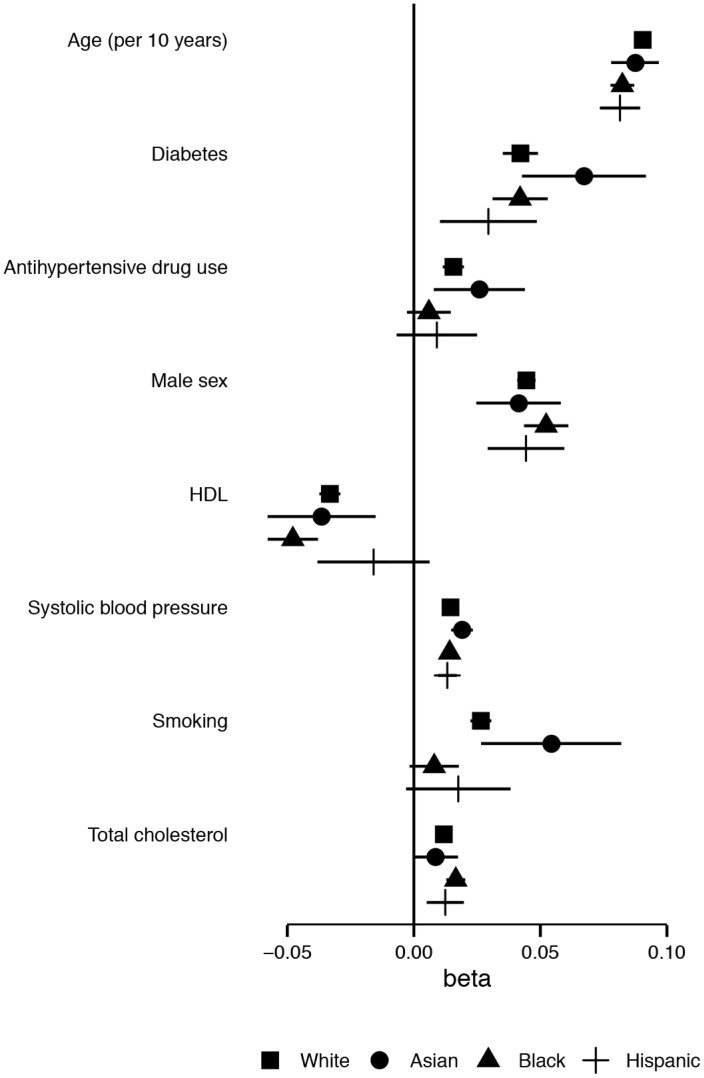
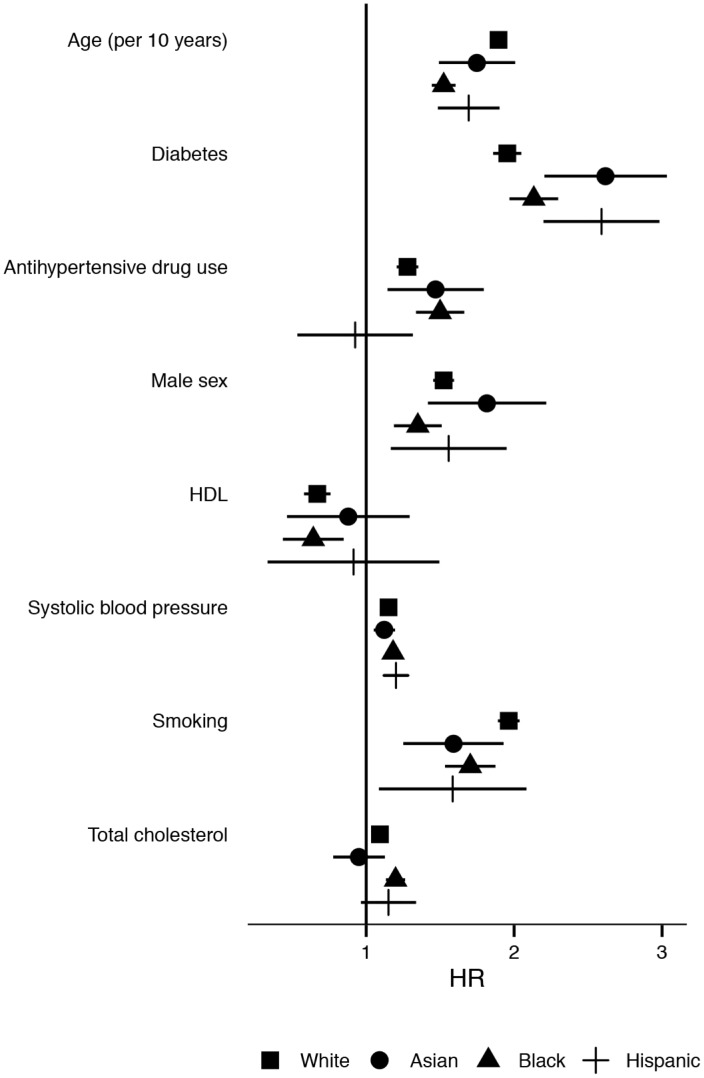
Verification
Claims the paper makes
The claims and statistics of this paper haven’t been checked yet.
Free: it reads the open-access text and checks the first 5 claims that cite a source we can check. Create a free account to check every claim.
Claims other papers make about this one
Each is checked against this paper’s own text: does it say what the citing paper says it does?
The source backs part of the claim, not all of it — or backs it for a different population, condition or comparison.
In the citing paper
“For example, some researchers have used data from the famous Framingham Heart study, which mainly included white males, to develop a cardiovascular risk prediction algorithm for African-American patients; and the result was not successful because the two demographic groups have different risk factors and disease etiology (Gijsberts et al., 2015).”
From Addressing Fairness, Bias, and Appropriate Use of Artificial Intelligence and Machine Learning in Global Health (2021) · cites this paper as Gijsberts et al., 2015
Experimental — accuracy not yet measuredThe source backs part of the claim, not all of it — or backs it for a different population, condition or comparison.
In the citing paper
“Unethically and irresponsibly designed AI/ML solutions deployed in the healthcare setting can exacerbate and perpetuate systematic biases and disparities for those from marginalized groups [27–29].”
From ChatGPT and large language models in academia: opportunities and challenges (2023) · cites this paper as [28]
Experimental — accuracy not yet measuredThe cited source says what the claim attributes to it.
In the citing paper
“For example, the Framingham heart study primarily included white participants. A model trained on this data may reflect racial and ethnic bias because associations between cardiovascular risk factors and events differ by race and ethnicity.25”
From Artificial Intelligence and Surgical Decision-making. (2020) · cites this paper as [25]
Self-check
Percentages, sums and reported differences re-computed from the paper’s own numbers.
The self-check needs the paper’s full text.
Citations
Cites
2013 ACCF/AHA Guideline for the Management of Heart Failure
Yancy, C. W., Jessup, M., Bozkurt, B., Butler, J., Casey, D. E., Drazner, M. H., Fonarow, G. C., Geraci, S. A., Horwich, T., Januzzi, J. L., et al. (2013) · Journal of the American College of Cardiology · doi:10.1016/j.jacc.2013.05.019 · Cited by 12,536
Yusuf, S., Hawken, S., Ôunpuu, S., Dans, T., Avezum, A., Lanas, F., McQueen, M., Budaj, A., Pais, P., Varigos, J., et al. (2004) · The Lancet · doi:10.1016/s0140-6736(04)17018-9 · Cited by 12,026
Child abuse: Adolescent records vs. adult recall
Femina, D. D., Yeager, C. A., & Lewis, D. O. (1990) · Child Abuse & Neglect · doi:10.1016/0145-2134(90)90033-p · Cited by 8,820
Global status report on noncommunicable diseases 2010.
Alwan, A. (2011) · Cited by 8,494
General Cardiovascular Risk Profile for Use in Primary Care: The Framingham Heart Study
D’Agostino, R. B., Vasan, R. S., Pencina, M. J., Wolf, P. A., Cobain, M., Massaro, J. M., & Kannel, W. B. (2008) · Circulation · doi:10.1161/circulationaha.107.699579 · Cited by 7,491
Estimation of ten-year risk of fatal cardiovascular disease in Europe: the SCORE project
Conroy, R. (2003) · European Heart Journal · doi:10.1016/s0195-668x(03)00114-3 · Cited by 5,290 · cited 1×
“For example, the landmark Framingham Risk Score (FRS)[3] and the European SCORE[4] have been developed in a largely White population.”
Background2013 ACC/AHA Guideline on the Assessment of Cardiovascular Risk
Goff, D. C., Lloyd-Jones, D. M., Bennett, G., Coady, S., D’Agostino, R. B., Gibbons, R., Greenland, P., Lackland, D. T., Levy, D., O’Donnell, C. J., et al. (2014) · Journal of the American College of Cardiology · doi:10.1016/j.jacc.2013.11.005 · Cited by 4,945
Goff, D. C., Lloyd-Jones, D. M., Bennett, G., Coady, S., D’Agostino, R. B., Gibbons, R., Greenland, P., Lackland, D. T., Levy, D., O’Donnell, C. J., et al. (2014) · Circulation · doi:10.1161/01.cir.0000437741.48606.98 · Cited by 3,697
The Cardiovascular Health Study: design and rationale.
Fried, L. P., Borhani, N. O., Enright, P., Furberg, C. D., Gardin, J. M., Kronmal, R. A., Kuller, L. H., Manolio, T. A., Mittelmark, M. B., Newman, A., et al. (1991) · Annals of Epidemiology · doi:10.1016/1047-2797(91)90005-w · Cited by 3,652 · cited 2×
“Out of the 17 cohorts participating in USE-IMT, we included 15 cohorts[12–26], consisting of 66,213 individuals.”
MethodSelf-citationA general cardiovascular risk profile: The Framingham study
Kannel, W. B., McGee, D., & Gordon, T. (1976) · The American Journal of Cardiology · doi:10.1016/0002-9149(76)90061-8 · Cited by 1,189 · cited 3×
“[5] Both QRISK2 and the FRS, identified only 10% to 24% of individuals to be at high risk of those who experienced cardiovascular (CV) events among African Caribbeans.”
Background
Research works printed but not linked: 1
- Centers for Disease Control and Prevention (CDC). Cigarette smoking among adults and trends in smoking cessation—United States, 2008. MMWR Morb Mortal Wkly Rep. 2009; 58: 1227– 32. 19910909
Cited by
Items 101–196 of 196
Data-driven machine learning: A new approach to process and utilize biomedical data
., K., Srivastava, A., & Jha, S. S. (2022) · Elsevier eBooks · doi:10.1016/b978-0-323-99864-2.00017-2 · Cited by 13
Basaraba, C. N., Scodes, J. M., Dambreville, R., Radigan, M., Dachepally, P., Gu, G., Wang, R., Dixon, L. B., & Wall, M. M. (2022) · JAMA Psychiatry · doi:10.1001/jamapsychiatry.2022.3571 · Cited by 11
Zhalechian, M., Oyen, M. P. V., Lavieri, M. S., Moraes, C. G. D., Girkin, C. A., Fazio, M. A., Weinreb, R. N., Bowd, C., Liebmann, J. M., Zangwill, L. M., et al. (2021) · Ophthalmology Science · doi:10.1016/j.xops.2021.100097 · Cited by 11
It's the data, stupid: Inflection point for Artificial Intelligence in Indian healthcare
Ramaswamy, A., Gowda, N. R., Vikas, H., Prabhu, M., Sharma, D. K., Gowda, P. R., Mohan, D., & Kumar, A. (2022) · Artificial Intelligence in Medicine · doi:10.1016/j.artmed.2022.102300 · Cited by 9
Diego, V. P., Manusov, E. G., Mao, X., Curran, J. E., Göring, H. H. H., Almeida, M., Mahaney, M. C., Peralta, J. M., Blangero, J., & Williams‐Blangero, S. (2023) · Frontiers in Genetics · doi:10.3389/fgene.2023.1132110 · Cited by 10
Marrast, L., Conigliaro, J., Chan, C., Kim, E. J., Duer-Hefele, J., Diefenbach, M. A., & Davidson, K. W. (2021) · Personalized Medicine · doi:10.2217/pme-2020-0166 · Cited by 6
Im, Y., Kang, S. H., Park, G., Yoo, H., Chun, M. Y., Kim, C., Park, C. J., Kim, J. P., Jang, H., Kim, H. J., et al. (2024) · Brain Communications · doi:10.1093/braincomms/fcae213 · Cited by 7
“25,26,43 For instance, hypertension is strongly associated with increased arterial stiffness 44 and carotid intima thickness 45,46 in Asians, which may further contribute to brain atrophy.”
BackgroundHealth inequalities in AI machine learning
Chung, R. Y., & Freedman, B. (2024) · Elsevier eBooks · doi:10.1016/b978-0-323-95068-8.00009-1 · Cited by 7
Ahmed, K. M., Das, B. C., Saadati, Y., & Amini, M. H. (2024) · Big and integrated artificial intelligence · doi:10.1007/978-3-031-57567-9_4 · Cited by 6
Solomon, S., Sarah, H., Rahayma, S., Jennifer, L. G., Phillips, M., & Stachel, A. G. (2021) · Journal of Infectious Diseases and Epidemiology · doi:10.23937/2474-3658/1510215 · Cited by 8
Artificial Intelligence in Healthcare
Aggarwal, N., Matheny, M. E., Shachar, C., Wang, S. X. Y., & Israni, S. T. (2022) · Oxford University Press eBooks · doi:10.1093/oxfordhb/9780197579329.013.50 · Cited by 8
Are the current evaluation tools for advanced therapies biased?
Givens, R. C. (2021) · Current Opinion in Cardiology · doi:10.1097/hco.0000000000000848 · Cited by 7
Robust Causal Inference Under Covariate Shift via Worst-Case Subpopulation Treatment EffectsPreprint
Jeong, S., & Namkoong, H. (2020) · arXiv (Cornell University) · Cited by 27
Lewis, A., Bacong, A., Palaniappan, L., & Hernandez-Boussard, T. (2025) · Journal of the American Heart Association : Cardiovascular and Cerebrovascular Disease · doi:10.1161/jaha.125.041549 · Cited by 8
Quarpong, W., Chandrasekaran, S., Narayan, K. M. V., Ramakrishnan, U., Tandon, N., & Patel, S. A. (2025) · Global Heart · doi:10.5334/gh.1408 · Cited by 7
Sone, P. E., & Ebune, E. J. (2025) · CogNexus · doi:10.63084/cognexus.v1i02.123 · Cited by 8
“The need to ensure cultural and linguistic sensitivity in AI systems is especially pressing in Nepal due to its ethnic diversity, a factor emphasized by Gijsberts et al. (2015) concerning algorithmic fairness.”
Anbar, R., Jones, S. H., Chaturvedi, N., Sudre, C. H., Richards, M., Sultan, S. R., & Hughes, A. D. (2024) · Atherosclerosis Plus · doi:10.1016/j.athplu.2024.01.002 · Cited by 6
“Studies in multi-ethnic populations have been small and infrequent [14 – 16].”
BackgroundKünstliche Intelligenz: Herausforderungen und Nutzen in der Intensivmedizin
Märtin, L., Peine, A., Gronholz, M., Marx, G., & Bickenbach, J. (2022) · AINS - Anästhesiologie · Intensivmedizin · Notfallmedizin · Schmerztherapie · doi:10.1055/a-1423-8006 · Cited by 8
Damen, J. A. (2016) · BMJ · doi:10.1136/bmj.i4485 · Cited by 6
Measuring and Reducing Racial Bias in a Pediatric Urinary Tract Infection ModelPreprint
Anderson, J. W., Shaikh, N., & Visweswaran, S. (2023) · medRxiv · doi:10.1101/2023.09.18.23295660 · Cited by 10
“For example, if there is systemic racism in healthcare access and delivery, historical EHR data will encode these biases and lead to discriminative predictive models [15].”
Choi, H., Kim, Y. T., Kang, J., Kim, Y., Lee, J., & Sung, K. (2025) · Journal of Clinical Medicine · doi:10.3390/jcm14061918 · Cited by 7
“This finding is consistent with previous research that reported a significant correlation between dyslipidemia and increased IMT, particularly in individuals with multiple cardiovascular risk factors [10].”
Diversity in Machine Learning: A Systematic Review of Text-Based Diagnostic Applications
Fitzsimmons, L., Dewan, M. L., & Dexheimer, J. W. (2022) · Applied Clinical Informatics · doi:10.1055/s-0042-1749119 · Cited by 7
Breast arterial calcification rates in a diverse, urban group of screening mammography patients
Montgomery, G. H., Schnur, J. B., Erblich, J., Narula, J., Benck, K. N., & Margolies, L. R. (2022) · Annals of Epidemiology · doi:10.1016/j.annepidem.2022.08.040 · Cited by 4
Obstacles to effective model deployment in healthcare
Chan, W. X., & Wong, L. (2023) · Journal of Bioinformatics and Computational Biology · doi:10.1142/s0219720023710014 · Cited by 4
“that was predominantly white and male, was found to be inaccurate when deployed on black populations.(20) To maximize the prediction performance of a model on the”
BackgroundStructural and social determinants of health: The multi-ethnic study of atherosclerosis
Besser, L. M., Forrester, S., Arabadjian, M. E., Bancks, M. P., Culkin, M. C., Hayden, K. M., Le, E. T., Pierre‐Louis, I. C., & Hirsch, J. A. (2024) · PLoS ONE · doi:10.1371/journal.pone.0313625 · Cited by 6
Akimoto, S., Goto, C., & Kuriki, K. (2019) · BMC Nutrition · doi:10.1186/s40795-019-0315-6 · Cited by 6
Algorithmic Fairness and AI Justice in Addressing Health Equity
Park, Y., Singh, M., Koski, E., Sow, D., Scheufele, E. L., & Bright, T. J. (2022) · Health informatics · doi:10.1007/978-3-031-07912-2_15 · Cited by 4
Quantifying and reducing inequity in average treatment effect estimation
Nieser, K. J., & Cochran, A. L. (2023) · BMC Medical Research Methodology · doi:10.1186/s12874-023-02104-2 · Cited by 4
“In many cases, such as investigations of associations between Framingham risk factors and cardio-vascular disease [44] and genetic studies of various health outcomes [45], imbalance in study representation has led to study findings that generalize better for subgroups with greater representation.”
BackgroundChair, S. Y., Chow, K. M., Chan, C. W.-L., Chan, J. Y., Law, B., & Waye, M. M. Y. (2024) · Genes · doi:10.3390/genes15081082 · Cited by 5
“In addition to enriching the wide breadth of biomedical knowledge, the information is needed for more accurate diagnosis for patients of different ancestral backgrounds [79,82].”
BackgroundBrito, D. J. D. A., Santos, E. M. D., Dias, R. S. C., Calado, I. L., Silva, G. E. B., Lages, J. S., Júnior, F. D. C. M., dos Santos, A. M., & Filho, N. S. (2018) · Renal Failure · doi:10.1080/0886022x.2018.1496932 · Cited by 3
“[10], in a metaanalysis that included 60,211 participants from four ethnic groups (White, Black, Asian, and Hispanic), found that an increase in age was related with the CIMT and the greater risk for cardiovascular events in the Black population.”
BackgroundImplementing pathways to anesthesiology: Promoting diversity, equity, inclusion, and success
O’Conor, K. J., Young, L., Tomobi, O., Golden, S. H., Samen, C. D. K., & Banks, M. (2022) · International Anesthesiology Clinics · doi:10.1097/aia.0000000000000386 · Cited by 4
Artificial intelligence in healthcare
Argenson, A., & Devi-Chou, V. (2023) · Principles of Gender-Specific Medicine · doi:10.1016/b978-0-323-88534-8.00025-0 · Cited by 4
Ultrasonography: The Global Imaging Solution
Elías, J., & Nogueira‐Barbosa, M. H. (2016) · Current Radiology Reports · doi:10.1007/s40134-016-0185-5 · Cited by 3
Salgado-Filho, N., Lages, J. S., Brito, D. J. D. A., Salgado, J. V., Silva, G. E. B., dos Santos, A. M., Monteiro-Júnior, F. C., Santos, E. M., da Sílva, A. A. M., Araújo, D. V., et al. (2018) · BMC Nephrology · doi:10.1186/s12882-018-0839-z · Cited by 4
Posadas‐Sánchez, R., Vargas‐Alarcón, G., Pérez-Méndez, O. A., Pérez‐Hernández, N., & Rodríguez-Pérez, J. M. (2022) · Life · doi:10.3390/life12101531 · Cited by 4
“We have to consider that stratification based on CIMT > 75th percentile of age and sex-biased towards increased diabetes and high-cholesterol frequencies in this group since both conditions are statistically associated with CIMT in Hispanic individuals [52] as well as in our study.”
ResultEthics, emerging research trends, issues and challenges
SCHNEIDER, P. L., & Xhafa, F. (2022) · Elsevier eBooks · doi:10.1016/b978-0-12-823818-9.00025-0 · Cited by 4
Artificial Intelligence in medicine: Potential applications and barriers to deployment
Sonawane, U., & Komorowski, M. (2023) · AI critique · doi:10.1515/9783839467664-009 · Cited by 5
Understanding Artificial Intelligence Along with Legal and Ethical Issues
ÇİÇİN, F. N., & Sayın, S. (2024) · Journal of Oncological Sciences · doi:10.37047/jos.2023-99598 · Cited by 5
Chomiuk, T., Kasiak, P. S., Mamcarz, A., & Śliż, D. (2025) · Reviews in Cardiovascular Medicine · doi:10.31083/rcm37493 · Cited by 2
“Moreover, studies most often include patients from Europe and North America [8,86].”
Noel, S. E., Cornell, D. J., Zhang, X., Mirochnick, J., Mattei, J., Falcón, L. M., & Tucker, K. L. (2021) · PLoS ONE · doi:10.1371/journal.pone.0245236 · Cited by 3
“In addition, as the FRS was developed and validated in a primarily non-Hispanic white population [15,16], it may inadequately determine CVD risk among Hispanic and other ethnic minority populations [16–19].”
MethodEthnicity in Anaesthesia research: Time to search our own backyards!
Upadya, M., Durga, P., Rao, S. T., & Kurdi, M. S. (2022) · Indian Journal of Anaesthesia · doi:10.4103/ija.ija_642_22 · Cited by 2
“An excellent example of this is the Framingham heart study, which found that ethnicity significantly modifies the association between risk factors and cardiovascular events.[1] Similarly, the performance of obstetric comorbidity adjustment indices was tested across race and ethnicity groups in a recent study.”
BackgroundThe Impact of Bias on Drift Detection in AI Health Software
Azar, A. K., Draghi, B., Rotalinti, Y., Myles, P. R., & Tucker, A. (2023) · Lecture notes in computer science · doi:10.1007/978-3-031-34344-5_37 · Cited by 8
Behavioral Health Decision Support Systems and User Interface Design in the Emergency Department
Jones, N. W., Song, S. L., Thomasian, N. M., Samuels, E. A., & Ranney, M. L. (2023) · Applied Clinical Informatics · doi:10.1055/s-0043-1771395 · Cited by 2
Artificial intelligence in peri‐operative prediction model research: are we there yet?
Shah, A., & Dhiman, P. (2024) · Anaesthesia · doi:10.1111/anae.16315 · Cited by 2
Gupta, V., Broughton, J., Rukundo, A., & Pinky, L. Y. (2025) · Informatics in Medicine Unlocked · doi:10.1016/j.imu.2025.101627 · Cited by 5
Clinician Cognition and Artificial Intelligence in Medicine
Chang, A. C. (2020) · Elsevier eBooks · doi:10.1016/b978-0-12-823337-5.00007-x · Cited by 4
Metabolic Syndrome Risk Models and Scores: A Systematic Review
Ibrahim, M. S., Pang, D., Pappas, Y., & Randhawa, G. (2020) · Biomedical Journal of Scientific & Technical Research · doi:10.26717/bjstr.2020.26.004307 · Cited by 2
“Having MetS models from those countries is necessary because it is a known fact that in risk prediction models there are significant variations in predictor-outcome association in different ethnicities [13,51].”
BackgroundWang, Y., Wang, A., Li, Z., Li, Z., Hu, B., Li, X., Zheng, H., Hu, H., Hu, H., Nie, Z., et al. (2020) · Trials · doi:10.1186/s13063-020-04741-0 · Cited by 2
Self-citationArtificial intelligence in healthcare in Nepal
Shankar, P. R. (2022) · Janaki Medical College Journal of Medical Science · doi:10.3126/jmcjms.v10i1.44622 · Cited by 2
“The algorithms and processes behind AI should be localized to fit local populations and practice patterns and must be rigorously tested for bias across different patient cohorts [7].”
BackgroundWilliams, J. R., & Razavian, N. (2019) · arXiv (Cornell University) · doi:10.48550/arxiv.1911.07679 · Cited by 2
“It showed that the presence of atherosclerotic disease interacted differently between race and ethnic groups[2].”
BackgroundMental Health Disparities and Technology: New Risks and Opportunities
Arevian, A. C., Jones, F., & Chung, B. (2019) · Psychiatric Annals · doi:10.3928/00485713-20190416-03 · Cited by 4
AI: simply reinforcing medicine’s worst biases?
Maitland, S., McElnay, P., & Brady, R. R. W. (2020) · BMJ Innovations · doi:10.1136/bmjinnov-2019-000376 · Cited by 1
Kirichenko, T. V., Chernova, E. V., Chegodaev, Y. S., Kontush, A., Sobenin, I. A., Giral, P., Summerhill, V. I., & Orekhov, A. N. (2020) · PubMed Central · Cited by 1
Addressing Health Equity: Sources, Impact and Mitigation of Biased Data
Koski, E., Suárez, F., Park, Y., South, B. R., Scheufele, E. L., & Dankwa‐Mullan, I. (2022) · Health informatics · doi:10.1007/978-3-031-07912-2_26 · Cited by 2
Beyond Quantity: Research with Subsymbolic AI
Sudmann, A., Echterhölter, A., Ramsauer, M., Retkowski, F., Schröter, J., & Waibel, A. (2023) · AI critique · doi:10.1515/9783839467664 · Cited by 14
Ravuri, V., Paromita, P., Mundnich, K., Nadarajan, A., Booth, B. M., Narayanan, S. S., & Chaspari, T. (2020) · International Journal of Semantic Computing · doi:10.1142/s1793351x20500075 · Cited by 2
Artificial Intelligence-Based Cardiovascular Risk Stratification
Malkawi, A., Almarzooq, Z., Al-Mallah, M. H., & Alaref, S. J. (2022) · Contemporary medical imaging · doi:10.1007/978-3-030-92087-6_39 · Cited by 2
Application of AI in Healthcare
Priya, V., & Prabu, S. (2022) · doi:10.1002/9781119762010.ch9 · Cited by 1
Participant Flow Diagrams for Health Equity in AI ResearchPreprint
Ellen, J., de Matos, J. C. R. G., Viola, M., Gallifant, J., Quion, J. M., Celi, L. A., & Hussein, N. S. A. (2023) · medRxiv · doi:10.1101/2023.10.05.23296611 · Cited by 1
“Many, for example, have highlighted instances of algorithmic discrimination [10]–[12], which often results from a lack of population representativeness or from the algorithm encoding structural biases already present in a dataset.”
BackgroundDalan, R. (2024) · DR-NTU (Nanyang Technological University) · doi:10.32657/10356/175011 · Cited by 5
Technology Dependence of Intima-Media Thickness Ultrasonographic Measurements
Braga, F. A., Salles-Cunha, S. X., de Barros, S. M. W., & Pitta, G. B. B. (2017) · Journal for Vascular Ultrasound · doi:10.1177/154431671704100301
Shorikov, E. I., Shorikova, D. V., Хухліна, О. С., Shuper, V. О., & Trefanenko, I. V. (2019) · Clinical & experimental pathology · doi:10.24061/1727-4338.xviii.3.69.2019.16
The $r$-value: evaluating stability with respect to distributional shiftsPreprint
Gupta, S., & Rothenhaüsler, D. (2021) · arXiv (Cornell University)
Neto, P. J. D. S. (2021) · Digital Library of Theses and Dissertations (Universidade de São Paulo) · doi:10.11606/t.5.2021.tde-19082021-112516
Impact of Artificial Intelligence Integration on Surgical Outcome
Umar, M. (2021) · Journal of the Dow University of Health Sciences · doi:10.36570/jduhs.2021.2.983 · Cited by 1
Carotid intima-media thickness and cardiovascular disease risk in African populations
Nonterah, E. A. (2021) · Utrecht University Repository (Utrecht University) · doi:10.33540/906
Worrall, B. B., Chiota-McCollum, N. A., & Southerland, A. M. (2017) · Springer eBooks · doi:10.1007/978-3-319-56210-0_12
Walker, K., Potter, E., Hwang, I., Dwyer, T., Egerton‐Warburton, D., Joe, K., Hutton, J., Freeman, S., & Flynn, D. (2022) · medRxiv · doi:10.1101/2022.03.30.22273211 · Cited by 2
Breast Arterial Calcification Rates in a Diverse, Urban Sample of Screening Mammography PatientsPreprint
Montgomery, G. H., Schnur, J. B., Erblich, J., Narula, J., Benck, K. N., & Margolies, L. R. (2022) · SSRN Electronic Journal · doi:10.2139/ssrn.4048686
Mercado, C. I., & Loustalot, F. V. (2016) · American Public Health Association eBooks · doi:10.2105/9780875532783ch14
Sanatang, S., & Ismail, M. A. (2023) · Poltekita Jurnal Ilmu Kesehatan · doi:10.33860/jik.v17i3.3355
Barriers to AI Adoption in Healthcare
Razmi, R. M. (2024) · Wiley eBooks · doi:10.1002/9781394240197.ch3 · Cited by 2
Künstliche Intelligenz: Herausforderungen und Nutzen in der Intensivmedizin
Märtin, L., Peine, A., Gronholz, M., Marx, G., & Bickenbach, J. (2024) · intensiv · doi:10.1055/a-2240-2823
Hospital racial composition and outcomes after transcatheter and surgical aortic valve replacement
Biancari, F., & Mäkikallio, T. H. (2024) · Catheterization and Cardiovascular Interventions · doi:10.1002/ccd.31022
Genetics of Carotid Atherosclerosis
Worrall, B. B., Southerland, A. M., & Gusler, M. T. (2024) · Springer eBooks · doi:10.1007/978-3-031-41777-1_14
Saurav Aryal, Okunji, P. O., Shara, N. M., Libin, A., Jackson, A. D., Laurence, B., Ferguson, E. S., Washington, G. J., & Burge, L. (2024) · American Public Health Association eBooks · doi:10.2105/9780875533476ch12
Prediction of glucose concentration in type 1 diabetes patients based on machine learning techniques
Lai, V., Lo, O., & Chow, P. (2024) · Elsevier eBooks · doi:10.1016/b978-0-323-95686-4.00008-3
Current trends of computational tools and artificial intelligence in geriatric medicine
Awuah, W. A., Yong, B. M. O., Mikhailova, T., Ng, J. C., Abdul‐Rahman, T., Yarlagadda, R., Tedeschi, A. J., Miteu, G. D., Garg, T., David, L., et al. (2024) · Elsevier eBooks · doi:10.1016/b978-0-443-15702-8.00023-3
Mitra, M., Basu, M., Ghosh, A., & Pal, R. (2024) · Journal of Surgical Specialties and Rural Practice · doi:10.4103/jssrp.jssrp_18_24
Racial/Ethnic Differences in Framingham Risk Score in an NHANES Cohort
Farokhrouz, A., Bowden, R. G., Richardson, K. A., Ahmed, T., & Kishore, J. (2024) · Journal of Preventive Medicine And Care · doi:10.14302/issn.2474-3585.jpmc-24-5299 · Cited by 1
García, J. J. (2017) · University of North Texas Digital Library (University of North Texas) · doi:10.12794/metadc1011872
Determinants of Progression and Regression of Subclinical Atherosclerosis: A Temporal Perspective
Ahmad, R., Frishman, W. H., & Aronow, W. S. (2025) · Cardiology in Review · doi:10.1097/crd.0000000000001053 · Cited by 1
Rudolph, M. D., Tanley, J. E., Ding, J., Sai, K. K. S., Chen, H., Hayden, K. M., Liu, Y., Bryan, R. N., Nasrallah, I. M., Dolui, S., et al. (2025) · Cerebral Circulation - Cognition and Behavior · doi:10.1016/j.cccb.2025.100406 · Cited by 2
“…that White participants had elevated levels of arteriosclerosis, and CAIDE scores were highest in Hispanic participants as previously reported [49,50]; Black participants exhibited relatively elevated sub-clinical composite scores compared to all other self-reported racial groups [49,51,52].”
Tan, K., Harris, S. E., Maddock, J., Tay, D., Jain, P., The HELIOS Study Team, Mok, S. Q., Herbrard, M., Schminke, U., Xue, C., et al. (2025) · medRxiv · doi:10.1101/2025.11.21.25340774
Additional file 1 of Quantifying and reducing inequity in average treatment effect estimation
Nieser, K. J., & Cochran, A. L. (2024) · Figshare · doi:10.6084/m9.figshare.26654446
Morgenstern, J., Rosella, L. C., Daley, M. J., Goel, V., Schünemann, H. J., & Piggott, T. (2021) · Figshare · doi:10.6084/m9.figshare.13534369
Morgenstern, J., Rosella, L. C., Daley, M. J., Goel, V., Schünemann, H. J., & Piggott, T. (2021) · Figshare · doi:10.6084/m9.figshare.13534360
Morgenstern, J., Rosella, L. C., Daley, M. J., Goel, V., Schünemann, H. J., & Piggott, T. (2021) · Figshare · doi:10.6084/m9.figshare.13534354
Wang, Y., Wang, A., Li, H., Li, Z., Hu, B., Li, X., Zheng, H., Fu, L., Hu, H., 聂志余, et al. (2020) · Figshare · doi:10.6084/m9.figshare.13225534
Self-citationMorgenstern, J., Rosella, L. C., Daley, M. J., Goel, V., Schünemann, H. J., & Piggott, T. (2021) · Figshare · doi:10.6084/m9.figshare.13534357
Waheed, M., & Ashista, H. (2026) · Journal of Immigrant and Minority Health · doi:10.1007/s10903-026-01881-4
Tan, K., Harris, S., Maddock, J., Tay, D., Jain, P. R., Science, H., Mok, S. Q., Hebrard, M., Schminke, U., Xue, C. C., et al. (2026) · Research Square · doi:10.21203/rs.3.rs-9046066/v1
Annotation et hiérarchisation de variants non-codants dans le contexte de maladies humaines
Moyon, L. (2019) · theses.fr (ABES) · doi:10.70675/208b20dcz3942z4342z8908z65691180bec0
Xie, X., Liu, C., Liu, Y., & Zhou, Y. (2026) · Chinese general practice journal. · doi:10.1016/j.cgpj.2026.100114
Quennelle, S., Malekzadeh-Milani, S. G., Garcelon, N., Burgun, A., Bonnet, D., & Neuraz, A. (2026) · BMC Cardiovascular Disorders · doi:10.1186/s12872-026-06065-4
Artificial Intelligence: Promises, Pitfalls, and Ethical Considerations
Aung, N., Roney, C. H., Leslie, D., Slabaugh, G., & Petersen, S. E. (2026) · Elsevier eBooks · doi:10.1016/b978-0-443-12497-6.00009-9
Metadata
- Authors
- Gijsberts, C. M., Groenewegen, K. A., Hoefer, I. E., Eijkemans, M. J. C., Asselbergs, F. W., Anderson, T. J., Britton, A. R., Dekker, J. M., Engström, G., Evans, G. W., de Graaf, J., Grobbee, D. E., Hedblad, B., Holewijn, S., Ikeda, A., Kitagawa, K., Kitamura, A., de Kleijn, D. P. V., Lonn, E. M., Lorenz, M. W., Mathiesen, E. B., Nijpels, G., Okazaki, S., O’Leary, D. H., Pasterkamp, G., Peters, S. A. E., Polak, J. F., Price, J. F., Robertson, C., Rembold, C. M., Rosvall, M., Rundek, T., Salonen, J. T., Sitzer, M., Stehouwer, C. D. A., Bots, M. L., & den Ruijter, H. M.
- Affiliations
- University Medical Center Utrecht (NL)
- University of Calgary (CA)
- University College London (GB)
- Amsterdam UMC Location Vrije Universiteit Amsterdam (NL)
- Lund University (SE)
- Wake Forest University Health Sciences (US)
- University Malaya Medical Centre (MY)
- Radboud University Medical Center (NL)
- Tokyo Women's Medical University (JP)
- Population Health Research Institute (CA)
- Goethe University Frankfurt (DE)
- UiT The Arctic University of Norway (NO)
- The University of Osaka (JP)
- Tufts Medical Center (US)
- University of Edinburgh (GB)
- University of Virginia (US)
- University of Miami (US)
- Maastricht University Medical Centre (NL)
- ORCID
- Gijsberts, Crystel M.
- Hoefer, Imo E.
- Eijkemans, Marinus J. C.
- Asselbergs, Folkert W.
- Anderson, Todd J.
- Britton, Annie R.
- Engström, Gunnar
- Grobbee, Diederick E.
- Holewijn, Suzanne
- Ikeda, Ai
- Kitagawa, Kazuo
- Kitamura, Akihiko
- Lonn, Eva M.
- Lorenz, Matthias W.
- Mathiesen, Ellisiv B.
- Nijpels, Giel
- Okazaki, Shuhei
- Pasterkamp, Gerard
- Peters, Sanne A. E.
- Polak, Joseph F.
- Rembold, Christopher M.
- Rundek, Tatjana
- Stehouwer, Coen D. A.
- Bots, Michiel L.
- Venue
- PLOS ONE
- Publisher
- Public Library of Science (PLoS)
- Published
- 2015-07-02
- Volume
- 10
- Issue
- 7
- Pages
- e0132321
- ISSN
- 1932-6203 (ISSN-L)
- PMC
- PMC4489855
- OpenAlex
- W1795144871
- Cited by
- 197
- References
- 39
- Citations by year
- 2026: 5 · 2025: 11 · 2024: 27 · 2023: 26 · 2022: 32 · 2021: 32 · 2020: 23 · 2019: 18 · 2018: 9 · 2017: 6 · 2016: 8
- FWCI
- 5.58
- Type
- journal article
- Language
- en
- Open access
- gold
- doi.org
- Licence
- Locations
- PLoS ONE (publishedVersion, cc-by)
- Europe PMC (PubMed Central) (publishedVersion, cc-by)
- PubMed Central (publishedVersion, cc-by)
- PubMed (publishedVersion)
- Research Publications (Maastricht University) (publishedVersion, cc-by)
- Amsterdam UMC (VU Amsterdam) - Institutional Repository (publishedVersion)
- National University of Singapore (submittedVersion, cc-by)
- DOAJ (DOAJ: Directory of Open Access Journals) (submittedVersion)
- UCL Discovery (University College London) (submittedVersion)
- Lund University Publications (Lund University) (submittedVersion)
- NORA - Norwegian Open Research Archives (submittedVersion, other-oa)
- Publication Server of Goethe University Frankfurt am Main (Goethe University Frankfurt) (submittedVersion, cc-by)
- Edinburgh Research Explorer (University of Edinburgh) (submittedVersion, cc-by)
- Radboud Repository (Radboud University) (submittedVersion)
- Radboud Repository (Radboud University) (submittedVersion, other-oa)
- Research Publications (Maastricht University) (submittedVersion, other-oa)
- Data Archiving and Networked Services (DANS) (submittedVersion, other-oa)
- Data Archiving and Networked Services (DANS) (submittedVersion)
- Funders
- ZonMw (200320003)
- National Institutes of Health (n01hc085082-026, n01hc085081-021, n01hc085079-024, n01hc085083-027, n01hc085080-026, n01hc085086-022, n01hc095167-000, HHSN268200800007C, N01-HC- 95159, n01hc95159-40-0-1, HHSN268201200036C, n01hc055222-001, N01-HC-95167, N01HC85086, N01-HC-85082, N01HC85079, N01HC85080, N01HC85083, N01-HC-85081)
- Medical Research Council (MR/M006638/1)
- National Heart, Lung, and Blood Institute (N01 HC085086, N01 HC-95159, N01 HC95167, N01 HC085079, N01 HC085083, N01 HC085080, HHSN 268200800007C, N01-HC-095159, HHSN268201200036C, N01 HC095167, N01HC085082, N01 HC055222, N01 HC085081)
- Topics
- Health Sciences › Medicine › Cardiology and Cardiovascular Medicine › Cardiovascular Health and Disease Prevention
- Health Sciences › Medicine › Cardiology and Cardiovascular Medicine › Cardiovascular Health and Risk Factors
- Health Sciences › Medicine › Endocrinology, Diabetes and Metabolism › Diabetes, Cardiovascular Risks, and Lipoproteins
- Keywords
- racial and ethnic differences, carotid intima-media thickness, cardiovascular risk factors, myocardial infarction, stroke, primary prevention, African Americans, Hispanic Americans, Asian Americans, systolic blood pressure, HDL cholesterol, smoking, total cholesterol, age
- MeSH terms
- Adult, Aged, Carotid Artery Diseases, Diabetes Mellitus, Ethnicity, Female, Follow-Up Studies, Humans, Hypertension, Cholesterol, HDL, Cholesterol, LDL, Male, Middle Aged, Myocardial Infarction, Risk Factors, Smoking, Global Health, Comorbidity, Incidence, Prevalence, Linear Models, Proportional Hazards Models, Age Distribution, Stroke, Racial Groups, Dyslipidemias, Carotid Intima-Media Thickness
About these checks
Registry, retraction, Cites and statistics results are computed, not judged, with one exception: a printed reference that no index lists is read once by a model before it counts as a citation error. Claims are extracted by a model and kept only when their quote appears verbatim in the text; each cited source is then checked, with a model’s help, for whether it says what the claim relies on. Those verdicts can be wrong — read the claim’s quote and the cited source before relying on one.
Statistics and arithmetic are recomputed, not judged.
Confidence bands are shown only for fields calibrated on our annotated test set. None is calibrated yet, so no band is shown.
What counts as a claim ›How we measure confidence ›How we check this ›
Are you an author, or do you see a problem with this page? Request a review
Data sources
Bibliographic data: Semantic Scholar, OpenAlex, Crossref.
Contains information from the Semantic Scholar Academic Graph Datasets, made available under the ODC Attribution License (ODC-BY 1.0).
Semantic Scholar’s data is described in: Kinney, R., et al. (2023). The Semantic Scholar Open Data Platform. arXiv:2301.10140.
