

Race/ethnic differences in the associations of the framingham risk factors with carotid IMT and cardiovascular events.
Open accessThe DOI matches its Crossref record; 37 of the 39 references it cites were found in a registry or an index.
Abstract
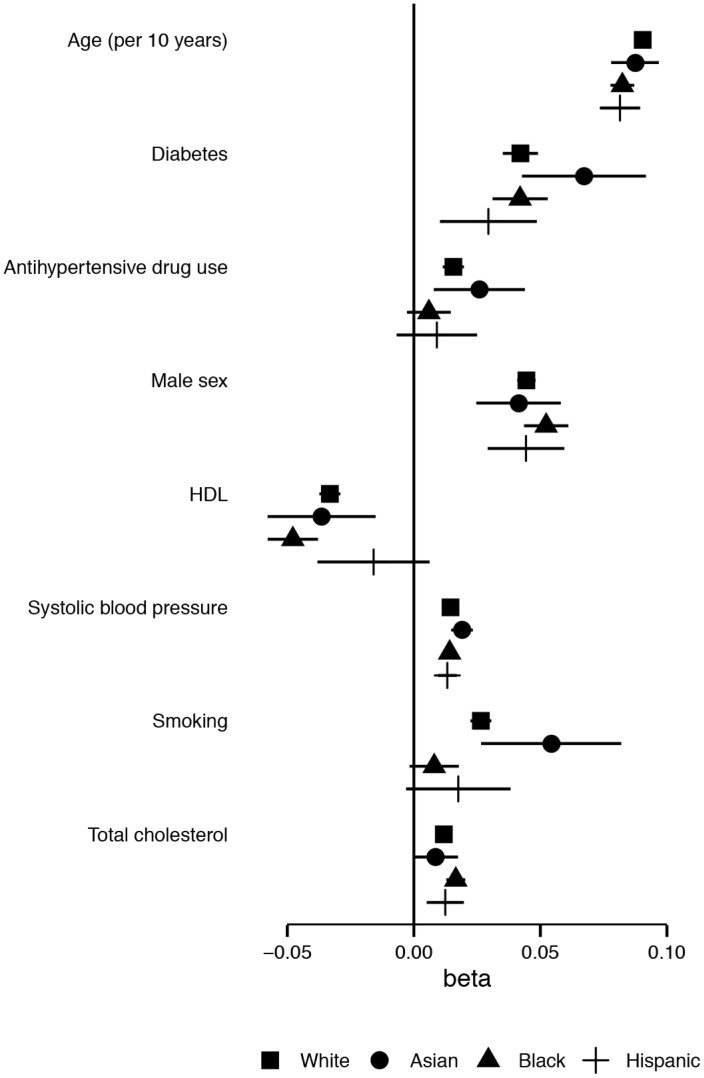
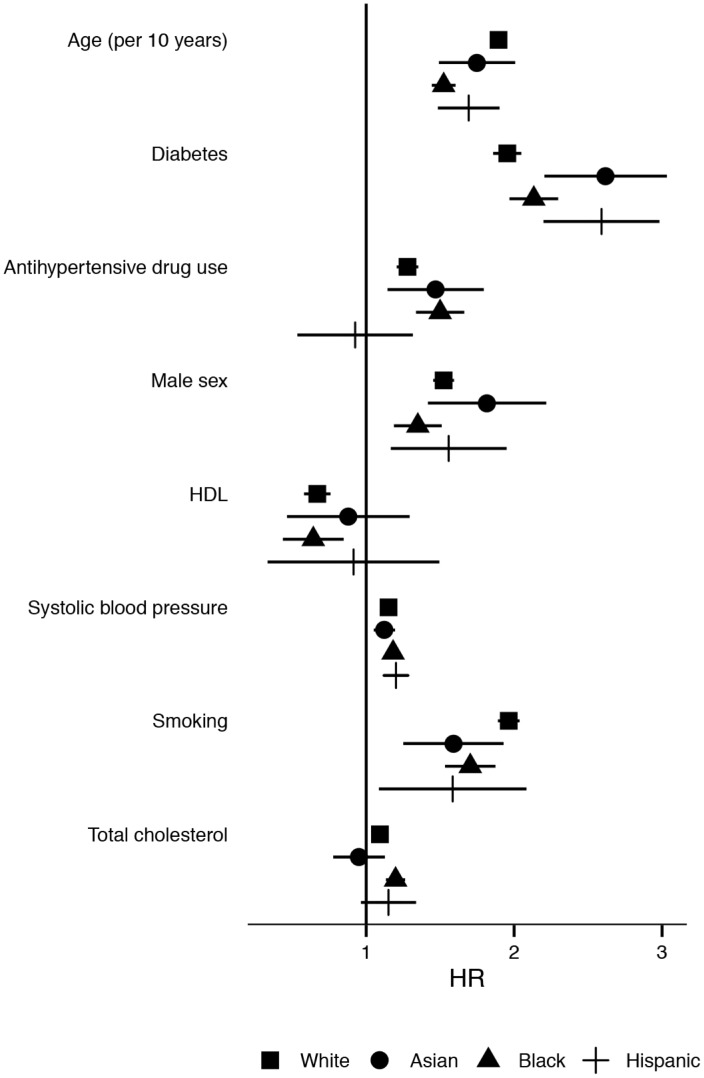
BACKGROUND: Clinical manifestations and outcomes of atherosclerotic disease differ between ethnic groups. In addition, the prevalence of risk factors is substantially different. Primary prevention programs are based on data derived from almost exclusively White people. We investigated how race/ethnic differences modify the associations of established risk factors with atherosclerosis and cardiovascular events. METHODS: We used data from an ongoing individual participant meta-analysis involving 17 population-based cohorts worldwide. We selected 60,211 participants without cardiovascular disease at baseline with available data on ethnicity (White, Black, Asian or Hispanic). We generated a multivariable linear regression model containing risk factors and ethnicity predicting mean common carotid intima-media thickness (CIMT) and a multivariable Cox regression model predicting myocardial infarction or stroke. For each risk factor we assessed how the association with the preclinical and clinical measures of cardiovascular atherosclerotic disease was affected by ethnicity. RESULTS: Ethnicity appeared to significantly modify the associations between risk factors and CIMT and cardiovascular events. The association between age and CIMT was weaker in Blacks and Hispanics. Systolic blood pressure associated more strongly with CIMT in Asians. HDL cholesterol and smoking associated less with CIMT in Blacks. Furthermore, the association of age and total cholesterol levels with the occurrence of cardiovascular events differed between Blacks and Whites. CONCLUSION: The magnitude of associations between risk factors and the presence of atherosclerotic disease differs between race/ethnic groups. These subtle, yet significant differences provide insight in the etiology of cardiovascular disease among race/ethnic groups. These insights aid the race/ethnic-specific implementation of primary prevention.
Overview
The claims and statistics of this paper haven’t been checked yet.
Free: it reads the open-access text and checks the first 5 claims that cite a source we can check. Create a free account to check every claim.
Integrity signals
Registry
Cites
Statistics
Figures
Verification
Claims the paper makes
The claims and statistics of this paper haven’t been checked yet.
Free: it reads the open-access text and checks the first 5 claims that cite a source we can check. Create a free account to check every claim.
Claims other papers make about this one
Each is checked against this paper’s own text: does it say what the citing paper says it does?
The source backs part of the claim, not all of it — or backs it for a different population, condition or comparison.
In the citing paper
“For example, some researchers have used data from the famous Framingham Heart study, which mainly included white males, to develop a cardiovascular risk prediction algorithm for African-American patients; and the result was not successful because the two demographic groups have different risk factors and disease etiology (Gijsberts et al., 2015).”
From Addressing Fairness, Bias, and Appropriate Use of Artificial Intelligence and Machine Learning in Global Health (2021) · cites this paper as Gijsberts et al., 2015
Experimental — accuracy not yet measuredThe source backs part of the claim, not all of it — or backs it for a different population, condition or comparison.
In the citing paper
“Unethically and irresponsibly designed AI/ML solutions deployed in the healthcare setting can exacerbate and perpetuate systematic biases and disparities for those from marginalized groups [27–29].”
From ChatGPT and large language models in academia: opportunities and challenges (2023) · cites this paper as [28]
Experimental — accuracy not yet measuredThe cited source says what the claim attributes to it.
In the citing paper
“For example, the Framingham heart study primarily included white participants. A model trained on this data may reflect racial and ethnic bias because associations between cardiovascular risk factors and events differ by race and ethnicity.25”
From Artificial Intelligence and Surgical Decision-making. (2020) · cites this paper as [25]
Self-check
Percentages, sums and reported differences re-computed from the paper’s own numbers.
The self-check needs the paper’s full text.
Citations
Cites
2013 ACCF/AHA Guideline for the Management of Heart Failure
Yancy, C. W., Jessup, M., Bozkurt, B., Butler, J., Casey, D. E., Drazner, M. H., Fonarow, G. C., Geraci, S. A., Horwich, T., Januzzi, J. L., et al. (2013) · Journal of the American College of Cardiology · doi:10.1016/j.jacc.2013.05.019 · Cited by 12,536
Yusuf, S., Hawken, S., Ôunpuu, S., Dans, T., Avezum, A., Lanas, F., McQueen, M., Budaj, A., Pais, P., Varigos, J., et al. (2004) · The Lancet · doi:10.1016/s0140-6736(04)17018-9 · Cited by 12,026
Child abuse: Adolescent records vs. adult recall
Femina, D. D., Yeager, C. A., & Lewis, D. O. (1990) · Child Abuse & Neglect · doi:10.1016/0145-2134(90)90033-p · Cited by 8,820
Global status report on noncommunicable diseases 2010.
Alwan, A. (2011) · Cited by 8,494
General Cardiovascular Risk Profile for Use in Primary Care: The Framingham Heart Study
D’Agostino, R. B., Vasan, R. S., Pencina, M. J., Wolf, P. A., Cobain, M., Massaro, J. M., & Kannel, W. B. (2008) · Circulation · doi:10.1161/circulationaha.107.699579 · Cited by 7,491
Estimation of ten-year risk of fatal cardiovascular disease in Europe: the SCORE project
Conroy, R. (2003) · European Heart Journal · doi:10.1016/s0195-668x(03)00114-3 · Cited by 5,290 · cited 1×
“For example, the landmark Framingham Risk Score (FRS)[3] and the European SCORE[4] have been developed in a largely White population.”
Background2013 ACC/AHA Guideline on the Assessment of Cardiovascular Risk
Goff, D. C., Lloyd-Jones, D. M., Bennett, G., Coady, S., D’Agostino, R. B., Gibbons, R., Greenland, P., Lackland, D. T., Levy, D., O’Donnell, C. J., et al. (2014) · Journal of the American College of Cardiology · doi:10.1016/j.jacc.2013.11.005 · Cited by 4,945
Goff, D. C., Lloyd-Jones, D. M., Bennett, G., Coady, S., D’Agostino, R. B., Gibbons, R., Greenland, P., Lackland, D. T., Levy, D., O’Donnell, C. J., et al. (2014) · Circulation · doi:10.1161/01.cir.0000437741.48606.98 · Cited by 3,697
The Cardiovascular Health Study: design and rationale.
Fried, L. P., Borhani, N. O., Enright, P., Furberg, C. D., Gardin, J. M., Kronmal, R. A., Kuller, L. H., Manolio, T. A., Mittelmark, M. B., Newman, A., et al. (1991) · Annals of Epidemiology · doi:10.1016/1047-2797(91)90005-w · Cited by 3,652 · cited 2×
“Out of the 17 cohorts participating in USE-IMT, we included 15 cohorts[12–26], consisting of 66,213 individuals.”
MethodSelf-citationA general cardiovascular risk profile: The Framingham study
Kannel, W. B., McGee, D., & Gordon, T. (1976) · The American Journal of Cardiology · doi:10.1016/0002-9149(76)90061-8 · Cited by 1,189 · cited 3×
“[5] Both QRISK2 and the FRS, identified only 10% to 24% of individuals to be at high risk of those who experienced cardiovascular (CV) events among African Caribbeans.”
Background
Research works printed but not linked: 1
- Centers for Disease Control and Prevention (CDC). Cigarette smoking among adults and trends in smoking cessation—United States, 2008. MMWR Morb Mortal Wkly Rep. 2009; 58: 1227– 32. 19910909
Cited by
Heart Disease and Stroke Statistics—2017 Update: A Report From the American Heart Association
Benjamin, E. J., Blaha, M. J., Chiuve, S. E., Cushman, M., Das, S. R., Deo, R., de Ferranti, S. D., Floyd, J., Fornage, M., Gillespie, C., et al. (2017) · Circulation · doi:10.1161/cir.0000000000000485 · Cited by 12,591
Heart Disease and Stroke Statistics—2020 Update: A Report From the American Heart Association
Virani, S. S., Alonso, A., Benjamin, E. J., Bittencourt, M. S., Callaway, C. W., Carson, A. P., Chamberlain, A. M., Chang, A. R., Cheng, S., Delling, F. N., et al. (2020) · Circulation · doi:10.1161/cir.0000000000000757 · Cited by 9,175
Heart Disease and Stroke Statistics—2019 Update: A Report From the American Heart Association
Benjamin, E. J., Muntner, P., Alonso, A., Bittencourt, M. S., Callaway, C. W., Carson, A. P., Chamberlain, A. M., Chang, A. R., Cheng, S., Das, S. R., et al. (2019) · Circulation · doi:10.1161/cir.0000000000000659 · Cited by 9,036
Heart disease and stroke statistics-2018 update: a report from the american heart association
Benjamin, E. J., Virani, S. S., Callaway, C. W., Chamberlain, A. M., Chang, A. R., Cheng, S., Chiuve, S. E., Cushman, M., Delling, F. N., Deo, R., et al. (2018) · Circulation · doi:10.1161/cir.0000000000000558 · Cited by 7,146
Heart Disease and Stroke Statistics—2021 Update: A Report From the American Heart Association
Virani, S. S., Alonso, A., Aparicio, H. J., Benjamin, E. J., Bittencourt, M. S., Callaway, C. W., Carson, A. P., Chamberlain, A. M., Cheng, S., Delling, F. N., et al. (2021) · Circulation · doi:10.1161/cir.0000000000000950 · Cited by 5,784
Implementing Machine Learning in Health Care — Addressing Ethical Challenges
Char, D. S., Shah, N. H., & Magnus, D. (2018) · New England Journal of Medicine · doi:10.1056/nejmp1714229 · Cited by 1,857
Prediction models for cardiovascular disease risk in the general population: systematic review
Damen, J. A. A. G., Hooft, L., Schuit, E., Debray, T. P. A., Collins, G. S., Tzoulaki, I., Lassale, C. M., Siontis, G. C. M., Chiocchia, V., Roberts, C., et al. (2016) · BMJ · doi:10.1136/bmj.i2416 · Cited by 935
Addressing bias in artificial intelligence in health care
Parikh, R. B., Teeple, S., & Navathe, A. S. (2019) · JAMA · doi:10.1001/jama.2019.18058 · Cited by 764
Artificial Intelligence and Surgical Decision-making.
Loftus, T. J., Tighe, P. J., Filiberto, A. C., Efron, P. A., Brakenridge, S. C., Mohr, A. M., Rashidi, P., Upchurch, G. R., & Bihorac, A. (2020) · JAMA Surgery · doi:10.1001/jamasurg.2019.4917 · Cited by 650
“25 Accountability for errors poses another challenge.”
ChatGPT and large language models in academia: opportunities and challenges
Meyer, J. G., Urbanowicz, R. J., Martin, P. C. N., O’Connor, K., Li, R., Peng, P.-C., Bright, T. J., Tatonetti, N., Won, K. J., Gonzalez-Hernandez, G., et al. (2023) · BioData Mining · doi:10.1186/s13040-023-00339-9 · Cited by 569
The “inconvenient truth” about AI in healthcare
Panch, T., Mattie, H., & Celi, L. A. (2019) · npj Digital Medicine · doi:10.1038/s41746-019-0155-4 · Cited by 473
Identifying Ethical Considerations for Machine Learning Healthcare Applications
Char, D. S., Abràmoff, M. D., & Feudtner, C. (2020) · The American Journal of Bioethics · doi:10.1080/15265161.2020.1819469 · Cited by 415
Fletcher, R. R., Nakeshimana, A., & Olubeko, O. (2021) · Frontiers in Artificial Intelligence · doi:10.3389/frai.2020.561802 · Cited by 305
“…the famous Framingham Heart study, which mainly included white males, to develop a cardiovascular risk prediction algorithm for African-American patients; and the result was not successful because the two demographic groups have different risk factors and disease etiology (Gijsberts et al., 2015).”
Ethical use of Artificial Intelligence in Health Professions Education: AMEE Guide No. 158
Masters, K. (2023) · Medical Teacher · doi:10.1080/0142159x.2023.2186203 · Cited by 302
“Data can be dominated by some demographic identifiers or under-represented by others (e.g. race, gender, cultural identity, disabilities, age) (Gijsberts et al. 2015), and so the algorithms formed according to those data will also reflect the dominance and under-representation.”
MethodSingh, R. P., Hom, G. L., Abramoff, M. D., Campbell, J. P., Chiang, M. F., & on behalf of the AAO Task Force on Artificial Intelligence (2020) · Translational Vision Science & Technology · doi:10.1167/tvst.9.2.45 · Cited by 259
Barrett, M., Boyne, J., Brandts, J., Brunner-La Rocca, H.-P., De Maesschalck, L., De Wit, K., Dixon, L., Eurlings, C., Fitzsimons, D., Golubnitschaja, O., et al. (2019) · EPMA Journal · doi:10.1007/s13167-019-00188-9 · Cited by 200
“The most widely used cardiovascular risk score developed using data from mostly white patients may be less precise in minorities [125].”
MethodAlgorithmic fairness in computational medicine
Xu, J., Xiao, Y., Wang, W. H., Ning, Y., Shenkman, E. A., Bian, J., & Wang, F. (2022) · eBioMedicine · doi:10.1016/j.ebiom.2022.104250 · Cited by 170
“For example, associations between Framingham risk factors and cardiovascular events have been shown to be significantly different across race and ethnicity groups 4 .”
BackgroundAlgorithmic Fairness in Computational Medicine
(2022) · doi:10.1101/2022.01.16.21267299 · Cited by 170
Artificial Intelligence and Health Technology Assessment: Anticipating a New Level of Complexity
Alami, H., Lehoux, P., Auclair, Y., de Guise, M., Gagnon, M.-P., Shaw, J., Roy, D., Fleet, R., Ag Ahmed, M. A., & Fortin, J.-P. (2020) · Journal of Medical Internet Research · doi:10.2196/17707 · Cited by 164
“In the same vein, the use of data from the Framingham Heart Study to predict the risk of cardiovascular events produced biased results, which both overestimated and underestimated risk when AI was used in non-white populations [34,35].”
MethodPutting the data before the algorithm in big data addressing personalized healthcare
Cahan, E. M., Hernandez-Boussard, T., Thadaney-Israni, S., & Rubin, D. L. (2019) · npj Digital Medicine · doi:10.1038/s41746-019-0157-2 · Cited by 149
“8 The second form of bias is observation bias, denoting the systematic miscalibration of measurement.”
BackgroundClinician checklist for assessing suitability of machine learning applications in healthcare
Scott, I., Carter, S., & Coiera, E. (2021) · BMJ Health & Care Informatics · doi:10.1136/bmjhci-2020-100251 · Cited by 143
Artificial intelligence in medicine: what is it doing for us today?
Becker, A. (2019) · Health Policy and Technology · doi:10.1016/j.hlpt.2019.03.004 · Cited by 137
Why Is the Electronic Health Record So Challenging for Research and Clinical Care?
Holmes, J. H., Beinlich, J., Boland, M. R., Bowles, K. H., Chen, Y., Cook, T. S., Demiris, G., Draugelis, M., Fluharty, L., Gabriel, P. E., et al. (2021) · Methods of Information in Medicine · doi:10.1055/s-0041-1731784 · Cited by 117
“21 Another example is that race has been used as part of an algorithm for estimating kidney function in practice, and it has been argued that this mayundulyrestrict access to care for under-served minority groups.”
MethodKokubo, Y., Watanabe, M., Higashiyama, A., Nakao, Y. M., Nakamura, F., & Miyamoto, Y. (2018) · Journal of the American Heart Association · doi:10.1161/jaha.117.007720 · Cited by 118
“Systolic BP and smoking are more strongly associated with IMT in Asian patients.(27) These characteristic backgrounds may have accentuated the association between the progression of plaque and incident CVD in our study.”
BackgroundMorgenstern, J. D., Rosella, L. C., Daley, M. J., Goel, V., Schünemann, H. J., & Piggott, T. (2021) · BMC Public Health · doi:10.1186/s12889-020-10030-x · Cited by 111
“This was highlighted recently among cardiovascular prediction models trained almost exclusively on White people [59].”
BackgroundApplications of Artificial Intelligence in Cardiology. The Future is Already Here
Dorado-Díaz, P. I., Sampedro-Gómez, J., Vicente-Palacios, V., & Sánchez, P. L. (2019) · Revista Española de Cardiología (English Edition) · doi:10.1016/j.rec.2019.05.014 · Cited by 111
Machine learning for sperm selection
You, J. B., McCallum, C., Wang, Y., Riordon, J., Nosrati, R., & Sinton, D. A. (2021) · Nature Reviews Urology · doi:10.1038/s41585-021-00465-1 · Cited by 115
“As an example of this concept, a model trained with data on cardiovascular risk factors based on a primarily white population led to both overestimation and underestimation of the risk of cardiovascular events in a non-white population 137 .”
MethodTackling COVID-19 through Responsible AI Innovation: Five Steps in the Right Direction
Leslie, D. (2020) · Harvard Data Science Review · doi:10.1162/99608f92.4bb9d7a7 · Cited by 94
Leeuwis, A. E., Smith, L. A., Melbourne, A., Hughes, A. D., Richards, M., Prins, N. D., Sokolska, M., Atkinson, D., Tillin, T., Jäger, H. R., et al. (2018) · Frontiers in Aging Neuroscience · doi:10.3389/fnagi.2018.00279 · Cited by 111
Applications of artificial intelligence for hypertension management
Tsoi, K. K. F., Yiu, K. K. L., Lee, H., Cheng, H., Wang, T., Tay, J. C., Teo, B. W., Turana, Y., Soenarta, A. A., Sogunuru, G. P., et al. (2021) · Journal of Clinical Hypertension · doi:10.1111/jch.14180 · Cited by 100
“However, it is sensitive to racial effects 25 and has a rather arbitrary scoring system.”
Evaluating and mitigating bias in machine learning models for cardiovascular disease prediction
Li, F., Wu, P., Ong, H. H., Peterson, J. F., Wei, W.-Q., & Zhao, J. (2023) · Journal of Biomedical Informatics · doi:10.1016/j.jbi.2023.104294 · Cited by 81
Pesapane, F., Bracchi, D., Mulligan, J. F., Linnikov, A. S., Maslennikov, O. V., Lanzavecchia, M. B., Tantrige, P. M., Stasolla, A., Biondetti, P., Giuggioli, P. F., et al. (2021) · Radiation · doi:10.3390/radiation1040022 · Cited by 93
Artificial intelligence and urology: ethical considerations for urologists and patients
Cacciamani, G. E., Chen, A. W., Gill, I. S., & Hung, A. J. (2023) · Nature Reviews Urology · doi:10.1038/s41585-023-00796-1 · Cited by 80
“…example, in the well-known Framingham study of cardiovascular disease risk, the projected risks for minority groups were 20% lower than those for non-Hispanic white individuals, despite having similar clinical characteristics, owing to under-representation of minorities in the original sample 79 .”
Yagi, M., Yamanouchi, K., Fujita, N., Funao, H., & Ebata, S. (2023) · Journal of Clinical Medicine · doi:10.3390/jcm12134188 · Cited by 79
“This concern underscores the critical need for transparent and interpretable AI and ML models [65].”
BackgroundAnnual Research Review: Translational machine learning for child and adolescent psychiatry
Dwyer, D., & Koutsouleris, N. (2022) · Journal of Child Psychology and Psychiatry · doi:10.1111/jcpp.13545 · Cited by 76
Arnould, L., Mériaudeau, F., Guénancia, C., Germanèse, C., Delcourt, C., Kawasaki, R., Cheung, C. Y.-L., Creuzot-Garcher, C. P., & Grzybowski, A. E. (2022) · Ophthalmology and Therapy · doi:10.1007/s40123-022-00641-5 · Cited by 74
“Indeed, historical prediction models for CVDs such as the Framingham risk score [31] and the recently updated SCORE2 [32, 33] in the general population may have some limitations in specific ethnic groups and intermediate risk profile patients [34, 35].”
MethodDevelopment of Health Parameter Model for Risk Prediction of CVD Using SVM
Unnikrishnan, P., Kumar, D. K., Poosapadi Arjunan, S., Kumar, H., Mitchell, P., & Kawasaki, R. (2016) · Computational and Mathematical Methods in Medicine · doi:10.1155/2016/3016245 · Cited by 62
A scoping review of fair machine learning techniques when using real-world data
Huang, Y., Guo, J., Chen, W.-H., Lin, H.-Y., Tang, H., Wang, F., Xu, H., & Bian, J. (2024) · Journal of Biomedical Informatics · doi:10.1016/j.jbi.2024.104622 · Cited by 61
Artificial Intelligence in Healthcare: Perception and Reality
Akinrinmade, A. O., Adebile, T. M., Ezuma-Ebong, C., Bolaji, K., Ajufo, A., Adigun, A. O., Mohammad, M., Dike, J. C., & Okobi, O. E. (2023) · Cureus · doi:10.7759/cureus.45594 · Cited by 58
“Another example is seen in the study of the Framingham risk factors, which had overestimations and underestimations in predicting cardiovascular events among the non-white study group [39].”
ResultSacks, F. M., Liang, L., Furtado, J. D., Cai, T., Davidson, W. S., He, Z., McClelland, R. L., Rimm, E. B., & Jensen, M. K. (2020) · Arteriosclerosis, Thrombosis, and Vascular Biology · doi:10.1161/atvbaha.120.314609 · Cited by 57
“Triglyceride,* mg/dL; mean (SD) 122 (101) 131 (110) 96 (56) 85 (41) 118 (79) 97 (71) 132 (91)”
The Role of Matrix Metalloproteinase Polymorphisms in Ischemic Stroke
Chang, J. J., Stanfill, A. G., & Pourmotabbed, T. (2016) · International Journal of Molecular Sciences · doi:10.3390/ijms17081323 · Cited by 53
Recent evolutions of machine learning applications in clinical laboratory medicine
Bruyne, S. D., Speeckaert, M. M., Biesen, W. V., & Delanghe, J. (2020) · Critical Reviews in Clinical Laboratory Sciences · doi:10.1080/10408363.2020.1828811 · Cited by 60
“The latter can be illustrated by biased results obtained in the risk prediction of cardiovascular events in nonwhite populations based on data from the Framingham Heart Study [140].”
MethodPhạm, Q., Gamble, A., Hearn, J., & Cafazzo, J. A. (2021) · Journal of Medical Internet Research · doi:10.2196/22320 · Cited by 56
“The long-used Framingham risk factors, which were modelled using a largely non-Hispanic White population, have recently been shown to inadequately capture risk in certain minority groups [65].”
Advances in the Application of AI Robots in Critical Care: Scoping Review
Li, Y., Wang, M., Wang, L., Cao, Y. Y., Liu, Y., Zhao, Y., Rui, Y., Yang, M., Lu, S., Sun, Z., et al. (2024) · Journal of Medical Internet Research · doi:10.2196/54095 · Cited by 75
“For instance, using Framingham Heart Study data to predict cardiovascular event risk in people of color may lead to both overestimation and underestimation of risk [139].”
Leveraging Digital Data to Inform and Improve Quality Cancer Care
Hernandez‐Boussard, T., Blayney, D. W., & Brooks, J. D. (2020) · Cancer Epidemiology Biomarkers & Prevention · doi:10.1158/1055-9965.epi-19-0873 · Cited by 49
“Concerns are arising regarding bias and equity of data-driven algorithms in health care (57), particularly because they are often trained on historical data that may be biased or only include nonrepresentative populations, similar to what has been found of older clinical trials (16, 58, 59).”
ResultIntelligent, Autonomous Machines in Surgery
Loftus, T. J., Filiberto, A. C., Balch, J. A., Ayzengart, A., Tighe, P. J., Rashidi, P., Bihorac, A., & Upchurch, G. R. (2020) · Journal of Surgical Research · doi:10.1016/j.jss.2020.03.046 · Cited by 51
Paik, K., Hicklen, R., Kaggwa, F., Puyat, C. V. M., Nakayama, L. F., Ong, B., Shropshire, J., & Villanueva, C. (2023) · PLOS Digital Health · doi:10.1371/journal.pdig.0000313 · Cited by 57
Cuspidi, C., Sala, C., Tadić, M., Gherbesi, E., Grassi, G. M., & Mancia, G. (2016) · Journal of Clinical Hypertension · doi:10.1111/jch.12790 · Cited by 42
“Ultrasonographic markers of subclinical cardiovascular damage, in particular increased LV mass and carotid IMT, have been shown to predict the risk of incident cardiovascular disease in essential hypertensive patients, as well as in populationbased cohorts.(26,27) The relationship of LVMI and carotid IMT with incident…”
BackgroundLi, L. T., Haley, L. C., Boyd, A. K., & Bernstam, E. V. (2023) · Journal of Biomedical Informatics · doi:10.1016/j.jbi.2023.104531 · Cited by 56
Aplicaciones de la inteligencia artificial en cardiología: el futuro ya está aquí
Dorado-Díaz, P. I., Sampedro-Gómez, J., Vicente-Palacios, V., & Sanchez, P. L. (2019) · Revista Española de Cardiología · doi:10.1016/j.recesp.2019.05.016 · Cited by 46
McIntosh, E. C., Tureson, K., Rotblatt, L. J., Singer, E. J., & Thames, A. D. (2020) · Journal of the International Neuropsychological Society · doi:10.1017/s1355617720001022 · Cited by 44
“Atherosclerotic disease outcomes and the prevalence of VRFs differ between ethnic groups (Gijsberts et al., 2015).”
BackgroundEnsuring machine learning for healthcare works for all
McCoy, L. G., Banja, J. D., Ghassemi, M., & Celi, L. A. (2020) · BMJ Health & Care Informatics · doi:10.1136/bmjhci-2020-100237 · Cited by 35
Cardiovascular risk in patients with type 2 diabetes: A systematic review of prediction models
Galbete, A., Tamayo, I., Librero, J., Enguita-Germán, M., Cambra, K., & Ibáñez-Beroiz, B. (2022) · Diabetes Research and Clinical Practice · doi:10.1016/j.diabres.2021.109089 · Cited by 32
Evaluating Large Language Models in extracting cognitive exam dates and scores
Zhang, H., Jethani, N., Jones, S., Genes, N. G., Major, V. J., Jaffe, I. S., Cardillo, A. B., Heilenbach, N., Ali, N. F., Bonanni, L. J., et al. (2024) · PLOS Digital Health · doi:10.1371/journal.pdig.0000685 · Cited by 39
“Active research areas, from causal studies on observational data [69] [70] [71] [72], to disease prognosis [73] [74] [75] [76] [77] [78] [79] [80] [81] [82] [83], disease/genomics understanding [84] [85] [86] [87] [88], treatment response monitoring [89] [90] [91] [92], and fairness and bias in medicine [93] [94] [95]…”
Prediction Models for Osteoporotic Fractures Risk: A Systematic Review and Critical Appraisal
Sun, X., Chen, Y., Gao, Y., Zhang, Z., Qin, L., Song, J., Wang, H., & Wu, X. (2022) · Aging and Disease · doi:10.14336/ad.2021.1206 · Cited by 35
“Tailored models for populations in these countries are important because it is well known that predictoroutcome associations vary among ethnic groups [91].”
BackgroundEvaluation of Prognostic and Predictive Models in the Oncology Clinic
Craddock, M., Crockett, C., McWilliam, A., Price, G. J., Sperrin, M., van der Veer, S. N., & Finn, C. F. (2021) · Clinical Oncology · doi:10.1016/j.clon.2021.11.022 · Cited by 35
Nonterah, E. A., Crowther, N. J., Klipstein‐Grobusch, K., Oduro, A. R., Kavousi, M., Agongo, G., Anderson, T. J., Asiki, G., Boua, P. R., Choma, S., et al. (2022) · Journal of the American Heart Association · doi:10.1161/jaha.121.023704 · Cited by 36
Self-citationBarinas‐Mitchell, E., Duan, C., Brooks, M. M., Khoudary, S. R. E., Thurston, R. C., Matthews, K. A., Jackson, E. A., Lewis, T. T., & Derby, C. A. (2020) · Journal of the American Heart Association · doi:10.1161/jaha.119.013876 · Cited by 30
“Largely consistent with our findings, in the recent USE-IMT individual participant meta-analysis of >60 000 individuals, the direction of associations between traditional CVD risk factors and CCA-IMT were similar across racial/ethnic groups, although the magnitudes of the associations in some cases varied.(25) There a…”
ResultArtificial Intelligence developments in medical education: a conceptual and practical framework
Masters, K. (2020) · MedEdPublish · doi:10.15694/mep.2020.000239.1 · Cited by 25
“In addition, because AI is so reliant upon data, and we know that some large medical datasets have an over-representation of some groups (Gijsberts et al. , 2015), these could also influence biases in AI (Parikh, Teeple and Navathe, 2019).”
BackgroundA Process Framework for Ethically Deploying Artificial Intelligence in Oncology
Hantel, A., Clancy, D. D., Kehl, K. L., Marron, J. M., Allen, E. M. V., & Abel, G. A. (2022) · Journal of Clinical Oncology · doi:10.1200/jco.22.01113 · Cited by 43
Schaich, C. L., Yeboah, J., Espeland, M. A., Baker, L. D., Ding, J., Hayden, K. M., Sachs, B. C., Craft, S., Rapp, S. R., Luchsinger, J. A., et al. (2021) · The Journals of Gerontology Series A · doi:10.1093/gerona/glab189 · Cited by 27
The Applications of Single-Cell RNA Sequencing in Atherosclerotic Disease
Slenders, L., Tessels, D. E., van der Laan, S. W., Pasterkamp, G., & Mokrý, M. (2022) · Frontiers in Cardiovascular Medicine · doi:10.3389/fcvm.2022.826103 · Cited by 32
“, diabetes, smoking, hypertension, hypercholesterolemia, ethnicity (57) etc.”
Self-citationAbeysuriya, V., Perera, R., & Wickremasinghe, A. R. (2022) · PLoS ONE · doi:10.1371/journal.pone.0268716 · Cited by 32
Ramaekers, M., Viviers, C. G. A., Janssen, B. V., Hellström, T. A. E., Ewals, L. J. S., van der Wulp, K., Nederend, J., Jacobs, I., Pluyter, J. R., Mavroeidis, D., et al. (2023) · Journal of Clinical Medicine · doi:10.3390/jcm12134209 · Cited by 31
“The prediction of an offender’s risk of recidivism has shown a tendency for racial discrimination, just as predicting the risk of cardiovascular events in non-white populations [94,95].”
BackgroundNeto, P. J. D. S., Santos, E. H. S., Meireles, D. P., Bittencourt, M. S., Santos, I. S., Benseñor, I. M., & Lotufo, P. A. (2021) · Journal of Stroke and Cerebrovascular Diseases · doi:10.1016/j.jstrokecerebrovasdis.2021.105671 · Cited by 27
Consumer Artificial Intelligence Mishaps and Mitigation Strategies
Saeedi, S., Fong, A. C. M., Mohanty, S. P., Gupta, A., & Carr, S. (2021) · IEEE Consumer Electronics Magazine · doi:10.1109/mce.2021.3075329 · Cited by 28
Nonterah, E. A., Boateng, D., Crowther, N. J., Klipstein‐Grobusch, K., Oduro, A. R., Agongo, G., Mohamed, S. F., Boua, P. R., Choma, S., Norris, S. A., et al. (2022) · JAMA Network Open · doi:10.1001/jamanetworkopen.2022.7559 · Cited by 30
Self-citationIngraham, N. E., Jones, E., King, S., Dries, J., Phillips, M., Loftus, T. J., Evans, H. L., Melton, G. B., & Tignanelli, C. J. (2022) · Annals of Surgery · doi:10.1097/sla.0000000000005661 · Cited by 30
Gupta, P., Prieto‐Merino, D., Ajay, V. S., Singh, K., Roy, A., Krishnan, A., Narayan, K. M. V., Ali, M. K., Tandon, N., Prabhakaran, D., et al. (2019) · Wellcome Open Research · doi:10.12688/wellcomeopenres.15137.2 · Cited by 23
Lee, M. H.-Y., Li, B., Feridooni, T., Li, P. Y., Shakespeare, A., Samarasinghe, Y., Cuen-Ojeda, C., Verma, R. K., Kishibe, T., & Al-Omran, M. A. (2022) · Journal of Vascular Surgery · doi:10.1016/j.jvs.2022.08.043 · Cited by 26
Mendelian randomization studies on coronary artery disease: a systematic review and meta-analysis
Silva, S., Fatumo, S., & Nitsch, D. (2024) · Systematic Reviews · doi:10.1186/s13643-023-02442-8 · Cited by 26
“…studies have established the fact that CAD prevalence and death rates vary between ancestry groups, with the highest observed amongst individuals of South Asian ancestry, insufficient research in such populations leaves a lot of uncertainty regarding disease pathophysiology [43, 68–70].”
BackgroundClustering of cardiovascular risk factors and carotid intima-media thickness: The USE-IMT study
Wang, X., Dalmeijer, G. W., den Ruijter, H. M., Anderson, T. J., Britton, A. R., Dekker, J., Engström, G., Evans, G., Graaf, J. D., Grobbee, D. E., et al. (2017) · PLoS ONE · doi:10.1371/journal.pone.0173393 · Cited by 24
“Race-ethnic groups were categorised as White, Black, Hispanic or Asian.”
MethodInfluentialSelf-citationIs Corneal Arcus Independently Associated With Incident Cardiovascular Disease in Asians?
Wong, M. Y. Z., Man, R. E. K., Gupta, P., Lim, S. H., Lim, B., Tham, Y. C., Sabanayagam, C., Wong, T. Y., Cheng, C., & Lamoureux, E. L. (2017) · American Journal of Ophthalmology · doi:10.1016/j.ajo.2017.09.002 · Cited by 21
Mostaza, J. M., Lahoz, C., Salinero-Fort, M. Á., de Dios, O., Castillo, E., González-Alegre, T., García-Iglesias, F., Estirado, E., Laguna, F., Sabín, C., et al. (2018) · Journal of clinical lipidology · doi:10.1016/j.jacl.2018.04.004 · Cited by 23
Khoshbayan, A., Taheri, F., Moghadam, M. T., Chegini, Z., & Shariati, A. (2021) · Microbial Pathogenesis · doi:10.1016/j.micpath.2021.104803 · Cited by 22
Participant flow diagrams for health equity in AI
Ellen, J., de Matos, J. C. R. G., Viola, M., Gallifant, J., Quion, J., Celi, L. A., & Hussein, N. S. A. (2024) · Journal of Biomedical Informatics · doi:10.1016/j.jbi.2024.104631 · Cited by 23
Akintoye, E. O., Mahmoud, K., Shokr, M., Sandio, A., Mallikethi‐Reddy, S., Sheikh, M. A., Adegbala, O. M., Egbe, A. C., Briasoulis, Α., & Afonso, L. (2018) · Clinical Cardiology · doi:10.1002/clc.22914 · Cited by 22
Negriff, S. L., Dilkina, B., Matai, L., & Rice, E. R. W. (2022) · PLoS ONE · doi:10.1371/journal.pone.0274998 · Cited by 21
Artificial Intelligence in Urology
Abid, R., Hussein, A. A., & Guru, K. A. (2023) · Urologic Clinics of North America · doi:10.1016/j.ucl.2023.06.005 · Cited by 25
Data-Driven Approaches in Healthcare: Challenges and Emerging Trends
Freitas, A. T. (2023) · Law, governance and technology series · doi:10.1007/978-3-031-41264-6_4 · Cited by 36
Advances in artificial intelligence and deep learning systems in ICU-related acute kidney injury
Ozrazgat-Baslanti, T., Loftus, T. J., Ren, Y., Ruppert, M. M., & Bihorac, A. (2021) · Current Opinion in Critical Care · doi:10.1097/mcc.0000000000000887 · Cited by 23
“Artificial intelligence algorithms learn from data; when trained on racially imbalanced datasets, algorithms may produce racially biased results [51,52].”
BackgroundThomas, J., Foraker, R. E., Zamstein, N., Morrow, J. D., Payne, P., Wilcox, A. B., Haendel, M. A., Chute, C. G., Gersing, K. R., Walden, A., et al. (2022) · Journal of the American Medical Informatics Association · doi:10.1093/jamia/ocac045 · Cited by 25
Neural Temporal Point Processes For Modelling Electronic Health RecordsPreprint
Enguehard, J., Busbridge, D., Bozson, A. J., Woodcock, C., & Hammerla, N. (2020) · arXiv (Cornell University) · doi:10.48550/arxiv.2007.13794 · Cited by 45
White, T., Selvarajah, V., Sand, F. W., Svangård, N., Mohankumar, G., Fenici, P., Rough, K., Onyango, N. O., Lyons, K., Mack, C. D., et al. (2024) · Diabetes Obesity and Metabolism · doi:10.1111/dom.15587 · Cited by 25
“31 When regression models are used to predict the risk of cardiovascular events, model parameters vary by race for key predictor variables, 32 meaning a model trained using data from primarily one racial group would lead to poorer risk estimation if deployed in populations comprised of other racial…”
MethodHow Should Surgeons Consider Emerging Innovations in Artificial Intelligence and Robotics?
Chappell, A. G., & Teven, C. M. (2023) · The AMA Journal of Ethic · doi:10.1001/amajethics.2023.589 · Cited by 16
“22,23,24,25,26 For example, machine learning algorithms likely will incorrectly estimate risks of certain diseases in patient populations that tend to have missing data in the electronic health record, 8 with deleterious consequences.”
BackgroundDiscrepancies in Stroke Distribution and Dataset Origin in Machine Learning for Stroke
Velagapudi, L., Mouchtouris, N., Baldassari, M. P., Nauheim, D. O., Khanna, O., Saiegh, F. A., Herial, N. A., Gooch, M. R., Tjoumakaris, S. I., Rosenwasser, R. H., et al. (2021) · Journal of Stroke and Cerebrovascular Diseases · doi:10.1016/j.jstrokecerebrovasdis.2021.105832 · Cited by 17
Gammie, A., Arlandis, S., Couri, B. M., Drinnan, M. J., Ochoa, D. C., Rantell, A., de Rijk, M. M., van Steenbergen, T. R. F., & Damaser, M. S. (2023) · Neurourology and Urodynamics · doi:10.1002/nau.25319 · Cited by 14
“12 If only one or a few centers' data are used for training in ML, the results will be biased towards the practices in those centers.”
BackgroundNakamizo, T., COLOGNE, J. B., Cordova, K. A., Yamada, M., Takahashi, T., Misumi, M., Fujiwara, S., Matsumoto, M., Kihara, Y., Hida, A., et al. (2021) · European Journal of Epidemiology · doi:10.1007/s10654-021-00731-x · Cited by 15
“Second, in previous studies, the associations of carotid IMT with smoking and with other traditional risk factors were also equivalent to about 10 years of age [56, 57].”
A meta‐analysis of diabetes risk prediction models applied to prediabetes screening
Liu, Y., Yu, S., Feng, W., Mo, H., Hua, Y., Zhang, M., Zhu, Z., Zhang, X., Wu, Z., Zheng, L., et al. (2024) · Diabetes Obesity and Metabolism · doi:10.1111/dom.15457 · Cited by 15
“57 We would encourage future research on external validation of models in different centres and countries to ensure generalizability.”
MethodPollock, B. D., Harville, E. W., Mills, K. T., Tang, W., Chen, W., & Bazzano, L. (2018) · Journal of the American Heart Association · doi:10.1161/jaha.117.007693 · Cited by 14
“Multiple studies have validated Framingham score in black populations, although some have documented that it may underestimate risk among such populations(36) or that its components may affect CVD differentially by race.(37) Regardless, the interaction between age and rank-rank slope was constant across races.”
BackgroundSonoda, H., Nakamura, K., & Tamakoshi, A. (2019) · Journal of Atherosclerosis and Thrombosis · doi:10.5551/jat.47779 · Cited by 15
Koski, E., Das, A. K., Hsueh, P.-Y. S., Solomonides, A. E., Joseph, A. L., Srivastava, G., Johnson, C. E., Kannry, J. L., Oladimeji, B., Price, A. I., et al. (2025) · Journal of the American Medical Informatics Association · doi:10.1093/jamia/ocaf133 · Cited by 18
Love, C. S. (2023) · The Linacre Quarterly · doi:10.1177/00243639231162431 · Cited by 16
“When results are applied to other ethnic groups the outcomes are less reliable due to genomic and social differences not accounted for in the study (Gijsberts et al. 2015, 1 – 13).”
BackgroundWang, W., Asken, B. M., DeSimone, J. C., Levy, S.-A. T., Barker, W., Fiala, J. A., Vélez-Uribe, I., Curiel, R. E., Rósselli, R., Marsiske, M., et al. (2024) · Ageing Research Reviews · doi:10.1016/j.arr.2024.102507 · Cited by 11
Spector, S. A., Brummel, S. S., Nievergelt, C. M., Maihofer, A. X., Singh, K. K., Purswani, M. U., Williams, P. L., Hazra, R., Dyke, R. V., & Seage, G. R. (2016) · Medicine · doi:10.1097/md.0000000000004733 · Cited by 12
Wirries, A., Geiger, F., Oberkircher, L., & Jabari, S. (2022) · Diagnostics · doi:10.3390/diagnostics12040836 · Cited by 10
Regulatory, social, ethical, and legal issues of artificial intelligence in medicine
Shearer, E. J., Cho, M. K., & Magnus, D. C. (2020) · Elsevier eBooks · doi:10.1016/b978-0-12-821259-2.00023-5 · Cited by 16
Reducing Cardiovascular Disease Risk for Employees Through Participation in a Wellness Program
Pesis-Katz, I., Smith, J. A. V. D. L., Norsen, L. H., DeVoe, J., & Singh, R. (2019) · Population Health Management · doi:10.1089/pop.2019.0106 · Cited by 10
Gupta, P., Prieto‐Merino, D., Ajay, V. S., Singh, K., Roy, A., Krishnan, A., Narayan, K. M. V., Ali, M. K., Tandon, N., Prabhakaran, D., et al. (2019) · Wellcome Open Research · doi:10.12688/wellcomeopenres.15137.1 · Cited by 10
Pinto, A. D., Birdi, S., Durant, S., Rabet, R., Parekh, R., Ali, S., Buckeridge, D. L., Ghassemi, M., Gibson, J., John‐Baptiste, A., et al. (2025) · JMIR Public Health and Surveillance · doi:10.2196/68952 · Cited by 13
“For instance, using data from the Framingham Heart Study to predict cardiovascular risk in non-White populations has led to biased results, overestimating or underestimating the risk [45].”
Metadata
- Authors
- Gijsberts, C. M., Groenewegen, K. A., Hoefer, I. E., Eijkemans, M. J. C., Asselbergs, F. W., Anderson, T. J., Britton, A. R., Dekker, J. M., Engström, G., Evans, G. W., de Graaf, J., Grobbee, D. E., Hedblad, B., Holewijn, S., Ikeda, A., Kitagawa, K., Kitamura, A., de Kleijn, D. P. V., Lonn, E. M., Lorenz, M. W., Mathiesen, E. B., Nijpels, G., Okazaki, S., O’Leary, D. H., Pasterkamp, G., Peters, S. A. E., Polak, J. F., Price, J. F., Robertson, C., Rembold, C. M., Rosvall, M., Rundek, T., Salonen, J. T., Sitzer, M., Stehouwer, C. D. A., Bots, M. L., & den Ruijter, H. M.
- Affiliations
- University Medical Center Utrecht (NL)
- University of Calgary (CA)
- University College London (GB)
- Amsterdam UMC Location Vrije Universiteit Amsterdam (NL)
- Lund University (SE)
- Wake Forest University Health Sciences (US)
- University Malaya Medical Centre (MY)
- Radboud University Medical Center (NL)
- Tokyo Women's Medical University (JP)
- Population Health Research Institute (CA)
- Goethe University Frankfurt (DE)
- UiT The Arctic University of Norway (NO)
- The University of Osaka (JP)
- Tufts Medical Center (US)
- University of Edinburgh (GB)
- University of Virginia (US)
- University of Miami (US)
- Maastricht University Medical Centre (NL)
- ORCID
- Gijsberts, Crystel M.
- Hoefer, Imo E.
- Eijkemans, Marinus J. C.
- Asselbergs, Folkert W.
- Anderson, Todd J.
- Britton, Annie R.
- Engström, Gunnar
- Grobbee, Diederick E.
- Holewijn, Suzanne
- Ikeda, Ai
- Kitagawa, Kazuo
- Kitamura, Akihiko
- Lonn, Eva M.
- Lorenz, Matthias W.
- Mathiesen, Ellisiv B.
- Nijpels, Giel
- Okazaki, Shuhei
- Pasterkamp, Gerard
- Peters, Sanne A. E.
- Polak, Joseph F.
- Rembold, Christopher M.
- Rundek, Tatjana
- Stehouwer, Coen D. A.
- Bots, Michiel L.
- Venue
- PLOS ONE
- Publisher
- Public Library of Science (PLoS)
- Published
- 2015-07-02
- Volume
- 10
- Issue
- 7
- Pages
- e0132321
- ISSN
- 1932-6203 (ISSN-L)
- PMC
- PMC4489855
- OpenAlex
- W1795144871
- Cited by
- 197
- References
- 39
- Citations by year
- 2026: 5 · 2025: 11 · 2024: 27 · 2023: 26 · 2022: 32 · 2021: 32 · 2020: 23 · 2019: 18 · 2018: 9 · 2017: 6 · 2016: 8
- FWCI
- 5.58
- Type
- journal article
- Language
- en
- Open access
- gold
- doi.org
- Licence
- Locations
- PLoS ONE (publishedVersion, cc-by)
- Europe PMC (PubMed Central) (publishedVersion, cc-by)
- PubMed Central (publishedVersion, cc-by)
- PubMed (publishedVersion)
- Research Publications (Maastricht University) (publishedVersion, cc-by)
- Amsterdam UMC (VU Amsterdam) - Institutional Repository (publishedVersion)
- National University of Singapore (submittedVersion, cc-by)
- DOAJ (DOAJ: Directory of Open Access Journals) (submittedVersion)
- UCL Discovery (University College London) (submittedVersion)
- Lund University Publications (Lund University) (submittedVersion)
- NORA - Norwegian Open Research Archives (submittedVersion, other-oa)
- Publication Server of Goethe University Frankfurt am Main (Goethe University Frankfurt) (submittedVersion, cc-by)
- Edinburgh Research Explorer (University of Edinburgh) (submittedVersion, cc-by)
- Radboud Repository (Radboud University) (submittedVersion)
- Radboud Repository (Radboud University) (submittedVersion, other-oa)
- Research Publications (Maastricht University) (submittedVersion, other-oa)
- Data Archiving and Networked Services (DANS) (submittedVersion, other-oa)
- Data Archiving and Networked Services (DANS) (submittedVersion)
- Funders
- ZonMw (200320003)
- National Institutes of Health (n01hc085082-026, n01hc085081-021, n01hc085079-024, n01hc085083-027, n01hc085080-026, n01hc085086-022, n01hc095167-000, HHSN268200800007C, N01-HC- 95159, n01hc95159-40-0-1, HHSN268201200036C, n01hc055222-001, N01-HC-95167, N01HC85086, N01-HC-85082, N01HC85079, N01HC85080, N01HC85083, N01-HC-85081)
- Medical Research Council (MR/M006638/1)
- National Heart, Lung, and Blood Institute (N01 HC085086, N01 HC-95159, N01 HC95167, N01 HC085079, N01 HC085083, N01 HC085080, HHSN 268200800007C, N01-HC-095159, HHSN268201200036C, N01 HC095167, N01HC085082, N01 HC055222, N01 HC085081)
- Topics
- Health Sciences › Medicine › Cardiology and Cardiovascular Medicine › Cardiovascular Health and Disease Prevention
- Health Sciences › Medicine › Cardiology and Cardiovascular Medicine › Cardiovascular Health and Risk Factors
- Health Sciences › Medicine › Endocrinology, Diabetes and Metabolism › Diabetes, Cardiovascular Risks, and Lipoproteins
- Keywords
- racial and ethnic differences, carotid intima-media thickness, cardiovascular risk factors, myocardial infarction, stroke, primary prevention, African Americans, Hispanic Americans, Asian Americans, systolic blood pressure, HDL cholesterol, smoking, total cholesterol, age
- MeSH terms
- Adult, Aged, Carotid Artery Diseases, Diabetes Mellitus, Ethnicity, Female, Follow-Up Studies, Humans, Hypertension, Cholesterol, HDL, Cholesterol, LDL, Male, Middle Aged, Myocardial Infarction, Risk Factors, Smoking, Global Health, Comorbidity, Incidence, Prevalence, Linear Models, Proportional Hazards Models, Age Distribution, Stroke, Racial Groups, Dyslipidemias, Carotid Intima-Media Thickness
About these checks
Registry, retraction, Cites and statistics results are computed, not judged, with one exception: a printed reference that no index lists is read once by a model before it counts as a citation error. Claims are extracted by a model and kept only when their quote appears verbatim in the text; each cited source is then checked, with a model’s help, for whether it says what the claim relies on. Those verdicts can be wrong — read the claim’s quote and the cited source before relying on one.
Statistics and arithmetic are recomputed, not judged.
Confidence bands are shown only for fields calibrated on our annotated test set. None is calibrated yet, so no band is shown.
What counts as a claim ›How we measure confidence ›How we check this ›
Are you an author, or do you see a problem with this page? Request a review
Data sources
Bibliographic data: Semantic Scholar, OpenAlex, Crossref.
Contains information from the Semantic Scholar Academic Graph Datasets, made available under the ODC Attribution License (ODC-BY 1.0).
Semantic Scholar’s data is described in: Kinney, R., et al. (2023). The Semantic Scholar Open Data Platform. arXiv:2301.10140.
