

Validity of (ultra-)short recordings for heart rate variability measurements.
Open accessThe DOI matches its Crossref record; 26 of the 27 references it cites were found in a registry or an index.
Abstract
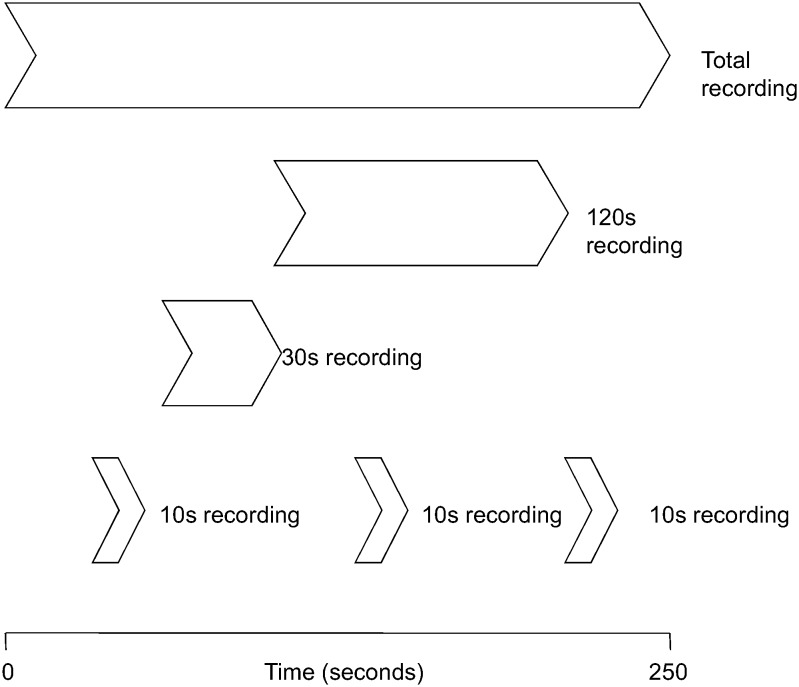
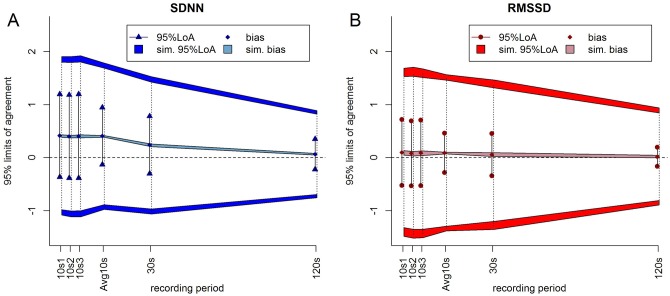
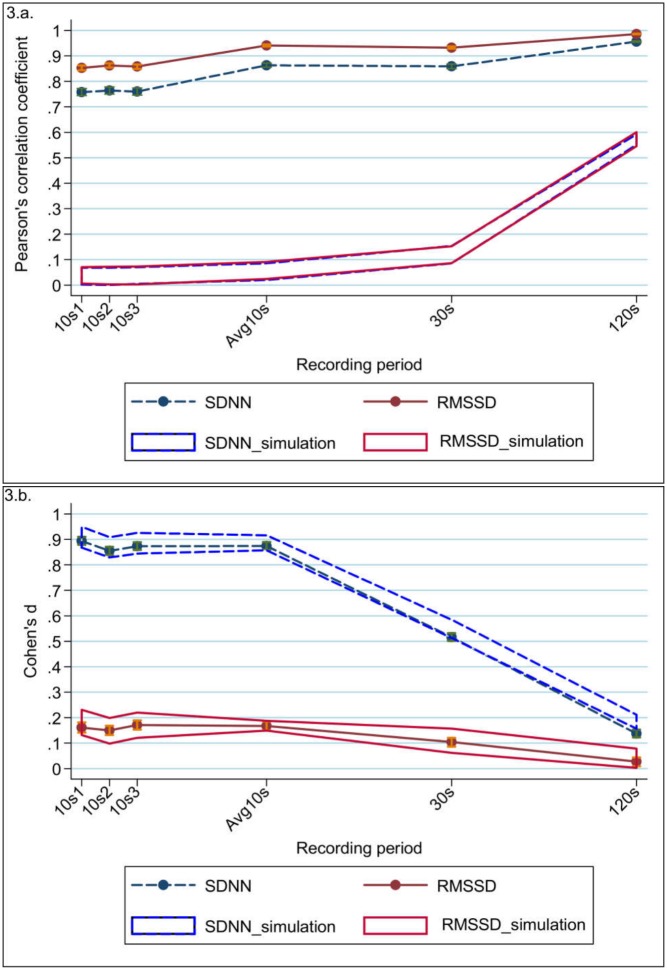
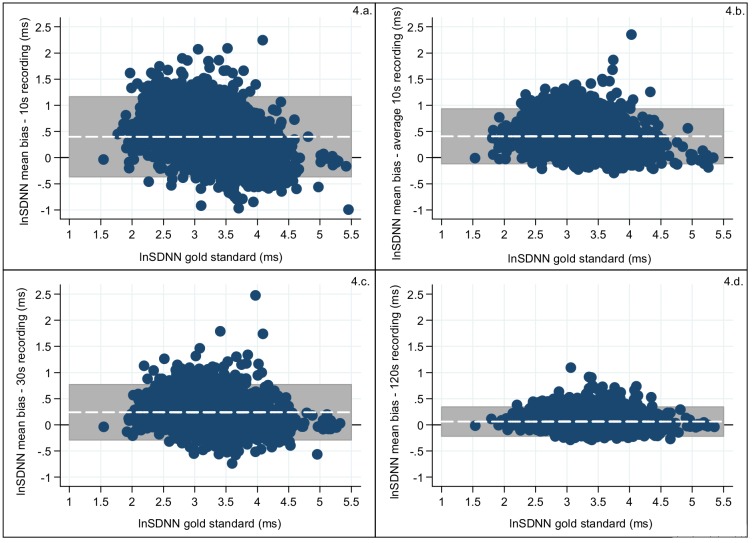
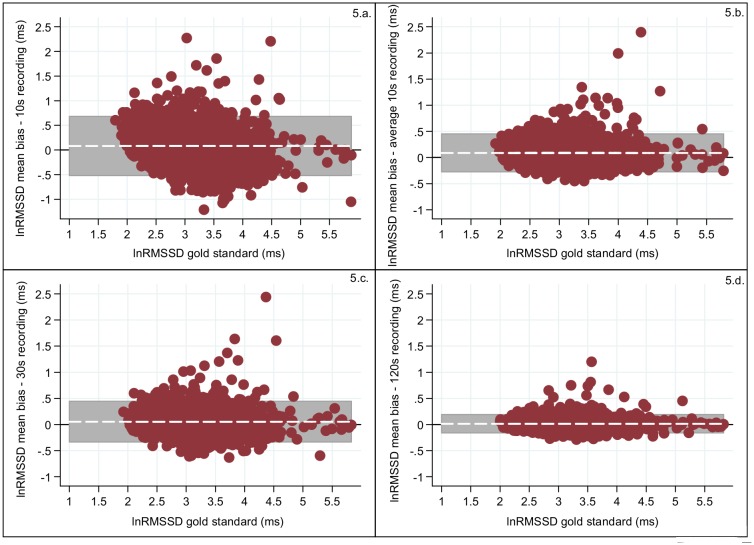
OBJECTIVES: In order to investigate the applicability of routine 10s electrocardiogram (ECG) recordings for time-domain heart rate variability (HRV) calculation we explored to what extent these (ultra-)short recordings capture the "actual" HRV. METHODS: The standard deviation of normal-to-normal intervals (SDNN) and the root mean square of successive differences (RMSSD) were measured in 3,387 adults. SDNN and RMSSD were assessed from (ultra)short recordings of 10s(3x), 30s, and 120s and compared to 240s-300s (gold standard) measurements. Pearson's correlation coefficients (r), Bland-Altman 95% limits of agreement and Cohen's d statistics were used as agreement analysis techniques. RESULTS: Agreement between the separate 10s recordings and the 240s-300s recording was already substantial (r = 0.758-0.764/Bias = 0.398-0.416/d = 0.855-0.894 for SDNN; r = 0.853-0.862/Bias = 0.079-0.096/d = 0.150-0.171 for RMSSD), and improved further when three 10s periods were averaged (r = 0.863/Bias = 0.406/d = 0.874 for SDNN; r = 0.941/Bias = 0.088/d = 0.167 for RMSSD). Agreement increased with recording length and reached near perfect agreement at 120s (r = 0.956/Bias = 0.064/d = 0.137 for SDNN; r = 0.986/Bias = 0.014/d = 0.027 for RMSSD). For all recording lengths and agreement measures, RMSSD outperformed SDNN. CONCLUSIONS: Our results confirm that it is unnecessary to use recordings longer than 120s to obtain accurate measures of RMSSD and SDNN in the time domain. Even a single 10s (standard ECG) recording yields a valid RMSSD measurement, although an average over multiple 10s ECGs is preferable. For SDNN we would recommend either 30s or multiple 10s ECGs. Future research projects using time-domain HRV parameters, e.g. genetic epidemiological studies, could calculate HRV from (ultra-)short ECGs enabling such projects to be performed at a large scale.
Overview
The claims and statistics of this paper haven’t been checked yet.
Free: it reads the open-access text and checks the first 5 claims that cite a source we can check. Create a free account to check every claim.
Integrity signals
Registry
Cites
Statistics
Figures
Verification
Claims the paper makes
The claims and statistics of this paper haven’t been checked yet.
Free: it reads the open-access text and checks the first 5 claims that cite a source we can check. Create a free account to check every claim.
Claims other papers make about this one
Each is checked against this paper’s own text: does it say what the citing paper says it does?
The cited source says what the claim attributes to it.
In the citing paper
“Those 10 s periods don’t need to be contiguous (i.e., not in succession), so it is possible to obtain a good estimate from several 10 s measurements spread over a trial or the experiment.”
From Heart Rate Variability and Cardiac Vagal Tone in Psychophysiological Research – Recommendations for Experiment Planning, Data Analysis, and Data Reporting (2017) · cites this paper as Munoz et al., 2015
The cited source says what the claim attributes to it.
In the citing paper
“In addition, even a single 10 s (standard ECG) was found to yield a valid RMSSD measurement, although an average over multiple 10 s ECGs is preferable.”
From Heart Rate Variability and Cardiac Vagal Tone in Psychophysiological Research – Recommendations for Experiment Planning, Data Analysis, and Data Reporting (2017) · cites this paper as Munoz et al., 2015
The cited source says what the claim attributes to it.
In the citing paper
“Very recent work by Munoz et al. (2015) investigated the validity of ultra-short and short recordings on HRV measurements in a very large adult sample (N = 3,387). They found that it is unnecessary to use recordings longer than 120 s to obtain accurate measures of RMSSD.”
From Heart Rate Variability and Cardiac Vagal Tone in Psychophysiological Research – Recommendations for Experiment Planning, Data Analysis, and Data Reporting (2017) · cites this paper as Munoz et al. (2015)
Self-check
Percentages, sums and reported differences re-computed from the paper’s own numbers.
The self-check needs the paper’s full text.
Citations
Cites
Statistical Power Analysis for the Behavioral Sciences
Muller, K. (1989) · Technometrics · doi:10.1080/00401706.1989.10488618 · Cited by 99,167
Statistical power analysis for the behavioral sciences
(1990) · Computers, Environment and Urban Systems · doi:10.1016/0198-9715(90)90050-4 · Cited by 65,269
Heart Rate Variability: Standards of Measurement, Physiological Interpretation, and Clinical Use
Electrophysiology, T. F. O. T. E. S. O. C. T. N. A. (1996) · Circulation · doi:10.1161/01.cir.93.5.1043 · Cited by 17,159
Measurement in Medicine: The Analysis of Method Comparison Studies
Altman, D. G., & Bland, J. M. (1983) · The Statistician · doi:10.2307/2987937 · Cited by 4,300
Heart rate variability: A review
Rajendra Acharya, U., Paul Joseph, K., Kannathal, N., Lim, C. M., & Suri, J. S. (2006) · Medical & Biological Engineering & Computing · doi:10.1007/s11517-006-0119-0 · Cited by 2,820 · cited 2×
“components [1–3].”
BackgroundApplying the right statistics: analyses of measurement studies
Bland, J. M., & Altman, D. G. (2003) · Ultrasound in Obstetrics & Gynecology · doi:10.1002/uog.122 · Cited by 1,311 · cited 18×
“However, the variation in those paired differences between the observed measurements of the (ultra-)short segments and those of the total recording is smaller than from the respective paired differences of the simulated measurements, explaining the much higher correlation and tighter 95%LoAs.”
BackgroundMethodInfluentialMalik, M. (1996) · Annals of Noninvasive Electrocardiology · doi:10.1111/j.1542-474x.1996.tb00275.x · Cited by 850
Heart Rate Variability ? A Historical Perspective
Billman, G. E. (2011) · Frontiers in Physiology · doi:10.3389/fphys.2011.00086 · Cited by 786 · cited 1×
“Both are easy to calculate and among the most widely used indices of HRV [7].”
How are we doing in soft psychology?
Rosenthal, R. (1990) · American Psychologist · doi:10.1037//0003-066x.45.6.775 · Cited by 515 · cited 1×
“80 is a large difference) [14,20].”
Dekker, J. M., Schouten, E. G., Klootwijk, P., Pool, J., Swenne, C. A., & Kromhout, D. (1997) · American Journal of Epidemiology · doi:10.1093/oxfordjournals.aje.a009049 · Cited by 512
Cited by
Items 101–200 of 422
Concussion History and Heart Rate Variability During Bouts of Acute Stress
Harrison, A. T., Lane‐Cordova, A. D., Fountaine, M. F. L., & Moore, R. D. (2021) · Journal of Athletic Training · doi:10.4085/1062-6050-0314.21 · Cited by 20
Effects of Industrial Noise on Physiological Responses
Masullo, M., Toma, R. A., & Maffei, L. (2022) · Acoustics · doi:10.3390/acoustics4030044 · Cited by 18
“For ultra-short time measures, there are methodological limitations; although for some researchers they are good surrogates of short-term HRV measurements [22], others are still trying to assess their validity [21,30].”
BackgroundMitsis, K., Zarkogianni, K., Kalafatis, E., Dalakleidi, K. V., Jaafar, A., Mourkousis, G., & Nikita, K. S. (2022) · Sensors · doi:10.3390/s22072472 · Cited by 27
“Reactive frames of different duration, 10 s and 30 s, were investigated in accordance with current practice for ultra-short analysis of heart rate variability [45,46].”
MethodMelo, H. M., Hoeller, A. A., Walz, R., & Takase, E. (2019) · Applied Psychophysiology and Biofeedback · doi:10.1007/s10484-019-09445-z · Cited by 21
Oh, J., Lee, H., & Park, H. (2021) · International Journal of Environmental Research and Public Health · doi:10.3390/ijerph18179136 · Cited by 28
“They were then exposed to each of the experimental stimuli for 2 min and 30 s [51,52].”
MethodMayor, D. F., Steffert, T., Datseris, G., Firth, A., Panday, D., Kandel, H. K., & Banks, D. (2023) · Entropy · doi:10.3390/e25020301 · Cited by 20
“[75] on the validity of (ultra-)short recordings for HRV measurements when analysis of our own data was already well under way.”
BackgroundInfluentialKrause, E., Vollmer, M., Wittfeld, K., Weihs, A., Frenzel, S., Dörr, M., Kaderali, L., Felix, S. B., Stubbe, B., Ewert, R., et al. (2023) · Frontiers in Cardiovascular Medicine · doi:10.3389/fcvm.2023.1144191 · Cited by 20
“First, as only two out of eleven studies mentioned above had a sample size larger than 100 (33, 36), some statistical analyses may have been affected by a lack of statistical power.”
BackgroundMethodResultInfluentialRossi, A., Pedreschi, D., Clifton, D. A., & Morelli, D. (2020) · Sensors · doi:10.3390/s20247122 · Cited by 21
Goldbeck, F., Xie, Y. L., Hautzinger, M., Fallgatter, A. J., Sudeck, G., & Ehlis, A. (2021) · Evidence-based Complementary and Alternative Medicine · doi:10.1155/2021/6673190 · Cited by 28
The promising prognostic value of vagal nerve activity at the initial management of ovarian cancer
Cherifi, F., Lefèvre‐Arbogast, S., Font, J., Abdeddaim, C., Bécourt, S., Penel, N., Coquan, E., Lequesne, J., Gidron, Y., & Joly, F. (2022) · Frontiers in Oncology · doi:10.3389/fonc.2022.1049970 · Cited by 19
“Furthermore, a strong correlation between the 5min HRV measurement and the 10second HRV measurement was found, with better accuracy for RMSDD, and do recommended the use of ultrashort ECG (28, 36, 37).”
MethodUltra-short-term heart rate variability during resistance exercise in the elderly
Arêas, G. P. T., Caruso, F., Simões, R. P., Castello‐Simões, V., Jaenisch, R. B., Sato, T. D. O., Cabiddu, R., Mendes, R. G., Arena, R. A., & Borghi‐Silva, A. (2018) · Brazilian Journal of Medical and Biological Research · doi:10.1590/1414-431x20186962 · Cited by 22
“(22) showed that it is unnecessary to use recordings longer than 120 s to obtain accurate measurements of RMSSD and SDNN in healthy Figure 5.”
BackgroundBrain activation and heart rate variability as markers of autonomic function under stress
Huber, A., Koenig, J., Bruns, B., Bendszus, M., Friederich, H., & Simon, J. J. (2025) · Scientific Reports · doi:10.1038/s41598-025-12430-8 · Cited by 25
Heart Rate Variability in Professional and Semiprofessional Soccer: A Scoping Review
Mirto, M., Filipas, L., Altini, M., Codella, R., & Meloni, A. (2024) · Scandinavian Journal of Medicine and Science in Sports · doi:10.1111/sms.14673 · Cited by 26
“Under resting conditions, interchangeability has been found between short-term and UST measurements for RMSSD in both athletes and nonathlete individuals [11, 61], potentially easing future implementation in sports settings.”
BackgroundMethodRominger, C., Papousek, I., Fink, A., Perchtold‐Stefan, C. M., Lackner, H. K., Weiss, E. M., & Schwerdtfeger, A. R. (2019) · PLoS ONE · doi:10.1371/journal.pone.0220205 · Cited by 20
Cohesin-protein Shugoshin-1 controls cardiac automaticity via HCN4 pacemaker channel
Liu, D., Song, A. T., Qi, X., Vliet, P. P. V., Xiao, J., Xiong, F., Andelfinger, G., & Nattel, S. (2021) · Nature Communications · doi:10.1038/s41467-021-22737-5 · Cited by 16
RapidHRV: an open-source toolbox for extracting heart rate and heart rate variability
Kirk, P. A., Bryan, A. D., Garfinkel, S. N., & Robinson, O. J. (2022) · PeerJ · doi:10.7717/peerj.13147 · Cited by 17
“Following preprocessing, the pipeline scales the data (between 0 and 100) and runs peak detection on every window (default width = 10s; for a methodological discussion and prior validation of using ultra-short, 10s windows in heart rate variability estimation, see Munoz et al., 2015).”
MethodTsai, C.-H., Christian, M., Kuo, Y.-Y., Lu, C. C., Lai, F., & Huang, W. (2023) · Sleep Medicine · doi:10.1016/j.sleep.2023.12.013 · Cited by 17
Condy, E. E., Friedman, B. H., & Gandjbakhche, A. (2020) · Frontiers in Neuroscience · doi:10.3389/fnins.2020.575589 · Cited by 21
Abdominothoracic Postural Tone Influences the Sensations Induced by Meal Ingestion
Livovsky, D. M., Barber, C., Barba, E., Accarino, A. M., & Azpiroz, F. (2021) · Nutrients · doi:10.3390/nu13020658 · Cited by 15
Hupin, D., Sarajlic, P., Venkateshvaran, A., Fridén, C., Nordgren, B., Opava, C. H., Lundberg, I. E., & Bäck, M. (2021) · Frontiers in Medicine · doi:10.3389/fmed.2021.788243 · Cited by 20
“For the assessment of ultrashort heart rate variability parameters as surrogates of longer recordings, the square root of the mean squared differences of successive RR intervals (RMSSD in ms) was considered reliable down to 10 s ECG recordings (26, 27).”
MethodThe effect of ambient sounds on decision-making and heart rate variability in autism
Bellamy, R., RING, H. A., Watson, P., Kemp, A. H., Munn, G., & Clare, I. C. H. (2021) · Autism · doi:10.1177/13623613211014993 · Cited by 16
“For each participant, four 2.5 min samples were assessed (Esco & Flatt, 2014; Laborde et al., 2017; Munoz et al., 2015).”
MethodInfluentialGrässler, B., Dordevic, M., Darius, S., Herold, F., Forte, G., Langhans, C., Halfpaap, N., Müller, P., Glanz, W., Dantas, E. H. M., et al. (2023) · Arquivos de Neuro-Psiquiatria · doi:10.1055/s-0042-1758862 · Cited by 16
You, S., Cho, B. H., Bae, H., Kim, Y., Kim, J.-R., Park, S., Shon, Y., Seo, D., & Kim, I. Y. (2023) · Journal of Clinical Medicine · doi:10.3390/jcm12134284 · Cited by 17
Stress Determined through Heart Rate Variability Predicts Immune Function
Hong, L., Wei, J., Yasin, Y., Wu, S. J., Barszczyk, A., Feng, Z., & Lee, K. (2019) · NeuroImmunoModulation · doi:10.1159/000500863 · Cited by 15
Valenzuela, A., Hornero, G., Royo, D., Aguilar, A., & Casas, Ó. (2020) · IEEE Access · doi:10.1109/access.2020.3008269 · Cited by 23
“could not be estimated in the desired short time period [37] and therefore could not be used to access the information in a reasonably short time.”
BackgroundDiminution of Heart Rate Variability in Bipolar Depression
Hage, B., Britton, B., Daniels, D., Heilman, K. J., Porges, S. W., & Halaris, A. E. (2017) · Frontiers in Public Health · doi:10.3389/fpubh.2017.00312 · Cited by 15
“org December 2017 | Volume 5 | Article 312 Recent evidence suggests that acute HRV measurements can be obtained by only 120 s of ECG recordings (62).”
BackgroundGroup B streptococcus toxic shock-like syndrome in a healthy woman: a case report.
Begley, J. S., & Barnes, R. C. (2007) · PubMed · Cited by 14
Heart Rate Variability Predicts Treatment Outcome in Major Depression
(2017) · Journal of Psychiatry and Brain Science · doi:10.20900/jpbs.20170017 · Cited by 13
Passi, T., Lukander, K., Laarni, J., Närväinen, J., Rissanen, J., Vaara, J. P., Pihlainen, K., Kallinen, K., Ojanen, T., Mauno, S., et al. (2022) · Frontiers in Psychology · doi:10.3389/fpsyg.2022.925157 · Cited by 22
Gu, Z., Zarubin, V. C., & Martsberger, C. (2023) · Physiological Reports · doi:10.14814/phy2.15863 · Cited by 16
“It has also been shown that 30s ECG is sufficient in deriving RMSSD (Munoz et al., 2015).”
BackgroundEvaluation of low vagally-mediated heart rate variability as an early marker of depression risk
Watanabe, D. K., Jarczok, M. N., Williams, D. P., Koenig, J., & Thayer, J. F. (2024) · Journal of Affective Disorders · doi:10.1016/j.jad.2024.08.051 · Cited by 17
Ultra-short term heart rate variability as a tool to assess changes in valence
Schippers, A., Aben, B., Griep, Y., & Overwalle, F. V. (2018) · Psychiatry Research · doi:10.1016/j.psychres.2018.10.005 · Cited by 20
Saad, M., Ray, L. B., Bradley-Garcia, M., Palamarchuk, I. S., Gholamrezaei, A., Douglass, A. B., Lee, E. K., Soucy, L., & Robillard, R. (2020) · Psychosomatic Medicine · doi:10.1097/psy.0000000000000766 · Cited by 13
“range between 10 and 30 seconds (42,43), and 30-second recordings have been recommended to evaluate SDNN (44).”
BackgroundRichter, J., Pietzner, A., Koenig, J., Thayer, J. F., Pané‐Farré, C. A., Gerlach, A. L., Gloster, A. T., Wïttchen, H., Lang�, T., Alpers, G. W., et al. (2021) · Scientific Reports · doi:10.1038/s41598-021-86867-y · Cited by 20
Heart rate variability and heart rate recovery in lung cancer survivors eligible for long-term cure
Ha, D. M., Malhotra, A., Ries, A. L., O’Neal, W. T., & Fuster, M. M. (2019) · Respiratory Physiology & Neurobiology · doi:10.1016/j.resp.2019.103264 · Cited by 14
“In addition, HRV from 10-s ECGs have increased agreement with the gold-standard 240-300-s tracings when repeated measurements are obtained (up to 3 times) (Munoz et al., 2015); we obtained HRV from single 10-s ECGs which may additionally explain some of the variances between HRR and HRV.”
MethodWhiting, W. L., & Murdock, K. K. (2021) · Quarterly Journal of Experimental Psychology · doi:10.1177/17470218211041851 · Cited by 25
“Specifically, we found measurable effects of notifications on HRV, even though the measurement period was limited to 6 s, affirming the viability of assessing HRV in brief (around 10 s) time intervals (Chen et al., 2014; McNames & Aboy, 2006; Munoz et al., 2015; Salahuddin et al., 2007).”
BackgroundThe Effect of High-Altitude Acclimatisation on Ultra-Short Heart Rate Variability
Boos, C. J., Mellor, A. J., Woods, D. R., & O'Hara, J. P. (2022) · Frontiers in Cardiovascular Medicine · doi:10.3389/fcvm.2022.787147 · Cited by 12
“the 10 s measures were done in triplicate and in quiet temperature-controlled room (23).”
BackgroundAlfonso, C., & Capdevila, L. (2022) · PeerJ · doi:10.7717/peerj.13094 · Cited by 20
Suitability of Ultra-Short-Term Heart Rate Variability in Military Trainees
Alalyan, M. J., Alkahtani, S. A., Habib, S. S., & Flatt, A. A. (2020) · Healthcare · doi:10.3390/healthcare8040409 · Cited by 12
“[31] compared RMSSD and SDNN from three consecutive 10-s samples, a 30-s sample and a 120-s sample derived from a 5-min finger pulse interval recording to the criterion (n = 3387 middle aged adults).”
MethodAlfonso, C., Clarke, D. C., & Capdevila, L. (2025) · Scientific Reports · doi:10.1038/s41598-025-13540-z · Cited by 20
Unraveling the Dynamics of Mental and Visuospatial Workload in Virtual Reality Environments
Bernal, G., Jung, H., Yassı, İ. E., Hidalgo, N., Alemu, Y., Barnes-Diana, T., & Maes, P. (2024) · Computers · doi:10.3390/computers13100246 · Cited by 15
Wang, H., Zhang, G., Lin, H., Sun, J., Yan, R., Meng, H., Hu, S., & Zhu, H. (2024) · Energy and Buildings · doi:10.1016/j.enbuild.2024.115188 · Cited by 16
Improving Heart Rate Variability Measurements from Consumer Smartwatches with Machine Learning
Maritsch, M., Bérubé, C., Kraus, M., Lehmann, V. F., Züger, T., Feuerriegel, S., Kowatsch, T., & Wortmann, F. (2019) · Alexandria (UniSG) (University of St.Gallen) · doi:10.7892/boris.138443 · Cited by 11
Choi, I. Y., Chang, Y., Kang, G., Jung, H. S., Shin, H. C., Wild, S. H., Byrne, C. D., & Ryu, S. (2022) · Scientific Reports · doi:10.1038/s41598-022-05037-w · Cited by 15
MacDonald, D. M., Mkorombindo, T., Ling, S. X., Adabağ, S., Casaburi, R. H., Connett, J. E., Helgeson, E. S., Pórszász, J., Rossiter, H. B., Stringer, W. W., et al. (2022) · Chronic Obstructive Pulmonary Diseases Journal of the COPD Foundation · doi:10.15326/jcopdf.2021.0264 · Cited by 15
Maqsood, R., Schofield, S. J., Bennett, A. N., Bull, A. M. J., Fear, N. T., Cullinan, P., Khattab, A., & Boos, C. J. (2023) · BMJ Military Health · doi:10.1136/military-2022-002316 · Cited by 11
“12 13 However, the femoral arterial waveform represents the down-stream physiological effect of ECG depolarisation and cardiac contraction.”
Heart Rate Variability Analysis: Application Overview
Londhe, A. N., & Atulkar, M. (2018) · International Conference Inventive Communication and Computational Technologies · doi:10.1109/icicct.2018.8473198 · Cited by 13
“[50] which evaluated two methods of measurement and shown 95% agreement between them over repeated measures.”
BackgroundMethodResting heart rate and incidence of venous thromboembolism
Folsom, A. R., Lutsey, P. L., Pope, Z., Fashanu, O. E., Misialek, J. R., Cushman, M., & Michos, E. D. (2019) · Research and Practice in Thrombosis and Haemostasis · doi:10.1002/rth2.12288 · Cited by 10
You, S., Jo, H., Cho, B. H., Song, J., Kim, D., Hwang, Y., Shon, Y., Seo, D., & Kim, I. Y. (2021) · Medicina · doi:10.3390/medicina57070666 · Cited by 11
Constantin, K. L., Lupo‐Flewelling, K., Moline, R. L., & McMurtry, C. M. (2022) · Journal of Pediatric Psychology · doi:10.1093/jpepsy/jsac035 · Cited by 12
Brabant, O., van de Ree, M., & Erkkilä, J. (2017) · The Arts in Psychotherapy · doi:10.1016/j.aip.2017.08.004 · Cited by 18
“Studies investigating the reliability of HRV indices for ultra-short segments have demonstrated that SDNN and RMSSD remain reliable with segments lasting only 30 seconds (Munoz et al., 2015; Salahuddin, Cho, Jeong, & Kim, 2007).”
BackgroundHoute, M. V. D., Ramakers, I., Oudenhove, L. V., den Bergh, O. V., & Bogaerts, K. (2024) · Journal of Psychosomatic Research · doi:10.1016/j.jpsychores.2024.112025 · Cited by 10
Jin, K., Guo, Z., Qiao, Z., Liu, M., Yang, Y., & Xu, C. (2024) · Life · doi:10.3390/life14070837 · Cited by 12
“These are consistent with previous studies [22,23], which indicated These fi ndings are consistent with previous studies [22,23], which indicated that HRV obtained from shorter periods (<4 min) had good agreement with that obtained from 5 min periods [24]. that HRV obtained Additionally, in the…”
BackgroundResultZimmermann‐Schlegel, V., Wild, B., Nawroth, P. P., Kopf, S., Herzog, W., & Hartmann, M. (2018) · Experimental and Clinical Endocrinology & Diabetes · doi:10.1055/s-0043-125445 · Cited by 12
Evaluating heart rate variability as a predictor of the influence of lying on memory
Paige, L. E., Wolf, J. M., & Gutchess, A. H. (2020) · Memory · doi:10.1080/09658211.2020.1849307 · Cited by 15
“…effects that could be evident later in the tachogram.1 The gold standard in HR analyses has often been 300 sec (5 min) of clean data (see Esco & Flatt, 2014) and recent research has argued that it is unnecessary to use long HR recordings to calculate accurate HRV indices (see Munoz et al., 2015).”
MethodChoi, B., Shin, H., Lee, J. H., Bang, J., Lee, E., & Noh, G. (2021) · Frontiers in Physiology · doi:10.3389/fphys.2021.554026 · Cited by 10
Heart rate variability predicts decline in sensorimotor rhythm control
Nann, M., Haslacher, D., Colucci, A., Eskofier, B. M., von Tscharner, V., & Soekadar, S. R. (2021) · Journal of Neural Engineering · doi:10.1088/1741-2552/ac1177 · Cited by 12
How to properly evaluate cardiac vagal tone in oncology studies: a state-of-the-art review
Martinez, P., Grinand, M., Cheggour, S., Taieb, J., & Gourjon, G. (2024) · Journal of the National Cancer Center · doi:10.1016/j.jncc.2024.02.002 · Cited by 14
“Munoz et al. 91 mention that long-term recording is not necessary to obtain accurate measurements of rMSSD and SDNN.”
BackgroundOrlando, E. M., Nenna, F., Zanardi, D., Buodo, G., Mingardi, M., Sarlo, M., & Gamberini, L. (2025) · International Journal of Human-Computer Studies · doi:10.1016/j.ijhcs.2025.103516 · Cited by 14
Sorek, G., Gagnon, I. J., Schneider, K., Chevignard, M., Stern, N., Fadida, Y., Kalderon, L., Shaklai, S., & Leurer, M. K. (2022) · Annals of Physical and Rehabilitation Medicine · doi:10.1016/j.rehab.2022.101652 · Cited by 9
Socioeconomic Differences in Sympathovagal Balance: The Healthy Life in an Urban Setting Study
van Nieuwenhuizen, B. P., Collard, D., Tan, H. L., Blom, M. T., van den Born, B. H., Kunst, A. E., & van Valkengoed, I. G. M. (2020) · Psychosomatic Medicine · doi:10.1097/psy.0000000000000887 · Cited by 11
“Although 24-hour recordings have been described as the “gold standard” for HRV (36), “ultra-short-term recordings” as short as 30 seconds have also shown to be valid (37).”
BackgroundNelson, B. W., Sheeber, L., Pfeifer, J. H., & Allen, N. B. (2021) · Research on Child and Adolescent Psychopathology · doi:10.1007/s10802-021-00840-x · Cited by 10
“To assess differences in reactivity a series of multilevel models were performed for each cardiovascular measure (HR, RMSSD, PEP, SCL) and affect measure (positive and negative) separately for adolescents (High-Risk and Lower-Risk Groups) and mothers (Depressed and NonDepressed Groups).”
MethodInfluentialMao, M., Wang, C., Hou, T., Han, X., Liu, R., Han, Q., Dong, Y., Wang, J., Liu, C., Cong, L., et al. (2023) · Journal of Alzheimer s Disease · doi:10.3233/jad-230056 · Cited by 9
“Previous studies have shown that the ECG parameters from the single 10-s ECG are less accurate in reflect-ing the cardiac conditions compared to those from the multiple 10-s ECG or 5-min ECG recording, especially in people with cardiovascular disorders (e.g., atrial fibrillation) [44, 45].”
Behnsen, P., Buil, J. M., Koot, S., Huizink, A. C., & van Lier, P. A. C. (2019) · Development and Psychopathology · doi:10.1017/s0954579419000269 · Cited by 10
“This indicator is a widely used short-term indicator of heart rate variability and has been shown to index parasympathetic rather than sympathetic nervous system functioning (Jarrin et al., 2015; Munoz et al., 2015; Polanczyk et al., 1998).”
BackgroundCharacterization of Assistive Robot Arm Teleoperation: A Preliminary Study to Inform Shared ControlPreprint
Javaremi, M. N., & Argall, B. (2020) · arXiv (Cornell University) · doi:10.48550/arxiv.2008.00109 · Cited by 9
“The time-domain Root Mean Square of the Successive Differences (RMSSD) [21] was used to assess the heart rate variability: where N is the total number of heart beats and I ( · ) is the interbeat interval.”
MethodHeart Rate Variability as a Predictor of +Gz Tolerance During the High-G Selective Test
Bačević, N., Ninković, M., Drvendzija, M., Vidaković, J. Z., Bacevic, M., & Stepanić, P. (2024) · Aerospace Medicine and Human Performance · doi:10.3357/amhp.6319.2024 · Cited by 7
Maza, A., Goizueta, S., & Lloréns, R. (2024) · IEEE Sensors Journal · doi:10.1109/jsen.2024.3359301 · Cited by 11
“However, the validity of ultra-short-term measures is still a matter of a debate [42], [46], [47].”
BackgroundPhysiological team dynamics explored: physiological synchrony in medical simulation training
Wespi, R., Neher, A. N., Birrenbach, T., Schauber, S. K., Frenkel, M. O., Schrom-Feiertag, H., Sauter, T. C., & Kämmer, J. E. (2025) · Advances in Simulation · doi:10.1186/s41077-025-00335-5 · Cited by 10
“In the context of ultra-short-term HRV measurements, RMSSD is widely recognised for its stability, even in intervals as short as 30 s [47].”
Drunk Driver Detection Using Multiple Non-Invasive Biosignals
Kim, S. H., Son, H. W., Lee, T. M., & Baek, H. J. (2025) · Sensors · doi:10.3390/s25051281 · Cited by 8
“Among previous studies on the recommended duration for HRV analysis, second-by-second HRV analysis was validated using advanced statistical methods, with recommendations to record ECG for a minimum of 10 s for RMSSD and 30 s for SDNN [36].”
Kennedy-Metz, L. R., DIAS, R. D., Srey, R., Rance, G. C., Conboy, H. M., Haime, M. E., Quin, J. A., Yule, S., & Zenati, M. A. (2020) · Human Factors The Journal of the Human Factors and Ergonomics Society · doi:10.1177/0018720820976297 · Cited by 10
“…recent evidence supports the accuracy and reliability of calculating HRV on ultra- short time scales, using time windows as narrow at 10 s (Baek et al., 2015; Munoz et al., 2015; Nussinovitch et al., 2011; Salahuddin et al., 2007; Schaaff & Adam, 2013; Shaffer et al., 2016; Thong et al., 2003).”
MethodSantos, A. C., Arriaga, P., & Simões, C. (2021) · Biological Psychology · doi:10.1016/j.biopsycho.2021.108089 · Cited by 11
Taylor, M. R., Scott, S., Steineck, A., & Rosenberg, A. R. (2021) · Journal of Pain and Symptom Management · doi:10.1016/j.jpainsymman.2021.04.015 · Cited by 10
Ayudhaya, W. S. N., Pityaratstian, N., Eungpinichpong, W., Rattananupong, T., Kitidumrongsuk, P., Loonlawong, S., & Jiamjarasrangsi, W. (2022) · BMC Psychiatry · doi:10.1186/s12888-022-03962-8 · Cited by 13
Lamberts, R. P., van Erp, T., Javaloyes, A., Eken, M. M., Langerak, N. G., & Tam, N. (2024) · European Journal of Applied Physiology · doi:10.1007/s00421-023-05385-z · Cited by 10
“…breathing and for minimally 5 min) (Malik et al. 1996), more recently, several researchers have started using ultra-short LnRMSSD measurements (as short as 30 s) after submaximal exercise, to monitor training status in athletes (Munoz et al. 2015; Krejci et al. 2018; Forner-Llacer et al. 2020).”
BackgroundResultInfluentialBurnout of the Mind – Burnout of the Body?
Traunmüller, C., Gaisbachgrabner, K., Lackner, H. K., & Schwerdtfeger, A. R. (2016) · Journal of Psychophysiology · doi:10.1027/0269-8803/a000182 · Cited by 13
Melo, H. M., Marques, J. L. B., Fialho, G. L., Wolf, P., d’Ávila, A., Lin, K., & Walz, R. (2021) · Epilepsy Research · doi:10.1016/j.eplepsyres.2021.106662 · Cited by 9
Maqsood, R., Schofield, S. J., Bennett, A. N., Khattab, A., Bull, A. M. J., Fear, N. T., & Boos, C. J. (2024) · Applied Psychophysiology and Biofeedback · doi:10.1007/s10484-024-09652-3 · Cited by 8
“Only one time-domain measure of HRV (RMSSD) was validated in this study, limited by its shorter but reliable recording length of 14s, as opposed to frequency and non-linear measures, which would have required longer recording (Malik, 1996; Munoz et al., 2015).”
InfluentialDistress detection in VR environment using Empatica E4 wristband and Bittium Faros 360
Medarević, J., Miljković, N., Stojmenova, K., & Sodnik, J. (2025) · Frontiers in Physiology · doi:10.3389/fphys.2025.1480018 · Cited by 8
Perek, S., Nussinovitch, U., Sagi, N., Gidron, Y., & Raz‐Pasteur, A. (2023) · PLoS ONE · doi:10.1371/journal.pone.0287607 · Cited by 8
Exploring the prevalence of undetected bradyarrhythmia in dementia with Lewy bodies
Heyman, I., Persson, T., Haglund, M., & Londos, E. (2023) · Clinical Autonomic Research · doi:10.1007/s10286-023-00962-w · Cited by 8
Khalil, M., Sinnott, S. M., Civieri, G., Abohashem, S., Grewal, S., Hanlon, E. C., Assefa, A., Qamar, I., Lau, H. C., Karam, K. A., et al. (2024) · Brain Behavior and Immunity · doi:10.1016/j.bbi.2024.12.155 · Cited by 8
Unobtrusive Cardio-Respiratory Assessment for Different Indoor Environmental Conditions
Rodrigues, M. J., Postolache, O. A., & Cercas, F. (2022) · IEEE Sensors Journal · doi:10.1109/jsen.2022.3207522 · Cited by 11
“) and LF/HF ratio [43], [44], as well as for all other HRV time-domain parameters [45].”
BackgroundCollard, D., Westerhof, B. E., Karemaker, J. M., Stok, W. J., Postema, P. G., Krediet, C. T. P., Vogt, L., & van den Born, B. H. (2023) · Medical & Biological Engineering & Computing · doi:10.1007/s11517-023-02768-4 · Cited by 9
“and challenges the recommendation in current guidelines that a minimum recording length of 300 s is required for reliable assessment of HRV [11, 17].”
BackgroundCan heart rate variability data from the Apple Watch electrocardiogram quantify stress?
Velmovitsky, P. E., Lotto, M., Alencar, P., Leatherdale, S. T., Cowan, D. D., & Morita, P. P. (2023) · Frontiers in Public Health · doi:10.3389/fpubh.2023.1178491 · Cited by 10
“(30), for example, found that a minimum of 10s was required for RMSSD and 30s for SDNN.”
BackgroundBlanco, C., Madej, T., Mangner, N., Hommel, J., Grimm, S., Knaut, M., Linke, A. H.-P., & Winzer, E. B. (2023) · ESC Heart Failure · doi:10.1002/ehf2.14508 · Cited by 6
“…HRV calculated from 10 s ECG recordings is less well established compared with short-term and longer term recordings of 10 min or 24 h. 14 Moreover, patients in our cohort having high NT-proBNP levels might be in a stage of HF too advanced to be susceptible for ANS modulation by BAT.”
MethodKennedy-Metz, L. R., & Parker, S. H. (2018) · Journal of Healthcare Informatics Research · doi:10.1007/s41666-018-0016-y · Cited by 7
“Of the timedomain measures, RMSSD is the most appropriate and consistent in detecting differences in mental stress and arousal [8, 41, 45].”
BackgroundRomero, D., & Jané, R. (2021) · IEEE Access · doi:10.1109/access.2021.3053310 · Cited by 9
“First, from the ultra-short-term analysis, we found a transient increase in HRV during apnea episodes, translated into higher values of SDNN , RMSSD and RR, in relation to pre-apneic values.”
BackgroundInfluentialHeart Rate Variability: A Methodological Survey
Londhe, A. N., & Atulkar, M. (2019) · International Conference on Intelligent Sustainable Systems (ICISS) · doi:10.1109/iss1.2019.8907985 · Cited by 8
Reshef, M., Perek, S., Odeh, T., Hamati, K., & Raz‐Pasteur, A. (2024) · Journal of Clinical Medicine · doi:10.3390/jcm13237255 · Cited by 6
Dyball, D. M., Maqsood, R., Schofield, S. J., Bennett, A. N., Cullinan, P., Bull, A. M. J., Boos, C. J., & Fear, N. T. (2025) · Journal of Affective Disorders · doi:10.1016/j.jad.2025.01.087 · Cited by 12
Classifying social and physical pain from multimodal physiological signals using machine learning
Jang, E.-H., Eum, Y.-J., Yoon, D., & Byun, S. (2025) · Scientific Reports · doi:10.1038/s41598-025-12476-8 · Cited by 10
“In addition, previous studies have shown that some time-domain HRV indices (e.g., RMSSD, SDNN) can still yield meaningful estimates even within a 30-s interval 73,74 , although a 60-s or longer interval is often recommended—particularly for frequency-domain HRV indices.”
Politi, K., Kaminer, K., & Nussinovitch, U. (2019) · Journal of Investigative Medicine · doi:10.1136/jim-2019-001106 · Cited by 6
Lee, K. H., & Byun, S. (2023) · Applied Sciences · doi:10.3390/app13052932 · Cited by 8
The Validity of Ultra-Short-Term Heart Rate Variability during Cycling Exercise
Tanoue, Y., Nakashima, S., Komatsu, T., Kosugi, M., Kawakami, S., Kawakami, S., Michishita, R., Higaki, Y., & Uehara, Y. (2023) · Sensors · doi:10.3390/s23063325 · Cited by 7
“Although the criteria for validity and some measurement conditions (posture, resting periods before recording, and so on) were different among previous studies, the acceptable results for the length of recording or analysis were reported for the various segments, including the 60 sec [29], 120 sec [25,27], 240 sec [32…”
MethodResultWei, L., Chen, Y., Chen, X., Baeken, C., & Wu, G. (2024) · NeuroImage · doi:10.1016/j.neuroimage.2024.120725 · Cited by 8
“Although the Task Force criteria (TaskForce, 1996) indicate that 5-min ECG recordings are preferable for measuring HRV, the time-domain RMSSD can still be accurately quantified using UST recording (e.g., 2 min) (Munoz et al., 2015; Nussinovitch et al., 2011; Schroeder et al., 2004).”
Measuring psychological immersion through cardiovascular response measures in subtitled films
Fernández, C. A. G., & Jankowska, A. M. (2024) · Translation Cognition & Behavior · doi:10.1075/tcb.00090.gon · Cited by 7
Weippert, M., Behrens, M., Mau‐Moeller, A., Bruhn, S., & Behrens, K. (2017) · Frontiers in Physiology · doi:10.3389/fphys.2017.00844 · Cited by 7
“…measures have been tested under resting conditions and recovery from exercise (Thong et al., 2003; Nussinovitch et al., 2011; Esco and Flatt, 2014; Munoz et al., 2015; Nakamura et al., 2017); however, a paucity of research exists regarding the validity and agreement with standard short-term…”
BackgroundReliability of ultra‐short indices for autonomic dysfunction in dyslipidemia
Nussinovitch, U. (2020) · Clinical Physiology and Functional Imaging · doi:10.1111/cpf.12661 · Cited by 6
“Munoz et al. reported that a single 10-s recording yielded a valid RMSSD measurement, although they concluded that an average over several 10-s ECGs is preferable (Munoz et al., 2015).”
BackgroundInteractive Effects of HRV and P-QRS-T on the Power Density Spectra of ECG Signals
Xiang, T., Ji, N., Clifton, D. A., Lü, L., & Zhang, Y. (2021) · IEEE Journal of Biomedical and Health Informatics · doi:10.1109/jbhi.2021.3100425 · Cited by 6
“One study even recommended either 30 s or multiple 10 s ECG recordings for ultra-short-term HRV calculation based on a large sample size of 3387 subjects [45].”
MethodGnacek, M., Mavridou, I. I., Broulidakis, J., Nduka, C. C., Balaguer‐Ballester, E., Κωστούλας, Θ., & Seiss, E. (2022) · International Conference on Affective Computing and Intelligent Interaction and workshops · doi:10.1109/acii55700.2022.9953891 · Cited by 8
“For instance, most videos are quite short, 3-15 seconds, but for measuring physiological data, such as heart rate variability, 30 seconds is recommended time [25].”
Background
Metadata
- Authors
- Munoz, M. L., van Roon, A., Riese, H., Thio, C., Oostenbroek, E., Westrik, I., de Geus, E. J. C., Gansevoort, R., Lefrandt, J., Nolte, I. M., & Snieder, H.
- Affiliations
- University Medical Center Groningen (NL)
- Corresponding author
- Nolte, Ilja M.
- Snieder, Harold
- ORCID
- Venue
- PLOS ONE
- Publisher
- Public Library of Science (PLoS)
- Published
- 2015-09-28
- Volume
- 10
- Issue
- 9
- Pages
- e0138921
- ISSN
- 1932-6203 (ISSN-L)
- PMC
- PMC4586373
- OpenAlex
- W2298185395
- Cited by
- 423
- References
- 27
- Citations by year
- 2026: 80 · 2025: 55 · 2024: 47 · 2023: 33 · 2022: 45 · 2021: 51 · 2020: 32 · 2019: 26 · 2018: 26 · 2017: 17 · 2016: 8
- FWCI
- 12.36
- Type
- journal article
- Language
- en
- Open access
- gold
- doi.org
- Licence
- Locations
- PLoS ONE (publishedVersion, cc-by)
- Europe PMC (PubMed Central) (publishedVersion, cc-by)
- PubMed Central (publishedVersion, cc-by)
- PubMed (publishedVersion)
- University of Groningen research database (University of Groningen / Centre for Information Technology) (publishedVersion, cc-by)
- VU Research Portal (publishedVersion, other-oa)
- DOAJ (DOAJ: Directory of Open Access Journals) (submittedVersion, cc-by-sa)
- University of Groningen research database (University of Groningen / Centre for Information Technology) (submittedVersion, cc-by)
- Data Archiving and Networked Services (DANS) (submittedVersion, other-oa)
- Topics
- Health Sciences › Medicine › Cardiology and Cardiovascular Medicine › Heart Rate Variability and Autonomic Control
- Health Sciences › Medicine › Cardiology and Cardiovascular Medicine › ECG Monitoring and Analysis
- Physical Sciences › Engineering › Biomedical Engineering › Non-Invasive Vital Sign Monitoring
- Keywords
- heart rate variability, time-domain HRV, SDNN, RMSSD, measurement agreement, method validation, autonomic nervous system, adults, limits of agreement
- MeSH terms
- Adult, Demography, Electrocardiography, Female, Heart Rate, Humans, Male, Middle Aged, Statistics as Topic, Time Factors, Reproducibility of Results
About these checks
Registry, retraction, Cites and statistics results are computed, not judged, with one exception: a printed reference that no index lists is read once by a model before it counts as a citation error. Claims are extracted by a model and kept only when their quote appears verbatim in the text; each cited source is then checked, with a model’s help, for whether it says what the claim relies on. Those verdicts can be wrong — read the claim’s quote and the cited source before relying on one.
Statistics and arithmetic are recomputed, not judged.
Confidence bands are shown only for fields calibrated on our annotated test set. None is calibrated yet, so no band is shown.
What counts as a claim ›How we measure confidence ›How we check this ›
Are you an author, or do you see a problem with this page? Request a review
Data sources
Bibliographic data: Semantic Scholar, OpenAlex, Crossref.
Contains information from the Semantic Scholar Academic Graph Datasets, made available under the ODC Attribution License (ODC-BY 1.0).
Semantic Scholar’s data is described in: Kinney, R., et al. (2023). The Semantic Scholar Open Data Platform. arXiv:2301.10140.
