

Validity of (ultra-)short recordings for heart rate variability measurements.
Open accessThe DOI matches its Crossref record; 26 of the 27 references it cites were found in a registry or an index.
Abstract
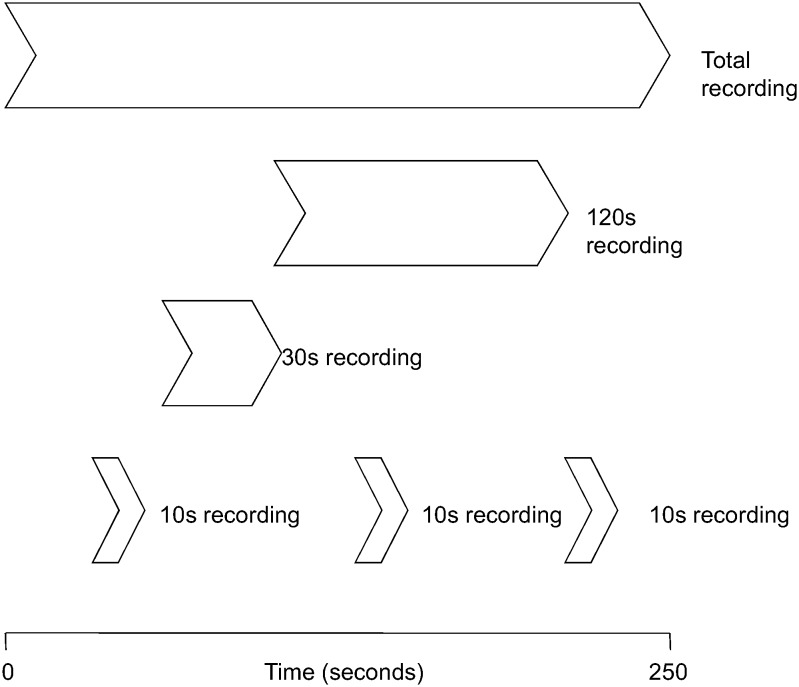
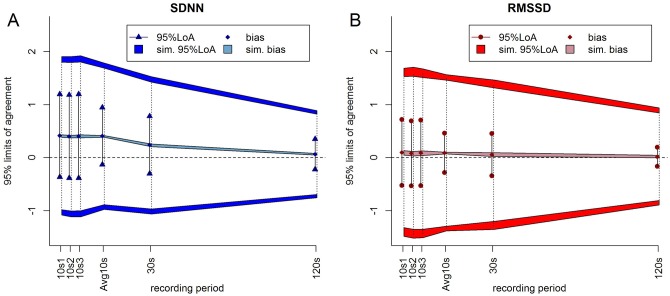
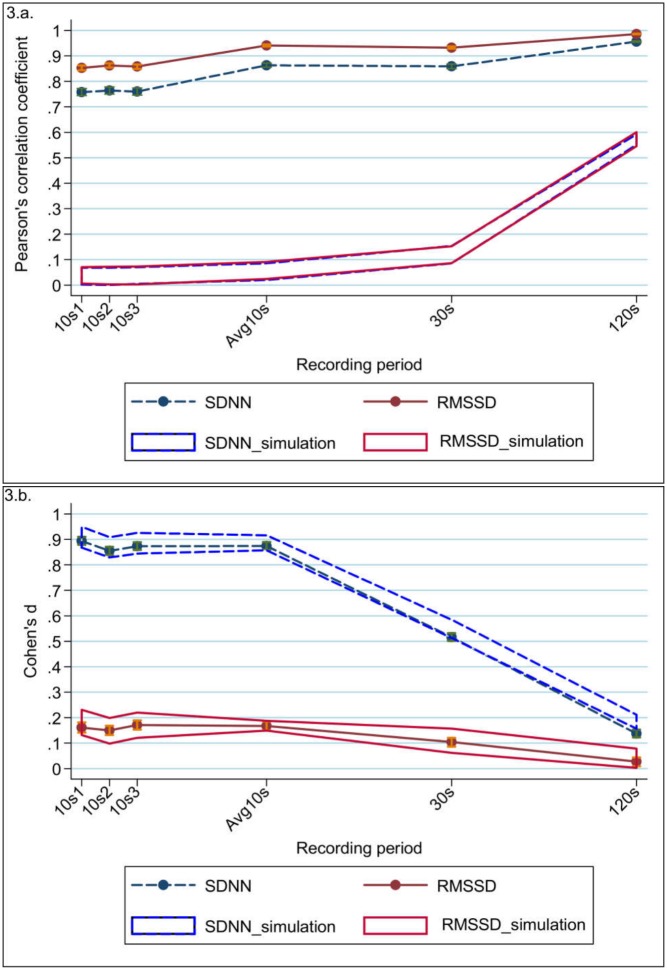
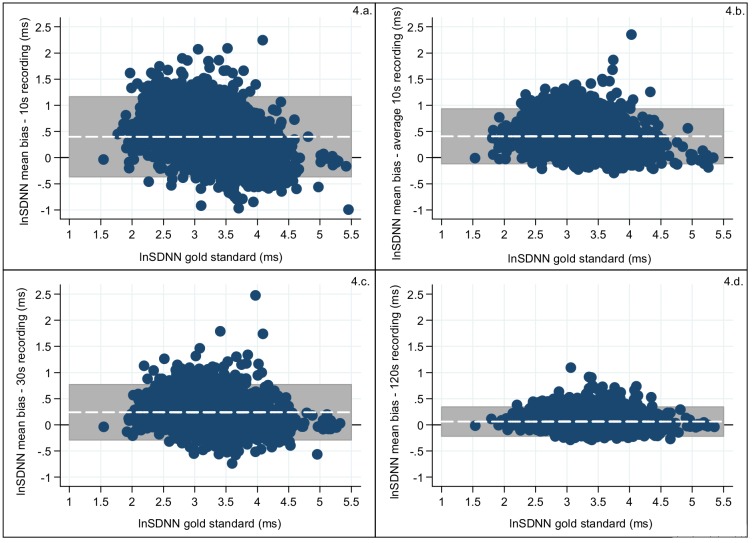
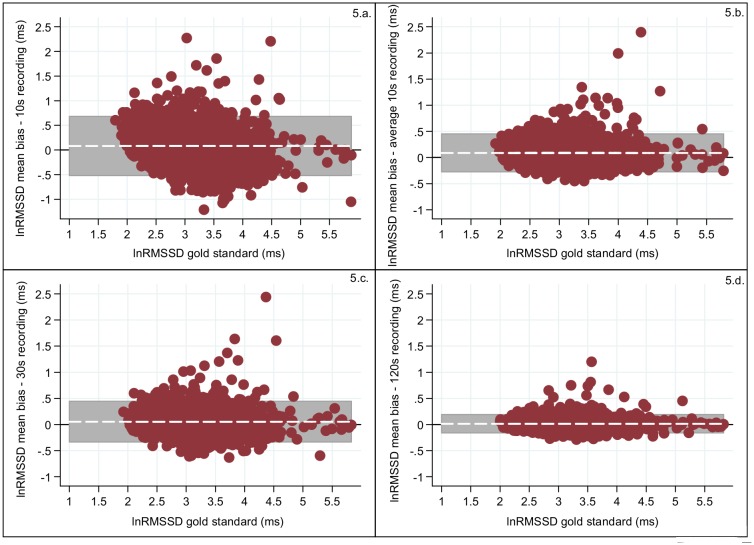
OBJECTIVES: In order to investigate the applicability of routine 10s electrocardiogram (ECG) recordings for time-domain heart rate variability (HRV) calculation we explored to what extent these (ultra-)short recordings capture the "actual" HRV. METHODS: The standard deviation of normal-to-normal intervals (SDNN) and the root mean square of successive differences (RMSSD) were measured in 3,387 adults. SDNN and RMSSD were assessed from (ultra)short recordings of 10s(3x), 30s, and 120s and compared to 240s-300s (gold standard) measurements. Pearson's correlation coefficients (r), Bland-Altman 95% limits of agreement and Cohen's d statistics were used as agreement analysis techniques. RESULTS: Agreement between the separate 10s recordings and the 240s-300s recording was already substantial (r = 0.758-0.764/Bias = 0.398-0.416/d = 0.855-0.894 for SDNN; r = 0.853-0.862/Bias = 0.079-0.096/d = 0.150-0.171 for RMSSD), and improved further when three 10s periods were averaged (r = 0.863/Bias = 0.406/d = 0.874 for SDNN; r = 0.941/Bias = 0.088/d = 0.167 for RMSSD). Agreement increased with recording length and reached near perfect agreement at 120s (r = 0.956/Bias = 0.064/d = 0.137 for SDNN; r = 0.986/Bias = 0.014/d = 0.027 for RMSSD). For all recording lengths and agreement measures, RMSSD outperformed SDNN. CONCLUSIONS: Our results confirm that it is unnecessary to use recordings longer than 120s to obtain accurate measures of RMSSD and SDNN in the time domain. Even a single 10s (standard ECG) recording yields a valid RMSSD measurement, although an average over multiple 10s ECGs is preferable. For SDNN we would recommend either 30s or multiple 10s ECGs. Future research projects using time-domain HRV parameters, e.g. genetic epidemiological studies, could calculate HRV from (ultra-)short ECGs enabling such projects to be performed at a large scale.
Overview
The claims and statistics of this paper haven’t been checked yet.
Free: it reads the open-access text and checks the first 5 claims that cite a source we can check. Create a free account to check every claim.
Integrity signals
Registry
Cites
Statistics
Figures
Verification
Claims the paper makes
The claims and statistics of this paper haven’t been checked yet.
Free: it reads the open-access text and checks the first 5 claims that cite a source we can check. Create a free account to check every claim.
Claims other papers make about this one
Each is checked against this paper’s own text: does it say what the citing paper says it does?
The cited source says what the claim attributes to it.
In the citing paper
“Those 10 s periods don’t need to be contiguous (i.e., not in succession), so it is possible to obtain a good estimate from several 10 s measurements spread over a trial or the experiment.”
From Heart Rate Variability and Cardiac Vagal Tone in Psychophysiological Research – Recommendations for Experiment Planning, Data Analysis, and Data Reporting (2017) · cites this paper as Munoz et al., 2015
The cited source says what the claim attributes to it.
In the citing paper
“In addition, even a single 10 s (standard ECG) was found to yield a valid RMSSD measurement, although an average over multiple 10 s ECGs is preferable.”
From Heart Rate Variability and Cardiac Vagal Tone in Psychophysiological Research – Recommendations for Experiment Planning, Data Analysis, and Data Reporting (2017) · cites this paper as Munoz et al., 2015
The cited source says what the claim attributes to it.
In the citing paper
“Very recent work by Munoz et al. (2015) investigated the validity of ultra-short and short recordings on HRV measurements in a very large adult sample (N = 3,387). They found that it is unnecessary to use recordings longer than 120 s to obtain accurate measures of RMSSD.”
From Heart Rate Variability and Cardiac Vagal Tone in Psychophysiological Research – Recommendations for Experiment Planning, Data Analysis, and Data Reporting (2017) · cites this paper as Munoz et al. (2015)
Self-check
Percentages, sums and reported differences re-computed from the paper’s own numbers.
The self-check needs the paper’s full text.
Citations
Cites
Statistical Power Analysis for the Behavioral Sciences
Muller, K. (1989) · Technometrics · doi:10.1080/00401706.1989.10488618 · Cited by 99,167
Statistical power analysis for the behavioral sciences
(1990) · Computers, Environment and Urban Systems · doi:10.1016/0198-9715(90)90050-4 · Cited by 65,269
Heart Rate Variability: Standards of Measurement, Physiological Interpretation, and Clinical Use
Electrophysiology, T. F. O. T. E. S. O. C. T. N. A. (1996) · Circulation · doi:10.1161/01.cir.93.5.1043 · Cited by 17,159
Measurement in Medicine: The Analysis of Method Comparison Studies
Altman, D. G., & Bland, J. M. (1983) · The Statistician · doi:10.2307/2987937 · Cited by 4,300
Heart rate variability: A review
Rajendra Acharya, U., Paul Joseph, K., Kannathal, N., Lim, C. M., & Suri, J. S. (2006) · Medical & Biological Engineering & Computing · doi:10.1007/s11517-006-0119-0 · Cited by 2,820 · cited 2×
“components [1–3].”
BackgroundApplying the right statistics: analyses of measurement studies
Bland, J. M., & Altman, D. G. (2003) · Ultrasound in Obstetrics & Gynecology · doi:10.1002/uog.122 · Cited by 1,311 · cited 18×
“However, the variation in those paired differences between the observed measurements of the (ultra-)short segments and those of the total recording is smaller than from the respective paired differences of the simulated measurements, explaining the much higher correlation and tighter 95%LoAs.”
BackgroundMethodInfluentialMalik, M. (1996) · Annals of Noninvasive Electrocardiology · doi:10.1111/j.1542-474x.1996.tb00275.x · Cited by 850
Heart Rate Variability ? A Historical Perspective
Billman, G. E. (2011) · Frontiers in Physiology · doi:10.3389/fphys.2011.00086 · Cited by 786 · cited 1×
“Both are easy to calculate and among the most widely used indices of HRV [7].”
How are we doing in soft psychology?
Rosenthal, R. (1990) · American Psychologist · doi:10.1037//0003-066x.45.6.775 · Cited by 515 · cited 1×
“80 is a large difference) [14,20].”
Dekker, J. M., Schouten, E. G., Klootwijk, P., Pool, J., Swenne, C. A., & Kromhout, D. (1997) · American Journal of Epidemiology · doi:10.1093/oxfordjournals.aje.a009049 · Cited by 512
Cited by
Items 201–300 of 422
Müller-Klein, A., Braun, M. N., de Sá, D. S. F., Michael, T., Link-Dorner, U., & Lass‐Hennemann, J. (2024) · Animals · doi:10.3390/ani14040604 · Cited by 12
“For time domain analysis, and specifically RMSSD, it has been previously shown that short measurement intervals of two minutes are sufficient to obtain a reliable and accurate measure of HRV [62,63].”
MethodBourdon, J. L., Moore, A. A., Eastman, M. L., Savage, J. E., Hazlett, L. E., Vrana, S. R., Hettema, J. M., & Roberson‐Nay, R. (2018) · Behavior Genetics · doi:10.1007/s10519-018-9915-1 · Cited by 11
Biopsychosocial Contributors to Parent Behaviors during Child Venipuncture
Constantin, K. L., Moline, R. L., Riddell, R. P., Spence, J. R., & McMurtry, C. M. (2022) · Children · doi:10.3390/children9071000 · Cited by 7
“, [42]), future research may examine the extent to which this baseline measure relates to HRV measured for longer durations in a clinical context.”
BackgroundHeart Rate Variability Biofeedback Improves Sports Performance in an Elite Female Athlete
Mueller, K., Williams, P. S., Haley, L., & Heick, J. D. (2019) · Cardiopulmonary Physical Therapy Journal · doi:10.1097/cpt.0000000000000120 · Cited by 7
“Heart rate variability can be reliably measured in 120 seconds with daily measures conducted on morning awakening in a supine position after emptying the urinary bladder.(26,27) Evidence suggests that a series of 10 to 20 daily supine 120-second HRV readings should be performed to establish a baseline HRV before using…”
BackgroundForner-Llacer, F., Aranda-Malavés, R., Malavés, R. A., Calleja-González, J., Perez-Turpin, J. A., & González-Ródenas, J. (2020) · International Journal of Sports Medicine · doi:10.1055/a-1186-1316 · Cited by 7
“[8], who reported similar correlation coefficients to those of our study; however, they did not control for pre-stabilization time.”
ResultSchmaußer, M., Holland, A. J., Beresford‐Webb, J., Eglen, S. J., Manning, K., Aman, L. C. S., Kronhaus, D. M., & Koenig, J. (2024) · Research in Developmental Disabilities · doi:10.1016/j.ridd.2024.104855 · Cited by 6
Steinerová, K., Krause, A., Parker, S., & Seddon, Y. M. (2025) · Frontiers in Veterinary Science · doi:10.3389/fvets.2025.1518153 · Cited by 8
Impact of signal length and window size on heart rate variability and pulse rate variability metrics
Uryga, A., Olszewski, B., Pietroń, D., & Kasprowicz, M. (2025) · Physiological Measurement · doi:10.1088/1361-6579/adece2 · Cited by 6
“One of the cohort studies performed on healthy adults reported that valid RMSSD results can be obtained from 10 and 30 s of ECG recordings (Munoz et al 2015).”
Li, Q., Qiao, F., McCreight, C., Mao, A., & Zhang, K. (2020) · International Journal of Civil Engineering · doi:10.1007/s40999-020-00497-5 · Cited by 7
Anthropometric Determinants of Respiratory Sinus Arrhythmia in Children
Lubocka, P., Sabiniewicz, R., Suligowska, K., & Zdrojewski, T. R. (2022) · International Journal of Environmental Research and Public Health · doi:10.3390/ijerph19010566 · Cited by 7
“Nevertheless, the data on RSA in children and adolescents in the literature are mainly extracted from 5 min HRV analysis, with only a few studies on short recordings [21,22].”
MethodFarhan, A., Mouhsen, A., Labakoum, B., Rattal, M., & Lyazidi, A. (2024) · Biomedical & Pharmacology Journal · doi:10.13005/bpj/2873 · Cited by 5
Yang, N., Tan, T., Wei, J., Gao, X., Wang, M., Li, R., Wang, C., Lei, M., Hu, H., Wang, M., et al. (2024) · Journal of Neuroscience Methods · doi:10.1016/j.jneumeth.2024.110217 · Cited by 5
Toner, E. R., Rucker, M., Wang, Z., Larrazabal, M. A., Cai, L., Datta, D., Lone, H. R., Boukhechba, M., Teachman, B. A., & Barnes, L. E. (2025) · IEEE Transactions on Affective Computing · doi:10.1109/taffc.2025.3562787 · Cited by 14
Test–retest reliability of heart-rate variability metrics in individuals with aphasia
Ashaie, S. A., Engel, S., & Cherney, L. R. (2022) · Neuropsychological Rehabilitation · doi:10.1080/09602011.2022.2037438 · Cited by 5
“Recent research has also investigated the use of ultra-short term ( 120 s) HRV recordings and found them reliable with short-term periods for computing HRV metrics (Munoz et al., 2015).”
BackgroundSluyter, J., Hughes, A. D., Lowe, A., Camargo, C. A., & Scragg, R. K. R. (2016) · Pharmacology Research & Perspectives · doi:10.1002/prp2.276 · Cited by 5
“Cardiovascular autonomic function measures HRV was assessed from the variability of the beat duration of the aortic pressure waveforms derived from the BP+ device.”
BackgroundMethodInfluentialRodrigues, J., Müller, M., & Hewig, J. S. (2020) · International Journal of Psychophysiology · doi:10.1016/j.ijpsycho.2020.08.010 · Cited by 7
Variabilidad de la frecuencia cardíaca
Gallardo, J., Bellone, G., & Risk, M. R. (2024) · Revista Andaluza de Medicina del Deporte · doi:10.33155/ramd.v16i3-4.908 · Cited by 5
Park, S., Kim, H., Jung, J., & Lee, S. (2024) · Medicina · doi:10.3390/medicina60122068 · Cited by 6
Shih, H., Martin, F., Ness, D. K., Romine, W. M., Peck, T. L., Turpin, T., Horoschak, R., Steeby, C., Phillips, H., Claypool, M., et al. (2025) · Animals · doi:10.3390/ani15020121 · Cited by 9
“However, time-domain metrics (e.g., RMSSD, SDNN) have been shown to be reliable indicators of heart rate variability when using short recording times [15].”
Zhou, H., Huang, Y., Xie, P., Zhang, S., Liu, M., Xiong, Z., Huang, R., Xu, X., Li, M., Zhou, Z., et al. (2025) · Journal of the American Heart Association · doi:10.1161/jaha.124.035788 · Cited by 5
“39 Second, cutoffs used in our analyses were derived from distribution in the ACCORD cohort.”
Shinagawa, K., Tanaka, Y., Terasawa, Y., & Umeda, S. (2025) · Neuroscience of Consciousness · doi:10.1093/nc/niaf059 · Cited by 14
“This ensemble averaging approach is supported by prior work on short-term HRV analysis (Munoz et al. 2015).”
Beutler, S., & Croy, I. (2023) · European Journal of Psychotraumatology · doi:10.1080/20008066.2023.2281753 · Cited by 5
“This was based on the methodological consideration between the recommended 1 min acquisition time (Sha ff er & Gins-berg, 2017) and the minimum required 10 s epoch for ultra-short assessments (Munoz et al., 2015; Nussi-novitch et al., 2011).”
MethodVignoli, E., Guerzoni, G., & Vitetta, G. M. (2024) · IEEE Access · doi:10.1109/access.2024.3507365 · Cited by 5
“…9 Our measurement scenario is consistent with that described in other publications on radar-based HRV estimation [11], [36], [42] or ECG [43], [44]. positions (denoted P x , with x =1, 2, 3 and 4) have been considered for the employed radar device [45], [46]: 1) placed above the chest (P1),…”
Idrobo-Ávila, E., Correa, H. L., Vargas-Cañas, R., Muñoz-Bolaños, F., & van Noorden, L. (2021) · Heliyon · doi:10.1016/j.heliyon.2021.e06257 · Cited by 4
“Using this amount of heartbeats, it is possible to establish a pattern behaviour in both the ECG signal and some heart rate variability (HRV) analysis [38, 39].”
MethodTo thine own self be true: interoceptive accuracy and interpersonal problems
D'Andrea, W. M., Nieves, N., & Cleave, T. V. (2022) · Borderline Personality Disorder and Emotion Dysregulation · doi:10.1186/s40479-021-00175-5 · Cited by 6
“RSA was measured for a short epoch which was sufficient for recording RSA and is comparable with gold-standard 5 min readings (see, for example, [3, 39]) but may be less reflective of overall trait vagal tone.”
MethodDeep Learning Classifier for Advancing Video Monitoring of Atrial Fibrillation
Bukum, K., Savur, C., & Tsouri, G. R. (2022) · IEEE/CVF Conference on Computer Vision and Pattern Recognition Workshops (CVPRW) · doi:10.1109/cvprw56347.2022.00240 · Cited by 8
“This result is in line with prior published studies, where an interval of 10 sec to 30 sec was used [28].”
ResultPersonal Pain Sensitivity Prediction from Ultra-short-term Resting Heart Rate Variability
Jiang, M., Wu, W., Wang, Y., Rahmani, A. M., Salanterä, S., & Liljeberg, P. (2022) · Annual International Conference of the IEEE Engineering in Medicine and Biology Society (EMBC) · doi:10.1109/embc48229.2022.9871427 · Cited by 4
“sensitivity and correlation with standard short-term HRV values [23].”
BackgroundMaqsood, R., Khattab, A., Bennett, A. N., & Boos, C. J. (2023) · PLoS ONE · doi:10.1371/journal.pone.0290618 · Cited by 4
Karavaev, A. S., Skazkina, V. V., Borovkova, E. I., Kiselev, A. R., Пономаренко, В. И., Kulminskiy, D. D., Gridnev, V. I., Prokhorov, M. D., & Bezruchko, B. P. (2018) · Russian Open Medical Journal · doi:10.15275/rusomj.2018.0403 · Cited by 4
Ten-second central SBP variability predicts first and recurrent cardiovascular events
Sluyter, J., Camargo, C. A., & Scragg, R. K. R. (2018) · Journal of Hypertension · doi:10.1097/hjh.0000000000001930 · Cited by 5
Lustig, A., Benady, A., Gilaie‐Dotan, S., & Plotnik, M. (2025) · Psychophysiology · doi:10.1111/psyp.70072 · Cited by 3
“…influences (Laborde et al. 2017; McCraty and Shaffer 2015; Kleiger et al. 2005; Dionne et al. 2002; Larsen et al. 2010); and (iii) RMSSD provides meaningful information also in short and ultra-short time intervals (i.e., 10–50 s) (Laborde et al. 2017; Salahuddin et al. 2007; Munoz et al. 2015).”
Does affective touch buffer emotional distress? Insights from subjective and physiological indices
Longa, L. D., Sarlo, M., & Farroni, T. (2025) · Social Cognitive and Affective Neuroscience · doi:10.1093/scan/nsaf090 · Cited by 7
The Impact of Control Interface on Features of Heart Rate Variability
Javaremi, M. N., Wu, D., & Argall, B. (2021) · Annual International Conference of the IEEE Engineering in Medicine and Biology Society (EMBC) · doi:10.1109/embc46164.2021.9631053 · Cited by 3
“Previous studies have investigated the reliability of various UST HRV features[17, 3, 18, 19, 20].”
BackgroundInsight and non-insight problem solving: A heart rate variability study
Stuyck, H., Demeyer, F., Bratanov, C., Cleeremans, A., & den Bussche, E. V. (2023) · Quarterly Journal of Experimental Psychology · doi:10.1177/17470218231202519 · Cited by 4
“The minimum solution search and recovery interval length deemed acceptable for assessing RMSSD was 10 s. Previous research (e.g., Munoz et al., 2015) has shown that RMSSD calculated with a 10 s ECG recording gives a reliable approximation of the RMSSD obtained with a 5-min ECG recording.”
MethodLonga, L. D., & Farroni, T. (2025) · International Journal of Behavioral Development · doi:10.1177/01650254251324157 · Cited by 5
“We selected this interval length as it has been shown that 2-min recording is sufficient for obtaining accurate measures of RMSSD (Munoz et al., 2015; Pham et al., 2021).”
Gender differences in alcohol-cue-induced craving and heart-rate variability in hazardous drinkers
Firdaus, I., Huizink, A. C., Kleiboer, A. M., Goudriaan, A. E., & Kaag, A. M. (2025) · Drug and Alcohol Dependence · doi:10.1016/j.drugalcdep.2025.112662 · Cited by 3
Differential Physiological Responses to Proxemic and Facial Threats in Virtual Avatar Interactions
Nierula, B., Lafci, M. T., Melnik, A., Akgül, M., Siewe, F. T., & Bosse, S. (2025) · IEEE International Symposium on Mixed and Augmented Reality Adjunct (ISMAR-Adjunct) · doi:10.1109/ismar-adjunct68609.2025.00036 · Cited by 5
“…i) parasympathetic reaction can be expected within 1s [29], ii) our RMSSD measures are averaged over 15 trials and are thus less prone to biases [28], iii) we ensured single RMSSD measures were based on 4 or more peak-to-peak intervals (on average 7), and iv) provide thus the first evidence for…”
Andersen, H. H., Imai, Y., Petersen, K. K., Koenig, J., Elberling, J., & Arendt‐Nielsen, L. (2016) · Somatosensory & Motor Research · doi:10.3109/08990220.2016.1173535 · Cited by 3
“Only time-domain measures were analyzed for the short 60–90 s HRV segment recorded of the regular CPM paradigm (Munoz et al. 2015).”
MethodMcIntosh, R. C., Khambaty, T., Llabre, M. M., Perreira, K. M., González, H. M., Kansal, M. M., Tarraf, W., & Schneiderman, N. (2021) · International Journal of Psychophysiology · doi:10.1016/j.ijpsycho.2021.01.019 · Cited by 4
Wu, L., Shi, P. A., & Yu, H. (2021) · Technology and Health Care · doi:10.3233/thc-218035 · Cited by 3
Does hostile intent cause physiological changes? An airport security check simulation experiment
Djeriouat, H., Matton, N., & Mouratille, D. (2021) · International Journal of Psychophysiology · doi:10.1016/j.ijpsycho.2021.03.008 · Cited by 3
Autonomic Nervous System Assessment During Physical Rehabilitation Serious Game
Rodrigues, M. J., Postolache, O. A., & Cercas, F. (2021) · IEEE International Symposium on Medical Measurements and Applications (MeMeA) · doi:10.1109/memea52024.2021.9478742 · Cited by 3
Heart Rate Variability: Validity of Autonomic Balance Indicators in Ultra-Short Recordings
Gallardo, J., Bellone, G., & Risk, M. R. (2021) · Communications in computer and information science · doi:10.1007/978-3-030-89654-6_22 · Cited by 3
Beydoun, N. Y., Quraishi, S. A., Tolman, E., Battarjee, W., WEINTRAUB, A. R., Cobey, F., & Hong, E. (2022) · Annals of Cardiac Anaesthesia · doi:10.4103/aca.aca_11_22 · Cited by 3
“[15] demonstrated a substantial agreement between the 5‐min and 10‐s recordings for both RMSSD (r = 0.”
BackgroundMethodKALP HIZI DEĞİŞKENLİĞİ VE EGZERSİZE KRONİK YANITLARI
Aras, D., Erdoğmuş, T. N., Ayvaz, Ö., & BİROL, A. (2022) · Ankara Üniversitesi Beden Eğitimi ve Spor Yüksekokulu SPORMETRE Beden Eğitimi ve Spor Bilimleri Dergisi · doi:10.33689/spormetre.1129126 · Cited by 3
Maqsood, R., Schofield, S. J., Bennett, A. N., Khattab, A., Clark, C., Bull, A. M. J., Fear, N. T., & Boos, C. J. (2023) · Military Medicine · doi:10.1093/milmed/usad341 · Cited by 4
“3 With a recording of 10-20 seconds, HRV UST offers feasibility under standard conditions with minimum burden on the patients and has shown validity with its short-term counterparts, 4 making it a valuable resource.”
BackgroundMethodKim, D., Baek, S., Kim, S. W., Kim, S. M., & Kim, S. M. (2024) · Biomedical Engineering Letters · doi:10.1007/s13534-024-00379-y · Cited by 3
Zarębski, Ł., & Futyma, P. (2024) · Journal of Interventional Cardiac Electrophysiology · doi:10.1007/s10840-024-01899-4 · Cited by 3
Evidence-Based Clinical Utility of Heart Rate Variability Across Populations, Including Long COVID
Steere, K. B. (2024) · Cardiopulmonary Physical Therapy Journal · doi:10.1097/cpt.0000000000000270 · Cited by 4
Alfonso, C., Haydt, V., Allen, M. S., Capdevila, L., & Laborde, S. (2025) · International Review of Sport and Exercise Psychology · doi:10.1080/1750984x.2025.2541350 · Cited by 5
Autonomic factors do not underlie the elevated self-disgust levels in Parkinson’s disease
Aristotelidou, V., Tsatali, M. S., Overton, P. G., & Vivas, A. B. (2021) · PLoS ONE · doi:10.1371/journal.pone.0256144 · Cited by 3
Heart rate variability and psychosocial symptoms in adolescents and young adults with cancer
Taylor, M. R., Garrison, M. M., & Rosenberg, A. R. (2021) · PLoS ONE · doi:10.1371/journal.pone.0259385 · Cited by 3
To the Editor—10-second ECG-based RMSSD as valid measure of HRV
Tegegne, B. S., Man, T., van Roon, A. M., Riese, H., & Snieder, H. (2018) · Heart Rhythm · doi:10.1016/j.hrthm.2018.10.038 · Cited by 3
Self-citationTang, X., He, R. Q., & Zhang, P. (2025) · BMJ Open · doi:10.1136/bmjopen-2025-101170 · Cited by 2
Levi, M. K., Gal, E., Weissman‐Fogel, I., Bar‐Shalita, T., Hoffman, T., Sprecher, E., Yarovinsky, N., Buxbaum, C., & Granovsky, Y. (2025) · Pain · doi:10.1097/j.pain.0000000000003750 · Cited by 2
Barki, H., Mai, N.-D., & Chung, W. (2025) · IEEE Journal of Biomedical and Health Informatics · doi:10.1109/jbhi.2025.3598354 · Cited by 5
“…While conventional HRV analysis typically uses 5-minute windows, recent studies have demonstrated that ultra-short-term HRV (UST-HRV) features from segments as brief as 5–30 seconds can be effectively used for emotion and stress recognition in real-time wearable applications [47], [48], [49], [50].”
LST-rPPG: A long-range spatio-temporal model for high-accuracy heart rate variability measurement
Li, J., Cheng, J., Song, R., & Liu, Y. (2025) · Expert Systems with Applications · doi:10.1016/j.eswa.2025.129526 · Cited by 7
Kreibig, S. D., Jung, S., Samson, A. C., & Gross, J. J. (2025) · Psychophysiology · doi:10.1111/psyp.70153 · Cited by 4
“…(24 h) assessments (Berntson et al. 1997; Quigley et al. 2024; Task Force of the European Society of Cardiology and the North American Society of Pacing Electrophysiology 1996), can be validly estimated from 10 to 20 s recordings (Baek et al. 2015; Munoz et al. 2015; Nussinovitch et al. 2011).”
António, H., Barros, C. A. F., de Castro, M. V., Oliveira, J., Gamito, P. S., Bouchard, S., & Pinto, R. J. (2025) · Cyberpsychology Behavior and Social Networking · doi:10.1177/21522715251394917 · Cited by 3
Berg, P., Koskela, A., Lipponen, J. A., Törnqvist, H., Kujala, J., Tarvainen, M. P., & Kujala, M. V. (2025) · Applied Animal Behaviour Science · doi:10.1016/j.applanim.2025.106899 · Cited by 6
Social exclusion in virtual reality: touch modulates physiological markers of self-regulation
Longa, L. D., Valori, I., Rizzi, F., Guglielminetti, I., Fairhurst, M. T., Marfia, G., & Farroni, T. (2025) · Heliyon · doi:10.1016/j.heliyon.2025.e44373 · Cited by 3
M-ECG: extracting heart signals with a novel computational analysis of magnetoencephalography data
Izadysadr, A., Bagherzadeh, H. S., Stapleton-Kotloski, J. R., Popli, G., O’Donovan, C. A., & Godwin, D. W. (2026) · Frontiers in Neuroimaging · doi:10.3389/fnimg.2025.1675960 · Cited by 1
“…the standard deviation of normal-to-normal intervals, which reflects overall variability, and the root mean square of successive differences, which estimates vagally mediated changes in HRV (Munoz et al., 2015; Shaffer and Ginsberg, 2017), were computed for both I-ECG and M-ECG signals (Table 1).”
Alhaskir, M., Kutafina, E. V., Linke, F., Fischer, F. P., Schriewer, E., Lauxmann, S., Klett, K., Hofmeister, J., Lutz, F., Burow, L., et al. (2026) · Computer Methods and Programs in Biomedicine · doi:10.1016/j.cmpb.2026.109295 · Cited by 4
Physiological responses to the overview effect: a virtual reality study on awe
Broers, H. A. T., Postma, M., & Louwerse, M. M. (2026) · Behaviour and Information Technology · doi:10.1080/0144929x.2026.2651109 · Cited by 2
Cao, Y., Sweetser, P., Chen, Z., & Zhu, X. (2026) · CHI Conference on Human Factors in Computing Systems · doi:10.1145/3772318.3791197 · Cited by 2
“Previous work has shown that 10-second ultra-short recordings provide acceptable accuracy for estimating these measures [7, 80].”
Woelk, S. P., Garfinkel, S. N., Mayiwar, L., & Knöferle, K. (2026) · Behavior Research Methods · doi:10.3758/s13428-026-02953-x · Cited by 4
“This constrained our analysis to time-domain HRV metrics, which have been shown to be accurate for ultrashort-term recordings of less than 1 min (Munoz et al., 2015; O’Neal et al., 2016).”
InfluentialA Proposal for a Data-Driven Approach to the Influence of Music on Heart Dynamics
Idrobo-Ávila, E., Correa, H. L., Muñoz-Bolaños, F., van Noorden, L., & Vargas-Cañas, R. (2021) · Frontiers in Cardiovascular Medicine · doi:10.3389/fcvm.2021.699145 · Cited by 2
“It is suggested to consider stimulus duration of at least 10 s; this interval of time is recommended since it allows the establishment of a pattern behaviour in some aspects of the HRV analysis (22, 71).”
Heart rate variability associated with acute exercise challenge in children with sickle cell anaemia
Kienzle, S. L., Rodeghier, M., & Liem, R. I. (2021) · British Journal of Haematology · doi:10.1111/bjh.17834 · Cited by 3
“Nonetheless, time and frequency domain measures have been validated using recording windows as short as 30–60 s.(15) Further investigation into the relationship between exercise and ANSD and its implications for exercise safety in individuals with SCA is warranted.”
MethodKuijpers, M., van de Zande, S. C., van Roon, A. M., van Roon, A. M., Stel, A. J., Smit, A. J., Bouma, W., DeJongste, M. J. L., Mariani, M. A., Klinkenberg, T. J., et al. (2022) · Seminars in Arthritis and Rheumatism · doi:10.1016/j.semarthrit.2022.152065 · Cited by 2
Prediction of intrapartum fever using continuously monitored vital signs and heart rate variability
Debnath, S., Koppel, R. I., Saadi, N., Potak, D., Weinberger, B. I., & Zanos, T. P. (2023) · Digital Health · doi:10.1177/20552076231187594 · Cited by 2
“SDNN and RMSSD are time-domain indices of HRV reliable at a short-term recording period of 5 minutes.(56,57) SDNN reflects both SNS and PNS nervous system activity and is also highly correlated with multiple frequency-domain HRV metrics.”
BackgroundElectrocardiographic activity depends on the relative position between intimate persons
Mukai, K., Isomura, T., Onagawa, R., & Watanabe, K. (2024) · Scientific Reports · doi:10.1038/s41598-024-54439-5 · Cited by 3
Fuchshuber, J., Schöber, H., Wohlmuth, M., Senra, H., Rominger, C., Schwerdtfeger, A. R., & Unterrainer, H. (2024) · BMC Medicine · doi:10.1186/s12916-024-03405-z · Cited by 3
“Moreover, it is relatively sensitive to short-term changes, stable and reliable in short-time measurements, and a well-documented indicator for stress responses of the autonomic nervous system [41–43].”
BackgroundBiggs, A. T., Jensen, A. E., & Kelly, K. R. (2024) · Frontiers in Sports and Active Living · doi:10.3389/fspor.2024.1444655 · Cited by 3
“Other evidence suggests that SDNN could still capture HRV accurately in a 30 s window (37), albeit this limitation too warrants consideration as these shooting scenarios lasted longer than 30 s while the key event (i.e., having to engage a target) might not have occurred until very late in the…”
BackgroundGörgülü, R., Oruç, H., Vasile, C., Corlaci, I., & Voinea, F. (2024) · Medicina · doi:10.3390/medicina60091547 · Cited by 5
“As one of the time domain measures of HRV, the r-MSSD is the most sensitive parameter, especially for short-duration recordings [70]; therefore, the r-MSSD could be a robust and valid indicator of emotional state in competitive situations, similar to our research.”
ResultMehak, A., Wilson, S., & Racine, S. E. (2024) · International Journal of Eating Disorders · doi:10.1002/eat.24293 · Cited by 3
“Unlike HF-HRV, RMSSD is largely independent of confounding respiratory influence and ideal for shorter recording periods (e.g., Laborde, Mosley, and Thayer 2017; Munoz et al. 2015).”
Jones, C. M., Conner, M. T., & Schüz, B. (2024) · Applied Psychology Health and Well-Being · doi:10.1111/aphw.12633 · Cited by 7
“The RMSSD has been shown to represent the magnitude of such moment-to-moment fluctuations very well across various disciplines (e.g., heart rate variability; Munoz et al., 2015; Shaffer & Ginsberg, 2017).”
Frau, L., Bruno, D., McGlone, F. P., & Cazzato, V. (2025) · International Journal of Psychophysiology · doi:10.1016/j.ijpsycho.2025.112525 · Cited by 2
Chieng, T. M., Hau, Y. W., Omar, Z., Lim, C. W., Ting, C., & Mandala, S. (2025) · Biomedical Signal Processing and Control · doi:10.1016/j.bspc.2025.108173 · Cited by 2
Groß, D. (2020) · Journal of Research in Personality · doi:10.1016/j.jrp.2020.103936 · Cited by 2
Sluyter, J., Hughes, A. D., Camargo, C. A., Lowe, A., & Scragg, R. K. R. (2017) · American Journal of Hypertension · doi:10.1093/ajh/hpx134 · Cited by 2
Andersen, T. G., Fiskum, C., Aslaksen, P. M., Flaten, M. A., & Jacobsen, K. H. (2019) · Journal of Psychophysiology · doi:10.1027/0269-8803/a000241 · Cited by 2
“Although 5-minute recordings have commonly been used in HRV research, recent studies indicate that ultrashort recordings of RMSSD are valid (Munoz et al., 2015).”
MethodKennedy-Metz, L. R., Weiss, P., & Parker, S. H. (2019) · Stress · doi:10.1080/10253890.2019.1660317 · Cited by 2
“Given the rapid advancement of modern sensor technology, HRV can now be accurately and reliably captured on ultra-short time scales spanning less than the traditionally accepted five-minute short-term analysis windows (Baek, Cho, Cho, & Woo, 2015; Munoz et al., 2015; Nussinovitch et al., 2011; Thong, Li, McNames, Aboy…”
BackgroundA Biofeedback-Enhanced Virtual Exergame for Upper Limb Repetitive Motor Tasks
Galletti, C., Parente, C., Bottino, A., Lamberti, F., Salatino, L., de Zambotti, M., Podda, J., Tacchino, A., Brichetto, G., Michieli, L. D., et al. (2023) · Conference proceedings/Conference proceedings - IEEE International Conference on Systems, Man, and Cybernetics · doi:10.1109/smc53992.2023.10394416 · Cited by 2
“RMSSD measured over 10 seconds proved to be reliable and a good proxy for the one measured from longer recording lengths (4-5min) [20].”
BackgroundFerrer-Mileo, V. (2019) · UPCommons institutional repository (Universitat Politècnica de Catalunya) · doi:10.5821/dissertation-2117-170437 · Cited by 3
“La metodología de los diversos estudios realizados para recomendar un tiempo de medida mínimo en cada uno de los índices ha sido común [99-107].”
BackgroundInfluentialLahr, P., Carling, C., Nauer, J., McGrath, R., & Grier, J. W. (2024) · Hearts · doi:10.3390/hearts5030020 · Cited by 2
“A trained interviewer recorded the time the ECG started for a 6 min duration for obtaining at least a conventional 240–300 s recording [28,29].”
Impact of Multiple Sensory Cues in Immersive Virtual Reality: Evidence From a Full-Body Haptic Suit
Caserman, P., Schnitzer, B. L., & Göbel, S. P. (2025) · IEEE Transactions on Games · doi:10.1109/tg.2025.3534571 · Cited by 2
“The validity to use short recordings to obtain accurate HRV measures was already confirmed [61].”
Ultra-Short Term Heart Rate Variability Estimation Using PPG and End-to-End Deep Learning
Wang, W., & Najafizadeh, L. (2024) · Asilomar Conference on Signals, Systems and Computers (ACSSC) · doi:10.1109/ieeeconf60004.2024.10943067 · Cited by 2
Does heart rate variability predict and improve performance in pediatric CPR?—a simulation study
Kula, Y., Wacht, O., Ben‐Shlomo, I., Gitler, A., & Gidron, Y. (2025) · BMC Emergency Medicine · doi:10.1186/s12873-025-01209-9 · Cited by 2
“Throughout the scenario, we collected three segments of 2-minute HRV s [44].”
Hillmann, H. A. K., Hermans, A. N. L., Gawalko, M. M., Müller‐Leisse, J., Betz, K., Sohaib, A., Fung, C. H., Pisters, R., Lodziński, P., Chaldoupi, S., et al. (2025) · European Heart Journal - Digital Health · doi:10.1093/ehjdh/ztaf035 · Cited by 3
Kim, J., Kim, J.-W., Ju, J., Jhon, M., Kang, H., Lee, J.-Y., Jang, H., Kim, J.-C., Kim, S., & Shin, I. (2025) · Journal of Psychiatric Research · doi:10.1016/j.jpsychires.2025.05.032 · Cited by 1
Schmaußer, M., Antink, C. H., Kaess, M., & Koenig, J. (2025) · Journal of Biological Rhythms · doi:10.1177/07487304251348516 · Cited by 1
“Based on prior research recommending a minimum signal length of 30 s to obtain valid estimates of cardiac metrics, particularly HRV outcomes (Munoz et al., 2015), segments shorter than 30 s were excluded from further analysis.”
Wagenblast, F., Seibt, R., Rieger, M. A., & Steinhilber, B. (2025) · Scientific Reports · doi:10.1038/s41598-025-28090-7 · Cited by 2
Alidadi, M., Mohebbi, M., Naghan, P. A., & Asl, B. M. (2025) · Scientific Reports · doi:10.1038/s41598-025-32811-3 · Cited by 3
Yamada, S., Nishida, Y., Nakagawa, Y., & Nagataki, S. (2026) · Current Psychology · doi:10.1007/s12144-025-08561-w · Cited by 2
“CVI appears to capture phasic vagal adjustments to contextual demands, whereas RMSSD reflects more stable parasym - pathetic regulation (Munoz et al., 2015; Toichi et al., 1997).”
Effects of Gamification and Physiological Stress on Webstore Retention and Purchase Intentions
Holopainen, J., & Hoffren, J. (2026) · International GamiFIN Conference (GamiFIN) · doi:10.1145/3789624.3789636 · Cited by 1
Nascimento, E. M. F., Borszcz, F. K., Ventura, T. P., Antunes, D., Guglielmo, L. G. A., & de Lucas, R. D. (2026) · Research Quarterly for Exercise and Sport · doi:10.1080/02701367.2026.2645354 · Cited by 1
Investigation of Heart Rate Variability Indices in Motion Sickness
Ponsiglione, A. M., Guerrini, L., Pierucci, S., Santoriello, V., Romano, M., Recenti, M., Petersen, H., Gargiulo, P., & Ricciardi, C. (2026) · Sensors · doi:10.3390/s26072114 · Cited by 3
Lin, X., Liu, G., Wang, L., Zhou, X., Deng, X., Ji, N., Wei, J., Shi, J., Yuan, C., Jiang, R., et al. (2026) · Physiological Measurement · doi:10.1088/1361-6579/ae5c54 · Cited by 1
Sørensen, L., Kvadsheim, E., Koenig, J., Thayer, J., Williams, D. P., MacDonald, H. J., McCardle, R. D., Wollschlaeger, D., Fasmer, O. B., & Osnes, B. (2026) · Biology of Sex Differences · doi:10.1186/s13293-026-00904-x · Cited by 1
“This is consistent with evidence indicating that RMSSD can be estimated from shorter recordings, whereas HF-HRV typically requires longer segments due to its dependence on respiratory oscillations [62, 63].”
Li, X., Liu, Z., Liang, J., & Jia, T. (2026) · Building and Environment · doi:10.1016/j.buildenv.2026.114756 · Cited by 2
Metadata
- Authors
- Munoz, M. L., van Roon, A., Riese, H., Thio, C., Oostenbroek, E., Westrik, I., de Geus, E. J. C., Gansevoort, R., Lefrandt, J., Nolte, I. M., & Snieder, H.
- Affiliations
- University Medical Center Groningen (NL)
- Corresponding author
- Nolte, Ilja M.
- Snieder, Harold
- ORCID
- Venue
- PLOS ONE
- Publisher
- Public Library of Science (PLoS)
- Published
- 2015-09-28
- Volume
- 10
- Issue
- 9
- Pages
- e0138921
- ISSN
- 1932-6203 (ISSN-L)
- PMC
- PMC4586373
- OpenAlex
- W2298185395
- Cited by
- 423
- References
- 27
- Citations by year
- 2026: 80 · 2025: 55 · 2024: 47 · 2023: 33 · 2022: 45 · 2021: 51 · 2020: 32 · 2019: 26 · 2018: 26 · 2017: 17 · 2016: 8
- FWCI
- 12.36
- Type
- journal article
- Language
- en
- Open access
- gold
- doi.org
- Licence
- Locations
- PLoS ONE (publishedVersion, cc-by)
- Europe PMC (PubMed Central) (publishedVersion, cc-by)
- PubMed Central (publishedVersion, cc-by)
- PubMed (publishedVersion)
- University of Groningen research database (University of Groningen / Centre for Information Technology) (publishedVersion, cc-by)
- VU Research Portal (publishedVersion, other-oa)
- DOAJ (DOAJ: Directory of Open Access Journals) (submittedVersion, cc-by-sa)
- University of Groningen research database (University of Groningen / Centre for Information Technology) (submittedVersion, cc-by)
- Data Archiving and Networked Services (DANS) (submittedVersion, other-oa)
- Topics
- Health Sciences › Medicine › Cardiology and Cardiovascular Medicine › Heart Rate Variability and Autonomic Control
- Health Sciences › Medicine › Cardiology and Cardiovascular Medicine › ECG Monitoring and Analysis
- Physical Sciences › Engineering › Biomedical Engineering › Non-Invasive Vital Sign Monitoring
- Keywords
- heart rate variability, time-domain HRV, SDNN, RMSSD, measurement agreement, method validation, autonomic nervous system, adults, limits of agreement
- MeSH terms
- Adult, Demography, Electrocardiography, Female, Heart Rate, Humans, Male, Middle Aged, Statistics as Topic, Time Factors, Reproducibility of Results
About these checks
Registry, retraction, Cites and statistics results are computed, not judged, with one exception: a printed reference that no index lists is read once by a model before it counts as a citation error. Claims are extracted by a model and kept only when their quote appears verbatim in the text; each cited source is then checked, with a model’s help, for whether it says what the claim relies on. Those verdicts can be wrong — read the claim’s quote and the cited source before relying on one.
Statistics and arithmetic are recomputed, not judged.
Confidence bands are shown only for fields calibrated on our annotated test set. None is calibrated yet, so no band is shown.
What counts as a claim ›How we measure confidence ›How we check this ›
Are you an author, or do you see a problem with this page? Request a review
Data sources
Bibliographic data: Semantic Scholar, OpenAlex, Crossref.
Contains information from the Semantic Scholar Academic Graph Datasets, made available under the ODC Attribution License (ODC-BY 1.0).
Semantic Scholar’s data is described in: Kinney, R., et al. (2023). The Semantic Scholar Open Data Platform. arXiv:2301.10140.
