

The DOI matches its Crossref record; 47 of the 47 references it cites were found in a registry or an index.
Atheists and Agnostics Are More Reflective than Religious Believers: Four Empirical Studies and a Meta-Analysis
Open accessAbstract
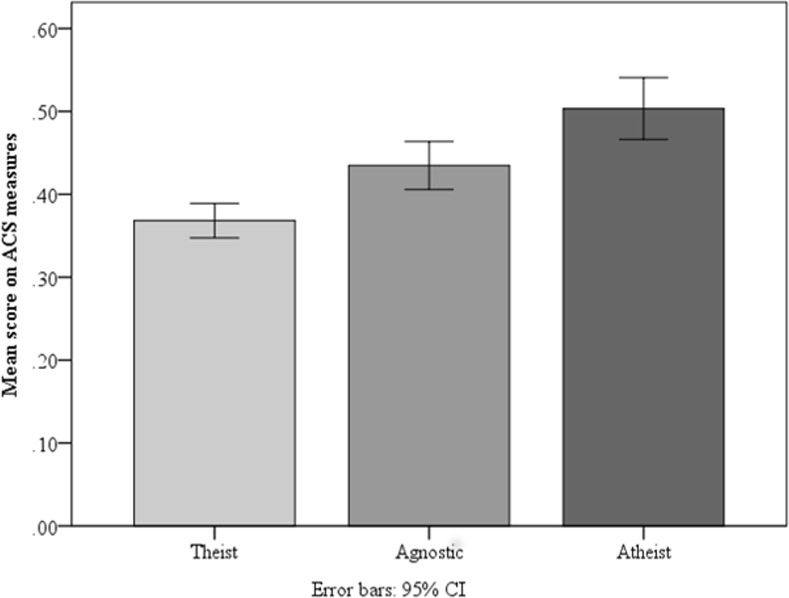
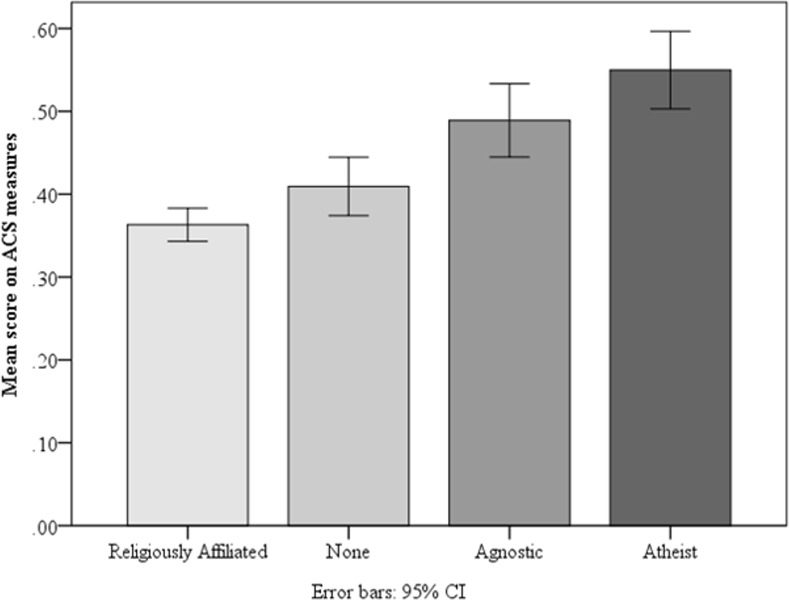
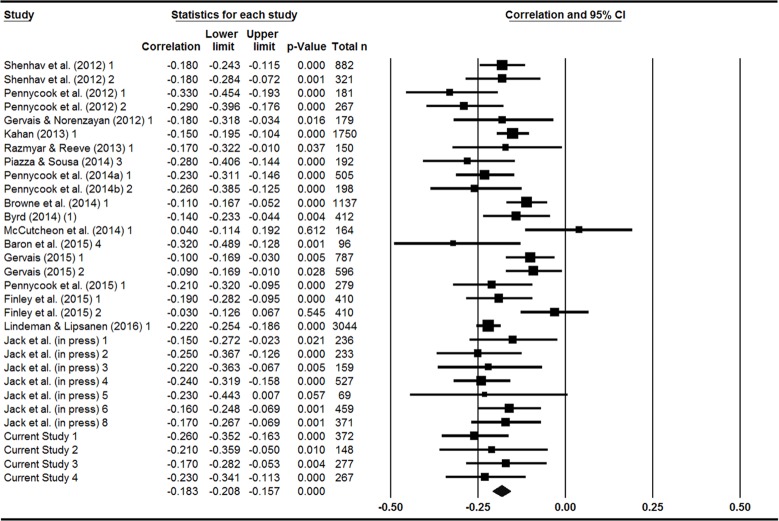
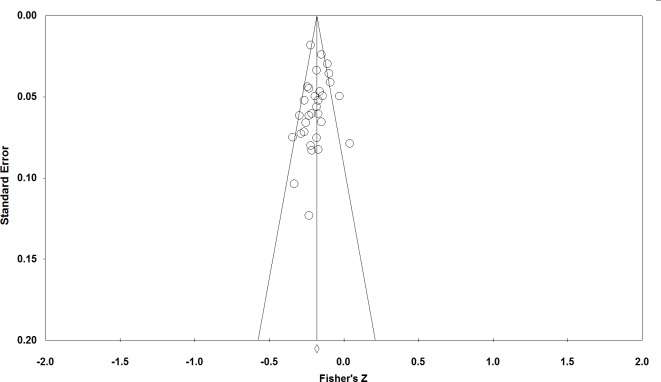
Individual differences in the mere willingness to think analytically has been shown to predict religious disbelief. Recently, however, it has been argued that analytic thinkers are not actually less religious; rather, the putative association may be a result of religiosity typically being measured after analytic thinking (an order effect). In light of this possibility, we report four studies in which a negative correlation between religious belief and performance on analytic thinking measures is found when religious belief is measured in a separate session. We also performed a meta-analysis on all previously published studies on the topic along with our four new studies (N = 15,078, k = 31), focusing specifically on the association between performance on the Cognitive Reflection Test (the most widely used individual difference measure of analytic thinking) and religious belief. This meta-analysis revealed an overall negative correlation (r) of -.18, 95% CI [-.21, -.16]. Although this correlation is modest, self-identified atheists (N = 133) scored 18.7% higher than religiously affiliated individuals (N = 597) on a composite measure of analytic thinking administered across our four new studies (d = .72). Our results indicate that the association between analytic thinking and religious disbelief is not caused by a simple order effect. There is good evidence that atheists and agnostics are more reflective than religious believers.
Overview
The claims and statistics of this paper haven’t been checked yet.
Run the check — free, no account needed. It reads the open-access text and checks the sources it cites.
Integrity signals
Registry
Cites
Statistics
Figures
Verification
Claims the paper makes
The claims and statistics of this paper haven’t been checked yet.
Run the check — free, no account needed. It reads the open-access text and checks the sources it cites.
Claims other papers make about this one
Each is checked against this paper’s own text: does it say what the citing paper says it does?
The source backs part of the claim, not all of it — or backs it for a different population, condition or comparison.
In the citing paper
“In summary, there appear to be at least three plausible contributors to religious disbelief: a lack of exposure to CREDs in the community while growing up, living under conditions of low existential threat, and a reliance on an analytic (vs. intuitive) cognitive style should all increase the likelihood of becoming a disbeliever.”
From The amoral atheist? A cross-national examination of cultural, motivational, and cognitive antecedents of disbelief, and their implications for morality (2021) · cites this paper as [41]
Experimental — accuracy not yet measuredIn the citing paper
“The use of more effortful and controlled System 2 processes (i.e., the propensity to engage in analytic thinking rather than relying on intuition) varies between individuals (e.g., Stanovich, 2012;Pennycook et al., 2016).”
From The detection of political deepfakes (2022) · cites this paper as Pennycook et al., 2016
In the citing paper
“Individuals have a general tendency to suspend effortful cognitive processes and to rely on associative processes and intuitions (e.g., Pennycook et al., 2016, reported that 65% gave an incorrect answer to the 'bat and ball' problem).”
From The detection of political deepfakes (2022) · cites this paper as Pennycook et al., 2016
In the citing paper
“Recent research has linked individual differences in analytic thinking with skepticism about various epistemically suspect information, such as fake news (Pennycook & Rand, 2019;2020), religious and paranormal beliefs (Pennycook et al., 2016;Shenhav et al., 2012), conspiracy theories (Swami et al., 2014), and pseudo-profound bullshit (Pennycook et al., 2015;Pennycook & Rand, 2020).”
From The detection of political deepfakes (2022) · cites this paper as Pennycook et al., 2016
Self-check
Percentages, sums and reported differences re-computed from the paper’s own numbers.
The self-check needs the paper’s full text.
Citations
Cites
Bias in meta-analysis detected by a simple, graphical test
Egger, M., Smith, G. D., Schneider, M., & Minder, C. (1997) · BMJ · doi:10.1136/bmj.315.7109.629 · Cited by 56,722
Borenstein, M., Hedges, L. V., Higgins, J. P. T., & Rothstein, H. R. (2009) · doi:10.1002/9780470743386 · Cited by 14,225
Wasserman, S. S., Hedges, L. V., & Olkin, I. (1988) · Journal of Educational Statistics · doi:10.2307/1164953 · Cited by 10,377
Borenstein, M., Hedges, L. V., Higgins, J. P. T., & Rothstein, H. R. (2021) · doi:10.1002/9781119558378 · Cited by 9,799
Cognitive Reflection and Decision Making
Frederick, S. (2005) · Journal of Economic Perspectives · doi:10.1257/089533005775196732 · Cited by 5,256
Dual-Process Theories of Higher Cognition: Advancing the Debate
Evans, J. S. B. T., & Stanovich, K. E. (2013) · Perspectives on Psychological Science · doi:10.1177/1745691612460685 · Cited by 4,271
Statistical Methods for Meta-Analysis
(1985) · Elsevier eBooks · doi:10.1016/c2009-0-03396-0 · Cited by 2,570
General Performance on a Numeracy Scale among Highly Educated Samples
Lipkus, I. M., Samsa, G., & Rimer, B. K. (2001) · Medical Decision Making · doi:10.1177/0272989x0102100105 · Cited by 1,501
Ideology, motivated reasoning, and cognitive reflection
Kahan, D. M. (2013) · Judgment and Decision Making · doi:10.1017/s1930297500005271 · Cited by 1,302
The Role of Numeracy in Understanding the Benefit of Screening Mammography
Schwartz, L. M., Woloshin, S., Black, W. C., & Welch, H. G. (1997) · Annals of Internal Medicine · doi:10.7326/0003-4819-127-11-199712010-00003 · Cited by 1,132
Cited by
Sorted by citations
Pennycook, G., & Rand, D. G. (2019) · Cognition · doi:10.1016/j.cognition.2018.06.011 · Cited by 2,022
Pennycook, G., & Rand, D. G. (2020) · Journal of Personality · doi:10.1111/jopy.12476 · Cited by 879
What makes us think? A three-stage dual-process model of analytic engagement
Pennycook, G., Fugelsang, J. A., & Koehler, D. J. (2015) · Cognitive Psychology · doi:10.1016/j.cogpsych.2015.05.001 · Cited by 508
Bronstein, M. V., Pennycook, G., Bear, A., Rand, D. G., & Cannon, T. D. (2019) · Journal of Applied Research in Memory and Cognition · doi:10.1016/j.jarmac.2018.09.005 · Cited by 324
Pennycook, G., Cheyne, J. A., Koehler, D. J., & Fugelsang, J. A. (2020) · Judgment and Decision Making · doi:10.1017/s1930297500007439 · Cited by 183
The role of cognitive rigidity in political ideologies: theory, evidence, and future directions
Zmigrod, L. (2020) · Current Opinion in Behavioral Sciences · doi:10.1016/j.cobeha.2019.10.016 · Cited by 162
The cognitive reflection test is robust to multiple exposures
Białek, M., & Pennycook, G. (2017) · Behavior Research Methods · doi:10.3758/s13428-017-0963-x · Cited by 168
Sirota, M., & Juanchich, M. (2018) · Behavior Research Methods · doi:10.3758/s13428-018-1029-4 · Cited by 120
Cognitive reflection, cognitive intelligence, and cognitive abilities: A meta-analysis
Otero, I., Salgado, J. F., & Moscoso, S. (2021) · Intelligence · doi:10.1016/j.intell.2021.101614 · Cited by 126
A Psychology of Ideology: Unpacking the Psychological Structure of Ideological Thinking
Zmigrod, L. (2022) · Perspectives on Psychological Science · doi:10.1177/17456916211044140 · Cited by 135
Sanchez, C., Sundermeier, B. A., Gray, K., & Calin-Jageman, R. J. (2017) · PLoS ONE · doi:10.1371/journal.pone.0172636 · Cited by 104
Cognitive Reflection is a Stable Trait
Stagnaro, M. N., Pennycook, G., & Rand, D. G. (2018) · Judgment and Decision Making · doi:10.1017/s1930297500007695 · Cited by 116
Cognitive Reflection and the 2016 U.S. Presidential Election
Pennycook, G., & Rand, D. G. (2018) · Personality and Social Psychology Bulletin · doi:10.1177/0146167218783192 · Cited by 102
The detection of political deepfakes
Appel, M., & Prietzel, F. (2022) · Journal of Computer-Mediated Communication · doi:10.1093/jcmc/zmac008 · Cited by 95
“Spiritual but not religious”: Cognition, schizotypy, and conversion in alternative beliefs
Willard, A. K., & Norenzayan, A. (2017) · Cognition · doi:10.1016/j.cognition.2017.05.018 · Cited by 95
The Content and Correlates of Belief in Karma Across Cultures
White, C., Norenzayan, A., & Schaller, M. (2018) · Personality and Social Psychology Bulletin · doi:10.1177/0146167218808502 · Cited by 103
Analytic atheism: A cross-culturally weak and fickle phenomenon?
Gervais, W. M., van Elk, M., Xygalatas, D., McKay, R. T., Aveyard, M., Buchtel, E. E., Dar-Nimrod, I., Klocová, E. K., Ramsay, J. E., Riekki, T., et al. (2018) · Judgment and Decision Making · doi:10.1017/s1930297500007701 · Cited by 88
Life-Course Religious Attendance and Cognitive Functioning in Later Life
Hill, T. D., Carr, D. C., Burdette, A. M., & Dowd‐Arrow, B. (2020) · Research on Aging · doi:10.1177/0164027520917059 · Cited by 87
Łowicki, P., Marchlewska, M., Molenda, Z., Karakula, A., & Szczepańska, D. (2021) · Personality and Individual Differences · doi:10.1016/j.paid.2021.111413 · Cited by 86
On the Disposition to Think Analytically: Four Distinct Intuitive-Analytic Thinking Styles
Newton, C., Feeney, J. R., & Pennycook, G. (2023) · Personality and Social Psychology Bulletin · doi:10.1177/01461672231154886 · Cited by 120
McPhetres, J., Jong, J., & Zuckerman, M. (2020) · Social Psychological and Personality Science · doi:10.1177/1948550620923239 · Cited by 76
The Negative Intelligence–Religiosity Relation: New and Confirming Evidence
Zuckerman, M., Li, C., Lin, S., & Hall, J. A. (2019) · Personality and Social Psychology Bulletin · doi:10.1177/0146167219879122 · Cited by 75
Barnes, M. E., Truong, J. M., Grunspan, D. Z., & Brownell, S. E. (2020) · PLoS ONE · doi:10.1371/journal.pone.0226826 · Cited by 75
The relation between different types of religiosity and analytic cognitive style
Bahçekapılı, H. G., & Yılmaz, O. (2017) · Personality and Individual Differences · doi:10.1016/j.paid.2017.06.013 · Cited by 73
Cognitive flexibility and religious disbelief
Zmigrod, L., Rentfrow, P. J., Zmigrod, S., & Robbins, T. W. (2018) · Psychological Research · doi:10.1007/s00426-018-1034-3 · Cited by 76
Religiosity predicts unreasonable coping with COVID-19.
Kranz, D., Niepel, C., Botes, E., & Greiff, S. (2020) · Psychology of Religion and Spirituality · doi:10.1037/rel0000395 · Cited by 69
A framework for understanding reasoning errors: From fake news to climate change and beyond
Pennycook, G. (2022) · Advances in experimental social psychology · doi:10.1016/bs.aesp.2022.11.003 · Cited by 95
Burge, R. P., & Williams, M. D. (2019) · Journal of Religion Media and Digital Culture · doi:10.1163/21659214-00803004 · Cited by 62
Analytic atheism: A cross-culturally weak and fickle phenomenon?Preprint
Gervais, W. M., van Elk, M., Xygalatas, D., McKay, R., Aveyard, M. E., Buchtel, E. E., Dar‐Nimrod, I., Klocová, E. K., Ramsay, J. E., Riekki, T. J. J., et al. (2017) · doi:10.31234/osf.io/92r8x · Cited by 60
Activating analytic thinking enhances the value given to individualizing moral foundations
Yılmaz, O., & Sarıbay, S. A. (2017) · Cognition · doi:10.1016/j.cognition.2017.05.009 · Cited by 67
The relationship between cognitive style and political orientation depends on the measures used
Yılmaz, O., & Sarıbay, S. A. (2017) · Judgment and Decision Making · doi:10.1017/s1930297500005684 · Cited by 56
White, C. J. M., & Norenzayan, A. (2019) · Advances in Experimental Social Psychology · doi:10.1016/bs.aesp.2019.03.001 · Cited by 54
Hoogeveen, S., Haaf, J. M., Bulbulia, J. A., Ross, R. M., McKay, R., Altay, S., Bendixen, T., Berniûnas, R., Cheshin, A., Gentili, C., et al. (2022) · Nature Human Behaviour · doi:10.1038/s41562-021-01273-8 · Cited by 62
Sarıbay, S. A., & Yılmaz, O. (2017) · Personality and Individual Differences · doi:10.1016/j.paid.2017.03.056 · Cited by 56
Frenken, M., Bilewicz, M., & Imhoff, R. (2022) · Political Psychology · doi:10.1111/pops.12822 · Cited by 66
Sobków, A., Olszewska, A., & Traczyk, J. (2020) · Intelligence · doi:10.1016/j.intell.2020.101452 · Cited by 54
The Origins of Religious Disbelief: A Dual Inheritance Approach
Gervais, W. M., Najle, M. B., & Caluori, N. (2021) · Social Psychological and Personality Science · doi:10.1177/1948550621994001 · Cited by 52
Ross, R. M., Pennycook, G., McKay, R., Gervais, W. M., Langdon, R. A., & Coltheart, M. (2016) · Cognitive Neuropsychiatry · doi:10.1080/13546805.2016.1192025 · Cited by 48
Stagnaro, M. N., Ross, R. M., Pennycook, G., & Rand, D. G. (2019) · Judgment and Decision Making · doi:10.1017/s1930297500003417 · Cited by 46
McPhetres, J., Conway, P. J., Hughes, J. S., & Zuckerman, M. (2018) · Journal of Experimental Social Psychology · doi:10.1016/j.jesp.2018.08.013 · Cited by 43
The psychology of nonbelievers
Užarević, F., & Coleman, T. J., III (2020) · Current Opinion in Psychology · doi:10.1016/j.copsyc.2020.08.026 · Cited by 44
Cognitive Pathways to Belief in Karma and Belief in God
White, C., Willard, A. K., Baimel, A., & Norenzayan, A. (2021) · Cognitive Science · doi:10.1111/cogs.12935 · Cited by 47
Religion, cognitive style, and rational thinking
Baron, J. (2020) · Current Opinion in Behavioral Sciences · doi:10.1016/j.cobeha.2019.12.015 · Cited by 44
How cultural learning and cognitive biases shape religious beliefs
White, C., Baimel, A., & Norenzayan, A. (2020) · Current Opinion in Psychology · doi:10.1016/j.copsyc.2020.07.033 · Cited by 50
Analytic Thought Training Promotes Liberalism on Contextualized (But Not Stable) Political Opinions
Yılmaz, O., & Sarıbay, S. A. (2017) · Social Psychological and Personality Science · doi:10.1177/1948550616687092 · Cited by 40
Empathy and Exposure to Credible Religious Acts during Childhood Independently Predict Religiosity
Łowicki, P., & Zajenkowski, M. (2019) · International Journal for the Psychology of Religion · doi:10.1080/10508619.2019.1672486 · Cited by 41
Shenhav, A., Rand, D. G., & Greene, J. D. (2017) · Judgment and Decision Making · doi:10.1017/s1930297500005209 · Cited by 41
Biomicroscopy and scanning electron microscopy of early opacities in the aging human lens.
Vrensen, G. F. J. M., & Willekens, B. (1990) · PubMed · Cited by 38
Ståhl, T. (2021) · PLOS ONE · doi:10.1371/journal.pone.0246593 · Cited by 35
“A recent meta-analysis (k = 31, N> 15,000) found that this relationship is reliable (albeit weak [41]).”
BackgroundRoss, R. M., Hartig, B., & McKay, R. (2016) · Journal of Behavior Therapy and Experimental Psychiatry · doi:10.1016/j.jbtep.2016.08.018 · Cited by 39
Who Thinks How? Social Patterns in Reliance on Automatic and Deliberate Cognition
Brett, G., & Miles, A. (2021) · Sociological Science · doi:10.15195/v8.a6 · Cited by 37
Vaingankar, J. A., Choudhary, N., Chong, S. A., Devi, F., Abdin, E., Shafie, S., Chua, B. Y., van Dam, R. M., & Subramaniam, M. (2021) · International Journal of Environmental Research and Public Health · doi:10.3390/ijerph18073368 · Cited by 51
McPhetres, J., & Zuckerman, M. (2017) · Social Psychological and Personality Science · doi:10.1177/1948550617691098 · Cited by 32
Belief in God: Why People Believe, and Why They Don’t
Mercier, B., Kramer, S. R., & Shariff, A. (2018) · Current Directions in Psychological Science · doi:10.1177/0963721418754491 · Cited by 35
Byrd, N., & Białek, M. (2021) · Cognition · doi:10.1016/j.cognition.2021.104649 · Cited by 32
Enstedt, D. (2019) · BRILL eBooks · doi:10.1163/9789004331471 · Cited by 35
Reflection increases belief in God through self-questioning among non-believers
Yılmaz, O., & İşler, O. (2019) · Judgment and Decision Making · doi:10.1017/s1930297500005374 · Cited by 30
Yılmaz, O. (2020) · Current Opinion in Psychology · doi:10.1016/j.copsyc.2020.09.014 · Cited by 33
The path to God is through the heart: Metaphoric self-location as a predictor of religiosity
Fetterman, A. K., Juhl, J., Meier, B. P., Abeyta, A. A., Routledge, C. D., & Robinson, M. D. (2019) · Self and Identity · doi:10.1080/15298868.2019.1651389 · Cited by 29
A framework for understanding reasoning errors: From fake news to climate change and beyondPreprint
Pennycook, G. (2022) · doi:10.31234/osf.io/j3w7d · Cited by 27
An Atheist Perspective on Self-Esteem and Meaning Making while under Death Awareness
Coleman, T. J., III, Sevi̇nç, K., Hood, R. W., & Jong, J. (2019) · Secular Studies · doi:10.1163/25892525-00102002 · Cited by 25
Byrd, N. (2022) · Review of Philosophy and Psychology · doi:10.1007/s13164-022-00628-y · Cited by 27
Juanchich, M., Sirota, M., & Bonnefon, J. (2020) · Journal of Behavioral Decision Making · doi:10.1002/bdm.2165 · Cited by 29
System 1 vs. System 2 Thinking
Silva, S. D. (2023) · Psych · doi:10.3390/psych5040071 · Cited by 41
A Psychology of Ideology: Unpacking the Psychological Structure of Ideological ThinkingPreprint
Zmigrod, L. (2020) · doi:10.31234/osf.io/ewy9t · Cited by 24
On the disposition to think analytically: Four distinct intuitive-analytic thinking stylesPreprint
Newton, C., Feeney, J. R., & Pennycook, G. (2021) · doi:10.31234/osf.io/r5wez · Cited by 24
Resting-state networks of believers and non-believers: An EEG microstate study
Nash, K. A., Kleinert, T., Leota, J., Scott, A., & Schimel, J. (2022) · Biological Psychology · doi:10.1016/j.biopsycho.2022.108283 · Cited by 24
Friedman, J. P., & Jack, A. I. (2017) · Journal of Religion and Health · doi:10.1007/s10943-017-0433-x · Cited by 24
Branković, M. (2019) · Europe’s Journal of Psychology · doi:10.5964/ejop.v15i1.1689 · Cited by 28
Reynolds, C. J., Makhanova, A., Ng, B. K. L., & Conway, P. (2020) · Personality and Individual Differences · doi:10.1016/j.paid.2019.109632 · Cited by 22
Reflective reasoning & philosophy
Byrd, N. (2021) · Philosophy Compass · doi:10.1111/phc3.12786 · Cited by 25
Religion, Evolution, and the Basis of Institutions: The Institutional Cognition Model of Religion
Wood, C. P., & Shaver, J. H. (2018) · Evolutionary Studies in Imaginative Culture · doi:10.26613/esic.2.2.89 · Cited by 22
Cappellen, P. V., & LaBouff, J. P. (2020) · Group Processes & Intergroup Relations · doi:10.1177/1368430220906860 · Cited by 23
Morrison, K. R. (2020) · Personality and Social Psychology Bulletin · doi:10.1177/0146167220929193 · Cited by 22
Jastrzębski, J., & Chuderski, A. (2022) · Intelligence · doi:10.1016/j.intell.2022.101705 · Cited by 23
Cuevas, J. A., Childers, G. M., & Dawson, B. L. (2023) · Trends in Neuroscience and Education · doi:10.1016/j.tine.2023.100209 · Cited by 28
Dual-Process Theory of Thought and Inhibitory Control: An ALE Meta-Analysis
Gronchi, G., Gavazzi, G., Viggiano, M. P., & Giovannelli, F. (2024) · Brain Sciences · doi:10.3390/brainsci14010101 · Cited by 31
Pennycook, G., Ross, R. M., Koehler, D. J., & Fugelsang, J. A. (2017) · PLoS ONE · doi:10.1371/journal.pone.0176586 · Cited by 19
Tosyalı, F., & Aktas, B. E. (2021) · Personality and Individual Differences · doi:10.1016/j.paid.2021.111122 · Cited by 21
The Cognitive Reflection Test is robust to multiple exposuresPreprint
Białek, M., & Pennycook, G. (2017) · PsyArXiv (OSF Preprints) · doi:10.31234/osf.io/5u437 · Cited by 21
Factores asociados al fatalismo ante la COVID-19 en 20 ciudades del Perú en marzo 2020
Mejia, C. R., Quispe-Sancho, A., Rodríguez-Alarcón, J. F., Ccasa-Valero, L., Ponce–López, V. L., Varela-Villanueva, E. S., Marticorena-Flores, R. K., Chamorro–Espinoza, S. E., Avalos-Reyes, M. S., & Vera–Gonzales, J. J. (2020) · Revista Habanera de Ciencias Médicas · Cited by 17
Meta-ethics and the mortality: Mortality salience leads people to adopt a less subjectivist morality
Yilmaz, O., & Bahçekapılı, H. G. (2018) · Cognition · doi:10.1016/j.cognition.2018.06.014 · Cited by 15
Does intuitive mindset influence belief in God? A registered replication of
Sarıbay, S. A., Yılmaz, O., & Körpe, G. G. (2020) · Judgment and Decision Making · doi:10.1017/s1930297500007348 · Cited by 17
Erceg, N., Galić, Z., & Bubić, A. (2019) · Europe’s Journal of Psychology · doi:10.5964/ejop.v15i1.1696 · Cited by 15
Atheism in the American Animal Rights Movement: An Invisible Majority
Wrenn, C. L. (2019) · Environmental Values · doi:10.3197/096327119x15579936382509 · Cited by 15
Cognitive Reflection is a Stable TraitPreprint
Stagnaro, M. N., Pennycook, G., & Rand, D. G. (2018) · SSRN Electronic Journal · doi:10.2139/ssrn.3115809 · Cited by 15
Why is belief in God not a delusion?
Ross, R. M., & McKay, R. (2017) · Religion Brain & Behavior · doi:10.1080/2153599x.2016.1249917 · Cited by 14
COGNITIVE ABILITIES, ANALYTIC COGNITIVE STYLE AND OVERCONFIDENCE: A COMMENTARY ON DUTTLE (2016)
Białek, M., & Domurat, A. (2017) · Bulletin of Economic Research · doi:10.1111/boer.12117 · Cited by 14
“The Big Lie”: How Fact Checking Influences Support for Insurrection
Painter, D. L., & Fernandes, J. (2022) · American Behavioral Scientist · doi:10.1177/00027642221103179 · Cited by 13
Schiavone, S. R., & Gervais, W. M. (2017) · Social and Personality Psychology Compass · doi:10.1111/spc3.12365 · Cited by 14
Stagnaro, M. N., & Pennycook, G. (2024) · Cognition · doi:10.1016/j.cognition.2024.105989 · Cited by 12
Analytic Thinking Reduces Anti-Atheist Bias in Voting Intentions
Franks, A. S., & Scherr, K. C. (2017) · International Journal for the Psychology of Religion · doi:10.1080/10508619.2017.1313013 · Cited by 12
Yılmaz, O., Sarıbay, S. A., & Iyer, R. (2019) · Current Psychology · doi:10.1007/s12144-019-0130-x · Cited by 11
Counting the Nonreligious: A Critical Review of New Measures
Coleman, T. J., III, & Jong, J. (2020) · Springer eBooks · doi:10.1007/978-3-030-52140-0_5 · Cited by 14
Are those who believe in God really more prosocial?
Stagnaro, M. N., Arechar, A. A., & Rand, D. G. (2019) · Religion Brain & Behavior · doi:10.1080/2153599x.2019.1695656 · Cited by 12
Analytic atheism and analytic apostasy across cultures
Byrd, N., Stich, S., & Sytsma, J. M. (2025) · Religious Studies · doi:10.1017/s0034412525000198 · Cited by 13
Susceptibilidad cognitiva a las falsas informaciones
Blasco, R. S., & de Francisco, C. C. (2019) · Historia y Comunicación Social · doi:10.5209/hics.66296 · Cited by 11
Advocating for Atheist Clients in the Counseling Profession
Bishop, B. (2018) · Counseling and Values · doi:10.1002/cvj.12070 · Cited by 11
Evaluating haemodialysis patient's nutritional status: Body mass index or body cell mass index?
Valente, A., Caetano, C. G., Oliveira, T. S., & Garagarza, C. A. (2018) · Nephrology · doi:10.1111/nep.13527 · Cited by 11
Cognitive style predicts how people explain mental magic tricks
Gronchi, G., & Zemla, J. C. (2021) · Acta Psychologica · doi:10.1016/j.actpsy.2021.103347 · Cited by 12
Metadata
- Authors
- Pennycook, G., Ross, R. M., Koehler, D. J., & Fugelsang, J. A.
- Affiliations
- University of Waterloo (CA)
- University of London (GB)
- Corresponding author
- Pennycook, Gordon
- Venue
- PLoS ONE
- Publisher
- Public Library of Science (PLoS)
- Published
- 2016-04-07
- Volume
- 11
- Issue
- 4
- Pages
- e0153039
- ISSN
- 1932-6203 (ISSN-L)
- PMC
- PMC4824409
- OpenAlex
- W2317198474
- Cited by
- 232
- References
- 47
- Citations by year
- 2026: 4 · 2025: 11 · 2024: 14 · 2023: 17 · 2022: 22 · 2021: 27 · 2020: 23 · 2019: 58 · 2018: 27 · 2017: 21 · 2016: 6
- FWCI
- 7.05
- Type
- journal article
- Language
- en
- Update notices
- correction (2017-04-21)
- Open access
- gold
- doi.org
- Licence
- Locations
- PLoS ONE (publishedVersion, cc-by)
- Europe PMC (PubMed Central) (publishedVersion, cc-by)
- PubMed Central (publishedVersion, cc-by)
- PubMed (publishedVersion)
- RePEc: Research Papers in Economics (submittedVersion)
- DOAJ (DOAJ: Directory of Open Access Journals) (submittedVersion, cc-by-sa)
- Figshare (submittedVersion, cc-by)
- Funders
- Natural Sciences and Engineering Research Council of Canada
- Topics
- Social Sciences › Health › Religion, Spirituality, and Psychology
- Social Sciences › Sociology and Political Science › Religion and Society Interactions
- Social Sciences › Arts and Humanities › Philosophy › Study and Philosophy of Religion
- Keywords
- analytical thinking, religious beliefs, atheism, agnosticism, cognitive reflection, Cognitive Reflection Test, individual differences, order effects, reflective thinking, religiosity
- MeSH terms
- Cognition, Female, Humans, Male, Religion, Thinking
About these checks
Registry, retraction, Cites and statistics results are computed, not judged, with one exception: a printed reference that no index lists is read once by a model before it counts as a citation error. Claims are extracted by a model and kept only when their quote appears verbatim in the text; each cited source is then checked, with a model’s help, for whether it says what the claim relies on. Those verdicts can be wrong — read the claim’s quote and the cited source before relying on one.
Statistics and arithmetic are recomputed, not judged.
Confidence bands are shown only for fields calibrated on our annotated test set. None is calibrated yet, so no band is shown.
What counts as a claim ›How we measure confidence ›How we check this ›
Are you an author, or do you see a problem with this page? Request a review
