

The DOI matches its Crossref record; 55 of the 56 references it cites were found in a registry or an index; none of the 74 sources its claims cite is checked for support yet.
More than 75 percent decline over 27 years in total flying insect biomass in protected areas
Open accessAbstract
Global declines in insects have sparked wide interest among scientists, politicians, and the general public. Loss of insect diversity and abundance is expected to provoke cascading effects on food webs and to jeopardize ecosystem services. Our understanding of the extent and underlying causes of this decline is based on the abundance of single species or taxonomic groups only, rather than changes in insect biomass which is more relevant for ecological functioning. Here, we used a standardized protocol to measure total insect biomass using Malaise traps, deployed over 27 years in 63 nature protection areas in Germany (96 unique location-year combinations) to infer on the status and trend of local entomofauna. Our analysis estimates a seasonal decline of 76%, and mid-summer decline of 82% in flying insect biomass over the 27 years of study. We show that this decline is apparent regardless of habitat type, while changes in weather, land use, and habitat characteristics cannot explain this overall decline. This yet unrecognized loss of insect biomass must be taken into account in evaluating declines in abundance of species depending on insects as a food source, and ecosystem functioning in the European landscape.
Overview
AI snapshot
Written from the paper’s full text.
TL;DR
Using standardized Malaise traps across 63 protected areas in Germany from 1989–2016, this study estimates a 76.7% seasonal decline and 81.6% mid-summer decline in total flying insect biomass. The decline occurred across habitat types and was not explained by measured weather, land-use, or habitat variables.
Key findings
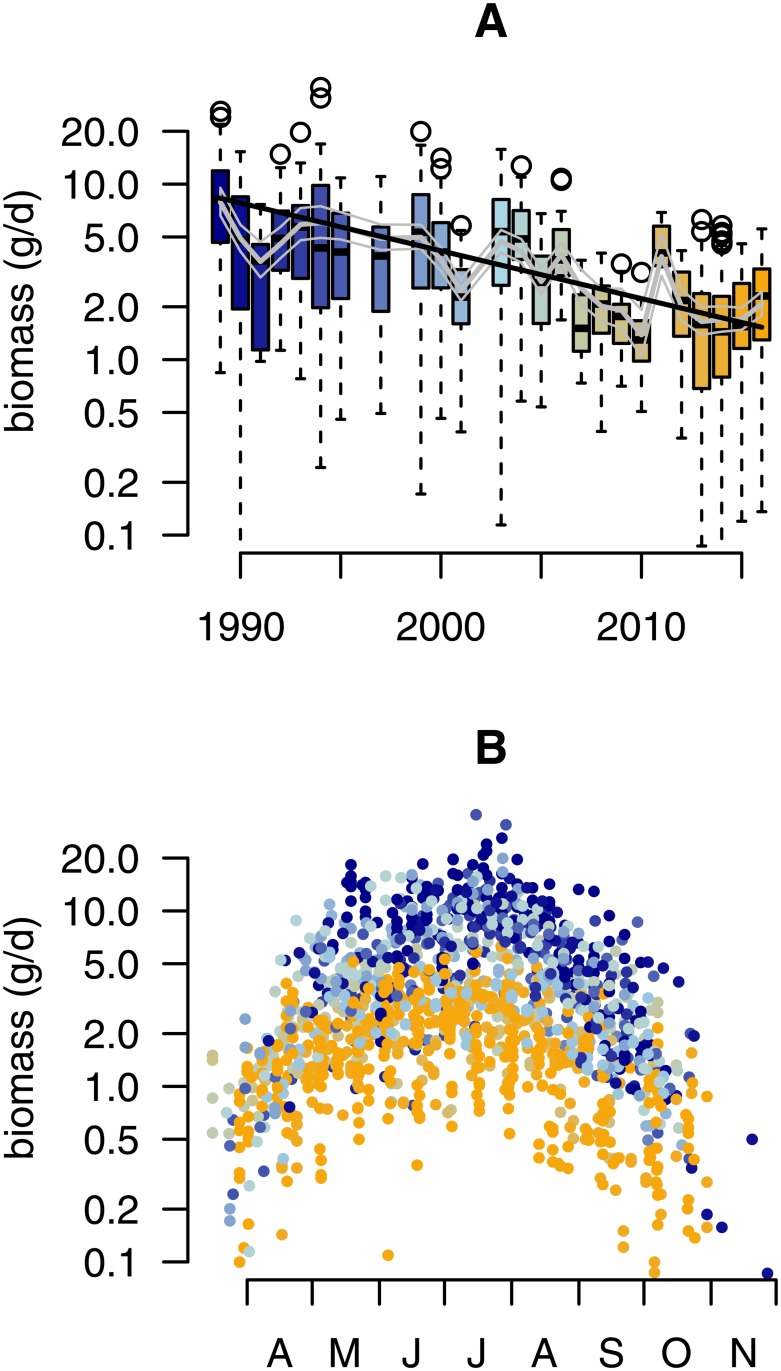
- The basic model estimated an annual trend coefficient of −0.063 (sd = 0.002), i.e. a 6.1% annual decline, yielding a seasonally weighted decline of 76.7% [74.8–78.5%] over 27 years and a mid-summer decline of 81.6% [79.7–83.4%].
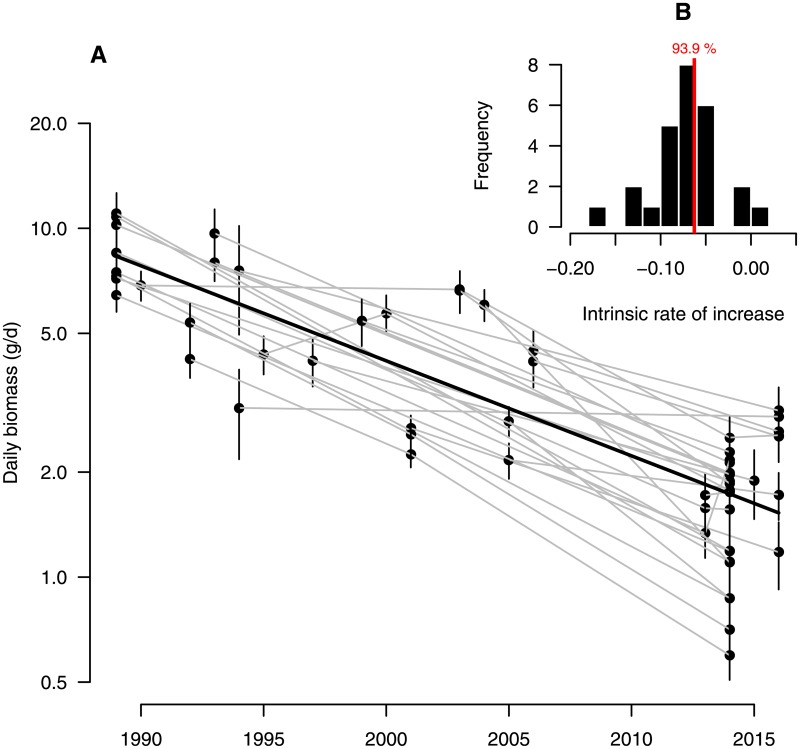
- The decline was similar across habitat clusters and across the 26 locations sampled in more than one year, where re-estimated decline was 76.2% [73.9–78.3%].
- Weather, land-use, and habitat variables did not explain the overall decline; the final model’s annual trend was even more negative (log(λ) = −0.081, sd = 0.006), and fixing the temporal trend to zero projected stable or approximately 8% higher biomass over the study period.
- Nutrient-rich grasslands, margins, and wasteland contained 43% more insect biomass than nutrient-poor heathland, sandy grassland, and dunes, but the rate of decline was similar.
Methods
- Standardized Malaise traps were deployed in 63 protected areas in western Germany between 1989 and 2016, producing 96 unique location-year combinations, 1,503 trap samples, 53.54 kg of invertebrates, and 16,908 trap exposure days; catches were emptied on average every 11.2 days (sd = 6.3).
- Biomass was measured from alcohol-wet samples using a standardized protocol; weather data came from 169 stations within 100 km and were interpolated to trap locations, while land-use and habitat variables were derived from aerial photographs and plant inventories.
- A Bayesian mixed-effects model modeled sample biomass as the sum of latent daily biomass, with covariates for season, year, weather, land use, habitat, and interactions; parameters were estimated via MCMC in JAGS, and models were compared using DIC and R².
Limitations
- The paper states that most locations were sampled in only one year, with repeated sampling at only 26 of 63 locations, so the data do not represent longitudinal records at single sites and could not derive location-specific trends.
- The paper states that land-use change was evaluated from coarse temporal aerial-photograph data and not management regimes, and that the full range of climatic variables and agricultural intensification, including pesticide use, could not be incorporated.
- Evident from the text: the study is observational and does not identify causal drivers; traps were in protected areas of limited size, with 94% of locations enclosed by agricultural fields, and biomass was not resolved to species-level trends.
Model-written summary. Check it against the paper before relying on it.
Integrity signals
Registry
Cites
Statistics
Figures
Verification
Claims the paper makes
40 Own result · 21 Not checked yet · 15 Own method · 12 Own interpretation · 3 No basis given
A result the paper reports from its own data — it cites no other source for it, so there is none to check. The quote shows it is in the paper.
In the paper
“Our analysis estimates a seasonal decline of 76%, and mid-summer decline of 82% in flying insect biomass over the 27 years of study.”
§ More than 75 percent decline over 27 years in total flying insect biomass in protected areas > Abstract
hedgedcorrelational- Asserted: passes — The authors put it forward as true.
- Checkable: passes — It can be checked against evidence.
- Load-bearing: passes — The paper’s conclusions depend on it.
- Based: passes — The paper gives a reason why it holds.
- The authors state this as an assumption: The seasonal insect biomass profiles from the sampled location-year combinations are random samples representative of the state of entomofauna in protected areas in western Germany.
- Rests on an assumption: Malaise trap catches provide a representative measure of total flying insect biomass at a location.
- Rests on an assumption: The sampled protected areas are representative of Western European low-altitude nature protection areas embedded in a human-dominated landscape.
A result the paper reports from its own data — it cites no other source for it, so there is none to check. The quote shows it is in the paper.
In the paper
“We show that this decline is apparent regardless of habitat type, while changes in weather, land use, and habitat characteristics cannot explain this overall decline.”
§ More than 75 percent decline over 27 years in total flying insect biomass in protected areas > Abstract
plain- Asserted: passes — The authors put it forward as true.
- Checkable: passes — It can be checked against evidence.
- Load-bearing: passes — The paper’s conclusions depend on it.
- Based: passes — The paper gives a reason why it holds.
- The authors state this as an assumption: The seasonal insect biomass profiles from the sampled location-year combinations are random samples representative of the state of entomofauna in protected areas in western Germany.
- Rests on an assumption: Malaise trap catches provide a representative measure of total flying insect biomass at a location.
- Rests on an assumption: The sampled protected areas are representative of Western European low-altitude nature protection areas embedded in a human-dominated landscape.
A result the paper reports from its own data — it cites no other source for it, so there is none to check. The quote shows it is in the paper.
In the paper
“Projections of our final model, while fixing the coefficient for the temporal annual trend log(λ) to zero, suggest insect biomass would have remained stable, or even increased by approximately 8% (mean rate = 1.075, 0.849–1.381) over the course of the study period.”
§ More than 75 percent decline over 27 years in total flying insect biomass in protected areas > Results
hedged- Asserted: passes — The authors put it forward as true.
- Checkable: passes — It can be checked against evidence.
- Load-bearing: passes — The paper’s conclusions depend on it.
- Based: passes — The paper gives a reason why it holds.
A result the paper reports from its own data — it cites no other source for it, so there is none to check. The quote shows it is in the paper.
In the paper
“Including species richness in our basic model, i.e. number of tree species and log number of herb species, revealed significant positive and negative effects respectively on insect biomass, but did not affect the annual trend coefficient (S3 Table), explaining some variation between locations rather than the annual trend coefficient.”
§ More than 75 percent decline over 27 years in total flying insect biomass in protected areas > Results
plaindirect- Asserted: passes — The authors put it forward as true.
- Checkable: passes — It can be checked against evidence.
- Load-bearing: unclear — It is unclear whether the paper’s conclusions depend on it.
- Based: passes — The paper gives a reason why it holds.
A result the paper reports from its own data — it cites no other source for it, so there is none to check. The quote shows it is in the paper.
In the paper
“As such, a seasonally weighted estimate (covering the period 1-April to 30-October; see methods) results in an overall 76.7% [74.8–78.5%] decline over a 27 year period.”
- Also stated in: § Discussion · plain
“Our results document a dramatic decline in average airborne insect biomass of 76% (up to 82% in midsummer) in just 27 years for protected nature areas in Germany.”
§ More than 75 percent decline over 27 years in total flying insect biomass in protected areas > Results
plaincorrelational- Asserted: passes — The authors put it forward as true.
- Checkable: passes — It can be checked against evidence.
- Load-bearing: passes — The paper’s conclusions depend on it.
- Based: passes — The paper gives a reason why it holds.
- Rests on an assumption: Malaise trap catches provide a representative measure of the total flying insect biomass in the protected areas studied.
- Also stated in: § Discussion · plain
A result the paper reports from its own data — it cites no other source for it, so there is none to check. The quote shows it is in the paper.
In the paper
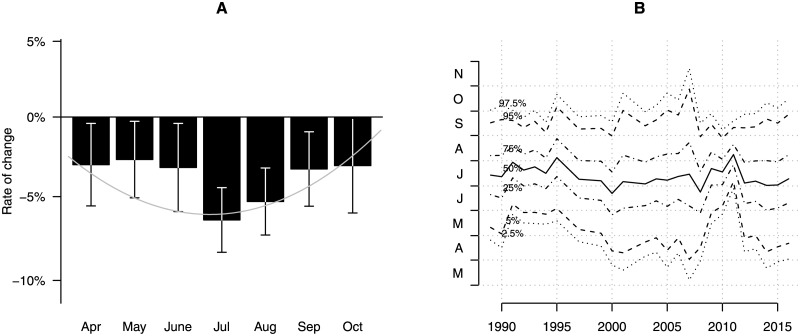
“Furthermore, a phenological shift with peak biomass earlier in the season could have resulted in lower biomass in the mid-season (Fig 3A), but this does not appear to be the case as none of the seasonal distribution quantiles in biomass showed any temporal trend (Fig 3B).”
§ More than 75 percent decline over 27 years in total flying insect biomass in protected areas > Results
hedged- Asserted: passes — The authors put it forward as true.
- Checkable: passes — It can be checked against evidence.
- Load-bearing: unclear — It is unclear whether the paper’s conclusions depend on it.
- Based: passes — The paper gives a reason why it holds.
A result the paper reports from its own data — it cites no other source for it, so there is none to check. The quote shows it is in the paper.
In the paper
“Insect biomass was positively related to temperature and negatively to precipitation (S1 Table).”
§ More than 75 percent decline over 27 years in total flying insect biomass in protected areas > Results
plaincorrelational- Asserted: passes — The authors put it forward as true.
- Checkable: passes — It can be checked against evidence.
- Load-bearing: unclear — It is unclear whether the paper’s conclusions depend on it.
- Based: passes — The paper gives a reason why it holds.
A result the paper reports from its own data — it cites no other source for it, so there is none to check. The quote shows it is in the paper.
In the paper
“Including species richness in our basic model, i.e. number of tree species and log number of herb species, revealed significant positive and negative effects respectively on insect biomass, but did not affect the annual trend coefficient (S3 Table), explaining some variation between locations rather than the annual trend coefficient.”
§ More than 75 percent decline over 27 years in total flying insect biomass in protected areas > Results
plaindirect- Asserted: passes — The authors put it forward as true.
- Checkable: passes — It can be checked against evidence.
- Load-bearing: unclear — It is unclear whether the paper’s conclusions depend on it.
- Based: passes — The paper gives a reason why it holds.
- It may state two separate claims as one. 26
- Probably not a substantial claim. 24
A result the paper reports from its own data — it cites no other source for it, so there is none to check. The quote shows it is in the paper.
In the paper
“On average, cover of arable land decreased, coverage of forests increased, while grassland and surface water did not change much in extent over the last three decades (S3 Fig).”
§ More than 75 percent decline over 27 years in total flying insect biomass in protected areas > Results
plain- Asserted: passes — The authors put it forward as true.
- Checkable: passes — It can be checked against evidence.
- Load-bearing: unclear — It is unclear whether the paper’s conclusions depend on it.
- Based: passes — The paper gives a reason why it holds.
It may state two separate claims as one.
A result the paper reports from its own data — it cites no other source for it, so there is none to check. The quote shows it is in the paper.
In the paper
“Over the course of the study period, some temporal changes occurred in the means of the weather variables (S2 Fig), most notably an increase by 0.5°C in mean temperature and a decline 0.2 m/sec in mean wind speed.”
§ More than 75 percent decline over 27 years in total flying insect biomass in protected areas > Results
plain- Asserted: passes — The authors put it forward as true.
- Checkable: passes — It can be checked against evidence.
- Load-bearing: fails — The paper’s conclusions may not depend on it.
- Based: passes — The paper gives a reason why it holds.
Probably not a substantial claim. The paper’s conclusions may not depend on it.
A result the paper reports from its own data — it cites no other source for it, so there is none to check. The quote shows it is in the paper.
In the paper
“On average, cover of arable land decreased, coverage of forests increased, while grassland and surface water did not change much in extent over the last three decades (S3 Fig).”
§ More than 75 percent decline over 27 years in total flying insect biomass in protected areas > Results
plain- Asserted: passes — The authors put it forward as true.
- Checkable: passes — It can be checked against evidence.
- Load-bearing: fails — The paper’s conclusions may not depend on it.
- Based: passes — The paper gives a reason why it holds.
Probably not a substantial claim. The paper’s conclusions may not depend on it.
In the paper
“Preliminary analysis of the relationship between log biomass and landuse variables, on a subset of the trap locations, indicated that land use elements at 200m radius better predicted insect biomass than elements at 500 and 1000m radius, similar to findings elsewhere for wild bees [45].”
§ More than 75 percent decline over 27 years in total flying insect biomass in protected areas > Materials and methods > Data
What the sources say
- Not checked yetcites [45] I Steffan-Dewenter, 2002, Scale-dependent effects of landscape context on three pollinator guilds, Ecology source
hedgedcorrelational- Asserted: passes — The authors put it forward as true.
- Checkable: passes — It can be checked against evidence.
- Load-bearing: fails — The paper’s conclusions may not depend on it.
- Based: passes — The paper gives a reason why it holds.
Probably not a substantial claim. The paper’s conclusions may not depend on it.
A result the paper reports from its own data — it cites no other source for it, so there is none to check. The quote shows it is in the paper.
In the paper
“The overall model fit improved as compared to our basic model (R2 = 65.4%, Table 3), explaining within and between year variation in insect biomass, but not the overall decline (log(λ) = −0.058, sd = 0.002).”
§ More than 75 percent decline over 27 years in total flying insect biomass in protected areas > Results
plain- Asserted: passes — The authors put it forward as true.
- Checkable: passes — It can be checked against evidence.
- Load-bearing: unclear — It is unclear whether the paper’s conclusions depend on it.
- Based: passes — The paper gives a reason why it holds.
It may state two separate claims as one.
A result the paper reports from its own data — it cites no other source for it, so there is none to check. The quote shows it is in the paper.
In the paper
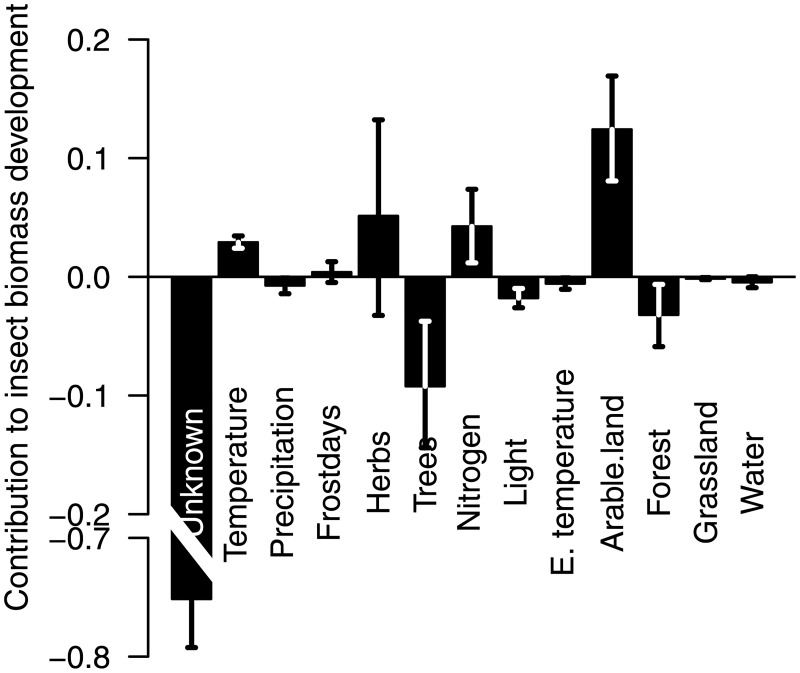
“The marginal net effect of changes in each covariate over time (see Analysis), showed a positive contribution to biomass growth rate of temporal developments in arable land, herb species richness, and Ellenberg Nitrogen, while negative effects of developments of tree species richness and forest coverage (Fig 5).”
§ More than 75 percent decline over 27 years in total flying insect biomass in protected areas > Results
plaindirect- Asserted: passes — The authors put it forward as true.
- Checkable: passes — It can be checked against evidence.
- Load-bearing: unclear — It is unclear whether the paper’s conclusions depend on it.
- Based: passes — The paper gives a reason why it holds.
It may state two separate claims as one.
A result the paper reports from its own data — it cites no other source for it, so there is none to check. The quote shows it is in the paper.
In the paper
“Over the course of the study period, some temporal changes occurred in the means of the weather variables (S2 Fig), most notably an increase by 0.5°C in mean temperature and a decline 0.2 m/sec in mean wind speed.”
§ More than 75 percent decline over 27 years in total flying insect biomass in protected areas > Results
plain- Asserted: passes — The authors put it forward as true.
- Checkable: passes — It can be checked against evidence.
- Load-bearing: fails — The paper’s conclusions may not depend on it.
- Based: passes — The paper gives a reason why it holds.
Probably not a substantial claim. The paper’s conclusions may not depend on it.
A result the paper reports from its own data — it cites no other source for it, so there is none to check. The quote shows it is in the paper.
In the paper
“However, including interactions between the annual trend coefficient and land use variables increased the model fit slightly (Table 3), and revealed significant interactions for all variables except coverage of surface water (S2 Table).”
§ More than 75 percent decline over 27 years in total flying insect biomass in protected areas > Results
plaindirect- Asserted: passes — The authors put it forward as true.
- Checkable: passes — It can be checked against evidence.
- Load-bearing: unclear — It is unclear whether the paper’s conclusions depend on it.
- Based: passes — The paper gives a reason why it holds.
It may state two separate claims as one.
A result the paper reports from its own data — it cites no other source for it, so there is none to check. The quote shows it is in the paper.
In the paper
“On average, cover of arable land decreased, coverage of forests increased, while grassland and surface water did not change much in extent over the last three decades (S3 Fig).”
§ More than 75 percent decline over 27 years in total flying insect biomass in protected areas > Results
plain- Asserted: passes — The authors put it forward as true.
- Checkable: passes — It can be checked against evidence.
- Load-bearing: fails — The paper’s conclusions may not depend on it.
- Based: passes — The paper gives a reason why it holds.
Probably not a substantial claim. The paper’s conclusions may not depend on it.
A result the paper reports from its own data — it cites no other source for it, so there is none to check. The quote shows it is in the paper.
In the paper
“However, Ellenberg values did not affect the insect biomass trend coefficient (log(λ) = −0.059, sd = 0.003, S3 Table) and only marginally improved the model fit (R2 = 61.9%, Table 3).”
§ More than 75 percent decline over 27 years in total flying insect biomass in protected areas > Results
plain- Asserted: passes — The authors put it forward as true.
- Checkable: passes — It can be checked against evidence.
- Load-bearing: unclear — It is unclear whether the paper’s conclusions depend on it.
- Based: passes — The paper gives a reason why it holds.
It may state two separate claims as one.
A result the paper reports from its own data — it cites no other source for it, so there is none to check. The quote shows it is in the paper.
In the paper
“Firstly, our basic model (including an annual rate of decline) outperformed the null-model (without an annual rate of decline; ΔDIC = 822.62 units; Table 3), while at the same time, between-plot variation (i.s. σsite) and residual variation (v) decreased by 44.3 and 9.7% respectively, after incorporating an annual rate of decline into the models.”
§ More than 75 percent decline over 27 years in total flying insect biomass in protected areas > Discussion
plaindirect- Asserted: passes — The authors put it forward as true.
- Checkable: passes — It can be checked against evidence.
- Load-bearing: passes — The paper’s conclusions depend on it.
- Based: passes — The paper gives a reason why it holds.
It may state two separate claims as one.
The paper states this without a source or data behind it here, so there is nothing to check it against. The quote shows it is in the paper.
In the paper
“The reserves in which the traps were placed are of limited size in this typical fragmented West-European landscape, and almost all locations (94%) are enclosed by agricultural fields.”
§ More than 75 percent decline over 27 years in total flying insect biomass in protected areas > Discussion
plain- Asserted: passes — The authors put it forward as true.
- Checkable: passes — It can be checked against evidence.
- Load-bearing: passes — The paper’s conclusions depend on it.
- Based: passes — The paper gives a reason why it holds.
It may state two separate claims as one.
None of the sources cited for this claim have been checked yet.
In the paper
“Loss of insects is certain to have adverse effects on ecosystem functioning, as insects play a central role in a variety of processes, including pollination [1, 2], herbivory and detrivory [3, 4], nutrient cycling [4] and providing a food source for higher trophic levels such as birds, mammals and amphibians.”
§ More than 75 percent decline over 27 years in total flying insect biomass in protected areas > Introduction
What the sources say
- Not checked yetcites [1] E Öckinger, 2007, Semi-natural grasslands as population sources for pollinating insects in agricultural landscapes, Journal of Applied Ecology source
- Not checked yetcites [2] J Ollerton, 2011, How many flowering plants are pollinated by animals?, Oikos source
- Not checked yetcites [3] WJ Mattson, 1975, Phytophagous insects as regulators of forest primary production, Science source
- Not checked yetcites [4] LH Yang, 2014, Insects as drivers of ecosystem processes, Current Opinion in Insect Science source
boosted- Asserted: passes — The authors put it forward as true.
- Checkable: passes — It can be checked against evidence.
- Load-bearing: passes — The paper’s conclusions depend on it.
- Based: passes — The paper gives a reason why it holds.
It may state two separate claims as one.
None of the sources cited for this claim have been checked yet.
In the paper
“Current data suggest an overall pattern of decline in insect diversity and abundance.”
§ More than 75 percent decline over 27 years in total flying insect biomass in protected areas > Introduction
What the sources say
- Not checked yetcites [7] C van Swaay, 2013, The European grassland butterfly indicator: 1990–2011, EEA Technical Reports
- Not checked yetcites [8] D Goulson, 2008, Decline and conservation of bumble bees, Annual Review of Entomology source
- Not checked yetcites [9] SG Nilsson, 2008, Long-term land-use changes and extinction of specialised butterflies, Insect Conservation and Diversity source
- Not checked yetcites [10] R Winfree, 2009, A meta-analysis of bees’ responses to anthropogenic disturbance, Ecology source
- Not checked yetcites [11] SG Potts, 2010, Global pollinator declines: trends, impacts and drivers, Trends in Ecology and Evolution source
- Not checked yetcites [12] A Ilyinykh, 2011, Analysis of the causes of declines in Western Siberian outbreaks of the nun moth Lymantria monacha, BioControl source
- Not checked yetcites [13] J Ollerton, 2014, Extinctions of aculeate pollinators in Britain and the role of large-scale agricultural changes, Science source
- Not checked yetcites [14] BA Woodcock, 2016, Impacts of neonicotinoid use on long-term population changes in wild bees in England, Nature Communications source
- Not checked yetcites [15] KF Conrad, 2002, Long-term decline in abundance and distribution of the garden tiger moth (Arctia caja) in Great Britain, Biological Conservation source
- Not checked yetcites [16] KF Conrad, 2006, Rapid declines of common, widespread British moths provide evidence of an insect biodiversity crisis, Biological Conservation source
hedgedcorrelational- Asserted: passes — The authors put it forward as true.
- Checkable: passes — It can be checked against evidence.
- Load-bearing: passes — The paper’s conclusions depend on it.
- Based: passes — The paper gives a reason why it holds.
It may state two separate claims as one.
What the paper did — it cites no source for this, so there is none to check. The quote shows it is in the paper.
In the paper
“Trend coefficients of richness over time between a Poisson mixed effects model and a negative binomial model were comparable but differed in magnitude (Poisson GLMM: −0.034 (se = 0.003), vs NB GLMM −0.027 (se = 0.006)).”
§ More than 75 percent decline over 27 years in total flying insect biomass in protected areas > Materials and methods > Data
plaincorrelational- Asserted: passes — The authors put it forward as true.
- Checkable: passes — It can be checked against evidence.
- Load-bearing: fails — The paper’s conclusions may not depend on it.
- Based: passes — The paper gives a reason why it holds.
Probably not a substantial claim. The paper’s conclusions may not depend on it. It may state two separate claims as one.
What the paper did — it cites no source for this, so there is none to check. The quote shows it is in the paper.
In the paper
“Although the fit is not perfect in the case of herb richness, we believe our trend adequately describes direction of change over time.”
§ More than 75 percent decline over 27 years in total flying insect biomass in protected areas > Materials and methods > Data
hedged- Asserted: passes — The authors put it forward as true.
- Checkable: passes — It can be checked against evidence.
- Load-bearing: fails — The paper’s conclusions may not depend on it.
- Based: passes — The paper gives a reason why it holds.
Probably not a substantial claim. The paper’s conclusions may not depend on it.
What the paper did — it cites no source for this, so there is none to check. The quote shows it is in the paper.
In the paper
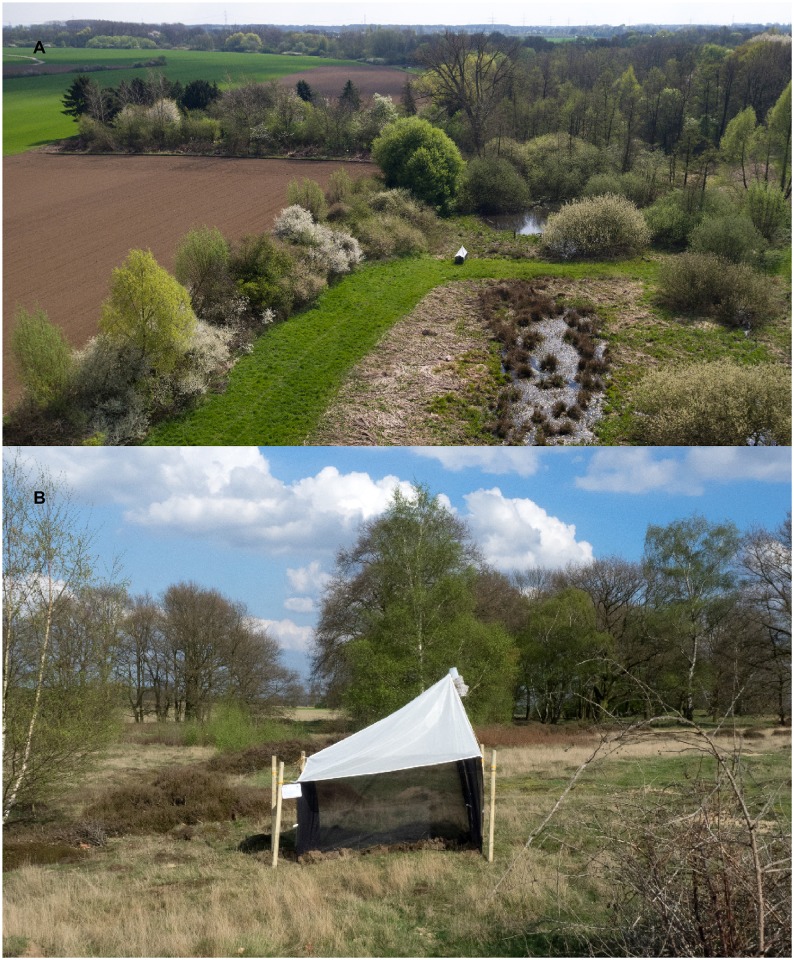
“The sampling was standardized in terms of trap construction, size and design (identical parts), colors, type of netting and ground sealing, trap orientation in the field as well as slope at the trap location. Hence none of the traps differed in any of these field aspects.”
§ More than 75 percent decline over 27 years in total flying insect biomass in protected areas > Materials and methods > Data
plain- Asserted: passes — The authors put it forward as true.
- Checkable: passes — It can be checked against evidence.
- Load-bearing: passes — The paper’s conclusions depend on it.
- Based: passes — The paper gives a reason why it holds.
It may state two separate claims as one.
- Rests on an assumption: Malaise trap catches provide a representative measure of total flying insect biomass at a location.
None of the sources cited for this claim have been checked yet.
In the paper
“Malaise traps are known to collect a much wider diversity of insect species (e.g. [29–31]) as compared to suction traps (e.g. [28]) and are therefore considered superior as a method of collecting flying insects.”
§ More than 75 percent decline over 27 years in total flying insect biomass in protected areas > Materials and methods > Data
What the sources say
- Not checked yetcites [29] U Bosch, 1994, Naturkundliche Untersuchungen zum Naturschutzgebiet Die Spey—III. Nachgewiesene Schmetterlinge (Macrolepidoptera), Natur am Niederrhein (NF)
- Not checked yetcites [30] C Schmidt, 1995, Naturkundliche Untersuchungen zum Naturschutzgebiet Die Spey—VI. Die Köcherfliegen (Insecta, Trichoptera), Natur am Niederrhein (NF)
- Not checked yetcites [31] M Hellenthal, 2007, Schwebfliegen (Diptera, Syrphidae) des Wahnbachtals im Bergischen Land (Nordrhein-Westfalen, Deutschland), Volucella
- Not checked yetcites [28] CR Shortall, 2009, Long-term changes in the abundance of flying insects, Insect Conservation and Diversity source
boosteddirect- Asserted: passes — The authors put it forward as true.
- Checkable: passes — It can be checked against evidence.
- Load-bearing: fails — The paper’s conclusions may not depend on it.
- Based: passes — The paper gives a reason why it holds.
Probably not a substantial claim. The paper’s conclusions may not depend on it. It may state two separate claims as one.
- Rests on an assumption: Malaise trap catches provide a representative measure of total flying insect biomass at a location.
In the paper
“For example, populations of European grassland butterflies are estimated to have declined by 50% in abundance between 1990 and 2011 [7].”
§ More than 75 percent decline over 27 years in total flying insect biomass in protected areas > Introduction
What the sources say
- Not checked yetcites [7] C van Swaay, 2013, The European grassland butterfly indicator: 1990–2011, EEA Technical Reports
hedged- Asserted: passes — The authors put it forward as true.
- Checkable: passes — It can be checked against evidence.
- Load-bearing: fails — The paper’s conclusions may not depend on it.
- Based: passes — The paper gives a reason why it holds.
Probably not a substantial claim. The paper’s conclusions may not depend on it.
None of the sources cited for this claim have been checked yet.
In the paper
“Climate change is a well-known factor responsible for insect declines [15, 18, 21, 37].”
§ More than 75 percent decline over 27 years in total flying insect biomass in protected areas > Materials and methods > Data
What the sources say
- Not checked yetcites [15] KF Conrad, 2002, Long-term decline in abundance and distribution of the garden tiger moth (Arctia caja) in Great Britain, Biological Conservation source
- Not checked yetcites [18] R Fox, 2014, Long-term changes to the frequency of occurrence of British moths are consistent with opposing and synergistic effects of climate and land-use changes, Journal of Applied Ecology source
- Not checked yetcites [21] M Morecroft, 2002, Effects of drought on contrasting insect and plant species in the UK in the mid-1990s, Global Ecology and Biogeography source
- Not checked yetcites [37] M Fliszkiewicz, 2012, Influence of winter temperature and simulated climate change on body mass and fat body depletion during diapause in adults of the Solitary bee, Osmia rufa (Hymenoptera: Megachilidae), Environmental Entomology source
boosteddirect- Asserted: passes — The authors put it forward as true.
- Checkable: passes — It can be checked against evidence.
- Load-bearing: fails — The paper’s conclusions may not depend on it.
- Based: passes — The paper gives a reason why it holds.
Probably not a substantial claim. The paper’s conclusions may not depend on it.
A conclusion the paper draws from its own results — it cites no other source for it, so there is none to check. The quote shows it is in the paper.
In the paper
“Yet, these changes either do not have an effect on insect biomass (e.g. wind speed) either are expected to positively affected insect biomass (e.g. increased temperature).”
§ More than 75 percent decline over 27 years in total flying insect biomass in protected areas > Results
plain- Asserted: passes — The authors put it forward as true.
- Checkable: passes — It can be checked against evidence.
- Load-bearing: passes — The paper’s conclusions depend on it.
- Based: passes — The paper gives a reason why it holds.
It may state two separate claims as one.
In the paper
“Parameter convergence was assessed by the potential scale reduction factor [54] (commonly ), that measures the ratio of posterior distributions between independent MCM chains (in all models, all parameters attained values below 1.02).”
§ More than 75 percent decline over 27 years in total flying insect biomass in protected areas > Materials and methods > Analysis
What the sources say
- Not checked yetcites [54] A Gelman, 1992, Inference from iterative simulation using multiple sequences, Statistical Science source
plain- Asserted: passes — The authors put it forward as true.
- Checkable: passes — It can be checked against evidence.
- Load-bearing: fails — The paper’s conclusions may not depend on it.
- Based: passes — The paper gives a reason why it holds.
Probably not a substantial claim. The paper’s conclusions may not depend on it.
What the paper did — it cites no source for this, so there is none to check. The quote shows it is in the paper.
In the paper
“Trap catches were stored in 80% ethanol solution, prior to weighing, and total insect biomass of each catch (bottle) was obtained based on a standardized measurement protocol by first subtracting fluid content.”
§ More than 75 percent decline over 27 years in total flying insect biomass in protected areas > Materials and methods > Data
plainn = 4- Asserted: passes — The authors put it forward as true.
- Checkable: passes — It can be checked against evidence.
- Load-bearing: passes — The paper’s conclusions depend on it.
- Based: passes — The paper gives a reason why it holds.
Probably not a substantial claim.
- Rests on an assumption: Malaise trap catches provide a representative measure of total flying insect biomass at a location.
The paper states this without a source or data behind it here, so there is nothing to check it against. The quote shows it is in the paper.
In the paper
“Hence, to what extent total insect biomass has declined, and the relative contribution of each proposed factor to the decline, remain unresolved yet highly relevant questions for ecosystem ecology and conservation.”
§ More than 75 percent decline over 27 years in total flying insect biomass in protected areas > Introduction
plain- Asserted: passes — The authors put it forward as true.
- Checkable: passes — It can be checked against evidence.
- Load-bearing: passes — The paper’s conclusions depend on it.
- Based: passes — The paper gives a reason why it holds.
Probably not a substantial claim. It may state two separate claims as one.
What the paper did — it cites no source for this, so there is none to check. The quote shows it is in the paper.
In the paper
“Biomass data were collected and archived using a standardized protocol across 63 unique locations between 1989 and 2016 (resulting in 96 unique location-year combinations) by the Entomological Society Krefeld.”
§ More than 75 percent decline over 27 years in total flying insect biomass in protected areas > Materials and methods > Data
plain- Asserted: passes — The authors put it forward as true.
- Checkable: passes — It can be checked against evidence.
- Load-bearing: passes — The paper’s conclusions depend on it.
- Based: passes — The paper gives a reason why it holds.
It may state two separate claims as one.
- Rests on an assumption: Malaise trap catches provide a representative measure of total flying insect biomass at a location.
What the paper did — it cites no source for this, so there is none to check. The quote shows it is in the paper.
In the paper
“Although a Poisson distribution fitted tree and shrub species adequately, (residual deviance/ degree of freedom = 0.94 and 1.04 respectively), severe overdispersion was found for herb species richness (residual deviance/ degree of freedom = 2.16).”
§ More than 75 percent decline over 27 years in total flying insect biomass in protected areas > Materials and methods > Data
plain- Asserted: passes — The authors put it forward as true.
- Checkable: passes — It can be checked against evidence.
- Load-bearing: fails — The paper’s conclusions may not depend on it.
- Based: passes — The paper gives a reason why it holds.
Probably not a substantial claim. The paper’s conclusions may not depend on it.
None of the sources cited for this claim have been checked yet.
In the paper
“Data for other well-studied taxa such as bees [8–14] and moths [15–18] suggest the same trend.”
§ More than 75 percent decline over 27 years in total flying insect biomass in protected areas > Introduction
What the sources say
- Not checked yetcites [8] D Goulson, 2008, Decline and conservation of bumble bees, Annual Review of Entomology source
- Not checked yetcites [9] SG Nilsson, 2008, Long-term land-use changes and extinction of specialised butterflies, Insect Conservation and Diversity source
- Not checked yetcites [10] R Winfree, 2009, A meta-analysis of bees’ responses to anthropogenic disturbance, Ecology source
- Not checked yetcites [11] SG Potts, 2010, Global pollinator declines: trends, impacts and drivers, Trends in Ecology and Evolution source
- Not checked yetcites [12] A Ilyinykh, 2011, Analysis of the causes of declines in Western Siberian outbreaks of the nun moth Lymantria monacha, BioControl source
- Not checked yetcites [13] J Ollerton, 2014, Extinctions of aculeate pollinators in Britain and the role of large-scale agricultural changes, Science source
- Not checked yetcites [14] BA Woodcock, 2016, Impacts of neonicotinoid use on long-term population changes in wild bees in England, Nature Communications source
- Not checked yetcites [15] KF Conrad, 2002, Long-term decline in abundance and distribution of the garden tiger moth (Arctia caja) in Great Britain, Biological Conservation source
- Not checked yetcites [16] KF Conrad, 2006, Rapid declines of common, widespread British moths provide evidence of an insect biodiversity crisis, Biological Conservation source
- Not checked yetcites [17] R Fox, 2013, The decline of moths in Great Britain: a review of possible causes, Insect Conservation and Diversity source
hedgedcorrelational- Asserted: passes — The authors put it forward as true.
- Checkable: passes — It can be checked against evidence.
- Load-bearing: fails — The paper’s conclusions may not depend on it.
- Based: passes — The paper gives a reason why it holds.
Probably not a substantial claim. The paper’s conclusions may not depend on it.
In the paper
“Amongst other methods, the geostatistical approach is considered a superior interpolation method in order to derive weather variables to trap locations [41].”
§ More than 75 percent decline over 27 years in total flying insect biomass in protected areas > Materials and methods > Data
What the sources say
- Not checked yetcites [41] W Luo, 2008, A comparison of spatial interpolation methods to estimate continuous wind speed surfaces using irregularly distributed data from England and Wales, International Journal of Climatology source
plain- Asserted: passes — The authors put it forward as true.
- Checkable: passes — It can be checked against evidence.
- Load-bearing: fails — The paper’s conclusions may not depend on it.
- Based: passes — The paper gives a reason why it holds.
Probably not a substantial claim. The paper’s conclusions may not depend on it.
What the paper did — it cites no source for this, so there is none to check. The quote shows it is in the paper.
In the paper
“In a series of 84 weightings of four different samples repeating this measurement procedure, an average deviation from the mean value of the measurement results of 0.4 percent was observed (unpublished results).”
§ More than 75 percent decline over 27 years in total flying insect biomass in protected areas > Materials and methods > Data
plainn = 4- Asserted: passes — The authors put it forward as true.
- Checkable: passes — It can be checked against evidence.
- Load-bearing: fails — The paper’s conclusions may not depend on it.
- Based: passes — The paper gives a reason why it holds.
Probably not a substantial claim. The paper’s conclusions may not depend on it.
- Rests on an assumption: Malaise trap catches provide a representative measure of total flying insect biomass at a location.
What the paper did — it cites no source for this, so there is none to check. The quote shows it is in the paper.
In the paper
“Most locations (59%, n = 37) were sampled in only one year, 20 locations in two years, five locations in three years, and one in four years, yielding in total 96 unique location-year combinations of measurements of seasonal total flying insect biomass.”
§ More than 75 percent decline over 27 years in total flying insect biomass in protected areas > Materials and methods > Data
plainn = 37- Asserted: passes — The authors put it forward as true.
- Checkable: passes — It can be checked against evidence.
- Load-bearing: passes — The paper’s conclusions depend on it.
- Based: passes — The paper gives a reason why it holds.
It may state two separate claims as one.
What the paper did — it cites no source for this, so there is none to check. The quote shows it is in the paper.
In the paper
“However, as our trap locations are all situated in lowland areas with little altitude variation, we do not expect a large error in our interpolations at trap locations.”
§ More than 75 percent decline over 27 years in total flying insect biomass in protected areas > Materials and methods > Data
hedged- Asserted: passes — The authors put it forward as true.
- Checkable: passes — It can be checked against evidence.
- Load-bearing: fails — The paper’s conclusions may not depend on it.
- Based: passes — The paper gives a reason why it holds.
Probably not a substantial claim. The paper’s conclusions may not depend on it.
None of the sources cited for this claim have been checked yet.
In the paper
“However, the number of studies on insect trends with sufficient replication and spatial coverage are limited [10, 23–25] and restricted to certain well-studied taxa.”
§ More than 75 percent decline over 27 years in total flying insect biomass in protected areas > Introduction
What the sources say
- Not checked yetcites [10] R Winfree, 2009, A meta-analysis of bees’ responses to anthropogenic disturbance, Ecology source
- Not checked yetcites [23] E Fuentes-Montemayor, 2011, The effectiveness of agri-environment schemes for the conservation of farmland moths: assessing the importance of a landscape-scale management approach, Journal of Applied Ecology source
- Not checked yetcites [24] R Dirzo, 2014, Defaunation in the Anthropocene, Science source
- Not checked yetcites [25] JA Thomas, 2016, Butterfly communities under threat, Science source
plain- Asserted: passes — The authors put it forward as true.
- Checkable: passes — It can be checked against evidence.
- Load-bearing: passes — The paper’s conclusions depend on it.
- Based: passes — The paper gives a reason why it holds.
It may state two separate claims as one.
What the paper did — it cites no source for this, so there is none to check. The quote shows it is in the paper.
In the paper
“For all models, we confirmed that the posterior distribution of the trend coefficient did not confound any other variable by plotting the relevant posterior samples and computing pairwise correlation coefficients.”
§ More than 75 percent decline over 27 years in total flying insect biomass in protected areas > Materials and methods > Analysis
plain- Asserted: passes — The authors put it forward as true.
- Checkable: passes — It can be checked against evidence.
- Load-bearing: fails — The paper’s conclusions may not depend on it.
- Based: passes — The paper gives a reason why it holds.
Probably not a substantial claim. The paper’s conclusions may not depend on it.
In the paper
“In that study, 12.2m high suction traps were deployed at four locations in the UK over the time period 1973–2002, and showed a biomass decline at one of the four sites only.”
§ More than 75 percent decline over 27 years in total flying insect biomass in protected areas > Discussion
What the sources say
- Not checked yetcites [28] CR Shortall, 2009, Long-term changes in the abundance of flying insects, Insect Conservation and Diversity source
plain- Asserted: passes — The authors put it forward as true.
- Checkable: passes — It can be checked against evidence.
- Load-bearing: passes — The paper’s conclusions depend on it.
- Based: passes — The paper gives a reason why it holds.
It may state two separate claims as one.
None of the sources cited for this claim have been checked yet.
In the paper
“Agricultural intensification, including the disappearance of field margins and new crop protection methods has been associated with an overall decline of biodiversity in plants, insects, birds and other species in the current landscape [20, 27, 67].”
§ More than 75 percent decline over 27 years in total flying insect biomass in protected areas > Discussion
What the sources say
- Not checked yetcites [20] TG Benton, 2002, Linking agricultural practice to insect and bird populations: a historical study over three decades, Journal of Applied Ecology source
- Not checked yetcites [27] JA Thomas, 2004, Comparative losses of British butterflies, birds, and plants and the global extinction crisis, Science source
- Not checked yetcites [67] CA Hallmann, 2014, Declines in insectivorous birds are associated with high neonicotinoid concentrations, Nature source
plaincorrelational- Asserted: passes — The authors put it forward as true.
- Checkable: passes — It can be checked against evidence.
- Load-bearing: fails — The paper’s conclusions may not depend on it.
- Based: passes — The paper gives a reason why it holds.
Probably not a substantial claim. The paper’s conclusions may not depend on it.
None of the sources cited for this claim have been checked yet.
In the paper
“Our results demonstrate that recently reported declines in several taxa such as butterflies [7, 25–27, 58], wild bees [8–14] and moths [15–18], are in parallel with a severe loss of total aerial insect biomass, suggesting that it is not only the vulnerable species, but the flying insect community as a whole, that has been decimated over the last few decades.”
§ More than 75 percent decline over 27 years in total flying insect biomass in protected areas > Discussion
What the sources say
- Not checked yetcites [7] C van Swaay, 2013, The European grassland butterfly indicator: 1990–2011, EEA Technical Reports
- Not checked yetcites [25] JA Thomas, 2016, Butterfly communities under threat, Science source
- Not checked yetcites [26] JC Habel, 2015, Butterfly community shifts over 2 centuries, Conservation Biology
- Not checked yetcites [27] JA Thomas, 2004, Comparative losses of British butterflies, birds, and plants and the global extinction crisis, Science source
- Not checked yetcites [58] M Kuussaari, 2007, Contrasting trends of butterfly species preferring semi-natural grasslands, field margins and forest edges in northern Europe, Journal of Insect Conservation source
- Not checked yetcites [8] D Goulson, 2008, Decline and conservation of bumble bees, Annual Review of Entomology source
- Not checked yetcites [9] SG Nilsson, 2008, Long-term land-use changes and extinction of specialised butterflies, Insect Conservation and Diversity source
- Not checked yetcites [10] R Winfree, 2009, A meta-analysis of bees’ responses to anthropogenic disturbance, Ecology source
- Not checked yetcites [11] SG Potts, 2010, Global pollinator declines: trends, impacts and drivers, Trends in Ecology and Evolution source
- Not checked yetcites [12] A Ilyinykh, 2011, Analysis of the causes of declines in Western Siberian outbreaks of the nun moth Lymantria monacha, BioControl source
hedgedcorrelational- Asserted: passes — The authors put it forward as true.
- Checkable: passes — It can be checked against evidence.
- Load-bearing: passes — The paper’s conclusions depend on it.
- Based: passes — The paper gives a reason why it holds.
It may state two separate claims as one.
- Rests on an assumption: Malaise trap catches provide a representative measure of the total flying insect biomass in the protected areas studied.
None of the sources cited for this claim have been checked yet.
In the paper
“While the gradual decline of rare insect species has been known for quite some time (e.g. specialized butterflies [9, 66]), our results illustrate an ongoing and rapid decline in total amount of airborne insects active in space and time.”
§ More than 75 percent decline over 27 years in total flying insect biomass in protected areas > Discussion
What the sources say
boosted- Asserted: passes — The authors put it forward as true.
- Checkable: passes — It can be checked against evidence.
- Load-bearing: passes — The paper’s conclusions depend on it.
- Based: passes — The paper gives a reason why it holds.
It may state two separate claims as one.
- Rests on an assumption: Malaise trap catches provide a representative measure of the total flying insect biomass in the protected areas studied.
A conclusion the paper draws from its own results — it cites no other source for it, so there is none to check. The quote shows it is in the paper.
In the paper
“The decline in insect biomass, being evident throughout the growing season, and irrespective of habitat type or landscape configuration, suggests large-scale factors must be involved.”
§ More than 75 percent decline over 27 years in total flying insect biomass in protected areas > Discussion
hedgeddirect- Asserted: passes — The authors put it forward as true.
- Checkable: passes — It can be checked against evidence.
- Load-bearing: passes — The paper’s conclusions depend on it.
- Based: passes — The paper gives a reason why it holds.
It may state two separate claims as one.
What the paper did — it cites no source for this, so there is none to check. The quote shows it is in the paper.
In the paper
“However, we have not exhaustively analysed the full range of climatic variables that could potentially impact insect biomass.”
§ More than 75 percent decline over 27 years in total flying insect biomass in protected areas > Discussion
plain- Asserted: passes — The authors put it forward as true.
- Checkable: passes — It can be checked against evidence.
- Load-bearing: fails — The paper’s conclusions may not depend on it.
- Based: passes — The paper gives a reason why it holds.
Probably not a substantial claim. The paper’s conclusions may not depend on it.
A conclusion the paper draws from its own results — it cites no other source for it, so there is none to check. The quote shows it is in the paper.
In the paper
“While some temporal changes in climatic variables in our study area have taken place, these either were not of influence (e.g. wind speed), or changed in a manner that should have increased insect biomass (e.g temperature).”
§ More than 75 percent decline over 27 years in total flying insect biomass in protected areas > Discussion
plain- Asserted: passes — The authors put it forward as true.
- Checkable: passes — It can be checked against evidence.
- Load-bearing: passes — The paper’s conclusions depend on it.
- Based: passes — The paper gives a reason why it holds.
It may state two separate claims as one.
A conclusion the paper draws from its own results — it cites no other source for it, so there is none to check. The quote shows it is in the paper.
In the paper
“Whatever the causal factors responsible for the decline, they have a far more devastating effect on total insect biomass than has been appreciated previously.”
§ More than 75 percent decline over 27 years in total flying insect biomass in protected areas > Discussion
boosteddirect- Asserted: passes — The authors put it forward as true.
- Checkable: fails — It may be too vague to check against evidence.
- Load-bearing: passes — The paper’s conclusions depend on it.
- Based: passes — The paper gives a reason why it holds.
Probably not a substantial claim. It may be too vague to check against evidence.
- Rests on an assumption: Malaise trap catches provide a representative measure of the total flying insect biomass in the protected areas studied.
What the paper did — it cites no source for this, so there is none to check. The quote shows it is in the paper.
In the paper
“We are however confident that our estimated rate of decline in total biomass resembles the true rate of decline, and is not an artifact of site selection.”
§ More than 75 percent decline over 27 years in total flying insect biomass in protected areas > Discussion
plainn = 26- Asserted: passes — The authors put it forward as true.
- Checkable: passes — It can be checked against evidence.
- Load-bearing: passes — The paper’s conclusions depend on it.
- Based: passes — The paper gives a reason why it holds.
It may state two separate claims as one.
None of the sources cited for this claim have been checked yet.
In the paper
“This considerably exceeds the estimated decline of 58% in global abundance of wild vertebrates over a 42-year period to 2012 [56, 57].”
§ More than 75 percent decline over 27 years in total flying insect biomass in protected areas > Discussion
What the sources say
- Not checked yetcites [56] WWF International. Living Planet Report 2016: Risk and resilience in a new era. Gland, Switzerland. 2016;.
- Not checked yetcites [57] G Ceballos, 2017, Biological annihilation via the ongoing sixth mass extinction signaled by vertebrate population losses and declines, Proceedings of the National Academy of Sciences source
plain- Asserted: passes — The authors put it forward as true.
- Checkable: passes — It can be checked against evidence.
- Load-bearing: passes — The paper’s conclusions depend on it.
- Based: passes — The paper gives a reason why it holds.
It may state two separate claims as one.
- Rests on an assumption: Malaise trap catches provide a representative measure of the total flying insect biomass in the protected areas studied.
A conclusion the paper draws from its own results — it cites no other source for it, so there is none to check. The quote shows it is in the paper.
In the paper
“The major and hitherto unrecognized loss of insect biomass that we report here for protected areas, adds a new dimension to this discussion, because it must have cascading effects across trophic levels and numerous other ecosystem effects.”
§ More than 75 percent decline over 27 years in total flying insect biomass in protected areas > Discussion
boosteddirect- Asserted: passes — The authors put it forward as true.
- Checkable: fails — It may be too vague to check against evidence.
- Load-bearing: passes — The paper’s conclusions depend on it.
- Based: fails — The paper may give no reason why it holds.
Probably not a substantial claim. It may be too vague to check against evidence. The paper may give no reason why it holds. It may state two separate claims as one.
- Rests on an assumption: Malaise trap catches provide a representative measure of the total flying insect biomass in the protected areas studied.
What the paper did — it cites no source for this, so there is none to check. The quote shows it is in the paper.
In the paper
“Although the present dataset spans a relatively large number of years (27) and sites (63), the number of repetitions (i.e. multiple years of seasonal distributions at the same locations) was lower (n = 26).”
§ More than 75 percent decline over 27 years in total flying insect biomass in protected areas > Discussion
plainn = 26- Asserted: passes — The authors put it forward as true.
- Checkable: passes — It can be checked against evidence.
- Load-bearing: passes — The paper’s conclusions depend on it.
- Based: passes — The paper gives a reason why it holds.
Probably not a substantial claim. It may state two separate claims as one.
The authors state this as an assumption.
The seasonal insect biomass profiles from the sampled location-year combinations are random samples representative of the state of entomofauna in protected areas in western Germany.
“However, the data do permit an analysis at a higher spatial level, i.e. by treating seasonal insect biomass profiles as random samples of the state of entomofauna in protected areas in western Germany.”
The paper relies on this without support.
Malaise trap catches provide a representative measure of total flying insect biomass at a location.
“In the present study, we consider the total biomass of flying insects to assess the state of local entomofauna as a group.”
The paper relies on this without support.
The sampled protected areas are representative of Western European low-altitude nature protection areas embedded in a human-dominated landscape.
“Here, we investigate total aerial insect biomass between 1989 and 2016 across 96 unique location-year combinations in Germany, representative of Western European low-altitude nature protection areas embedded in a human-dominated landscape (S1 Fig).”
The authors state this as an assumption.
The mass of each sample is normally distributed about the sum of the latent expected daily mass.
“The mass m of each sample j, at site s in year k, is assumed to be distributed normally about the sum of the latent expected daily mass (zt, s, k), with variance :”
The authors state this as an assumption.
Location-specific random effects are normally distributed about zero.
“The random term (us) denotes the location-specific random effect assumed to be distributed normally about zero .”
The paper relies on this without support.
Malaise trap catches provide a representative measure of the total flying insect biomass in the protected areas studied.
“Our results document a dramatic decline in average airborne insect biomass of 76% (up to 82% in midsummer) in just 27 years for protected nature areas in Germany.”
“malaise traps as used in the present study target insects flying close to the ground surface (up to 1 meter), with a much wider diversity of taxa.”
Claims other papers make about this one
Each is checked against this paper’s own text: does it say what the citing paper says it does?
In the citing paper
“More recently, climate disruption is becoming a major cause of species endangerment (10, 11, 14–17).”
From Vertebrates on the brink as indicators of biological annihilation and the sixth mass extinction (2020) · cites this paper as [16]
In the citing paper
“Their statistical models largely eliminated land-use change as an explanatory variable but did not thoroughly analyze a number of climate-change variables.”
From Climate-driven declines in arthropod abundance restructure a rainforest food web (2018) · cites this paper as [61]
In the citing paper
“Increases in average temperature had a positive influence on insect biomass, an effect predicted by Tewksbury et al. (62) for temperate insects.”
From Climate-driven declines in arthropod abundance restructure a rainforest food web (2018) · cites this paper as [61]
In the citing paper
“Overall, they found a 75% decline in biomass between 1989 and 2016.”
From Climate-driven declines in arthropod abundance restructure a rainforest food web (2018) · cites this paper as [61]
Self-check
Percentages, sums and reported differences re-computed from the paper’s own numbers.
Each contradiction between two passages listed here was confirmed by an independent check.
Rated minor: it would not touch a result — a value no result rests on, a p-value that stays on the same side of the significance level, or a conflict that is clerical, resolved elsewhere in the paper, or outside its own findings.
In the paper
§ More than 75 percent decline over 27 years in total flying insect biomass in protected areas > Results
“log(λ) = −0.081, sd = 0.006, Table 4”
§ More than 75 percent decline over 27 years in total flying insect biomass in protected areas > Materials and methods > Analysis
“| Temporal | log(λ) | -0.080 | 0.007 | -0.094 | -0.067 | 0.000 | *** |”
Rated minor: it would not touch a result — a value no result rests on, a p-value that stays on the same side of the significance level, or a conflict that is clerical, resolved elsewhere in the paper, or outside its own findings.
In the paper
§ More than 75 percent decline over 27 years in total flying insect biomass in protected areas > Materials and methods > Analysis
“| Habitat | Habitat cluster 2 | ✔ | ✔ | ✔ | ✔ | ✔ | ✔ | | | Habitat | Habitat cluster 3 | ✔ | ✔ | ✔ | ✔ | ✔ | ✔ | |”
§ More than 75 percent decline over 27 years in total flying insect biomass in protected areas > Materials and methods > Analysis
“| Land use | Habitat Cluster 2 | 0.420 | 0.162 | 0.080 | 0.729 | 0.007 | ** | | Land use | Habitat Cluster 3 | 0.332 | 0.237 | -0.133 | 0.806 | 0.078 | . |”
Rated minor: it would not touch a result — a value no result rests on, a p-value that stays on the same side of the significance level, or a conflict that is clerical, resolved elsewhere in the paper, or outside its own findings.
In the paper
§ More than 75 percent decline over 27 years in total flying insect biomass in protected areas > Materials and methods > Analysis
“| Habitat | Nitrogen | | | | ✔ | | | |”
§ More than 75 percent decline over 27 years in total flying insect biomass in protected areas > Materials and methods > Analysis
“| Habitat | Ell. Nitrogen | 0.181 | 0.065 | 0.051 | 0.311 | 0.003 | ** |”
Citations
Cites
Fitting Linear Mixed-Effects Models Using lme4
Bates, D., Mächler, M., Bolker, B., & Walker, S. (2015) · Journal of Statistical Software · doi:10.18637/jss.v067.i01 · Cited by 86,835
Inference from iterative simulation using multiple sequences
Gelman, A., & Rubin, D. B. (1992) · Statistical Science · doi:10.1214/ss/1177011136 · Cited by 16,627
Global pollinator declines: trends, impacts and drivers
Potts, S. G., Biesmeijer, J. C., Kremen, C., Neumann, P., Schweiger, O., & Kunin, W. E. (2010) · Trends in Ecology & Evolution · doi:10.1016/j.tree.2010.01.007 · Cited by 6,458
JAGS: A program for analysis of Bayesian graphical models using Gibbs sampling
Plummer, M. (2003) · Cited by 4,720
Defaunation in the Anthropocene
Dirzo, R., Young, H. S., Galetti, M., Ceballos, G., Isaac, N. J. B., & Collen, B. (2014) · Science · doi:10.1126/science.1251817 · Cited by 4,474
How many flowering plants are pollinated by animals?
Ollerton, J., Winfree, R., & Tarrant, S. (2011) · Oikos · doi:10.1111/j.1600-0706.2010.18644.x · Cited by 3,874
Parallel Declines in Pollinators and Insect-Pollinated Plants in Britain and the Netherlands
Biesmeijer, J. C., Roberts, S. P. M., Reemer, M., Ohlemüller, R., Edwards, M., Peeters, T., Schaffers, A. P., Potts, S. G., Kleukers, R., Thomas, C. D., et al. (2006) · Science · doi:10.1126/science.1127863 · Cited by 3,189
Multivariable geostatistics in S: the gstat package
Pebesma, E. J. (2004) · Computers & Geosciences · doi:10.1016/j.cageo.2004.03.012 · Cited by 3,096
Zeigerwerte von Pflanzen in Mitteleuropa
Weber, H. E., Düll, R., & Ellenberg, H. (1992) · Cited by 2,844
Ceballos, G., Ehrlich, P. R., & Dirzo, R. (2017) · Proceedings of the National Academy of Sciences · doi:10.1073/pnas.1704949114 · Cited by 2,663 · cited 1×
“This considerably exceeds the estimated decline of 58% in global abundance of wild vertebrates over a 42-year period to 2012 [56, 57].”
Research works printed but not linked: 7
- U Bosch, 1994, Naturkundliche Untersuchungen zum Naturschutzgebiet Die Spey—III. Nachgewiesene Schmetterlinge (Macrolepidoptera), Natur am Niederrhein (NF), 9, 40
- C Schmidt, 1995, Naturkundliche Untersuchungen zum Naturschutzgebiet Die Spey—VI. Die Köcherfliegen (Insecta, Trichoptera), Natur am Niederrhein (NF), 10, 62
- M Hellenthal, 2007, Schwebfliegen (Diptera, Syrphidae) des Wahnbachtals im Bergischen Land (Nordrhein-Westfalen, Deutschland), Volucella, 8, 219
- H Schwan, 1993, Naturkundliche Untersuchungen zum Naturschutzgebiet Die Spey (Stadt Krefeld, Kreis Neuss)—I. Untersuchungsstandorte und Methoden, Natur am Niederrhein (NF), 8, 1
- M Sorg, 1990, Entomophage Insekten des Versuchsgutes Höfchen (BRD, Burscheid).- Teil 1. Aphidiinae (Hymenoptera, Braconidae), Pflanzenschutz-Nachrichten Bayer, 43, 29
- M Sorg, 2013, Ermittlung der Biomassen flugaktiver Insekten im Naturschutzgebiet Orbroicher Bruch mit Malaise Fallen in den Jahren 1989 und 2013, Mitteilungen aus dem Entomologischen Verein Krefeld, 2013, 1
- N Cressie, 1993, Statistics for spatial data: Wiley series in probability and statistics, Wiley-Interscience New York, 15, 16
Cited by
Sorted by citations
Items 901–1,000 of 1,004
Tobisch, C., Rojas‐Botero, S., Uhler, J., Kollmann, J., Müller, J. C., Moning, C., Redlich, S., Steffan-Dewenter, I. D., Benjamin, C., Englmeier, J., et al. (2023) · Ecological Indicators · doi:10.1016/j.ecolind.2023.110039 · Cited by 27
Rosslenbroich, B. (2023) · The MIT Press eBooks · doi:10.7551/mitpress/14739.001.0001 · Cited by 25
Elevational homogenization of mountain parasitoids across six decades
Marco, M. D., Santini, L., Corcos, D., Tschorsnig, H., & Cerretti, P. (2023) · Proceedings of the National Academy of Sciences · doi:10.1073/pnas.2308273120 · Cited by 22
Entomoscope: An Open-Source Photomicroscope for Biodiversity Discovery
Wührl, L., Rettenberger, L., Meier, R., Hartop, E., Graf, J., & Pylatiuk, C. (2024) · IEEE Access · doi:10.1109/access.2024.3355272 · Cited by 22
Christmann, S. (2018) · Environmental Science & Policy · doi:10.1016/j.envsci.2018.10.004 · Cited by 22
Ramlal, P. S., Stenström, T. A., Munien, S., Amoah, I. D., Buckley, C. A., & Sershen (2019) · Journal of Water Sanitation and Hygiene for Development · doi:10.2166/washdev.2019.180 · Cited by 23
Elmberg, J., Arzel, C., Gunnarsson, G., Holopainen, S., Nummi, P., Pöysä, H., & Sjöberg, K. (2019) · Freshwater Biology · doi:10.1111/fwb.13411 · Cited by 22
Kusack, J. W., Mitchell, G. W., Evans, D. R., Cadman, M. D., & Hobson, K. A. (2019) · The Science of The Total Environment · doi:10.1016/j.scitotenv.2019.136195 · Cited by 24
Uhl, B., Wölfling, M., & Fiedler, K. (2020) · Biodiversity and Conservation · doi:10.1007/s10531-020-01981-z · Cited by 22
Feathers of Three Waterfowl Bird Species from Northern Iran for Heavy Metals Biomonitoring
Solgi, E., Mirzaei-Rajeouni, E., & Zamani, A. (2020) · Bulletin of Environmental Contamination and Toxicology · doi:10.1007/s00128-020-02852-7 · Cited by 22
OdoBD: An online database for the dragonflies and damselflies of Bangladesh
Shah, M. N. A., & Khan, M. K. (2020) · PLoS ONE · doi:10.1371/journal.pone.0231727 · Cited by 21
Jönsson, G. M., Broad, G. R., Sumner, S., & Isaac, N. J. B. (2021) · Insect Conservation and Diversity · doi:10.1111/icad.12494 · Cited by 22
Zytynska, S. E., & Meyer, S. T. (2019) · Entomologia Experimentalis et Applicata · doi:10.1111/eea.12751 · Cited by 22
Moths are less attracted to light traps than they used to be
Battles, I., Burkness, E. C., Crossley, M. S., Edwards, C. B., Holmstrom, K., Hutchison, W. D., Ingerson-Mahar, J., Owens, D., & Owens, A. C. S. (2024) · Journal of Insect Conservation · doi:10.1007/s10841-024-00588-x · Cited by 22
A systematic review and meta‐analysis on urban arthropod diversity
Sanllorente, O., Blanco-Urdillo, E., Sánchez-Tójar, A., & Ibáñez-Álamo, J. D. (2025) · Insect Conservation and Diversity · doi:10.1111/icad.12831 · Cited by 18
Vialatte, A., Tibi, A., Alignier, A., Angeon, V., Bedoussac, L., Bohan, D. A., Bougherara, D., Cordeau, S., Courtois, P., Deguine, J., et al. (2025) · One Earth · doi:10.1016/j.oneear.2025.101309 · Cited by 21
Fifty Years after “How to Wreck the Environment”: Anthropogenic Extinction of Life on Earth
Herndon, J. M., Whiteside, M., & Baldwin, I. (2018) · Journal of Geography Environment and Earth Science International · doi:10.9734/jgeesi/2018/42006 · Cited by 21
Current and future ranges of an elusive North American insect using species distribution models
Silva, D. P., de Andrade, A. F. A., de Oliveira, J. P. J., Morais, D. M., Vieira, J. E. D. A., & Engel, M. S. (2019) · Journal of Insect Conservation · doi:10.1007/s10841-019-00131-3 · Cited by 22
Arancibia, F., Motta, R., & Clausing, P. (2019) · Journal of Land Use Science · doi:10.1080/1747423x.2019.1659431 · Cited by 21
Unlocking the potential of historical abundance datasets to study biomass change in flying insects
Kinsella, R. S., Thomas, C. D., Crawford, T. J., Hill, J. K., Mayhew, P. J., & Macgregor, C. J. (2020) · Ecology and Evolution · doi:10.1002/ece3.6546 · Cited by 20
Personalised ecology and detection functions
Gaston, K. J. (2020) · People and Nature · doi:10.1002/pan3.10129 · Cited by 21
Changes in a peri‐urban butterfly assemblage over 80 years near Melbourne, Australia
Braby, M. F., Williams, M. R., Douglas, F., Beardsell, C., & Crosby, D. F. (2021) · Austral Entomology · doi:10.1111/aen.12514 · Cited by 21
Bacterial streamers as colloidal systems: Five grand challenges
Ghosh, U. U., Ali, H., Ghosh, R. R., & Kumar, A. (2021) · Journal of Colloid and Interface Science · doi:10.1016/j.jcis.2021.02.102 · Cited by 21
Declines in Common and Migratory Breeding Landbird Species in South Korea Over the Past Two Decades
Kim, H., Mo, Y., Choi, C., McComb, B. C., & Betts, M. G. (2021) · Frontiers in Ecology and Evolution · doi:10.3389/fevo.2021.627765 · Cited by 22
Local and landscape responses of biodiversity in calcareous grasslands
Loos, J., Krauß, J., Lyons, A., Föst, S., Ohlendorf, C., Racky, S., Röder, M., Hudel, L., Herfert, V., & Tscharntke, T. (2021) · Biodiversity and Conservation · doi:10.1007/s10531-021-02201-y · Cited by 22
Burner, R. C., Selås, V., Kobro, S., Jacobsen, R. M., & Sverdrup‐Thygeson, A. (2021) · Journal of Insect Conservation · doi:10.1007/s10841-021-00353-4 · Cited by 21
Wich, S. A., Hudson, M., Andrianandrasana, H. T., & Longmore, S. N. (2021) · Oxford University Press eBooks · doi:10.1093/oso/9780198850243.003.0003 · Cited by 23
Ecological corridors for which species?
Merenlender, A. M., Keeley, A. T. H., & Hilty, J. (2022) · Therya · doi:10.12933/therya-22-1162 · Cited by 25
Ogan, S., Paulus, C., Froehlich, C., Renker, C., Kolwelter, C., Schendzielorz, M., Danielczak, A., Müller, K., Eulering, H., & Hochkirch, A. (2022) · Diversity and Distributions · doi:10.1111/ddi.13548 · Cited by 21
The tragedy of the Natural History Museum, London
Naggs, F. (2022) · Megataxa · doi:10.11646/megataxa.7.1.2 · Cited by 20
Obregon, D., Pederson, G., Taylor, A. G., & Poveda, K. (2022) · PLoS ONE · doi:10.1371/journal.pone.0267984 · Cited by 26
Effectiveness of Flowers Strips on Insect's Restoration in Intensive Grassland
Hussain, R. I., Walcher, R., Vogel, N., Krautzer, B., Rasran, L., & Frank, T. (2022) · Agriculture Ecosystems & Environment · doi:10.1016/j.agee.2023.108436 · Cited by 21
ADDI-Spraydrift: A comprehensive model of pesticide spray drift with an assessment in vineyards
Djouhri, M., Loubet, B., Bedos, C., Dagès, C., Douzals, J., & Voltz, M. (2023) · Biosystems Engineering · doi:10.1016/j.biosystemseng.2023.05.008 · Cited by 21
Glyphosate impairs aversive learning in bumblebees
Nouvian, M., Foster, J. J., & Weidenmüller, A. (2023) · The Science of The Total Environment · doi:10.1016/j.scitotenv.2023.165527 · Cited by 20
Effects of nocturnal celestial illumination on high-flying migrant insects
Gao, B., Hu, G., & Chapman, J. W. (2024) · Philosophical Transactions of the Royal Society B Biological Sciences · doi:10.1098/rstb.2023.0115 · Cited by 21
Muehlbauer, J. D., Lupoli, C. A., & Kraus, J. M. (2019) · Freshwater Science · doi:10.1086/706104 · Cited by 22
Piccini, I., Caprio, E., Palestrini, C., & Rolando, A. (2019) · Ecological Entomology · doi:10.1111/een.12802 · Cited by 21
Lampert, P., Müllner, B., Pany, P., Scheuch, M., & Kiehn, M. (2020) · Journal of Biological Education · doi:10.1080/00219266.2020.1739424 · Cited by 21
Advances in insects for food and feed
Egonyu, J. P., Kinyuru, J. N., Fombong, F., Ng’ang’a, J., Ahmed, Y. A., & Niassy, S. (2021) · International Journal of Tropical Insect Science · doi:10.1007/s42690-021-00610-8 · Cited by 21
Ongoing decline in insect-pollinated plants across Danish grasslands
Ehlers, B., Bataillon, T. M., & Damgaard, C. F. (2021) · Biology Letters · doi:10.1098/rsbl.2021.0493 · Cited by 21
Editorial: Arthropod Interactions and Responses to Disturbance in a Changing World
Murphy, S. M., Richards, L. A., & Wimp, G. M. (2020) · Frontiers in Ecology and Evolution · doi:10.3389/fevo.2020.00093 · Cited by 20
Central-place foraging poses variable constraints year-round in a neotropical migrant
Lalla, K., Fraser, K. C., Frei, B., Fischer, J. D., Siegrist, J., Ray, J. D., Cohn-Haft, M. E., & Elliott, K. H. (2022) · Movement Ecology · doi:10.1186/s40462-022-00337-2 · Cited by 20
Landscape type affects the functional diversity of carabid beetles in agricultural landscapes
Deppe, F., & Fischer, K. (2023) · Insect Conservation and Diversity · doi:10.1111/icad.12634 · Cited by 24
Insect biomass shows a stronger decrease than species richness along urban gradients
Svenningsen, C. S., Peters, B., Bowler, D. E., Dunn, R. R., Bonn, A., & Tøttrup, A. P. (2024) · Insect Conservation and Diversity · doi:10.1111/icad.12694 · Cited by 25
Current frontiers in the passive acoustic monitoring of bats
Roemer, C., Haquart, A., López‐Baucells, A., & Besnard, A. G. (2025) · Methods in Ecology and Evolution · doi:10.1111/2041-210x.70157 · Cited by 20
Janzen’s mountain passes hypothesis is comprehensively tested in its fifth decade
Smith, M. A. (2018) · Proceedings of the National Academy of Sciences · doi:10.1073/pnas.1817774115 · Cited by 20
Impact of climate change on insect–human interactions
Vega, A., & Castro, L. (2019) · Current Opinion in Allergy and Clinical Immunology · doi:10.1097/aci.0000000000000565 · Cited by 20
Grassland management for meadow birds in the Netherlands is unfavourable to pollinators
Tanis, M. F., Marshall, L., Biesmeijer, J. C., & van Kolfschoten, L. (2019) · Basic and Applied Ecology · doi:10.1016/j.baae.2019.12.002 · Cited by 20
Observations on the natural history of a savanna drought
Smit, I. P. J., & Bond, W. J. (2020) · African Journal of Range and Forage Science · doi:10.2989/10220119.2020.1723695 · Cited by 21
Wietzke, A., van Waveren, C., Bergmeier, E., Meyer, S., & Leuschner, C. (2020) · Diversity · doi:10.3390/d12120469 · Cited by 20
Effect of Weed Management on the Parasitoid Community in Mediterranean Vineyards
Möller, G., Keasar, T., Shapira, I., Möller, D., Ferrante, M., & Segoli, M. (2020) · Biology · doi:10.3390/biology10010007 · Cited by 20
Genoud, A. P., Williams, G., & Thomas, B. (2021) · PLoS ONE · doi:10.1371/journal.pone.0260167 · Cited by 20
SAD but True: Species Awareness Disparity in Bees Is a Result of Bee-Less Biology Lessons in Germany
Christ, L., & Dreesmann, D. (2022) · Sustainability · doi:10.3390/su14052604 · Cited by 20
Scheimpflug lidar range profiling of bee activity patterns and spatial distributions
Rydhmer, K., Prangsma, J. C., Brydegaard, M. S., Smith, H. G., Kirkeby, C., Schmidt, I. K., & Boelt, B. (2022) · Animal Biotelemetry · doi:10.1186/s40317-022-00285-z · Cited by 20
Potts, J., Jones, D. L., Macdonald, A. J., Ma, Q., & Cross, P. (2022) · The Science of The Total Environment · doi:10.1016/j.scitotenv.2022.156711 · Cited by 20
Boehnke, D., Krehl, A., Mörmann, K., Volk, R., Lützkendorf, T., Naber, E., Becker, R., & Norra, S. (2022) · Sustainability · doi:10.3390/su14159029 · Cited by 20
Climate‐driven divergent long‐term trends of forest beetles in Japan
Evans, M. J., Barton, P. S., Niwa, S., Soga, M., Seibold, S., Tsuchiya, K., & Hisano, M. (2022) · Ecology Letters · doi:10.1111/ele.14082 · Cited by 20
Emerson, B. C., Borges, P. A. V., Cardoso, P., Convey, P., deWaard, J. R., Economo, E. P., Gillespie, R. G., Kennedy, S. R., Krehenwinkel, H., Meier, R., et al. (2022) · Molecular Ecology · doi:10.1111/mec.16683 · Cited by 20
Canopy arthropod declines along a gradient of olive farming intensification
Vasconcelos, S., Pina, S., Herrera, J. M., Silva, B., Sousa, P., Porto, M., Melguizo‐Ruiz, N., Jiménez‐Navarro, G., Ferreira, S., Moreira, F., et al. (2022) · Scientific Reports · doi:10.1038/s41598-022-21480-1 · Cited by 20
Residues of Pesticides in Dairy Cow Rations and Fly Treatments Reduce Number of Coleoptera in Dung
Bruinenberg, M. H., van Agtmaal, M., Hoekstra, N. J., & van Eekeren, N. J. M. (2022) · Agriculture Ecosystems & Environment · doi:10.1016/j.agee.2022.108307 · Cited by 26
Effects of field-level strip and mixed cropping on aerial arthropod and arable flora communities
Cuperus, F., Ozinga, W. A., Bianchi, F. J. J. A., Croijmans, L., Rossing, W. A. H., & van Apeldoorn, D. F. (2022) · Agriculture Ecosystems & Environment · doi:10.1016/j.agee.2023.108568 · Cited by 21
The rate of species extinction in declining or fragmented ecological communities
Halley, J. M., & Pimm, S. L. (2023) · PLoS ONE · doi:10.1371/journal.pone.0285945 · Cited by 19
Patterns of high-flying insect abundance are shaped by landscape type and abiotic conditions
Knop, E., Grimm, M. (., Korner‐Nievergelt, F., Schmid, B., & Liechti, F. (2023) · Scientific Reports · doi:10.1038/s41598-023-42212-z · Cited by 23
Biological effects of electromagnetic fields on insects: a systematic review and meta-analysis
Thill, A., Cammaerts, M., & Balmorí, A. (2023) · Reviews on Environmental Health · doi:10.1515/reveh-2023-0072 · Cited by 20
No recovery in the biomass of flying insects over the last decade in German nature protected areas
Mühlethaler, R., Köthe, S., Hörren, T., Sorg, M., Eichler, L., & Lehmann, G. U. C. (2024) · Ecology and Evolution · doi:10.1002/ece3.11182 · Cited by 20
Self-citationCaruso, V., Hartop, E., Chimeno, C., Noori, S., Srivathsan, A., Haas, M., Lee, L., Meier, R., & Whitmore, D. (2024) · Insect Conservation and Diversity · doi:10.1111/icad.12762 · Cited by 20
Conforti, S., Dietrich, J. S., Kuhn, T., van Koppenhagen, N., Baur, J., Rohner, P. T., Blanckenhorn, W. U., & Schäfer, M. A. (2018) · Ecotoxicology and Environmental Safety · doi:10.1016/j.ecoenv.2018.07.029 · Cited by 20
Using field-based entomological research to promote awareness about forest ecosystem conservation
Lamarre, G. P. A., Juin, Y., Lapied, E., Gall, P. L., & Nakamura, A. (2018) · Nature Conservation · doi:10.3897/natureconservation.29.26876 · Cited by 20
There Is No Planet B: A Handbook for the Make or Break Years
Berners-Lee, M. (2019) · Cited by 20
Baker, N. J., Pilotto, F., Jourdan, J., Beudert, B., & Haase, P. (2020) · The Science of The Total Environment · doi:10.1016/j.scitotenv.2020.143685 · Cited by 20
Bakker, L., van der Werf, W., & Bianchi, F. J. J. A. (2020) · Agriculture Ecosystems & Environment · doi:10.1016/j.agee.2020.107253 · Cited by 19
Bradley, P. M., Kulp, M. A., Huffman, B. J., Romanok, K. M., Smalling, K. L., Breitmeyer, S. E., Clark, J. M., & Journey, C. A. (2021) · The Science of The Total Environment · doi:10.1016/j.scitotenv.2021.146711 · Cited by 21
Effects of land cover and protected areas on flying insect diversity
Sinclair, J. S., Buchner, D., Gessner, M. O., Müller, J., Pauls, S. U., Stoll, S., Welti, E. A. R., Bässler, C., Buse, J., Dziock, F., et al. (2024) · Conservation Biology · doi:10.1111/cobi.14425 · Cited by 22
Self-citationPesticide Risk Assessment in a Changing World
Tissier, M. L., Shahmohamadloo, R. S., & Guzman, L. M. (2025) · Global Change Biology · doi:10.1111/gcb.70203 · Cited by 19
Lahr, J., Krämer, W., Mazerolles, V., Poulsen, V., Jölli, D., Müller, M., McVey, E. A., Wassenberg, J., Derkx, M. P. M., Brouwer, A., et al. (2018) · EFSA Supporting Publications · doi:10.2903/sp.efsa.2018.en-1513 · Cited by 19
Neff, F., Resch, M. C., Marty, A., Rolley, J. D., Schütz, M., Risch, A. C., & Goßner, M. M. (2020) · Ecological Applications · doi:10.1002/eap.2133 · Cited by 21
Pinedo-Escatel, J. A., Aragón‐Parada, J., Dietrich, C. H., Moya‐Raygoza, G., Zahniser, J. N., & Portillo, L. (2021) · Diversity and Distributions · doi:10.1111/ddi.13254 · Cited by 19
Impact of light pollution on moth morphology–A 137-year study in Germany
Keinath, S., Hölker, F., Müller, J., & Rödel, M. (2021) · Basic and Applied Ecology · doi:10.1016/j.baae.2021.05.004 · Cited by 19
Causes and Reasons of Insect Decline and the Way Forward
Dar, S. A., Ansari, M. J., Naggar, Y. A., Hassan, S., Nighat, S., Zehra, S. B., Rashid, R., Hassan, M., & Hussain, B. (2021) · IntechOpen eBooks · doi:10.5772/intechopen.98786 · Cited by 22
Messéan, A., Viguier, L., Paresys, L., Aubertot, J., Canali, S., Iannetta, P. P. M., Justes, É., Karley, A. J., Keillor, B., Kemper, L., et al. (2021) · Frontiers of Agricultural Science and Engineering · doi:10.15302/j-fase-2021406 · Cited by 28
Pendl, M., Hussain, R. I., Moser, D., Frank, T., & Drapela, T. (2021) · Urban Ecosystems · doi:10.1007/s11252-021-01168-6 · Cited by 19
Geographical homogenization but little net change in the local richness of Canadian butterflies
Lewthwaite, J. M. M., & Mooers, A. Ø. (2021) · Global Ecology and Biogeography · doi:10.1111/geb.13426 · Cited by 17
Schmied, H., Getrost, L., Diestelhorst, O., Maaßen, G., & Gerhard, L. (2022) · Journal of Insect Conservation · doi:10.1007/s10841-022-00383-6 · Cited by 19
He, M., Ran, N., Jiang, H., Han, Z., Dian, Y., Li, X., Xie, D., Bowler, P. A., & Wang, H. (2022) · Diversity · doi:10.3390/d14030208 · Cited by 19
Mahony, S. (2022) · Herpetological Journal · doi:10.33256/32.3.142175 · Cited by 19
Rapid evolution of selfing syndrome traits in Viola arvensis revealed by resurrection ecology
Cheptou, P., Imbert, E., & Thomann, M. (2022) · American Journal of Botany · doi:10.1002/ajb2.16028 · Cited by 19
Controversy over the decline of arthropods: a matter of temporal baseline?
Duchenne, F., Porcher, E., Mihoub, J., Loïs, G., & Fontaine, C. (2022) · Peer Community Journal · doi:10.24072/pcjournal.131 · Cited by 20
Palmersheim, M. C., Schürch, R., O’Rourke, M. E., Slezak, J., & Couvillon, M. J. (2022) · Horticulturae · doi:10.3390/horticulturae8111068 · Cited by 19
Defarge, N., Otto, M., & Hilbeck, A. (2022) · The Science of The Total Environment · doi:10.1016/j.scitotenv.2022.161158 · Cited by 19
Genoud, A. P., Saha, T., Williams, G., & Thomas, B. (2023) · Applied Physics B · doi:10.1007/s00340-023-07973-5 · Cited by 19
Sulg, S., Kovács, G. E., Willow, J., Kaasik, R., Smagghe, G. J., Löveï, G. L., & Veromann, E. (2023) · Pest Management Science · doi:10.1002/ps.7391 · Cited by 20
Schmied, H., Getrost, L., Hamm, A., & Dünzkofer, T. (2023) · Agriculture Ecosystems & Environment · doi:10.1016/j.agee.2023.108375 · Cited by 19
European Habitats Directive has fostered monitoring but not prevented species declines
Engelhardt, E. K., Bowler, D. E., & Hof, C. (2023) · Conservation Letters · doi:10.1111/conl.12948 · Cited by 19
Giroud, S., Ragger, M.-T., Baille, A., Hoelzl, F., Smith, S., Nowack, J., & Ruf, T. (2023) · Frontiers in Zoology · doi:10.1186/s12983-023-00498-9 · Cited by 19
Trends in butterfly populations in UK gardens—New evidence from citizen science monitoring
Plummer, K. E., Dadam, D., BRERETON, T. M., Dennis, E. B., Massimino, D., Risely, K., SIRIWARDENA, G. M., & Toms, M. P. (2023) · Insect Conservation and Diversity · doi:10.1111/icad.12645 · Cited by 19
Hüftlein, F., Seidenath, D., Mittereder, A., Hillenbrand, T., Brüggemann, D., Otti, O., Feldhaar, H., Laforsch, C., & Schott, M. (2023) · Journal of Hazardous Materials · doi:10.1016/j.jhazmat.2023.131905 · Cited by 18
Artificially raised roost temperatures lead to larger body sizes in wild bats
Mundinger, C., Wolf, J. M., Gogarten, J. F., Fierz, M., Scheuerlein, A., & Kerth, G. (2023) · Current Biology · doi:10.1016/j.cub.2023.08.004 · Cited by 19
Higher and bigger: How riparian bats react to climate change
Russo, D., Jones, G., Polizzi, M. D., Meola, V., & Cistrone, L. (2024) · The Science of The Total Environment · doi:10.1016/j.scitotenv.2023.169733 · Cited by 19
The Mesoamerican milpa agroecosystem fosters greater arthropod diversity compared to monocultures
Grof‐Tisza, P., Muller, M. H., Gónzalez-Salas, R., Bustos‐Segura, C., & Benrey, B. (2024) · Agriculture Ecosystems & Environment · doi:10.1016/j.agee.2024.109074 · Cited by 21
Founder effects drive the genetic structure of passively dispersed aquatic invertebrates
Montero‐Pau, J., Gómez, Á., & Serra, M. (2018) · PeerJ · doi:10.7717/peerj.6094 · Cited by 19
Metadata
- Authors
- Hallmann, C. A., Sorg, M., Jongejans, E., Siepel, H., Hofland, N., Schwan, H., Stenmans, W., Müller, A., Sumser, H., Hörren, T., Goulson, D., & de Kroon, H.
- Affiliations
- Radboud University Nijmegen (NL)
- University of Sussex (GB)
- Corresponding author
- Hallmann, Caspar A.
- ORCID
- Venue
- PLOS ONE
- Publisher
- Public Library of Science (PLoS)
- Published
- 2017-10-18
- Volume
- 12
- Issue
- 10
- Pages
- e0185809
- ISSN
- 1932-6203 (ISSN-L)
- PMC
- PMC5646769
- OpenAlex
- W2766208183
- Semantic Scholar
- 332d4e7950ea583b7755f37fadf8c536d35876c1
- Cited by
- 3,499
- References
- 56
- Citations by year
- 2026: 289 · 2025: 397 · 2024: 367 · 2023: 434 · 2022: 425 · 2021: 513 · 2020: 463 · 2019: 387 · 2018: 200 · 2017: 12
- FWCI
- 252.10
- Type
- journal article
- Language
- en
- Open access
- gold
- doi.org
- Licence
- Locations
- PLoS ONE (publishedVersion, cc-by)
- Europe PMC (PubMed Central) (publishedVersion, cc-by)
- PubMed Central (publishedVersion, cc-by)
- PubMed (publishedVersion)
- Sussex Research Online (University of Sussex) (submittedVersion, cc-by)
- DOAJ (DOAJ: Directory of Open Access Journals) (submittedVersion, cc-by-sa)
- Figshare (submittedVersion, cc-by)
- Radboud Repository (Radboud University) (submittedVersion)
- Radboud Repository (Radboud University) (submittedVersion, other-oa)
- Funders
- Nederlandse Organisatie voor Wetenschappelijk Onderzoek (840.11.001, 841.11.007)
- Triodos Foundation
- Topics
- Life Sciences › Agricultural and Biological Sciences › Ecology, Evolution, Behavior and Systematics › Plant and animal studies
- Physical Sciences › Environmental Science › Nature and Landscape Conservation › Ecology and Vegetation Dynamics Studies
- Life Sciences › Agricultural and Biological Sciences › Ecology, Evolution, Behavior and Systematics › Entomological Studies and Ecology
- Keywords
- flying insects, insect fauna, long-term monitoring, protected areas, seasonal decline, ecosystem services, food webs, land use, weather effects, habitat characteristics, Malaise trap
- MeSH terms
- Animals, Conservation of Natural Resources, Flight, Animal, Insecta, Models, Theoretical, Seasons, Time Factors, Sample Size, Biomass
About these checks
Registry, retraction, Cites and statistics results are computed, not judged, with one exception: a printed reference that no index lists is read once by a model before it counts as a citation error. Claims are extracted by a model and kept only when their quote appears verbatim in the text; each cited source is then checked, with a model’s help, for whether it says what the claim relies on. Those verdicts can be wrong — read the claim’s quote and the cited source before relying on one.
A language model drew the claims from the paper on 2026-10-06, under version 3 of the claim definition (model deepseek-v4.1-flash, prompt extract-v3).
A second model labelled each claim on 2026-10-06 (model jev-1.13-20260917, definition revision gold-guideline-v0.2).
Statistics and arithmetic are recomputed, not judged.
Confidence bands are shown only for fields calibrated on our annotated test set. None is calibrated yet, so no band is shown.
What counts as a claim ›How we measure confidence ›How we check this ›
Are you an author, or do you see a problem with this page? Request a review
