

The unequal vulnerability of communities of color to wildfire
Open accessThe DOI matches its Crossref record; 44 of the 45 references it cites were found in a registry or an index.
Abstract
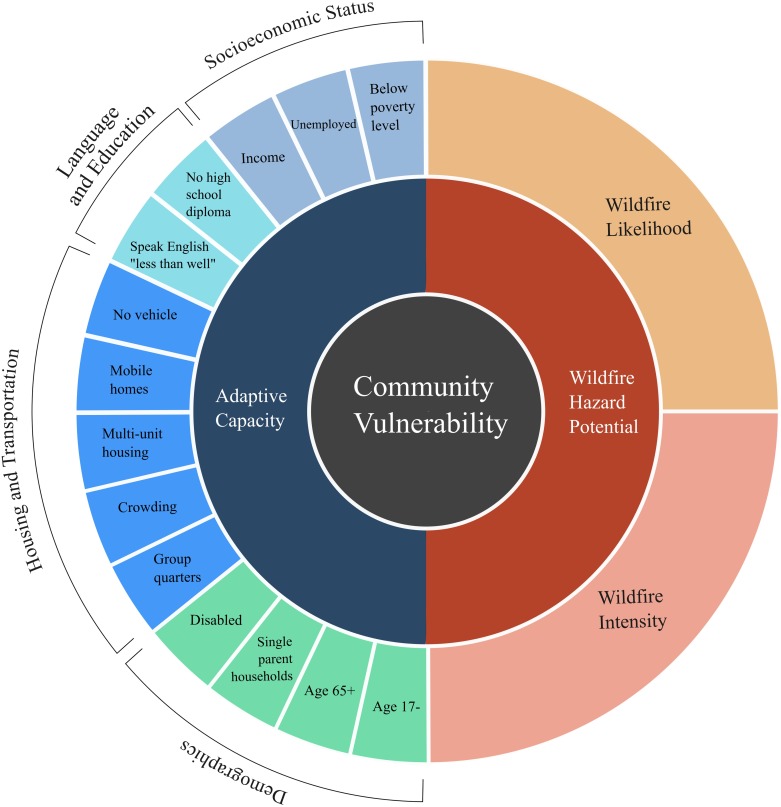
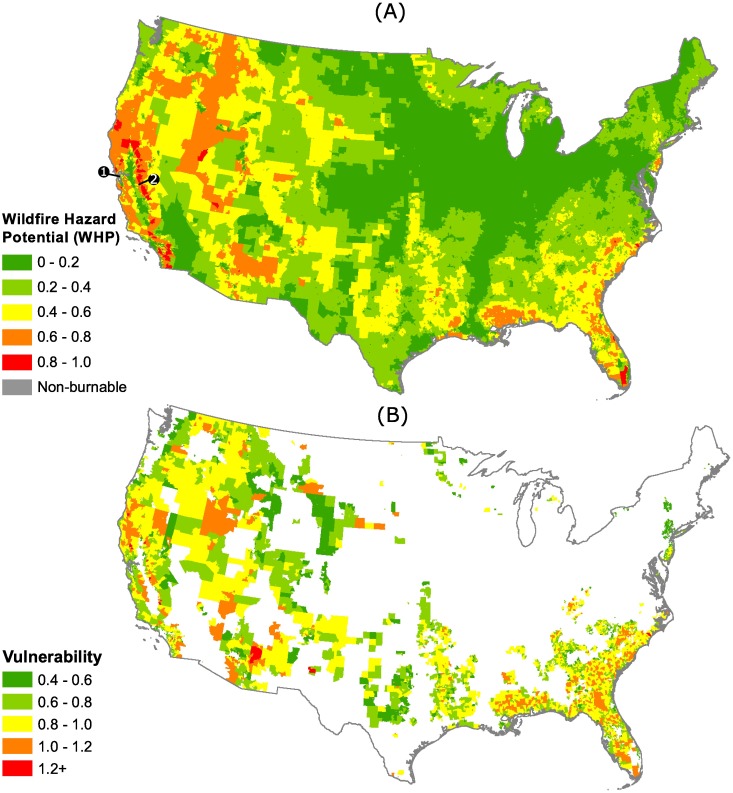
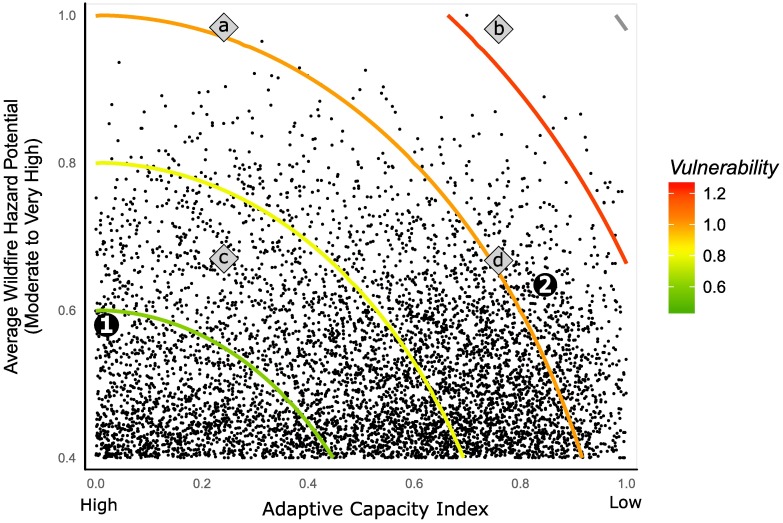
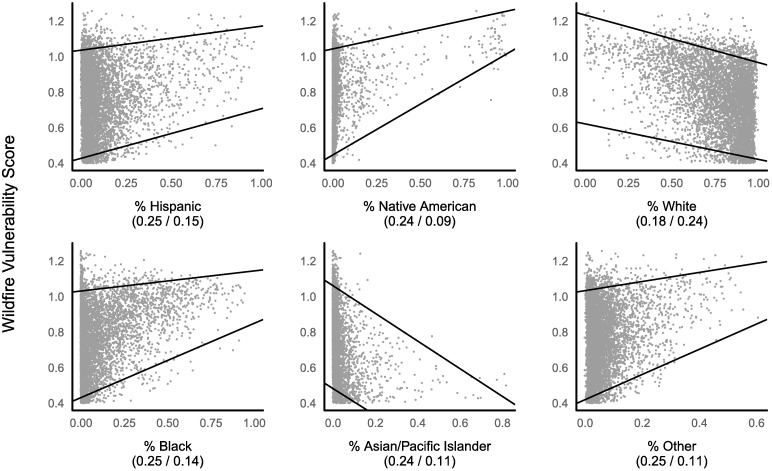
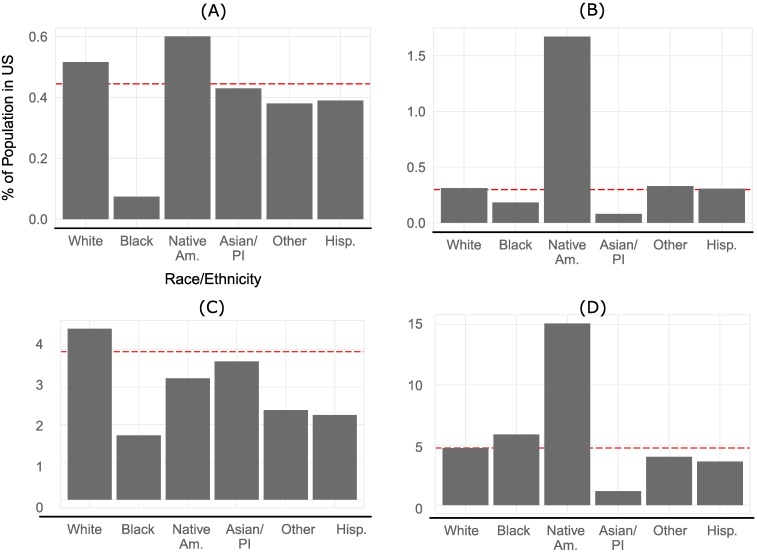
Globally, environmental disasters impact billions of people and cost trillions of dollars in damage, and their impacts are often felt most acutely by minority and poor communities. Wildfires in the U.S. have similarly outsized impacts on vulnerable communities, though the ethnic and geographic distribution of those communities may be different than for other hazards. Here, we develop a social-ecological approach for characterizing fire vulnerability and apply it to >70,000 census tracts across the United States. Our approach incorporates both the wildfire potential of a landscape and socioeconomic attributes of overlying communities. We find that over 29 million Americans live with significant potential for extreme wildfires, a majority of whom are white and socioeconomically secure. Within this segment, however, are 12 million socially vulnerable Americans for whom a wildfire event could be devastating. Additionally, wildfire vulnerability is spread unequally across race and ethnicity, with census tracts that were majority Black, Hispanic or Native American experiencing ca. 50% greater vulnerability to wildfire compared to other census tracts. Embracing a social-ecological perspective of fire-prone landscapes allows for the identification of areas that are poorly equipped to respond to wildfires.
Overview
The claims and statistics of this paper haven’t been checked yet.
Free: it reads the open-access text and checks the first 5 claims that cite a source we can check. Create a free account to check every claim.
Integrity signals
Registry
Cites
Statistics
Figures
Verification
Claims the paper makes
The claims and statistics of this paper haven’t been checked yet.
Free: it reads the open-access text and checks the first 5 claims that cite a source we can check. Create a free account to check every claim.
Claims other papers make about this one
Each is checked against this paper’s own text: does it say what the citing paper says it does?
The source backs part of the claim, not all of it — or backs it for a different population, condition or comparison.
In the citing paper
“Comparatively, communities with budgetary constraints, endemic poverty, gender issues, and systemic racism are likely to be disproportionately impacted by water supply impairment (Cross, 2001; Davies et al., 2018).”
From Scientists' warning on extreme wildfire risks to water supply (2021) · cites this paper as Davies et al., 2018
Experimental — accuracy not yet measuredThe source backs part of the claim, not all of it — or backs it for a different population, condition or comparison.
In the citing paper
“Researchers using a social‐ecological approach for characterizing fire vulnerability highlighted that communities of low SES are poorly equipped to perform preventative and protective fire measures, such as trimming bushes and trees around homes and purchasing air filtration devices [72].”
From Wildfires and Atopic Diseases: A Review (2026) · cites this paper as [72]
Experimental — accuracy not yet measuredThe source backs part of the claim, not all of it — or backs it for a different population, condition or comparison.
In the citing paper
“Moreover, low‐income communities may have insufficient funds or lack homeowner insurance coverage to rebuild burned homes. They may face difficulties in accessing disaster relief funds and/or assistance programs, inhibiting their recovery from wildfires [72].”
From Wildfires and Atopic Diseases: A Review (2026) · cites this paper as [72]
Experimental — accuracy not yet measuredThe cited source says what the claim attributes to it.
In the citing paper
“A study found that wildfire vulnerability is spread unequally across race and ethnicity, and those living in census tracts that were primarily Black, Hispanic, or Native American had a 50% greater vulnerability to wildfire.54”
From Effects of Extreme Weather on Health in Underserved Communities (2024) · cites this paper as [54]
Self-check
Percentages, sums and reported differences re-computed from the paper’s own numbers.
The self-check needs the paper’s full text.
Citations
Cites
Social Vulnerability to Environmental Hazards*
Cutter, S. L., Boruff, B. J., & Shirley, W. L. (2003) · Social Science Quarterly · doi:10.1111/1540-6237.8402002 · Cited by 5,702
A place-based model for understanding community resilience to natural disasters
Cutter, S. L., Barnes, L., Berry, M., Burton, C., Evans, E., Tate, E., & Webb, J. (2008) · Global Environmental Change · doi:10.1016/j.gloenvcha.2008.07.013 · Cited by 4,307
Bowman, D. M. J. S., Balch, J. K., Artaxo, P., Bond, W. J., Carlson, J. M., Cochrane, M. A., D’Antonio, C. M., DeFries, R. S., Doyle, J. C., Harrison, S. P., et al. (2009) · Science · doi:10.1126/science.1163886 · Cited by 3,351
Social-Ecological Resilience to Coastal Disasters
Adger, W. N., Hughes, T. P., Folke, C., Carpenter, S. R., & Rockström, J. (2005) · Science · doi:10.1126/science.1112122 · Cited by 2,685
McGranahan, G., Balk, D., & Anderson, B. (2007) · Environment and Urbanization · doi:10.1177/0956247807076960 · Cited by 2,609
A Social Vulnerability Index for Disaster Management
Flanagan, B. E., Gregory, E. W., Hallisey, E. J., Heitgerd, J. L., & Lewis, B. (2011) · Journal of Homeland Security and Emergency Management · doi:10.2202/1547-7355.1792 · Cited by 1,860
Temporal and spatial changes in social vulnerability to natural hazards
Cutter, S. L., & Finch, C. (2008) · Proceedings of the National Academy of Sciences · doi:10.1073/pnas.0710375105 · Cited by 1,326
Vulnerability of national economies to the impacts of climate change on fisheries
Allison, E. H., Perry, A. L., Badjeck, M., Neil Adger, W., Brown, K., Conway, D., Halls, A. S., Pilling, G. M., Reynolds, J. D., Andrew, N. L., et al. (2009) · Fish and Fisheries · doi:10.1111/j.1467-2979.2008.00310.x · Cited by 1,259
Poverty and Disasters in the United States: A Review of Recent Sociological Findings
Fothergill, A., & Peek, L. A. (2004) · Natural Hazards · doi:10.1023/b:nhaz.0000026792.76181.d9 · Cited by 1,153 · cited 1×
“Additionally, lower income households face more obstacles rebuilding or finding new housing after a fire [29].”
BackgroundIdentifying and Mapping Community Vulnerability
Morrow, B. H. (1999) · Disasters · doi:10.1111/1467-7717.00102 · Cited by 1,119
Research works printed but not linked: 3
- Fixler K. Marin County landlord charged with price gouging as prosecutors scour for cases after wildfires. North Bay Business Journal. Santa Rosa; 4 2018 Available: http://www.northbaybusinessjournal.com/northbay/marincounty/8241236-181/marin-novato-landlord-rent-gouging-wildfire
- Juntunen L. Addressing Social Vulnerability to Hazards. Disaster Saf Rev. 2005; 4: 3– 10. Available: http://www.dnr.wa.gov/geology/tsuinfo/index.html.
- Smith AM, Kolden CA, Paveglio TB, Cochrane MA, Mjs Bowman D, Moritz MA, et al The Science of Firescapes: Achieving Fire-Resilient Communities. Bioscience. 2016; 130 10.1093/biosci/biv182 29593361 PMC5865631 · DOI · Paper page
Cited by
U.S. fires became larger, more frequent, and more widespread in the 2000s
Iglesias, V., Balch, J. K., & Travis, W. R. (2022) · Science Advances · doi:10.1126/sciadv.abc0020 · Cited by 280
Méndez, M., Flores-Haro, G., & Zucker, L. (2020) · Geoforum · doi:10.1016/j.geoforum.2020.07.007 · Cited by 214
D’Evelyn, S. M., Jung, J., Alvarado, E., Baumgartner, J., Caligiuri, P., Hagmann, R. K., Henderson, S. B., Hessburg, P. F., Hopkins, S., Kasner, E. J., et al. (2022) · Current Environmental Health Reports · doi:10.1007/s40572-022-00355-7 · Cited by 198
Self-citationRisky Development: Increasing Exposure to Natural Hazards in the United States
Iglesias, V., Braswell, A., Rossi, M. W., Joseph, M. B., McShane, C., Cattau, M., Koontz, M. J., McGlinchy, J., Nagy, R. C., Balch, J., et al. (2021) · Earth s Future · doi:10.1029/2020ef001795 · Cited by 154
Queer and present danger: understanding the disparate impacts of disasters on LGBTQ+ communities
Goldsmith, L., Raditz, V., & Méndez, M. (2022) · Disasters · doi:10.1111/disa.12509 · Cited by 153
Social vulnerability to large wildfires in the western USA
Palaiologou, P., Ager, A. A., Nielsen‐Pincus, M., Evers, C., & Day, M. A. (2019) · Landscape and Urban Planning · doi:10.1016/j.landurbplan.2019.04.006 · Cited by 153
Scientists' warning on extreme wildfire risks to water supply
Robinne, F., Hallema, D. W., Bladon, K. D., Flannigan, M. D., Boisramé, G., Bréthaut, C. M., Doerr, S. H., Di Baldassarre, G., Gallagher, L. A., Hohner, A. K., et al. (2021) · Hydrological Processes · doi:10.1002/hyp.14086 · Cited by 149
“Comparatively, communities with budgetary constraints, endemic poverty, gender issues, and systemic racism are likely to be disproportionately impacted by water supply impairment (Cross, 2001; Davies et al., 2018).”
BackgroundMonitoring exposure to climate-related hazards: Indicator methodology and key results
Maes, M. J. A., Gonzales-Hishinuma, A., Haščič, I., Hoffmann, C., Banquet, A., Veneri, P., Bizeul, A., Martin, A. R., & Quadrelli, R. (2022) · OECD environment working papers · doi:10.1787/da074cb6-en · Cited by 140
Social drivers of vulnerability to wildfire disasters: A review of the literature
Lambrou, N., Kolden, C. A., Loukaitou‐Sideris, A., Anjum, E., & Acey, C. (2023) · Landscape and Urban Planning · doi:10.1016/j.landurbplan.2023.104797 · Cited by 136
Climate Change and Children’s Health: Building a Healthy Future for Every Child
Ahdoot, S., Baum, C. R., Cataletto, M. B., Hogan, P., Wu, C. B., Bernstein, A. S., Bole, A., Balk, S. J., Byron, L. G., Huerta-Montañez, G. M., et al. (2024) · PEDIATRICS · doi:10.1542/peds.2023-065505 · Cited by 121
The mental health and well-being effects of wildfire smoke: a scoping review
Eisenman, D. P., & Galway, L. P. (2022) · BMC Public Health · doi:10.1186/s12889-022-14662-z · Cited by 120
Shifting social-ecological fire regimes explain increasing structure loss from Western wildfires
Higuera, P. E., Cook, M., Balch, J. K., Stavros, E. N., Mahood, A. L., & Denis, L. A. S. (2023) · PNAS Nexus · doi:10.1093/pnasnexus/pgad005 · Cited by 109
Jones, C. G., Rappold, A. G., Vargo, J., Cascio, W. E., Kharrazi, M., McNally, B., Hoshiko, S., & with the CARES Surveillance Group (2020) · Journal of the American Heart Association · doi:10.1161/jaha.119.014125 · Cited by 104
The Climate Gap and the Color Line — Racial Health Inequities and Climate Change
Morello-Frosch, R. A., & Obasogie, O. K. (2023) · New England Journal of Medicine · doi:10.1056/nejmsb2213250 · Cited by 104
Masri, S., Scaduto, E., Jin, Y., & Wu, J. (2021) · International Journal of Environmental Research and Public Health · doi:10.3390/ijerph18083921 · Cited by 100
“Similarly, in a study examining the US, Census tracts that were majority Black, Hispanic, or Native American were 50% more vulnerable to wildfire compared to other Census tracts [26].”
BackgroundCasey, J. A., Kioumourtzoglou, M., Padula, A. M., González, D. J. X., Elser, H. C., Aguilera, R., Northrop, A. J., Tartof, S. Y., Mayeda, E. R., Braun, D., et al. (2024) · Proceedings of the National Academy of Sciences · doi:10.1073/pnas.2306729121 · Cited by 98
Versey, H. S. (2021) · Policy Insights from the Behavioral and Brain Sciences · doi:10.1177/2372732220982628 · Cited by 94
Chen, C., Schwarz, L., Rosenthal, N., Marlier, M. E., & Benmarhnia, T. (2024) · Science Advances · doi:10.1126/sciadv.adj7264 · Cited by 91
Mortality attributable to PM 2.5 from wildland fires in California from 2008 to 2018
Connolly, R. E., Marlier, M. E., Garcia-Gonzales, D. A., Wilkins, J. L., Su, J. G., Bekker, C., Jung, J., Bonilla, E. X., Burnett, R. T., Zhu, Y., et al. (2024) · Science Advances · doi:10.1126/sciadv.adl1252 · Cited by 86
Mapping wildfire hazard, vulnerability, and risk to Canadian communities
Erni, S., Wang, X., Swystun, T., Taylor, S. W., Parisien, M., Robinne, F., Eddy, B., Oliver, J. A., Armitage, B., & Flannigan, M. (2023) · International Journal of Disaster Risk Reduction · doi:10.1016/j.ijdrr.2023.104221 · Cited by 85
Thomas, A. S., Escobedo, F. J., Sloggy, M. R., & Sánchez, J. J. (2022) · PLoS ONE · doi:10.1371/journal.pone.0271019 · Cited by 84
Cultural Factors in Disaster Response Among Diverse Children and Youth Around the World
Rahmani, M., Muzwagi, A. B., & Pumariega, A. J. (2022) · Current Psychiatry Reports · doi:10.1007/s11920-022-01356-x · Cited by 81
Pregnancy, Birthing, and Postpartum Experiences During COVID-19 in the United States
DeYoung, S. E., & Mangum, M. (2021) · Frontiers in Sociology · doi:10.3389/fsoc.2021.611212 · Cited by 79
(IPCC), I. P. O. C. C. (2023) · Cambridge University Press eBooks · doi:10.1017/9781009325844.016 · Cited by 76
Protecting Cardiovascular Health From Wildfire Smoke
Hadley, M. B., Henderson, S. B., Brauer, M. D., & Vedanthan, R. (2022) · Circulation · doi:10.1161/circulationaha.121.058058 · Cited by 75
Climate Change and Children’s Health: Building a Healthy Future for Every Child
Ahdoot, S., Baum, C. R., Cataletto, M. B., Hogan, P., Wu, C. B., Bernstein, A. S., Bole, A., Balk, S. J., Byron, L. G., Huerta-Montañez, G. M., et al. (2024) · PEDIATRICS · doi:10.1542/peds.2023-065504 · Cited by 74
Balch, J. K., Iglesias, V., Braswell, A. E., Rossi, M. W., Joseph, M. B., Mahood, A. L., Shrum, T. R., White, C. T., Scholl, V. M., McGuire, B., et al. (2020) · Earth's Future · doi:10.1029/2019ef001319 · Cited by 71
Social Vulnerability in US Communities Affected by Wildfire Smoke, 2011 to 2021
Vargo, J., Lappe, B. L., Mirabelli, M. C., & Conlon, K. C. (2023) · American Journal of Public Health · doi:10.2105/ajph.2023.307286 · Cited by 68
Iglesias, V., Stavros, E. N., Balch, J. K., Barrett, K., Cobian‐Iñiguez, J., Hester, C. M., Kolden, C. A., Leyk, S., Nagy, R. C., Reid, C. E., et al. (2022) · Environmental Research Letters · doi:10.1088/1748-9326/ac5c0c · Cited by 66
Yu, M., Zhang, S., Ning, H., Li, Z., & Zhang, K. (2024) · The Science of The Total Environment · doi:10.1016/j.scitotenv.2024.171853 · Cited by 67
Kramer, A. L., Liu, J., Li, L., Connolly, R., Barbato, M., & Zhu, Y. (2023) · Science of The Total Environment · doi:10.1016/j.scitotenv.2022.159218 · Cited by 65
Meyer, M. L., Louder, C. N., & Nicolas, G. (2021) · American Journal of Evaluation · doi:10.1177/10982140211016059 · Cited by 63
Amil, M. L. C., Nogueira, E., Prestemon, J. P., & Touza, J. (2022) · Landscape and Urban Planning · doi:10.1016/j.landurbplan.2022.104577 · Cited by 64
Miles‐Novelo, A., & Anderson, C. A. (2022) · Cambridge University Press eBooks · doi:10.1017/9781108953078 · Cited by 62
Integrated Risk Assessment for the Blue Economy
Hodgson, E. E., Essington, T. E., Samhouri, J. F., Allison, E. H., Bennett, N. J., Bostrom, A., Cullen, A. C., Kasperski, S., Levin, P. S., & Poe, M. R. (2019) · Frontiers in Marine Science · doi:10.3389/fmars.2019.00609 · Cited by 61
Self-citationSocial vulnerability of the people exposed to wildfires in U.S. West Coast states
Rad, A. M., Abatzoglou, J. T., Fleishman, E., Mockrin, M. H., Radeloff, V. C., Pourmohamad, Y., Cattau, M. E., Johnson, J. M., Higuera, P. E., Nauslar, N. J., et al. (2023) · Science Advances · doi:10.1126/sciadv.adh4615 · Cited by 61
Akter, S., & Grafton, R. Q. (2021) · Climatic Change · doi:10.1007/s10584-021-03064-6 · Cited by 59
Parker, E. R., Mo, J., & Goodman, R. S. (2022) · The Journal of Climate Change and Health · doi:10.1016/j.joclim.2022.100162 · Cited by 58
Fine-scale assessment of inequities in inland flood vulnerability
Messager, M., Ettinger, A. K., Murphy-Williams, M., & Levin, P. S. (2021) · Applied Geography · doi:10.1016/j.apgeog.2021.102492 · Cited by 58
Self-citationMoritz, M. A., Hazard, R., Johnston, K., Mayes, M., Mowery, M., Oran, K., Parkinson, A.-M. L., Schmidt, D. A., & Wesolowski, G. (2022) · Frontiers in Forests and Global Change · doi:10.3389/ffgc.2022.848254 · Cited by 58
Andersen, L. M., & Sugg, M. M. (2019) · International Journal of Disaster Risk Reduction · doi:10.1016/j.ijdrr.2019.101123 · Cited by 58
Sharpe, J. D., & Wolkin, A. F. (2021) · Public Health Reports · doi:10.1177/00333549211047235 · Cited by 56
Scieszka, D. P., Hunter, R., Begay, J., Bitsui, M., Lin, Y., Galewsky, J., Morishita, M., Klaver, Z. M., Wagner, J. G., Harkema, J. R., et al. (2021) · Toxicological Sciences · doi:10.1093/toxsci/kfab147 · Cited by 54
The distributional incidence of wildfire hazard in the western United States
Wibbenmeyer, M. J., & Robertson, M. (2022) · Environmental Research Letters · doi:10.1088/1748-9326/ac60d7 · Cited by 53
A scoping review of wildfire smoke risk communications: issues, gaps, and recommendations
Vien, M. H., Ivey, S. L., Boyden, H., Holm, S. M., & Neuhauser, L. (2024) · BMC Public Health · doi:10.1186/s12889-024-17681-0 · Cited by 52
Pozo, R. A., Galleguillos, M., González, M. E., Lavín, F. V., & Arriagada, R. (2021) · The Science of The Total Environment · doi:10.1016/j.scitotenv.2021.152002 · Cited by 50
Effects of Extreme Weather on Health in Underserved Communities
Leap, S. R., Soled, D. R., Sampath, V., & Nadeau, K. C. (2024) · Annals of Allergy, Asthma & Immunology · doi:10.1016/j.anai.2024.04.018 · Cited by 49
Displacement after the Camp Fire: Where are the Most Vulnerable?
Chase, J. R., & Hansen, P. (2021) · Society & Natural Resources · doi:10.1080/08941920.2021.1977879 · Cited by 49
Koehn, L. E., Nelson, L. K., Samhouri, J. F., Norman, K., Jacox, M. G., Cullen, A. C., Fiechter, J., Buil, M. P., & Levin, P. S. (2022) · PLoS ONE · doi:10.1371/journal.pone.0272120 · Cited by 49
Self-citationPalsa, E., Bauer, M., Evers, C., Hamilton, M., & Nielsen‐Pincus, M. (2022) · PLoS ONE · doi:10.1371/journal.pone.0263757 · Cited by 47
Copes‐Gerbitz, K., Dickson‐Hoyle, S., Ravensbergen, S., Hagerman, S., Daniels, L. D., & Coutu, J. (2022) · Frontiers in Forests and Global Change · doi:10.3389/ffgc.2022.829125 · Cited by 47
Sánchez, J. J., Holmes, T. P., Loomis, J. B., & González‐Cabán, A. (2021) · International Journal of Disaster Risk Reduction · doi:10.1016/j.ijdrr.2021.102696 · Cited by 47
Kelp, M., Carroll, M. C., Liu, T., Yantosca, R. M., Hockenberry, H. E., & Mickley, L. J. (2023) · Earth s Future · doi:10.1029/2022ef003468 · Cited by 47
Energy Justice, Decarbonization, and the Clean Energy Transformation
Bennear, L. S. (2022) · Annual Review of Resource Economics · doi:10.1146/annurev-resource-111920-022328 · Cited by 46
Buma, B. J., & Schultz, C. A. (2020) · Journal of Applied Ecology · doi:10.1111/1365-2664.13606 · Cited by 46
Laurent, J. G. C., Parhizkar, H., Calderon, L., Lizoňová, D., Tsiodra, I., Mihalopoulos, N., Kavouras, I. G., Alam, M., Baalousha, M., Bazina, L., et al. (2024) · Environmental Science & Technology · doi:10.1021/acs.est.4c02016 · Cited by 44
Nelson, L. K., Cullen, A. C., Koehn, L. E., Harper, S. J., Runnebaum, J., Bøgeberg, M., Strawn, A., & Levin, P. S. (2023) · PLOS Climate · doi:10.1371/journal.pclm.0000103 · Cited by 44
Self-citationA framework for considering justice aspects in integrated wildfire risk management
Schinko, T., Berchtold, C., Handmer, J. W., Deubelli-Hwang, T. M., Preinfalk, E., Linnerooth‐Bayer, J., Scolobig, A., Serra, M., & Plana, E. (2023) · Nature Climate Change · doi:10.1038/s41558-023-01726-0 · Cited by 43
Woo, S. H. L., Liu, J. C., Yue, X., Mickley, L. J., & Bell, M. L. (2020) · Environmental Research Letters · doi:10.1088/1748-9326/ab9270 · Cited by 42
Social vulnerabilities and wildfire evacuations: A case study of the 2019 Kincade fire
Sun, Y., Forrister, A., Kuligowski, E. D., Lovreglio, R., Cova, T. J., & Zhao, X. (2024) · Safety Science · doi:10.1016/j.ssci.2024.106557 · Cited by 42
Regional-specific trends of PM2.5 and O3 temperature sensitivity in the United States
Yin, L., Bai, B., Zhang, B., Zhu, Q., Di, Q., Réquia, W. J., Schwartz, J. D., Shi, L., & Liu, P. F. (2025) · npj Climate and Atmospheric Science · doi:10.1038/s41612-024-00862-4 · Cited by 41
Impacts of disaster exposure on climate adaptation injustice across U.S. cities
Liu, T., & Fan, C. H. (2022) · Sustainable Cities and Society · doi:10.1016/j.scs.2022.104371 · Cited by 40
Combined Burden of Heat and Particulate Matter Air Quality in WA Agriculture
Austin, E., Kasner, E. J., Seto, E., & Spector, J. T. (2020) · Journal of Agromedicine · doi:10.1080/1059924x.2020.1795032 · Cited by 38
Climate Change and Recreation in the Western United States: Effects and Opportunities for Adaptation
Miller, A. B., Winter, P. L., Sánchez, J. J., Peterson, D. L., & Smith, J. W. (2022) · Journal of Forestry · doi:10.1093/jofore/fvab072 · Cited by 38
Evaluating rural Pacific Northwest towns for wildfire evacuation vulnerability
Dye, A. W., Kim, J. B., McEvoy, A., Fang, F., & Riley, K. L. (2021) · Natural Hazards · doi:10.1007/s11069-021-04615-x · Cited by 37
Reid, C. E., Considine, E. M., Watson, G. L., Telesca, D., Pfister, G. G., & Jerrett, M. (2023) · Environmental Research Health · doi:10.1088/2752-5309/acc4e1 · Cited by 37
California dreaming: Why environmental justice is integral to the success of climate change policy
Pastor, M., Cha, J. M., Méndez, M., & Morello-Frosch, R. A. (2024) · Proceedings of the National Academy of Sciences · doi:10.1073/pnas.2310073121 · Cited by 36
Garrison, J. D., & Huxman, T. E. (2020) · Cities · doi:10.1016/j.cities.2020.102725 · Cited by 36
The Environmental Justice Implications of Managing Hazardous Fuels on Federal Forest Lands
Adams, M. D. O., & Charnley, S. (2020) · Annals of the American Association of Geographers · doi:10.1080/24694452.2020.1727307 · Cited by 35
Disaster recovery gentrification in post-wildfire landscapes: The case of Paradise, CA
Lambrou, N., Kolden, C. A., & Loukaitou‐Sideris, A. (2025) · International Journal of Disaster Risk Reduction · doi:10.1016/j.ijdrr.2025.105235 · Cited by 34
Increasing wildfires and changing sociodemographics in communities across California, USA
Yadav, K., Escobedo, F. J., Thomas, A. S., & Johnson, N. G. (2023) · International Journal of Disaster Risk Reduction · doi:10.1016/j.ijdrr.2023.104065 · Cited by 33
The geography of social vulnerability and wildfire occurrence (1984–2018) in the conterminous USA
Schumann, R. L., Emrich, C. T., Butsic, V., Mockrin, M. H., Zhou, Y., Gaither, C. J., Price, O. F., Syphard, A. D., Whittaker, J., & Aksha, S. K. (2024) · Natural Hazards · doi:10.1007/s11069-023-06367-2 · Cited by 33
Kondo, M. C., Reid, C. E., Mockrin, M. H., Heilman, W. E., & Long, D. D. (2021) · The Science of The Total Environment · doi:10.1016/j.scitotenv.2021.150564 · Cited by 33
Jerrett, M., Connolly, R. E., Garcia-Gonzales, D. A., Bekker, C., Nguyen, J. T., Su, J. G., Li, Y., & Marlier, M. E. (2024) · Proceedings of the National Academy of Sciences · doi:10.1073/pnas.2310081121 · Cited by 32
Hamilton, M., Nielsen‐Pincus, M., & Evers, C. (2023) · Ecology and Society · doi:10.5751/es-13856-280303 · Cited by 32
Historical seasonal changes in prescribed burn windows in California
Baijnath‐Rodino, J. A., Li, S., Martinez, A., Kumar, M., Quinn-Davidson, L. N., York, R. A., & Banerjee, T. (2022) · The Science of The Total Environment · doi:10.1016/j.scitotenv.2022.155723 · Cited by 32
Schaffer-Smith, D., Myint, S. W., Muenich, R. L., Tong, D., & DeMeester, J. E. (2020) · Environmental Science & Technology · doi:10.1021/acs.est.9b07815 · Cited by 32
Jones, B. A., McDermott, S. M., Champ, P. A., & Berrens, R. P. (2022) · International Journal of Wildland Fire · doi:10.1071/wf22025 · Cited by 32
Conceptualizing a probabilistic risk and loss assessment framework for wildfires
Khorasani, N. E., Ebrahimian, H., Buja, L. E., Cutter, S. L., Kosović, B., Lareau, N. P., Meacham, B. J., Rowell, E. M., Taciroğlu, E., Thompson, M. P., et al. (2022) · Natural Hazards · doi:10.1007/s11069-022-05472-y · Cited by 30
The Demography of Disasters: Impacts for Population and Place
Karácsonyi, D., Taylor, A., & Bird, D. (2020) · Springer eBooks · doi:10.1007/978-3-030-49920-4 · Cited by 30
Barros, A. M. G., Day, M. A., Preisler, H. K., Abatzoglou, J. T., Krawchuk, M. A., Houtman, R. M., & Ager, A. A. (2021) · Environmental Research Letters · doi:10.1088/1748-9326/ac03da · Cited by 30
Review of Research on Human Behavior in Large Outdoor Fires
Khorasani, N. E., Kinateder, M. T., Lemiale, V., Manzello, S. L., Marom, I., Marquez, L., Suzuki, S., Theodori, M., Wang, Y., & Wong, S. D. (2023) · Fire Technology · doi:10.1007/s10694-023-01388-6 · Cited by 29
Zabaniotou, A. A., Pritsa, A., & Kyriakou, E.-A. (2021) · Sustainability · doi:10.3390/su13031556 · Cited by 29
Economic drivers of global fire activity: A critical review using the DPSIR framework
Kim, Y., Rodrígues, M., & Robinne, F. (2021) · Forest Policy and Economics · doi:10.1016/j.forpol.2021.102563 · Cited by 28
Pathways framework identifies wildfire impacts on agriculture
Kabeshita, L., Sloat, L., Fischer, E. V., Kampf, S. K., Magzamen, S. L., Schultz, C. A., Wilkins, M. J., Kinnebrew, E., & Mueller, N. D. (2023) · Nature Food · doi:10.1038/s43016-023-00803-z · Cited by 28
Biogeographic patterns of daily wildfire spread and extremes across North America
Balik, J. A., Coop, J. D., Krawchuk, M. A., Naficy, C. E., Parisien, M., Parks, S. A., Stevens‐Rumann, C. S., & Whitman, E. (2024) · Frontiers in Forests and Global Change · doi:10.3389/ffgc.2024.1355361 · Cited by 28
Paveglio, T. B., & Edgeley, C. M. (2023) · Journal of Forestry · doi:10.1093/jofore/fvad021 · Cited by 27
African American Exposure to Prescribed Fire Smoke in Georgia, USA
Gaither, C. J., Afrin, S., Garcia–Menendez, F., Odman, M. T., Huang, R., Goodrick, S. L., & da Silva, A. R. (2019) · International Journal of Environmental Research and Public Health · doi:10.3390/ijerph16173079 · Cited by 27
Chapter 31 : Adaptation. Fifth National Climate Assessment
Wasley, E., Dahl, T. A., Simpson, C. F., Fischer, L. W., HELGESON, J. F., Kenney, M. A., Parris, A. S., Siders, A. R., Tate, E. C., & Ulibarrí, N. (2023) · doi:10.7930/nca5.2023.ch31 · Cited by 25
Emergency managers’ challenges with wildfires and related cascading hazards in California
Ermagun, A., Thompson, D., Vahedifard, F., & Silver, R. C. (2025) · Journal of Environmental Management · doi:10.1016/j.jenvman.2024.124008 · Cited by 25
Winker, R., Payton, A., Brown, E., McDermott, E., Freedman, J. H., Lenhardt, W. C., Eaves, L. A., Fry, R. C., & Rager, J. E. (2024) · Frontiers in Public Health · doi:10.3389/fpubh.2024.1339700 · Cited by 25
Baker, B., Dinh, Y., Foxfoot, I. R., Ortiz, E., Sells, A., & Anderson, S. E. (2024) · Fire · doi:10.3390/fire7020041 · Cited by 25
Chapter 22 : Southeast. Fifth National Climate Assessment
Hoffman, J. S., McNulty, S. G., Brown, C., Dello, K. D., Knox, P. N., Lascurain, A., Mickalonis, C., Mitchum, G. T., Rivers, L., Schaefer, M. G., et al. (2023) · doi:10.7930/nca5.2023.ch22 · Cited by 24
Chapter 28 : Southwest. Fifth National Climate Assessment
White, D. D., Elias, E. H., Thomas, K. A., Brădăţan, C., Brunson, M. W., Chischilly, A. M., Enquist, C. A. F., Fisher, L. R., Froehlich, H. E., Koebele, E. A., et al. (2023) · doi:10.7930/nca5.2023.ch28 · Cited by 24
Advancing the community health vulnerability index for wildland fire smoke exposure
Jung, J., Wilkins, J. L., Schollaert, C. L., Masuda, Y. J., Flunker, J. C., Connolly, R. E., D’Evelyn, S. M., Bonillia, E., Rappold, A. G., Haugo, R. D., et al. (2023) · The Science of The Total Environment · doi:10.1016/j.scitotenv.2023.167834 · Cited by 24
Self-citationIncome and Insurability as Factors in Wildfire Risk
Auer, M. R., & Hexamer, B. E. (2022) · Forests · doi:10.3390/f13071130 · Cited by 23
Villarreal, M. L., Norman, L. M., Yao, E. H., & Conrad, C. (2022) · Geomatics Natural Hazards and Risk · doi:10.1080/19475705.2022.2039787 · Cited by 23
Estimating Migration Impacts of Wildfire: California’s 2017 North Bay Fires
Sharygin, E. J. (2020) · Springer eBooks · doi:10.1007/978-3-030-49920-4_3 · Cited by 23
Grubesic, T. H., & Durbin, K. M. (2022) · International Journal of Environmental Research and Public Health · doi:10.3390/ijerph191911847 · Cited by 23
Wildfire and Smoke Risk Communication: A Systematic Literature Review from a Health Equity Focus
Sandoval, S., Bui, J., & Hopfer, S. (2025) · International Journal of Environmental Research and Public Health · doi:10.3390/ijerph22030368 · Cited by 22
Metadata
- Authors
- Davies, I. P., Haugo, R. D., Robertson, J. C., & Levin, P. S.
- Affiliations
- University of Washington (US)
- The Nature Conservancy (US)
- Corresponding author
- Davies, Ian P.
- Haugo, Ryan D.
- Robertson, James C.
- Levin, Phillip S.
- Venue
- PLOS ONE
- Publisher
- Public Library of Science (PLoS)
- Published
- 2018-11-02
- Volume
- 13
- Issue
- 11
- Pages
- e0205825
- ISSN
- 1932-6203 (ISSN-L)
- PMC
- PMC6214520
- OpenAlex
- W2899158916
- Cited by
- 339
- References
- 45
- Citations by year
- 2026: 45 · 2025: 50 · 2024: 59 · 2023: 82 · 2022: 48 · 2021: 32 · 2020: 17 · 2019: 5 · 2018: 1
- FWCI
- 31.24
- Type
- journal article
- Language
- en
- Open access
- gold
- doi.org
- Licence
- Locations
- PLoS ONE (publishedVersion, cc-by)
- Europe PMC (PubMed Central) (publishedVersion, cc-by)
- PubMed Central (publishedVersion, cc-by)
- PubMed (publishedVersion)
- RePEc: Research Papers in Economics (submittedVersion)
- DOAJ (DOAJ: Directory of Open Access Journals) (submittedVersion, cc-by-sa)
- Figshare (submittedVersion, cc-by)
- Topics
- Social Sciences › Sociology and Political Science › Disaster Management and Resilience
- Social Sciences › Sociology and Political Science › Environmental Justice and Health Disparities
- Physical Sciences › Environmental Science › Global and Planetary Change › Fire effects on ecosystems
- Keywords
- wildfire vulnerability, communities of color, racial and ethnic disparities, socioeconomic vulnerability, social-ecological systems, fire-prone landscapes, census tracts, Black communities, Latino communities, Native American tribes, extreme wildfires, disaster risk
- MeSH terms
- Wildfires, Geography, Humans, United States, Censuses, Racial Groups
About these checks
Registry, retraction, Cites and statistics results are computed, not judged, with one exception: a printed reference that no index lists is read once by a model before it counts as a citation error. Claims are extracted by a model and kept only when their quote appears verbatim in the text; each cited source is then checked, with a model’s help, for whether it says what the claim relies on. Those verdicts can be wrong — read the claim’s quote and the cited source before relying on one.
Statistics and arithmetic are recomputed, not judged.
Confidence bands are shown only for fields calibrated on our annotated test set. None is calibrated yet, so no band is shown.
What counts as a claim ›How we measure confidence ›How we check this ›
Are you an author, or do you see a problem with this page? Request a review
Data sources
Bibliographic data: Semantic Scholar, OpenAlex, Crossref.
Contains information from the Semantic Scholar Academic Graph Datasets, made available under the ODC Attribution License (ODC-BY 1.0).
Semantic Scholar’s data is described in: Kinney, R., et al. (2023). The Semantic Scholar Open Data Platform. arXiv:2301.10140.
