

The unequal vulnerability of communities of color to wildfire
Open accessThe DOI matches its Crossref record; 44 of the 45 references it cites were found in a registry or an index.
Abstract
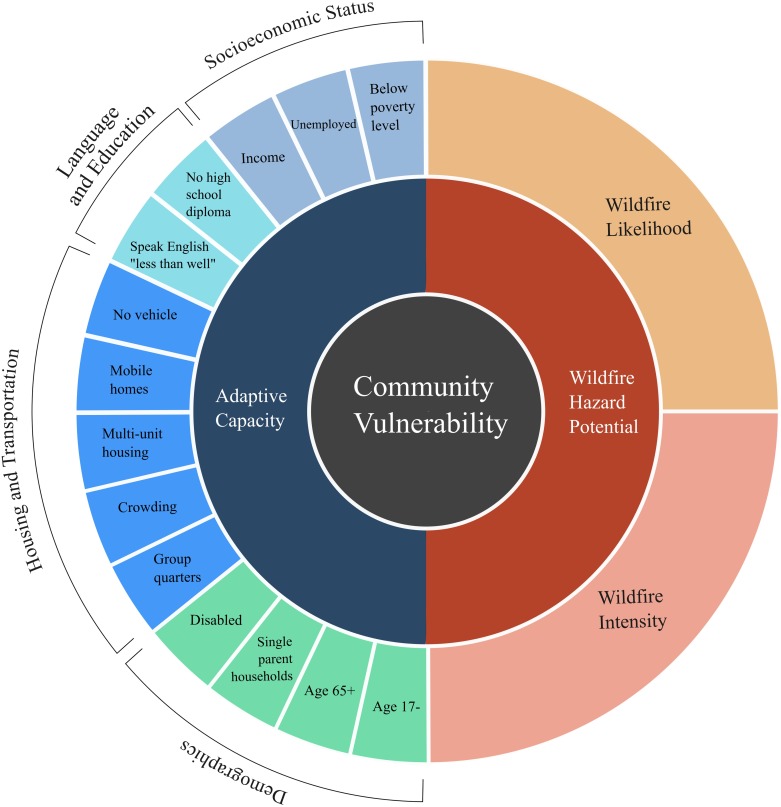
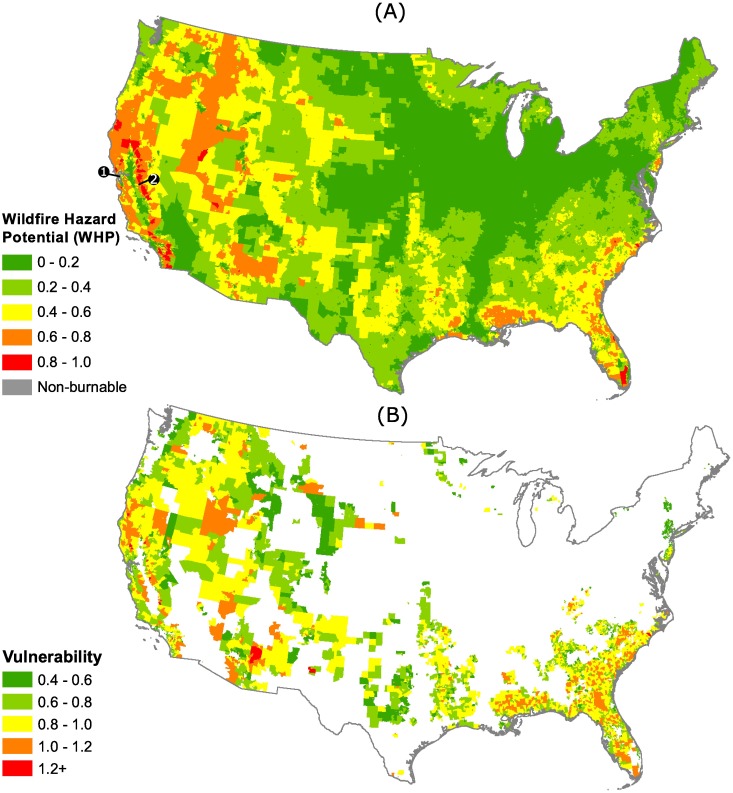
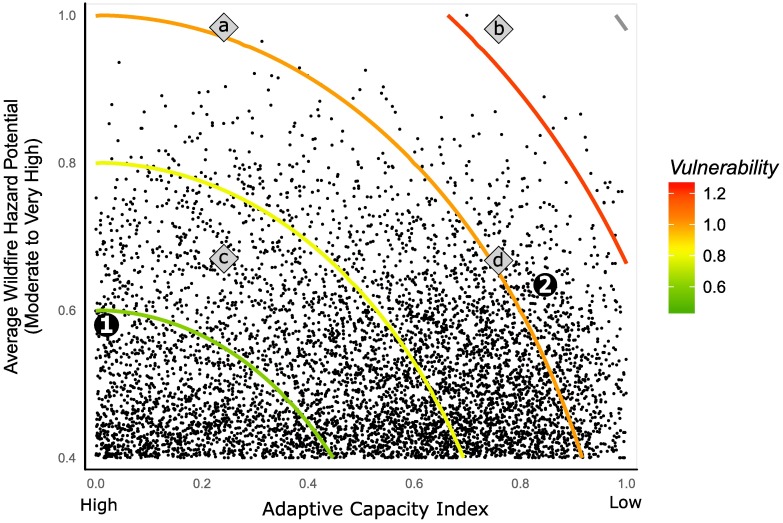
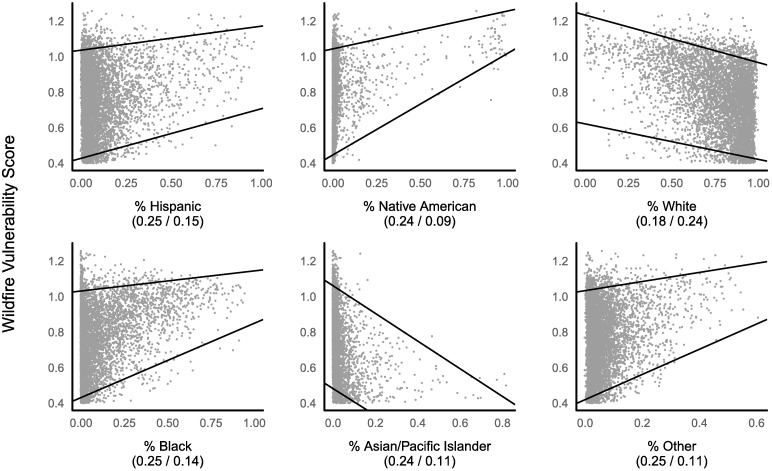
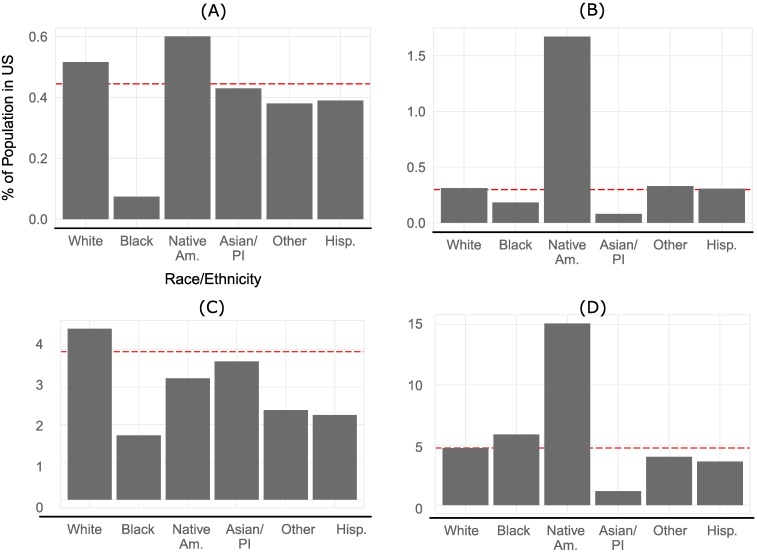
Globally, environmental disasters impact billions of people and cost trillions of dollars in damage, and their impacts are often felt most acutely by minority and poor communities. Wildfires in the U.S. have similarly outsized impacts on vulnerable communities, though the ethnic and geographic distribution of those communities may be different than for other hazards. Here, we develop a social-ecological approach for characterizing fire vulnerability and apply it to >70,000 census tracts across the United States. Our approach incorporates both the wildfire potential of a landscape and socioeconomic attributes of overlying communities. We find that over 29 million Americans live with significant potential for extreme wildfires, a majority of whom are white and socioeconomically secure. Within this segment, however, are 12 million socially vulnerable Americans for whom a wildfire event could be devastating. Additionally, wildfire vulnerability is spread unequally across race and ethnicity, with census tracts that were majority Black, Hispanic or Native American experiencing ca. 50% greater vulnerability to wildfire compared to other census tracts. Embracing a social-ecological perspective of fire-prone landscapes allows for the identification of areas that are poorly equipped to respond to wildfires.
Overview
The claims and statistics of this paper haven’t been checked yet.
Free: it reads the open-access text and checks the first 5 claims that cite a source we can check. Create a free account to check every claim.
Integrity signals
Registry
Cites
Statistics
Figures
Verification
Claims the paper makes
The claims and statistics of this paper haven’t been checked yet.
Free: it reads the open-access text and checks the first 5 claims that cite a source we can check. Create a free account to check every claim.
Claims other papers make about this one
Each is checked against this paper’s own text: does it say what the citing paper says it does?
The source backs part of the claim, not all of it — or backs it for a different population, condition or comparison.
In the citing paper
“Comparatively, communities with budgetary constraints, endemic poverty, gender issues, and systemic racism are likely to be disproportionately impacted by water supply impairment (Cross, 2001; Davies et al., 2018).”
From Scientists' warning on extreme wildfire risks to water supply (2021) · cites this paper as Davies et al., 2018
Experimental — accuracy not yet measuredThe source backs part of the claim, not all of it — or backs it for a different population, condition or comparison.
In the citing paper
“Researchers using a social‐ecological approach for characterizing fire vulnerability highlighted that communities of low SES are poorly equipped to perform preventative and protective fire measures, such as trimming bushes and trees around homes and purchasing air filtration devices [72].”
From Wildfires and Atopic Diseases: A Review (2026) · cites this paper as [72]
Experimental — accuracy not yet measuredThe source backs part of the claim, not all of it — or backs it for a different population, condition or comparison.
In the citing paper
“Moreover, low‐income communities may have insufficient funds or lack homeowner insurance coverage to rebuild burned homes. They may face difficulties in accessing disaster relief funds and/or assistance programs, inhibiting their recovery from wildfires [72].”
From Wildfires and Atopic Diseases: A Review (2026) · cites this paper as [72]
Experimental — accuracy not yet measuredThe cited source says what the claim attributes to it.
In the citing paper
“A study found that wildfire vulnerability is spread unequally across race and ethnicity, and those living in census tracts that were primarily Black, Hispanic, or Native American had a 50% greater vulnerability to wildfire.54”
From Effects of Extreme Weather on Health in Underserved Communities (2024) · cites this paper as [54]
Self-check
Percentages, sums and reported differences re-computed from the paper’s own numbers.
The self-check needs the paper’s full text.
Citations
Cites
Social Vulnerability to Environmental Hazards*
Cutter, S. L., Boruff, B. J., & Shirley, W. L. (2003) · Social Science Quarterly · doi:10.1111/1540-6237.8402002 · Cited by 5,702
A place-based model for understanding community resilience to natural disasters
Cutter, S. L., Barnes, L., Berry, M., Burton, C., Evans, E., Tate, E., & Webb, J. (2008) · Global Environmental Change · doi:10.1016/j.gloenvcha.2008.07.013 · Cited by 4,307
Bowman, D. M. J. S., Balch, J. K., Artaxo, P., Bond, W. J., Carlson, J. M., Cochrane, M. A., D’Antonio, C. M., DeFries, R. S., Doyle, J. C., Harrison, S. P., et al. (2009) · Science · doi:10.1126/science.1163886 · Cited by 3,351
Social-Ecological Resilience to Coastal Disasters
Adger, W. N., Hughes, T. P., Folke, C., Carpenter, S. R., & Rockström, J. (2005) · Science · doi:10.1126/science.1112122 · Cited by 2,685
McGranahan, G., Balk, D., & Anderson, B. (2007) · Environment and Urbanization · doi:10.1177/0956247807076960 · Cited by 2,609
A Social Vulnerability Index for Disaster Management
Flanagan, B. E., Gregory, E. W., Hallisey, E. J., Heitgerd, J. L., & Lewis, B. (2011) · Journal of Homeland Security and Emergency Management · doi:10.2202/1547-7355.1792 · Cited by 1,860
Temporal and spatial changes in social vulnerability to natural hazards
Cutter, S. L., & Finch, C. (2008) · Proceedings of the National Academy of Sciences · doi:10.1073/pnas.0710375105 · Cited by 1,326
Vulnerability of national economies to the impacts of climate change on fisheries
Allison, E. H., Perry, A. L., Badjeck, M., Neil Adger, W., Brown, K., Conway, D., Halls, A. S., Pilling, G. M., Reynolds, J. D., Andrew, N. L., et al. (2009) · Fish and Fisheries · doi:10.1111/j.1467-2979.2008.00310.x · Cited by 1,259
Poverty and Disasters in the United States: A Review of Recent Sociological Findings
Fothergill, A., & Peek, L. A. (2004) · Natural Hazards · doi:10.1023/b:nhaz.0000026792.76181.d9 · Cited by 1,153 · cited 1×
“Additionally, lower income households face more obstacles rebuilding or finding new housing after a fire [29].”
BackgroundIdentifying and Mapping Community Vulnerability
Morrow, B. H. (1999) · Disasters · doi:10.1111/1467-7717.00102 · Cited by 1,119
Research works printed but not linked: 3
- Fixler K. Marin County landlord charged with price gouging as prosecutors scour for cases after wildfires. North Bay Business Journal. Santa Rosa; 4 2018 Available: http://www.northbaybusinessjournal.com/northbay/marincounty/8241236-181/marin-novato-landlord-rent-gouging-wildfire
- Juntunen L. Addressing Social Vulnerability to Hazards. Disaster Saf Rev. 2005; 4: 3– 10. Available: http://www.dnr.wa.gov/geology/tsuinfo/index.html.
- Smith AM, Kolden CA, Paveglio TB, Cochrane MA, Mjs Bowman D, Moritz MA, et al The Science of Firescapes: Achieving Fire-Resilient Communities. Bioscience. 2016; 130 10.1093/biosci/biv182 29593361 PMC5865631 · DOI · Paper page
Cited by
Items 201–300 of 400
Quantifying wildfire risk to the built environment in rural rangelands of the US Interior West
McGranahan, D. A., & Wonkka, C. L. (2025) · Philosophical Transactions of the Royal Society B Biological Sciences · doi:10.1098/rstb.2023.0457 · Cited by 5
Silva, M. H., Capps, S., & London, J. K. (2024) · Birth Defects Research · doi:10.1002/bdr2.2395 · Cited by 5
Lambrou, N., Zhang, C., Kolden, C. A., & Loukaitou‐Sideris, A. (2026) · Environment and Planning D Society and Space · doi:10.1177/02637758261435009 · Cited by 5
Resilience Hubs: A Climate Change Resource for Vulnerable Populations in the United States
Strawderman, M., & Herrmann, L. (2023) · MDPI eBooks · doi:10.3390/books978-3-0365-5503-4-4 · Cited by 5
Dermatology at the intersection of climate change, social justice, and children's health
Sun, M., Boos, M. D., & Coates, S. J. (2021) · The Journal of Climate Change and Health · doi:10.1016/j.joclim.2021.100101 · Cited by 5
Sandoval, C. J. K., & Lanthier, P. (2021) · Studies in media and communications · doi:10.1108/s2050-206020240000025003 · Cited by 5
Addressing inequities and meeting needs of Indigenous communities in floodplain management
Zimmerman, O., Eison, T., Carey, R. G., & Levin, P. S. (2024) · Frontiers in Climate · doi:10.3389/fclim.2024.1306542 · Cited by 5
Self-citationRisk Factors and Wildfire Mitigation Planning by Public Utilities in Washington State
Bradbury, N. P., & Cullen, A. C. (2025) · Fire · doi:10.3390/fire8030118 · Cited by 5
Collishaw, S., Moos, M., & Vinodrai, T. (2023) · Housing Policy Debate · doi:10.1080/10511482.2023.2251431 · Cited by 5
Muruthi, J. R., Raqueno-Angel, S., Yang, D., Muruthi, B. A., McRell, A. S., & McClure, H. H. (2025) · Journal of Communications In Healthcare · doi:10.1080/17538068.2025.2514981 · Cited by 4
Farajpoor, P., & Narimani, M. (2026) · Frontiers in Sustainability · doi:10.3389/frsus.2026.1975724 · Cited by 4
Hegeman, E. E., & Levin, P. S. (2023) · Landscape and Urban Planning · doi:10.1016/j.landurbplan.2023.104905 · Cited by 4
Self-citationHousehold needs among wildfire survivors in the 2017 Northern California wildfires
Snyder, M., Miles, M. G., Hertz‐Picciotto, I., & Conlon, K. C. (2025) · Environmental Research Health · doi:10.1088/2752-5309/ad951c · Cited by 4
Informing proactive wildfire management that benefits vulnerable communities and ecological values
Lacey, L. M., Suraci, J. P., Littlefield, C. E., Busse, B. S., & Dickson, B. G. (2024) · People and Nature · doi:10.1002/pan3.10733 · Cited by 4
Thiel, A. M., Tilt, J. H., Ellsworth, L. M., Schmidt, A., & Hiner, N. (2025) · Frontiers in Human Dynamics · doi:10.3389/fhumd.2025.1620541 · Cited by 4
Impact of Wildland Fire Smoke PM 2.5 on Birth Weight in California
Gao, X., Picciotto, S., Goin, D. E., LURMANN, F., Pavlovic, N., Woodruff, T. J., Morello-Frosch, R. A., & Padula, A. M. (2026) · Environmental Science & Technology · doi:10.1021/acs.est.5c05040 · Cited by 4
Equity, Justice, and Drought: Lessons for Climate Services from the U.S. Southwest
Greene, C., & Ferguson, D. B. (2023) · Bulletin of the American Meteorological Society · doi:10.1175/bams-d-22-0185.1 · Cited by 4
Letellier, N., Jones, C. G., Cheung, M. W., Aguilera, R., Casey, J. A., Zakaras, J. M., Sugrue, R. A., Teherani, A., Thakur, N., Collard, H. R., et al. (2025) · Environment International · doi:10.1016/j.envint.2025.109955 · Cited by 4
Tourist Population Vulnerability Assessment in Cross-Border Wildfire-Prone Areas
Vaiciulyte, S., Rohaert, A., & Ronchi, E. (2025) · Fire Technology · doi:10.1007/s10694-025-01750-w · Cited by 4
Ghasemi, S., Roohi, M., Sanderson, D. R., Sediek, O. A., & van de Lindt, J. W. (2026) · International Journal of Disaster Risk Reduction · doi:10.1016/j.ijdrr.2026.106077 · Cited by 4
Examining the shifting role of the human in disaster studies
Cardwell, J. (2022) · Journal of the Bulgarian Geographical Society · doi:10.3897/jbgs.e87743 · Cited by 4
Fire: An Analysis to Support the Southern Forest Outlook
Pomara, L. Y., Gould, N. P., Nepal, S., Emmett, K. D., Goodrick, S. L., & Lee, D. C. (2025) · doi:10.2737/srs-gtr-280 · Cited by 3
The Role of Migrant Communities in Building Climate Resilience in Urban Environments
Ngin, C., Neef, A., & Grayman, J. H. (2020) · Springer eBooks · doi:10.1007/978-3-030-32811-5_21-1 · Cited by 3
Kotsila, P., Cayuela, S. R., & González‐Hidalgo, M. (2026) · Progress in Environmental Geography · doi:10.1177/27539687261452256 · Cited by 3
Connecting dryland fine-fuel assessments to wildfire exposure and natural resource values at risk
Wells, A. G., Munson, S. M., Villarreal, M. L., Sesnie, S. E., & Laushman, K. M. (2023) · Fire Ecology · doi:10.1186/s42408-023-00196-1 · Cited by 3
Riobueno‐Naylor, A., Clay, L., Aubé, B. S. S., & Lai, B. S. (2024) · Disaster Medicine and Public Health Preparedness · doi:10.1017/dmp.2024.140 · Cited by 3
Ersing, R. L., Ward, B. G., & Collins, J. M. (2022) · Hurricane Risk/Hurricane risk · doi:10.1007/978-3-031-08568-0_13 · Cited by 3
Wildfire displacement in the United States: a qualitative synthesis of the social consequences
Gonzalez, J. A., & Fisher, D. R. (2026) · Environmental Research Climate · doi:10.1088/2752-5295/ae4a43 · Cited by 3
Introducing the “Fire Social Science” Section of the Journal Fire
Eriksen, C. (2022) · Fire · doi:10.3390/fire5050157 · Cited by 3
Urban areas in the United States experience substantial wildfire impacts
McConnell, K., Mueller, J. T., Burow, P. B., & Denis, L. A. S. (2026) · Communications Earth & Environment · doi:10.1038/s43247-026-03336-y · Cited by 3
Syal, S. M., Eggerman, K., & Gerritsen, M. G. (2021) · Engineering Archive (engrXiv) · doi:10.31224/osf.io/n2rjs · Cited by 3
Pinto, A. R., Gabriel Inostraza, V., Habert, G. P., & Szmulewicz, P. (2023) · Natural and social sciences of Patagonia · doi:10.1007/978-3-031-38048-8_13 · Cited by 3
Fire Back: Rematriating Indigenous Cultural Fire and Sovereignty
Adams, M. M., Caverley, N., Gregor, T., Leonard, K., Burgueno, E., Cardinal Christianson, A., Carrière, M., Carrière, S., Carrière, R., Courtorielle, M., et al. (2026) · American Indian Culture and Research Journal · doi:10.17953/a3.43537 · Cited by 2
Rego, F. C., Morgan, P., Fernandes, P. M., & Hoffman, C. M. (2021) · Springer textbooks in earth sciences, geography and environment · doi:10.1007/978-3-030-69815-7_10 · Cited by 2
Equity or exclusion? An alternative framework to disaster risks assessment metrics
Radianti, J. (2026) · Progress in Disaster Science · doi:10.1016/j.pdisas.2026.100544 · Cited by 2
The Impact of Climate Change on Maternal and Child Health in the Caribbean
Joseph, D. D., & Doon, R. A. (2023) · MDPI eBooks · doi:10.3390/books978-3-0365-5503-4-2 · Cited by 2
Pena, M., McConney, P., Simmons, B., & Blackman, K. (2023) · MDPI eBooks · doi:10.3390/books978-3-0365-5503-4-7 · Cited by 2
Keshavjee, S. A. (2023) · Duke University Press eBooks · doi:10.1215/9781478024378-005 · Cited by 2
Inhorn, M. C. (2023) · Duke University Press eBooks · doi:10.1215/9781478024378-009 · Cited by 2
The Role of Migrant Communities in Building Climate Resilience in Urban Environments
Ngin, C., Neef, A., & Grayman, J. H. (2021) · Springer eBooks · doi:10.1007/978-3-030-42462-6_21 · Cited by 2
Vulnerable Groups During Crisis
DeYoung, S. E. (2021) · Oxford University Press eBooks · doi:10.1093/acrefore/9780190228637.013.1565 · Cited by 2
Laszewski, S., Jia, S., Viner, J., Ho, W., Hoover, B. A., Kim, S. H., & Kafatos, M. C. (2024) · Environmental Research Communications · doi:10.1088/2515-7620/ad2a93 · Cited by 2
Social vulnerability gaps: Dynamics of the unsheltered homeless and wildfire hazards
Zheng, Z., Murray, A. T., Sweeney, S. H., & Arabadjis, S. D. (2025) · Applied Geography · doi:10.1016/j.apgeog.2025.103648 · Cited by 2
Climate Change and Air Pollution: The Twin Threats to Children’s Health and Well-Being
Sritharan, E. S. (2025) · Medicine Law & Society · doi:10.18690/mls.18.1.155-214.2025 · Cited by 2
Mitchell, A. L., Lee, S. J., Naderi, P., Hansen, A., Farris, K., & Chapman, K. A. (2025) · Disaster Medicine and Public Health Preparedness · doi:10.1017/dmp.2025.131 · Cited by 2
Nayeri, O., Gorzin, F., & Shabanpour, R. (2026) · npj natural hazards. · doi:10.1038/s44304-026-00239-y · Cited by 2
Social Class Targeting of Property Buyouts
Mullin, M. (2026) · RSF The Russell Sage Foundation Journal of the Social Sciences · doi:10.7758/rsf.2026.12.4.11 · Cited by 2
Proposed Federal OSHA Standards for Wildfire Smoke
Layton, K. (2020) · bepress Legal Repository · Cited by 2
Courtney, K., Salerno, J., Cheng, T., & Walker, S. E. (2023) · Digital Collections of Colorado (Colorado State University) · doi:10.25675/3.02482 · Cited by 2
Risques naturels, alimentaires et environnementaux : de l'identification à la gestion
Caquet, T., Naaïm, M., Rigolot, É., Eckert, N., Allard, D., Erdlenbruch, K., Garric, J., Gohin, A., Lang, M., Marette, S., et al. (2021) · HAL · doi:10.15454/db0p-0s25 · Cited by 2
Racial and ethnic minorities are more vulnerable to wildfires
Levin, P. S., & Davies, I. P. (2018) · The Conversation · doi:10.64628/aai.eg9y7qmnd · Cited by 2
Self-citationThe Mental Health Impacts of Wildfire Exposure: A Scoping Review of the Quantitative Evidence
Teigen, K., Coomes, D. M., Nori‐Sarma, A., & Casey, J. A. (2026) · Current Environmental Health Reports · doi:10.1007/s40572-026-00547-5 · Cited by 1
Myadze-Pike, E., & Yılmaz, A. (2024) · SSRN Electronic Journal · doi:10.2139/ssrn.4713265 · Cited by 1
Wildfire-power grid interactions: Feedback, impacts, monitoring, modeling, and mitigation strategies
Mao, J., Hao, Y., Buster, G., Shi, X., Jin, M., Li, F. F., & THORNTON, P. E. (2026) · Renewable and Sustainable Energy Reviews · doi:10.1016/j.rser.2026.116817 · Cited by 1
Nguyen, J. T., Casey, J. A., Benmarhnia, T., & Chen, C. (2026) · PLOS Climate · doi:10.1371/journal.pclm.0000796 · Cited by 1
Five Core Tenets of Pyrogeography
Gill, N. S., Porter, M. S., Mahmud, A., Ghimire, B. P., Adams, P., Bowers, D. A., & Cupito, A. (2026) · Annals of the American Association of Geographers · doi:10.1080/24694452.2026.2648323 · Cited by 1
From risk perception to readiness: understanding US wildfire preparedness drivers
Kyei, D., Donner, W., Lomelí, A., & Kyne, D. (2026) · Fire Ecology · doi:10.1186/s42408-026-00467-7 · Cited by 1
Silva, J., Andrade-Torres, A. R., Schuster, C. J., Black, J. L., Tavira, J., Yelechin, V., Villa, A., Tom, K., Clark, S., Karr, C. J., et al. (2025) · Research Square · doi:10.21203/rs.3.rs-7359173/v1 · Cited by 1
McEvoy, A., Dunn, C. J., & Metlen, K. L. (2026) · Environmental Research Letters · doi:10.1088/1748-9326/ae5993 · Cited by 1
Cardon, M. K., & Karr, C. J. (2025) · Journal of Obstetric, Gynecologic & Neonatal Nursing · doi:10.1016/j.jogn.2025.06.001 · Cited by 1
Lessons Learned from the Ethnography of Care
Kleinman, A. (2023) · Duke University Press eBooks · doi:10.1215/9781478024378-014 · Cited by 1
Mitigating Climate Change and Climate Injustice SimultaneouslyPreprint
Reich, P. B., Grace, K. L., Agrawal, A., & Nagendra, H. (2022) · Authorea · doi:10.22541/au.166854259.96417881/v2 · Cited by 1
Mitigating Climate Change and Climate Injustice SimultaneouslyPreprint
Reich, P. B., Grace, K. L., Agrawal, A., & Nagendra, H. (2022) · Authorea · doi:10.22541/au.166854259.96417881/v3 · Cited by 1
Chowdhury, P. K. R., Robertson, J. C., Levin, P. S., Case, M. J., & Brown, D. G. (2025) · PLOS Climate · doi:10.1371/journal.pclm.0000580 · Cited by 1
Self-citationThe Environment and Our Wellness
Henney, S. M., & Hackett, J. D. (2025) · Springer eBooks · doi:10.1007/978-3-031-91611-3_13 · Cited by 1
Curry, T., Lovecraft, A. L., & Quintyne, A. (2025) · Weather Climate and Society · doi:10.1175/wcas-d-24-0087.1 · Cited by 1
The relationship between social vulnerability and wildfire structure loss across California
Syphard, A. D., Romsos-Rustigian, H., Rodriguez, C., Conlisk, E., Jennings, M., & Greenberg, M. (2026) · International Journal of Disaster Risk Reduction · doi:10.1016/j.ijdrr.2026.106066 · Cited by 1
Mullan, K., Avery, T., Boise, P., Leary, C. S., Rice, W. L., & Semmens, E. O. (2024) · SSRN Electronic Journal · doi:10.2139/ssrn.4768728 · Cited by 1
Li, J., Liu, X. G., Yu, Q., & Zhu, Y. (2026) · Environmental Science & Technology · doi:10.1021/acs.est.5c18065 · Cited by 1
Understanding and addressing the health impacts of wildfires on Latines in California
Rojo, E. M., González, D. J. X., Schwarz, L., Nava, P. C., Mascareñas, A., Castillo, F., Bosworth, H. B., & Perez-Ramos, J. G. (2026) · The Journal of Climate Change and Health · doi:10.1016/j.joclim.2026.100652 · Cited by 1
Balch, J. K. (2020) · The Conversation · doi:10.64628/aai.vkft7ahf3 · Cited by 1
Factors Affecting the Adoption of Wildfire Management Technology in Ghana
Nunoo, I., Asante, J., Ansah, M. O., Twumasi-Ankrah, B., Frimpong, B. N., Osei, E., Abu, D. K., Mensah, E., Asante, A., Offei, P., et al. (2024) · International Journal of Natural Resource Ecology and Management · doi:10.11648/j.ijnrem.20240902.13 · Cited by 1
Equity and disproportionate impacts of COVID-19
Casciano, M., Scales, S. E., & Horney, J. A. (2022) · Elsevier eBooks · doi:10.1016/b978-0-323-98810-0.00003-x · Cited by 1
Pewitt, K. J., Muwahidah, A., Tu, B., Ling, C., & Tomori, C. (2026) · International Journal of Disaster Risk Reduction · doi:10.1016/j.ijdrr.2026.106323 · Cited by 1
da Rosa, C. (2025) · PDXScholar (Portland State University) · doi:10.15760/etd.4011 · Cited by 1
From Properties to Public Lands: Human and Wildfire Interactions Across the Western United States
Dolman, M. R. (2025) · ScholarWorks (Boise State University) · doi:10.18122/td.2326.boisestate · Cited by 1
Pinzón, N. (2024) · eScholarship (California Digital Library) · Cited by 1
Rassismusforschung III: Rassismus in Strukturen und Praxisfeldern
Rassismusmonitor, N. D. U. (2025) · Gesellschaft der Unterschiede · doi:10.14361/9783839467527 · Cited by 1
Preparing political science for disaster
Koeijer, V. J. C. D., & Parkinson, S. E. (2020) · Leiden Repository (Leiden University) · Cited by 1
INVESTIGATING DIMENSIONS OF SOCIAL VULNERABILITY TO WILDFIRE: A CASE STUDY OF WESTERN MONTANA
Brodowski, E. (2025) · Digital Commons - Michigan Tech (Michigan Technological University) · doi:10.37099/mtu.dc.etdr/1912 · Cited by 1
Shorter Recovery Periods Between Smoke Waves: A Spatio‐Temporal Analysis in California (2006–2020)
Jones, C. G., Chen, C., Aguilera, R., Marlier, M. E., & Benmarhnia, T. (2026) · GeoHealth · doi:10.1029/2025gh001389 · Cited by 1
Chakraborty, J., & Soroka, S. (2026) · International Journal of Wildland Fire · doi:10.1071/wf25244 · Cited by 1
Shaik, N. (2025) · IEEE Conference on Technologies for Sustainability · doi:10.1109/sustech63138.2025.11025662 · Cited by 1
Pyrogeography in Context: Encountering Wildland Fire in Canadian National Parks
Sutherland, C. R. (2020) · York University Digital Library (York University) · Cited by 1
Abrokwah, M., Bian, X., Devos, E., & Sun, X. (2026) · The Journal of Real Estate Finance and Economics · doi:10.1007/s11146-026-10050-1 · Cited by 1
Juntakut, P., Jantakat, Y., Jantakat, C., Yasawutee, P., & Kambhu, A. (2025) · International Review for Spatial Planning and Sustainable Development · doi:10.14246/irspsd.13.3_276 · Cited by 1
Agyekum-Sah, J., Agbevade, J., & Amoako, A. A. (2025) · Advances in engineering research/Advances in Engineering Research · doi:10.2991/978-94-6463-970-4_51 · Cited by 1
Perugia, F., Babb, C., Scherini, R., Rowley, S., Logan, C., Shirowzhan, S., Lu, Y., & Pettit, C. J. (2025) · AHURI Final Report · doi:10.18408/ahuri8133301 · Cited by 1
Wang, D. (2023) · ScholarWorks (Boise State University) · doi:10.18122/td.2204.boisestate · Cited by 1
Wildfires and Atopic Diseases: A Review
Ha, A., Balmes, J. R., & Wei, M. L. (2026) · Allergy · doi:10.1111/all.70116
“They may face difficulties in accessing disaster relief funds and/or assistance programs, inhibiting their recovery from wildfires [72].”
Considerations for Disaster Behavioral Health in the Era of Climate Change
Reim, A., Hierholzer, E., & Felder, S. (2024) · Springer eBooks · doi:10.1007/978-3-031-56736-0_12
Yerlikaya, E. B. G., & Balaban, O. (2025) · Climate Policy · doi:10.1080/14693062.2025.2558179
Biomass Burning as an Integral Force
Soja, A. J., Gargulinski, E., & Wiggins, E. B. (2023) · Geophysical monograph · doi:10.1002/9781119757030.ch2
Extreme Wildfires: A Growing Threat—and a Call to Support Indigenous and Community Leadership
MacCarthy, J., Richter, J., Borcea, S., Barriga, I., & Blanch, S. (2025) · doi:10.46830/wrirpt.23.00006
Equity and social vulnerability in earthquake and wildfire mitigation policy
Saiyed, Z. N. (2023) · Digital Repository Service (Northeastern University) · doi:10.17760/d20623246
Sousa, C., Mason, W. A., Wilmayani, N. K., King, K., & Norton, L. (2026) · Social Work in Public Health · doi:10.1080/19371918.2026.2636679
Wildfire smoke toxicology and health effects
Marder, M. E. (2023) · Elsevier eBooks · doi:10.1016/b978-0-12-824315-2.01158-1
Liu, G. Y., Raffuse, S. M., Miles, M. G., Alaniz, M., Gigoyan, L., Kenyon, N. J., Kalhan, R., & Hertz-Picciotto, I. (2026) · Respiratory Research · doi:10.1186/s12931-026-03694-3
Metadata
- Authors
- Davies, I. P., Haugo, R. D., Robertson, J. C., & Levin, P. S.
- Affiliations
- University of Washington (US)
- The Nature Conservancy (US)
- Corresponding author
- Davies, Ian P.
- Haugo, Ryan D.
- Robertson, James C.
- Levin, Phillip S.
- Venue
- PLOS ONE
- Publisher
- Public Library of Science (PLoS)
- Published
- 2018-11-02
- Volume
- 13
- Issue
- 11
- Pages
- e0205825
- ISSN
- 1932-6203 (ISSN-L)
- PMC
- PMC6214520
- OpenAlex
- W2899158916
- Cited by
- 339
- References
- 45
- Citations by year
- 2026: 45 · 2025: 50 · 2024: 59 · 2023: 82 · 2022: 48 · 2021: 32 · 2020: 17 · 2019: 5 · 2018: 1
- FWCI
- 31.24
- Type
- journal article
- Language
- en
- Open access
- gold
- doi.org
- Licence
- Locations
- PLoS ONE (publishedVersion, cc-by)
- Europe PMC (PubMed Central) (publishedVersion, cc-by)
- PubMed Central (publishedVersion, cc-by)
- PubMed (publishedVersion)
- RePEc: Research Papers in Economics (submittedVersion)
- DOAJ (DOAJ: Directory of Open Access Journals) (submittedVersion, cc-by-sa)
- Figshare (submittedVersion, cc-by)
- Topics
- Social Sciences › Sociology and Political Science › Disaster Management and Resilience
- Social Sciences › Sociology and Political Science › Environmental Justice and Health Disparities
- Physical Sciences › Environmental Science › Global and Planetary Change › Fire effects on ecosystems
- Keywords
- wildfire vulnerability, communities of color, racial and ethnic disparities, socioeconomic vulnerability, social-ecological systems, fire-prone landscapes, census tracts, Black communities, Latino communities, Native American tribes, extreme wildfires, disaster risk
- MeSH terms
- Wildfires, Geography, Humans, United States, Censuses, Racial Groups
About these checks
Registry, retraction, Cites and statistics results are computed, not judged, with one exception: a printed reference that no index lists is read once by a model before it counts as a citation error. Claims are extracted by a model and kept only when their quote appears verbatim in the text; each cited source is then checked, with a model’s help, for whether it says what the claim relies on. Those verdicts can be wrong — read the claim’s quote and the cited source before relying on one.
Statistics and arithmetic are recomputed, not judged.
Confidence bands are shown only for fields calibrated on our annotated test set. None is calibrated yet, so no band is shown.
What counts as a claim ›How we measure confidence ›How we check this ›
Are you an author, or do you see a problem with this page? Request a review
Data sources
Bibliographic data: Semantic Scholar, OpenAlex, Crossref.
Contains information from the Semantic Scholar Academic Graph Datasets, made available under the ODC Attribution License (ODC-BY 1.0).
Semantic Scholar’s data is described in: Kinney, R., et al. (2023). The Semantic Scholar Open Data Platform. arXiv:2301.10140.
