

Can a semi-quantitative method replace the current quantitative method for the annual screening of microalbuminuria in patients with diabetes? Diagnostic accuracy and cost-saving analysis considering the potential health burden
Open accessThe DOI matches its Crossref record; 47 of the 47 references it cites were found in a registry or an index.
Abstract
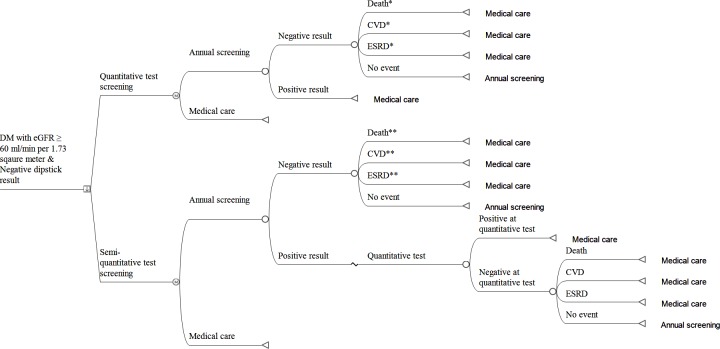
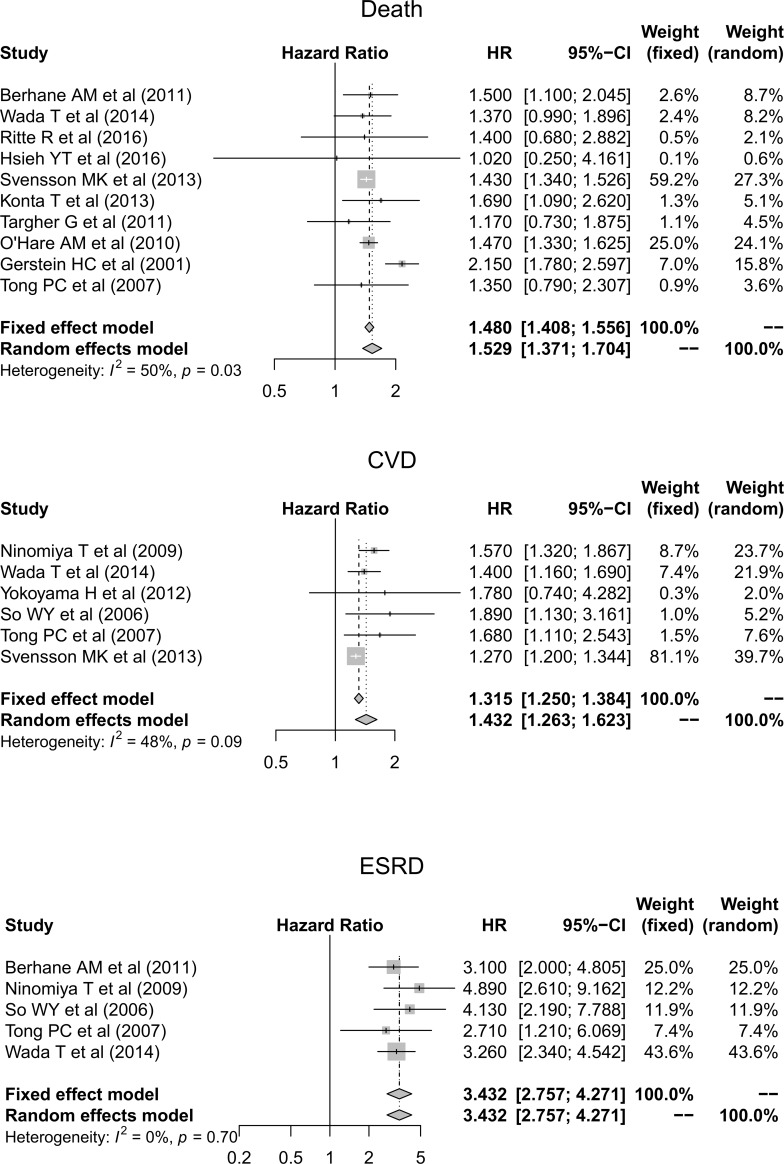
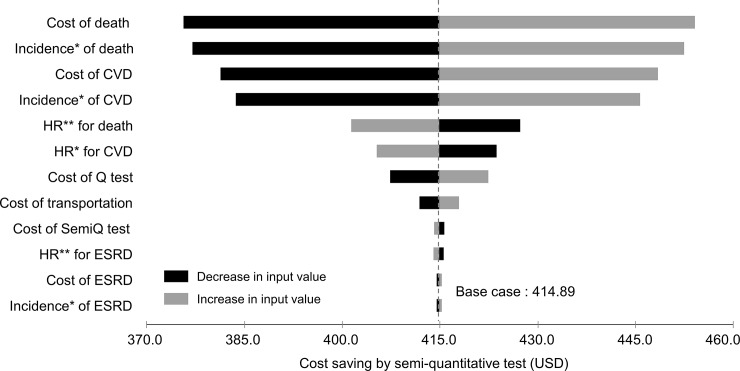
OBJECTIVES: Diabetes is a global epidemic, and the high cost of annually and quantitatively measuring urine albumin excretion using the turbidimetric immunoassay is challenging. We aimed to determine whether a semi-quantitative urinary albumin-creatinine ratio test could be used as a screening tool for microalbuminuria in diabetic patients. METHODS: We assessed the diagnostic accuracy of the semi-quantitative method. The costs of false results in the semi-quantitative method were calculated based on the annual probability of disease progression analyzed through a systematic literature review and meta-analysis. The pooled long-term cost-saving effect of the semi-quantitative method compared with the quantitative test was assessed using a Markov model simulating a long-term clinical setting. Diagnostic accuracy and the cost-saving effect were also validated in an independent external cohort. RESULTS: Compared with the quantitative test, the semi-quantitative method had sensitivities of 93.5% and 81.3% and specificities of 61.4% and 63.1% in the overall sample of diabetic patients (n = 1,881) and in diabetic patients with eGFR ≥60 ml/min/1.73 m2 and a negative dipstick test (n = 1,110), respectively. After adjusting for direct and indirect medical costs, including the risk of disease progression, which was adjusted by the meta-analyzed hazard ratio for clinical outcomes, it was determined that using the semi-quantitative method could save 439.4 USD per person for 10 years. Even after adjusting the result to the external validation cohort, 339.6 USD could be saved for one diabetic patient for 10 years. CONCLUSIONS: The semi-quantitative method could be an appropriate screening tool for albuminuria in diabetic patients. Moreover, it can minimize the testing time and inconvenience and significantly reduce national health costs.
Overview
The claims and statistics of this paper haven’t been checked yet.
Free: it reads the open-access text and checks the first 5 claims that cite a source we can check. Create a free account to check every claim.
Integrity signals
Registry
Cites
Statistics
Figures
Verification
Claims the paper makes
The claims and statistics of this paper haven’t been checked yet.
Free: it reads the open-access text and checks the first 5 claims that cite a source we can check. Create a free account to check every claim.
Claims other papers make about this one
Each is checked against this paper’s own text: does it say what the citing paper says it does?
The cited source says what the claim attributes to it.
In the citing paper
“A cost-effectiveness analysis of 1,881 individuals with diabetes published in 2020 evaluated medical costs of CKD and concluded that the semiquantitative uACR dipstick method could be an appropriate screening tool for albuminuria in people with diabetes.”
From Guidelines and Recommendations for Laboratory Analysis in the Diagnosis and Management of Diabetes Mellitus (2023) · cites this paper as [503]
The cited source says what the claim attributes to it.
In the citing paper
“Moreover, the authors point out that it can minimize the testing time and inconvenience and significantly reduce national health costs (503).”
From Guidelines and Recommendations for Laboratory Analysis in the Diagnosis and Management of Diabetes Mellitus (2023) · cites this paper as [503]
Self-check
Percentages, sums and reported differences re-computed from the paper’s own numbers.
The self-check needs the paper’s full text.
Citations
Cites
Toprak, O., Kurt, H., Sarı, Y., Şarkış, C., Us, H., & Kırık, A. (2017) · Kidney and Blood Pressure Research · doi:10.1159/000468530 · Cited by 29,627
Levey, A. S., Coresh, J., Bolton, K., Culleton, B. F., Harvey, K. S., Ikizler, T. A., Johnson, C. A., Kausz, A., Kimmel, P. L., Kusek, J. W., et al. (2002) · University of Groningen research database (University of Groningen / Centre for Information Technology) · Cited by 11,633
Haffner, S. M., Lehto, S., Rönnemaa, T., Pyörälä, K., & Laakso, M. (1998) · New England Journal of Medicine · doi:10.1056/nejm199807233390404 · Cited by 7,000
2. Classification and Diagnosis of Diabetes: Standards of Medical Care in Diabetes—2022
American Diabetes Association Professional Practice Committee (2022) · Diabetes Care · doi:10.2337/dc22-s002 · Cited by 4,792
Standards of medical care in diabetes—2013
American Diabetes Association (2013) · Diabetes Care · doi:10.2337/dc13-s011 · Cited by 4,369
Zhou, B., Lu, Y., Hajifathalian, K., Bentham, J., Di Cesare, M., Danaei, G., Bixby, H., Cowan, M., Ali, M., Taddei, C., et al. (2016) · The Lancet · doi:10.1016/s0140-6736(16)00618-8 · Cited by 4,311
Targeting the KEAP1-NRF2 system to prevent kidney disease progression
Nezu, M., Suzuki, N., & Yamamoto, M. (2017) · American Journal of Nephrology · doi:10.1159/000475890 · Cited by 3,447
2. Classification and Diagnosis of Diabetes:Standards of Medical Care in Diabetes—2019
American Diabetes Association (2019) · Diabetes Care · doi:10.2337/dc19-s002 · Cited by 2,697
Gerstein, H. C. (2001) · JAMA · doi:10.1001/jama.286.4.421 · Cited by 2,440
Adler, A. I., Stevens, R. J., Manley, S. E., Bilous, R. W., Cull, C. A., Holman, R. R., & UKPDS Group (2003) · Kidney International · doi:10.1046/j.1523-1755.2003.00712.x · Cited by 1,816
Cohort Profile: The National Health Insurance Service–National Sample Cohort (NHIS-NSC), South Korea
Lee, J., Lee, J. S., Park, S.-H., Shin, S. A., & Kim, K. (2016) · International Journal of Epidemiology · doi:10.1093/ije/dyv319 · Cited by 1,469
Self-citationCheol Seong, S., Kim, Y.-Y., Khang, Y.-H., Heon Park, J., Kang, H.-J., Lee, H., Do, C.-H., Song, J.-S., Hyon Bang, J., Ha, S., et al. (2016) · International Journal of Epidemiology · doi:10.1093/ije/dyw253 · Cited by 1,277 · cited 1×
“[20] Statistical data regarding the population and the mortality rate according to age were extracted from the Korean Statistical Information Service.”
Self-citationTemporal trends in the prevalence of diabetic kidney disease in the United States
de Boer, I. H. (2011) · JAMA · doi:10.1001/jama.2011.861 · Cited by 1,036
Albuminuria and kidney function independently predict cardiovascular and renal outcomes in diabetes
Ninomiya, T., Perkovic, V., de Galan, B. E., Zoungas, S., Pillai, A., Jardine, M., Patel, A., Cass, A., Neal, B., Poulter, N., et al. (2009) · Journal of the American Society of Nephrology · doi:10.1681/asn.2008121270 · Cited by 965
Klausen, K., Borch-Johnsen, K., Feldt-Rasmussen, B., Jensen, G., Clausen, P., Scharling, H., Appleyard, M., & Jensen, J. S. (2004) · Circulation · doi:10.1161/01.cir.0000133312.96477.48 · Cited by 693
Valmadrid, C. T., Klein, R., Moss, S. E., & Klein, B. E. K. (2000) · Archives of Internal Medicine · doi:10.1001/archinte.160.8.1093 · Cited by 472
Price, C. P. (2001) · BMJ · doi:10.1136/bmj.322.7297.1285 · Cited by 368 · cited 1×
“[7] Recently, researchers have focused on the economic advantage of PoCT.”
Brancati, F. L. (1997) · JAMA · doi:10.1001/jama.278.23.2069 · Cited by 272
Medical Costs of CKD in the Medicare Population
Honeycutt, A. A., Segel, J. E., Zhuo, X., Hoerger, T. J., Imai, K., & Williams, D. (2013) · Journal of the American Society of Nephrology · doi:10.1681/asn.2012040392 · Cited by 261
Olson, M., & Bailey, M. J. (1981) · Journal of Political Economy · doi:10.1086/260947 · Cited by 251
Heindel, N. D., Gotta, Y., Klasko, S. K., & Lu, B. A. (2010) · Cited by 246
Republic of Korea Health system review
Chun, C.-B., Kim, S., Lee, J., & Lee, S.-Y. (2009) · Cited by 218
Self-citationSo, W. Y., Kong, A. P. S., Ma, R. C. W., Ozaki, R., Szeto, C. C., Chan, N. N., Ng, V., Ho, C. S., Lam, C. W. K., Chow, C. C., et al. (2006) · Diabetes Care · doi:10.2337/dc06-0248 · Cited by 208
Yuyun, M. F. (2004) · International Journal of Epidemiology · doi:10.1093/ije/dyh008 · Cited by 192
Nichols, J. H., Christenson, R. H., Clarke, W., Gronowski, A., Hammett-Stabler, C. A., Jacobs, E., Kazmierczak, S., Lewandrowski, K., Price, C., Sacks, D. B., et al. (2007) · Clinica Chimica Acta · doi:10.1016/j.cca.2006.12.025 · Cited by 169
Berhane, A. M., Weil, E. J., Knowler, W. C., Nelson, R. G., & Hanson, R. L. (2011) · Clinical Journal of the American Society of Nephrology · doi:10.2215/cjn.00580111 · Cited by 159
Wada, T., Haneda, M., Furuichi, K., Babazono, T., Yokoyama, H., Iseki, K., Araki, S., Ninomiya, T., Hara, S., Suzuki, Y., et al. (2013) · Clinical and Experimental Nephrology · doi:10.1007/s10157-013-0879-4 · Cited by 156
Ward, A., Alvarez, P., Vo, L., & Martin, S. (2014) · Journal of Medical Economics · doi:10.3111/13696998.2014.882843 · Cited by 131
Jin, D. C., Yun, S.-R., Lee, S. W., Han, S.-W., Kim, W. B., Park, J., & Kim, Y.-K. (2018) · Kidney Research and Clinical Practice · doi:10.23876/j.krcp.2018.37.1.20 · Cited by 128
Self-citationPersonalized prophylactic anticoagulation decision analysis in patients with membranous nephropathy
Lee, T., Biddle, A. K., Lionaki, S., Derebail, V. K., Barbour, S. J., Tannous, S., Hladunewich, M., Hu, Y., Poulton, C. J., Mahoney, S., et al. (2013) · Kidney International · doi:10.1038/ki.2013.476 · Cited by 106
The economic burden of progressive chronic kidney disease among patients with type 2 diabetes
Vupputuri, S. X., Kimes, T. M., Calloway, M. O., Christian, J. B., Bruhn, D. F., Martin, A. A., & Nichols, G. A. (2013) · Journal of Diabetes and its Complications · doi:10.1016/j.jdiacomp.2013.09.014 · Cited by 91
Svensson, M. K., Cederholm, J., Eliasson, B., Zethelius, B., & Gudbjörnsdottir, S. (2013) · Diabetes and Vascular Disease Research · doi:10.1177/1479164113500798 · Cited by 90
Kim, K. W., Ho, A., Alshabee-Akil, A., Hardikar, A. A., Kay, T. W. H., Rawlinson, W. D., & Craig, M. E. (2015) · Diabetes · doi:10.2337/db15-0956 · Cited by 69
O’Hare, A. M. (2010) · Archives of Internal Medicine · doi:10.1001/archinternmed.2010.129 · Cited by 59
PoCT Trial Management Group, Laurence, C. O., Moss, J. R., Briggs, N. E., & Beilby, J. J. (2010) · BMC Health Services Research · doi:10.1186/1472-6963-10-165 · Cited by 57
Gialamas, A., St John, A., Laurence, C. O., & Bubner, T. K. (2010) · Family Practice · doi:10.1093/fampra/cmp084 · Cited by 57
Graziani, M. S., Gambaro, G., Mantovani, L., Sorio, A., Yabarek, T., Abaterusso, C., Lupo, A., & Rizzotti, P. (2009) · Nephrology Dialysis Transplantation · doi:10.1093/ndt/gfn639 · Cited by 54
McTaggart, M. P., Price, C. P., Pinnock, R. G., Stevens, P. E., Newall, R. G., & Lamb, E. J. (2012) · American Journal of Kidney Diseases · doi:10.1053/j.ajkd.2012.05.009 · Cited by 53
Yokoyama, H., Araki, S., Haneda, M., Matsushima, M., Kawai, K., Hirao, K., Oishi, M., Sugimoto, K., Sone, H., Maegawa, H., et al. (2012) · Diabetologia · doi:10.1007/s00125-012-2536-y · Cited by 51
Tong, P. C. Y., Kong, A. P. S., So, W., Yang, X., Ng, M. C. Y., Ho, C. S., Ma, R. C. W., Ozaki, R., Ng, V. S. W., Chow, C. C., et al. (2007) · Diabetic Medicine · doi:10.1111/j.1464-5491.2007.02145.x · Cited by 44
Konta, T., Kudo, K., Sato, H., Ichikawa, K., Ikeda, A., Suzuki, K., Hirayama, A., Shibata, Y., Watanabe, T., Daimon, M., et al. (2013) · Clinical and Experimental Nephrology · doi:10.1007/s10157-013-0770-3 · Cited by 41
Meinhardt, U. (2003) · Journal of Diabetes and its Complications · doi:10.1016/s1056-8727(02)00180-0 · Cited by 38
Targher, G., Zoppini, G., Chonchol, M., Negri, C., Stoico, V., Perrone, F., Muggeo, M., & Bonora, E. (2010) · Nutrition Metabolism and Cardiovascular Diseases · doi:10.1016/j.numecd.2009.10.002 · Cited by 35
The clinical application of a urine albumin:creatinine ratio point-of-care device
Croal, B. L., Mutch, W. J., Clark, B. M., Dickie, A., Church, J., Noble, D., & Ross, I. S. (2001) · Clinica Chimica Acta · doi:10.1016/s0009-8981(01)00450-8 · Cited by 35
Floch, J. P. L., Marre, M., Rodier, M., & Passa, P. (2001) · PubMed · Cited by 27
Hsieh, Y., Kuo, J.-F., Su, S., Chen, J., Chen, H., & Hsieh, M. (2016) · Medicine · doi:10.1097/md.0000000000002200 · Cited by 13
Clinical outcomes associated with albuminuria in central Australia: a cohort study
Ritte, R., Luke, J., Nelson, C., Brown, A. D. H., O’Dea, K., Jenkins, A. J., Best, J. D., McDermott, R. A., Daniel, M., & Rowley, K. (2016) · BMC Nephrology · doi:10.1186/s12882-016-0328-1 · Cited by 5
Research works printed but not linked: 2
- Tholen DW, Kallner A, Kennedy JW, Krouwer JS, Meier K. Evaluation of precision performance of quantitative measurement methods; approved guideline—second edition. Evaluation. 2004; 24(25).
- Ahn JH, Kim YH, Shin SJ, JY P. Cost of Medical Decision Making—Asian Joint Research on Effectiveness. National Evidence-based Healthcare Collaborating Agency; 2012.
Cited by
KDIGO 2024 clinical practice guideline for the evaluation and management of chronic kidney disease
Stevens, P. E., Ahmed, S. B., Carrero, J. J., Foster, B., Francis, A., Hall, R. K., Herrington, W. G., Hill, G., Inker, L. A., Kazancıoğlu, R., et al. (2024) · Kidney International · doi:10.1016/j.kint.2023.10.018 · Cited by 8,530
Sacks, D. B., Arnold, M., Bakris, G. L., Bruns, D. E., Horvath, A. R., Lernmark, Å., Metzger, B. E., Nathan, D. M., & Kirkman, M. S. (2023) · Diabetes Care · doi:10.2337/dci23-0036 · Cited by 351
Sacks, D. B., Arnold, M. A., Bakris, G. L., Bruns, D. E., Horvath, A. R., Lernmark, Å., Metzger, B. E., Nathan, D. M., & Kirkman, M. S. (2023) · Clinical Chemistry · doi:10.1093/clinchem/hvad080 · Cited by 206
Screening, identifying, and treating chronic kidney disease: why, who, when, how, and what?
Farrell, D. R., & Vassalotti, J. A. (2024) · BMC Nephrology · doi:10.1186/s12882-024-03466-5 · Cited by 114
Urine Albumin Measurements in Clinical Diagnostics
Seegmiller, J. C., & Bachmann, L. M. (2024) · Clinical Chemistry · doi:10.1093/clinchem/hvad174 · Cited by 62
Metadata
- Authors
- Kim, Y., Park, S., Kim, M.-H., Song, S. H., Lee, W. M., Kim, H. S., Jin, K., Han, S., Kim, Y. C., Han, S. S., Lee, H., Lee, J. P., Joo, K. W., Lim, C. S., Kim, Y. S., & Kim, D. K.
- Affiliations
- Seoul National University (KR)
- Eulji University (KR)
- Keimyung University (KR)
- Corresponding author
- Kim, Dong Ki
- ORCID
- Venue
- PLOS ONE
- Publisher
- Public Library of Science (PLoS)
- Published
- 2020-01-21
- Volume
- 15
- Issue
- 1
- Pages
- e0227694
- ISSN
- 1932-6203 (ISSN-L)
- PMC
- PMC6974274
- OpenAlex
- W3001164618
- Semantic Scholar
- d89c07ec49177ff6e3442eb40ff3cea6b97fe6c0
- Cited by
- 12
- References
- 47
- Citations by year
- 2026: 1 · 2025: 2 · 2024: 5 · 2023: 2 · 2022: 1 · 2021: 1
- FWCI
- 0.63
- Type
- journal article
- Language
- en
- Open access
- gold
- doi.org
- Licence
- Locations
- PLoS ONE (publishedVersion, cc-by)
- PubMed Central (publishedVersion, cc-by)
- PubMed (publishedVersion)
- RePEc: Research Papers in Economics (submittedVersion)
- DOAJ (DOAJ: Directory of Open Access Journals) (submittedVersion, cc-by-sa)
- Figshare (submittedVersion, cc-by)
- Seoul National University Open Repository (Seoul National University) (submittedVersion)
- Funders
- Ministry of Health and Welfare (HI17C0530)
- Topics
- Health Sciences › Medicine › Nephrology › Chronic Kidney Disease and Diabetes
- Social Sciences › Economics, Econometrics and Finance › Economics and Econometrics › Health Systems, Economic Evaluations, Quality of Life
- Health Sciences › Medicine › Endocrinology, Diabetes and Metabolism › Diabetes Management and Research
- Keywords
- microalbuminuria, diabetes mellitus, urinary albumin-creatinine ratio, diabetic nephropathy screening, diagnostic accuracy, cost saving, disease progression, Markov model
- MeSH terms
- Albuminuria, Diabetes Mellitus, Diabetic Nephropathies, Humans, Mass Screening, Reproducibility of Results, Cohort Studies, Urinalysis, Cost Savings, Republic of Korea
About these checks
Registry, retraction, Cites and statistics results are computed, not judged, with one exception: a printed reference that no index lists is read once by a model before it counts as a citation error. Claims are extracted by a model and kept only when their quote appears verbatim in the text; each cited source is then checked, with a model’s help, for whether it says what the claim relies on. Those verdicts can be wrong — read the claim’s quote and the cited source before relying on one.
Statistics and arithmetic are recomputed, not judged.
Confidence bands are shown only for fields calibrated on our annotated test set. None is calibrated yet, so no band is shown.
What counts as a claim ›How we measure confidence ›How we check this ›
Are you an author, or do you see a problem with this page? Request a review
Data sources
Bibliographic data: Semantic Scholar, OpenAlex, Crossref.
Contains information from the Semantic Scholar Academic Graph Datasets, made available under the ODC Attribution License (ODC-BY 1.0).
Semantic Scholar’s data is described in: Kinney, R., et al. (2023). The Semantic Scholar Open Data Platform. arXiv:2301.10140.
