

Mental health problems and social media exposure during COVID-19 outbreak
Open accessThe DOI matches its Crossref record; 14 of the 14 references it cites were found in a registry or an index; 10 of the 24 sources its claims cite were checked for support.
Abstract
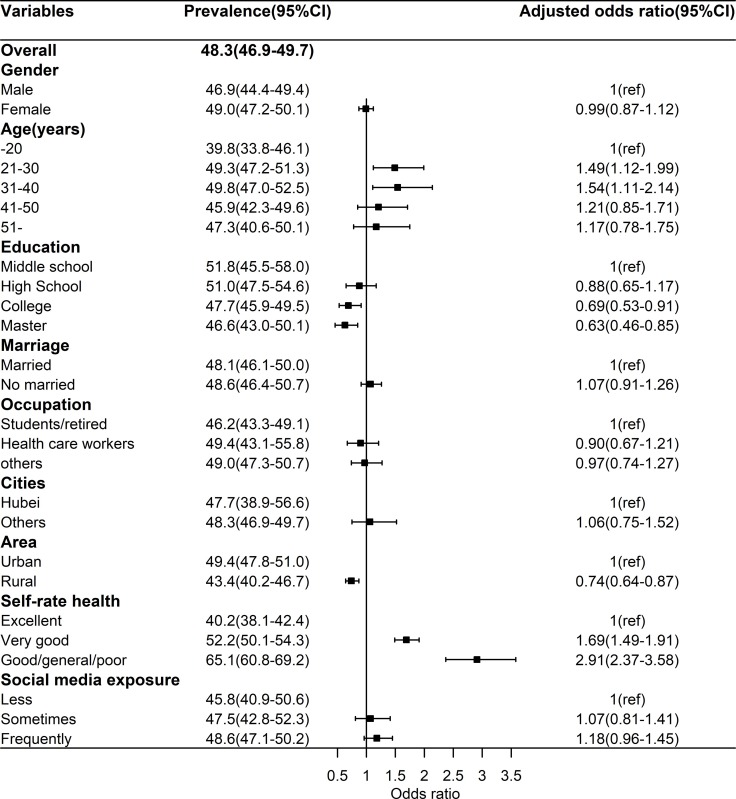
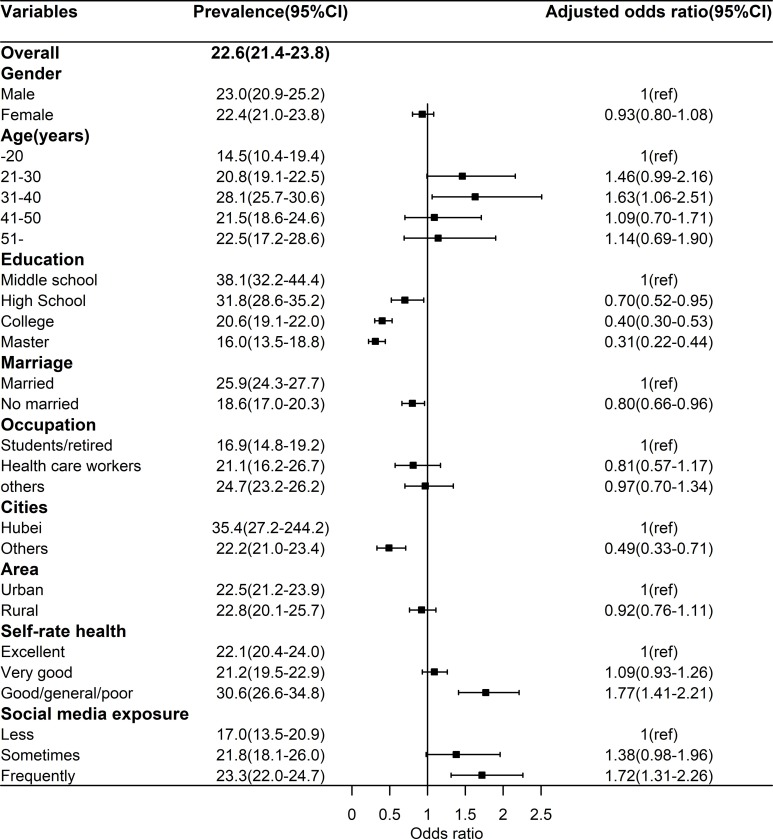
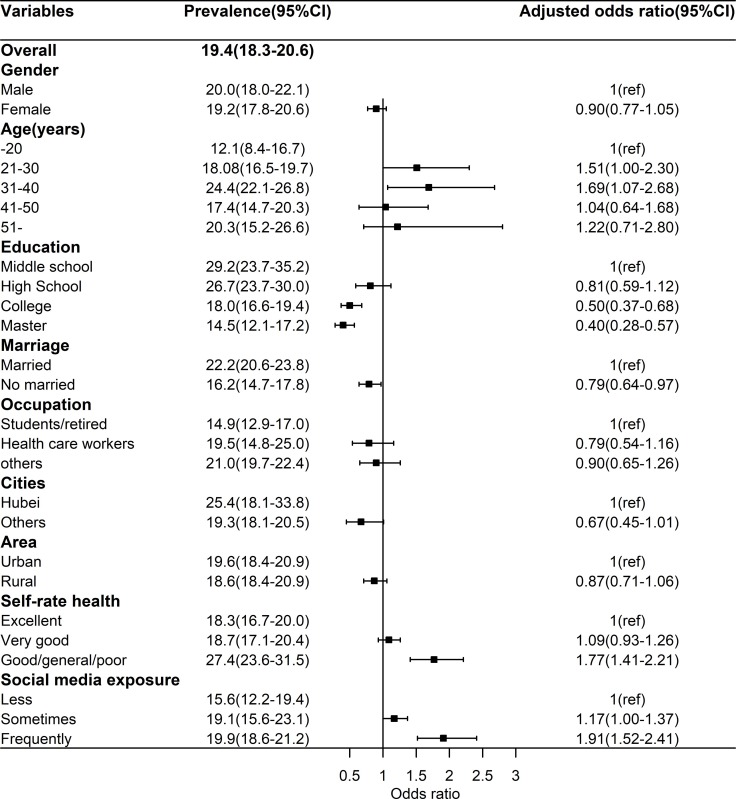
Huge citizens expose to social media during a novel coronavirus disease (COVID-19) outbroke in Wuhan, China. We assess the prevalence of mental health problems and examine their association with social media exposure. A cross-sectional study among Chinese citizens aged≥18 years old was conducted during Jan 31 to Feb 2, 2020. Online survey was used to do rapid assessment. Total of 4872 participants from 31 provinces and autonomous regions were involved in the current study. Besides demographics and social media exposure (SME), depression was assessed by The Chinese version of WHO-Five Well-Being Index (WHO-5) and anxiety was assessed by Chinese version of generalized anxiety disorder scale (GAD-7). multivariable logistic regressions were used to identify associations between social media exposure with mental health problems after controlling for covariates. The prevalence of depression, anxiety and combination of depression and anxiety (CDA) was 48.3% (95%CI: 46.9%-49.7%), 22.6% (95%CI: 21.4%-23.8%) and 19.4% (95%CI: 18.3%-20.6%) during COVID-19 outbroke in Wuhan, China. More than 80% (95%CI:80.9%-83.1%) of participants reported frequently exposed to social media. After controlling for covariates, frequently SME was positively associated with high odds of anxiety (OR = 1.72, 95%CI: 1.31-2.26) and CDA (OR = 1.91, 95%CI: 1.52-2.41) compared with less SME. Our findings show there are high prevalence of mental health problems, which positively associated with frequently SME during the COVID-19 outbreak. These findings implicated the government need pay more attention to mental health problems, especially depression and anxiety among general population and combating with "infodemic" while combating during public health emergency.
Overview
CoChat Summary
## TL;DR
This cross-sectional online survey of 4,872 Chinese adults during the COVID-19 outbreak found high prevalence of depression, anxiety, and co-occurring depression/anxiety. Frequent social media exposure was positively associated with anxiety and with the combination of depression and anxiety, but not significantly with depression alone after adjustment.
## Key findings
- Among 4,827 participants in the results, the prevalence was 48.3% for depression, 22.6% for anxiety, and 19.4% for combination of depression and anxiety (CDA).
- 82.0% of participants reported frequent social media exposure; only 8.8% reported less exposure and 9.2% reported sometimes exposure.
- After controlling for covariates, frequent SME was associated with higher odds of anxiety (OR = 1.72, 95% CI 1.31–2.26) and CDA (OR = 1.91, 95% CI 1.52–2.41) compared with less SME.
- Frequent SME was not significantly associated with depression after adjustment.
- Depression, anxiety, and CDA were all reported as much higher than the cited national sample estimates in China during the same period.
## Methods
- Design: Cross-sectional online survey conducted Jan 31 to Feb 2, 2020 during the COVID-19 outbreak.
- Sample/data: Chinese citizens aged 18 years or older recruited via the Wenjuanxing platform; 5,851 participated and 4,872 completed questionnaires from 31 provinces and autonomous regions were included.
- Measures/analysis: Depression was assessed with the WHO-5 (score <13), anxiety with the GAD-7 (score ≥10), and social media exposure was categorized as less, sometimes, or frequently. The authors used chi-square/trend tests and multivariable logistic regression adjusting for demographic and other covariates.
## Limitations
- The paper states that, because the study is cross-sectional, it is difficult to determine causal relationships between SME and mental health.
- The paper notes possible respondent bias from the online survey, including few elder citizens’ participation.
- The paper states that residual confounding from unmeasured factors cannot be excluded.
- Evident from the text: the sample was online and self-selected, so it may not be fully representative of all Chinese adults.
Model-written summary. Check it against the paper before relying on it.
Integrity signals
Registry
Cites
Statistics
Figures
Verification
Claims the paper makes
7 Valid · 1 Not valid · 6 Not checked · 13 Own results and interpretations
The cited sources support only part of this claim — read each source’s verdict below.
In the paper
“It indicated that participants from Hubei province- the infectious focus directly expose to public health emergency, and may suffer more mental health problemes[17,19].”
§ Mental health problems and social media exposure during COVID-19 outbreak > Discussion
What the sources say
- Not checked — no full text of the sourcecites [17] Xie Z, Xu J, Wu Z. Mental health problems among survivors in hard-hit areas of the 5.12 Wenchuan and 4.20 Lushan earthquakes. J Ment Health 2017; 26(1): 43– 9. 10.1080/09638237.2016.1276525 28084103 source
- Partly supportedcites [19] Mak IW, Chu CM, Pan PC, Yiu MG, Chan VL. Long-term psychiatric morbidities among SARS survivors. Gen Hosp Psychiatry 2009; 31(4): 318– 26. 10.1016/j.genhosppsych.2009.03.001 19555791 PMC7112501 sourceExperimental — accuracy not yet measured
The Introduction describes SARS survivors as direct victims of an outbreak, and the Results (Subgroup analysis of HCWs; page unavailable) report more chronic PTSD among health care workers than other survivors. This supports the general possibility of greater mental-health burden with outbreak exposure, but the paper studies SARS survivors in Hong Kong, not participants from Hubei province or a comparison based on residence in an infectious focus. (LLM, conf=0.82)
hedgedstates a possible cause- Asserted: passes — The authors put it forward as true.
- Checkable: passes — It can be checked against evidence.
- Load-bearing: passes — The paper’s conclusions depend on it.
- Based: passes — The paper gives a reason why it holds.
The cited sources that could be checked couldn’t confirm or dispute this claim.
In the paper
“Besides, many citizens expressed their negative feelings, such as fear, worry, nervous, anxiety et al. on social media, which are contagious social network[21,22].”
§ Mental health problems and social media exposure during COVID-19 outbreak > Discussion
What the sources say
- Not checked — no full text of the sourcecites [21] Kramer AD, Guillory JE, Hancock JT. Experimental evidence of massive-scale emotional contagion through social networks. Proc Natl Acad Sci U S A 2014; 111(24): 8788– 90. 10.1073/pnas.1320040111 24889601 PMC4066473 source
- Could not verifycites [22] Niederkrotenthaler T, Stack S, Till B, et al Association of Increased Youth Suicides in the United States With the Release of 13 Reasons Why. JAMA Psychiatry 2019; 76(9): 933– 40. PMC6547137 31141094 sourceExperimental — accuracy not yet measured
The Discussion and Conclusions discuss possible suicide contagion following a fictional television portrayal, using social-media activity to gauge attention to the show. They do not address whether fear, worry, anxiety, or other negative feelings expressed on social media spread through social networks; searches for negative feelings and emotional contagion found no such passage. The indexed passages provide section labels but no page numbers. (LLM, conf=0.77)
plainstates a cause- Asserted: passes — The authors put it forward as true.
- Checkable: passes — It can be checked against evidence.
- Load-bearing: passes — The paper’s conclusions depend on it.
- Based: passes — The paper gives a reason why it holds.
The sources with a verdict support this claim; the rest weren’t checked yet, have no full text we could read, or their verdicts aren’t rated yet.
In the paper
“These findings are consistent with the previous studies’ that exposing public health emergency can cause public mental health problems, such as Wenchuan and Lushan earthquakes[17], 2014 Ebola Outbreak[7,18], and SARS[19].”
§ Mental health problems and social media exposure during COVID-19 outbreak > Discussion
What the sources say
- Not checked — no full text of the sourcecites [17] Xie Z, Xu J, Wu Z. Mental health problems among survivors in hard-hit areas of the 5.12 Wenchuan and 4.20 Lushan earthquakes. J Ment Health 2017; 26(1): 43– 9. 10.1080/09638237.2016.1276525 28084103 source
- Not checked — no full text of the sourcecites [7] Shultz JM, Baingana F, Neria Y. The 2014 Ebola Outbreak and Mental Health: Current Status and Recommended Response. JAMA 2015; 313(6): 567– 8. 10.1001/jama.2014.17934 25532102 source
- Supportedcites [18] Ji D, Ji YJ, Duan XZ, et al Prevalence of psychological symptoms among Ebola survivors and healthcare workers during the 2014–2015 Ebola outbreak in Sierra Leone: a cross-sectional study. Oncotarget 2017; 8(8): 12784– 91. 10.18632/oncotarget.14498 28061463 PMC5355054 source
For the Ebola example attributed to this source, the Discussion reports pronounced psychological symptoms among Ebola survivors and Sierra Leonean healthcare workers exposed during the outbreak. The Introduction also describes public fear and panic. The earthquake and SARS examples have separate citations and are not attributed to this paper. (LLM, conf=0.90)
- Supportedcites [19] Mak IW, Chu CM, Pan PC, Yiu MG, Chan VL. Long-term psychiatric morbidities among SARS survivors. Gen Hosp Psychiatry 2009; 31(4): 318– 26. 10.1016/j.genhosppsych.2009.03.001 19555791 PMC7112501 source
The citation is attached to SARS, not to the earthquakes or Ebola outbreak. The Discussion (Clinical implications) states that SARS can cause significant, prolonged psychiatric problems, and the Discussion (Range of psychiatric disorders and functional outcome) identifies PTSD, depression, and anxiety disorders among survivors. (LLM, conf=0.90)
plainstates a cause- Asserted: passes — The authors put it forward as true.
- Checkable: passes — It can be checked against evidence.
- Load-bearing: unclear — It is unclear whether the paper’s conclusions depend on it.
- Based: passes — The paper gives a reason why it holds.
A result the paper reports from its own data — it cites no other source for it, so there is none to check. The quote shows it is in the paper.
In the paper
“higher frequency of SME was insignificantly positively associated with the adjusted odds of depression after controlling for all covariates.”
§ Mental health problems and social media exposure during COVID-19 outbreak > Results > Depression and SME
plainstates an association- Asserted: passes — The authors put it forward as true.
- Checkable: passes — It can be checked against evidence.
- Load-bearing: passes — The paper’s conclusions depend on it.
- Based: passes — The paper gives a reason why it holds.
A result the paper reports from its own data — it cites no other source for it, so there is none to check. The quote shows it is in the paper.
In the paper
“After controlling for covariates, frequently SME was positively associated with high odds of anxiety (OR = 1.72, 95%CI: 1.31–2.26) and CDA (OR = 1.91, 95%CI: 1.52–2.41) compared with less SME.”
- Also stated in: § Combination of depression and anxiety and SME · plain
“frequently SME can increase the adjusted odds (OR = 1.91, 95%CI: 1.52–2.41) of CDA compared with less SEM after controlling for all covariates.”
- Also stated in: § Discussion · plain
“frequently SME associated high odds of anxiety and CDA”
§ Mental health problems and social media exposure during COVID-19 outbreak > Abstract Huge citizens expose to social media during a novel coronavirus disease (COVID-19) outbroke in Wuhan, China. We assess the prevalence of mental health problems and examine their association with social media exposure. A cross-sectional study among Chinese citizens aged≥18 years old was conducted during Jan 31 to Feb 2, 2020. Online survey was used to do rapid assessment. Total of 4872 participants from 31 provinces and autonomous regions were involved in the current study. Besides demographics and social media exposure (SME), depression was assessed by The Chinese version of WHO-Five Well-Being Index (WHO-5) and anxiety was assessed by Chinese version of generalized anxiety disorder scale (GAD-7). multivariable logistic regressions were used to identify associations between social media exposure with mental health problems after controlling for covariates. The prevalence of depression, anxiety and combination of depression and anxiety (CDA) was 48.3% (95%CI: 46.9%-49.7%), 22.6% (95%CI: 21.4%-23.8%) and 19.4% (95%CI: 18.3%-20.6%) during COVID-19 outbroke in Wuhan, China. More than 80% (95%CI:80.9%-83.1%) of participants reported frequently exposed to social media. After controlling for covariates, frequently SME was positively associated with high odds of anxiety (OR = 1.72, 95%CI: 1.31–2.26) and CDA (OR = 1.91, 95%CI: 1.52–2.41) compared with less SME. Our findings show there are high prevalence of mental health problems, which positively associated with frequently SME during the COVID-19 outbreak. These findings implicated the government need pay more attention to mental health problems, especially depression and anxiety among general population and combating with “infodemic” while combating during public health emergency.
plainstates an associationn = 4,872- Asserted: passes — The authors put it forward as true.
- Checkable: passes — It can be checked against evidence.
- Load-bearing: passes — The paper’s conclusions depend on it.
- Based: passes — The paper gives a reason why it holds.
- Also stated in: § Combination of depression and anxiety and SME · plain
10 more claims
Create a free account to see all 27 claims and every source verdict.
- Probably not a substantial claim. 8
- It may state two separate claims as one. 4
- The quote only partly states this claim. 1
Claims other papers make about this one
Each is checked against this paper’s own text: does it say what the citing paper says it does?
The source backs part of the claim, not all of it — or backs it for a different population, condition or comparison.
In the citing paper
“In the current pandemic, the additional layer of extensive social media use and exposure to often sensationalized online news while in physical isolation may add new complexities to implementing emotional epidemiology in managing concerns, fears, and misconceptions [96,97], as these tools have been argued to bear negative effects on psychological well-being [97,98].”
From Psychosocial Effects of the COVID-19 Pandemic: Large-scale Quasi-Experimental Study on Social Media (2020) · cites this paper as [96]
Experimental — accuracy not yet measuredThe source backs part of the claim, not all of it — or backs it for a different population, condition or comparison.
In the citing paper
“Recent research has shown that, in the general public, the COVID-19 pandemic is associated with greater levels of psychological distress and a range of psychopathological problems such as depression, anxiety, and post-traumatic stress symptoms (e.g., Gao et al., 2020; Qiu et al., 2020; Wang et al., 2020).”
From Why did all the toilet paper disappear? Distinguishing between panic buying and hoarding during COVID-19 (2021) · cites this paper as Gao et al., 2020
Experimental — accuracy not yet measuredThe source backs part of the claim, not all of it — or backs it for a different population, condition or comparison.
In the citing paper
“Misleading content overload and the distortion of information affect users' stress levels and create mental health problems (Gao et al., 2020).”
From The Psycho-Emotive Effects of AI-Generated Fake News on Social Media Users (2026) · cites this paper as Gao et al., 2020
Experimental — accuracy not yet measuredThe source backs part of the claim, not all of it — or backs it for a different population, condition or comparison.
In the citing paper
“It is known that exposure to news about the process on social media also increases the levels of psychological distress and that the use of social media is higher in young people.[47]”
From Psychological Distress of Breast Cancer Survivors During the COVID-19 Pandemic and Related Factors: A Controlled Study. (2023) · cites this paper as [47]
Experimental — accuracy not yet measuredThe source backs part of the claim, not all of it — or backs it for a different population, condition or comparison.
In the citing paper
“Studies have concluded that perceived poor health status during the COVID-19 period is associated with increased anxiety levels.[47]”
From Psychological Distress of Breast Cancer Survivors During the COVID-19 Pandemic and Related Factors: A Controlled Study. (2023) · cites this paper as [47]
Experimental — accuracy not yet measured
4 more claims about this paper
Create a free account to see every claim other papers make about this one.
Self-check
Percentages, sums and reported differences re-computed from the paper’s own numbers.
Each contradiction between two passages listed here was confirmed by an independent check.
Rated major: it would touch a result — a value a result rests on, reported and recomputed p-values on opposite sides of the significance level, two passages that conflict with no sign which is right, or a cited work retracted before this paper was published.
In the paper
§ Mental health problems and social media exposure during COVID-19 outbreak > Materials and methods > Design and participants
“After removing the participants without completed questionnaires, 4872 participants from 31 provinces and autonomous regions were involved in the current study.”
§ Mental health problems and social media exposure during COVID-19 outbreak > Results > Social media exposure
“Of all 4827 participants, the mean age of was 32.3±10.0 years (ranged 18–85),”
Rated minor: it would not touch a result — a value no result rests on, a p-value that stays on the same side of the significance level, or a conflict that is clerical, resolved elsewhere in the paper, or outside its own findings.
In the paper
§ Mental health problems and social media exposure during COVID-19 outbreak > Abstract
“Total of 4872 participants from 31 provinces and autonomous regions were involved in the current study.”
§ Mental health problems and social media exposure during COVID-19 outbreak > Results > Social media exposure
“Of all 4827 participants, the mean age of was 32.3±10.0 years (ranged 18–85), the proportion of “less”, “sometimes”, and “frequently” of SME was 8.8%(95%CI:8.0%-9.6%), 9.2%(95%CI:8.4%-10.0%) and 82.0%(95%CI:80.9%-83.1%).”
Citations
Cites
A Brief Measure for Assessing Generalized Anxiety Disorder: The GAD-7
Spitzer, R. L., Kroenke, K., Williams, J. B. W., & Löwe, B. (2006) · Archives of Internal Medicine · doi:10.1001/archinte.166.10.1092 · Cited by 31,765 · cited 2×
“Anxiety was assessed by Chinese version of generalized anxiety disorder scale (GAD-7) [15, 16] , which consists 7 symptoms.”
BackgroundMethodExperimental evidence of massive-scale emotional contagion through social networks
Kramer, A. D. I., Guillory, J. E., & Hancock, J. T. (2014) · Proceedings of the National Academy of Sciences · doi:10.1073/pnas.1320040111 · Cited by 3,687 · cited 1×
“on social media, which are contagious social network[21,22].”
BackgroundPrevalence of mental disorders in China: a cross-sectional epidemiological study
Huang, Y., Wang, Y., Wang, H., Liu, Z., Yu, X., Yan, J., Yu, Y., Kou, C., Xu, X., Lu, J., et al. (2019) · The Lancet Psychiatry · doi:10.1016/s2215-0366(18)30511-x · Cited by 2,335 · cited 2×
“So, the current study aims to describes the prevalence and distribution of two major mental disorders-anxiety and depression among Chinese population [13], and examine their associations with social media exposure by rapid assessment during COVID-19 outbreak.”
BackgroundSelf-citationThe mental health of medical workers in Wuhan, China dealing with the 2019 novel coronavirus.
Kang, L., Li, Y., Hu, S., Chen, M., Yang, C., Yang, B. X., Wang, Y., Hu, J., Lai, J., Ma, X., et al. (2020) · The Lancet Psychiatry · doi:10.1016/s2215-0366(20)30047-x · Cited by 2,061 · cited 8×
“%) during COVID-19 outbroke in Wuhan, China.”
BackgroundInfluentialSelf-citation2019-nCoV epidemic: Address mental health care to empower society
Bao, Y., Sun, Y., Meng, S., Shi, J., & Lu, L. (2020) · The Lancet · doi:10.1016/s0140-6736(20)30309-3 · Cited by 2,038 · cited 11×
“%) during COVID-19 outbroke in Wuhan, China.”
BackgroundInfluentialShigemura, J., Ursano, R. J., Morganstein, J. C., Kurosawa, M., & Benedek, D. M. (2020) · Psychiatry and Clinical Neurosciences · doi:10.1111/pcn.12988 · Cited by 1,959 · cited 1×
“The outbreak of COVID-19 in China has caused mental health problems among the public in China[3] and Japan[4] and medical workers in Wuhan[5].”
BackgroundLong-term psychiatric morbidities among SARS survivors
Mak, I. W. C., Chu, C. M., Pan, P. C., Yiu, M. G. C., & Chan, V. L. (2009) · General Hospital Psychiatry · doi:10.1016/j.genhosppsych.2009.03.001 · Cited by 1,018 · cited 2×
“It indicated that participants from Hubei province- the infectious focus directly expose to public health emergency, and may suffer more mental health problemes[17,19].”
BackgroundResultThe 2014 Ebola Outbreak and Mental Health: Current Status and Recommended Response
Shultz, J. M., Baingana, F., & Neria, Y. (2015) · JAMA · doi:10.1001/jama.2014.17934 · Cited by 324
Ji, D., Ji, Y.-J., Duan, X.-Z., Li, W.-G., Sun, Z.-Q., Song, X.-A., Meng, Y.-H., Tang, H.-M., Chu, F., Niu, X.-X., et al. (2017) · Oncotarget · doi:10.18632/oncotarget.14498 · Cited by 257 · cited 1×
“These findings are consistent with the previous studies’ that exposing public health emergency can cause public mental health problems, such as Wenchuan and Lushan earthquakes[17], 2014 Ebola Outbreak[7,18], and SARS[19].”
ResultThe impact of social media on risk perceptions during the MERS outbreak in South Korea
Choi, D.-H., Yoo, W., Noh, G.-Y., & Park, K. (2017) · Computers in Human Behavior · doi:10.1016/j.chb.2017.03.004 · Cited by 246 · cited 1×
“A previous study also shown social media exposure may positively related to forming risk perceptions during the MERS outbreak in South Korea [12] .”
Result
Research works printed but not linked: 2
- Florian Roth, Brönnimann G. Focal Report 8: Risk Analysis Using the Internet for Public Risk Communication. https://www.researchgate.net/publication/256126259. (accessed Feb 12, 2020)
- Xu WF PY, Chen BQ. Assessment of Anxiety and Depression by Self-rating Scales of GAD-7 and PHQ-9 in Cardiovascular Outpatients. World Latest Medicine Information (Electronic Version), 2018, 18(16): 12– 14. (in Chinese)
Cited by
Items 2,001–2,100 of 2,694
Diagnósticos, Resultados E Intervenções De Enfermagem No Contexto Da Infodemia No Idoso Na Covid-19
Bitencourt, G. R., de Souza, P. A., Santana, R. F., Aquino, R. G., Pereira, E. D. S., Moreira, L. D. F. A., & Costa, E. C. R. D. (2022) · Editora ABEn eBooks · doi:10.51234/aben.22.e10.c12 · Cited by 1
Kusumadewi, A. F., Seswandhana, M. A., & Aulia, A. (2022) · Bioscientia Medicina Journal of Biomedicine and Translational Research · doi:10.37275/bsm.v6i11.583 · Cited by 1
COVID-19 Pandemic and its Effect on Mental Health among General Population of Gandaki Province
Shrestha, S., Gurung, B., Gaire, B., et al. (2022) · Journal of College of Medical Sciences-Nepal · doi:10.3126/jcmsn.v18i2.35348 · Cited by 1
Introduction to ISEE Assessment Working Group 1 - education in and for flourishing
Ergas, O., Gilead, T., & Singh, N. C. (2022) · UNESCO MGIEP eBooks · doi:10.56383/rvqu2646 · Cited by 2
THE EFFECTS OF THE COVID-19 PANDEMIC PROCESS ON SOCIAL MEDIA USE: THE CASE OF UŞAK UNIVERSITY
Ramazan, A. C. A. R., & ŞENTÜRK, Z. A. (2022) · The Journal of Social Sciences · doi:10.29228/sobider.64243 · Cited by 1
Wpływ izolacji związanej z pandemią COVID-19 na zdrowie psychiczne
Święcicki, Ł. (2022) · Wydawnictwo Naukowe Instytutu na rzecz Kultury Prawnej Ordo Iuris eBooks · doi:10.37873/oipress.37.42 · Cited by 1
Recovery from Long COVID: How College Students Thrive During Lockdown
Cabacungan, A. M., Delima, K. R. M., Mortiz, J. N. B., Paguta, L. D. C., & Billones, R. R. (2022) · Tazkiya Journal of Psychology · doi:10.15408/tazkiya.v10i2.26341 · Cited by 5
Do Greek University Students Trust Social Media Regarding Science Related Issues? The Covid-19 Case
Vranias, K., & Kyridis, A. (2022) · International Journal of Social Science Research · doi:10.5296/ijssr.v11i1.20259 · Cited by 1
Delice, B., Saleki, N., Pehlivan, M., Sezer, F. E., Bakırhan, H., & Özkaya, V. (2022) · Nutrition and Health · doi:10.1177/02601060221138897 · Cited by 1
COVID-19 Pandemi Döneminde Bireylerin Geleneksel ve Sosyal Medyaya Yönelik Güven ve Tutumları
Cerit, K., & Can, S. (2022) · Uluslararası İnsan Çalışmaları Dergisi · doi:10.35235/uicd.1203675 · Cited by 1
Wulansari, D., & Kurniawati, Y. (2021) · IJEBD (International Journal Of Entrepreneurship And Business Development) · doi:10.29138/ijebd.v4i4.1421 · Cited by 1
Fagbola, O. (2022) · Texila international journal of public health · doi:10.21522/tijph.2013.10.04.art017 · Cited by 1
Bhardwaj, T., & Viju, P. D. (2023) · Indian Journal of Psychological Medicine · doi:10.1177/02537176221140150 · Cited by 2
Analysis of Healthcare Professionals’ and Institutions’ Roles in Twitter Colostomy Information
Hidalgo, P. J. J., Jiménez-Gómez, B., Ruíz-Núñez, C., Segado-Fernández, S., Diez-Villacañas, F., López‐Espuela, F., & Herrera‐Peco, I. (2023) · Healthcare · doi:10.3390/healthcare11020215 · Cited by 2
Media trust among university students during the COVID-19 pandemic in Ukraine
Rizun, V., Тукаєв, С., Havrylets, Y., Vasheka, T. V., Enzminger, A., Grimm, J., Palamar, B. I., Dolgova, O. M., Pravda, O., & Makarchuk, M. Y. (2022) · Current Issues of Mass Communication · doi:10.17721/cimc.2022.32.35-49 · Cited by 1
Mixed Methods Research to Build Bridges
Landrum, B., & Garza, G. J. (2022) · Springer eBooks · doi:10.1007/978-3-031-13942-0_9 · Cited by 1
Villafania, R. J. B. (2023) · Arts & Humanities Open Access Journal · doi:10.15406/ahoaj.2023.05.00183 · Cited by 1
Kyaw, T. M., Kumar, S. A. P. S. V., Kumar, R. C. D. A. L. D., Muniyandy, U. M. A. P., Sivabalan, T. A. P., Saidi, N. A. B., & Manja, M. R. B. N. (2023) · Malaysian Journal of Public Health Medicine · doi:10.37268/mjphm/vol.22/no.3/art.1698 · Cited by 1
Cardona-Isaza, A. D. J., Trujillo, Á., Munévar, F. R., & Montoya‐Castilla, I. (2023) · CES Psicología · doi:10.21615/cesp.6341 · Cited by 1
The traumatic impact of the COVID-19 pandemic: the possible role of rumination and uncertainty
Yiğitoğlu, G. T., Keskin, G., & Köktaş, N. Ç. (2023) · Current Psychology · doi:10.1007/s12144-023-04379-6 · Cited by 3
A influência das mídias e redes sociais na saúde mental dos jovens
Santos, I. V. P., Amâncio, N. D. F. G., Romão, M. F., & de Almeida, K. C. (2023) · Brazilian Journal of Health Review · doi:10.34119/bjhrv6n1-292 · Cited by 1
O processo de autocuidado de idosos comunitários no contexto da pandemia de COVID-19
Lopes, L. P., Santi, D. B., Marques, F. R. D. M., et al. (2023) · Revista Brasileira de Enfermagem · doi:10.1590/0034-7167-2022-0644pt · Cited by 1
ÇAĞATAY, A., TOPAL, A., & ARSLAN, Ü. (2023) · International Journal of Health Management and Tourism · doi:10.31201/ijhmt.1252536 · Cited by 1
COVID-19-Related Obsessions and Its Predictors: A Community- Based Research in Turkey
Tanrıverdi, E. Ç., CEVHEROĞLU, B. A., Özkurt, Z., & Şahingöz, M. (2023) · Clinical and Experimental Health Sciences · doi:10.33808/clinexphealthsci.993404 · Cited by 1
Fear of COVID-19 in dentistry students: an evaluation of their knowledge and practices
Majeed, M. M., Anwar, M., Uzair, M., Bashir, M. B., Iqbal, S. N., & Tanoli, N. A. (2022) · Pakistan Journal of Public Health · doi:10.32413/pjph.v12i3.865 · Cited by 1
Xiong, X., Hu, R. X., Chen, C., & Ning, W. (2023) · Frontiers in Psychiatry · doi:10.3389/fpsyt.2023.1147530 · Cited by 1
Social Support and Health Anxiety during COVID-19 Pandemic
Hou, S. (2022) · Psychology Research and Practice · doi:10.37155/2972-3086-0101-3 · Cited by 1
Jin, L., Chen, P., Fang, X.-H., et al. (2023) · PubMed · Cited by 1
Design of a Prototypic Mental Health Ontology for Sentiment Analysis of Tweets
Chaudhary, D., Singh, J., & Kaur, P. (2023) · Lecture notes in electrical engineering · doi:10.1007/978-981-19-9090-8_19 · Cited by 1
Carriker, N., Hongsanguansri, S., Pavasuthipaisit, C., & Kiatrungrit, K. (2023) · Siriraj Medical Journal/San Sirirat · doi:10.33192/smj.v75i6.261124 · Cited by 5
Perceived Effects of the COVID-19 Pandemic on Loneliness: The Most Vulnerable Population Groups
Gedvilaitė-Kordušienė, M., & Mikulionienė, S. (2023) · Emerging Science Journal · doi:10.28991/esj-2023-sper-020 · Cited by 2
Mental Health Status Of A Population During COVID-19 Pandemic in Bangladesh: A Cross-Sectional Study
Haque, M. R., Islam, T., Milton, A. H., & Abir, T. A. (2023) · Bangladesh Medical Research Council Bulletin · doi:10.3329/bmrcb.v48i3.63811 · Cited by 2
Sarfo, J. O., Ansah, E. W., Sarfo, J. C., Ashraf, F., Suraya, A., Malik, S., Azam, U., Malik, N. I., Amoah, S. K., & Donyeh, P. S. (2023) · Psychology of Language and Communication · doi:10.58734/plc-2023-0016 · Cited by 2
Early Cyberspace Emergency Response by Predicting Social‐Emotional Security
Jiang, S., Fu, Z., Zhang, H., Qi, J., Zhou, Y., & Fang, B. (2022) · Wireless Communications and Mobile Computing · doi:10.1155/2022/5876180 · Cited by 1
Devrim-Lanpir, A., & Güzeldere, H. K. B. (2023) · Acibadem Universitesi Saglik Bilimleri Dergisi · doi:10.31067/acusaglik.1239014 · Cited by 2
Joseph, D. D., & Doon, R. A. (2023) · Springer eBooks · doi:10.1007/978-3-031-31119-2_16 · Cited by 2
Determining the Coronavirus-19 Phobia Level of a Group of University Students
KOLÇAK, B., Külekçi, E., HACIOSMANOĞLU, K. A., & Tamer, F. (2023) · Yüksek İhtisas Üniversitesi Sağlık Bilimleri Dergisi · doi:10.51261/yiu.2023.1323469 · Cited by 1
Impact of covid-19 pandemic on patients seeking prosthodontic treatment- A cross sectional Study
Francis, L., & Deepthi, V. S. (2023) · The Journal of Prosthetic and Implant Dentistry · doi:10.55231/jpid.2023.v07.i01.04 · Cited by 1
Polat, M., & Yıldız, İ. (2023) · Early Child Development and Care · doi:10.1080/03004430.2023.2257003 · Cited by 1
Michinaka, M., Sai, A., & Yamauchi, T. (2023) · PLoS ONE · doi:10.1371/journal.pone.0292377 · Cited by 2
The COVID-19 pandemic: new challenges for the mental health protection system
Mishiev, V., Mykhaylov, B., Grinevich, E. G., Omelyanovich, V., & Kaafarani, A. (2023) · Postępy Psychiatrii i Neurologii · doi:10.5114/ppn.2023.132119 · Cited by 2
Children's Technology Use during the Pandemic Period
Dulkadir, R., Yaman, N. D., & Yaman, F. (2023) · Anadolu Üniversitesi Eğitim Fakültesi Dergisi · doi:10.34056/aujef.1259530 · Cited by 1
Keskin, G., Gümüşsoy, S., & Yiğitoğlu, G. T. (2023) · Women & Health · doi:10.1080/03630242.2023.2272205 · Cited by 2
Keywords on COVID-19 Vaccination: An Application of NLP into Macau Netizens’ Social Media Comments
Chen, X., Wang, V. X., Lim, L., & Huang, C. (2023) · Smart innovation, systems and technologies · doi:10.1007/978-981-99-6702-5_10 · Cited by 1
Effect of COVID-19 Exposure and Concerns of Healthcare Workers on Their Hopelessness Levels
Kılınç, N. Ö., & Erci, B. (2023) · DÜSTAD Dünya Sağlık ve Tabiat Bilimleri Dergisi · doi:10.56728/dustad.1388667 · Cited by 2
Kgarose, M., Rachekhu, K., Makhubela, D. K., & Malahlela, M. J. (2023) · International Journal of Research in Business and Social Science (2147-4478) · doi:10.20525/ijrbs.v12i8.2946 · Cited by 2
Bienestar emocional, percepciones y actitudes frente a la COVID-19 en adolescentes
Torralbo, A. M., Noguerola, S. R., Martin, V., Bielsa-Pascual, J., Alcazo, M. T. L., Domínguez, M. J. M., & Urgell, C. V. (2023) · Medicina de Familia SEMERGEN · doi:10.1016/j.semerg.2023.102158 · Cited by 6
So, B., & Kwon, K. H. (2024) · Global Knowledge, Memory and Communication · doi:10.1108/gkmc-05-2023-0158 · Cited by 4
How are Negative Articles Consumed? A Quantitative Analysis of User Behavior in a Real News Service
Ohata, K., Iyatomi, H., Morita, H., & Iizuka, K. (2023) · Conference proceedings/Conference proceedings - IEEE International Conference on Systems, Man, and Cybernetics · doi:10.1109/smc53992.2023.10394466 · Cited by 2
Exploring the health care system’s representation in the media through hierarchical topic modeling
Mukhamediev, R. I., Yelis, M., Yakunin, K., Popova, Y., Kuchin, Y. I., Сымагулов, А., Yunicheva, N., Zaitseva, E., Levashenko, V., Muhamedijeva, E., et al. (2024) · Cogent Engineering · doi:10.1080/23311916.2024.2324614 · Cited by 1
"COVID-19 Pandemic Impact on Children and Adolescent’s Mental Health: A Review of Current Research"
Mikhail, M. (2024) · Biomedical Journal of Scientific & Technical Research · doi:10.26717/bjstr.2024.55.008742
Crisis risk communication and public behavior: Analysis of the COVID-19 pandemic in Pakistan
Siraj, S. A., & Noor, M. (2024) · Mediterranean Journal of Social & Behavioral Research · doi:10.30935/mjosbr/14435 · Cited by 1
Explosion of research on psychopathology and social media use after COVID-19: A scientometric study
Zhang, M.-D., He, R., Luo, J., Huang, W., Wei, J.-Y., Dai, J., Huang, H., Yang, Z. Y., Kong, J.-L., & Chen, G. (2024) · World Journal of Psychiatry · doi:10.5498/wjp.v14.i5.742 · Cited by 1
Self-citationThe Effect of Social Media on Awareness and Mental Health of People During COVID-19 Pandemic
Anand, P. U., Patil, S. V., & Deshmukh, R. B. (2022) · D Y Patil Journal of Health Sciences · doi:10.4103/dypj.dypj_40_21 · Cited by 1
Jianu, A., & Iorga, A. (2024) · Psychology · doi:10.4236/psych.2024.155049 · Cited by 1
Berwanger, J. L. W., Filho, O. A. D. V., & Camelo, L. D. L. (2024) · JURIS - Revista da Faculdade de Direito · doi:10.14295/juris.v33i2.15783 · Cited by 1
Insights from the COVID-19 Pandemic: A Survey of Data Mining and Beyond
Afyouni, I., Hashim, I., Aghbari, Z. A., Elsaka, T., Almahmoud, M. H., & Abualigah, L. (2024) · Applied Spatial Analysis and Policy · doi:10.1007/s12061-024-09588-5 · Cited by 4
Nair, B. (2024) · Procedia Computer Science · doi:10.1016/j.procs.2024.06.274 · Cited by 1
Zhang, H., Huang, J., & Zhang, K. (2024) · Journal of Family Medicine and Primary Care · doi:10.4103/jfmpc.jfmpc_1544_23 · Cited by 1
Setiadi, T., & Pamuji, E. (2024) · Information & Media · doi:10.15388/im.2024.99.10 · Cited by 1
Samadieh, H., Reshvanloo, F. T., & Stults‐Kolehmainen, M. (2025) · Current Psychology · doi:10.1007/s12144-025-07458-y · Cited by 3
Bao, Q., Shen, Y., Zheng, Z., Zheng, Y., Li, Y., Ren, Y., Zhang, N., Chen, X., & Ke, M. (2025) · Scientific Reports · doi:10.1038/s41598-025-89791-7 · Cited by 3
Jiang, M., Chen, L., Tuo, N., Yang, D., Liu, S., & Huang, Z. (2025) · Psychiatry Investigation · doi:10.30773/pi.2024.0205 · Cited by 1
Wu, W., Liu, J., Fleming, K., & Lu, X. (2025) · Mass Communication & Society · doi:10.1080/15205436.2025.2494759 · Cited by 3
Murtani, B. J., Wiguna, T., Siste, K., & Nasrun, M. W. S. (2025) · East Asian Archives of Psychiatry · doi:10.12809/eaap2567 · Cited by 2
Nguyen, B. T. N., Nguyen, N. P. H., Hoang, H. T., Nguyen, Q.-A. N., & Le, U. T. T. (2023) · ASEAN Journal of Psychiatry · doi:10.54615/2231-7805.47308 · Cited by 3
Chen, L., Gao, S.-Y., Li, J., Chen, L.-G., & Huang, J.-H. (2025) · BMC Psychology · doi:10.1186/s40359-025-03193-y · Cited by 1
Gambaran tingkat kecemasan mahasiswa pada masa pandemi covid-19
Suharti, S., Fitri, F. E., & Nurlisan, M. (2025) · JOURNAL OF Tropical Medicine Issues · doi:10.56922/tmi.v2i2.1271 · Cited by 1
Infodemic within a Pandemic - The Case of COVID-19 and Urban India
Patel, S., & Nath, P. (2020) · International Journal of Medicine and Public Health · doi:10.5530/ijmedph.2020.3.24 · Cited by 1
Çelik, H., Yürük, E., & Çetinkaya, Ş. (2020) · Türkiye Halk Sağlığı Dergisi · doi:10.20518/tjph.757207 · Cited by 1
Psychological Impacts of COVID-19
Singh, S., Dubey, S., Kumar, N., Goyal, M. K., & Pal, I. (2020) · Disaster Resilience and Green Growth · doi:10.1007/978-981-15-7679-9_7 · Cited by 2
Rajendhiran, G., Ramasubramanian, V., Arunachalam, A. M., Bijulakshmi, P., & Raja Soundara Pandian, P. (2020) · Journal of Evolution of Medical and Dental Sciences · doi:10.14260/jemds/2020/739 · Cited by 1
Ayed, M. M. A., & Hashem, S. (2020) · Egyptian Journal of Health Care · doi:10.21608/ejhc.2020.125751 · Cited by 1
Problematic Use of Mobile Phones during the COVID-19 Pandemic in Peruvian University Students, 2020
Perez-Siguas, R. E., Unzueta, R. J. S., Matta-Solis, H. H., Yauri-Machaca, M., & Matta-Solis, E. P. (2020) · International Journal of Advanced Computer Science and Applications · doi:10.14569/ijacsa.2020.0111254 · Cited by 2
Quarantine Barriers and Facilitators in COVID-19 pandemic: Short Communication
Ghonoodi, F., Mohammadnejad, E., Ehsani., S. R., & Salehi, Z. (2020) · Military Caring Sciences · doi:10.29252/mcs.7.1.73 · Cited by 1
Role of Print Media During COVID-19: A Content Analysis of Daily Mashriq and Daily Aaj in Pakistan
Shahid, M., Istimraj, A., & Nawaz, U. (2020) · Global Mass Communication Review · doi:10.31703/gmcr.2020(v-ii).02 · Cited by 1
Andriopoulou, P., & Servina, N. P. S. (2021) · Journal of Psychology and Psychotherapy Research · doi:10.12974/2313-1047.2021.08.1 · Cited by 3
Sharma, N., & Nahak, F. M. (2021) · Cited by 1
Singhal, A., Malhotra, P., Ramachandran, A., & Chauhan, R. (2021) · The Journal of Community Health Management · doi:10.18231/j.jchm.2021.008 · Cited by 1
Using Media by Nurses: A Case of Novel Coronavirus Disease
Kaya, A., & Seren, A. K. H. (2021) · Sağlık ve Hemşirelik Yönetimi Dergisi · doi:10.5222/shyd.2021.68553 · Cited by 1
Between New Virus and News Virus (A Contradictive Situation in Covid-19 Pandemic)
Wargadinata, W., & Maimunah, I. (2021) · Advances in Social Science, Education and Humanities Research/Advances in social science, education and humanities research · doi:10.2991/assehr.k.210421.083
The Use of Web-Based Social Networks: Trends, Antecedents, and Consequences
Kaur, N., & Sandhu, A. (2021) · Webology · doi:10.14704/web/v18si03/web18037 · Cited by 2
Psychological impact of COVID-19 on the general population of India: A cross-sectional study
Nagarajan, A., Malhotra, P., Chauhan, R., & Swain, S. (2021) · The Journal of Community Health Management · doi:10.18231/j.jchm.2021.006 · Cited by 1
Tanggap Siaga Dalam Masa Pandemi Covid-19 Desa Tempursari Kabupaten Magelang
Nuraini, P., Pratiwi, A., Gusti, K., et al. (2021) · Jurdimas (Jurnal Pengabdian Kepada Masyarakat) Royal · doi:10.33330/jurdimas.v4i2.946 · Cited by 1
Early Impact of Lockdown on Daily Activity Behaviors and Sleep Pattern in Small Indian Population
Dwivedi, A., Jaiswal, S., Malik, S., & Rani, S. (2021) · Asian Journal of Medicine and Health · doi:10.9734/ajmah/2021/v19i430316 · Cited by 3
Fishback, K. A. (2021) · Scholarship@Western (Western University) · Cited by 1
Comparison of Mental Health of General Population at the Peak of COVID-19 Pandemic in Iran
Fardin, M. A., & Khaneghahi, S. (2021) · Annals of Military and Health Sciences Research · doi:10.5812/amh.114833 · Cited by 1
Tozoğlu, E. Ö., Alkan, E., & Özpolat, G. (2021) · Çukurova medical journal (Online)/Çukurova medical journal · doi:10.17826/cumj.903054 · Cited by 2
COVID-19 and Healthcare Worker: What We Need to Know
Jakhar, D., Grover, C., Kaur, I., Das, A., & Kaul, S. (2021) · Indian Journal of Dermatology · doi:10.4103/ijd.ijd_462_21 · Cited by 2
Ángel, N. G., Rubio, I. M., & Góngora, D. P. (2021) · International Journal of Developmental and Educational Psychology Revista INFAD de psicología · doi:10.17060/ijodaep.2021.n1.v2.2111 · Cited by 1
Sehlikoğlu, Ş., Almi, B., Ma, S. S., Egi, O., & lmez, L. (2021) · Medicine Science | International Medical Journal · doi:10.5455/medscience.2021.04.115
ICT Adaptation in ERL-Based Learning During the COVID-19 Pandemic
Mariyudi, M., Sakdiah, H., Fadhla, T., & Ikramuddin, I. (2021) · International Journal of Engineering Science and Information Technology · doi:10.52088/ijesty.v1i3.137 · Cited by 1
Mrduljaš-Đujić, N., Antičević, V., & Britvić, D. (2021) · Family Practice · doi:10.1093/fampra/cmab128 · Cited by 1
MENTAL HEALTH COLLEGE STUDENTS IN THE PANDEMIC ERA COVID-19
Syahril, S., & Janna, S. R. (2021) · Pamomong Journal of Islamic Educational Counseling · doi:10.18326/pamomong.v2i1.25-37 · Cited by 2
Information on YouTube: Orthodontics and COVID-19
Olkun, H. K. (2021) · International Dental Research · doi:10.5577/intdentres.2021.vol11.suppl1.36 · Cited by 1
Ab, N., Mohd, R. H., & Kadir, N. B. A. (2021) · Makara Journal of Health Research · doi:10.7454/msk.v25i2.1265 · Cited by 1
Delam, H., Eidi, A., Soufı, O., & Bazrafshan, M.-R. (2021) · International journal of epidemiologic research · doi:10.34172/ijer.2021.20 · Cited by 1
The Development of Coronavirus Anxiety Scale in Urdu (CASU)
Hussain, S., & Ahmad, S. (2021) · Journal of Pakistan Psychiatric Society · doi:10.63050/jpps.18.01.84 · Cited by 1
Obsessive-compulsive disorder during the SARS-CoV-2 pandemic (case report)
Тювина, Н. А., Maksimova, T. N., Прохорова, С. В., & Vysokova, V. O. (2021) · Neurology neuropsychiatry Psychosomatics · doi:10.14412/2074-2711-2021-5-134-139 · Cited by 1
Alrajhi, D. M., Almutairi, R., Alturki, B. A., Almutairi, A., Binyousef, F. H., Alruwaili, S. A., & Alessa, D. (2021) · Open Journal of Ophthalmology · doi:10.4236/ojoph.2021.114022 · Cited by 2
Metadata
- Authors
- Gao, J., Zheng, P., Jia, Y., Chen, H., Mao, Y., Chen, S., Wang, Y., Fu, H., & Dai, J.
- Affiliations
- Fudan University (CN)
- Corresponding author
- Dai, Junming
- ORCID
- Venue
- PLoS ONE
- Publisher
- Public Library of Science (PLoS)
- Published
- 2020-04-16
- Volume
- 15
- Issue
- 4
- Pages
- e0231924
- ISSN
- 1932-6203 (ISSN-L)
- PMC
- PMC7162477
- OpenAlex
- W3011720761
- Semantic Scholar
- e6352661273fcd34e64ee831c1033952c75f1bee
- Cited by
- 2,830
- References
- 14
- Citations by year
- 2026: 55 · 2025: 140 · 2024: 211 · 2023: 392 · 2022: 599 · 2021: 965 · 2020: 463
- FWCI
- 241.45
- Type
- journal article
- Language
- en
- Open access
- gold
- doi.org
- Licence
- Locations
- PLoS ONE (publishedVersion, cc-by)
- SSRN Electronic Journal (publishedVersion)
- PubMed Central (publishedVersion, cc-by)
- PubMed (publishedVersion)
- RePEc: Research Papers in Economics (submittedVersion, cc-by)
- DOAJ (DOAJ: Directory of Open Access Journals) (submittedVersion, cc-by-sa)
- Figshare (submittedVersion, cc-by)
- Funders
- National key R&D Program of China (2018YFC2002000 & 2018YFC2002001)
- National Natural Science Foundation of China (71573048)
- Topics
- Social Sciences › Psychology › Clinical Psychology › COVID-19 and Mental Health
- Social Sciences › Sociology and Political Science › Impact of Technology on Adolescents
- Social Sciences › Communication › Communication and COVID-19 Impact
- Keywords
- COVID-19 pandemic, social media exposure, mental health, depression, anxiety, infodemic, public health emergencies, prevalence, Wuhan
- MeSH terms
- Betacoronavirus, COVID-19, SARS-CoV-2, Adolescent, Adult, Aged, Aged, 80 and over, Anxiety, Depression, Disease Outbreaks, Female, Humans, Male, Mental Health, Middle Aged, Pneumonia, Viral, Coronavirus Infections, Young Adult, Pandemics, Social Media
About these checks
Registry, retraction, Cites and statistics results are computed, not judged, with one exception: a printed reference that no index lists is read once by a model before it counts as a citation error. Claims are extracted by a model and kept only when their quote appears verbatim in the text; each cited source is then checked, with a model’s help, for whether it says what the claim relies on. Those verdicts can be wrong — read the claim’s quote and the cited source before relying on one.
The claim verdicts this report counts are experimental: their accuracy is not yet measured.
A language model drew the claims from the paper on 2026-10-10, under version 3 of the claim definition (model deepseek-v4.1-flash, prompt extract-v3).
A second model labelled each claim on 2026-10-10 (model jev-1.13-20260917, definition revision gold-guideline-v0.2).
Cited sources are checked with a language model’s help (gpt-6-sol).
Statistics and arithmetic are recomputed, not judged.
Confidence bands are shown only for fields calibrated on our annotated test set. None is calibrated yet, so no band is shown.
What counts as a claim ›How we measure confidence ›How we check this ›
Are you an author, or do you see a problem with this page? Request a review
Data sources
Bibliographic data: Semantic Scholar, OpenAlex, Crossref.
Contains information from the Semantic Scholar Academic Graph Datasets, made available under the ODC Attribution License (ODC-BY 1.0).
Semantic Scholar’s data is described in: Kinney, R., et al. (2023). The Semantic Scholar Open Data Platform. arXiv:2301.10140.
