

Mental health problems and social media exposure during COVID-19 outbreak
Open accessThe DOI matches its Crossref record; 14 of the 14 references it cites were found in a registry or an index; 10 of the 24 sources its claims cite were checked for support.
Abstract
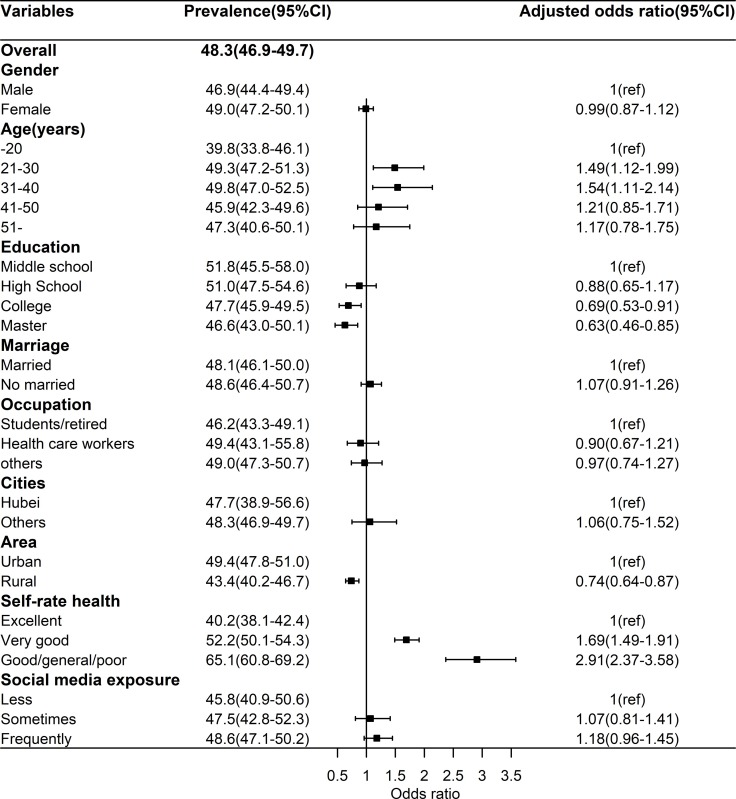
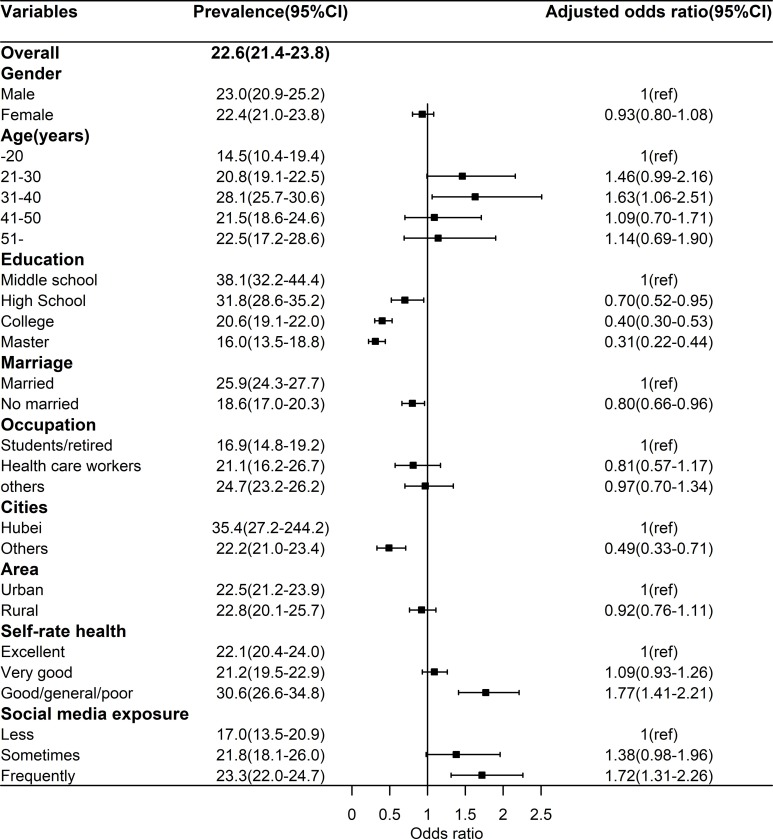
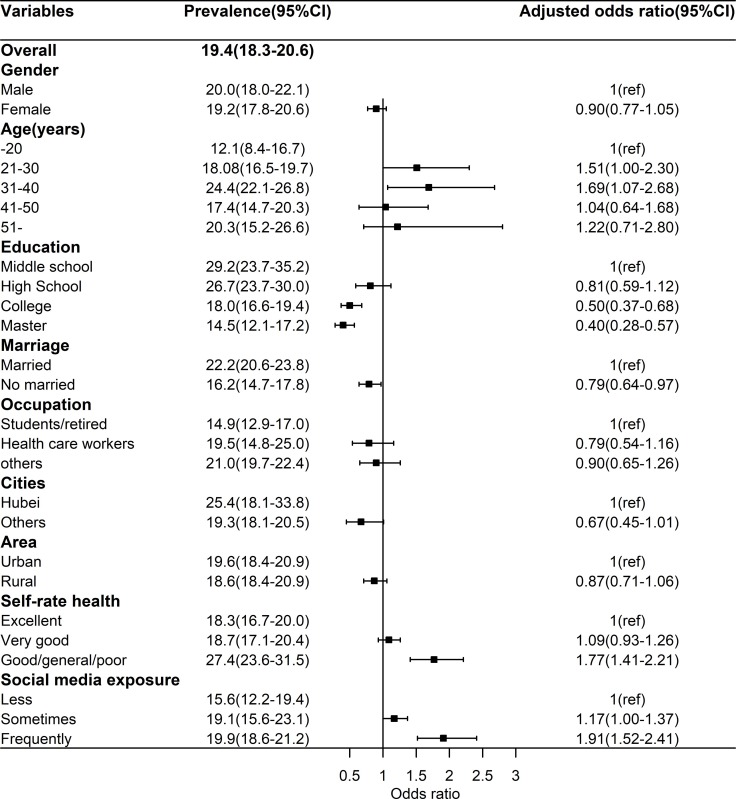
Huge citizens expose to social media during a novel coronavirus disease (COVID-19) outbroke in Wuhan, China. We assess the prevalence of mental health problems and examine their association with social media exposure. A cross-sectional study among Chinese citizens aged≥18 years old was conducted during Jan 31 to Feb 2, 2020. Online survey was used to do rapid assessment. Total of 4872 participants from 31 provinces and autonomous regions were involved in the current study. Besides demographics and social media exposure (SME), depression was assessed by The Chinese version of WHO-Five Well-Being Index (WHO-5) and anxiety was assessed by Chinese version of generalized anxiety disorder scale (GAD-7). multivariable logistic regressions were used to identify associations between social media exposure with mental health problems after controlling for covariates. The prevalence of depression, anxiety and combination of depression and anxiety (CDA) was 48.3% (95%CI: 46.9%-49.7%), 22.6% (95%CI: 21.4%-23.8%) and 19.4% (95%CI: 18.3%-20.6%) during COVID-19 outbroke in Wuhan, China. More than 80% (95%CI:80.9%-83.1%) of participants reported frequently exposed to social media. After controlling for covariates, frequently SME was positively associated with high odds of anxiety (OR = 1.72, 95%CI: 1.31-2.26) and CDA (OR = 1.91, 95%CI: 1.52-2.41) compared with less SME. Our findings show there are high prevalence of mental health problems, which positively associated with frequently SME during the COVID-19 outbreak. These findings implicated the government need pay more attention to mental health problems, especially depression and anxiety among general population and combating with "infodemic" while combating during public health emergency.
Overview
CoChat Summary
## TL;DR
This cross-sectional online survey of 4,872 Chinese adults during the COVID-19 outbreak found high prevalence of depression, anxiety, and co-occurring depression/anxiety. Frequent social media exposure was positively associated with anxiety and with the combination of depression and anxiety, but not significantly with depression alone after adjustment.
## Key findings
- Among 4,827 participants in the results, the prevalence was 48.3% for depression, 22.6% for anxiety, and 19.4% for combination of depression and anxiety (CDA).
- 82.0% of participants reported frequent social media exposure; only 8.8% reported less exposure and 9.2% reported sometimes exposure.
- After controlling for covariates, frequent SME was associated with higher odds of anxiety (OR = 1.72, 95% CI 1.31–2.26) and CDA (OR = 1.91, 95% CI 1.52–2.41) compared with less SME.
- Frequent SME was not significantly associated with depression after adjustment.
- Depression, anxiety, and CDA were all reported as much higher than the cited national sample estimates in China during the same period.
## Methods
- Design: Cross-sectional online survey conducted Jan 31 to Feb 2, 2020 during the COVID-19 outbreak.
- Sample/data: Chinese citizens aged 18 years or older recruited via the Wenjuanxing platform; 5,851 participated and 4,872 completed questionnaires from 31 provinces and autonomous regions were included.
- Measures/analysis: Depression was assessed with the WHO-5 (score <13), anxiety with the GAD-7 (score ≥10), and social media exposure was categorized as less, sometimes, or frequently. The authors used chi-square/trend tests and multivariable logistic regression adjusting for demographic and other covariates.
## Limitations
- The paper states that, because the study is cross-sectional, it is difficult to determine causal relationships between SME and mental health.
- The paper notes possible respondent bias from the online survey, including few elder citizens’ participation.
- The paper states that residual confounding from unmeasured factors cannot be excluded.
- Evident from the text: the sample was online and self-selected, so it may not be fully representative of all Chinese adults.
Model-written summary. Check it against the paper before relying on it.
Integrity signals
Registry
Cites
Statistics
Figures
Verification
Claims the paper makes
7 Valid · 1 Not valid · 6 Not checked · 13 Own results and interpretations
The cited sources support only part of this claim — read each source’s verdict below.
In the paper
“It indicated that participants from Hubei province- the infectious focus directly expose to public health emergency, and may suffer more mental health problemes[17,19].”
§ Mental health problems and social media exposure during COVID-19 outbreak > Discussion
What the sources say
- Not checked — no full text of the sourcecites [17] Xie Z, Xu J, Wu Z. Mental health problems among survivors in hard-hit areas of the 5.12 Wenchuan and 4.20 Lushan earthquakes. J Ment Health 2017; 26(1): 43– 9. 10.1080/09638237.2016.1276525 28084103 source
- Partly supportedcites [19] Mak IW, Chu CM, Pan PC, Yiu MG, Chan VL. Long-term psychiatric morbidities among SARS survivors. Gen Hosp Psychiatry 2009; 31(4): 318– 26. 10.1016/j.genhosppsych.2009.03.001 19555791 PMC7112501 sourceExperimental — accuracy not yet measured
The Introduction describes SARS survivors as direct victims of an outbreak, and the Results (Subgroup analysis of HCWs; page unavailable) report more chronic PTSD among health care workers than other survivors. This supports the general possibility of greater mental-health burden with outbreak exposure, but the paper studies SARS survivors in Hong Kong, not participants from Hubei province or a comparison based on residence in an infectious focus. (LLM, conf=0.82)
hedgedstates a possible cause- Asserted: passes — The authors put it forward as true.
- Checkable: passes — It can be checked against evidence.
- Load-bearing: passes — The paper’s conclusions depend on it.
- Based: passes — The paper gives a reason why it holds.
The cited sources that could be checked couldn’t confirm or dispute this claim.
In the paper
“Besides, many citizens expressed their negative feelings, such as fear, worry, nervous, anxiety et al. on social media, which are contagious social network[21,22].”
§ Mental health problems and social media exposure during COVID-19 outbreak > Discussion
What the sources say
- Not checked — no full text of the sourcecites [21] Kramer AD, Guillory JE, Hancock JT. Experimental evidence of massive-scale emotional contagion through social networks. Proc Natl Acad Sci U S A 2014; 111(24): 8788– 90. 10.1073/pnas.1320040111 24889601 PMC4066473 source
- Could not verifycites [22] Niederkrotenthaler T, Stack S, Till B, et al Association of Increased Youth Suicides in the United States With the Release of 13 Reasons Why. JAMA Psychiatry 2019; 76(9): 933– 40. PMC6547137 31141094 sourceExperimental — accuracy not yet measured
The Discussion and Conclusions discuss possible suicide contagion following a fictional television portrayal, using social-media activity to gauge attention to the show. They do not address whether fear, worry, anxiety, or other negative feelings expressed on social media spread through social networks; searches for negative feelings and emotional contagion found no such passage. The indexed passages provide section labels but no page numbers. (LLM, conf=0.77)
plainstates a cause- Asserted: passes — The authors put it forward as true.
- Checkable: passes — It can be checked against evidence.
- Load-bearing: passes — The paper’s conclusions depend on it.
- Based: passes — The paper gives a reason why it holds.
The sources with a verdict support this claim; the rest weren’t checked yet, have no full text we could read, or their verdicts aren’t rated yet.
In the paper
“These findings are consistent with the previous studies’ that exposing public health emergency can cause public mental health problems, such as Wenchuan and Lushan earthquakes[17], 2014 Ebola Outbreak[7,18], and SARS[19].”
§ Mental health problems and social media exposure during COVID-19 outbreak > Discussion
What the sources say
- Not checked — no full text of the sourcecites [17] Xie Z, Xu J, Wu Z. Mental health problems among survivors in hard-hit areas of the 5.12 Wenchuan and 4.20 Lushan earthquakes. J Ment Health 2017; 26(1): 43– 9. 10.1080/09638237.2016.1276525 28084103 source
- Not checked — no full text of the sourcecites [7] Shultz JM, Baingana F, Neria Y. The 2014 Ebola Outbreak and Mental Health: Current Status and Recommended Response. JAMA 2015; 313(6): 567– 8. 10.1001/jama.2014.17934 25532102 source
- Supportedcites [18] Ji D, Ji YJ, Duan XZ, et al Prevalence of psychological symptoms among Ebola survivors and healthcare workers during the 2014–2015 Ebola outbreak in Sierra Leone: a cross-sectional study. Oncotarget 2017; 8(8): 12784– 91. 10.18632/oncotarget.14498 28061463 PMC5355054 source
For the Ebola example attributed to this source, the Discussion reports pronounced psychological symptoms among Ebola survivors and Sierra Leonean healthcare workers exposed during the outbreak. The Introduction also describes public fear and panic. The earthquake and SARS examples have separate citations and are not attributed to this paper. (LLM, conf=0.90)
- Supportedcites [19] Mak IW, Chu CM, Pan PC, Yiu MG, Chan VL. Long-term psychiatric morbidities among SARS survivors. Gen Hosp Psychiatry 2009; 31(4): 318– 26. 10.1016/j.genhosppsych.2009.03.001 19555791 PMC7112501 source
The citation is attached to SARS, not to the earthquakes or Ebola outbreak. The Discussion (Clinical implications) states that SARS can cause significant, prolonged psychiatric problems, and the Discussion (Range of psychiatric disorders and functional outcome) identifies PTSD, depression, and anxiety disorders among survivors. (LLM, conf=0.90)
plainstates a cause- Asserted: passes — The authors put it forward as true.
- Checkable: passes — It can be checked against evidence.
- Load-bearing: unclear — It is unclear whether the paper’s conclusions depend on it.
- Based: passes — The paper gives a reason why it holds.
A result the paper reports from its own data — it cites no other source for it, so there is none to check. The quote shows it is in the paper.
In the paper
“higher frequency of SME was insignificantly positively associated with the adjusted odds of depression after controlling for all covariates.”
§ Mental health problems and social media exposure during COVID-19 outbreak > Results > Depression and SME
plainstates an association- Asserted: passes — The authors put it forward as true.
- Checkable: passes — It can be checked against evidence.
- Load-bearing: passes — The paper’s conclusions depend on it.
- Based: passes — The paper gives a reason why it holds.
A result the paper reports from its own data — it cites no other source for it, so there is none to check. The quote shows it is in the paper.
In the paper
“After controlling for covariates, frequently SME was positively associated with high odds of anxiety (OR = 1.72, 95%CI: 1.31–2.26) and CDA (OR = 1.91, 95%CI: 1.52–2.41) compared with less SME.”
- Also stated in: § Combination of depression and anxiety and SME · plain
“frequently SME can increase the adjusted odds (OR = 1.91, 95%CI: 1.52–2.41) of CDA compared with less SEM after controlling for all covariates.”
- Also stated in: § Discussion · plain
“frequently SME associated high odds of anxiety and CDA”
§ Mental health problems and social media exposure during COVID-19 outbreak > Abstract Huge citizens expose to social media during a novel coronavirus disease (COVID-19) outbroke in Wuhan, China. We assess the prevalence of mental health problems and examine their association with social media exposure. A cross-sectional study among Chinese citizens aged≥18 years old was conducted during Jan 31 to Feb 2, 2020. Online survey was used to do rapid assessment. Total of 4872 participants from 31 provinces and autonomous regions were involved in the current study. Besides demographics and social media exposure (SME), depression was assessed by The Chinese version of WHO-Five Well-Being Index (WHO-5) and anxiety was assessed by Chinese version of generalized anxiety disorder scale (GAD-7). multivariable logistic regressions were used to identify associations between social media exposure with mental health problems after controlling for covariates. The prevalence of depression, anxiety and combination of depression and anxiety (CDA) was 48.3% (95%CI: 46.9%-49.7%), 22.6% (95%CI: 21.4%-23.8%) and 19.4% (95%CI: 18.3%-20.6%) during COVID-19 outbroke in Wuhan, China. More than 80% (95%CI:80.9%-83.1%) of participants reported frequently exposed to social media. After controlling for covariates, frequently SME was positively associated with high odds of anxiety (OR = 1.72, 95%CI: 1.31–2.26) and CDA (OR = 1.91, 95%CI: 1.52–2.41) compared with less SME. Our findings show there are high prevalence of mental health problems, which positively associated with frequently SME during the COVID-19 outbreak. These findings implicated the government need pay more attention to mental health problems, especially depression and anxiety among general population and combating with “infodemic” while combating during public health emergency.
plainstates an associationn = 4,872- Asserted: passes — The authors put it forward as true.
- Checkable: passes — It can be checked against evidence.
- Load-bearing: passes — The paper’s conclusions depend on it.
- Based: passes — The paper gives a reason why it holds.
- Also stated in: § Combination of depression and anxiety and SME · plain
10 more claims
Create a free account to see all 27 claims and every source verdict.
- Probably not a substantial claim. 8
- It may state two separate claims as one. 4
- The quote only partly states this claim. 1
Claims other papers make about this one
Each is checked against this paper’s own text: does it say what the citing paper says it does?
The source backs part of the claim, not all of it — or backs it for a different population, condition or comparison.
In the citing paper
“In the current pandemic, the additional layer of extensive social media use and exposure to often sensationalized online news while in physical isolation may add new complexities to implementing emotional epidemiology in managing concerns, fears, and misconceptions [96,97], as these tools have been argued to bear negative effects on psychological well-being [97,98].”
From Psychosocial Effects of the COVID-19 Pandemic: Large-scale Quasi-Experimental Study on Social Media (2020) · cites this paper as [96]
Experimental — accuracy not yet measuredThe source backs part of the claim, not all of it — or backs it for a different population, condition or comparison.
In the citing paper
“Recent research has shown that, in the general public, the COVID-19 pandemic is associated with greater levels of psychological distress and a range of psychopathological problems such as depression, anxiety, and post-traumatic stress symptoms (e.g., Gao et al., 2020; Qiu et al., 2020; Wang et al., 2020).”
From Why did all the toilet paper disappear? Distinguishing between panic buying and hoarding during COVID-19 (2021) · cites this paper as Gao et al., 2020
Experimental — accuracy not yet measuredThe source backs part of the claim, not all of it — or backs it for a different population, condition or comparison.
In the citing paper
“Misleading content overload and the distortion of information affect users' stress levels and create mental health problems (Gao et al., 2020).”
From The Psycho-Emotive Effects of AI-Generated Fake News on Social Media Users (2026) · cites this paper as Gao et al., 2020
Experimental — accuracy not yet measuredThe source backs part of the claim, not all of it — or backs it for a different population, condition or comparison.
In the citing paper
“It is known that exposure to news about the process on social media also increases the levels of psychological distress and that the use of social media is higher in young people.[47]”
From Psychological Distress of Breast Cancer Survivors During the COVID-19 Pandemic and Related Factors: A Controlled Study. (2023) · cites this paper as [47]
Experimental — accuracy not yet measuredThe source backs part of the claim, not all of it — or backs it for a different population, condition or comparison.
In the citing paper
“Studies have concluded that perceived poor health status during the COVID-19 period is associated with increased anxiety levels.[47]”
From Psychological Distress of Breast Cancer Survivors During the COVID-19 Pandemic and Related Factors: A Controlled Study. (2023) · cites this paper as [47]
Experimental — accuracy not yet measured
4 more claims about this paper
Create a free account to see every claim other papers make about this one.
Self-check
Percentages, sums and reported differences re-computed from the paper’s own numbers.
Each contradiction between two passages listed here was confirmed by an independent check.
Rated major: it would touch a result — a value a result rests on, reported and recomputed p-values on opposite sides of the significance level, two passages that conflict with no sign which is right, or a cited work retracted before this paper was published.
In the paper
§ Mental health problems and social media exposure during COVID-19 outbreak > Materials and methods > Design and participants
“After removing the participants without completed questionnaires, 4872 participants from 31 provinces and autonomous regions were involved in the current study.”
§ Mental health problems and social media exposure during COVID-19 outbreak > Results > Social media exposure
“Of all 4827 participants, the mean age of was 32.3±10.0 years (ranged 18–85),”
Rated minor: it would not touch a result — a value no result rests on, a p-value that stays on the same side of the significance level, or a conflict that is clerical, resolved elsewhere in the paper, or outside its own findings.
In the paper
§ Mental health problems and social media exposure during COVID-19 outbreak > Abstract
“Total of 4872 participants from 31 provinces and autonomous regions were involved in the current study.”
§ Mental health problems and social media exposure during COVID-19 outbreak > Results > Social media exposure
“Of all 4827 participants, the mean age of was 32.3±10.0 years (ranged 18–85), the proportion of “less”, “sometimes”, and “frequently” of SME was 8.8%(95%CI:8.0%-9.6%), 9.2%(95%CI:8.4%-10.0%) and 82.0%(95%CI:80.9%-83.1%).”
Citations
Cites
A Brief Measure for Assessing Generalized Anxiety Disorder: The GAD-7
Spitzer, R. L., Kroenke, K., Williams, J. B. W., & Löwe, B. (2006) · Archives of Internal Medicine · doi:10.1001/archinte.166.10.1092 · Cited by 31,765 · cited 2×
“Anxiety was assessed by Chinese version of generalized anxiety disorder scale (GAD-7) [15, 16] , which consists 7 symptoms.”
BackgroundMethodExperimental evidence of massive-scale emotional contagion through social networks
Kramer, A. D. I., Guillory, J. E., & Hancock, J. T. (2014) · Proceedings of the National Academy of Sciences · doi:10.1073/pnas.1320040111 · Cited by 3,687 · cited 1×
“on social media, which are contagious social network[21,22].”
BackgroundPrevalence of mental disorders in China: a cross-sectional epidemiological study
Huang, Y., Wang, Y., Wang, H., Liu, Z., Yu, X., Yan, J., Yu, Y., Kou, C., Xu, X., Lu, J., et al. (2019) · The Lancet Psychiatry · doi:10.1016/s2215-0366(18)30511-x · Cited by 2,335 · cited 2×
“So, the current study aims to describes the prevalence and distribution of two major mental disorders-anxiety and depression among Chinese population [13], and examine their associations with social media exposure by rapid assessment during COVID-19 outbreak.”
BackgroundSelf-citationThe mental health of medical workers in Wuhan, China dealing with the 2019 novel coronavirus.
Kang, L., Li, Y., Hu, S., Chen, M., Yang, C., Yang, B. X., Wang, Y., Hu, J., Lai, J., Ma, X., et al. (2020) · The Lancet Psychiatry · doi:10.1016/s2215-0366(20)30047-x · Cited by 2,061 · cited 8×
“%) during COVID-19 outbroke in Wuhan, China.”
BackgroundInfluentialSelf-citation2019-nCoV epidemic: Address mental health care to empower society
Bao, Y., Sun, Y., Meng, S., Shi, J., & Lu, L. (2020) · The Lancet · doi:10.1016/s0140-6736(20)30309-3 · Cited by 2,038 · cited 11×
“%) during COVID-19 outbroke in Wuhan, China.”
BackgroundInfluentialShigemura, J., Ursano, R. J., Morganstein, J. C., Kurosawa, M., & Benedek, D. M. (2020) · Psychiatry and Clinical Neurosciences · doi:10.1111/pcn.12988 · Cited by 1,959 · cited 1×
“The outbreak of COVID-19 in China has caused mental health problems among the public in China[3] and Japan[4] and medical workers in Wuhan[5].”
BackgroundLong-term psychiatric morbidities among SARS survivors
Mak, I. W. C., Chu, C. M., Pan, P. C., Yiu, M. G. C., & Chan, V. L. (2009) · General Hospital Psychiatry · doi:10.1016/j.genhosppsych.2009.03.001 · Cited by 1,018 · cited 2×
“It indicated that participants from Hubei province- the infectious focus directly expose to public health emergency, and may suffer more mental health problemes[17,19].”
BackgroundResultThe 2014 Ebola Outbreak and Mental Health: Current Status and Recommended Response
Shultz, J. M., Baingana, F., & Neria, Y. (2015) · JAMA · doi:10.1001/jama.2014.17934 · Cited by 324
Ji, D., Ji, Y.-J., Duan, X.-Z., Li, W.-G., Sun, Z.-Q., Song, X.-A., Meng, Y.-H., Tang, H.-M., Chu, F., Niu, X.-X., et al. (2017) · Oncotarget · doi:10.18632/oncotarget.14498 · Cited by 257 · cited 1×
“These findings are consistent with the previous studies’ that exposing public health emergency can cause public mental health problems, such as Wenchuan and Lushan earthquakes[17], 2014 Ebola Outbreak[7,18], and SARS[19].”
ResultThe impact of social media on risk perceptions during the MERS outbreak in South Korea
Choi, D.-H., Yoo, W., Noh, G.-Y., & Park, K. (2017) · Computers in Human Behavior · doi:10.1016/j.chb.2017.03.004 · Cited by 246 · cited 1×
“A previous study also shown social media exposure may positively related to forming risk perceptions during the MERS outbreak in South Korea [12] .”
Result
Research works printed but not linked: 2
- Florian Roth, Brönnimann G. Focal Report 8: Risk Analysis Using the Internet for Public Risk Communication. https://www.researchgate.net/publication/256126259. (accessed Feb 12, 2020)
- Xu WF PY, Chen BQ. Assessment of Anxiety and Depression by Self-rating Scales of GAD-7 and PHQ-9 in Cardiovascular Outpatients. World Latest Medicine Information (Electronic Version), 2018, 18(16): 12– 14. (in Chinese)
Cited by
Items 2,101–2,200 of 2,694
Mental Health during Covid-19 Pandemic
Saravanan, R. A. (2020) · INDIAN JOURNAL OF MENTAL HEALTH AND NEUROSCIENCES · doi:10.32746/10.32746/ijmhns.2020.v3.i2.67 · Cited by 5
Indonesian Uncertainty on Tourism Components in the New Normal Period and the Ability to Travel Soon
Hakim, I. N., Koesfardani, C. F. P. P., & Amory, I. D. G. R. A. (2021) · Jurnal Humaniora · doi:10.22146/jh.66879 · Cited by 1
YILDIRIM, T. A., & ÖZTÜRK, Ş. Ş. (2021) · Turkish Journal of Family Medicine & Primary Care · doi:10.21763/tjfmpc.968006 · Cited by 1
David, J.-C., Nadarajah, K., Niang, A., Delouvée, S., Goyette, M., Bordel, S., & Somat, A. (2021) · Infectious Disease Reports · doi:10.3390/idr13040089 · Cited by 3
Impact of The Covid -19 Pandemic on Mental Health in Society
Sulistyaningsih, A. (2021) · Muhammadiyah International Public Health and Medicine Proceeding · doi:10.53947/miphmp.v1i1.69 · Cited by 1
COVID-19 Phobia Of Emergency And Disaster Management Students
Tercan, B. (2021) · Gevher Nesibe Journal IESDR · doi:10.46648/gnj.289 · Cited by 1
Ayurveda and COVID 19 pandemic in Nepal
Healer, T. (2020) · The Healer · doi:10.51649/healer.13 · Cited by 1
Body-related predictors of depression: a cross-sectional study among adults during COVID-19
Modrzejewska, J., Modrzejewska, A., & Czepczor‐Bernat, K. (2022) · Advances in Mental Health · doi:10.1080/18387357.2021.2022501 · Cited by 1
Uso de las ciencias del comportamiento en políticas públicas: perspectivas desde la pandemia
Abrevaya, S., Putrino, N., Tomio, A., Bibbo, D., Yoris, A., & Ramenzoni, V. C. (2022) · Revista Iberoamericana ConCiencia. · doi:10.32654/concienciaepg.7-1.7
Kusumawaty, I., Suzanna, S., Yunike, Y., Marlinda, M., & Upoyo, A. S. (2022) · Open Access Macedonian Journal of Medical Sciences · doi:10.3889/oamjms.2022.8654 · Cited by 2
Coronaphobia and Its Impact on Quality of Life in a Sample of the General Population of Saudi Arabia
Hussien, R. M. (2022) · Egyptian Journal of Health Care · doi:10.21608/ejhc.2022.222638 · Cited by 1
Percepción de tiempo, salud mental en tiempos de pandemia por COVID-19 y cuarentenas
Camargo, A., & Vargas, R. (2022) · Universidad y Salud · doi:10.22267/rus.222402.272 · Cited by 8
Mental Health of Healthcare Workers During the COVID-19 Pandemic
Katsuta, N. (2022) · Juntendō Igaku/Juntendo igaku · doi:10.14789/jmj.jmj21-0032-r · Cited by 1
Suzanna, S., Natosba, J., & Fatriansari, A. (2022) · Jurnal Aisyah Jurnal Ilmu Kesehatan · doi:10.30604/jika.v7i1.823 · Cited by 2
Influential factors for COVID-19 related distancing in daily life: a distinct focus on ego-gram
Kim, K.-M., & Rhee, H.-S. (2022) · BMC Public Health · doi:10.1186/s12889-022-13336-0 · Cited by 1
EVIDÊNCIAS CIENTÍFICAS ACERCA DO IMPACTO DAS MÍDIAS SOCIAIS NO ENFRENTAMENTO DA PANDEMIA DA COVID-19
Araújo, A. H., Silva, I. L., & dos Santos, R. L. (2020) · Revista Interfaces Saúde Humanas e Tecnologia · doi:10.16891/2317-434x.v8.e3.a2020.pp766-774 · Cited by 5
EKSISTENSI PANDEMI COVID-19 DALAM STUDI MASALAH SOCIAL DI INDONESIA
Syamsuni, H. R., Elli, E., Rismawati, R., & Sumarni, S. (2022) · JURNAL SOSIAL HUMANIORA · doi:10.30997/jsh.v13i1.4543 · Cited by 1
Luo, J., Zhang, Y., & Song, Y. (2022) · Frontiers in Public Health · doi:10.3389/fpubh.2022.800789 · Cited by 3
Liu, C., Tang, J., Shen, C., Zhan, X., Bu, E., Shen, B., & Huang, W. (2022) · Frontiers in Psychology · doi:10.3389/fpsyg.2022.891778 · Cited by 1
Dobiała, E., Gulczyńska, A., Małecki, R., Efremova, P., Ławicka, J., Karmolińska-Jagodzik, E., & Kirillov, I. (2022) · International Journal of Environmental Research and Public Health · doi:10.3390/ijerph19127361 · Cited by 1
PANDAS@TamilNLP-ACL2022: Emotion Analysis in Tamil Text using Language Agnostic Embeddings
Divyasri, K., Gayathri, G. L., Swaminathan, K., Thenmozhi, D., Bharathi, B., & Kumar, B. S. (2022) · Workshop on Speech, Vision, and Language Technologies for Dravidian Languages (DravidianLangTech) · doi:10.18653/v1/2022.dravidianlangtech-1.17 · Cited by 1
Masters Program in Public Health, U. S. M., Fresna, R. H., Murti, B., Masters Program in Public Health, U. S. M., & Prasetya, H. (2021) · Journal of Epidemiology and Public Health · doi:10.26911/jepublichealth.2021.06.03.12 · Cited by 1
Oshagh, M., Najafi, H. Z., Jafarzadeh, H., Gholinia, F., Dalaie, K., & Jahanbazi, H. (2022) · Journal of Education and Health Promotion · doi:10.4103/jehp.jehp_633_21 · Cited by 1
孙, 洋. (2022) · Advances in Applied Mathematics · doi:10.12677/aam.2022.118530 · Cited by 1
Yao, J., Irshad, M. J., Irshad, M., Khalil, I., Zahoor, S., Akram, M., Saeed, M. M., Jafari-Sales, A., Elbossaty, W. F., Saïd, M. B., et al. (2022) · Medicine · doi:10.1097/md.0000000000029485 · Cited by 1
Fatores de vulnerabilidade para o sofrimento psicológico durante o distanciamento social
Dalcin, L. R., Neto, J. L. F., & Guzella, M. D. S. (2022) · Psicologia - Teoria e Prática · doi:10.5935/1980-6906/eptpcp14194.pt · Cited by 1
Ozden-Yıldırım, M. S. (2022) · Global Journal of Guidance and Counseling in Schools Current Perspectives · doi:10.18844/gjgc.v12i1.7053 · Cited by 1
Jackson, A., Weaver, R. H., Weybright, E. H., Lanigan, J. D., Parker, L. A., Iniguez, A., & Decker, A. (2022) · Journal of Prevention and Health Promotion · doi:10.1177/26320770221096839 · Cited by 2
Passos, A. A., DeJesus, B. M., Santos, H. F., & Teixeira-Machado, L. (2022) · Research Society and Development · doi:10.33448/rsd-v11i12.34551 · Cited by 1
Arumugam, V., Annie, I. K., & John William Felix, A. (2022) · International Journal of Community Medicine and Public Health · doi:10.18203/2394-6040.ijcmph20222969
Anxiety Level in Covid-19 Survivors
Das, H., Maco, R., Balamurugan, G., et al. (2022) · International Journal of Psychiatric Nursing · doi:10.37506/ijpn.v9i1.18829 · Cited by 1
Work, Depression and Pandemic Stress in Times of COVID-19 in Buenos Aires, Argentina
Caccia, P. A., Grandis, C. D., Elgier, Á. M., & Múlgura, T. N. (2022) · Interpersona An International Journal on Personal Relationships · doi:10.5964/ijpr.7027 · Cited by 1
Saúde Mental e Avaliação Psicológica Durante a Pandemia de Covid-19: Revisão Sistemática
Scortegagna, S. A., de Lima, E. D. S., Marchi, A. C. B. D., & Portella, M. R. (2022) · Psicologia Teoria e Pesquisa · doi:10.1590/0102.3772e38425.pt · Cited by 4
Ansiedad, depresión y TEPT durante el confinamiento: un estudio longitudinal
Universidad de Murcia, F. D. P., Vicente-Escudero, J. L., Melchor, A., & Universidad de Murcia, F. D. P. (2022) · Avances en Psicología · doi:10.33539/avpsicol.2022.v30n2.2595 · Cited by 2
METAFORA PADA IKLAN LAYANAN MASYARAKAT COVID-19
Nurbani, S., & Barlian, Y. A. (2022) · Semantik · doi:10.22460/semantik.v11i2.p135-148 · Cited by 1
Llovet, I., Dinardi, G., Esteban, D., & Gustavo, A. (2022) · Annals of Public Health Reports · doi:10.36959/856/536
Prevalence Of Sleep Disorders Among Physicians And Nurses During COVID-19 Pandemic
Karnaukhov, V. E., Narodova, E. A., Демко, И. В., Shnayder, N. A., Народова, В. В., Дмитренко, Д. В., & Nasyrova, R. F. (2022) · Russian Open Medical Journal · doi:10.15275/rusomj.2022.0301 · Cited by 1
Emergence of first manic episode in recovered COVID-19 patients: A case series from Egypt
Elgohary, H. M., Sehlo, M. G., Youssef, U. M., & Abdelghani, M. (2023) · International Journal of Health Sciences · doi:10.21608/ijhegy.2023.190477.1004
HUBUNGAN MEDIA SOSIAL DAN KECEMASAN PADA MAHASISWA FK UISU
Sutriani, & Rahmadhani, M. (2023) · Jurnal Kedokteran STM (Sains dan Teknologi Medik) · doi:10.30743/stm.v6i1.347 · Cited by 5
FACTORS ASSOCIATED WITH DEPRESSION AND ANXIETY IN YOUNG ADULTS IN METROPOLITAN CITY
Asih, D. R., Askin, A. N. H., & Nisa, H. (2023) · Jurnal Riset Kesehatan · doi:10.31983/jrk.v12i1.9446 · Cited by 5
Perceived Stress During Covid-19 Pandemic: Its Relationship To The Academic Performance Of Students
Demetillo, K. M. A. D., Melitante, K. J. A., & Nabua, E. B. (2023) · ACPES (ASEAN Council of Physical Education and Sport) International Conference (ACPES) · doi:10.4108/eai.28-10-2022.2327404 · Cited by 1
How do Good and Bad News Impact Mood During the Covid-19 Pandemic? The Role of Similarity
Dörnemann, A., Boenisch, N., Schommer, L., Winkelhorst, L., & Wingen, T. (2022) · Journal of European Psychology Students · doi:10.5334/jeps.566 · Cited by 5
(2023) · Pakistan Journal of Humanities and Social Sciences Research · doi:10.37605/pjhssr.v6i1.333
Covid-19 Information on Social Media and Anxiety Disorders in Students
Marpaung, S. P., Alamiyah, S. S., & Sillalahi, T. S. (2021) · JOSAR (Journal of Students Academic Research) · doi:10.35457/josar.v7i1.1543 · Cited by 1
Yigezu, A., Yitayal, M., Mirkuzie, A. H., Getu, Z., & Hailu, A. (2020) · Research Square · doi:10.21203/rs.3.rs-121849/v1 · Cited by 2
Reply to ‘COVID-19 on youth mental health’
Chatterjee, K., & Chauhan, V. S. (2020) · Medical Journal Armed Forces India · doi:10.1016/j.mjafi.2020.10.001 · Cited by 1
An In-depth Review of Privacy Concerns Raised by the COVID-19 PandemicPreprint
Wang, J. (2021) · arXiv (Cornell University) · doi:10.48550/arxiv.2101.10868 · Cited by 3
Vietnamese People’s Well-Being During the COVID-19 Pandemic: An Online SurveyPreprint
Hoang, T. D., Colebunders, R., Fodjo, J. N. S., Nguyen, N. P. T., Trung, T. Đ., & Vo, T. V. (2021) · Preprints.org · doi:10.20944/preprints202103.0646.v1 · Cited by 1
“Please Don’t Hurt Yourself”: Managing Youth Suicide Risk During the COVID-19 Pandemic
Pearson, G. S. (2021) · Journal of the American Psychiatric Nurses Association · doi:10.1177/10783903211023731 · Cited by 1
Yang, Y., & Shigeno, M. (2021) · arXiv.org · doi:10.48550/arxiv.2110.01331 · Cited by 2
Emergence of the first manic episode in recovered COVID-19 patients: A case series from EgyptPreprint
Elgohary, H. M., Sehlo, M. G., Youssef, U. M., & Abdelghani, M. (2021) · Research Square · doi:10.21203/rs.3.rs-964024/v1 · Cited by 1
Lin, B., Zou, L., Duffield, N. G., Mostafavi, A., Cai, H., Zhou, B., Tao, J., Yang, M., Mandal, D., & Abedin, J. (2021) · arXiv (Cornell University) · doi:10.48550/arxiv.2111.03446 · Cited by 1
Leong, F. T. L. (2008) · Sage eBooks · doi:10.4135/9781412963978.n131 · Cited by 1
Zhai, W., Bian, J., Zhang, J., & Bai, X. (2021) · medRxiv · doi:10.1101/2021.12.14.21267757 · Cited by 2
Дунаєва, Л. М., Кононенко, О. І., Смокова, Л. С., Dunaieva, L. M., & Smokova, L. S. (2021) · doi:10.18524/978-617-689-425-4 · Cited by 1
The 2020 Research on Problematic Information on the COVID19 Pandemic. A Systematic Literature ReviewPreprint
Righetti, N., Rossi, L., & Marino, G. (2021) · SocArXiv (OSF Preprints) · doi:10.31235/osf.io/fn3cj · Cited by 2
Thi, H. T., Kitajima, T., Takeshi, S., & Hiroko, M. (2022) · Research Square · doi:10.21203/rs.3.rs-1552849/v1 · Cited by 1
Abdullah, M. F. I. L. B., Yusof, H. A., Shariff, N. M., et al. (2020) · Research Square · doi:10.21203/rs.3.rs-114780/v1 · Cited by 1
The 'Welcomed Lockdown' Hypothesis: When Do Mobility Restrictions Influence Mental Wellbeing?Preprint
Costa‐Font, J., Knapp, M. R. J., & Vilaplana‐Prieto, C. (2022) · SSRN Electronic Journal · doi:10.2139/ssrn.4137953 · Cited by 1
Somasundram, K. G., Hackney, A., Yung, M., Oakman, J., Nowrouzi‐Kia, B., & Yazdani, A. (2022) · Research Square · doi:10.21203/rs.3.rs-1782175/v1 · Cited by 1
Music's manifold emotions for mental well-being: a topological approachPreprint
Darcourt, J. (2023) · Research Square · doi:10.21203/rs.3.rs-3602878/v1 · Cited by 1
Sándor, A. V. (2023) · Eötvös Loránd Tudományegyetem · doi:10.15476/elte.2023.118 · Cited by 1
Zhang, H., Zhang, W., Zhang, W., Li, W., Li, T., & An, C. (2025) · Research Square · doi:10.21203/rs.3.rs-6703030/v1 · Cited by 1
anuk, D. (2023) · Turkish Journal of Oncology · doi:10.5505/tjo.2023.3934
“[47 ] Considering that the COVID-19 virus has entered our lives quickly, it is thought that the information pollution in the media about cancer patients may have affected BCS women without any scientific study yet.”
MethodJavaheri, T., Seidi, K., Jahanban‐Esfahlan, R., & Rawassizadeh, R. (2020) · doi:10.22541/au.158575942.25035807
PSYCHOSOCIAL RISKS FOR MENTAL HEALTH DURING A PANDEMIC
Igumnov, S. A. (2020) · Health Sciences · doi:10.35988/sm-hs.2020.098
Prevalence and predictors of psychological response during immediate covid-19 pandemiaPreprint
Cansel, N., Ucuz, İ., Arslan, A. K., Tetik, B. K., Çolak, C., Melez, A. N. P., Gümüştakım, R. Ş., Ceylan, S., Öztürk, G. Z., rk, Y. K. L. Z., et al. (2020) · doi:10.22541/au.159769413.38035384
V. C. (2021) · Library philosophy and practice · doi:10.5281/zenodo.5139350
COVID-19: infodemia e saúde mental
dos Santos, E. M., & Wysocki, A. D. (2020) · Revista Enfermagem Atual In Derme · doi:10.31011/reaid-2020-v.93-n.0-art.848
Feng, S., & Kirkley, A. (2020) · arXiv (Cornell University) · doi:10.48550/arxiv.2009.10461
Public Perception About Pandemic Risk
Widiyanti, B. L. (2020) · Social Humanities and Educational Studies (SHEs) Conference Series · doi:10.20961/shes.v3i1.45080
The influence of sociodemographic factors on the development of anxiety during the COVID-19 pandemic
Jandrić-Kočić Marijana, C., & Knežević, S. (2020) · Zdravstvena zastita · doi:10.5937/zdravzast49-27391
Askarian, M., Groot, G., Taherifard, E., Taherifard, E., Akbarialiabad, H., Borazjani, R., Askarian, A., & Taghrir, M. H. (2020) · Research Square · doi:10.21203/rs.3.rs-104826/v1
Exploring the Healthy Behaviors of Nigerians during the COVID-19 PandemicPreprint
Eyisi, I. M. (2020) · medRxiv · doi:10.1101/2020.11.25.20235457
Religious Ambience on Social Media: A Case Study in A Pandemic Situation
Bordoloi, P. (2020) · Al-Albab · doi:10.24260/alalbab.v9i2.1788
Immunity and Mental Health: Towards COVID-19
Malhotra, V., Bharshankar, R. N., Mukherjee, S., Gupta, A., & Gautam, N. (2020) · Janaki Medical College Journal of Medical Science · doi:10.3126/jmcjms.v8i2.33978
Mental health in the pandemic context
Nemeş, B. (2020) · Psihiatru ro · doi:10.26416/psih.61.2.2020.3585
Coronavirus and Mental health: A Narrative Review Study
Moeini, F., Dowran, B., & Taheri, N. (2020) · Nurse and Physician within War · doi:10.29252/npwjm.8.26.7 · Cited by 1
Kebede, M. A., Demissie, D. B., Guddu, D. K., Haile, M. T., Bitew, Z. W., & Muleta, M. B. (2020) · doi:10.21203/rs.3.rs-107059/v1
How does COVID-19 change insurance and vaccine demand? Evidence from short-panel data in JapanPreprint
Yamamura, E., & Tsutsui, Y. (2021) · RePEc: Research Papers in Economics · doi:10.48550/arxiv.2101.08922
Gupta, V. K., Mohanty, N., Sahoo, A. R., Choudhury, S., & Nayak, C. (2021) · Homœopathic Links · doi:10.1055/s-0040-1721058 · Cited by 1
The Smokescreen of Media during COVID-19 and Its Perpetual Resolutions: A Thick Description
Adnan, M., Sultana, I., & Hameed, M. B. (2020) · Global Legal Studies Review · doi:10.31703/glsr.2020(v-iv).02
Basics of developing a COVID-19 reopening roadmap, a systematic scoping review of reopening roadmapsPreprint
Askarian, M., Groot, G., Taherifard, E., Taherifard, E., Akbarialiabad, H., Borazjani, R., Askarian, A., & Taghrir, M. H. (2020) · Research Square · doi:10.21203/rs.3.rs-104826/v2
Antenore, M., Rodríguez, J. M. C., & Panizzi, E. (2021) · arXiv.org · doi:10.48550/arxiv.2102.01148 · Cited by 6
Psychological crisis interventions with victims of the coronavirus pandemic
Petrović, N., & Lalevic, N. (2020) · Temida · doi:10.2298/tem2003407p
سامى, ر. (2021) · مجلة البحوث الإعلامیة · doi:10.21608/jsb.2021.150199 · Cited by 1
Blessy, K. S., Lakshmi, T. N. P., Lakshmi, M. B., et al. (2021) · International Journal of Scientific Research in Science and Technology · doi:10.32628/ijsrst218117
Evaluation of Perceived Stress Levels of Radiology Workers Regarding COVID-19 Outbreak
Arslan, H. N., & Soylu, A. İ. (2021) · Bezmialem Science · doi:10.14235/bas.galenos.2020.4893
¿Mejora la comunicación con las redes sociales?
Ugalde, C. (2021) · Obra digital · doi:10.25029/od.2021.312.20
Kebede, M. A., Ayano, G., Bayissa, D., Getachew, A., Bekele, M., Getnet, M., Seyum, M., Molla, A., Demelash, S., Taddesse, G., et al. (2021) · Research Square · doi:10.21203/rs.3.rs-248456/v1 · Cited by 1
COVID-19 Pandemic: Psychological Stress, Ways for Patients to Cope, and Risk Mitigation
Rath, N., Sahai, A. K., & Sood, V. (2021) · International Journal of Current Research and Review · doi:10.31782/ijcrr.2021.sp166 · Cited by 1
Alhwsawi, E. A., Sharahili, A. A., & Ghzwany, A. A. (2021) · International Journal of Medicine in Developing Countries · doi:10.24911/ijmdc.51-1614072366
Planting Seeds of Victory: Creating Shared Meaning while Gardening amidst a Pandemic
Cannon, E., Mulvaney, C., Harlow, E. E., Silvasy, T., Duncan, L., Janney, H., Corbett, H., Hunter, M., Marek, A., & Bailey, M. (2021) · Journal of International Agricultural and Extension Education · doi:10.5191/jiaee.2021.28202 · Cited by 1
Geographical Modules of COVID-19 Pandemic in Bangladesh: Social Response and Action Taken
Alam, M. T., Ashrafuzzaman, M., Showva, N. N., Ahmed, M., Jewel, F. A., & Rahman, M. (2021) · SciMedicine Journal · doi:10.28991/scimedj-2021-03-si-4
Yigezu, A., Mengistu, M., & Mikuzie, A. (2020) · Research Square · doi:10.21203/rs.3.rs-46767/v1
Rodas, J. A., Jara-Rizzo, M. F., & Oleas, D. (2021) · doi:10.31234/osf.io/ykv8r
Mokhtari-Hesari, P., Yarmohammadi, H., Bahabadi, M. R., Moghari1, F. N. M. F. N., Maftoon, F., Tavousi, M., Riazi, H., & Montazeri, A. (2021) · Research Square · doi:10.21203/rs.3.rs-518988/v1
Metadata
- Authors
- Gao, J., Zheng, P., Jia, Y., Chen, H., Mao, Y., Chen, S., Wang, Y., Fu, H., & Dai, J.
- Affiliations
- Fudan University (CN)
- Corresponding author
- Dai, Junming
- ORCID
- Venue
- PLoS ONE
- Publisher
- Public Library of Science (PLoS)
- Published
- 2020-04-16
- Volume
- 15
- Issue
- 4
- Pages
- e0231924
- ISSN
- 1932-6203 (ISSN-L)
- PMC
- PMC7162477
- OpenAlex
- W3011720761
- Semantic Scholar
- e6352661273fcd34e64ee831c1033952c75f1bee
- Cited by
- 2,830
- References
- 14
- Citations by year
- 2026: 55 · 2025: 140 · 2024: 211 · 2023: 392 · 2022: 599 · 2021: 965 · 2020: 463
- FWCI
- 241.45
- Type
- journal article
- Language
- en
- Open access
- gold
- doi.org
- Licence
- Locations
- PLoS ONE (publishedVersion, cc-by)
- SSRN Electronic Journal (publishedVersion)
- PubMed Central (publishedVersion, cc-by)
- PubMed (publishedVersion)
- RePEc: Research Papers in Economics (submittedVersion, cc-by)
- DOAJ (DOAJ: Directory of Open Access Journals) (submittedVersion, cc-by-sa)
- Figshare (submittedVersion, cc-by)
- Funders
- National key R&D Program of China (2018YFC2002000 & 2018YFC2002001)
- National Natural Science Foundation of China (71573048)
- Topics
- Social Sciences › Psychology › Clinical Psychology › COVID-19 and Mental Health
- Social Sciences › Sociology and Political Science › Impact of Technology on Adolescents
- Social Sciences › Communication › Communication and COVID-19 Impact
- Keywords
- COVID-19 pandemic, social media exposure, mental health, depression, anxiety, infodemic, public health emergencies, prevalence, Wuhan
- MeSH terms
- Betacoronavirus, COVID-19, SARS-CoV-2, Adolescent, Adult, Aged, Aged, 80 and over, Anxiety, Depression, Disease Outbreaks, Female, Humans, Male, Mental Health, Middle Aged, Pneumonia, Viral, Coronavirus Infections, Young Adult, Pandemics, Social Media
About these checks
Registry, retraction, Cites and statistics results are computed, not judged, with one exception: a printed reference that no index lists is read once by a model before it counts as a citation error. Claims are extracted by a model and kept only when their quote appears verbatim in the text; each cited source is then checked, with a model’s help, for whether it says what the claim relies on. Those verdicts can be wrong — read the claim’s quote and the cited source before relying on one.
The claim verdicts this report counts are experimental: their accuracy is not yet measured.
A language model drew the claims from the paper on 2026-10-10, under version 3 of the claim definition (model deepseek-v4.1-flash, prompt extract-v3).
A second model labelled each claim on 2026-10-10 (model jev-1.13-20260917, definition revision gold-guideline-v0.2).
Cited sources are checked with a language model’s help (gpt-6-sol).
Statistics and arithmetic are recomputed, not judged.
Confidence bands are shown only for fields calibrated on our annotated test set. None is calibrated yet, so no band is shown.
What counts as a claim ›How we measure confidence ›How we check this ›
Are you an author, or do you see a problem with this page? Request a review
Data sources
Bibliographic data: Semantic Scholar, OpenAlex, Crossref.
Contains information from the Semantic Scholar Academic Graph Datasets, made available under the ODC Attribution License (ODC-BY 1.0).
Semantic Scholar’s data is described in: Kinney, R., et al. (2023). The Semantic Scholar Open Data Platform. arXiv:2301.10140.
