

Transcriptional Regulation of Chemical Diversity in Aspergillus fumigatus by LaeA
Open accessThe DOI matches its Crossref record; 67 of the 67 references it cites were found in a registry or an index.
Abstract
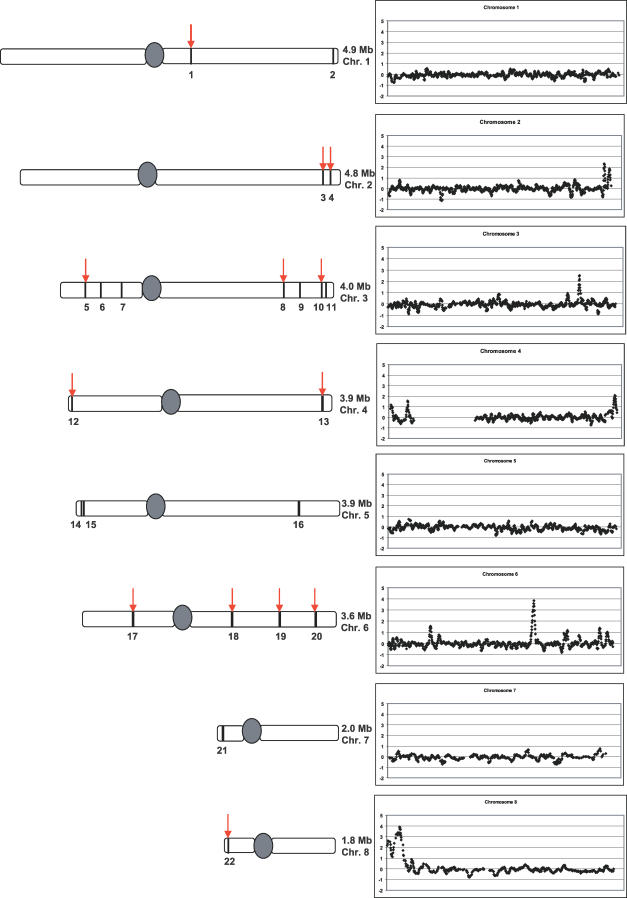
Secondary metabolites, including toxins and melanins, have been implicated as virulence attributes in invasive aspergillosis. Although not definitively proved, this supposition is supported by the decreased virulence of an Aspergillus fumigatus strain, DeltalaeA, that is crippled in the production of numerous secondary metabolites. However, loss of a single LaeA-regulated toxin, gliotoxin, did not recapitulate the hypovirulent DeltalaeA pathotype, thus implicating other toxins whose production is governed by LaeA. Toward this end, a whole-genome comparison of the transcriptional profile of wild-type, DeltalaeA, and complemented control strains showed that genes in 13 of 22 secondary metabolite gene clusters, including several A. fumigatus-specific mycotoxin clusters, were expressed at significantly lower levels in the DeltalaeA mutant. LaeA influences the expression of at least 9.5% of the genome (943 of 9,626 genes in A. fumigatus) but positively controls expression of 20% to 40% of major classes of secondary metabolite biosynthesis genes such as nonribosomal peptide synthetases (NRPSs), polyketide synthases, and P450 monooxygenases. Tight regulation of NRPS-encoding genes was highlighted by quantitative real-time reverse-transcription PCR analysis. In addition, expression of a putative siderophore biosynthesis NRPS (NRPS2/sidE) was greatly reduced in the DeltalaeA mutant in comparison to controls under inducing iron-deficient conditions. Comparative genomic analysis showed that A. fumigatus secondary metabolite gene clusters constitute evolutionarily diverse regions that may be important for niche adaptation and virulence attributes. Our findings suggest that LaeA is a novel target for comprehensive modification of chemical diversity and pathogenicity.
Overview
The claims and statistics of this paper haven’t been checked yet.
Free: it reads the open-access text and checks the first 5 claims that cite a source we can check. Create a free account to check every claim.
Integrity signals
Registry
Cites
Statistics
Figures
Verification
Claims the paper makes
The claims and statistics of this paper haven’t been checked yet.
Free: it reads the open-access text and checks the first 5 claims that cite a source we can check. Create a free account to check every claim.
Claims other papers make about this one
Each is checked against this paper’s own text: does it say what the citing paper says it does?
In the citing paper
“However, only a limited impact of the deletion of the LaeA was seen in experimental murine aspergillosis trials with a laeA mutant (436–438).”
From Aspergillus fumigatus and Aspergillosis in 2019 (2019) · cites this paper as [438]
Self-check
Percentages, sums and reported differences re-computed from the paper’s own numbers.
The self-check needs the paper’s full text.
Citations
Cites
Robust Locally Weighted Regression and Smoothing Scatterplots
Cleveland, W. S. (1979) · Journal of the American Statistical Association · doi:10.1080/01621459.1979.10481038 · Cited by 11,594 · cited 1×
“Prior to statistical analysis, the LOWESS normalization method was used to remove any systematic bias from the raw expression ratios [61].”
MethodIn silico prediction of protein-protein interactions in human macrophages
Souiai, O., Guerfali, F., Ben Miled, S., Brun, C., & Benkahla, A. (2014) · BMC Research Notes · doi:10.1186/1756-0500-7-157 · Cited by 10,803
Significance analysis of microarrays applied to the ionizing radiation response
Tusher, V. G., Tibshirani, R., & Chu, G. (2001) · Proceedings of the National Academy of Sciences · doi:10.1073/pnas.091062498 · Cited by 10,568
TM4: a free, open-source system for microarray data management and analysis
Saeed, A. I., Sharov, V., White, J., Li, J., Liang, W., Bhagabati, N., Braisted, J., Klapa, M., Currier, T., Thiagarajan, M., et al. (2003) · BioTechniques · doi:10.2144/03342mt01 · Cited by 4,837
Aspergillus fumigatus and Aspergillosis
Latgé, J.-P. (1999) · Clinical Microbiology Reviews · doi:10.1128/cmr.12.2.310 · Cited by 2,307 · cited 2×
“Invasive aspergillosis has an associated mortality rate ranging from 50% to 90% depending on the patient population [2].”
BackgroundPfam: clans, web tools and services
Finn, R. D. (2006) · Nucleic Acids Research · doi:10.1093/nar/gkj149 · Cited by 2,302 · cited 1×
“Numbers of genes in the indicated Pfam protein domain categories [65] were subjected to statistical analysis by EASE [64] to identify categories overrepresented compared with the whole genome data set.”
Method[9] TM4 Microarray Software Suite
Saeed, A. I., Bhagabati, N. K., Braisted, J. C., Liang, W., Sharov, V., Howe, E. A., Li, J., Thiagarajan, M., White, J. A., & Quackenbush, J. (2006) · Methods in Enzymology · doi:10.1016/s0076-6879(06)11009-5 · Cited by 1,983 · cited 1×
“tm4.org) [62, 63 ]. This allowed identification of genes whose mean expression across experiments is significantly different from a userspecified mean (log2 ¼ 0, corresponding to identical mRNA levels in the mutant and wild-type strains).”
BackgroundIdentifying biological themes within lists of genes with EASE
Hosack, D. A., Dennis, G., Sherman, B. T., Lane, H. C., & Lempicki, R. A. (2003) · Genome Biology · doi:10.1186/gb-2003-4-10-r70 · Cited by 1,950 · cited 9×
“Fisher’s exact test probabilities and Bonferroni corrected (step-down) probabilities (Bonferroni SD Corr.) are reported from the EASE analysis.”
BackgroundMethodInfluentialFungal secondary metabolism — from biochemistry to genomics
Keller, N. P., Turner, G., & Bennett, J. W. (2005) · Nature Reviews Microbiology · doi:10.1038/nrmicro1286 · Cited by 1,731 · cited 5×
“Alternative models suggest that clusters are maintained due to coregulation mechanisms, likely at the level of chromatin regulation [8,9].”
BackgroundInfluentialSelf-citationGenomic sequence of the pathogenic and allergenic filamentous fungus Aspergillus fumigatus
Nierman, W. C., Pain, A., Anderson, M. J., Wortman, J. R., Kim, H. S., Arroyo, J., Berriman, M., Abe, K., Archer, D. B., Bermejo, C., et al. (2005) · Nature · doi:10.1038/nature04332 · Cited by 1,391 · cited 8×
“The clustering of secondary metabolite biosynthetic genes has been suggested to reflect their evolutionary history [8,9,20,51,56,57].”
BackgroundMethodInfluentialSelf-citation
Cited by
Fungal secondary metabolism: regulation, function and drug discovery
Keller, N. P. (2019) · Nature Reviews Microbiology · doi:10.1038/s41579-018-0121-1 · Cited by 1,390
Self-citationAspergillus fumigatus and Aspergillosis in 2019
Latgé, J.-P., & Chamilos, G. (2019) · Clinical Microbiology Reviews · doi:10.1128/cmr.00140-18 · Cited by 1,400
Regulation of fungal secondary metabolism
Brakhage, A. A. (2013) · Nature Reviews Microbiology · doi:10.1038/nrmicro2916 · Cited by 1,147
One Juliet and four Romeos: VeA and its methyltransferases
Sarikaya-Bayram, Ã., Palmer, J. M., Keller, N., Braus, G. H., & Bayram, Ã. (2015) · Frontiers in Microbiology · doi:10.3389/fmicb.2015.00001 · Cited by 1,148
“In the postgenomic era, understanding the diversity and the molecular control of secondary metabolites (SMs) are two challenging tasks addressed by the research community.”
BackgroundInfluentialSelf-citationPathogenesis of Aspergillus fumigatus in Invasive Aspergillosis
Dagenais, T. R. T., & Keller, N. P. (2009) · Clinical Microbiology Reviews · doi:10.1128/cmr.00055-08 · Cited by 993
Self-citation
Metadata
- Authors
- Perrin, R. M., Fedorova, N. D., Bok, J. W., Cramer, R. A., Wortman, J. R., Kim, H. S., Nierman, W. C., & Keller, N. P.
- Affiliations
- University of Wisconsin–Madison (US)
- Duke Medical Center (US)
- Korea University (KR)
- George Washington University (US)
- Corresponding author
- Keller, Nancy P
- ORCID
- Venue
- PLoS Pathogens
- Publisher
- Public Library of Science (PLoS)
- Published
- 2007-04-13
- Volume
- 3
- Issue
- 4
- Pages
- e50
- ISSN
- 1553-7366 (ISSN-L)
- 1553-7374
- PMC
- PMC1851976
- OpenAlex
- W2018878486
- Cited by
- 352
- References
- 67
- Citations by year
- 2026: 5 · 2025: 7 · 2024: 13 · 2023: 13 · 2022: 15 · 2021: 10 · 2020: 12 · 2019: 18 · 2018: 16 · 2017: 14 · 2016: 22 · 2015: 21 · 2014: 32 · 2013: 24 · 2012: 29
- FWCI
- 18.37
- Type
- journal article
- Language
- en
- Open access
- gold
- doi.org
- Locations
- PLoS Pathogens (publishedVersion, cc-by)
- PubMed Central (publishedVersion, cc-by)
- PubMed (publishedVersion)
- DOAJ (DOAJ: Directory of Open Access Journals) (submittedVersion, cc-by-sa)
- Figshare (submittedVersion, cc-by)
- Funders
- National Science Foundation (0236393)
- National Institutes of Health
- National Institute of Allergy and Infectious Diseases (AI052080, R21AI052236, R01AI065728, AI052236, U01AI048830, T32AI052080)
- Topics
- Life Sciences › Immunology and Microbiology › Applied Microbiology and Biotechnology › Microbial Natural Products and Biosynthesis
- Life Sciences › Biochemistry, Genetics and Molecular Biology › Molecular Biology › Fungal and yeast genetics research
- Life Sciences › Agricultural and Biological Sciences › Plant Science › Mycotoxins in Agriculture and Food
- Keywords
- Aspergillus fumigatus, LaeA, transcriptional regulation, secondary metabolites, invasive aspergillosis, gliotoxin, nonribosomal peptide synthetase, polyketide synthase, cytochrome P450 monooxygenase, siderophore biosynthesis, iron deficiency, virulence, chemical diversity, gene expression profiling
- MeSH terms
- Aspergillus fumigatus, Genes, Fungal, Multigene Family, Iron, Peptide Synthases, RNA, Fungal, RNA, Messenger, Transcription, Genetic, Genetic Variation, Chromosomes, Fungal, Gene Expression Regulation, Fungal, Siderophores, Gene Deletion, Reverse Transcriptase Polymerase Chain Reaction, Oligonucleotide Array Sequence Analysis, Gene Expression Profiling, Genomics
About these checks
Registry, retraction, Cites and statistics results are computed, not judged, with one exception: a printed reference that no index lists is read once by a model before it counts as a citation error. Claims are extracted by a model and kept only when their quote appears verbatim in the text; each cited source is then checked, with a model’s help, for whether it says what the claim relies on. Those verdicts can be wrong — read the claim’s quote and the cited source before relying on one.
Statistics and arithmetic are recomputed, not judged.
Confidence bands are shown only for fields calibrated on our annotated test set. None is calibrated yet, so no band is shown.
What counts as a claim ›How we measure confidence ›How we check this ›
Are you an author, or do you see a problem with this page? Request a review
Data sources
Bibliographic data: Semantic Scholar, OpenAlex, Crossref.
Contains information from the Semantic Scholar Academic Graph Datasets, made available under the ODC Attribution License (ODC-BY 1.0).
Semantic Scholar’s data is described in: Kinney, R., et al. (2023). The Semantic Scholar Open Data Platform. arXiv:2301.10140.
