

In vivo Hypoxia and a Fungal Alcohol Dehydrogenase Influence the Pathogenesis of Invasive Pulmonary Aspergillosis
Open accessThe DOI matches its Crossref record; 84 of the 84 references it cites were found in a registry or an index.
Abstract
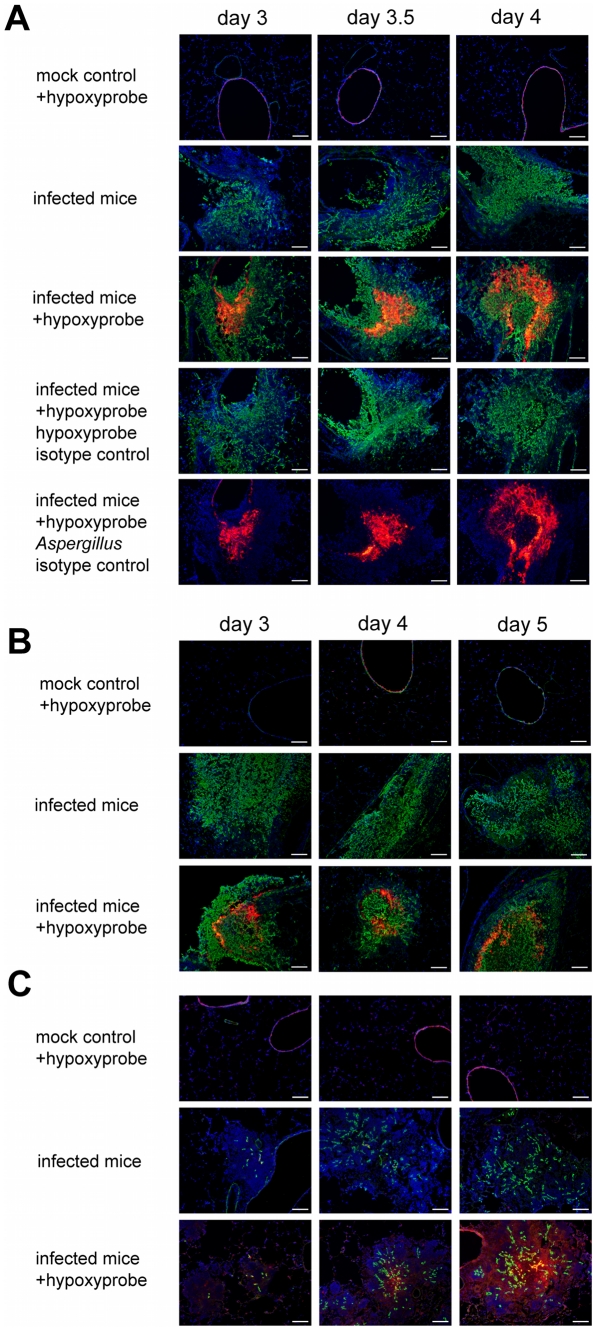
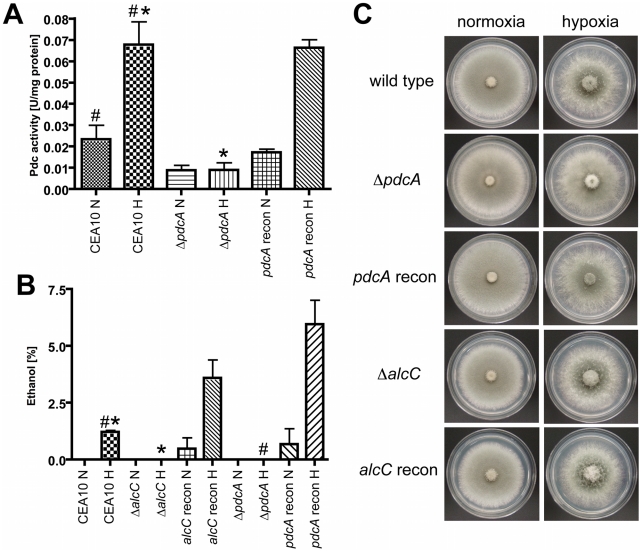
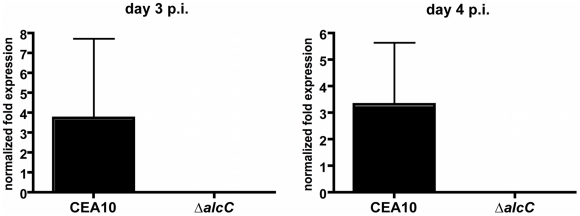
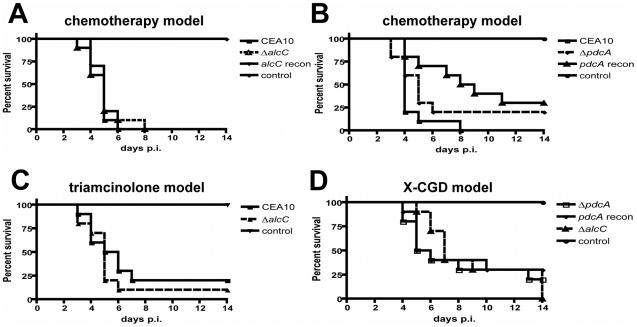
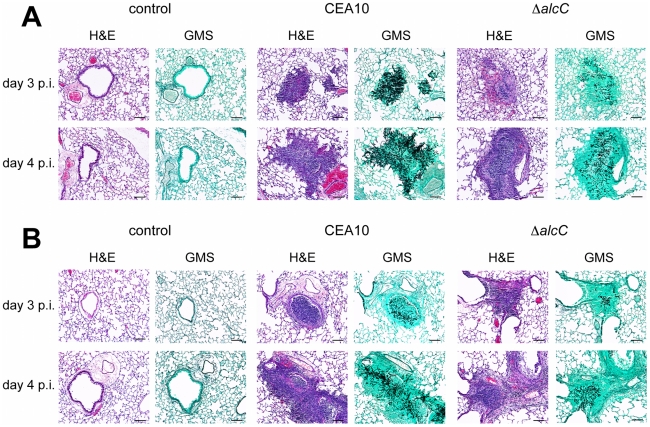
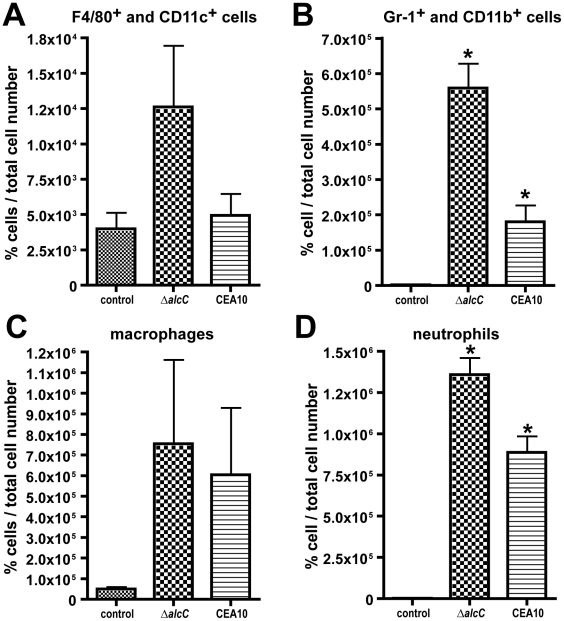
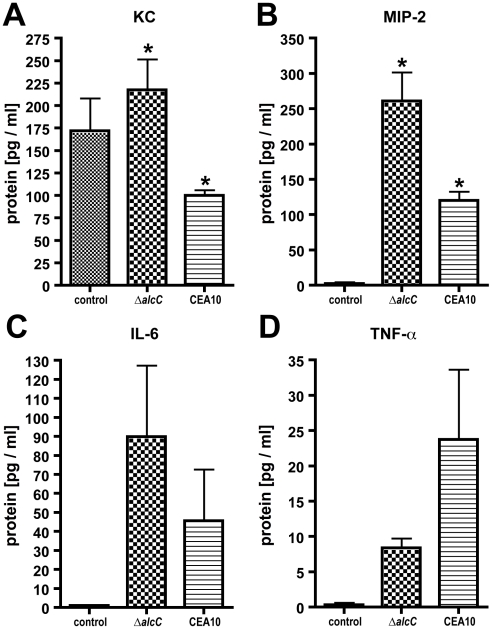
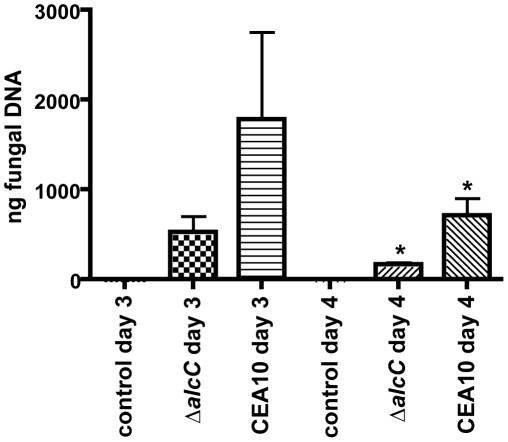
Currently, our knowledge of how pathogenic fungi grow in mammalian host environments is limited. Using a chemotherapeutic murine model of invasive pulmonary aspergillosis (IPA) and (1)H-NMR metabolomics, we detected ethanol in the lungs of mice infected with Aspergillus fumigatus. This result suggests that A. fumigatus is exposed to oxygen depleted microenvironments during infection. To test this hypothesis, we utilized a chemical hypoxia detection agent, pimonidazole hydrochloride, in three immunologically distinct murine models of IPA (chemotherapeutic, X-CGD, and corticosteroid). In all three IPA murine models, hypoxia was observed during the course of infection. We next tested the hypothesis that production of ethanol in vivo by the fungus is involved in hypoxia adaptation and fungal pathogenesis. Ethanol deficient A. fumigatus strains showed no growth defects in hypoxia and were able to cause wild type levels of mortality in all 3 murine models. However, lung immunohistopathology and flow cytometry analyses revealed an increase in the inflammatory response in mice infected with an alcohol dehydrogenase null mutant strain that corresponded with a reduction in fungal burden. Consequently, in this study we present the first in vivo observations that hypoxic microenvironments occur during a pulmonary invasive fungal infection and observe that a fungal alcohol dehydrogenase influences fungal pathogenesis in the lung. Thus, environmental conditions encountered by invading pathogenic fungi may result in substantial fungal metabolism changes that influence subsequent host immune responses.
Overview
The claims and statistics of this paper haven’t been checked yet.
Free: it reads the open-access text and checks the first 5 claims that cite a source we can check. Create a free account to check every claim.
Integrity signals
Registry
Cites
Statistics
Figures
Verification
Claims the paper makes
The claims and statistics of this paper haven’t been checked yet.
Free: it reads the open-access text and checks the first 5 claims that cite a source we can check. Create a free account to check every claim.
Claims other papers make about this one
Each is checked against this paper’s own text: does it say what the citing paper says it does?
In the citing paper
“Specific enzymes and proteins associated with fungal virulence are produced during hypoxic growth (400–404).”
From Aspergillus fumigatus and Aspergillosis in 2019 (2019) · cites this paper as [400]
Self-check
Percentages, sums and reported differences re-computed from the paper’s own numbers.
The self-check needs the paper’s full text.
Citations
Cites
Aspergillus fumigatus and Aspergillosis
Latgé, J.-P. (1999) · Clinical Microbiology Reviews · doi:10.1128/cmr.12.2.310 · Cited by 2,307 · cited 1×
“Among these, invasive pulmonary aspergillosis (IPA) is the most lethal with mortality rates ranging from 30–90% depending on the patient population [6,7,8,9,10,11].”
BackgroundAspergillus fumigatus and Aspergillosis in 2019
Latgé, J.-P., & Chamilos, G. (2019) · Clinical Microbiology Reviews · doi:10.1128/cmr.00140-18 · Cited by 1,400
Genomic sequence of the pathogenic and allergenic filamentous fungus Aspergillus fumigatus
Nierman, W. C., Pain, A., Anderson, M. J., Wortman, J. R., Kim, H. S., Arroyo, J., Berriman, M., Abe, K., Archer, D. B., Bermejo, C., et al. (2005) · Nature · doi:10.1038/nature04332 · Cited by 1,391 · cited 1×
“fumigatus genome sequence for genes encoding enzymes known to be involved in ethanol fermentation [46,47].”
BackgroundPollock, J. D., Williams, D. A., Gifford, M. A. C., Li, L. L., Du, X., Fisherman, J., Orkin, S. H., Doerschuk, C. M., & Dinauer, M. C. (1995) · Nature Genetics · doi:10.1038/ng0295-202 · Cited by 921 · cited 1×
“We first examined the virulence of the DpdcA and DalcC strains in the chemotherapeutic and X-linked chronic granulomatous disease (X-CGD, gp91 mice) murine models of IPA [45,53].”
BackgroundStuder, L., Csete, M., Lee, S.-H., Kabbani, N., Walikonis, J., Wold, B., & McKay, R. (2000) · The Journal of Neuroscience · doi:10.1523/jneurosci.20-19-07377.2000 · Cited by 708 · cited 1×
“With regard to fungal-human interactions, oxygen availability in mammalian tissues is also substantially below atmospheric levels [20,21,22].”
BackgroundTrends in Mortality Due to Invasive Mycotic Diseases in the United States, 1980–1997
McNeil, M. M., Nash, S. L., Hajjeh, R. A., Phelan, M. A., Conn, L. A., Plikaytis, B. D., & Warnock, D. W. (2001) · Clinical Infectious Diseases · doi:10.1086/322606 · Cited by 657
Tissue oxygen tension and brain sensitivity to hypoxia
Erecińska, M., & Silver, I. A. (2001) · Respiration Physiology · doi:10.1016/s0034-5687(01)00306-1 · Cited by 615 · cited 1×
“With regard to fungal-human interactions, oxygen availability in mammalian tissues is also substantially below atmospheric levels [20,21,22].”
BackgroundThe pathobiology of Aspergillus fumigatus
Latgé, J.-P. (2001) · Trends in Microbiology · doi:10.1016/s0966-842x(01)02104-7 · Cited by 546 · cited 1×
“Among these, invasive pulmonary aspergillosis (IPA) is the most lethal with mortality rates ranging from 30–90% depending on the patient population [6,7,8,9,10,11].”
BackgroundUpton, A., Kirby, K. A., Carpenter, P., Boeckh, M., & Marr, K. A. (2007) · Clinical Infectious Diseases · doi:10.1086/510592 · Cited by 514 · cited 1×
“Among these, invasive pulmonary aspergillosis (IPA) is the most lethal with mortality rates ranging from 30–90% depending on the patient population [6,7,8,9,10,11].”
BackgroundGenomic Islands in the Pathogenic Filamentous Fungus Aspergillus fumigatus
Fedorova, N. D., Khaldi, N., Joardar, V. S., Maiti, R., Amedeo, P., Anderson, M. J., Crabtree, J., Silva, J. C., Badger, J. H., Albarraq, A., et al. (2008) · PLoS Genetics · doi:10.1371/journal.pgen.1000046 · Cited by 508 · cited 1×
“fumigatus genome sequence for genes encoding enzymes known to be involved in ethanol fermentation [46,47].”
Background
Cited by
Aspergillus fumigatus and Aspergillosis in 2019
Latgé, J.-P., & Chamilos, G. (2019) · Clinical Microbiology Reviews · doi:10.1128/cmr.00140-18 · Cited by 1,400
Aspergillus fumigatus morphology and dynamic host interactions
van de Veerdonk, F. L., Gresnigt, M. S., Romani, L., Netea, M. G., & Latgé, J.-P. (2017) · Nature Reviews Microbiology · doi:10.1038/nrmicro.2017.90 · Cited by 490
Keeley, T. P., & Mann, G. E. (2019) · Physiological Reviews · doi:10.1152/physrev.00041.2017 · Cited by 329
Aspergillus fumigatus and aspergillosis: From basics to clinics
Arastehfar, A., Carvalho, A., Houbraken, J., Lombardi, L., Garcia-Rubio, R., Jenks, J. D., Rivero-Menendez, O., Aljohani, R., Jacobsen, I. D., Berman, J., et al. (2021) · Studies in Mycology · doi:10.1016/j.simyco.2021.100115 · Cited by 241
Chung, D., Barker, B. M., Carey, C. C., Merriman, B., Werner, E. R., Lechner, B. E., Dhingra, S., Cheng, C., Xu, W., Blosser, S. J., et al. (2014) · PLoS Pathogens · doi:10.1371/journal.ppat.1004487 · Cited by 193
“fumigatus as previously described [7].”
BackgroundMethodInfluentialSelf-citation
Metadata
- Authors
- Grahl, N., Puttikamonkul, S., Macdonald, J. M., Gamcsik, M. P., Ngo, L. Y., Hohl, T. M., & Cramer, R. A.
- Affiliations
- Montana State University (US)
- University of North Carolina at Chapel Hill (US)
- Fred Hutch Cancer Center (US)
- Corresponding author
- Cramer, Robert A.
- Venue
- PLoS Pathogens
- Publisher
- Public Library of Science (PLoS)
- Published
- 2011-07-21
- Volume
- 7
- Issue
- 7
- Pages
- e1002145
- ISSN
- 1553-7366 (ISSN-L)
- 1553-7374
- PMC
- PMC3141044
- OpenAlex
- W2075891899
- Cited by
- 217
- References
- 84
- Citations by year
- 2026: 4 · 2025: 13 · 2024: 12 · 2023: 11 · 2022: 7 · 2021: 18 · 2020: 16 · 2019: 19 · 2018: 17 · 2017: 20 · 2016: 16 · 2015: 13 · 2014: 21 · 2013: 15 · 2012: 13
- FWCI
- 11.05
- Type
- journal article
- Language
- en
- Open access
- gold
- doi.org
- Locations
- PLoS Pathogens (publishedVersion, cc-by)
- Europe PMC (PubMed Central) (publishedVersion, cc-by)
- PubMed Central (publishedVersion, cc-by)
- PubMed (publishedVersion)
- Montana State University ScholarWorks (Montana State University) (submittedVersion, cc-by)
- Carolina Digital Repository (University of North Carolina at Chapel Hill) (submittedVersion, cc-by)
- DOAJ (DOAJ: Directory of Open Access Journals) (submittedVersion, cc-by-sa)
- Figshare (submittedVersion, cc-by)
- UNC Libraries
- Funders
- M.J. Murdock Charitable Trust
- Montana State University
- National Institutes of Health (project 2, RR 020185)
- National Institute of Allergy and Infectious Diseases (R01 AI81838, L40 AI084526, R01AI093808, R01AI081838, R37AI093808)
- National Institute of Environmental Health Sciences (P30ES010126)
- National Center for Research Resources (P20RR020185, RR 020185)
- Topics
- Health Sciences › Medicine › Infectious Diseases › Antifungal resistance and susceptibility
- Life Sciences › Biochemistry, Genetics and Molecular Biology › Molecular Biology › Fungal and yeast genetics research
- Health Sciences › Medicine › Infectious Diseases › Fungal Infections and Studies
- Keywords
- invasive pulmonary aspergillosis, Aspergillus fumigatus, hypoxia, ethanol production, hypoxic microenvironment, fungal pathogenesis, pimonidazole, X-linked chronic granulomatous disease, corticosteroid immunosuppression, lung inflammation, fungal metabolism, host immune response
- MeSH terms
- Alcohol Dehydrogenase, Ethanol, Animals, Hypoxia, Aspergillus fumigatus, Fungal Proteins, Humans, Lung, Mice, Mutant Strains, Mice, Metabolomics, Pulmonary Aspergillosis
About these checks
Registry, retraction, Cites and statistics results are computed, not judged, with one exception: a printed reference that no index lists is read once by a model before it counts as a citation error. Claims are extracted by a model and kept only when their quote appears verbatim in the text; each cited source is then checked, with a model’s help, for whether it says what the claim relies on. Those verdicts can be wrong — read the claim’s quote and the cited source before relying on one.
Statistics and arithmetic are recomputed, not judged.
Confidence bands are shown only for fields calibrated on our annotated test set. None is calibrated yet, so no band is shown.
What counts as a claim ›How we measure confidence ›How we check this ›
Are you an author, or do you see a problem with this page? Request a review
Data sources
Bibliographic data: Semantic Scholar, OpenAlex, Crossref.
Contains information from the Semantic Scholar Academic Graph Datasets, made available under the ODC Attribution License (ODC-BY 1.0).
Semantic Scholar’s data is described in: Kinney, R., et al. (2023). The Semantic Scholar Open Data Platform. arXiv:2301.10140.
