

Filamentous fungal carbon catabolite repression supports metabolic plasticity and stress responses essential for disease progression
Open accessThe DOI matches its Crossref record; 57 of the 57 references it cites were found in a registry or an index.
Abstract
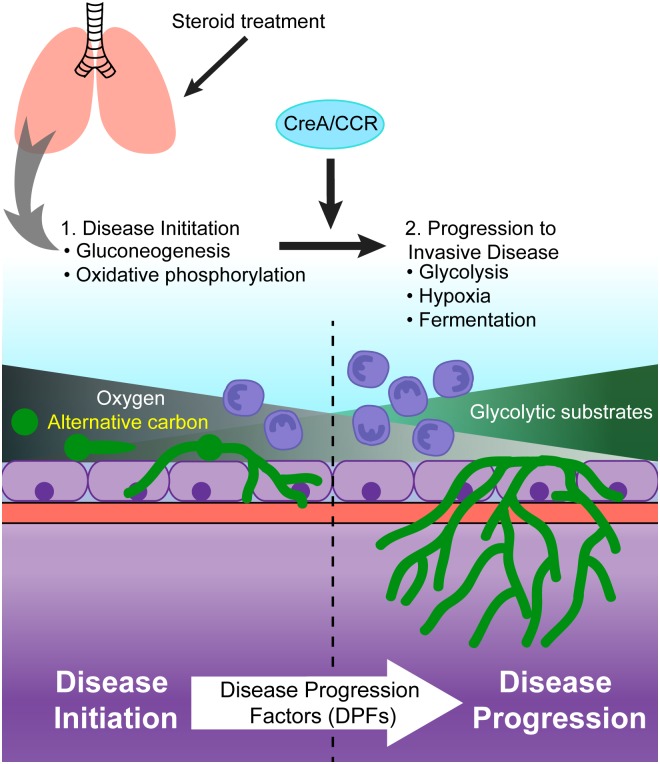
Aspergillus fumigatus is responsible for a disproportionate number of invasive mycosis cases relative to other common filamentous fungi. While many fungal factors critical for infection establishment are known, genes essential for disease persistence and progression are ill defined. We propose that fungal factors that promote navigation of the rapidly changing nutrient and structural landscape characteristic of disease progression represent untapped clinically relevant therapeutic targets. To this end, we find that A. fumigatus requires a carbon catabolite repression (CCR) mediated genetic network to support in vivo fungal fitness and disease progression. While CCR as mediated by the transcriptional repressor CreA is not required for pulmonary infection establishment, loss of CCR inhibits fungal metabolic plasticity and the ability to thrive in the dynamic infection microenvironment. Our results suggest a model whereby CCR in an environmental filamentous fungus is dispensable for initiation of pulmonary infection but essential for infection maintenance and disease progression. Conceptually, we argue these data provide a foundation for additional studies on fungal factors required to support fungal fitness and disease progression and term such genes and factors, DPFs (disease progression factors).
Overview
The claims and statistics of this paper haven’t been checked yet.
Free: it reads the open-access text and checks the first 5 claims that cite a source we can check. Create a free account to check every claim.
Integrity signals
Registry
Cites
Statistics
Figures
Verification
Claims the paper makes
The claims and statistics of this paper haven’t been checked yet.
Free: it reads the open-access text and checks the first 5 claims that cite a source we can check. Create a free account to check every claim.
Claims other papers make about this one
Each is checked against this paper’s own text: does it say what the citing paper says it does?
In the citing paper
“While the transcriptional repressor CreA, controlling carbon catabolite repression, is not required for the initiation of a pulmonary infection, it seems important for infection maintenance and disease progression under an environment that is poor in oxygen and in gluconeogenic carbon sources (340).”
From Aspergillus fumigatus and Aspergillosis in 2019 (2019) · cites this paper as [340]
Self-check
Percentages, sums and reported differences re-computed from the paper’s own numbers.
The self-check needs the paper’s full text.
Citations
Cites
Moderated estimation of fold change and dispersion for RNA-seq data with DESeq2
Love, M. I., Huber, W., & Anders, S. (2014) · Genome Biology · doi:10.1186/s13059-014-0550-8 · Cited by 95,106
Fast, scalable generation of high‐quality protein multiple sequence alignments using Clustal Omega
Sievers, F., Wilm, A., Dineen, D., Gibson, T. J., Karplus, K., Li, W., Lopez, R., McWilliam, H., Remmert, M., Söding, J., et al. (2011) · Molecular Systems Biology · doi:10.1038/msb.2011.75 · Cited by 15,355
Trapnell, C., Roberts, A., Goff, L., Pertea, G., Kim, D., Kelley, D. R., Pimentel, H., Salzberg, S. L., Rinn, J. L., & Pachter, L. (2012) · Nature Protocols · doi:10.1038/nprot.2012.016 · Cited by 12,116
TopHat: discovering splice junctions with RNA-Seq
Trapnell, C., Pachter, L., & Salzberg, S. L. (2009) · Bioinformatics · doi:10.1093/bioinformatics/btp120 · Cited by 11,617
Jalview Version 2—a multiple sequence alignment editor and analysis workbench
Waterhouse, A. M., Procter, J. B., Martin, D. M. A., Clamp, M., & Barton, G. J. (2009) · Bioinformatics · doi:10.1093/bioinformatics/btp033 · Cited by 11,399
Carbon catabolite repression in bacteria: many ways to make the most out of nutrients
Görke, B., & Stülke, J. (2008) · Nature Reviews Microbiology · doi:10.1038/nrmicro1932 · Cited by 1,701
Crucial Step in Cholesterol Homeostasis
Yang, T., Espenshade, P. J., Wright, M. E., Yabe, D., Gong, Y., Aebersold, R., Goldstein, J. L., & Brown, M. S. (2002) · Cell · doi:10.1016/s0092-8674(02)00872-3 · Cited by 987
Fusion PCR and gene targeting in Aspergillus nidulans
Szewczyk, E., Nayak, T., Oakley, C. E., Edgerton, H., Xiong, Y., Taheri-Talesh, N., Osmani, S. A., & Oakley, B. R. (2006) · Nature Protocols · doi:10.1038/nprot.2006.405 · Cited by 766
Love, M. I., Huber, W. K., & Anders, S. (2014) · Cited by 718
The damage-response framework of microbial pathogenesis
Casadevall, A., & Pirofski, L.-A. (2003) · Nature Reviews Microbiology · doi:10.1038/nrmicro732 · Cited by 658
Cited by
Items 101–103 of 103
Reyes-Chavez, B., Kerkaert, J. D., & Huberman, L. B. (2026) · PLoS Biology · doi:10.1371/journal.pbio.3003983 · Cited by 2
“Fungal pathogens of plants and animals that do not regulate carbon catabolite repression like wild-type cells frequently have reduced virulence [8,77–79].”
Carbon and nitrogen sources can fuel fungal virulence
Patiño-Medina, J. A., & Casadevall, A. (2026) · Infection and Immunity · doi:10.1128/iai.00460-26
“In A. fumigatus , CreA contributes to metabolic adaptation, resistance to stress-cell wall agents, and disease progression in a murine model of invasive pulmonary aspergillosis (82).”
Bai, X., Pan, Z., Du, Y., Dara, M. Z. N., Wang, J., Ou, M., Zhang, M., Cheng, R., Tian, X., Zhang, Y., et al. (2026) · Phytopathology Research · doi:10.1186/s42483-026-00454-5
“The Δ CreA mutant in A. fumig-atus is more sensitive to calcofluor white (CFW) than the wild type (Beattie et al. 2017).”
Metadata
- Authors
- Beattie, S. R., Mark, K. M. K., Thammahong, A., Ries, L. N. A., Dhingra, S., Caffrey-Carr, A. K., Cheng, C., Black, C. C., Bowyer, P., Bromley, M. J., Obar, J. J., Goldman, G. H., & Cramer, R. A.
- Affiliations
- Dartmouth College (US)
- Universidade de São Paulo (BR)
- Dartmouth–Hitchcock Medical Center (US)
- University of Manchester (GB)
- Corresponding author
- Beattie, Sarah R.
- Mark, Kenneth M. K.
- Thammahong, Arsa
- Ries, Laure Nicolas Annick
- Dhingra, Sourabh
- Caffrey-Carr, Alayna K.
- Cheng, Chao
- Black, Candice C.
- Bowyer, Paul
- Bromley, Michael J.
- Obar, Joshua J.
- Goldman, Gustavo H.
- Cramer, Robert A.
- ORCID
- Venue
- PLOS Pathogens
- Publisher
- Public Library of Science (PLoS)
- Published
- 2017-04-19
- Volume
- 13
- Issue
- 4
- Pages
- e1006340
- ISSN
- 1553-7366 (ISSN-L)
- 1553-7374
- PMC
- PMC5411099
- OpenAlex
- W2607468292
- Cited by
- 103
- References
- 57
- Citations by year
- 2026: 12 · 2025: 11 · 2024: 14 · 2023: 10 · 2022: 7 · 2021: 17 · 2020: 10 · 2019: 8 · 2018: 6 · 2017: 7
- FWCI
- 3.46
- Type
- journal article
- Language
- en
- Update notices
- new_version (2017-05-01)
- Open access
- gold
- doi.org
- Licence
- Locations
- PLoS Pathogens (publishedVersion, cc-by)
- PubMed Central (publishedVersion, cc-by)
- PubMed (publishedVersion)
- DOAJ (DOAJ: Directory of Open Access Journals) (submittedVersion, cc-by-sa)
- Figshare (submittedVersion, cc-by)
- Research Explorer (The University of Manchester) (submittedVersion, cc-by)
- Funders
- National Institute of Allergy and Infectious Diseases (2R01AI081838)
- Burroughs Wellcome Fund (1013522)
- National Institute of General Medical Sciences (T32GM008704, P30GM106394)
- Fundação de Amparo à Pesquisa do Estado de São Paulo
- Conselho Nacional de Desenvolvimento Científico e Tecnológico
- European Union Seventh Framework ProgrammeH (HEALTH-F3-2013-601963)
- Topics
- Life Sciences › Biochemistry, Genetics and Molecular Biology › Molecular Biology › Fungal and yeast genetics research
- Health Sciences › Medicine › Infectious Diseases › Antifungal resistance and susceptibility
- Health Sciences › Medicine › Infectious Diseases › Fungal Infections and Studies
- Keywords
- Aspergillus fumigatus, catabolite repression, CREA, metabolic plasticity, invasive aspergillosis, pulmonary infection, fungal fitness, transcriptional regulation, fungal stress response, therapeutic target
- MeSH terms
- Aspergillosis, Aspergillus fumigatus, Carbon, Fungal Proteins, Models, Biological, Repressor Proteins, Stress, Physiological, Gene Expression Regulation, Fungal, Disease Progression, Gene Regulatory Networks, Catabolite Repression
About these checks
Registry, retraction, Cites and statistics results are computed, not judged, with one exception: a printed reference that no index lists is read once by a model before it counts as a citation error. Claims are extracted by a model and kept only when their quote appears verbatim in the text; each cited source is then checked, with a model’s help, for whether it says what the claim relies on. Those verdicts can be wrong — read the claim’s quote and the cited source before relying on one.
Statistics and arithmetic are recomputed, not judged.
Confidence bands are shown only for fields calibrated on our annotated test set. None is calibrated yet, so no band is shown.
What counts as a claim ›How we measure confidence ›How we check this ›
Are you an author, or do you see a problem with this page? Request a review
Data sources
Bibliographic data: Semantic Scholar, OpenAlex, Crossref.
Contains information from the Semantic Scholar Academic Graph Datasets, made available under the ODC Attribution License (ODC-BY 1.0).
Semantic Scholar’s data is described in: Kinney, R., et al. (2023). The Semantic Scholar Open Data Platform. arXiv:2301.10140.
