

Alterations in Heart Rate Variability Associated With Irritable Bowel Syndrome or Inflammatory Bowel Disease: A Systematic Review and Meta-Analysis
Open accessThe DOI matches its Crossref record; 76 of the 76 references it cites were found in a registry or an index; 20 of the 57 sources its claims cite were checked for support.
Abstract
INTRODUCTION: Irritable bowel syndrome (IBS) and inflammatory bowel disease (IBD) are gastrointestinal pathologies affecting large numbers of the global population and incurring significant healthcare costs. Disruptions in the gut-brain axis occurring in these conditions can lead to increased inflammation, affecting gastrointestinal and autonomic nervous system function. Heart rate variability (HRV) is commonly used to assess the state of the sympathetic and parasympathetic function of the autonomic nervous system, but it remains unclear how HRV measures are associated with gastrointestinal pathologies. Here, we conduct a systematic review of the literature comparing HRV of subjects diagnosed with IBS or IBD to HRV in healthy controls (HC). METHODS: We searched PubMed, Cochrane Library, and CINAHL (EBSCO) for eligible studies up to 2018. We included any study comparing a recognized measure of HRV between a group of patients with either IBS or IBD to a group of matched HC before any intervention. Studies were screened, and data were extracted from included articles using predefined criteria. Random effects meta-analysis was performed for each outcome, with effect size reported as the standardized mean difference. RESULTS: There were significant differences between IBD and HC in time domain HRV and significant decreases in high-frequency power measures were also noted, in both IBS and IBD compared with HC. DISCUSSION: Parasympathetic nervous system activity, represented through high-frequency power, seems to be lower in people with IBS and IBD, but conclusions are limited by the small number of studies that provide usable data, methodological heterogeneity, and high risks of bias in primary study methods and measures.
Overview
CoChat Summary
TL;DR
This systematic review and meta-analysis found evidence that people with IBS or IBD have lower parasympathetic-linked HRV, especially high-frequency power, compared with healthy controls, but the authors caution that conclusions are limited by few usable studies, methodological heterogeneity, and high risk of bias. The only primary time-domain outcome with adequate data was RMSSD, which was significantly lower in IBD versus controls.
Key findings
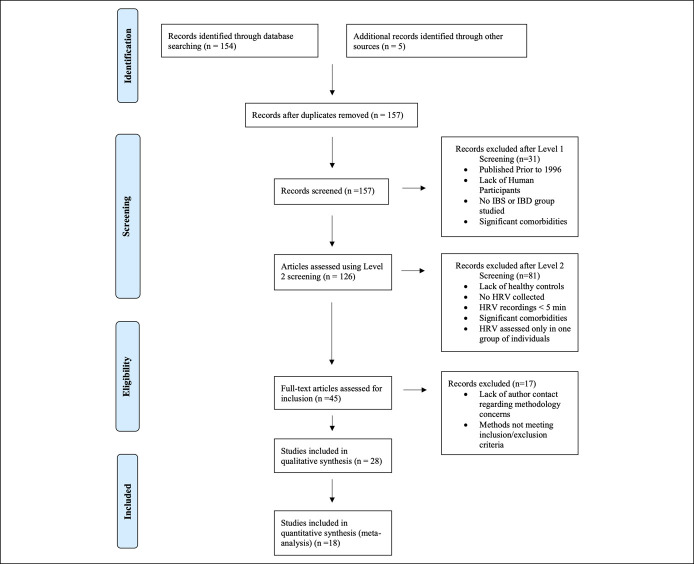
- Across 28 included studies, there were 2,314 participants: 956 IBS, 438 IBD, and 895 healthy controls; 18 studies (1,447 participants) provided data for meta-analysis.
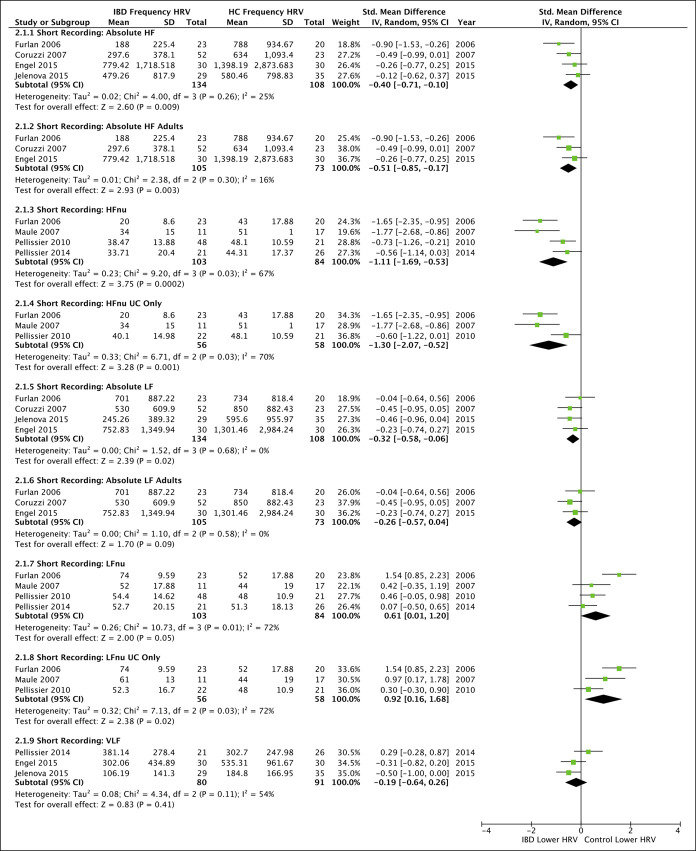
- RMSSD was significantly lower in IBD compared with healthy controls (3 studies; pooled SMD = −0.37 [−0.66, −0.07], P = 0.02, I² = 0%).
- Absolute high-frequency HRV in short recordings was significantly lower in IBD versus controls after adult-only subanalysis (3 studies; pooled SMD = −0.51 [−0.85, −0.17], P = 0.003, I² = 16%), and HFnu was significantly lower in IBD versus controls (P = 0.0002), remaining significant for ulcerative colitis only (P = 0.001).
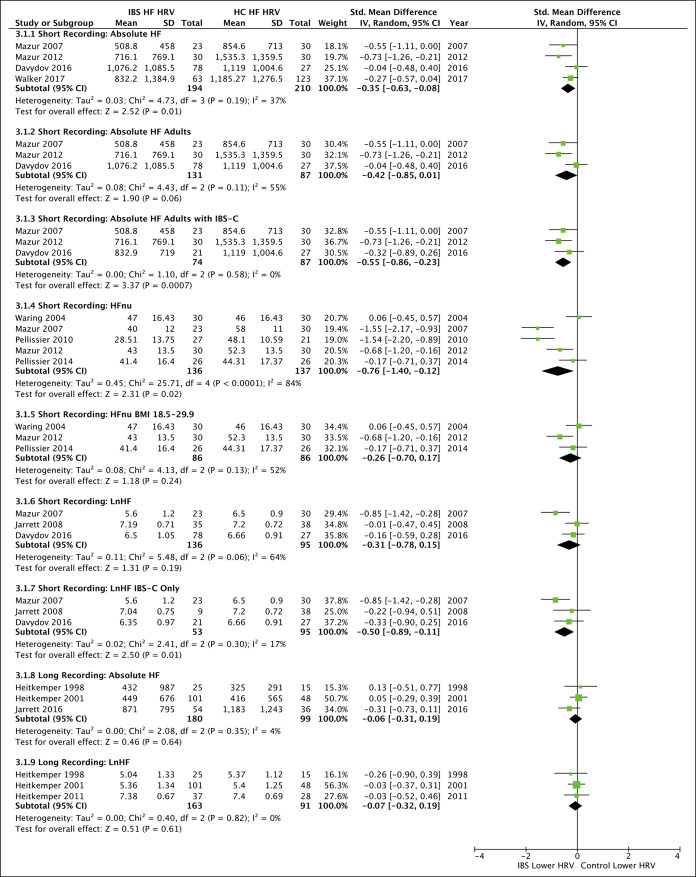
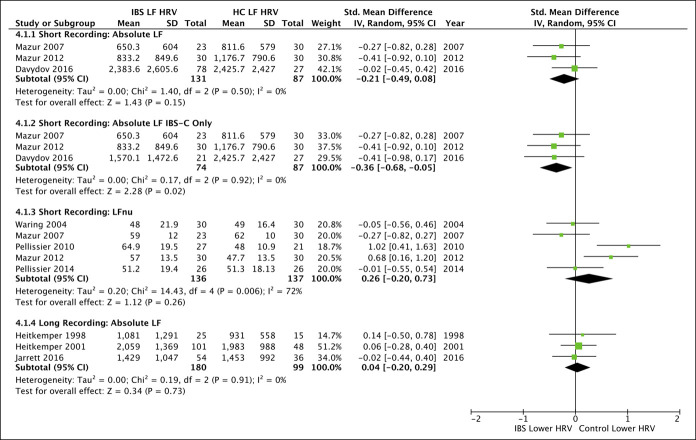
- In IBS, absolute high-frequency HRV in short recordings was significantly lower than controls (4 studies; pooled SMD = −0.35 [−0.63, −0.08], P = 0.01, I² = 37%), but long recordings were not significant (3 studies; pooled SMD = −0.06 [−0.31, 0.19], P = 0.64, I² = 4%); the short-recording result remained significant in IBS-C (3 studies; pooled SMD = −0.55 [−0.86, −0.23], P = 0.0007, I² = 0%).
Methods
- Systematic review and random-effects meta-analysis registered in PROSPERO (CRD4201800072), following PRISMA; PubMed, Cochrane Library, and CINAHL were searched through June 2018, with reference lists and trial registries also checked.
- Eligible studies compared a recognized HRV measure between IBS or IBD patients and healthy controls before any intervention, using continuous recordings of 5 minutes to 24 hours; participants with cardiovascular disease, nervous system comorbidities, diabetes, renal failure, alcoholism, or relevant medications were excluded.
- Pooled standardized mean differences with 95% CIs were calculated using an inverse variance model; heterogeneity was assessed with I², publication bias was investigated visually with funnel plots, and risk of bias was assessed with a modified ROBINS-I tool.
Limitations
- The authors state the main limitations were small primary study sample sizes, significant heterogeneity in primary study methods and measures, and high risk of bias; there was also inconsistent reporting of HRV measures, recording software, timing of HRV collection, and lack of HRV assessor blinding.
- The authors note insufficient data to compare IBS with IBD, inconsistent disease severity data, and insufficient data to draw conclusions about associations between HRV and disease severity within diseased populations.
- Evident from the text: only 18 of 28 included studies provided suitable data for meta-analysis; most studies had moderate or serious bias, only 2 studies confirmed blinded HRV assessment, and NN50 was not presented in any study.
Model-written summary. Check it against the paper before relying on it.
Integrity signals
Registry
Cites
Statistics
Figures

Verification
Claims the paper makes
11 Valid · 3 Not valid · 7 Not checked · 52 Own results and interpretations
The sources with a verdict support this claim; the rest weren’t checked yet, have no full text we could read, or their verdicts aren’t rated yet.
In the paper
“Such monitoring might be achieved through a set of noninvasive electrocardiography parameters, collectively referred to as heart rate variability (HRV), that provides an indirect measure of the autonomic nervous system (ANS) (8–14).”
§ Alterations in Heart Rate Variability Associated With Irritable Bowel Syndrome or Inflammatory Bowel Disease: A Systematic Review and Meta-Analysis > INTRODUCTION
What the sources say
- Not checked — no full text of the sourcecites [8] 8. Carabotti M, Scirocco A, Maselli MA, et al. The gut-brain axis: Interactions between enteric microbiota, central and enteric nervous systems. Ann Gastroenterol 2015;28(2):203–9.
- Not checked — no full text of the sourcecites [9] 9. Holtmann GJ, Ford AC, Talley NJ. Pathophysiology of irritable bowel syndrome. Lancet Gastroenterol Hepatol 2016;1(2):133–46. source
- Could not verifycites [10] 10. Drossman DA, Hasler WL. Rome IV-functional GI disorders: Disorders of gut-brain interaction. Gastroenterology 2016;150(6):1257–61. sourceExperimental — accuracy not yet measured
The Special Issue Editors passages discuss gut–brain interactions and nervous-system physiology but do not address heart rate variability as a measure of autonomic function. Searches for heart rate variability, HRV, electrocardiography, and the autonomic nervous system found no passage establishing the claim; page numbers were not available in the indexed copy. (LLM, conf=0.74)
- Supportedcites [11] 11. Bonaz BL, Bernstein CN. Brain-gut interactions in inflammatory bowel disease. Gastroenterology 2013;144(1):36–49. source
The section on heart rate variability describes HRV as a noninvasive ECG-based technique used to assess autonomic imbalances. It also identifies HRV components reflecting vagal and sympathetic activity, supporting its use as an indirect measure of autonomic nervous system activity. No page number is provided in our copy. (LLM, conf=0.94)
- Supportedcites [12] 12. Bonaz B, Sinniger V, Pellissier S. The vagus nerve in the neuro-immune axis: Implications in the pathology of the gastrointestinal tract. Front Immunol 2017;8:1452. source
The Chronic Inflammatory Bowel Disorders section describes HRV as a reliable, noninvasive tool that quantifies sympathetic and parasympathetic activity and can be used to assess vagal tone and sympathovagal balance. This supports the claim that HRV provides an indirect measure of autonomic nervous system activity. (LLM, conf=0.93)
- Supportedcites [13] 13. Shaffer F, Ginsberg JP. An overview of heart rate variability metrics and norms. Front Public Health 2017;5:258. source
The Heart Rate Variability section says HRV indexes neurocardiac function and is generated in part by autonomic nervous system processes. The Short-Term HRV section also describes contributions from the sympathetic and parasympathetic branches, supporting HRV as an indirect measure of ANS activity. (LLM, conf=0.92)
- Not checked — no full text of the sourcecites [14] 14. Rajendra Acharya U, Paul JK, Kannathal N, et al. Heart rate variability: A review. Med Biol Eng Comput 2006;44(12):1031–51. source
plainstates an association- Asserted: passes — The authors put it forward as true.
- Checkable: passes — It can be checked against evidence.
- Load-bearing: passes — The paper’s conclusions depend on it.
- Based: passes — The paper gives a reason why it holds.
The sources with a verdict support this claim; the rest weren’t checked yet, have no full text we could read, or their verdicts aren’t rated yet.
In the paper
“Despite suggestions that lowered HRV is associated with pathological processes and mortality, definitive reference ranges constituting normal or healthy HRV values remain unclear (13–15)”
§ Alterations in Heart Rate Variability Associated With Irritable Bowel Syndrome or Inflammatory Bowel Disease: A Systematic Review and Meta-Analysis > INTRODUCTION
What the sources say
- Supportedcites [13] 13. Shaffer F, Ginsberg JP. An overview of heart rate variability metrics and norms. Front Public Health 2017;5:258. source
The Abstract says baseline HRV values depend on recording length, age, and sex, and cautions that norms from different recording lengths are not interchangeable. The Summary adds that appropriate reference values depend on measurement methods and population characteristics. Together, these support the claim that a single definitive healthy HRV range is unclear, although the paper does report published norms. (LLM, conf=0.86)
- Not checked — no full text of the sourcecites [14] 14. Rajendra Acharya U, Paul JK, Kannathal N, et al. Heart rate variability: A review. Med Biol Eng Comput 2006;44(12):1031–51. source
- Not checked — no full text of the sourcecites [15] 15. Nunan D, Sandercock GR, Brodie DA. A quantitative systematic review of normal values for short-term heart rate variability in healthy adults. Pacing Clin Electrophysiol 2010;33(11):1407–17. source
plain- Asserted: passes — The authors put it forward as true.
- Checkable: passes — It can be checked against evidence.
- Load-bearing: unclear — It is unclear whether the paper’s conclusions depend on it.
- Based: passes — The paper gives a reason why it holds.
- Supported
The cited sources support only part of this claim — read each source’s verdict below.
In the paper
“Excessive sympathetic or parasympathetic activity in the ANS can lead to dysregulation within the gut-brain axis contributing to maladaptive gastrointestinal responses and resulting in symptomatic flares (8–12,14).”
§ Alterations in Heart Rate Variability Associated With Irritable Bowel Syndrome or Inflammatory Bowel Disease: A Systematic Review and Meta-Analysis > INTRODUCTION
What the sources say
- Not checked — no full text of the sourcecites [8] 8. Carabotti M, Scirocco A, Maselli MA, et al. The gut-brain axis: Interactions between enteric microbiota, central and enteric nervous systems. Ann Gastroenterol 2015;28(2):203–9.
- Not checked — no full text of the sourcecites [9] 9. Holtmann GJ, Ford AC, Talley NJ. Pathophysiology of irritable bowel syndrome. Lancet Gastroenterol Hepatol 2016;1(2):133–46. source
- Partly supportedcites [10] 10. Drossman DA, Hasler WL. Rome IV-functional GI disorders: Disorders of gut-brain interaction. Gastroenterology 2016;150(6):1257–61. sourceExperimental — accuracy not yet measured
The Special Issue Editors section (page not provided) says that central nervous system dysregulation of gut signaling and motor function contributes to gastrointestinal symptoms. It does not identify excessive sympathetic or parasympathetic activity as the cause or describe resulting symptomatic flares. (LLM, conf=0.84)
- Partly supportedcites [11] 11. Bonaz BL, Bernstein CN. Brain-gut interactions in inflammatory bowel disease. Gastroenterology 2013;144(1):36–49. sourceExperimental — accuracy not yet measured
The “Vagal inhibition” section (page unavailable) says stress increases sympathetic outflow and decreases vagal, or parasympathetic, outflow, favoring intestinal inflammation. “Stress and IBD” links stress to symptomatic flares. The paper does not support the claim that excessive parasympathetic activity contributes to flares; it describes reduced parasympathetic activity instead. (LLM, conf=0.88)
- Partly supportedcites [12] 12. Bonaz B, Sinniger V, Pellissier S. The vagus nerve in the neuro-immune axis: Implications in the pathology of the gastrointestinal tract. Front Immunol 2017;8:1452. sourceExperimental — accuracy not yet measured
The Irritable Bowel Syndrome section (page unavailable) links brain–gut dysfunction to high sympathetic and low parasympathetic tone, and says stress often triggers symptoms. The Chronic Inflammatory Bowel Disorders section (page unavailable) also describes autonomic imbalance. The paper does not support excessive parasympathetic activity as a cause of gastrointestinal responses or symptomatic flares; its IBS example reports low parasympathetic tone. (LLM, conf=0.86)
- Not checked — no full text of the sourcecites [14] 14. Rajendra Acharya U, Paul JK, Kannathal N, et al. Heart rate variability: A review. Med Biol Eng Comput 2006;44(12):1031–51. source
plainstates a cause- Asserted: passes — The authors put it forward as true.
- Checkable: passes — It can be checked against evidence.
- Load-bearing: passes — The paper’s conclusions depend on it.
- Based: passes — The paper gives a reason why it holds.
The sources with a verdict support this claim; the rest weren’t checked yet, have no full text we could read, or their verdicts aren’t rated yet.
In the paper
“Pooling of data was based on length of HRV recording, separating studies according to short or long recording periods because these measures can represent different facets of ANS function (27,28).”
§ Alterations in Heart Rate Variability Associated With Irritable Bowel Syndrome or Inflammatory Bowel Disease: A Systematic Review and Meta-Analysis > METHODS > Synthesis of results
What the sources say
- Not checked — no full text of the sourcecites [27] 27. Berntson GG, Bigger JT, Eckberg DL, et al. Heart rate variability: Origins, methods, and interpretive caveats. Psychophysiology 1997;34(6):623–48. source
- Supportedcites [28] 28. Hayano J, Yuda E. Pitfalls of assessment of autonomic function by heart rate variability. J Physiol Anthropol 2019;38(1):3. source
The ‘Short-term and long-term HRV analyses’ section distinguishes the recording conditions and uses of short- and long-term HRV. The following discussion says that autonomic-function relationships established for short-term HRV cannot simply be extended to long-term HRV, supporting the reason for separating them. (LLM, conf=0.90)
plainstates an association- Asserted: passes — The authors put it forward as true.
- Checkable: passes — It can be checked against evidence.
- Load-bearing: passes — The paper’s conclusions depend on it.
- Based: passes — The paper gives a reason why it holds.
The sources with a verdict support this claim; the rest weren’t checked yet, have no full text we could read, or their verdicts aren’t rated yet.
In the paper
“there are inconsistencies regarding the reproducibility of HRV measures in a variety of unrelated populations (64–66).”
§ Alterations in Heart Rate Variability Associated With Irritable Bowel Syndrome or Inflammatory Bowel Disease: A Systematic Review and Meta-Analysis > DISCUSSION > Implications/recommendations for research
What the sources say
- Not checked — no full text of the sourcecites [64] 64. Sandercock GR, Bromley PD, Brodie DA. The reliability of short-term measurements of heart rate variability. Int J Cardiol 2005;103(3):238–47. source
- Not checked — no full text of the sourcecites [65] 65. Bjelakovic B, Ilic D, Lukic S, et al. Reproducibility of 24-h heart rate variability in children. Clin Auton Res 2017;27(4):273–8. source
- Supportedcites [66] 66. Plaza-florido A, Alcantara JMA, Migueles JH, et al. Inter- and intra-researcher reproducibility of heart rate variability parameters in three human cohorts. Sci Rep 2020;10(1):11399. source
The Discussion reports differences in inter- and intra-researcher reproducibility across three human cohorts, with frequency-domain HRV parameters generally less reproducible than time-domain parameters. The Conclusion notes that some inter-researcher differences could be clinically relevant. The paper therefore supports the claim, specifically for HRV parameters derived from short-term recordings. (LLM, conf=0.86)
plain- Asserted: passes — The authors put it forward as true.
- Checkable: passes — It can be checked against evidence.
- Load-bearing: passes — The paper’s conclusions depend on it.
- Based: passes — The paper gives a reason why it holds.
37 more claims · 2 with their cited sources checked
Create a free account to see all 73 claims and to verify the 1 reference still open.
- Probably not a substantial claim. 21
- It may state two separate claims as one. 14
Self-check
Percentages, sums and reported differences re-computed from the paper’s own numbers.
Each contradiction between two passages listed here was confirmed by an independent check.
Rated minor: it would not touch a result — a value no result rests on, a p-value that stays on the same side of the significance level, or a conflict that is clerical, resolved elsewhere in the paper, or outside its own findings.
In the paper
§ Alterations in Heart Rate Variability Associated With Irritable Bowel Syndrome or Inflammatory Bowel Disease: A Systematic Review and Meta-Analysis > RESULTS > Study characteristics
“one conducted 12-hour recordings (45)”
§ Alterations in Heart Rate Variability Associated With Irritable Bowel Syndrome or Inflammatory Bowel Disease: A Systematic Review and Meta-Analysis > METHODS > Data collection/data items
“| Jarrett et al. (45) | USA | Cohort | 54/37 | 0/0 | III | IBS-C/D/M | Seated/standing/supine 4 hr | 2:00 am to 6:00 am | HF: 0.15–0.40; LF: 0.04–0.15 | Vision Premier Software |”
Rated minor: it would not touch a result — a value no result rests on, a p-value that stays on the same side of the significance level, or a conflict that is clerical, resolved elsewhere in the paper, or outside its own findings.
In the paper
§ Alterations in Heart Rate Variability Associated With Irritable Bowel Syndrome or Inflammatory Bowel Disease: A Systematic Review and Meta-Analysis > METHODS > Data collection/data items
“| Mouzas et al. (50) | Serious | Low | Low | Low | Moderate | Serious | Critical |”
§ Alterations in Heart Rate Variability Associated With Irritable Bowel Syndrome or Inflammatory Bowel Disease: A Systematic Review and Meta-Analysis > METHODS > Quality appraisal
“- Critical = At least one domain at critical risk”
Rated minor: it would not touch a result — a value no result rests on, a p-value that stays on the same side of the significance level, or a conflict that is clerical, resolved elsewhere in the paper, or outside its own findings.
In the paper
“LF was recorded in 26 (96.8%) (31–47,50–58)”
§ Alterations in Heart Rate Variability Associated With Irritable Bowel Syndrome or Inflammatory Bowel Disease: A Systematic Review and Meta-Analysis > RESULTS > Study characteristics
Reported 96.8 · recomputed 92.857143
Citations
Cites
Measuring inconsistency in meta-analyses
Higgins, J. P. T., Thompson, S. G., Deeks, J. J., & Altman, D. G. (2003) · BMJ · doi:10.1136/bmj.327.7414.557 · Cited by 63,139 · cited 1×
“75% considered extensive heterogeneity (16,26).”
Liberati, A., Altman, D. G., Tetzlaff, J., Mulrow, C., Gøtzsche, P. C., Ioannidis, J. P. A., Clarke, M., Devereaux, P. J., Kleijnen, J., & Moher, D. (2009) · PLoS Medicine · doi:10.1371/journal.pmed.1000100 · Cited by 28,164
ROBINS-I: a tool for assessing risk of bias in non-randomised studies of interventions
Sterne, J. A., Hernán, M. A., Reeves, B. C., Savović, J., Berkman, N. D., Viswanathan, M., Henry, D., Altman, D. G., Ansari, M. T., Boutron, I., et al. (2016) · BMJ · doi:10.1136/bmj.i4919 · Cited by 20,329 · cited 2×
“The overall risk of bias was graded as follows (29):”
BackgroundMethodLiberati, A., Altman, D. G., Tetzlaff, J., Mulrow, C., Gotzsche, P. C., Ioannidis, J. P. A., Clarke, M., Devereaux, P. J., Kleijnen, J., & Moher, D. (2009) · BMJ · doi:10.1136/bmj.b2700 · Cited by 17,648
Heart Rate Variability: Standards of Measurement, Physiological Interpretation, and Clinical Use
Electrophysiology, T. F. O. T. E. S. O. C. T. N. A. (1996) · Circulation · doi:10.1161/01.cir.93.5.1043 · Cited by 17,159
Heart rate variability: Standards of measurement, physiological interpretation, and clinical use
Malik, M., Bigger, J. T., Camm, A. J., Kleiger, R. E., Malliani, A., Moss, A. J., & Schwartz, P. J. (1996) · European Heart Journal · doi:10.1093/oxfordjournals.eurheartj.a014868 · Cited by 15,289
An overview of heart rate variability metrics and norms
Shaffer, F., & Ginsberg, J. P. (2017) · Frontiers in Public Health · doi:10.3389/fpubh.2017.00258 · Cited by 7,185 · cited 6×
“Of the primary outcomes of interest, SDNN (34,42,49,50,55,56), the natural log of SDNN (42), RMSSD (34,42,48–50,53,55,56,58), and pNN50 (34,49,50,53,55) were presented.”
BackgroundInfluentialHeart rate variability: origins, methods, and interpretive caveats
BERNTSON, G. G., THOMAS BIGGER, J., ECKBERG, D. L., GROSSMAN, P., KAUFMANN, P. G., MALIK, M., NAGARAJA, H. N., PORGES, S. W., SAUL, J. P., STONE, P. H., et al. (1997) · Psychophysiology · doi:10.1111/j.1469-8986.1997.tb02140.x · Cited by 3,962 · cited 1×
“measures can represent different facets of ANS function (27,28).”
BackgroundHeart rate variability: A review
Rajendra Acharya, U., Paul Joseph, K., Kannathal, N., Lim, C. M., & Suri, J. S. (2006) · Medical & Biological Engineering & Computing · doi:10.1007/s11517-006-0119-0 · Cited by 2,820 · cited 1×
“Studies using participants with cardiovascular diseases, central or peripheral nervous system comorbidities, diabetes, renal failure, alcoholism, or on beta-blockers, beta-adrenergic agonists, or calcium channel blockers were excluded because these conditions may influenceHRV (14).”
Meta-analysis in clinical trials revisited
DerSimonian, R., & Laird, N. (2015) · Contemporary Clinical Trials · doi:10.1016/j.cct.2015.09.002 · Cited by 2,677 · cited 1×
“Owing to the heterogeneity across study methodologies, a random-effects metaanalysis was used to derive pooled standardized mean difference (SMD) with 95% CIs using an inverse variance model (25).”
MethodThe gut-brain axis: interactions between enteric microbiota, central and enteric nervous systems.
(2015) · PubMed Central · Cited by 2,540
Global Prevalence of and Risk Factors for Irritable Bowel Syndrome: A Meta-analysis
Lovell, R. M., & Ford, A. C. (2012) · Clinical Gastroenterology and Hepatology · doi:10.1016/j.cgh.2012.02.029 · Cited by 2,155 · cited 1×
“2) (3) with direct and indirect annual healthcare costs exceeding 20 billion dollars (4).”
BackgroundRome IV—Functional GI Disorders: Disorders of Gut-Brain Interaction
Drossman, D. A., & Hasler, W. L. (2016) · Gastroenterology · doi:10.1053/j.gastro.2016.03.035 · Cited by 1,928
The LF/HF ratio does not accurately measure cardiac sympatho-vagal balance
Billman, G. E. (2013) · Frontiers in Physiology · doi:10.3389/fphys.2013.00026 · Cited by 1,401
Irritable Bowel Syndrome: A Clinical Review
Chey, W. D., Kurlander, J., & Eswaran, S. (2015) · JAMA · doi:10.1001/jama.2015.0954 · Cited by 1,081 · cited 1×
“2) (3) with direct and indirect annual healthcare costs exceeding 20 billion dollars (4).”
BackgroundReyes del Paso, G. A., Langewitz, W., Mulder, L. J. M., van Roon, A., & Duschek, S. (2013) · Psychophysiology · doi:10.1111/psyp.12027 · Cited by 954
Schünemann, H. J., Cuello, C., Akl, E. A., Mustafa, R. A., Meerpohl, J. J., Thayer, K., Morgan, R. L., Gartlehner, G., Kunz, R., Katikireddi, S. V., et al. (2019) · Journal of Clinical Epidemiology · doi:10.1016/j.jclinepi.2018.01.012 · Cited by 911 · cited 1×
“Quality appraisal A modified Cochrane Collaboration’s Risk of Bias in NonRandomized Studies of Interventionswas used to evaluate the risk of bias in selected studies as low, moderate, serious, and critical based on 6 domains (Table 3) (29,30).”
MethodNUNAN, D., SANDERCOCK, G. R. H., & BRODIE, D. A. (2010) · Pacing and Clinical Electrophysiology · doi:10.1111/j.1540-8159.2010.02841.x · Cited by 874
Schmulson, M. J., & Drossman, D. A. (2017) · Journal of Neurogastroenterology and Motility · doi:10.5056/jnm16214 · Cited by 788 · cited 1×
“In addition, future studies should rely onupdatedRomeCriteria for diagnosis of IBS because the most recent guidelines suggest that IBS subgroups exist on a spectrum and not as distinct entities (69).”
MethodBrain–Gut Interactions in Inflammatory Bowel Disease
Bonaz, B. L., & Bernstein, C. N. (2013) · Gastroenterology · doi:10.1053/j.gastro.2012.10.003 · Cited by 667
Direct Health Care Costs of Crohn's Disease and Ulcerative Colitis in US Children and Adults
Kappelman, M. D., Rifas–Shiman, S. L., Porter, C. Q., Ollendorf, D. A., Sandler, R. S., Galanko, J. A., & Finkelstein, J. A. (2008) · Gastroenterology · doi:10.1053/j.gastro.2008.09.012 · Cited by 634 · cited 1×
“3 billion dollars, with a lack of data on indirect costs (7).”
BackgroundPathophysiology of irritable bowel syndrome
Holtmann, G. J., Ford, A. C., & Talley, N. J. (2016) · The Lancet Gastroenterology & Hepatology · doi:10.1016/s2468-1253(16)30023-1 · Cited by 590
Ford, A. C., Lacy, B. E., & Talley, N. J. (2017) · New England Journal of Medicine · doi:10.1056/nejmra1607547 · Cited by 587 · cited 1×
“INTRODUCTION Irritable bowel syndrome (IBS) is a functional gastrointestinal disorder (FGID) consisting of 4 subtypes (constipation, diarrhea, mixed, and unclassified) in the absence of organic or structural etiologies and diagnosed with Rome or Manning criteria (1).”
BackgroundSperber, A. D., Dumitrascu, D., Fukudo, S., Gerson, C., Ghoshal, U. C., Gwee, K. A., Hungin, A. P. S., Kang, J.-Y., Minhu, C., Schmulson, M., et al. (2017) · Gut · doi:10.1136/gutjnl-2015-311240 · Cited by 554 · cited 1×
“Its global prevalence remains elusive because of the methodological heterogeneity, symptom perception, and reporting concerns (2).”
BackgroundLagattolla, N. (2002) · Key Topics in General Surgery · doi:10.1201/b14719-46 · Cited by 521
An Update on Inflammatory Bowel Disease
Sairenji, T., Collins, K. L., & Evans, D. V. (2017) · Primary Care: Clinics in Office Practice · doi:10.1016/j.pop.2017.07.010 · Cited by 499 · cited 1×
“Greater than 5 million individuals are affected globally (5,6) and its direct healthcare costs in the United States are estimated at 6.”
BackgroundBonaz, B., Sinniger, V., & Pellissier, S. (2017) · Frontiers in Immunology · doi:10.3389/fimmu.2017.01452 · Cited by 405
The epidemiology of inflammatory bowel disease
Burisch, J., & Munkholm, P. (2015) · Scandinavian Journal of Gastroenterology · doi:10.3109/00365521.2015.1014407 · Cited by 365 · cited 1×
“Greater than 5 million individuals are affected globally (5,6) and its direct healthcare costs in the United States are estimated at 6.”
BackgroundPitfalls of assessment of autonomic function by heart rate variability
Hayano, J., & Yuda, E. (2019) · Journal of Physiological Anthropology · doi:10.1186/s40101-019-0193-2 · Cited by 349 · cited 2×
“Caution is strongly advised when using metrics developed to measure neuronal functions of the heart to noncardiac health outcomes (28).”
BackgroundEverything Hertz: methodological issues in short-term frequency-domain HRV.
Heathers, J. A. J. (2014) · Frontiers in Physiology · doi:10.3389/fphys.2014.00177 · Cited by 322
The reliability of short-term measurements of heart rate variability
Sandercock, G. R. H., Bromley, P. D., & Brodie, D. A. (2005) · International Journal of Cardiology · doi:10.1016/j.ijcard.2004.09.013 · Cited by 307
Martínez-Martínez, L.-A., Mora, T., Vargas, A., Fuentes-Iniestra, M., & Martínez-Lavín, M. (2014) · JCR: Journal of Clinical Rheumatology · doi:10.1097/rhu.0000000000000089 · Cited by 224
Pellissier, S., Dantzer, C., Mondillon, L., Trocme, C., Gauchez, A.-S., Ducros, V., Mathieu, N., Toussaint, B., Fournier, A., Canini, F., et al. (2014) · PLoS ONE · doi:10.1371/journal.pone.0105328 · Cited by 212 · cited 9×
“Specific to IBD studies, 3 compared UC with HC (51,52,58), 2 comparedCDonlywithHC (44,56), and 4 presented data on both subgroups (41,53–55).”
BackgroundInfluentialHidden Signals—The History and Methods of Heart Rate Variability
Ernst, G. (2017) · Frontiers in Public Health · doi:10.3389/fpubh.2017.00265 · Cited by 201
Pellissier, S., Dantzer, C., Canini, F., Mathieu, N., & Bonaz, B. (2010) · Psychoneuroendocrinology · doi:10.1016/j.psyneuen.2009.10.004 · Cited by 198 · cited 7×
“(41) France Cross-sectional 48/21 17/8 CD and UC Seated, 10 min 8:00 AM to 12:00”
BackgroundResultInfluentialAutonomic nervous system function in women with irritable bowel syndrome
Heitkemper, M., Jarrett, M., Cain, K. C., Burr, R., Levy, R. L., Feld, A., & Hertig, V. (2001) · Digestive Diseases and Sciences · doi:10.1023/a:1010671514618 · Cited by 145
Elsenbruch, S., & Orr, W. C. (2001) · American Journal of Gastroenterology · doi:10.1111/j.1572-0241.2001.03526.x · Cited by 140 · cited 4×
“(33) USA Cross-sectional 24/20 0/0 I IBS-C/D/M Supine, 30 min 12:00 PM”
BackgroundMethodInfluentialTak, L. M., Riese, H., de Bock, G. H., Andiappan, M., Kok, I. C., & Rosmalen, J. G. M. (2009) · Biological Psychology · doi:10.1016/j.biopsycho.2009.05.002 · Cited by 137
Evidence for autonomic nervous system imbalance in women with irritable bowel syndrome
Heitkemper, M., Burr, R. L., Jarrett, M., Hertig, V., Lustyk, M. K., & Bond, E. F. (1998) · Digestive Diseases and Sciences · doi:10.1023/a:1018871617483 · Cited by 117 · cited 6×
“(31) USA Cross-sectional 25/15 0/0 I IBS-C/D/M Seated/standing/”
BackgroundResultInfluentialSympathetic overactivity in active ulcerative colitis: effects of clonidine
Furlan, R., Ardizzone, S., Palazzolo, L., Rimoldi, A., Perego, F., Barbic, F., Bevilacqua, M., Vago, L., Porro, G. B., & Malliani, A. (2006) · American Journal of Physiology-Regulatory, Integrative and Comparative Physiology · doi:10.1152/ajpregu.00442.2005 · Cited by 106 · cited 4×
“(51) Critical Low Low Low Moderate Moderate Critical”
BackgroundInfluentialHeart rate variability in the irritable bowel syndrome: A review of the literature
Mazurak, N., Seredyuk, N., Sauer, H., Teufel, M., & Enck, P. (2012) · Neurogastroenterology & Motility · doi:10.1111/j.1365-2982.2011.01866.x · Cited by 102
Autonomic cardiovascular responses are impaired in women with irritable bowel syndrome
Waring, W. S., Chui, M., Japp, A., Nicol, E. F., & Ford, M. J. (2004) · Journal of Clinical Gastroenterology · doi:10.1097/01.mcg.0000135362.35665.49 · Cited by 83 · cited 5×
“HF and LF outcomes were presented in absolute units (31,34,38,39,43,45–47,51,53,55–57), normalized units (37,39,41, 43,44,48,49,51,52,55), natural log form (31,34,39,40,42,46,50), and as frequency percentages (32,35,54).”
BackgroundInfluentialAutonomic regulation of cardiac function during sleep in patients with irritable bowel syndrome
Orr, W. C., Elsenbruch, S., & Harnish, M. J. (2000) · American Journal of Gastroenterology · doi:10.1111/j.1572-0241.2000.02318.x · Cited by 83 · cited 7×
“Specific HRV software was unclear in 4 studies (42,51–53); MATLAB software was the most commonly reported (n 5 5) (32,33,35,36,47).”
BackgroundMethodResultInfluentialAutonomic functioning during REM sleep differentiates IBS symptom subgroups
Thompson, J. J., Elsenbruch, S., Harnish, M. J., & Orr, W. C. (2002) · American Journal of Gastroenterology · doi:10.1111/j.1572-0241.2002.07112.x · Cited by 78 · cited 6×
“(35) USA Cross-sectional 16/21 0/0 I IBS-C/D/M Supine, 15 min Unclear HF: 0.”
BackgroundMethodInfluentialLiu, Q., Wang, E. M., Yan, X. J., & Chen, S. L. (2013) · Journal of Digestive Diseases · doi:10.1111/1751-2980.12092 · Cited by 69 · cited 1×
“75% considered extensive heterogeneity (16,26).”
Heitkemper, M. M., Cain, K. C., Burr, R. L., Jun, S.-E., & Jarrett, M. E. (2011) · Biological Research For Nursing · doi:10.1177/1099800410393274 · Cited by 68 · cited 7×
“Of the primary outcomes of interest, SDNN (34,42,49,50,55,56), the natural log of SDNN (42), RMSSD (34,42,48–50,53,55,56,58), and pNN50 (34,49,50,53,55) were presented.”
BackgroundResultInfluentialCain, K. C., Jarrett, M. E., Burr, R. L., Hertig, V. L., & Heitkemper, M. M. (2007) · Neurogastroenterology & Motility · doi:10.1111/j.1365-2982.2006.00877.x · Cited by 67 · cited 5×
“(38) USA Cross-sectional 165/50 0/0 I/II IBS-C/D/M Seated/standing/”
BackgroundMethodResultInfluentialAutonomic dysfunctions in patients with inflammatory bowel disease in clinical remission
Sharma, P., Makharia, G. K., Ahuja, V., Dwivedi, S. N., & Deepak, K. K. (2009) · Digestive Diseases and Sciences · doi:10.1007/s10620-008-0424-6 · Cited by 64 · cited 6×
“Of the primary outcomes of interest, SDNN (34,42,49,50,55,56), the natural log of SDNN (42), RMSSD (34,42,48–50,53,55,56,58), and pNN50 (34,49,50,53,55) were presented.”
BackgroundInfluentialAutonomic nervous system activity in constipation-predominant irritable bowel syndrome patients
Mazur, M., Furgała, A., Jabłoński, K., Mach, T., & Thor, P. (2012) · Medical Science Monitor · doi:10.12659/msm.883269 · Cited by 59 · cited 6×
“(43) Poland Cross-sectional 30/30 12/11 III IBS-C Unclear, 30 min Unclear HF: 0.”
BackgroundResultInfluentialGanguli, S. C., Kamath, M. V., Redmond, K., Chen, Y., Irvine, E. J., Collins, S. M., & Tougas, G. (2007) · Neurogastroenterology & Motility · doi:10.1111/j.1365-2982.2007.00987.x · Cited by 56 · cited 5×
“One study used HRVmethods before the 1996 guidelines and was not included in the meta-analysis (54).”
BackgroundMethodInfluentialRobert, J. J. T., Orr, W. C., & Elsenbruch, S. (2004) · Digestive Diseases and Sciences · doi:10.1023/b:ddas.0000037820.54069.6c · Cited by 51 · cited 4×
“Six studies conducted 24-hour HRV recordings (31,34,38,49,50,58) and one conducted 12-hour recordings (45); 4 were conducted while sleeping (32,35,36,45), of which 3 separated data into sleep stages (32,35,40).”
BackgroundMethodInfluentialJarrett, M. E., Cain, K. C., Barney, P. G., Burr, R. L., Naliboff, B. D., Shulman, R., Zia, J., & Heitkemper, M. M. (2015) · Journal of Neurogastroenterology and Motility · doi:10.5056/jnm15067 · Cited by 48 · cited 1×
“Only a limited number of clinical trials in IBS have evaluated associations between improvements in the disease course and changes in HRV outcomes, with conflicting results; no such trials have been conducted for IBD (67,68).”
ResultMazur, M., Furgała, A., Jabłoński, K., Mądroszkiewicz, D., Ciećko-Michalska, I., Bugajski, A. J., & Thor, P. (2007) · PubMed · Cited by 48
Walker, L. S., Stone, A. L., Smith, C. A., Bruehl, S. P., Garber, J., Puzanovova, M., & Diedrich, A. (2017) · Pain · doi:10.1097/j.pain.0000000000000942 · Cited by 47 · cited 5×
“(47) Serious Low Low Low Low Moderate Serious”
BackgroundMethodResultInfluentialAutonomic nervous system function during sleep among women with irritable bowel syndrome
Jarrett, M. E., Burr, R. L., Cain, K. C., Rothermel, J. D., Landis, C. A., & Heitkemper, M. M. (2008) · Digestive Diseases and Sciences · doi:10.1007/s10620-007-9943-9 · Cited by 46 · cited 4×
“Six studies conducted 24-hour HRV recordings (31,34,38,49,50,58) and one conducted 12-hour recordings (45); 4 were conducted while sleeping (32,35,36,45), of which 3 separated data into sleep stages (32,35,40).”
BackgroundInfluentialPlaza-Florido, A., Alcantara, J. M. A., Migueles, J. H., Amaro-Gahete, F. J., Acosta, F. M., Mora-Gonzalez, J., Sacha, J., & Ortega, F. B. (2020) · Scientific Reports · doi:10.1038/s41598-020-68197-7 · Cited by 44
Engel, T., Ben-Horin, S., & Beer-Gabel, M. (2015) · Inflammatory Bowel Diseases · doi:10.1097/mib.0000000000000508 · Cited by 40 · cited 7×
“Of the primary outcomes of interest, SDNN (34,42,49,50,55,56), the natural log of SDNN (42), RMSSD (34,42,48–50,53,55,56,58), and pNN50 (34,49,50,53,55) were presented.”
BackgroundInfluentialGunterberg, V., Simrén, M., Öhman, L., Friberg, P., Jones, M. P., Van Oudenhove, L., & Strid, H. (2016) · Neurogastroenterology & Motility · doi:10.1111/nmo.12865 · Cited by 36 · cited 4×
“(58) Serious Low Low Serious Moderate Moderate Serious”
BackgroundInfluentialAutonomic cardiovascular regulation in quiescent ulcerative colitis and Crohn's disease
Coruzzi, P., Castiglioni, P., Parati, G., Brambilla, V., Brambilla, L., Gualerzi, M., Cademartiri, F., Franzè, A., De Angelis, G., Di Rienzo, M., et al. (2007) · European Journal of Clinical Investigation · doi:10.1111/j.1365-2362.2007.01887.x · Cited by 35 · cited 3×
“(53) Italy Cross-sectional 52/23 29/12 CD and UC Supine, 5 min Unclear HF: 0.”
BackgroundJang, A., Hwang, S.-K., Padhye, N. S., & Meininger, J. C. (2017) · Journal of Neurogastroenterology and Motility · doi:10.5056/jnm17017 · Cited by 35 · cited 1×
“Only a limited number of clinical trials in IBS have evaluated associations between improvements in the disease course and changes in HRV outcomes, with conflicting results; no such trials have been conducted for IBD (67,68).”
ResultRome IV Functional Gastrointestinal Disorders of Gut-Brain Interaction
(2016) · The Rome Foundation eBooks · doi:10.24890/gb · Cited by 35
Emotional overactivity in patients with irritable bowel syndrome
Fournier, A., Mondillon, L., Dantzer, C., Gauchez, A., Ducros, V., Mathieu, N., Faure, P., Canini, F., Bonaz, B. L., & Pellissier, S. (2018) · Neurogastroenterology & Motility · doi:10.1111/nmo.13387 · Cited by 34 · cited 4×
“(48) France Cross-sectional 25/26 7/8 II IBS-C/D/M Seated, 10 min 8:00 AM”
BackgroundInfluentialMouzas, I., Pallis, A. G., KOCHIADAKIS, G. E., Marketou, M. E., CHLOUVERAKIS, G. I., Melissas, J., Vardas, P. E., & Kouroumalis, E. (2002) · Digestive and Liver Disease · doi:10.1016/s1590-8658(02)80070-6 · Cited by 32 · cited 7×
“Of the primary outcomes of interest, SDNN (34,42,49,50,55,56), the natural log of SDNN (42), RMSSD (34,42,48–50,53,55,56,58), and pNN50 (34,49,50,53,55) were presented.”
BackgroundInfluentialBaroreflex mechanisms in irritable bowel syndrome: Part I. Traditional indices
Davydov, D. M., Naliboff, B., Shahabi, L., & Shapiro, D. (2016) · Physiology & Behavior · doi:10.1016/j.physbeh.2016.01.042 · Cited by 29
Jarrett, M. E., Han, C. J., Cain, K. C., Burr, R. L., Shulman, R. J., Barney, P., Naliboff, B. D., Zia, J., & Heitkemper, M. M. (2016) · Neurogastroenterology & Motility · doi:10.1111/nmo.12812 · Cited by 28 · cited 4×
“Specific to IBS studies, one combined IBS with diarrhea predominant (IBS-D) and IBS mixed presentation (IBS-M) into one group (32), one combined IBS with constipation predominant (IBS-C) and IBS-M into one group (45), 2 recruited only IBS-C participants (39,43), and 3 did not report subtype (41,42,47); although one re…”
BackgroundResultInfluentialPolster, A., Friberg, P., Gunterberg, V., Öhman, L., Le Nevé, B., Törnblom, H., Cvijovic, M., & Simren, M. (2018) · Neurogastroenterology & Motility · doi:10.1111/nmo.13320 · Cited by 28 · cited 8×
“Of the primary outcomes of interest, SDNN (34,42,49,50,55,56), the natural log of SDNN (42), RMSSD (34,42,48–50,53,55,56,58), and pNN50 (34,49,50,53,55) were presented.”
BackgroundInfluentialSympathetic hyperactivity in patients with ulcerative colitis
Maule, S. V., Pierangeli, G., Cevoli, S., Grimaldi, D., Gionchetti, P., Barbara, G., Rizzello, F., Stanghellini, V., Corinaldesi, R., Campieri, M., et al. (2007) · Clinical Autonomic Research · doi:10.1007/s10286-007-0425-0 · Cited by 26 · cited 4×
“(52) Italy Cross-sectional 11/17 7/NA UC Supine, 30 min Unclear HF: 0.”
BackgroundInfluentialHeart rate variability and 24-hour minimum heart rate
Burr, R. L., Motzer, S. A., Chen, W., Cowan, M. J., Shulman, R. J., & Heitkemper, M. M. (2006) · Biological Research For Nursing · doi:10.1177/1099800405285268 · Cited by 22
Heart rate variability in children with inflammatory bowel diseases.
Jelenova, D., Ocisková, M., Praško, J. P., et al. (2015) · PubMed · Cited by 17
Chey, W. D., Eswaran, S., & Kurlander, J. (2015) · JAMA · doi:10.1001/jama.2015.0958 · Cited by 11
Heart Rate Variability as a Measure of Disease State in Irritable Bowel Syndrome
Park, H.-J. (2008) · Asian Nursing Research · doi:10.1016/s1976-1317(08)60024-9 · Cited by 8
Reproducibility of 24-h heart rate variability in children
Bjelakovic, B., Ilic, D., Lukic, S., Vukomanovic, V., Zarko, C., Stankovic, Z., & Marko, J. (2017) · Clinical Autonomic Research · doi:10.1007/s10286-017-0445-3 · Cited by 7
Autonomic functioning during REM sleep differentiates IBS symptom subgroups
Thompson, J., Elsenbruch, S., Harnish, M. J., & Orr, W. C. (2001) · Gastroenterology · doi:10.1016/s0016-5085(08)83177-0 · Cited by 6
Lovell, R. M., & Ford, A. C. (2012) · Gastroenterology · doi:10.1016/s0016-5085(12)61519-4
1044 Costs of Treatment of Crohn's Disease and Ulcerative Colitis in U.S. Children and Adults
Kappelman, M. D., Rifas-Shiman, S., Porter, C. Q., et al. (2008) · Gastroenterology · doi:10.1016/s0016-5085(08)60723-4
Research works printed but not linked: 1
- 21. Review Manager (RevMan) [Computer program]. Version 5.3. The Nordic Cochrane Centre, The Cochrane Collaboration: Copenhagen, Denmark, 2014.
Cited by
Kleinstäuber, M., Schröder, A., Daehler, S., Pallesen, K. J., Rask, C. U., Sanyer, M., Van den Bergh, O., Weinreich Petersen, M., & Rosmalen, J. G. M. (2023) · Clinical Psychology in Europe · doi:10.32872/cpe.11179 · Cited by 37
“Four high quality reviews suggest involvement of the ANS in painful FSS ( Sadowski et al., 2021; Tak et al., 2009; Tracy et al., 2016) in painful FSS and syndromes of fatigue and exhaustion (Tak et al., 2011).”
BackgroundAtanasova, K., Lotter, T., Reindl, W., & Lis, S. (2021) · Frontiers in Psychiatry · doi:10.3389/fpsyt.2021.680878 · Cited by 29
Bora, G., Atkinson, S. N., Pan, A., Sood, M., Salzman, N. H., & Karrento, K. (2023) · Journal of Digestive Diseases · doi:10.1111/1751-2980.13203 · Cited by 22
Mróz, M., Czub, M., & Brytek‐Matera, A. (2022) · Nutrients · doi:10.3390/nu14163447 · Cited by 19
“The most recent meta-analysis [29] focused on the analysis of the differences in resting HRV (HF) between healthy and IBS patients.”
BackgroundInfluentialSchiwe, D., Vendrusculo, F. M., Becker, N. A., & Donadio, M. V. F. (2023) · Pediatric Pulmonology · doi:10.1002/ppul.26340 · Cited by 15
“We believe that this strategy is more suitable for analyzing the results of meta‐analyses, confirming evidence already available in the literature.(35) In addition to the standard resting HRV measurement, exercise response may be another way of assessing ANS.”
Method
Metadata
- Authors
- Sadowski, A., Dunlap, C., Lacombe, A., & Hanes, D.
- Affiliations
- National University of Natural Medicine (US)
- Corresponding author
- Sadowski, Adam
- Venue
- Clinical and Translational Gastroenterology
- Published
- 2020-12-18
- Volume
- 12
- Issue
- 1
- Pages
- e00275
- ISSN
- 2155-384X (ISSN-L)
- PMC
- PMC7752679
- OpenAlex
- W3118231085
- Semantic Scholar
- 79a20127e90bd82a3ead160bfcd9898cea9b5cba
- Cited by
- 45
- References
- 75
- Citations by year
- 2026: 10 · 2025: 12 · 2024: 5 · 2023: 14 · 2022: 3 · 2021: 1
- FWCI
- 0.79
- Type
- journal article
- Language
- en
- Open access
- gold
- doi.org
- Licence
- Locations
- Clinical and Translational Gastroenterology (publishedVersion, cc-by-nc-nd)
- PubMed Central (publishedVersion, cc-by-nc-nd)
- PubMed (publishedVersion)
- Topics
- Health Sciences › Medicine › Cardiology and Cardiovascular Medicine › Heart Rate Variability and Autonomic Control
- Health Sciences › Medicine › Gastroenterology › Gastrointestinal motility and disorders
- Health Sciences › Medicine › Gastroenterology › Inflammatory Bowel Disease
- Keywords
- heart rate variability, irritable bowel syndrome, inflammatory bowel disease, autonomic nervous system, parasympathetic activity, gut-brain axis, high-frequency power, time-domain HRV, sympathetic nervous system
- MeSH terms
- Female, Heart Rate, Humans, Male, Parasympathetic Nervous System, Inflammatory Bowel Diseases, Irritable Bowel Syndrome
About these checks
Registry, retraction, Cites and statistics results are computed, not judged, with one exception: a printed reference that no index lists is read once by a model before it counts as a citation error. Claims are extracted by a model and kept only when their quote appears verbatim in the text; each cited source is then checked, with a model’s help, for whether it says what the claim relies on. Those verdicts can be wrong — read the claim’s quote and the cited source before relying on one.
The claim verdicts this report counts are experimental: their accuracy is not yet measured.
A language model drew the claims from the paper on 2026-10-04, under version 3 of the claim definition (model deepseek-v4.1-flash, prompt extract-v3).
A second model labelled each claim on 2026-10-04 (model jev-1.13-20260917, definition revision gold-guideline-v0.2).
Cited sources are checked with a language model’s help (gpt-6-sol).
Statistics and arithmetic are recomputed, not judged.
Confidence bands are shown only for fields calibrated on our annotated test set. None is calibrated yet, so no band is shown.
What counts as a claim ›How we measure confidence ›How we check this ›
Are you an author, or do you see a problem with this page? Request a review
Data sources
Bibliographic data: Semantic Scholar, OpenAlex, Crossref.
Contains information from the Semantic Scholar Academic Graph Datasets, made available under the ODC Attribution License (ODC-BY 1.0).
Semantic Scholar’s data is described in: Kinney, R., et al. (2023). The Semantic Scholar Open Data Platform. arXiv:2301.10140.
