

The DOI matches its Crossref record; 18 of the 18 references it cites were found in a registry or an index.
Effect of Dietary Protein on Fat-Free Mass in Energy Restricted, Resistance-Trained Individuals: An Updated Systematic Review With Meta-Regression
Abstract
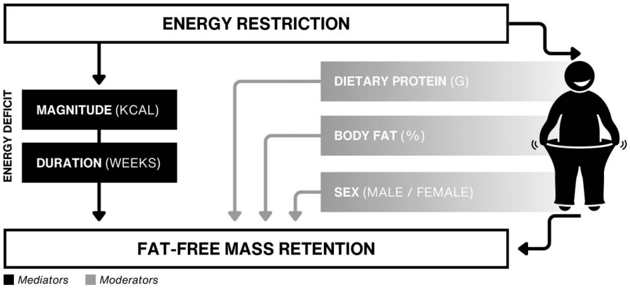
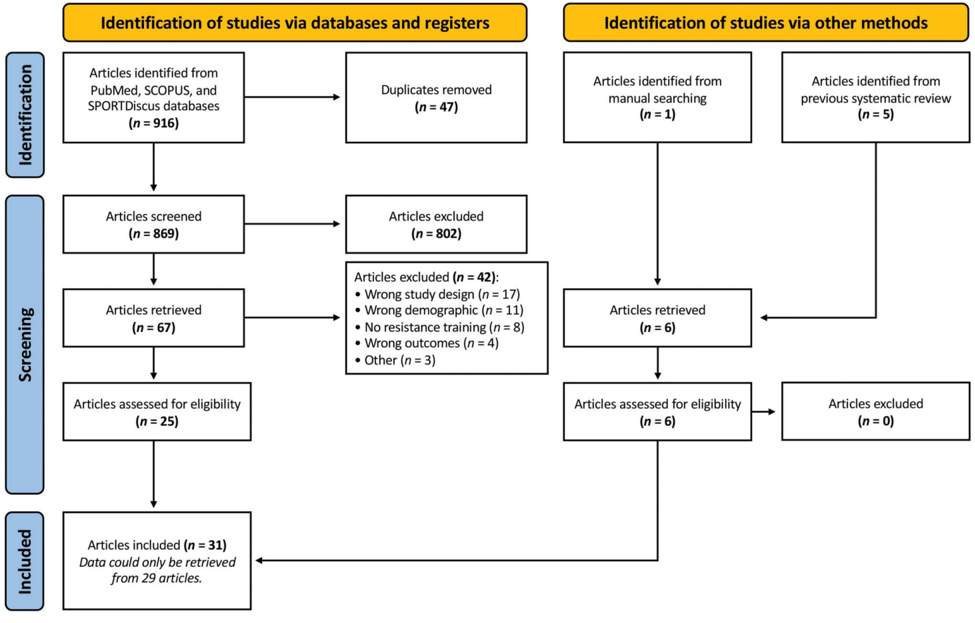
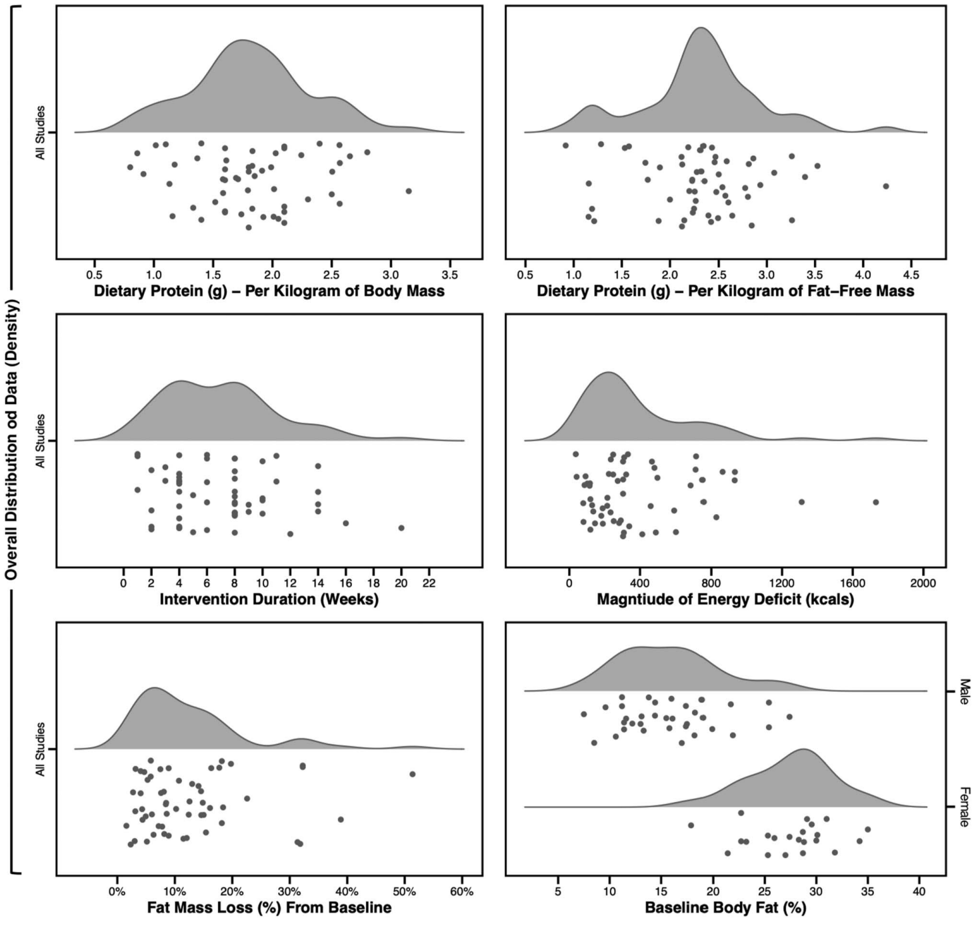
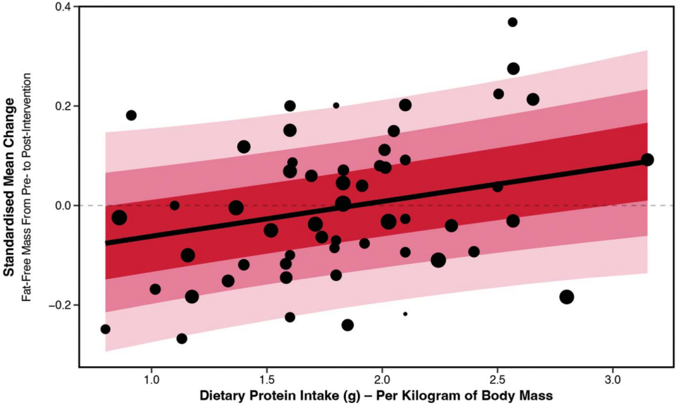
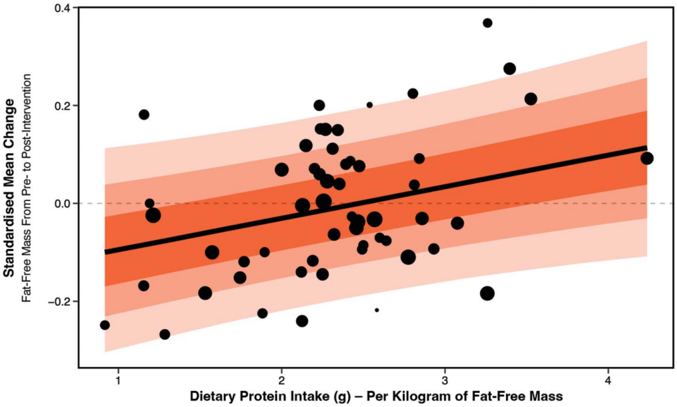
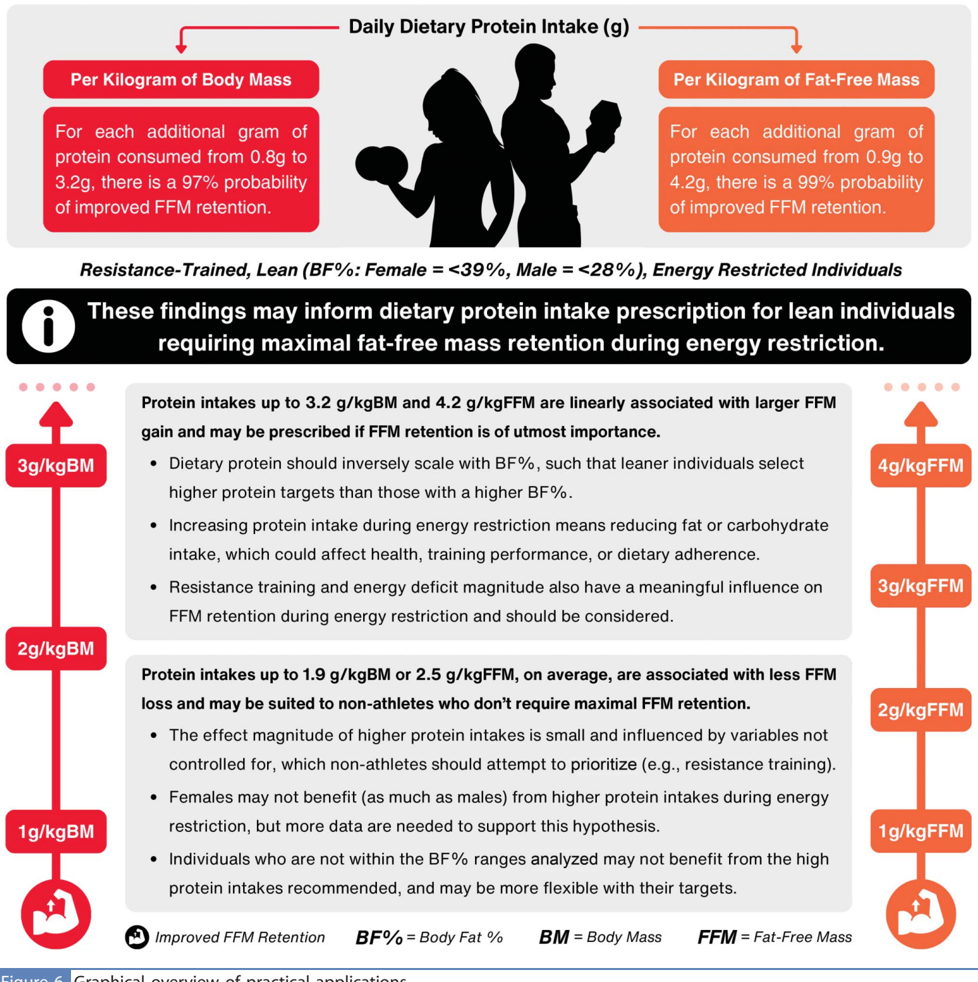
Individuals often restrict energy intake to lose fat mass (and body mass [BM]) while performing resistance training (RT) to retain fat-free mass (FFM). Therefore, the aim of the present systematic review with meta-regression was to explore (a) the pattern and strength of the dose-response relationship between daily dietary protein intake and FFM change, and (b) whether intervention duration, energy deficit magnitude, baseline body fat percentage (BF%), and participant sex influence this relationship. Studies were included if they involved a standardized RT protocol with nonobese, energy-restricted (experiencing fat mass loss) individuals with a minimum of 3 months RT experience. Of 916 retrieved studies, data were extracted from a total of 29 studies. Bayesian methods were used to fit linear and nonlinear meta-regression models and estimate effect sizes, highest density credible intervals, and probabilities. Results suggest a >97% probability of a linear dose-response relationship between daily protein intake [g/kgBM: β = 0.07 (95% highest density interval [HDI]: −0.01 to 0.14), and g/kg/FFM: β = 0.06 (95% HDI: 0.01 to 0.12)] and favorable FFM changes. The relationship is stronger when protein intake is expressed relative to FFM, in interventions longer than 4 weeks, in men, and when BF% is lower. Overall, the heterogeneity between studies renders our findings exploratory.
Overview
The claims and statistics of this paper haven’t been checked yet.
Run the check — free, no account needed. It reads the open-access text and checks the sources it cites.
Integrity signals
Registry
Cites
Statistics
Figures



Verification
Claims the paper makes
The claims and statistics of this paper haven’t been checked yet.
Run the check — free, no account needed. It reads the open-access text and checks the sources it cites.
Claims other papers make about this one
Each is checked against this paper’s own text: does it say what the citing paper says it does?
The cited source says what the claim attributes to it.
In the citing paper
“A more recent systematic review and meta-regression by Refalo et al. [116] revisited Helms et al.’s research question and included an additional decade of studies (29 in total), with analyses of non-obese, resistance-trained individuals in hypocaloric conditions. A daily protein intake of 1.9–3.2 g/kg BW, or 2.5–4.2 g/kg FFM, was associated with greater retention of fat-free mass.”
From International Society of Sports Nutrition position stand: diets for body weight reduction (2026) · cites this paper as [116]
Self-check
Percentages, sums and reported differences re-computed from the paper’s own numbers.
The self-check needs the paper’s full text.
Citations
Cites
The PRISMA 2020 statement: An updated guideline for reporting systematic reviews
Page, M. J., McKenzie, J. E., Bossuyt, P. M., Boutron, I., Hoffmann, T. C., Mulrow, C. D., Shamseer, L., Tetzlaff, J. M., Akl, E. A., Brennan, S. E., et al. (2021) · BMJ · doi:10.1136/bmj.n71 · Cited by 108,283
Kruschke, J. K., & Liddell, T. M. (2018) · Psychonomic Bulletin & Review · doi:10.3758/s13423-016-1221-4 · Cited by 1,288
Morton, R. W., Murphy, K. T., McKellar, S. R., Schoenfeld, B. J., Henselmans, M., Helms, E., Aragon, A. A., Devries, M. C., Banfield, L., Krieger, J. W., et al. (2018) · British Journal of Sports Medicine · doi:10.1136/bjsports-2017-097608 · Cited by 1,269
Self-citationMoro, T., Tinsley, G., Bianco, A., Marcolin, G., Pacelli, Q. F., Battaglia, G., Palma, A., Gentil, P., Neri, M., & Paoli, A. (2016) · Journal of Translational Medicine · doi:10.1186/s12967-016-1044-0 · Cited by 732
Mountjoy, M., Ackerman, K. E., Bailey, D. M., Burke, L. M., Constantini, N., Hackney, A. C., Heikura, I. A., Melin, A., Pensgaard, A. M., Stellingwerff, T., et al. (2023) · British Journal of Sports Medicine · doi:10.1136/bjsports-2023-106994 · Cited by 724
Smart, N. A., Waldron, M., Ismail, H., Giallauria, F., Vigorito, C., Cornelissen, V., & Dieberg, G. (2015) · International Journal of Evidence-Based Healthcare · doi:10.1097/xeb.0000000000000020 · Cited by 499
International society of sports nutrition position stand: diets and body composition
Aragon, A. A., Schoenfeld, B. J., Wildman, R., Kleiner, S., VanDusseldorp, T., Taylor, L., Earnest, C. P., Arciero, P. J., Wilborn, C., Kalman, D. S., et al. (2017) · Journal of the International Society of Sports Nutrition · doi:10.1186/s12970-017-0174-y · Cited by 301
Increased Protein Intake Reduces Lean Body Mass Loss during Weight Loss in Athletes
METTLER, S., MITCHELL, N., & TIPTON, K. D. (2010) · Medicine & Science in Sports & Exercise · doi:10.1249/mss.0b013e3181b2ef8e · Cited by 288
Nunes, E. A., Colenso‐Semple, L., McKellar, S. R., Yau, T., Ali, M. U., Fitzpatrick‐Lewis, D., Sherifali, D., Gaudichon, C., Tomé, D., Atherton, P. J., et al. (2022) · Journal of Cachexia, Sarcopenia and Muscle · doi:10.1002/jcsm.12922 · Cited by 280
Longland, T. M., Oikawa, S. Y., Mitchell, C. J., Devries, M. C., & Phillips, S. M. (2016) · The American Journal of Clinical Nutrition · doi:10.3945/ajcn.115.119339 · Cited by 271
Research works printed but not linked: 52
- Abernathy, 1996, Healthy body weights: An alternative perspective, Am J Clin Nutr, 63, 448S, 10.1093/ajcn/63.3.448 · DOI
- Bagheri, 2020, Comparison of whole egg v. egg white ingestion during 12 weeks of resistance training on skeletal muscle regulatory markers in resistance-trained men, Br J Nutr, 124, 1035, 10.1017/S0007114520002238 · DOI
- Bone, 2017, Manipulation of muscle creatine and glycogen changes dual X-ray absorptiometry estimates of body composition, Med Sci Sports Exerc, 49, 1029, 10.1249/MSS.0000000000001174 · DOI
- Campbell, 2018, Effects of high versus low protein intake on body composition and maximal strength in aspiring female physique athletes engaging in an 8-week resistance training program, Int J Sport Nutr Exerc Metab, 28, 580, 10.1123/ijsnem.2017-0389 · DOI
- Carbone, 2014, Effects of short-term energy deficit on muscle protein breakdown and intramuscular proteolysis in normal-weight young adults, Appl Physiol Nutr Metab, 39, 960, 10.1139/apnm-2013-0433 · DOI
- Conlin, 2021, Flexible vs. rigid dieting in resistance-trained individuals seeking to optimize their physiques: A randomized controlled trial, J Int Soc Sports Nutr, 18, 52, 10.1186/s12970-021-00452-2 · DOI
- Correia, 2021, Effects of time-restricted feeding on supramaximal exercise performance and body composition: A randomized and counterbalanced crossover study in healthy men, Int J Environ Res Public Health, 18, 7227, 10.3390/ijerph18147227 · DOI
- Correia, 2023, Effect of time-restricted eating and resistance training on high-speed strength and body composition, Nutrients, 15, 285, 10.3390/nu15020285 · DOI
- Dudgeon, 2017, Effect of whey protein in conjunction with a caloric-restricted diet and resistance training, J Strength Cond Res, 31, 1353, 10.1519/JSC.0000000000001196 · DOI
- Elia, 1999, Differences in fat, carbohydrate, and protein metabolism between lean and obese subjects undergoing total starvation, Obes Res, 7, 597, 10.1002/j.1550-8528.1999.tb00720.x · DOI · Paper page
- Helms, 2014, Evidence-based recommendations for natural bodybuilding contest preparation: Nutrition and supplementation, J Int Soc Sports Nutr, 11, 20, 10.1186/1550-2783-11-20 · DOI · Paper page
- Helms, 2014, A systematic review of dietary protein during caloric restriction in resistance trained lean athletes: A case for higher intakes, Int J Sport Nutr Exerc Metab, 24, 127, 10.1123/ijsnem.2013-0054 · DOI · Paper page
- Helms, 2015, High-protein, low-fat, short-term diet results in less stress and fatigue than moderate-protein moderate-fat diet during weight loss in male weightlifters: A pilot study, Int J Sport Nutr Exerc Metab, 25, 163, 10.1123/ijsnem.2014-0056 · DOI · Paper page
- Heymsfield, 2011, Voluntary weight loss: Systematic review of early phase body composition changes, Obes Rev, 12, e348, 10.1111/j.1467-789X.2010.00767.x · DOI · Paper page
- Hulmi, 2016, The effects of intensive weight reduction on body composition and serum hormones in female fitness competitors, Front Physiol, 7, 689
- Huovinen, 2015, Body composition and power performance improved after weight reduction in male athletes without hampering hormonal balance, J Strength Cond Res, 29, 29, 10.1519/JSC.0000000000000619 · DOI
- Ingram, 1987, Effect of low-fat diet on female sex hormone levels, J Natl Cancer Inst, 79, 1225, 10.1093/jnci/79.6.1225 · DOI
- Isenmann, 2021, The effects of a macronutrient-based diet and time-restricted feeding (16:8) on body composition in physically active individuals-A 14-week randomised controlled trial, Nutrients, 13, 3122, 10.3390/nu13093122 · DOI
- Isola, 2023, Weight loss induces changes in adaptive thermogenesis in female and male physique athletes, Appl Physiol Nutr Metab, 48, 307, 10.1139/apnm-2022-0372 · DOI
- Januszko, 2021, Nutrition, supplementation and weight reduction in combat sports: A review, AIMS Public Health, 8, 485, 10.3934/publichealth.2021038 · DOI
- King, 2022, The ergogenic effects of acute carbohydrate feeding on resistance exercise performance: A systematic review and meta-analysis, Sports Med, 52, 2691, 10.1007/s40279-022-01716-w · DOI
- King, 2023, The general nutrition practices of competitive powerlifters vary by competitive calibre and sex, weight, and age class, Eur J Nutr, 62, 3297, 10.1007/s00394-023-03233-6 · DOI
- MacKenzie-Shalders, 2016, Increasing protein distribution has No effect on changes in lean mass during a rugby preseason, Int J Sport Nutr Exerc Metab, 26, 1, 10.1123/ijsnem.2015-0040 · DOI
- Maestu, 2010, Anabolic and catabolic hormones and energy balance of the male bodybuilders during the preparation for the competition, J Strength Cond Res, 24, 1074, 10.1519/JSC.0b013e3181cb6fd3 · DOI
- McGuire, 2023, Energy availability and macronutrient intake in elite male Gaelic football players, Sci Med Footb, 7, 1, 10.1080/24733938.2022.2029551 · DOI
- Mero, 2010, Moderate energy restriction with high protein diet results in healthier outcome in women, J Int Soc Sports Nutr, 7, 4, 10.1186/1550-2783-7-4 · DOI
- Mielgo-Ayuso, 2015, Dietary intake habits and controlled training on body composition and strength in elite female volleyball players during the season, Appl Physiol Nutr Metab, 40, 827, 10.1139/apnm-2015-0100 · DOI
- Morris, 2008, Estimating effect sizes from pretest-posttest-control group designs, Organizational Res Methods, 11, 364, 10.1177/1094428106291059 · DOI · Paper page
- Murphy, 2022, Energy deficiency impairs resistance training gains in lean mass but not strength: A meta-analysis and meta-regression, Scand J Med Sci Sports, 32, 125, 10.1111/sms.14075 · DOI · Paper page
- Olenick, 2023, Training status impacts metabolic response to A high-protein weight loss diet in recreationally resistance-trained females, Int J Exerc Sci, 16, 377
- Oliveira, 2023, Performance of body fat percentage, fat mass index and body mass index for detecting cardiometabolic outcomes in Brazilian adults, Nutrients, 15, 2974, 10.3390/nu15132974 · DOI
- Paoli, 2021, Effects of two months of very low carbohydrate ketogenic diet on body composition, muscle strength, muscle area, and blood parameters in competitive natural body builders, Nutrients, 13, 374, 10.3390/nu13020374 · DOI
- Pearson, 2021, A hypoenergetic diet with decreased protein intake does not reduce lean body mass in trained females, Eur J Appl Physiol, 121, 771, 10.1007/s00421-020-04555-7 · DOI
- Peos, 2021, Continuous versus intermittent dieting for fat loss and fat-free mass retention in resistance-trained adults: The ICECAP trial, Med Sci Sports Exerc, 53, 1685, 10.1249/MSS.0000000000002636 · DOI
- Roberts, 2020, Nutritional recommendations for physique athletes, J Hum Kinet, 71, 79, 10.2478/hukin-2019-0096 · DOI
- Rodriguez, 2024, Skeletal muscle estimation: A review of techniques and their applications, Clin Physiol Funct Imaging, 44, 261, 10.1111/cpf.12874 · DOI
- Roth, 2022, Lean mass sparing in resistance-trained athletes during caloric restriction: The role of resistance training volume, Eur J Appl Physiol, 122, 1129, 10.1007/s00421-022-04896-5 · DOI
- Saidi, 2018, Intake of carbohydrate-protein supplements by recreational users at gyms: Body composition improved? ScienceDirect, Sci Sports, e141, 10.1016/j.scispo.2018.02.004 · DOI
- Siedler, 2023, The effects of intermittent diet breaks during 25% energy restriction on body composition and resting metabolic rate in resistance-trained females: A randomized controlled trial, J Hum Kinet, 86, 117, 10.5114/jhk/159960 · DOI
- Slater, 2011, Nutrition guidelines for strength sports: Sprinting, weightlifting, throwing events, and bodybuilding, J Sports Sci, 29, S67, 10.1080/02640414.2011.574722 · DOI
- Slater, 2019, SPRINTING. Dietary approaches to optimize training adaptation and performance, Int J Sport Nutr Exerc Metab, 29, 85, 10.1123/ijsnem.2018-0273 · DOI
- Stratton, 2020, Four weeks of time-restricted feeding combined with resistance training does not differentially influence measures of body composition, muscle performance, resting energy expenditure, and blood biomarkers, Nutrients, 12, 1126, 10.3390/nu12041126 · DOI
- Swinton, 2022, Comparative effect size distributions in strength and conditioning and implications for future research, SportRxiv
- Sygo, 2019, Fueling for the field: Nutrition for jumps, throws, and combined events, Int J Sport Nutr Exerc Metab, 29, 95, 10.1123/ijsnem.2018-0272 · DOI
- Tarnopolsky, 2000, Gender differences in metabolism; nutrition and supplements, J Sci Med Sport, 3, 287, 10.1016/S1440-2440(00)80038-9 · DOI
- Tinsley, 2019, Time-restricted feeding plus resistance training in active females: A randomized trial, Am J Clin Nutr, 110, 628, 10.1093/ajcn/nqz126 · DOI · Paper page
- Tipton, 2001, Gender differences in protein metabolism, Curr Opin Clin Nutr Metab Care, 4, 493
- Umeda, 2004, Adverse effects of energy restriction on myogenic enzymes in judoists, J Sports Sci, 22, 329, 10.1080/0264041031000140446 · DOI
- Vargas-Molina, 2023, Efficacy of progressive versus severe energy restriction on body composition and strength in concurrent trained women, Eur J Appl Physiol, 123, 1311, 10.1007/s00421-023-05158-8 · DOI
- Walberg, 1988, Macronutrient content of a hypoenergy diet affects nitrogen retention and muscle function in weight lifters, Int J Sports Med, 9, 261, 10.1055/s-2007-1025018 · DOI
- Whittaker, 2021, Low-fat diets and testosterone in men: Systematic review and meta-analysis of intervention studies, J Steroid Biochem Mol Biol, 210, 105878, 10.1016/j.jsbmb.2021.105878 · DOI
- Witard, 2019, Dietary protein for training adaptation and body composition manipulation in track and field athletes, Int J Sport Nutr Exerc Metab, 29, 165, 10.1123/ijsnem.2018-0267 · DOI
Cited by
Sorted by citations
International Society of Sports Nutrition position stand: diets for body weight reduction
Aragon, A. A., Campbell, B. I., Schoenfeld, B. J., Stout, J. R., Kalman, D., Arciero, P. J., Arent, S. M., Kreider, R. B., Taylor, L. W., Bannock, L., et al. (2026) · Journal of the International Society of Sports Nutrition · doi:10.1080/15502783.2026.2740266
Metadata
- Authors
- Refalo, M. C., Trexler, E. T., & Helms, E. R.
- Affiliations
- Institute for Physical Activity and Nutrition (IPAN), School of Exercise and Nutrition Sciences, Deakin University, Geelong, Australia;
- Department of Evolutionary Anthropology, Duke University, Durham, North Carolina;
- Sport Performance Research Institute New Zealand (SPRINZ), Auckland University of Technology, Auckland, New Zealand; and
- Venue
- Strength & Conditioning Journal
- Published
- 2025-01-22
- Volume
- 48
- Issue
- 4
- Pages
- 398-412
- ISSN
- 1524-1602
- 1533-4295
- Cited by
- 5
- References
- 18
- Language
- en
- Funders
- Renaissance Periodization, LLC, Reg. U.S. Pat. & Tm. Off.
About these checks
Registry, retraction, Cites and statistics results are computed, not judged, with one exception: a printed reference that no index lists is read once by a model before it counts as a citation error. Claims are extracted by a model and kept only when their quote appears verbatim in the text; each cited source is then checked, with a model’s help, for whether it says what the claim relies on. Those verdicts can be wrong — read the claim’s quote and the cited source before relying on one.
Statistics and arithmetic are recomputed, not judged.
Confidence bands are shown only for fields calibrated on our annotated test set. None is calibrated yet, so no band is shown.
What counts as a claim ›How we measure confidence ›How we check this ›
Are you an author, or do you see a problem with this page? Request a review
