

The DOI matches its Crossref record; 63 of the 63 references it cites were found in a registry or an index.
Cannabinoid Modulation of Amygdala Reactivity to Social Signals of Threat in Humans
Open accessAbstract
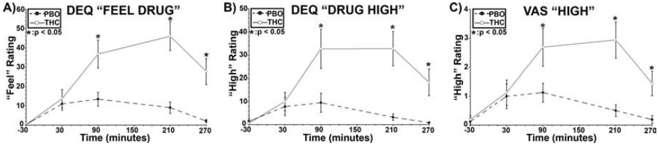
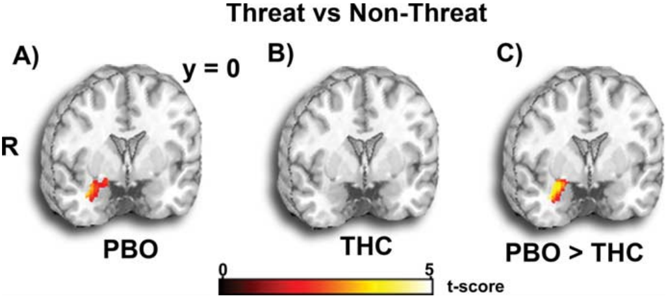
The cannabinoid (CB) system is a key neurochemical mediator of anxiety and fear learning in both animals and humans. The anxiolytic effects of Δ 9 -tetrahydrocannabinol (THC), the primary psychoactive ingredient in cannabis, are believed to be mediated through direct and selective agonism of CB 1 receptors localized within the basolateral amygdala, a critical brain region for threat perception. However, little is known about the effects of THC on amygdala reactivity in humans. We used functional magnetic resonance imaging and a well validated task to probe amygdala responses to threat signals in 16 healthy, recreational cannabis users after a double-blind crossover administration of THC or placebo. We found that THC significantly reduced amygdala reactivity to social signals of threat but did not affect activity in primary visual and motor cortex. The current findings fit well with the notion that THC and other cannabinoids may have an anxiolytic role in central mechanisms of fear behaviors and provide a rationale for exploring novel therapeutic strategies that target the cannabinoid system for disorders of anxiety and social fear.
Overview
The claims and statistics of this paper haven’t been checked yet.
Run the check — free, no account needed. It reads the open-access text and checks the sources it cites.
Integrity signals
Registry
Cites
Statistics
Figures
Verification
Claims the paper makes
The claims and statistics of this paper haven’t been checked yet.
Run the check — free, no account needed. It reads the open-access text and checks the sources it cites.
Claims other papers make about this one
Each is checked against this paper’s own text: does it say what the citing paper says it does?
In the citing paper
“Administration of Δ9-tetrahydrocannabinoid (THC), the main psychoactive constituent of cannabis, reduces amygdala response to social signals of threat, an action that may underlie anxiolytic effects of THC (Phan et al. 2008).”
From Effects of MDMA on sociability and neural response to social threat and social reward (2009) · cites this paper as Phan et al. 2008
Self-check
Percentages, sums and reported differences re-computed from the paper’s own numbers.
The self-check needs the paper’s full text.
Citations
Cites
Tzourio-Mazoyer, N., Landeau, B., Papathanassiou, D., Crivello, F., Etard, O., Delcroix, N., Mazoyer, B., & Joliot, M. (2002) · NeuroImage · doi:10.1006/nimg.2001.0978 · Cited by 16,319
Statistical parametric maps in functional imaging: A general linear approach
Friston, K. J., Holmes, A. P., Worsley, K. J., Poline, J. ‐., Frith, C. D., & Frackowiak, R. S. J. (1994) · Human Brain Mapping · doi:10.1002/hbm.460020402 · Cited by 9,688
LeDoux, J. E. (2000) · Annual Review of Neuroscience · doi:10.1146/annurev.neuro.23.1.155 · Cited by 8,444
Functional neuroanatomy of emotion: A meta-analysis of emotion activation studies in PET and fMRI
Phan, K. L., Wager, T., Taylor, S. F., & Liberzon, I. (2002) · NeuroImage · doi:10.1006/nimg.2002.1087 · Cited by 3,502
Self-citationEtkin, A., & Wager, T. D. (2007) · American Journal of Psychiatry · doi:10.1176/appi.ajp.2007.07030504 · Cited by 3,391 · cited 1×
“Amygdala hyperactivity to threatening faces has also consistently been observed in patients with anxiety disorders (Etkin and Wager, 2007).”
BackgroundThe role of the amygdala in fear and anxiety
Davis, M. (1992) · Annual Review of Neuroscience · doi:10.1146/annurev.ne.15.030192.002033 · Cited by 2,357
Whalen, P. J., Rauch, S. L., Etcoff, N. L., McInerney, S. C., Lee, M. B., & Jenike, M. A. (1998) · The Journal of Neuroscience · doi:10.1523/jneurosci.18-01-00411.1998 · Cited by 2,205
A differential neural response in the human amygdala to fearful and happy facial expressions
Morris, J. S., Frith, C. D., Perrett, D. I., Rowland, D., Young, A. W., Calder, A. J., & Dolan, R. J. (1996) · Nature · doi:10.1038/383812a0 · Cited by 2,013
Neural systems for recognizing emotion
Adolphs, R. (2002) · Current Opinion in Neurobiology · doi:10.1016/s0959-4388(02)00301-x · Cited by 1,933
The endogenous cannabinoid system controls extinction of aversive memories
Marsicano, G., Wotjak, C. T., Azad, S. C., Bisogno, T., Rammes, G., Cascio, M. G., Hermann, H., Tang, J., Hofmann, C., Zieglgänsberger, W., et al. (2002) · Nature · doi:10.1038/nature00839 · Cited by 1,728
Oxytocin Modulates Neural Circuitry for Social Cognition and Fear in Humans
Kirsch, P., Esslinger, C., Chen, Q., Mier, D., Lis, S., Siddhanti, S., Gruppe, H., Mattay, V. S., Gallhofer, B., & Meyer-Lindenberg, A. (2005) · The Journal of Neuroscience · doi:10.1523/jneurosci.3984-05.2005 · Cited by 1,639
Human emotion and memory: Interactions of the amygdala and hippocampal complex
Phelps, E. A. (2004) · Current Opinion in Neurobiology · doi:10.1016/j.conb.2004.03.015 · Cited by 1,577
A mechanism for impaired fear recognition after amygdala damage
Adolphs, R., Gosselin, F., Buchanan, T. W., Tranel, D., Schyns, P., & Damasio, A. R. (2005) · Nature · doi:10.1038/nature03086 · Cited by 1,331 · cited 2×
“Consistent with findings in nonhumans, the amygdala is critical and particular to threat perception and fear learning in humans (LeDoux, 2000; Zald, 2003; Phelps, 2004; Adolphs et al., 2005).”
BackgroundResultRauch, S. L., Whalen, P. J., Shin, L. M., McInerney, S. C., Macklin, M. L., Lasko, N. B., Orr, S. P., & Pitman, R. K. (2000) · Biological Psychiatry · doi:10.1016/s0006-3223(00)00828-3 · Cited by 1,111
The human amygdala and the emotional evaluation of sensory stimuli
Zald, D. H. (2003) · Brain Research Reviews · doi:10.1016/s0165-0173(02)00248-5 · Cited by 1,062
D'Souza, D. C., Perry, E., MacDougall, L., Ammerman, Y., Cooper, T., Wu, Y.-T., Braley, G., Gueorguieva, R., & Krystal, J. H. (2004) · Neuropsychopharmacology · doi:10.1038/sj.npp.1300496 · Cited by 1,024
Targeting abnormal neural circuits in mood and anxiety disorders: from the laboratory to the clinic
Ressler, K. J., & Mayberg, H. S. (2007) · Nature Neuroscience · doi:10.1038/nn1944 · Cited by 1,007
The Amygdala Response to Emotional Stimuli: A Comparison of Faces and Scenes
Hariri, A. R., Tessitore, A., Mattay, V. S., Fera, F., & Weinberger, D. R. (2002) · NeuroImage · doi:10.1006/nimg.2002.1179 · Cited by 984
Generalisability, Random Effects & Population Inference
Holmes, A. P., & Friston, K. J. (1998) · NeuroImage · doi:10.1016/s1053-8119(18)31587-8 · Cited by 886
A Susceptibility Gene for Affective Disorders and the Response of the Human Amygdala
Hariri, A. R., Drabant, E. M., Munoz, K. E., Kolachana, B. S., Mattay, V. S., Egan, M. F., & Weinberger, D. R. (2005) · Archives of General Psychiatry · doi:10.1001/archpsyc.62.2.146 · Cited by 815
Katona, I., Rancz, E. A., Acsády, L., Ledent, C., Mackie, K., Hájos, N., & Freund, T. F. (2001) · The Journal of Neuroscience · doi:10.1523/jneurosci.21-23-09506.2001 · Cited by 668 · cited 9×
“CB1 receptors are densely localized to a distinct population of GABAergic interneurons in the lateral and basal (BLA), but not central (CeA), nuclei of the amygdala (Katona et al., 2001).”
BackgroundInfluentialGur, R. C., Šára, R., Hagendoorn, M., Marom, O., Hughett, P., Macy, L., Turner, T. H., Bajcsy, R., Posner, A., & Gur, R. E. (2002) · Journal of Neuroscience Methods · doi:10.1016/s0165-0270(02)00006-7 · Cited by 663
Increased Amygdala Activation to Angry and Contemptuous Faces in Generalized Social Phobia
Stein, M. B., Goldin, P. R., Sareen, J., Zorrilla, L. T. E., & Brown, G. G. (2002) · Archives of General Psychiatry · doi:10.1001/archpsyc.59.11.1027 · Cited by 598
Phan, K. L., Fitzgerald, D. A., Nathan, P. J., & Tancer, M. E. (2006) · Biological Psychiatry · doi:10.1016/j.biopsych.2005.08.012 · Cited by 539
Self-citationInvolvement of CB1 cannabinoid receptors in emotional behaviour
Martín, M., Ledent, C. A., Parmentier, M., Maldonado, R. J., & Valverde, O. (2002) · Psychopharmacology · doi:10.1007/s00213-001-0946-5 · Cited by 525
Reliability, validity, and clinical application of the visual analogue mood scale
Folstein, M. F., & Luria, R. E. (1973) · Psychological Medicine · doi:10.1017/s0033291700054283 · Cited by 514
Activation of Corticotropin-Releasing Factor in the Limbic System During Cannabinoid Withdrawal
Rodrı́guez de Fonseca, F., Carrera, M. R. A., Navarro, M., Koob, G. F., & Weiss, F. (1997) · Science · doi:10.1126/science.276.5321.2050 · Cited by 499
Endocannabinoid system and stress and anxiety responses
VIVEROS, M., MARCO, E., & FILE, S. (2005) · Pharmacology Biochemistry and Behavior · doi:10.1016/j.pbb.2005.01.029 · Cited by 485
Antidepressant Drug Treatment Modifies the Neural Processing of Nonconscious Threat Cues
Harmer, C. J., Mackay, C. E., Reid, C. B., Cowen, P. J., & Goodwin, G. M. (2006) · Biological Psychiatry · doi:10.1016/j.biopsych.2005.10.015 · Cited by 450
Beyond threat: amygdala reactivity across multiple expressions of facial affect
Fitzgerald, D. A., Angstadt, M., Jelsone, L. M., Nathan, P. J., & Phan, K. L. (2006) · NeuroImage · doi:10.1016/j.neuroimage.2005.11.003 · Cited by 427
Self-citationEndocannabinoid signaling system and brain reward: emphasis on dopamine
GARDNER, E. (2005) · Pharmacology Biochemistry and Behavior · doi:10.1016/j.pbb.2005.01.032 · Cited by 387
Enhancing Cannabinoid Neurotransmission Augments the Extinction of Conditioned Fear
Chhatwal, J. P., Davis, M., Maguschak, K. A., & Ressler, K. J. (2005) · Neuropsychopharmacology · doi:10.1038/sj.npp.1300655 · Cited by 376
Glucocorticoids reduce phobic fear in humans
Soravia, L. M., Heinrichs, M., Aerni, A., Maroni, C., Schelling, G., Ehlert, U., Roozendaal, B., & de Quervain, D. J. ‐. (2006) · Proceedings of the National Academy of Sciences · doi:10.1073/pnas.0509184103 · Cited by 361
Neural correlates of genetically abnormal social cognition in Williams syndrome
Meyer-Lindenberg, A., Hariri, A. R., Munoz, K. E., Mervis, C. B., Mattay, V. S., Morris, C. A., & Berman, K. F. (2005) · Nature Neuroscience · doi:10.1038/nn1494 · Cited by 357
The effects of genetic and pharmacological blockade of the CB1 cannabinoid receptor on anxiety
Haller, J., Bakos, N., Szirmay, M., Ledent, C., & Freund, T. F. (2002) · European Journal of Neuroscience · doi:10.1046/j.1460-9568.2002.02192.x · Cited by 354
Paulus, M. P., Feinstein, J. S., Castillo, G., Simmons, A. N., & Stein, M. B. (2005) · Archives of General Psychiatry · doi:10.1001/archpsyc.62.3.282 · Cited by 314
Pharmacological characterization of cannabinoids in the elevated plus maze.
Onaivi, E. S., Green, M. R., & Martin, B. R. (1990) · Journal of Pharmacology and Experimental Therapeutics · doi:10.1016/s0022-3565(25)13195-9 · Cited by 312
Patel, S., Roelke, C. T., Rademacher, D. J., & Hillard, C. J. (2005) · European Journal of Neuroscience · doi:10.1111/j.1460-9568.2005.03916.x · Cited by 297
Dopamine Modulates the Response of the Human Amygdala: A Study in Parkinson's Disease
Tessitore, A., Hariri, A. R., Fera, F., Smith, W. G., Chase, T. N., Hyde, T. M., Weinberger, D. R., & Mattay, V. S. (2002) · The Journal of Neuroscience · doi:10.1523/jneurosci.22-20-09099.2002 · Cited by 293
Haller, J., Varga, B., Ledent, C., Barna, I., & Freund, T. F. (2004) · European Journal of Neuroscience · doi:10.1111/j.1460-9568.2004.03293.x · Cited by 284
Neurobiology of marijuana abuse
Abood, M. E., & Martin, B. R. (1992) · Trends in Pharmacological Sciences · doi:10.1016/0165-6147(92)90064-d · Cited by 249
Kalin, N. H., Shelton, S. E., Davidson, R. J., & Kelley, A. E. (2001) · Journal of Neuroscience · doi:10.1523/jneurosci.21-06-02067.2001 · Cited by 227
The endocannabinoid nervous system
Porter, A. C., & Felder, C. C. (2001) · Pharmacology & Therapeutics · doi:10.1016/s0163-7258(01)00130-9 · Cited by 226
Involvement of the opioid system in the anxiolytic-like effects induced by Δ9-tetrahydrocannabinol
Berrendero, F., & Maldonado, R. J. (2002) · Psychopharmacology · doi:10.1007/s00213-002-1144-9 · Cited by 225
Cannabinoid CB1 Receptor Mediates Fear Extinction via Habituation-Like Processes
Kamprath, K., Marsicano, G., Tang, J., Monory, K., Bisogno, T., Marzo, V. D., Lutz, B., & Wotjak, C. T. (2006) · Journal of Neuroscience · doi:10.1523/jneurosci.0153-06.2006 · Cited by 217
Comparison of the subjective effects of Δ 9 -tetrahydrocannabinol and marijuana in humans
Wachtel, S. R., ElSohly, M. A., Ross, S. A., AMBRE, J. J., & de Wit, H. (2002) · Psychopharmacology · doi:10.1007/s00213-002-1033-2 · Cited by 210
The intercalated cell masses project to the central and medial nuclei of the amygdala in cats
Paré, D., & Smith, Y. (1993) · Neuroscience · doi:10.1016/0306-4522(93)90050-p · Cited by 209
Drug preference and mood in humans: Diazepam
Johanson, C. E., & UHLENHUTH, E. H. (1980) · Psychopharmacology · doi:10.1007/bf00433061 · Cited by 208
Hájos, N., & Freund, T. F. (2002) · Neuropharmacology · doi:10.1016/s0028-3908(02)00157-0 · Cited by 201
Laviolette, S. R., & Grace, A. A. (2006) · Journal of Neuroscience · doi:10.1523/jneurosci.0707-06.2006 · Cited by 189
Dextroamphetamine modulates the response of the human amygdala
Hariri, A. (2002) · Neuropsychopharmacology · doi:10.1016/s0893-133x(02)00373-1 · Cited by 185
Endogenous cortisol level interacts with noradrenergic activation in the human amygdala
van Stegeren, A. H., Wolf, O. T., Everaerd, W. T. A. M., Scheltens, P., Barkhof, F., & Rombouts, S. A. R. B. (2006) · Neurobiology of Learning and Memory · doi:10.1016/j.nlm.2006.05.008 · Cited by 170
A role for cannabinoid CB1 receptors in mood and anxiety disorders
Witkin, J. M., Tzavara, E. T., & Nomikos, G. G. (2005) · Behavioural Pharmacology · doi:10.1097/00008877-200509000-00005 · Cited by 160
Reinforcing and subjective effects of oral Δ9-THC and smoked marijuana in humans
Chait, L. D., & Zacny, J. P. (1992) · Psychopharmacology · doi:10.1007/bf02245145 · Cited by 143
Pistis, M., Perra, S., Pillolla, G., Melis, M., Gessa, G., & Muntoni, A. (2004) · Neuropharmacology · doi:10.1016/j.neuropharm.2003.08.003 · Cited by 124
Genn, R. F., Tucci, S. A., Marco, E. M., Viveros, M., & File, S. E. (2004) · Pharmacology Biochemistry and Behavior · doi:10.1016/j.pbb.2003.12.019 · Cited by 92
Navarro, M. A., Fernández‐Ruíz, J., de Miguel, R., Hernández, M., Cebeira, M., & Ramos, J. A. (1993) · Behavioural Brain Research · doi:10.1016/0166-4328(93)90059-y · Cited by 77
Responses to Oral Δ9-Tetrahydrocannabinol in Frequent and Infrequent Marijuana Users
Kirk, J. M., & de Wit, H. (1999) · Pharmacology Biochemistry and Behavior · doi:10.1016/s0091-3057(98)00264-0 · Cited by 65
Crossing cultural divides: moral conflict and the Cairo population conference.
Davis, J. E. (1995) · PubMed · Cited by 65
Antianxiety effect of cannabis: Involvement of central benzodiazepine receptors
Sethi, B. B., Trivedi, J. K., Kumar, P., Gulati, A., Agarwal, A. K., & Sethi, N. (1986) · Biological Psychiatry · doi:10.1016/0006-3223(86)90003-x · Cited by 52
Effects of smoked marijuana on human social behavior in small groups
Foltin, R. W., & Fischman, M. W. (1988) · Pharmacology Biochemistry and Behavior · doi:10.1016/0091-3057(88)90494-7 · Cited by 35
Worsley (1996) · doi:10.1002/(sici)1097-0193(1996)4:1
Basser (2000) · doi:10.1002/1522-2594(200010)44:4
Research works printed but not linked: 1
- Walter B Blecker C Kirsch P Sammer G Schlienle A Stark R Vaitl D (2003) Paper presented at Ninth International Conference on Functional Mapping of the Human Brain (June, New York, NY), MARINA: an easy to use tool for the creation of MAsks for Region of INterest Analyses.
Cited by
Sorted by citations
Bhattacharyya, S., Morrison, P. D., Fusar-Poli, P., Martin-Santos, R., Borgwardt, S., Winton-Brown, T., Nosarti, C., O' Carroll, C. M., Seal, M., Allen, P., et al. (2010) · Neuropsychopharmacology · doi:10.1038/npp.2009.184 · Cited by 680
Oxytocin Attenuates Amygdala Reactivity to Fear in Generalized Social Anxiety Disorder
Labuschagne, I., Phan, K. L., Wood, A., Angstadt, M., Chua, P., Heinrichs, M., Stout, J. C., & Nathan, P. J. (2010) · Neuropsychopharmacology · doi:10.1038/npp.2010.123 · Cited by 549
Self-citationBatalla, A., Bhattacharyya, S., Yücel, M., Fusar‐Poli, P., Crippa, J. A. S., Nogué, S., Torrens, M., Pujol, J., Farré, M., & Martín‐Santos, R. (2013) · PLoS ONE · doi:10.1371/journal.pone.0055821 · Cited by 437
Cannabis and anxiety: a critical review of the evidence
Crippa, J. A., Zuardi, A. W., Martín‐Santos, R., Bhattacharyya, S., Atakan, Z., McGuire, P., & Fusar‐Poli, P. (2009) · Human Psychopharmacology: Clinical and Experimental · doi:10.1002/hup.1048 · Cited by 509
The neurobiology of individual differences in complex behavioral traits
Hariri, A. R. (2009) · Annual Review of Neuroscience · doi:10.1146/annurev.neuro.051508.135335 · Cited by 273
Metadata
- Authors
- Phan, K. L., Angstadt, M., Golden, J., Onyewuenyi, I., Popovska, A., & de Wit, H.
- Affiliations
- University of Michigan (US)
- Howard University (US)
- Amherst College (US)
- Venue
- The Journal of Neuroscience
- Publisher
- Society for Neuroscience
- Published
- 2008-03-05
- Volume
- 28
- Issue
- 10
- Pages
- 2313-2319
- ISSN
- 0270-6474 (ISSN-L)
- 1529-2401
- PMC
- PMC2657360
- OpenAlex
- W2004840573
- Cited by
- 251
- References
- 63
- Citations by year
- 2026: 9 · 2025: 8 · 2024: 3 · 2023: 8 · 2022: 11 · 2021: 22 · 2020: 26 · 2019: 12 · 2018: 13 · 2017: 20 · 2016: 11 · 2015: 19 · 2014: 16 · 2013: 14 · 2012: 20
- FWCI
- 8.91
- Type
- journal article
- Language
- en
- Open access
- hybrid
- doi.org
- Licence
- Locations
- Journal of Neuroscience (publishedVersion, cc-by-nc-sa)
- PubMed Central (publishedVersion)
- PubMed (publishedVersion)
- Funders
- National Institutes of Health
- National Institute of Mental Health (MH076198, K23MH076198)
- National Institute on Drug Abuse (R03DA024197, DA024197, R90DA023425, DA009133, DA023425, R01DA009133, R01DA002812, DA002812)
- Topics
- Health Sciences › Medicine › Pharmacology (medical) › Cannabis and Cannabinoid Research
- Social Sciences › Psychology › Clinical Psychology › Psychedelics and Drug Studies
- Life Sciences › Neuroscience › Cognitive Neuroscience › Memory and Neural Mechanisms
- Keywords
- endocannabinoid system, delta-9-tetrahydrocannabinol, THC, amygdala, fear, anxiety, CB1 receptor, anxiolytic effects, cannabis users, fear learning
- MeSH terms
- Adolescent, Adult, Amygdala, Cannabinoids, Double-Blind Method, Fear, Female, Humans, Magnetic Resonance Imaging, Male, Psychomotor Performance, Social Behavior, Dronabinol
About these checks
Registry, retraction, Cites and statistics results are computed, not judged, with one exception: a printed reference that no index lists is read once by a model before it counts as a citation error. Claims are extracted by a model and kept only when their quote appears verbatim in the text; each cited source is then checked, with a model’s help, for whether it says what the claim relies on. Those verdicts can be wrong — read the claim’s quote and the cited source before relying on one.
Statistics and arithmetic are recomputed, not judged.
Confidence bands are shown only for fields calibrated on our annotated test set. None is calibrated yet, so no band is shown.
What counts as a claim ›How we measure confidence ›How we check this ›
Are you an author, or do you see a problem with this page? Request a review
