

Youth risk behavior surveillance-United States, 2017
Open accessThe DOI matches its Crossref record; 27 of the 35 references it cites were found in a registry or an index.
Abstract
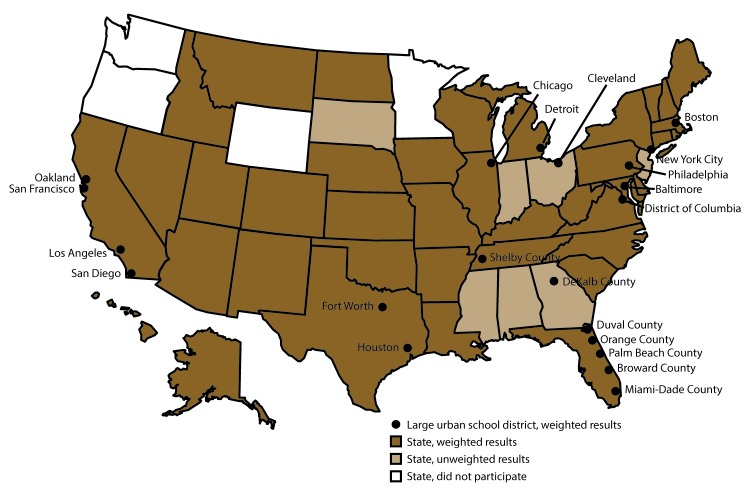
PROBLEM: Health-risk behaviors contribute to the leading causes of morbidity and mortality among youth and adults in the United States. In addition, significant health disparities exist among demographic subgroups of youth defined by sex, race/ethnicity, and grade in school and between sexual minority and nonsexual minority youth. Population-based data on the most important health-related behaviors at the national, state, and local levels can be used to help monitor the effectiveness of public health interventions designed to protect and promote the health of youth at the national, state, and local levels. REPORTING PERIOD COVERED: September 2016-December 2017. DESCRIPTION OF THE SYSTEM: The Youth Risk Behavior Surveillance System (YRBSS) monitors six categories of priority health-related behaviors among youth and young adults: 1) behaviors that contribute to unintentional injuries and violence; 2) tobacco use; 3) alcohol and other drug use; 4) sexual behaviors related to unintended pregnancy and sexually transmitted infections (STIs), including human immunodeficiency virus (HIV) infection; 5) unhealthy dietary behaviors; and 6) physical inactivity. In addition, YRBSS monitors the prevalence of other health-related behaviors, obesity, and asthma. YRBSS includes a national school-based Youth Risk Behavior Survey (YRBS) conducted by CDC and state and large urban school district school-based YRBSs conducted by state and local education and health agencies. Starting with the 2015 YRBSS cycle, a question to ascertain sexual identity and a question to ascertain sex of sexual contacts were added to the national YRBS questionnaire and to the standard YRBS questionnaire used by the states and large urban school districts as a starting point for their questionnaires. This report summarizes results from the 2017 national YRBS for 121 health-related behaviors and for obesity, overweight, and asthma by demographic subgroups defined by sex, race/ethnicity, and grade in school and by sexual minority status; updates the numbers of sexual minority students nationwide; and describes overall trends in health-related behaviors during 1991-2017. This reports also summarizes results from 39 state and 21 large urban school district surveys with weighted data for the 2017 YRBSS cycle by sex and sexual minority status (where available). RESULTS: Results from the 2017 national YRBS indicated that many high school students are engaged in health-risk behaviors associated with the leading causes of death among persons aged 10-24 years in the United States. During the 30 days before the survey, 39.2% of high school students nationwide (among the 62.8% who drove a car or other vehicle during the 30 days before the survey) had texted or e-mailed while driving, 29.8% reported current alcohol use, and 19.8% reported current marijuana use. In addition, 14.0% of students had taken prescription pain medicine without a doctor's prescription or differently than how a doctor told them to use it one or more times during their life. During the 12 months before the survey, 19.0% had been bullied on school property and 7.4% had attempted suicide. Many high school students are engaged in sexual risk behaviors that relate to unintended pregnancies and STIs, including HIV infection. Nationwide, 39.5% of students had ever had sexual intercourse and 9.7% had had sexual intercourse with four or more persons during their life. Among currently sexually active students, 53.8% reported that either they or their partner had used a condom during their last sexual intercourse. Results from the 2017 national YRBS also indicated many high school students are engaged in behaviors associated with chronic diseases, such as cardiovascular disease, cancer, and diabetes. Nationwide, 8.8% of high school students had smoked cigarettes and 13.2% had used an electronic vapor product on at least 1 day during the 30 days before the survey. Forty-three percent played video or computer games or used a computer for 3 or more hours per day on an average school day for something that was not school work and 15.4% had not been physically active for a total of at least 60 minutes on at least 1 day during the 7 days before the survey. Further, 14.8% had obesity and 15.6% were overweight. The prevalence of most health-related behaviors varies by sex, race/ethnicity, and, particularly, sexual identity and sex of sexual contacts. Specifically, the prevalence of many health-risk behaviors is significantly higher among sexual minority students compared with nonsexual minority students. Nonetheless, analysis of long-term temporal trends indicates that the overall prevalence of most health-risk behaviors has moved in the desired direction. INTERPRETATION: Most high school students cope with the transition from childhood through adolescence to adulthood successfully and become healthy and productive adults. However, this report documents that some subgroups of students defined by sex, race/et
Overview
The claims and statistics of this paper haven’t been checked yet.
Free: it reads the open-access text and checks the first 5 claims that cite a source we can check. Create a free account to check every claim.
Integrity signals
Registry
Cites
Statistics
Figures
Verification
Claims the paper makes
The claims and statistics of this paper haven’t been checked yet.
Free: it reads the open-access text and checks the first 5 claims that cite a source we can check. Create a free account to check every claim.
Claims other papers make about this one
Each is checked against this paper’s own text: does it say what the citing paper says it does?
The source backs part of the claim, not all of it — or backs it for a different population, condition or comparison.
In the citing paper
“The incidence has been steadily rising in the USA, and 5.1% of male and 9.3% of female high school students in the USA report a suicide attempt in the past year [2].”
From Adolescent Suicide—Understanding Unique Risks and Opportunities for Trauma Centers to Recognize, Intervene, and Prevent a Leading Cause of Death (2022) · cites this paper as [2]
Experimental — accuracy not yet measuredThe source backs part of the claim, not all of it — or backs it for a different population, condition or comparison.
In the citing paper
“School surveys also show young sexual and gender minority individuals continue to experience high levels of bullying and name calling [54].”
From Minority stress theory: Application, critique, and continued relevance (2023) · cites this paper as [54]
Experimental — accuracy not yet measuredThe source backs part of the claim, not all of it — or backs it for a different population, condition or comparison.
In the citing paper
“Further evidence indicates that exposure to minority stress remains a significant concern in the lives of sexual and gender minority individuals.”
From Minority stress theory: Application, critique, and continued relevance (2023) · cites this paper as [54]
Experimental — accuracy not yet measuredThe cited source says what the claim attributes to it.
In the citing paper
“as it is well documented female individuals have higher rates of attempted suicide.12,13”
From Trends in Suicide Among Youth Aged 10 to 19 Years in the United States, 1975 to 2016 (2019) · cites this paper as [12]
Self-check
Percentages, sums and reported differences re-computed from the paper’s own numbers.
The self-check needs the paper’s full text.
Citations
Cites
CDC growth charts: United States.
Kuczmarski, R. J., Ogden, C. L., Grummer‐Strawn, L. M., Flegal, K. M., Guo, S. S., Wei, R. X., Mei, Z., Curtin, L. R., Roche, A. F., & Johnson, C. L. (2000) · PubMed · Cited by 5,298
(2006) · PubMed · Cited by 3,378
Self-citation(2012) · Choice Reviews Online · doi:10.5860/choice.49-2699 · Cited by 2,593
Youth Risk Behavior Surveillance United States, 2015
Kann, L., McManus, T., Harris, W. A., Shanklin, S. L., Flint, K. H., Hawkins, J., Queen, B., Lowry, R., Olsen, E. O., Chyen, D., et al. (2016) · MMWR. Surveillance Summaries · doi:10.15585/mmwr.ss6506a1 · Cited by 2,036
Self-citationYouth Risk Behavior Surveillance - United States, 2009: (661322010-001)
(2010) · PsycEXTRA Dataset · doi:10.1037/e661322010-001 · Cited by 1,749
Self-citationMethodology of the Youth Risk Behavior Surveillance System: (548562006-001)
(2004) · PsycEXTRA Dataset · doi:10.1037/e548562006-001 · Cited by 1,182
Self-citationReliability of the 1999 youth risk behavior survey questionnaire
BRENER, N., KANN, L., MCMANUS, T., KINCHEN, S., SUNDBERG, E., & ROSS, J. (2002) · Journal of Adolescent Health · doi:10.1016/s1054-139x(02)00339-7 · Cited by 1,101
Self-citationU.S. Department of Health and Human (2015) · Journal of Pain & Palliative Care Pharmacotherapy · doi:10.3109/15360288.2015.1037530 · Cited by 891
Sexual and Gender Minority Health: What We Know and What Needs to Be Done
Mayer, K. H., Bradford, J. B., Makadon, H. J., Stall, R., Goldhammer, H., & Landers, S. (2008) · American Journal of Public Health · doi:10.2105/ajph.2007.127811 · Cited by 806
Martin, J. A., Be, H., Osterman, M. J. K., Ak, D., & Drake, P. F. (2018) · PubMed · Cited by 752
Cited by
Items 101–200 of 1,006
Patrick, M. E., Terry‐McElrath, Y. M., Lanza, S. T., Jager, J., Schulenberg, J. E., & O'Malley, P. M. (2019) · Alcoholism: Clinical and Experimental Research · doi:10.1111/acer.13933 · Cited by 100
“…measure of 5+ drinks for both men and women (rather than gender-specific levels of 4+ for women and 5+ drinks for men per occasion [e.g., Centers for Disease Control and Prevention, 2015; Kann et al., 2018]), and focused on binge drinking within a relatively short time frame (i.e., past 2 weeks).”
Lee, A., Lo, A. S. C., Keung, M. W., Kwong, C. M. A., & Wong, K. K. (2019) · BMC Public Health · doi:10.1186/s12889-019-7425-6 · Cited by 100
Irwin, C. C., Irwin, R. L., Ryan, T. D., & Drayer, J. (2009) · Injury Prevention · doi:10.1136/ip.2008.020461 · Cited by 100
Impact of Bathroom Discrimination on Mental Health Among Transgender and Nonbinary Youth
Price, M. N., Green, A. E., & Dorison, S. H. (2020) · Journal of Adolescent Health · doi:10.1016/j.jadohealth.2020.11.001 · Cited by 100
Yakubu, I., Garmaroudi, G., Sadeghi, R., Tol, A., Yekaninejad, M. S., & Yidana, A. (2019) · Reproductive Health · doi:10.1186/s12978-019-0784-8 · Cited by 101
Piolanti, A., & Foran, H. M. (2021) · Archives of Pediatrics and Adolescent Medicine · doi:10.1001/jamapediatrics.2021.4829 · Cited by 97
Alessi, E. J., Greenfield, B., Manning, D., & Dank, M. (2020) · Journal of Interpersonal Violence · doi:10.1177/0886260519898434 · Cited by 96
Testing effects of social rejection on aggressive and prosocial behavior: A meta‐analysis
Quarmley, M., Feldman, J. L., Grossman, H., Clarkson, T., Moyer, A. E., & Jarcho, J. M. (2022) · Aggressive Behavior · doi:10.1002/ab.22026 · Cited by 96
La Edad de Inicio en el Consumo de Drogas, un Indicador de Consumo Problemático
López, T. H., & Fernández, J. R. (2009) · Psychosocial Intervention · doi:10.5093/in2009v18n3a2 · Cited by 95
Human Papillomavirus Vaccination: ACOG Committee Opinion, Number 809
(2020) · Obstetrics and Gynecology · doi:10.1097/aog.0000000000004000 · Cited by 95
Sex education in school, are gender and sexual minority youth included?: A decade in review
Rabbitte, M. (2020) · American Journal of Sexuality Education · doi:10.1080/15546128.2020.1832009 · Cited by 95
Chorin, E., Hassidim, A., Hartal, M., Havakuk, O., Flint, N., Ziv‐Baran, T., & Arbel, Y. (2015) · American Journal of Hypertension · doi:10.1093/ajh/hpv007 · Cited by 95
LGBTQ Bullying: Translating Research to Action in Pediatrics
Earnshaw, V. A., Reisner, S. L., Juvonen, J., Hatzenbuehler, M. L., Perrotti, J., & Schuster, M. A. (2017) · Pediatrics · doi:10.1542/peds.2017-0432 · Cited by 93
Htet, H., Saw, Y. M., Saw, T. N., Htun, N. M. M., Mon, K. L., Cho, S. M., Thike, T., Khine, A. T., Kariya, T., Yamamoto, E., et al. (2020) · PLoS ONE · doi:10.1371/journal.pone.0229329 · Cited by 93
Familism, Family Environment, and Suicide Attempts among Latina Youth
Peña, J. B., Kuhlberg, J. A., Zayas, L. H., Baumann, A. A., Gulbas, L., Hausmann‐Stabile, C., & Nolle, A. P. (2011) · Suicide and Life-Threatening Behavior · doi:10.1111/j.1943-278x.2011.00032.x · Cited by 92
Stokes, M. N., Hope, E. C., Cryer‐Coupet, Q. R., & Elliot, E. R. (2020) · Journal of Youth and Adolescence · doi:10.1007/s10964-020-01317-8 · Cited by 92
Maia, C., Braz, D. S., Fernandes, H. M., Sarmento, H., & Machado‐Rodrigues, A. M. (2025) · Children · doi:10.3390/children12020203 · Cited by 93
The Impact of Group Drumming on Social‐Emotional Behavior in Low‐Income Children
Ho, P., Tsao, J. C. I., Bloch, L., & Zeltzer, L. K. (2011) · Evidence-Based Complementary and Alternative Medicine · doi:10.1093/ecam/neq072 · Cited by 91
Easterbrooks, M. A., Chaudhuri, J. H., & Gestsdóttir, S. (2005) · Infant Mental Health Journal · doi:10.1002/imhj.20057 · Cited by 91
Association between insufficient sleep and suicidal ideation among adolescents
Baiden, P., Tadeo, S. K., Tonui, B. C., Seastrunk, J. D., & Boateng, G. O. (2019) · Psychiatry Research · doi:10.1016/j.psychres.2019.112579 · Cited by 91
Impact of Tobacco Control Policies on Adolescent Smoking
Hawkins, S. S., Bach, N., & Baum, C. F. (2016) · Journal of Adolescent Health · doi:10.1016/j.jadohealth.2016.02.014 · Cited by 92
Yu, Y., Yang, X., Wang, S., Wang, H., Chang, R., Tsamlag, L., Zhang, S., Xu, C., Yu, X., Cai, Y., et al. (2020) · BMC Psychiatry · doi:10.1186/s12888-020-02870-z · Cited by 90
Michael, S. L., Lowry, R., Merlo, C. L., Cooper, A. C., Hyde, E. T., & McKeon, R. (2020) · Preventive Medicine Reports · doi:10.1016/j.pmedr.2020.101153 · Cited by 89
Self-citationFortuna, L. R., Álvarez, K., Ramos Ortiz, Z., Wang, Y., Mozo Alegría, X., Cook, B. L., & Alegría, M. (2016) · European Psychiatry · doi:10.1016/j.eurpsy.2016.03.001 · Cited by 89
Pampati, S., Johns, M. M., Szucs, L. E., Bishop, M. D., Mallory, A. B., Barrios, L. C., & Russell, S. T. (2020) · Journal of Adolescent Health · doi:10.1016/j.jadohealth.2020.09.032 · Cited by 89
Recreational Marijuana Legalization and Adolescent Use of Marijuana, Tobacco, and Alcohol
Coley, R. L., Kruzik, C., Ghiani, M., Carey, N., Hawkins, S. S., & Baum, C. F. (2020) · Journal of Adolescent Health · doi:10.1016/j.jadohealth.2020.10.019 · Cited by 89
Loth, K. A., Wall, M. M., Larson, N., & Neumark‐Sztainer, D. (2015) · International Journal of Eating Disorders · doi:10.1002/eat.22382 · Cited by 89
Stewart, J., Spivey, L. A., Widman, L. M., Choukas‐Bradley, S., & Prinstein, M. J. (2019) · Journal of Adolescence · doi:10.1016/j.adolescence.2019.10.006 · Cited by 90
Adolescents' Health Literacy and Decision-making: A Qualitative Study
Fleary, S. A., & Joseph, P. L. (2020) · American Journal of Health Behavior · doi:10.5993/ajhb.44.4.3 · Cited by 89
Adewuya, A. O., & Oladipo, O. E. (2019) · European Child & Adolescent Psychiatry · doi:10.1007/s00787-019-01462-x · Cited by 89
Recent advances in understanding and managing self-harm in adolescents
Clarke, S., Allerhand, L. A., & Berk, M. S. (2019) · F1000Research · doi:10.12688/f1000research.19868.1 · Cited by 87
Nock, M. K., Prinstein, M. J., & Sterba, S. K. (2010) · Psychology of Violence · doi:10.1037/2152-0828.1.s.36 · Cited by 87
Vander Stoep, A., Adrian, M., Mc Cauley, E., Crowell, S. E., Stone, A., & Flynn, C. (2011) · Suicide and Life-Threatening Behavior · doi:10.1111/j.1943-278x.2011.00031.x · Cited by 86
Can Active Video Games Improve Physical Activity in Adolescents? A Review of RCT
Williams, W. M., & Ayres, C. G. (2020) · International Journal of Environmental Research and Public Health · doi:10.3390/ijerph17020669 · Cited by 86
Gleason, N., Banik, S., Braverman, J., & Coleman, E. (2021) · The Journal of Sexual Medicine · doi:10.1016/j.jsxm.2021.08.008 · Cited by 86
E-cigarettes and youth: Patterns of use, potential harms, and recommendations
Singh, S., Windle, S. B., Filion, K. B., Thombs, B. D., O’Loughlin, J. L., Grad, R. M., & Eisenberg, M. J. (2020) · Preventive Medicine · doi:10.1016/j.ypmed.2020.106009 · Cited by 87
Electronic cigarette exposure disrupts blood-brain barrier integrity and promotes neuroinflammation
Heldt, N. A., Seliga, A., Winfield, M., Gajghate, S., Reichenbach, N. L., Yu, X., Rom, S., Tenneti, A., May, D., Gregory, B. D., et al. (2020) · Brain Behavior and Immunity · doi:10.1016/j.bbi.2020.03.034 · Cited by 86
Vance, S. R., Boyer, C. B., Glidden, D. V., & Sevelius, J. (2021) · JAMA Network Open · doi:10.1001/jamanetworkopen.2021.3256 · Cited by 85
School Teasing and Bullying After the Presidential Election
Huang, F. L., & Cornell, D. G. (2019) · Educational Researcher · doi:10.3102/0013189x18820291 · Cited by 85
Physical Activity and the Achievement Gap Among Urban Minority Youth
Basch, C. E. (2011) · Journal of School Health · doi:10.1111/j.1746-1561.2011.00637.x · Cited by 84
Hooper, L., Telke, S. E., Larson, N., Mason, S. M., & Neumark‐Sztainer, D. (2020) · Public Health Nutrition · doi:10.1017/s1368980020000464 · Cited by 85
Mereish, E. H., Parra, L. A., Watson, R. J., & Fish, J. N. (2021) · Prevention Science · doi:10.1007/s11121-021-01294-9 · Cited by 85
Taggart, T., Liang, Y., Pina, P. R., & Albritton, T. (2020) · PLoS ONE · doi:10.1371/journal.pone.0234821 · Cited by 84
Rasberry, C. N., Lowry, R., Johns, M. M., Robin, L. E., Dunville, R. L., Pampati, S., Dittus, P., & Balaji, A. B. (2018) · MMWR Morbidity and Mortality Weekly Report · doi:10.15585/mmwr.mm6736a3 · Cited by 83
Self-citationTrauma-informed care as a rights-based “standard of care”: A critical review
BARGEMAN, M., Smith, S., & Wekerle, C. (2020) · Child Abuse & Neglect · doi:10.1016/j.chiabu.2020.104762 · Cited by 85
Contextual factors associated with sexual behavior among Brazilian adolescents
Oliveira-Campos, M., Giatti, L., Malta, D. C., & Barreto, S. M. (2013) · Annals of Epidemiology · doi:10.1016/j.annepidem.2013.03.009 · Cited by 83
Sexual Violence Victimization of Youth and Health Risk Behaviors
Basile, K. C., Clayton, H. B., Rostad, W. L., & Leemis, R. W. (2020) · American Journal of Preventive Medicine · doi:10.1016/j.amepre.2019.11.020 · Cited by 84
Disparities in Youth Sports Participation in the U.S., 2017–2018
Hyde, E. T., Omura, J. D., Fulton, J. E., Lee, S. M., Piercy, K. L., & Carlson, S. A. (2020) · American Journal of Preventive Medicine · doi:10.1016/j.amepre.2020.05.011 · Cited by 82
Kontostoli, E., Jones, A., Pearson, N., Foley, L. S., Biddle, S., & Atkin, A. J. (2021) · Obesity Reviews · doi:10.1111/obr.13263 · Cited by 82
Risk and Protective Factors to LGBTQ+ Youth Suicide: A Review of the Literature
Gorse, M. M. (2020) · Child and Adolescent Social Work Journal · doi:10.1007/s10560-020-00710-3 · Cited by 82
Examination of Different Accelerometer Cut-Points for Assessing Sedentary Behaviors in Children
Kim, Y., Lee, J. M., Peters, B. P., Gaesser, G. A., & Welk, G. J. (2014) · PLoS ONE · doi:10.1371/journal.pone.0090630 · Cited by 82
Ajie, W. N., & Chapman-Novakofski, K. M. (2014) · Journal of Adolescent Health · doi:10.1016/j.jadohealth.2013.12.019 · Cited by 81
Distinguishing Between Subgroups of Adolescents Who Self‐Harm
Hargus, E., Hawton, K., & Rodham, K. (2009) · Suicide and Life-Threatening Behavior · doi:10.1521/suli.2009.39.5.518 · Cited by 81
Hoagwood, K. E., Purtle, J., Spandorfer, J., Peth-Pierce, R., & Horwitz, S. M. (2020) · American Psychologist · doi:10.1037/amp0000706 · Cited by 81
Epidemiology of firesetting in adolescents: mental health and substance use correlates
MacKay, S., Paglia‐Boak, A., Henderson, J. L., Marton, P., & Adlaf, E. M. (2009) · Journal of Child Psychology and Psychiatry · doi:10.1111/j.1469-7610.2009.02103.x · Cited by 82
Cyberbullying Among Tweens in the United States: Prevalence, Impact, and Helping Behaviors
Patchin, J. W., & Hinduja, S. (2021) · The Journal of Early Adolescence · doi:10.1177/02724316211036740 · Cited by 82
Call, D. C., Challa, M., & Telingator, C. J. (2021) · Current Psychiatry Reports · doi:10.1007/s11920-021-01245-9 · Cited by 82
Alcohol brand appearances in US popular music
Primack, B. A., Nuzzo, E., Rice, K., & Sargent, J. D. (2011) · Addiction · doi:10.1111/j.1360-0443.2011.03649.x · Cited by 81
Trends in bullying victimization by gender among U.S. high school students
Pontes, N. M. H., Ayres, C. G., Lewandowski, C., & Pontes, M. C. F. (2018) · Research in Nursing & Health · doi:10.1002/nur.21868 · Cited by 80
DeGue, S. A., Niolon, P. H., Estefan, L. F., Tracy, A. J., Le, V. D., Vivolo-Kantor, A. M., Little, T. D., Latzman, N. E., Tharp, A. T., Lang, K. M., et al. (2020) · Prevention Science · doi:10.1007/s11121-020-01152-0 · Cited by 80
Prevalence and correlates of physical activity among adolescents from Southern Brazil
Dumith, S. C., Domingues, M. R., Gigante, D. P., Hallal, P. C., Menezes, A. M. B., & Kohl, H. W. (2010) · Revista de Saúde Pública · doi:10.1590/s0034-89102010000300009 · Cited by 82
Self-Reported Use of Tobacco, E-cigarettes, and Marijuana Versus Urinary Biomarkers
Boykan, R., Messina, C. R., Chateau, G., Eliscu, A., Tolentino, J., & Goniewicz, M. L. (2019) · Pediatrics · doi:10.1542/peds.2018-3531 · Cited by 79
Mental health of non-binary youth: a systematic review and meta-analysis
Klinger, D., Oehlke, S., Riedl, S., Eschbaum, K., Zesch, H. E., Karwautz, A. F. K., Plener, P. L., & Kothgassner, O. D. (2024) · Child and Adolescent Psychiatry and Mental Health · doi:10.1186/s13034-024-00822-z · Cited by 79
Trends in Adolescent Suicide by Method in the US, 1999-2020
Ormiston, C. K., Lawrence, W. R., Sulley, S., Shiels, M. S., Haozous, E. A., Pichardo, C. M., Stephens, E. S., Thomas, A. L., Adzrago, D., Williams, D. R., et al. (2024) · JAMA Network Open · doi:10.1001/jamanetworkopen.2024.4427 · Cited by 79
Developmental perspectives on risky and impulsive choice
Rosenbaum, G. M., & Hartley, C. A. (2018) · Philosophical Transactions of the Royal Society B Biological Sciences · doi:10.1098/rstb.2018.0133 · Cited by 79
Bidirectional Association Between Bullying Perpetration and Internalizing Problems Among Youth
Silva, M. A. D., Gonzalez, J. C., Person, G. L., & Martins, S. S. (2019) · Journal of Adolescent Health · doi:10.1016/j.jadohealth.2019.09.022 · Cited by 78
Programs to improve adolescent sexual and reproductive health in the US: a review of the evidence
Manlove, J. S., Fish, H., & Moore, K. A. (2015) · Adolescent Health Medicine and Therapeutics · doi:10.2147/ahmt.s48054 · Cited by 78
Baiden, P., Graaf, G., Zaami, M., Acolatse, C. K., & Adeku, Y. (2019) · Journal of Psychiatric Research · doi:10.1016/j.jpsychires.2019.02.018 · Cited by 77
Lee, C., & Wong, J. S. (2022) · Journal of Experimental Criminology · doi:10.1007/s11292-020-09442-x · Cited by 77
Kulakow, S., Raufelder, D., & Hoferichter, F. (2021) · Journal of Adolescence · doi:10.1016/j.adolescence.2020.12.008 · Cited by 77
Dysregulation and Suicide in Children and Adolescents
Benton, T. D., Muhrer, E. J., Jones, J. D., & Lewis, J. (2021) · Child and Adolescent Psychiatric Clinics of North America · doi:10.1016/j.chc.2020.10.008 · Cited by 77
Trends and sex disparities in school bullying victimization among U.S. youth, 2011–2019
Li, R., Lian, Q., Su, Q., Li, L., Xie, M., & Hu, J. (2020) · BMC Public Health · doi:10.1186/s12889-020-09677-3 · Cited by 77
Bullying and Cyberbullying Offending Among US Youth: The Influence of Six Parenting Dimensions
Hinduja, S., & Patchin, J. W. (2022) · Journal of Child and Family Studies · doi:10.1007/s10826-021-02208-7 · Cited by 77
Basile, K. C., Smith, S. G., Liu, Y., Lowe, A., Gilmore, A. K., Khatiwada, S., & Kresnow, M. (2021) · Drug and Alcohol Dependence · doi:10.1016/j.drugalcdep.2021.108839 · Cited by 77
Thakur, J. S., Jeet, G., Nangia, R., Singh, D. R., Grover, S., Lyngdoh, T., Pal, A., Verma, R. K., Aggarwal, R., Khan, M. H., et al. (2019) · PLoS ONE · doi:10.1371/journal.pone.0208872 · Cited by 77
Tavares, L. F., de Castro, I. R. R., Levy, R. B., Cardoso, L. D. O., & Claro, R. M. (2014) · Cadernos de Saúde Pública · doi:10.1590/0102-311x00016814 · Cited by 78
Changing school start times: impact on sleep in primary and secondary school students
Meltzer, L. J., Wahlstrom, K. L., Plog, A. E., & Strand, M. J. (2021) · SLEEP · doi:10.1093/sleep/zsab048 · Cited by 76
Frequency of E-cigarette Use, Health Status, and Risk and Protective Health Behaviors in Adolescents
Dunbar, M. S., Tucker, J. S., Ewing, B. A., Pedersen, E. R., Miles, J. N. V., Shih, R. A., & D’Amico, E. J. (2016) · Journal of Addiction Medicine · doi:10.1097/adm.0000000000000272 · Cited by 78
Chun, T. H., Mace, S. E., Katz, E. R., Shook, J. E., Chun, T. H., Conners, G. P., Conway, E. E., Dudley, N. C., Fuchs, S. M., Lane, N., et al. (2016) · PEDIATRICS · doi:10.1542/peds.2016-1570 · Cited by 76
Early adolescent temperament, parental monitoring, and substance use in Mexican‐origin adolescents
Clark, D. A., Donnellan, M. B., Robins, R. W., & Conger, R. D. (2015) · Journal of Adolescence · doi:10.1016/j.adolescence.2015.02.010 · Cited by 76
Behavioral interventions to extend sleep duration: A systematic review and meta-analysis
Baron, K. G., Duffecy, J. L., Reutrakul, S., Levenson, J. C., McFarland, M., Lee, S., & Qeadan, F. (2021) · Sleep Medicine Reviews · doi:10.1016/j.smrv.2021.101532 · Cited by 75
Clark, C., & Kosciw, J. G. (2021) · Psychology in the Schools · doi:10.1002/pits.22500 · Cited by 75
McCabe, K. O., Modecki, K. L., & Barber, B. L. (2016) · Journal of Youth and Adolescence · doi:10.1007/s10964-016-0454-x · Cited by 77
Reidpath, D. D., Davey, T. M., Kadirvelu, A., Soyiri, I. N., & Allotey, P. A. (2013) · Preventive Medicine · doi:10.1016/j.ypmed.2013.11.011 · Cited by 75
Teenagers, Sexting, and the Law
Strasburger, V. C., Zimmerman, H., Temple, J. R., & Madigan, S. (2019) · Pediatrics · doi:10.1542/peds.2018-3183 · Cited by 74
Piñeros, M., & Pardo, C. (2010) · Revista de Salud Pública · doi:10.1590/s0124-00642010000600003 · Cited by 74
Prevention of internalizing disorders and suicide via adolescent sleep interventions
Blake, M. J., & Allen, N. B. (2019) · Current Opinion in Psychology · doi:10.1016/j.copsyc.2019.08.027 · Cited by 74
Alexander, K. A., Willie, T. C., McDonald‐Mosley, R., Campbell, J. C., Miller, E. P., & Decker, M. R. (2019) · Journal of Interpersonal Violence · doi:10.1177/0886260519860900 · Cited by 75
Driving Under the Influence of Risky Peers: An Experimental Study of Adolescent Risk Taking
Centifanti, L. C. M., Modecki, K. L., MacLellan, S., & Gowling, H. (2014) · Journal of Research on Adolescence · doi:10.1111/jora.12187 · Cited by 76
Rodriguez‐Acevedo, A. J., Green, A. C., Sinclair, C., van Deventer, E., & Gordon, L. G. (2019) · British Journal of Dermatology · doi:10.1111/bjd.18412 · Cited by 76
King, C. A., Brent, D., Grupp-Phelan, J., Shenoi, R., Page, K., Mahabee-Gittens, E. M., Chernick, L. S., Melzer-Lange, M., Rea, M., McGuire, T. C., et al. (2020) · Journal of the American Academy of Child & Adolescent Psychiatry · doi:10.1016/j.jaac.2019.10.015 · Cited by 73
Incidence and Costs of Personal and Property Crimes in the USA, 2017
Miller, T. R., Cohen, M. A., Swedler, D. I., Ali, B., & Hendrie, D. V. (2021) · Journal of Benefit-Cost Analysis · doi:10.1017/bca.2020.36 · Cited by 73
Measurement of gender and sexuality in the Adolescent Brain Cognitive Development (ABCD) study
Potter, A., Dube, S. L., Barrios, L. C., Bookheimer, S. Y., Espinoza, A., Ewing, S. W. F., Freedman, E. G., Hoffman, E. A., Ivanova, M. Y., Jefferys, H., et al. (2022) · Developmental Cognitive Neuroscience · doi:10.1016/j.dcn.2022.101057 · Cited by 73
Khan, N. A., Javed, Z., Acquah, I., Hagan, K., Khan, M., Elizondo, J. V., Chang, R. P., Javed, U., Taha, M. B., Blaha, M. J., et al. (2023) · BMC Public Health · doi:10.1186/s12889-023-15621-y · Cited by 73
Scull, T. M., Kupersmidt, J. B., Malik, C. V., & Morgan‐López, A. A. (2018) · Journal of Health Communication · doi:10.1080/10810730.2018.1548669 · Cited by 72
Primary and Secondary Prevention of Youth Suicide
Horowitz, L., Tipton, M. V., & Pao, M. (2020) · Pediatrics · doi:10.1542/peds.2019-2056h · Cited by 72
Valence biases in reinforcement learning shift across adolescence and modulate subsequent memory
Rosenbaum, G. M., Grassie, H. L., & Hartley, C. A. (2022) · eLife · doi:10.7554/elife.64620 · Cited by 72
Prescription Opioid Misuse Associated With Risk Behaviors Among Adolescents
Clayton, H. B., Bohm, M. K., Lowry, R., Ashley, C. L., & Ethier, K. A. (2019) · American Journal of Preventive Medicine · doi:10.1016/j.amepre.2019.05.017 · Cited by 72
Self-citationJonas, L., de Pablo, G. S., Shum, M., Nosarti, C., Abbott, C., & Vaquerizo‐Serrano, J. (2022) · JCPP Advances · doi:10.1002/jcv2.12079 · Cited by 71
Shrier, L. A., Rhoads, A. M., Burke, P. J., Walls, C. E., & Blood, E. (2013) · Addictive Behaviors · doi:10.1016/j.addbeh.2013.09.028 · Cited by 72
Metadata
- Authors
- Kann, L., McManus, T., Harris, W. A., Shanklin, S. L., Flint, K. H., Queen, B., Lowry, R., Chyen, D., Whittle, L., Thornton, J., Lim, C., Bradford, D., Yamakawa, Y., Leon, M., Brener, N., & Ethier, K. A.
- Affiliations
- Centers for Disease Control and Prevention (US)
- Westat (United States) (US)
- Corresponding author
- Kann, Laura
- Venue
- MMWR. Surveillance Summaries
- Published
- 2018-06-15
- Volume
- 67
- Issue
- 8
- Pages
- 1-114
- ISSN
- 1545-8636 (ISSN-L)
- 1546-0738
- PMC
- PMC6002027
- OpenAlex
- W2808153400
- Cited by
- 2,502
- References
- 35
- Citations by year
- 2026: 76 · 2025: 100 · 2024: 148 · 2023: 192 · 2022: 282 · 2021: 405 · 2020: 594 · 2019: 313 · 2018: 73
- FWCI
- 528.74
- Type
- journal article
- Language
- en
- Open access
- hybrid
- doi.org
- Licence
- public-domain
- Locations
- MMWR Surveillance Summaries (publishedVersion, public-domain)
- Europe PMC (PubMed Central) (publishedVersion, cc-by)
- PubMed Central (publishedVersion, cc-by)
- PubMed (publishedVersion)
- Funders
- Robert Wood Johnson Foundation
- Topics
- Health Sciences › Medicine › Public Health, Environmental and Occupational Health › Adolescent Sexual and Reproductive Health
- Health Sciences › Medicine › Public Health, Environmental and Occupational Health › Adolescent Health and Behaviors
- Social Sciences › Psychology › Social Psychology › LGBTQ Health, Identity, and Policy
- Keywords
- youth risk behavior, adolescent health, unintentional injuries, violence, tobacco use, alcohol and drug use, sexual behavior, HIV, sexually transmitted infections, unintended pregnancy, dietary behavior, physical inactivity, obesity, asthma, sexual minority youth, health disparities, high school students, health behavior trends, sexual identity, race and ethnicity, school grades
- MeSH terms
- Health Risk Behaviors, Adolescent, Adolescent Behavior, Child, Female, Humans, Male, Population Surveillance, United States, Behavioral Risk Factor Surveillance System, Young Adult
About these checks
Registry, retraction, Cites and statistics results are computed, not judged, with one exception: a printed reference that no index lists is read once by a model before it counts as a citation error. Claims are extracted by a model and kept only when their quote appears verbatim in the text; each cited source is then checked, with a model’s help, for whether it says what the claim relies on. Those verdicts can be wrong — read the claim’s quote and the cited source before relying on one.
Statistics and arithmetic are recomputed, not judged.
Confidence bands are shown only for fields calibrated on our annotated test set. None is calibrated yet, so no band is shown.
What counts as a claim ›How we measure confidence ›How we check this ›
Are you an author, or do you see a problem with this page? Request a review
Data sources
Bibliographic data: Semantic Scholar, OpenAlex, Crossref.
Contains information from the Semantic Scholar Academic Graph Datasets, made available under the ODC Attribution License (ODC-BY 1.0).
Semantic Scholar’s data is described in: Kinney, R., et al. (2023). The Semantic Scholar Open Data Platform. arXiv:2301.10140.
