

Youth risk behavior surveillance-United States, 2017
Open accessThe DOI matches its Crossref record; 27 of the 35 references it cites were found in a registry or an index.
Abstract
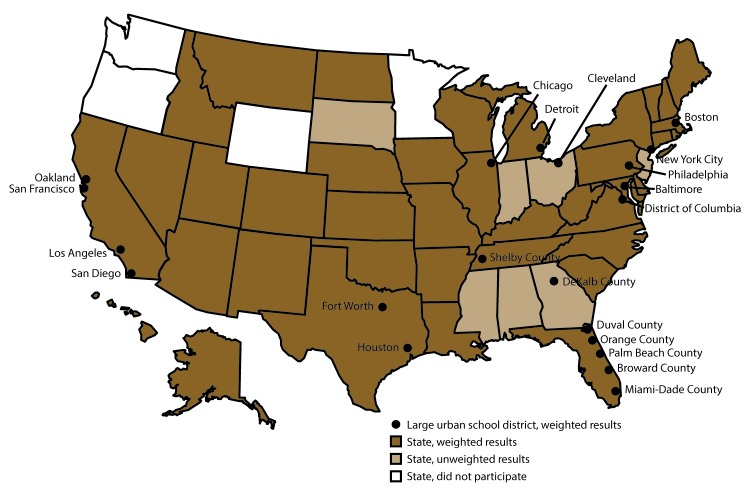
PROBLEM: Health-risk behaviors contribute to the leading causes of morbidity and mortality among youth and adults in the United States. In addition, significant health disparities exist among demographic subgroups of youth defined by sex, race/ethnicity, and grade in school and between sexual minority and nonsexual minority youth. Population-based data on the most important health-related behaviors at the national, state, and local levels can be used to help monitor the effectiveness of public health interventions designed to protect and promote the health of youth at the national, state, and local levels. REPORTING PERIOD COVERED: September 2016-December 2017. DESCRIPTION OF THE SYSTEM: The Youth Risk Behavior Surveillance System (YRBSS) monitors six categories of priority health-related behaviors among youth and young adults: 1) behaviors that contribute to unintentional injuries and violence; 2) tobacco use; 3) alcohol and other drug use; 4) sexual behaviors related to unintended pregnancy and sexually transmitted infections (STIs), including human immunodeficiency virus (HIV) infection; 5) unhealthy dietary behaviors; and 6) physical inactivity. In addition, YRBSS monitors the prevalence of other health-related behaviors, obesity, and asthma. YRBSS includes a national school-based Youth Risk Behavior Survey (YRBS) conducted by CDC and state and large urban school district school-based YRBSs conducted by state and local education and health agencies. Starting with the 2015 YRBSS cycle, a question to ascertain sexual identity and a question to ascertain sex of sexual contacts were added to the national YRBS questionnaire and to the standard YRBS questionnaire used by the states and large urban school districts as a starting point for their questionnaires. This report summarizes results from the 2017 national YRBS for 121 health-related behaviors and for obesity, overweight, and asthma by demographic subgroups defined by sex, race/ethnicity, and grade in school and by sexual minority status; updates the numbers of sexual minority students nationwide; and describes overall trends in health-related behaviors during 1991-2017. This reports also summarizes results from 39 state and 21 large urban school district surveys with weighted data for the 2017 YRBSS cycle by sex and sexual minority status (where available). RESULTS: Results from the 2017 national YRBS indicated that many high school students are engaged in health-risk behaviors associated with the leading causes of death among persons aged 10-24 years in the United States. During the 30 days before the survey, 39.2% of high school students nationwide (among the 62.8% who drove a car or other vehicle during the 30 days before the survey) had texted or e-mailed while driving, 29.8% reported current alcohol use, and 19.8% reported current marijuana use. In addition, 14.0% of students had taken prescription pain medicine without a doctor's prescription or differently than how a doctor told them to use it one or more times during their life. During the 12 months before the survey, 19.0% had been bullied on school property and 7.4% had attempted suicide. Many high school students are engaged in sexual risk behaviors that relate to unintended pregnancies and STIs, including HIV infection. Nationwide, 39.5% of students had ever had sexual intercourse and 9.7% had had sexual intercourse with four or more persons during their life. Among currently sexually active students, 53.8% reported that either they or their partner had used a condom during their last sexual intercourse. Results from the 2017 national YRBS also indicated many high school students are engaged in behaviors associated with chronic diseases, such as cardiovascular disease, cancer, and diabetes. Nationwide, 8.8% of high school students had smoked cigarettes and 13.2% had used an electronic vapor product on at least 1 day during the 30 days before the survey. Forty-three percent played video or computer games or used a computer for 3 or more hours per day on an average school day for something that was not school work and 15.4% had not been physically active for a total of at least 60 minutes on at least 1 day during the 7 days before the survey. Further, 14.8% had obesity and 15.6% were overweight. The prevalence of most health-related behaviors varies by sex, race/ethnicity, and, particularly, sexual identity and sex of sexual contacts. Specifically, the prevalence of many health-risk behaviors is significantly higher among sexual minority students compared with nonsexual minority students. Nonetheless, analysis of long-term temporal trends indicates that the overall prevalence of most health-risk behaviors has moved in the desired direction. INTERPRETATION: Most high school students cope with the transition from childhood through adolescence to adulthood successfully and become healthy and productive adults. However, this report documents that some subgroups of students defined by sex, race/et
Overview
The claims and statistics of this paper haven’t been checked yet.
Free: it reads the open-access text and checks the first 5 claims that cite a source we can check. Create a free account to check every claim.
Integrity signals
Registry
Cites
Statistics
Figures
Verification
Claims the paper makes
The claims and statistics of this paper haven’t been checked yet.
Free: it reads the open-access text and checks the first 5 claims that cite a source we can check. Create a free account to check every claim.
Claims other papers make about this one
Each is checked against this paper’s own text: does it say what the citing paper says it does?
The source backs part of the claim, not all of it — or backs it for a different population, condition or comparison.
In the citing paper
“The incidence has been steadily rising in the USA, and 5.1% of male and 9.3% of female high school students in the USA report a suicide attempt in the past year [2].”
From Adolescent Suicide—Understanding Unique Risks and Opportunities for Trauma Centers to Recognize, Intervene, and Prevent a Leading Cause of Death (2022) · cites this paper as [2]
Experimental — accuracy not yet measuredThe source backs part of the claim, not all of it — or backs it for a different population, condition or comparison.
In the citing paper
“School surveys also show young sexual and gender minority individuals continue to experience high levels of bullying and name calling [54].”
From Minority stress theory: Application, critique, and continued relevance (2023) · cites this paper as [54]
Experimental — accuracy not yet measuredThe source backs part of the claim, not all of it — or backs it for a different population, condition or comparison.
In the citing paper
“Further evidence indicates that exposure to minority stress remains a significant concern in the lives of sexual and gender minority individuals.”
From Minority stress theory: Application, critique, and continued relevance (2023) · cites this paper as [54]
Experimental — accuracy not yet measuredThe cited source says what the claim attributes to it.
In the citing paper
“as it is well documented female individuals have higher rates of attempted suicide.12,13”
From Trends in Suicide Among Youth Aged 10 to 19 Years in the United States, 1975 to 2016 (2019) · cites this paper as [12]
Self-check
Percentages, sums and reported differences re-computed from the paper’s own numbers.
The self-check needs the paper’s full text.
Citations
Cites
CDC growth charts: United States.
Kuczmarski, R. J., Ogden, C. L., Grummer‐Strawn, L. M., Flegal, K. M., Guo, S. S., Wei, R. X., Mei, Z., Curtin, L. R., Roche, A. F., & Johnson, C. L. (2000) · PubMed · Cited by 5,298
(2006) · PubMed · Cited by 3,378
Self-citation(2012) · Choice Reviews Online · doi:10.5860/choice.49-2699 · Cited by 2,593
Youth Risk Behavior Surveillance United States, 2015
Kann, L., McManus, T., Harris, W. A., Shanklin, S. L., Flint, K. H., Hawkins, J., Queen, B., Lowry, R., Olsen, E. O., Chyen, D., et al. (2016) · MMWR. Surveillance Summaries · doi:10.15585/mmwr.ss6506a1 · Cited by 2,036
Self-citationYouth Risk Behavior Surveillance - United States, 2009: (661322010-001)
(2010) · PsycEXTRA Dataset · doi:10.1037/e661322010-001 · Cited by 1,749
Self-citationMethodology of the Youth Risk Behavior Surveillance System: (548562006-001)
(2004) · PsycEXTRA Dataset · doi:10.1037/e548562006-001 · Cited by 1,182
Self-citationReliability of the 1999 youth risk behavior survey questionnaire
BRENER, N., KANN, L., MCMANUS, T., KINCHEN, S., SUNDBERG, E., & ROSS, J. (2002) · Journal of Adolescent Health · doi:10.1016/s1054-139x(02)00339-7 · Cited by 1,101
Self-citationU.S. Department of Health and Human (2015) · Journal of Pain & Palliative Care Pharmacotherapy · doi:10.3109/15360288.2015.1037530 · Cited by 891
Sexual and Gender Minority Health: What We Know and What Needs to Be Done
Mayer, K. H., Bradford, J. B., Makadon, H. J., Stall, R., Goldhammer, H., & Landers, S. (2008) · American Journal of Public Health · doi:10.2105/ajph.2007.127811 · Cited by 806
Martin, J. A., Be, H., Osterman, M. J. K., Ak, D., & Drake, P. F. (2018) · PubMed · Cited by 752
Cited by
Heart Disease and Stroke Statistics—2020 Update: A Report From the American Heart Association
Virani, S. S., Alonso, A., Benjamin, E. J., Bittencourt, M. S., Callaway, C. W., Carson, A. P., Chamberlain, A. M., Chang, A. R., Cheng, S., Delling, F. N., et al. (2020) · Circulation · doi:10.1161/cir.0000000000000757 · Cited by 9,175
Heart Disease and Stroke Statistics—2011 Update: A Report From the American Heart Association
Roger, V. L., Go, A. S., Lloyd-Jones, D. M., Adams, R. J., Berry, J. D., Brown, T. M., Carnethon, M. R., Dai, S., de Simone, G., Ford, E. S., et al. (2011) · Circulation · doi:10.1161/cir.0b013e3182009701 · Cited by 6,149
Heart Disease and Stroke Statistics—2021 Update: A Report From the American Heart Association
Virani, S. S., Alonso, A., Aparicio, H. J., Benjamin, E. J., Bittencourt, M. S., Callaway, C. W., Carson, A. P., Chamberlain, A. M., Cheng, S., Delling, F. N., et al. (2021) · Circulation · doi:10.1161/cir.0000000000000950 · Cited by 5,784
Minority stress theory: Application, critique, and continued relevance
Frost, D. M., & Meyer, I. H. (2023) · Current Opinion in Psychology · doi:10.1016/j.copsyc.2023.101579 · Cited by 957
“School surveys also show young sexual and gender minority individuals continue to experience high levels of bullying and name calling [54].”
BackgroundNock, M. K., Prinstein, M. J., & Sterba, S. K. (2009) · Journal of Abnormal Psychology · doi:10.1037/a0016948 · Cited by 662
Tobacco product use and associated factors among middle and high school students—United States, 2019
Wang, T. W., Gentzke, A. S., Creamer, M. R., Cullen, K. A., Holder-Hayes, E., Sawdey, M. D., Anic, G. M., Portnoy, D. B., Hu, S., Homa, D. M., et al. (2019) · MMWR. Surveillance Summaries · doi:10.15585/mmwr.ss6812a1 · Cited by 576
“Although most current youth tobacco product users are not daily users (9,12,13), estimates of frequent e-cigarette use among high school students were comparable to those observed for cigarette and smokeless tobacco product users in 2019.”
BackgroundIvey-Stephenson, A. Z., Demissie, Z., Crosby, A. E., Stone, D. M., Gaylor, E., Wilkins, N., Lowry, R., & Brown, M. (2020) · MMWR Supplements · doi:10.15585/mmwr.su6901a6 · Cited by 478
Self-citationSocial media use and risky behaviors in adolescents: A meta-analysis
Vannucci, A., Simpson, E. G., Gagnon, S., & Ohannessian, C. M. (2020) · Journal of Adolescence · doi:10.1016/j.adolescence.2020.01.014 · Cited by 410
Substance Use Screening, Brief Intervention, and Referral to Treatment
Levy, S. J. L., Williams, J. F., COMMITTEE ON SUBSTANCE USE AND PREVENTION, Ryan, S. A., Gonzalez, P. K., Patrick, S. W., Quigley, J., Siqueira, L., Smith, V. C., & Walker, L. R. (2016) · Pediatrics · doi:10.1542/peds.2016-1211 · Cited by 347
Sexuality Education for Children and Adolescents
Breuner, C. C., Mattson, G., COMMITTEE ON ADOLESCENCE, COMMITTEE ON PSYCHOSOCIAL ASPECTS OF CHILD AND FAMILY HEALTH, Breuner, C. C., Adelman, W. P., Alderman, E. M., Garofalo, R., Marcell, A. V., Powers, M. E., et al. (2016) · Pediatrics · doi:10.1542/peds.2016-1348 · Cited by 324
Vagi, K. J., O’Malley Olsen, E., Basile, K. C., & Vivolo-Kantor, A. M. (2015) · JAMA Pediatrics · doi:10.1001/jamapediatrics.2014.3577 · Cited by 317
Trends in Suicide Among Youth Aged 10 to 19 Years in the United States, 1975 to 2016
Ruch, D. A., Sheftall, A. H., Schlagbaum, P., Rausch, J., Campo, J. V., & Bridge, J. A. (2019) · JAMA Network Open · doi:10.1001/jamanetworkopen.2019.3886 · Cited by 303
Anabolic–androgenic steroid dependence: an emerging disorder
Kanayama, G., Brower, K. J., Wood, R. I., Hudson, J. I., & Pope Jr, H. G. (2009) · Addiction · doi:10.1111/j.1360-0443.2009.02734.x · Cited by 294
Understanding the Mental Health of Transgender and Nonbinary Youth
Price-Feeney, M., Green, A. E., & Dorison, S. (2020) · Journal of Adolescent Health · doi:10.1016/j.jadohealth.2019.11.314 · Cited by 277
Planey, A. M., Smith, S. M., Moore, S., & Walker, T. D. (2019) · Children and Youth Services Review · doi:10.1016/j.childyouth.2019.04.001 · Cited by 254
The Effects Of Violence On Health
Rivara, F., Adhia, A., Lyons, V., Massey, A., Mills, B., Morgan, E., Simckes, M., & Rowhani-Rahbar, A. (2019) · Health Affairs · doi:10.1377/hlthaff.2019.00480 · Cited by 252
Feiss, R., Dolinger, S. B., Merritt, M., Reiche, E., Martin, K., Yanes, J. A., Thomas, C. M., & Pangelinan, M. (2019) · Journal of Youth and Adolescence · doi:10.1007/s10964-019-01085-0 · Cited by 252
Meyer, I. H., Russell, S. T., Hammack, P. L., Frost, D. M., & Wilson, B. D. M. (2021) · PLOS ONE · doi:10.1371/journal.pone.0246827 · Cited by 249
Lu, C. Y., Zhang, F., Lakoma, M. D., Madden, J. M., Rusinak, D., Penfold, R. B., Simon, G., Ahmedani, B. K., Clarke, G., Hunkeler, E. M., et al. (2014) · BMJ · doi:10.1136/bmj.g3596 · Cited by 232
National trends in mental health care for US adolescents
Mojtabai, R., & Olfson, M. (2020) · JAMA Psychiatry · doi:10.1001/jamapsychiatry.2020.0279 · Cited by 229
Screening for HIV Infection: US Preventive Services Task Force Recommendation Statement
US Preventive Services Task Force, Owens, D. K., Davidson, K. W., Krist, A. H., Barry, M. J., Cabana, M., Caughey, A. B., Curry, S. J., Doubeni, C. A., Epling, J. W., et al. (2019) · JAMA · doi:10.1001/jama.2019.6587 · Cited by 218
The Influence of Social Desirability on Sexual Behavior Surveys: A Review
King, B. M. (2022) · Archives of Sexual Behavior · doi:10.1007/s10508-021-02197-0 · Cited by 210
School Health as a Strategy to Improve Both Public Health and Education
Kolbe, L. J. (2018) · Annual Review of Public Health · doi:10.1146/annurev-publhealth-040218-043727 · Cited by 210
Adolescent connectedness and adult health outcomes
Steiner, R. J., Sheremenko, G., Lesesne, C., Dittus, P. J., Sieving, R. E., & Ethier, K. A. (2019) · Pediatrics · doi:10.1542/peds.2018-3766 · Cited by 199
“0% have misused prescription pain medicine.(8)”
Self-citationSuicidality Disparities Between Transgender and Cisgender Adolescents
Thoma, B. C., Salk, R. H., Choukas-Bradley, S., Goldstein, T. R., Levine, M. D., & Marshal, M. P. (2019) · Pediatrics · doi:10.1542/peds.2019-1183 · Cited by 198
Stonard, K. E., Bowen, E., Lawrence, T. R., & Price, S. A. (2014) · Aggression and Violent Behavior · doi:10.1016/j.avb.2014.06.005 · Cited by 193
Women and Suicidal Behavior: Paradigm-Shift Lessons from China
Canetto, S. S., & Chen, J. (2020) · The Cambridge Handbook of the International Psychology of Women · doi:10.1017/9781108561716.042 · Cited by 192
Johns, M. M., Poteat, V. P., Horn, S. S., & Kosciw, J. G. (2019) · LGBT Health · doi:10.1089/lgbt.2018.0109 · Cited by 190
Reviewing evidence of LGBTQ+ discrimination and exclusion in sport
Denison, E., Bevan, N., & Jeanes, R. (2020) · Sport Management Review · doi:10.1016/j.smr.2020.09.003 · Cited by 189
Overview and Methods for the Youth Risk Behavior Surveillance System — United States, 2021
Mpofu, J. J., Underwood, J. M., Thornton, J. E., Brener, N. D., Rico, A., Kilmer, G., Harris, W. A., Leon-Nguyen, M., Chyen, D., Lim, C., et al. (2023) · MMWR Supplements · doi:10.15585/mmwr.su7201a1 · Cited by 188
Self-citationEdelmann, D., Pfirrmann, D., Heller, S., Dietz, P., Reichel, J. L., Werner, A. M., Schäfer, M., Tibubos, A. N., Deci, N., Letzel, S., et al. (2022) · Frontiers in Public Health · doi:10.3389/fpubh.2022.821703 · Cited by 189
Johns, M. M., Lowry, R., Haderxhanaj, L. T., Rasberry, C. N., Robin, L., Scales, L., Stone, D., & Suarez, N. A. (2020) · MMWR Supplements · doi:10.15585/mmwr.su6901a3 · Cited by 187
“(YRBS) revealed that LGB high school students experienced more bullying at school (33% among LGB students and 17% among heterosexual students), more sexual dating violence by dating partners (LGB, 16%; heterosexual, 6%), and more suicide attempts (LGB, 23%; heterosexual, 5%) (3) than their heterosexual peers.”
BackgroundSelf-citationTandon, P. S., Zhou, C., Johnson, A. M., Gonzalez, E. S., & Kroshus, E. (2021) · JAMA Network Open · doi:10.1001/jamanetworkopen.2021.27892 · Cited by 185
The Impact of Marijuana Policies on Youth: Clinical, Research, and Legal Update
Ammerman, S., Ryan, S., Adelman, W. P., THE COMMITTEE ON SUBSTANCE ABUSE, T. C. O. A., Levy, S., Ammerman, S. D., Gonzalez, P. K., Ryan, S. A., Siqueira, L. M., Smith, V. C., et al. (2015) · Pediatrics · doi:10.1542/peds.2014-4147 · Cited by 183
Harris, N. S., Johnson, A. S., Huang, Y.-L. A., Kern, D., Fulton, P., Smith, D. K., Valleroy, L. A., & Hall, H. I. (2019) · MMWR. Morbidity and Mortality Weekly Report · doi:10.15585/mmwr.mm6848e1 · Cited by 180
Johnson, B. T., Scott-Sheldon, L. A. J., Huedo-Medina, T. B., & Carey, M. P. (2011) · Archives of Pediatrics & Adolescent Medicine · doi:10.1001/archpediatrics.2010.251 · Cited by 176
Campisi, S. C., Carducci, B., Akseer, N., Zasowski, C., Szatmari, P., & Bhutta, Z. A. (2020) · BMC Public Health · doi:10.1186/s12889-020-09209-z · Cited by 175
Hertz, M. F., Everett Jones, S., Barrios, L., David‐Ferdon, C., & Holt, M. (2015) · Journal of School Health · doi:10.1111/josh.12339 · Cited by 175
Soto, C. J. (2015) · Journal of Personality · doi:10.1111/jopy.12168 · Cited by 172
Time for an Adolescent Health Surveillance System in Saudi Arabia: Findings From “Jeeluna”
AlBuhairan, F. S., Tamim, H., Dubayee, M. A., AlDhukair, S., Al-Shehri, S. N., Tamimi, W., Bcheraoui, C. E., Magzoub, M. E., de Vries, N. K., & Alwan, I. A. A. (2015) · Journal of Adolescent Health · doi:10.1016/j.jadohealth.2015.06.009 · Cited by 170
Defining “High-risk Sexual Behavior” in the Context of Substance Use
Chawla, N., & Sarkar, S. (2019) · Journal of Psychosexual Health · doi:10.1177/2631831818822015 · Cited by 169
Horwitz, A. G., Berona, J., Czyz, E. K., Yeguez, C. E., & King, C. A. (2017) · Suicide and Life-Threatening Behavior · doi:10.1111/sltb.12273 · Cited by 168
Szucs, L. E., Lowry, R., Fasula, A. M., Pampati, S., Copen, C. E., Hussaini, K. S., Kachur, R. E., Koumans, E. H. A., & Steiner, R. J. (2020) · MMWR Supplements · doi:10.15585/mmwr.su6901a2 · Cited by 168
Self-citationArendt, F., Scherr, S., & Romer, D. (2019) · New Media & Society · doi:10.1177/1461444819850106 · Cited by 164
de Sá, C. D. S. C., Pombo, A., Luz, C., Rodrigues, L. P., & Cordovil, R. (2021) · Revista Paulista de Pediatria · doi:10.1590/1984-0462/2021/39/2020159 · Cited by 162
Vuorre, M., Orben, A., & Przybylski, A. K. (2021) · Clinical Psychological Science · doi:10.1177/2167702621994549 · Cited by 158
“YRBS is a biennial survey of ninth to 12th graders in the United States and has been conducted since 1991 by the U.S. Centers for Disease Control and Prevention (Kann, 2018).”
MethodForster, M., Grigsby, T. J., Gower, A. L., Mehus, C. J., & McMorris, B. J. (2020) · Journal of Youth and Adolescence · doi:10.1007/s10964-020-01235-9 · Cited by 158
Su, C., Aseltine, R., Doshi, R., Chen, K., Rogers, S. C., & Wang, F. (2020) · Translational Psychiatry · doi:10.1038/s41398-020-01100-0 · Cited by 155
Immigrant Health Inequalities in the United States: Use of Eight Major National Data Systems
Singh, G. K., Rodriguez-Lainz, A., & Kogan, M. D. (2013) · The Scientific World Journal · doi:10.1155/2013/512313 · Cited by 155
The Changing Characteristics of African-American Adolescent Suicides, 2001–2017
Price, J. H., & Khubchandani, J. (2019) · Journal of Community Health · doi:10.1007/s10900-019-00678-x · Cited by 151
for the FACTS Consortium, Oliphant, S. N., Mouch, C. A., Rowhani-Rahbar, A., Hargarten, S., Jay, J., Hemenway, D., Zimmerman, M., & Carter, P. M. (2019) · Journal of Behavioral Medicine · doi:10.1007/s10865-019-00048-x · Cited by 146
Baiden, P., & Tadeo, S. K. (2020) · Child Abuse & Neglect · doi:10.1016/j.chiabu.2020.104417 · Cited by 146
Widman, L. M., Evans-Paulson, R., Javidi, H., & Choukas‐Bradley, S. (2019) · Archives of Pediatrics and Adolescent Medicine · doi:10.1001/jamapediatrics.2019.2324 · Cited by 145
Cho, H.-S., & Yang, Y. (2023) · International Journal of Public Health · doi:10.3389/ijph.2023.1605669 · Cited by 145
Cooper, K. M., Auerbach, A. J., Bader, J. D., Beadles-Bohling, A. S., Brashears, J., Cline, E. T., Eddy, S. L., Elliott, D. B., Farley, E., Fuselier, L., et al. (2020) · CBE—Life Sciences Education · doi:10.1187/cbe.20-04-0062 · Cited by 143
Artz, S., Jackson, M. A., Rossiter, K. R., Nijdam-Jones, A., Géczy, I., & Porteous, S. (2014) · International Journal of Child Youth and Family Studies · doi:10.18357/ijcyfs54201413274 · Cited by 142
A Content Analysis of Displayed Alcohol References on a Social Networking Web Site
Moreno, M. A., Briner, L. R., Williams, A., Brockman, L., Walker, L., & Christakis, D. A. (2010) · Journal of Adolescent Health · doi:10.1016/j.jadohealth.2010.01.001 · Cited by 142
Physical Activity Assessment and Counseling in Pediatric Clinical Settings
Lobelo, F., Muth, N. D., Hanson, S., Nemeth, B. A., COUNCIL ON SPORTS MEDICINE AND FITNESS, OBESITY, S. O., LaBella, C. R., Brooks, M. A., Canty, G., Diamond, A. B., et al. (2020) · Pediatrics · doi:10.1542/peds.2019-3992 · Cited by 141
Adolescent self-injurers: comparing non-ideators, suicide ideators, and suicide attempters.
Stewart, J. G., Esposito, E. C., Glenn, C. R., Gilman, S. E., Pridgen, B., Gold, J., & Auerbach, R. P. (2017) · Journal of Psychiatric Research · doi:10.1016/j.jpsychires.2016.09.031 · Cited by 139
School Restroom and Locker Room Restrictions and Sexual Assault Risk Among Transgender Youth
Murchison, G. R., Agénor, M., Reisner, S. L., & Watson, R. J. (2019) · PEDIATRICS · doi:10.1542/peds.2018-2902 · Cited by 138
Opara, I., Assan, M. A., Pierre, K., Gunn, J. F., Metzger, I., Hamilton, J., & Arugu, E. (2020) · Journal of Black Studies · doi:10.1177/0021934720935641 · Cited by 136
“A final example of how this can be amplified by belonging to intersecting identities is the increased risk of suicide among LGBTQ Black youth (Bostwick et al., 2014; Kann et al., 2018; Settler & Katz, 2017).”
BackgroundSelf-Reported Conversion Efforts and Suicidality Among US LGBTQ Youths and Young Adults, 2018
Green, A. E., Price, M. N., Dorison, S. H., & Pick, C. J. (2020) · American Journal of Public Health · doi:10.2105/ajph.2020.305701 · Cited by 132
Youth Athlete Development Models: A Narrative Review
Varghese, M., Ruparell, S., & LaBella, C. R. (2021) · Sports Health A Multidisciplinary Approach · doi:10.1177/19417381211055396 · Cited by 132
Ong, M., Lakoma, M. D., Bhosrekar, S. G., Hickok, J. D., McLean, L. E., Murphy, M., Poland, R. E., Purtell, N., & Ross‐Degnan, D. (2020) · Child and Adolescent Mental Health · doi:10.1111/camh.12400 · Cited by 131
Czyz, E. K., Horwitz, A. G., Arango, A., & King, C. A. (2019) · Journal of Child Psychology and Psychiatry · doi:10.1111/jcpp.12974 · Cited by 130
Rose, I. D., Lesesne, C. A., Sun, J., Johns, M. M., Zhang, X., & Hertz, M. F. (2022) · The Journal of School Nursing · doi:10.1177/10598405221096802 · Cited by 132
Loth, K. A., MacLehose, R. F., Fulkerson, J. A., Crow, S. J., & Neumark‐Sztainer, D. (2013) · International Journal of Eating Disorders · doi:10.1002/eat.22189 · Cited by 132
Scull, T. M., Malik, C. V., Geller, J. G., Reeder, L. C., & Stump, K. N. (2022) · Journal of Youth and Adolescence · doi:10.1007/s10964-021-01567-0 · Cited by 128
Adolescent Substance Use Disorder Treatment: an Update on Evidence-Based Strategies
Fadus, M. C., Squeglia, L. M., Valadez, E. A., Tomko, R. L., Bryant, B. E., & Gray, K. M. (2019) · Current Psychiatry Reports · doi:10.1007/s11920-019-1086-0 · Cited by 127
Mackin, D. M., Perlman, G., Davila, J., Kotov, R., & Klein, D. N. (2017) · Psychological Medicine · doi:10.1017/s0033291716003275 · Cited by 127
Johns, M. M., Lowry, R., Rasberry, C. N., Dunville, R., Robin, L., Pampati, S., Stone, D. M., & Mercer Kollar, L. M. (2018) · MMWR. Morbidity and Mortality Weekly Report · doi:10.15585/mmwr.mm6743a4 · Cited by 127
Self-citationE-Cigarettes and Similar Devices
Jenssen, B. P., Walley, S. C., CONTROL, S. O. T., Groner, J. A., Rahmandar, M., Boykan, R., Mih, B., Marbin, J. N., & Caldwell, A. L. (2019) · Pediatrics · doi:10.1542/peds.2018-3652 · Cited by 126
A Multilevel Assessment of School Climate, Bullying Victimization, and Physical Activity
Roman, C. G., & Taylor, C. J. (2013) · Journal of School Health · doi:10.1111/josh.12043 · Cited by 126
Intimate Partner Homicide of Adolescents
Adhia, A., Kernic, M. A., Hemenway, D., Vavilala, M. S., & Rivara, F. P. (2019) · Archives of Pediatrics and Adolescent Medicine · doi:10.1001/jamapediatrics.2019.0621 · Cited by 126
A Middle School Program to Prevent E-Cigarette Use: A Pilot Study of “CATCH My Breath”
Kelder, S. H., Mantey, D. S., Dusen, D. V., Case, K. R., Haas, A., & Springer, A. E. (2020) · Public Health Reports · doi:10.1177/0033354919900887 · Cited by 126
Tobacco Product Use Among High School Students — Youth Risk Behavior Survey, United States, 2019
Creamer, M. R., Jones, S. E., Gentzke, A. S., Jamal, A., & King, B. A. (2020) · MMWR Supplements · doi:10.15585/mmwr.su6901a7 · Cited by 121
Pediatric Mental Health Boarding
McEnany, F. B., Ojugbele, O., Doherty, J. R., McLaren, J. L., & Leyenaar, J. K. (2020) · Pediatrics · doi:10.1542/peds.2020-1174 · Cited by 120
Haidar, A., Ranjit, N., Archer, N. P., & Hoelscher, D. M. (2019) · BMC Public Health · doi:10.1186/s12889-019-7001-0 · Cited by 119
Tang, J. J., Yu, Y., Wilcox, H. C., Kang, C., Wang, K., Wang, C., Wu, Y., & Chen, R. (2019) · EClinicalMedicine · doi:10.1016/j.eclinm.2019.100253 · Cited by 119
Physical Activity, Sadness, and Suicidality in Bullied US Adolescents
Sibold, J., Edwards, E. M., Murray-Close, D. K., & Hudziak, J. J. (2015) · Journal of the American Academy of Child & Adolescent Psychiatry · doi:10.1016/j.jaac.2015.06.019 · Cited by 119
Spiller, H. A., Ackerman, J. P., Spiller, N. E., & Casavant, M. J. (2019) · The Journal of Pediatrics · doi:10.1016/j.jpeds.2019.02.045 · Cited by 119
Baiden, P., LaBrenz, C. A., Asiedua-Baiden, G., & Muehlenkamp, J. J. (2020) · Journal of Psychiatric Research · doi:10.1016/j.jpsychires.2020.02.029 · Cited by 118
Bersia, M., Koumantakis, E., Berchialla, P., Charrier, L., Ricotti, A., Grimaldi, P., Dalmasso, P., & Comoretto, R. I. (2022) · EClinicalMedicine · doi:10.1016/j.eclinm.2022.101705 · Cited by 118
Ingram, K. M., Espelage, D. L., Davis, J. P., & Merrin, G. J. (2020) · Frontiers in Psychiatry · doi:10.3389/fpsyt.2020.00026 · Cited by 120
Mothers know best: redirecting adolescent reward sensitivity toward safe behavior during risk taking
Telzer, E. H., Ichien, N. T., & Qu, Y. (2015) · Social Cognitive and Affective Neuroscience · doi:10.1093/scan/nsv026 · Cited by 117
Substance Use Among Transgender Students in California Public Middle and High Schools
Pedro, K. T. D., Gilreath, T. D., Jackson, C., & Esqueda, M. C. (2017) · Journal of School Health · doi:10.1111/josh.12499 · Cited by 117
Delisle, T. T., Werch, C. E., Wong, A. H., Bian, H., & Weiler, R. (2010) · Journal of School Health · doi:10.1111/j.1746-1561.2009.00477.x · Cited by 116
de Melo, L. D., Sodré, C. P., Spíndola, T., Martins, E. R. C., André, N. L. N. D. O., & da Motta, C. V. V. (2022) · Enfermería Global · doi:10.6018/eglobal.481541 · Cited by 116
An Integrated Public Health Approach to Interpersonal Violence and Suicide Prevention and Response
Decker, M. R., Wilcox, H. C., Holliday, C. N., & Webster, D. W. (2018) · Public Health Reports® · doi:10.1177/0033354918800019 · Cited by 115
“National surveillance of high school students conducted in 2017 found high rates of pastyear physical fighting (17% among female students, 30% among male students) and past-month weapon carrying (24% among male students, 7% among female students).(29) Intimate partner violence and sexual violence are concentrated amon…”
BackgroundThe Relationship Between Parents’ and Children’s Television Viewing
Bleakley, A., Jordan, A. B., & Hennessy, M. (2013) · Pediatrics · doi:10.1542/peds.2012-3415 · Cited by 115
A latent class analysis of health lifestyles and suicidal behaviors among US adolescents
Xiao, Y., Romanelli, M., & Lindsey, M. A. (2019) · Journal of Affective Disorders · doi:10.1016/j.jad.2019.05.031 · Cited by 114
Bullying Victimization Among LGBTQ Youth: Critical Issues and Future Directions
Gower, A. L., Rider, G. N., McMorris, B. J., & Eisenberg, M. E. (2018) · Current Sexual Health Reports · doi:10.1007/s11930-018-0169-y · Cited by 112
Sexual orientation and suicide attempt disparities among US Adolescents: 2009–2017
Raifman, J., Charlton, B. M., Arrington-Sanders, R., Chan, P. A., Rusley, J., Mayer, K. H., Stein, M. D., Austin, S. B., & McConnell, M. (2020) · PEDIATRICS · doi:10.1542/peds.2019-1658 · Cited by 107
Baiden, P., Tadeo, S. K., & Peters, K. E. (2019) · Psychiatry Research · doi:10.1016/j.psychres.2019.112586 · Cited by 106
Fulginiti, A., Goldbach, J. T., Mamey, M. R., Rusow, J. A., Srivastava, A., Rhoades, H., Schrager, S. M., Bond, D., & Marshal, M. P. (2020) · Suicide and Life-Threatening Behavior · doi:10.1111/sltb.12623 · Cited by 102
Wang, Y., & Yip, T. (2020) · Child Development · doi:10.1111/cdev.13324 · Cited by 104
Brown, M. J., Masho, S. W., Perera, R. A., Mezuk, B. R., & Cohen, S. A. (2015) · Child Abuse & Neglect · doi:10.1016/j.chiabu.2015.02.019 · Cited by 102
Baams, L., & Russell, S. T. (2020) · Youth & Society · doi:10.1177/0044118x20951045 · Cited by 102
King, C. A., Grupp‐Phelan, J., Brent, D., Dean, J. M., Webb, M., Bridge, J. A., Spirito, A., Chernick, L. S., Mahabee‐Gittens, E. M., Mistry, R. D., et al. (2019) · Journal of Child Psychology and Psychiatry · doi:10.1111/jcpp.13087 · Cited by 101
Addressing HPV vaccine myths: practical information for healthcare providers
Bednarczyk, R. A. (2019) · Human Vaccines & Immunotherapeutics · doi:10.1080/21645515.2019.1565267 · Cited by 101
Metadata
- Authors
- Kann, L., McManus, T., Harris, W. A., Shanklin, S. L., Flint, K. H., Queen, B., Lowry, R., Chyen, D., Whittle, L., Thornton, J., Lim, C., Bradford, D., Yamakawa, Y., Leon, M., Brener, N., & Ethier, K. A.
- Affiliations
- Centers for Disease Control and Prevention (US)
- Westat (United States) (US)
- Corresponding author
- Kann, Laura
- Venue
- MMWR. Surveillance Summaries
- Published
- 2018-06-15
- Volume
- 67
- Issue
- 8
- Pages
- 1-114
- ISSN
- 1545-8636 (ISSN-L)
- 1546-0738
- PMC
- PMC6002027
- OpenAlex
- W2808153400
- Cited by
- 2,502
- References
- 35
- Citations by year
- 2026: 76 · 2025: 100 · 2024: 148 · 2023: 192 · 2022: 282 · 2021: 405 · 2020: 594 · 2019: 313 · 2018: 73
- FWCI
- 528.74
- Type
- journal article
- Language
- en
- Open access
- hybrid
- doi.org
- Licence
- public-domain
- Locations
- MMWR Surveillance Summaries (publishedVersion, public-domain)
- Europe PMC (PubMed Central) (publishedVersion, cc-by)
- PubMed Central (publishedVersion, cc-by)
- PubMed (publishedVersion)
- Funders
- Robert Wood Johnson Foundation
- Topics
- Health Sciences › Medicine › Public Health, Environmental and Occupational Health › Adolescent Sexual and Reproductive Health
- Health Sciences › Medicine › Public Health, Environmental and Occupational Health › Adolescent Health and Behaviors
- Social Sciences › Psychology › Social Psychology › LGBTQ Health, Identity, and Policy
- Keywords
- youth risk behavior, adolescent health, unintentional injuries, violence, tobacco use, alcohol and drug use, sexual behavior, HIV, sexually transmitted infections, unintended pregnancy, dietary behavior, physical inactivity, obesity, asthma, sexual minority youth, health disparities, high school students, health behavior trends, sexual identity, race and ethnicity, school grades
- MeSH terms
- Health Risk Behaviors, Adolescent, Adolescent Behavior, Child, Female, Humans, Male, Population Surveillance, United States, Behavioral Risk Factor Surveillance System, Young Adult
About these checks
Registry, retraction, Cites and statistics results are computed, not judged, with one exception: a printed reference that no index lists is read once by a model before it counts as a citation error. Claims are extracted by a model and kept only when their quote appears verbatim in the text; each cited source is then checked, with a model’s help, for whether it says what the claim relies on. Those verdicts can be wrong — read the claim’s quote and the cited source before relying on one.
Statistics and arithmetic are recomputed, not judged.
Confidence bands are shown only for fields calibrated on our annotated test set. None is calibrated yet, so no band is shown.
What counts as a claim ›How we measure confidence ›How we check this ›
Are you an author, or do you see a problem with this page? Request a review
Data sources
Bibliographic data: Semantic Scholar, OpenAlex, Crossref.
Contains information from the Semantic Scholar Academic Graph Datasets, made available under the ODC Attribution License (ODC-BY 1.0).
Semantic Scholar’s data is described in: Kinney, R., et al. (2023). The Semantic Scholar Open Data Platform. arXiv:2301.10140.
