

Exercise for depression in older adults: a meta-analysis of randomized controlled trials adjusting for publication bias
Open accessThe DOI matches its Crossref record; 56 of the 56 references it cites were found in a registry or an index.
Abstract
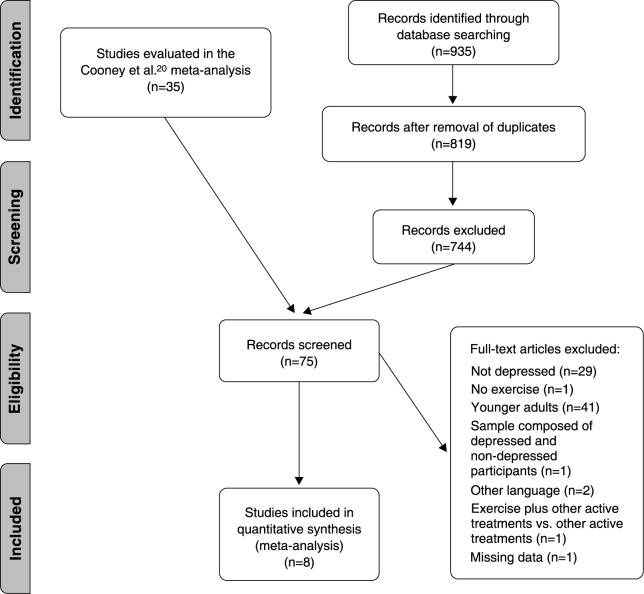
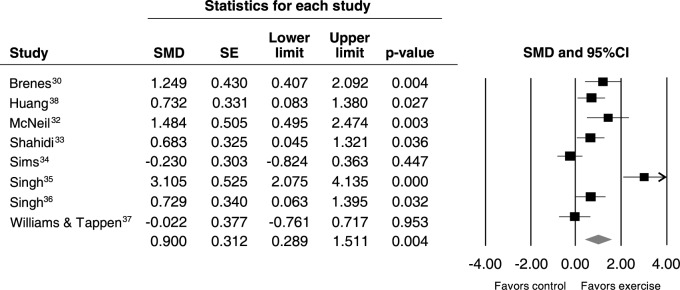
OBJECTIVE: To evaluate the antidepressant effects of exercise in older adults, using randomized controlled trial (RCT) data. METHODS: We conducted a meta-analysis of exercise in older adults, addressing limitations of previous works. RCTs of exercise interventions in older people with depression (≥ 60 years) comparing exercise vs. control were eligible. A random-effects meta-analysis calculating the standardized mean difference (SMD) (95% confidence interval [95%CI]), meta-regressions, and trim, fill, and fail-safe number analyses were conducted. RESULTS: Eight RCTs were included, representing 138 participants in exercise arms and 129 controls. Exercise had a large and significant effect on depression (SMD = -0.90 [95%CI -0.29 to -1.51]), with a fail-safe number of 71 studies. Significant effects were found for 1) mixed aerobic and anaerobic interventions, 2) at moderate intensity, 3) that were group-based, 4) that utilized mixed supervised and unsupervised formats, and 5) in people without other clinical comorbidities. CONCLUSION: Adjusting for publication bias increased the beneficial effects of exercise in three subgroup analysis, suggesting that previous meta-analyses have underestimated the benefits of exercise due to publication bias. We advocate that exercise be considered as a routine component of the management of depression in older adults.
Overview
The claims and statistics of this paper haven’t been checked yet.
Free: it reads the open-access text and checks the first 5 claims that cite a source we can check. Create a free account to check every claim.
Integrity signals
Registry
Cites
Statistics
Figures
Verification
Claims the paper makes
The claims and statistics of this paper haven’t been checked yet.
Free: it reads the open-access text and checks the first 5 claims that cite a source we can check. Create a free account to check every claim.
Claims other papers make about this one
Each is checked against this paper’s own text: does it say what the citing paper says it does?
The source backs part of the claim, not all of it — or backs it for a different population, condition or comparison.
In the citing paper
“One meta-analysis [59] (AMSTAR = 10, AMSTAR+ = 1) included two RCTs of older people with MDD or dysthymia and found the effects of exercise on symptoms of depression fell short of statistical significance (SMD = -1.883,95% CI 0.44 to -4.21, p = 0.11, I 2 = 93.06%).”
From Exercise as Medicine for Mental and Substance Use Disorders: A Meta-review of the Benefits for Neuropsychiatric and Cognitive Outcomes (2020) · cites this paper as [59]
Experimental — accuracy not yet measuredThe source backs part of the claim, not all of it — or backs it for a different population, condition or comparison.
In the citing paper
“However, the pooled data including older people with depressive symptoms found that aerobic exercise improved depressive symptoms (SMD = -0.90,95% CI -0.29 to -1.51, RCTs = 8, n intervention = 138, n control = 129).”
From Exercise as Medicine for Mental and Substance Use Disorders: A Meta-review of the Benefits for Neuropsychiatric and Cognitive Outcomes (2020) · cites this paper as [59]
Experimental — accuracy not yet measuredThe source backs part of the claim, not all of it — or backs it for a different population, condition or comparison.
In the citing paper
“Eight meta-analyses examined effects of exercise in MDD [57][58][59][60][61][62][63][64].”
From Exercise as Medicine for Mental and Substance Use Disorders: A Meta-review of the Benefits for Neuropsychiatric and Cognitive Outcomes (2020) · cites this paper as [59]
Experimental — accuracy not yet measuredThe source backs part of the claim, not all of it — or backs it for a different population, condition or comparison.
In the citing paper
“To date, most evidence for exercise interventions in psychiatry is for depressive disorders-where there is relative harmony across the seven meta-analyses of RCTs that exercise is an effective add-on treatment to usual care to reduce symptoms of depression in adolescents [57,58], working age [60][61][62][63] and older adults [59].”
From Exercise as Medicine for Mental and Substance Use Disorders: A Meta-review of the Benefits for Neuropsychiatric and Cognitive Outcomes (2020) · cites this paper as [59]
Experimental — accuracy not yet measuredIn the citing paper
“Regular physical exercise is recommended to all older adults, and indeed to those at increased risk of AD, as it may improve physical health, reduce frailty, lower the risk of depression, improve cognitive function in the short and long term (26–31).”
From The Multidisciplinary Approach to Alzheimer’s Disease and Dementia. A Narrative Review of Non-Pharmacological Treatment (2018) · cites this paper as [28]
Self-check
Percentages, sums and reported differences re-computed from the paper’s own numbers.
The self-check needs the paper’s full text.
Citations
Cites
Preferred Reporting Items for Systematic Reviews and Meta-Analyses: the PRISMA statement
Moher, D., Liberati, A., Tetzlaff, J., Altman, D. G., & for the PRISMA Group (2009) · BMJ · doi:10.1136/bmj.b2535 · Cited by 83,823
Preferred Reporting Items for Systematic Reviews and Meta-Analyses: The PRISMA Statement
Moher, D., Liberati, A., Tetzlaff, J., Altman, D. G., & The PRISMA Group (2009) · PLoS Medicine · doi:10.1371/journal.pmed.1000097 · Cited by 64,042
Bias in meta-analysis detected by a simple, graphical test
Egger, M., Smith, G. D., Schneider, M., & Minder, C. (1997) · BMJ · doi:10.1136/bmj.315.7109.629 · Cited by 56,722
An inventory for measuring depression
BECK, A. T. (1961) · Archives of General Psychiatry · doi:10.1001/archpsyc.1961.01710120031004 · Cited by 38,032
Preferred reporting items for systematic reviews and meta-analyses: The PRISMA statement
Moher, D., Liberati, A., Tetzlaff, J., Altman, D. G., & the PRISMA Group* (2009) · Annals of Internal Medicine · doi:10.7326/0003-4819-151-4-200908180-00135 · Cited by 37,554
Cochrane Handbook for Systematic Reviews of Interventions: Cochrane Book Series
(2008) · doi:10.1002/9780470712184 · Cited by 25,048
Dermyshi, E., Wang, Y., Yan, C., Hong, W., Qiu, G., Gong, X., & Zhang, T. (2017) · Neonatology · doi:10.1159/000454668 · Cited by 24,451
Meta-analysis of Observational Studies in Epidemiology<SUBTITLE>A Proposal for Reporting</SUBTITLE>
Stroup, D. F. (2000) · JAMA · doi:10.1001/jama.283.15.2008 · Cited by 20,623
Preferred Reporting Items for Systematic Reviews and Meta-Analyses: The PRISMA Statement
Moher, D., Liberati, A., Tetzlaff, J., & Altman, D. G. (2009) · Journal of Clinical Epidemiology · doi:10.1016/j.jclinepi.2009.06.005 · Cited by 19,575
Wang, G., Ma, R., Qiao, G., Wada, K., Aizawa, Y., & Satoh, T. (2015) · Integrative Medicine International · doi:10.1159/000368408 · Cited by 18,657
Research works printed but not linked: 2
- American Psychiatric Association Diagnostic and Statistical Manual of Mental Disorders, Fifth Edition (DSM-5). Arlington American Psychiatric Publishing 2013
- Schünemann HJ Oxman AD Vist GE Higgins JPT Deeks JJ Glasziou P Interpreting results and drawing conclusions Higgins JPT Green S Cochrane handbook for systematic reviews of interventions Chichester WileyBlackwell 2008 359 87
Cited by
Singh, B., Olds, T., Curtis, R., Dumuid, D., Virgara, R., Watson, A., Szeto, K., O'Connor, E., Ferguson, T., Eglitis, E., et al. (2023) · British Journal of Sports Medicine · doi:10.1136/bjsports-2022-106195 · Cited by 1,049
Relationship between depression and frailty in older adults: A systematic review and meta-analysis
Soysal, P., Veronese, N., Thompson, T., Kahl, K. G., Fernandes, B. S., Prina, A. M., Solmi, M., Schofield, P., Koyanagi, A., Tseng, P.-T., et al. (2017) · Ageing Research Reviews · doi:10.1016/j.arr.2017.03.005 · Cited by 876
Self-citationMarx, W., Penninx, B. W. J. H., Solmi, M., Furukawa, T. A., Firth, J., Carvalho, A. F., & Berk, M. (2023) · Nature Reviews Disease Primers · doi:10.1038/s41572-023-00454-1 · Cited by 768
Self-citationStubbs, B., Vancampfort, D., Hallgren, M., Firth, J., Veronese, N., Solmi, M., Brand, S., Cordes, J., Malchow, B., Gerber, M., et al. (2018) · European Psychiatry · doi:10.1016/j.eurpsy.2018.07.004 · Cited by 697
Self-citationMeta-evaluation of meta-analysis: ten appraisal questions for biologists
Nakagawa, S., Noble, D. W. A., Senior, A. M., & Lagisz, M. (2017) · BMC Biology · doi:10.1186/s12915-017-0357-7 · Cited by 579
Ashdown-Franks, G., Firth, J., Carney, R., Carvalho, A. F., Hallgren, M., Koyanagi, A., Rosenbaum, S., Schuch, F. B., Smith, L., Solmi, M., et al. (2020) · Sports Medicine · doi:10.1007/s40279-019-01187-6 · Cited by 460
Self-citationThe Role of Exercise in Management of Mental Health Disorders: An Integrative Review
Smith, P. J., & Merwin, R. M. (2021) · Annual Review of Medicine · doi:10.1146/annurev-med-060619-022943 · Cited by 360
“Multiple meta-analytic studies have examined the impact of exercise training, primarily aerobic but also resistance training (10), with varying degrees of efficacy depending on methodological considerations, including study quality, duration (11), and choice of comparator group (12).”
BackgroundZucchella, C., Sinforiani, E., Tamburin, S., Federico, A., Mantovani, E., Bernini, S., Casale, R., & Bartolo, M. (2018) · Frontiers in Neurology · doi:10.3389/fneur.2018.01058 · Cited by 297
Barnett, A., Zhang, C. J. P., Johnston, J. M., & Cerin, E. (2018) · International Psychogeriatrics · doi:10.1017/s104161021700271x · Cited by 213
Marx, W., Manger, S. H., Blencowe, M., Murray, G., Ho, F. Y.-Y., Lawn, S., Blumenthal, J. A., Schuch, F., Stubbs, B., Ruusunen, A., et al. (2023) · The World Journal of Biological Psychiatry · doi:10.1080/15622975.2022.2112074 · Cited by 179
Self-citationPhysical Exercise in Major Depression: Reducing the Mortality Gap While Improving Clinical Outcomes
Belvederi Murri, M., Ekkekakis, P., Magagnoli, M., Zampogna, D., Cattedra, S., Capobianco, L., Serafini, G., Calcagno, P., Zanetidou, S., & Amore, M. (2019) · Frontiers in Psychiatry · doi:10.3389/fpsyt.2018.00762 · Cited by 163
Physical Exercise and Neuroinflammation in Major Depressive Disorder
Ignácio, Z. M., da Silva, R. S., Plissari, M. E., Quevedo, J., & Réus, G. Z. (2019) · Molecular Neurobiology · doi:10.1007/s12035-019-01670-1 · Cited by 153
Miller, K. J., Gonçalves-Bradley, D. C., Areerob, P., Hennessy, D., Mesagno, C., & Grace, F. (2020) · Ageing Research Reviews · doi:10.1016/j.arr.2019.100999 · Cited by 152
Martins, R. N., Villemagne, V., Sohrabi, H. R., Chatterjee, P., Shah, T. M., Verdile, G., Fraser, P., Taddei, K., Gupta, V. B., Rainey-Smith, S. R., et al. (2018) · Journal of Alzheimer’s Disease · doi:10.3233/jad-171145 · Cited by 129
A Scoping Review of the Relationship between Running and Mental Health
Oswald, F., Campbell, J., Williamson, C., Richards, J. A., & Kelly, P. (2020) · International Journal of Environmental Research and Public Health · doi:10.3390/ijerph17218059 · Cited by 179
Self-citationda Silva, L. A., Tortelli, L., Motta, J. V. D. S., Menguer, L., Mariano, S., Tasca, G. M., Silveira, G. D. B., Pinho, R. A., & Silveira, P. C. L. (2019) · Clinics · doi:10.6061/clinics/2019/e322 · Cited by 188
Physical exercise for late-life depression: Effects on symptom dimensions and time course.
Murri, M. B., Ekkekakis, P., Menchetti, M., Neviani, F., Trevisani, F., Tedeschi, S., Latessa, P. M., Nerozzi, E., Ermini, G., Zocchi, D., et al. (2018) · Journal of Affective Disorders · doi:10.1016/j.jad.2018.01.004 · Cited by 106
“Exercise participation has been found to substantially reduce the severity of depressive symptoms (Ekkekakis, 2015; Schuch et al., 2016b), is well tolerated (Stubbs et al., 2016b), increases physical fitness (Stubbs et al., 2016a), and is among patient preferred treatment options (Luck-Sikorski et…”
BackgroundResultInfluentialWu, X. V., Chi, Y., Lee, J. K., Goh, H. S., Chen, D. Y. M., Haugan, G., Chao, F. F. T., & Klainin‐Yobas, P. (2021) · International Journal of Nursing Studies · doi:10.1016/j.ijnurstu.2021.104025 · Cited by 155
Ashdown‐Franks, G., Stubbs, B., Koyanagi, A., Schuch, F. B., Firth, J., Veronese, N., & Vancampfort, D. (2018) · Journal of Affective Disorders · doi:10.1016/j.jad.2018.09.036 · Cited by 107
Self-citationCzosnek, L., Lederman, O., Cormie, P., Zopf, E., Stubbs, B., & Rosenbaum, S. (2019) · Mental Health and Physical Activity · doi:10.1016/j.mhpa.2018.11.001 · Cited by 94
“…Vancampfort, Richards, et al., 2016c; Schuch et al., 2016b; Schuch, Vancampfort, Rosenbaum, et al., 2016c; Stubbs, Rosenbaum, Vancampfort, Ward, & Schuch, 2016; Sukhato et al., 2017), ten reviews included people with a schizophrenia diagnosis(Dauwan, Begemann, Heringa, & Sommer, 2016; Firth,…”
Self-citationVaghef-Mehrabany, E., Maleki, V., Behrooz, M., Ranjbar, F., & Ebrahimi-Mameghani, M. (2020) · Clinical Nutrition · doi:10.1016/j.clnu.2019.06.004 · Cited by 89
Immune-based strategies for mood disorders: facts and challenges
Colpo, G. D., Leboyer, M., Dantzer, R., Trivedi, M. H., & Teixeira, A. L. (2018) · Expert Review of Neurotherapeutics · doi:10.1080/14737175.2018.1407242 · Cited by 89
Ashdown‐Franks, G., Williams, J., Vancampfort, D., Firth, J., Schuch, F. B., Hubbard, K., Craig, T., Gaughran, F., & Stubbs, B. (2018) · Schizophrenia Research · doi:10.1016/j.schres.2018.06.058 · Cited by 105
Self-citationCross-sectional and prospective relationship between physical activity and depression symptoms
Marques, A., Bordado, J., Peralta, M., Gouveia, É. R., Tesler, R., Demetriou, Y., & Gómez‐Baya, D. (2020) · Scientific Reports · doi:10.1038/s41598-020-72987-4 · Cited by 97
Effectiveness of Physical Exercise in Older Adults With Mild to Moderate Depression
Hidalgo, J. L.-T., Sotos, J. R., & DEP-EXERCISE Group (2021) · The Annals of Family Medicine · doi:10.1370/afm.2670 · Cited by 76
Andrade-Gómez, E., Martínez‐Gómez, D., Rodríguez‐Artalejo, F., & García‐Esquinas, E. (2018) · Depression and Anxiety · doi:10.1002/da.22804 · Cited by 87
Sáez, I., Solabarrieta, J., & Florido, I. R. (2021) · Sustainability · doi:10.3390/su13063183 · Cited by 129
Pilot randomized controlled trial of exercise training for older veterans with PTSD
Hall, K. S., Morey, M. C., Bosworth, H. B., Beckham, J. C., Pebole, M. M., Sloane, R., & Pieper, C. F. (2020) · Journal of Behavioral Medicine · doi:10.1007/s10865-019-00073-w · Cited by 70
Zasadzka, E., Pieczyńska, A., Trzmiel, T., Kleka, P., & Pawlaczyk, M. (2021) · International Journal of Environmental Research and Public Health · doi:10.3390/ijerph18094823 · Cited by 80
Home-Based Physical Activity Program Improves Depression and Anxiety in Older Adults
Aguiñaga, S., Ehlers, D. K., Salerno, E. A., Fanning, J. T., Motl, R. W., & McAuley, E. (2018) · Journal of Physical Activity and Health · doi:10.1123/jpah.2017-0390 · Cited by 78
Medications & Polypharmacy Influence on Recurrent Fallers in Community: a Systematic Review
Ming, Y., & Zecevic, A. (2018) · Canadian Geriatrics Journal · doi:10.5770/cgj.21.268 · Cited by 87
Lambertus, M., Øverberg, L. T., Andersson, K. A., Hjelden, M. S., Hadzic, A., Haugen, Ø. P., Storm‐Mathisen, J., Bergersen, L. H., Geiseler, S., & Morland, C. (2021) · Acta Physiologica · doi:10.1111/apha.13587 · Cited by 61
Nock, N. L., Minnes, S., & Alberts, J. L. (2017) · Birth Defects Research · doi:10.1002/bdr2.1182 · Cited by 61
“Exercise has also been shown to reduce depression, distress, and anxiety in adolescents (Blumenthal et al., 1999; Nabkasorn et al., 2006; Salmon, 2001; Schuch et al., 2016a, 2016b), all of which may be more prevalent in adolescents with SUDs (Kelly, Chan, Mason, & Williams, 2015; Rhew et al., 2017).”
BackgroundMoraes, H. S., Silveira, H. S., Oliveira, N. A., Matta Mello Portugal, E., Araújo, N. B., Vasques, P. E., Bergland, A., Santos, T. M., Engedal, K., Coutinho, E. S., et al. (2020) · Neuropsychobiology · doi:10.1159/000503750 · Cited by 60
Self-citationSabé, M., Chen, C., Sentissi, O., Deenik, J., Vancampfort, D., Firth, J., Smith, L., Stubbs, B., Rosenbaum, S., Schuch, F. B., et al. (2022) · Frontiers in Public Health · doi:10.3389/fpubh.2022.943435 · Cited by 69
Self-citationGuerrera, C. S., Furneri, G., Grasso, M., Caruso, G., Castellano, S., Drago, F., Di Nuovo, S., & Caraci, F. (2020) · Frontiers in Psychology · doi:10.3389/fpsyg.2020.00857 · Cited by 58
Adjibade, M., Lemogne, C., Julia, C., Herçberg, S., Galan, P., Assmann, K. E., & Kesse‐Guyot, E. (2018) · Journal of Affective Disorders · doi:10.1016/j.jad.2018.05.038 · Cited by 62
Rahimi, S., Peeri, M., Azarbayjani, M. A., Anoosheh, L., Ghasemzadeh, E., Khalifeh, N., Noroozi-Mahyari, S., Deravi, S., Saffari-Anaraki, S., Zangeneh, F. H., et al. (2020) · Physiology & Behavior · doi:10.1016/j.physbeh.2020.113130 · Cited by 63
Ahmadpanah, M., Akbari, T., Akhondi, A., Haghighi, M., Jahangard, L., Bahmani, D. S., Bajoghli, H., Holsboer‐Trachsler, E., & Brand, S. (2017) · Psychiatry Research · doi:10.1016/j.psychres.2017.07.030 · Cited by 66
Sadeghi Bahmani, D., Razazian, N., Farnia, V., Alikhani, M., Tatari, F., & Brand, S. (2019) · Multiple Sclerosis and Related Disorders · doi:10.1016/j.msard.2019.07.032 · Cited by 53
Murri, M. B., Folesani, F., Zerbinati, L., Nanni, M. G., Ounalli, H., Caruso, R., & Grassi, L. G. (2020) · International Journal of Environmental Research and Public Health · doi:10.3390/ijerph17155545 · Cited by 66
Baba, H., Kito, S., Nukariya, K., Takeshima, M., Fujise, N., Iga, J., Oshibuchi, H., Kawano, M., Kimura, M., Mizukami, K., et al. (2022) · Psychiatry and Clinical Neurosciences · doi:10.1111/pcn.13349 · Cited by 50
Exercise and Depressive Disorder
Bueno‐Antequera, J., & Munguía‐Izquierdo, D. (2020) · Advances in experimental medicine and biology · doi:10.1007/978-981-15-1792-1_18 · Cited by 61
Liu, Q., Ni, W., Zhang, L., Zhao, M., Bai, X., Zhang, S., Ding, Y., Yin, H., & Chen, L. (2023) · Ageing Research Reviews · doi:10.1016/j.arr.2023.102071 · Cited by 55
Activity Engagement and Cognitive Performance Amongst Older Adults
Weaver, A. N., & Jaeggi, S. M. (2021) · Frontiers in Psychology · doi:10.3389/fpsyg.2021.620867 · Cited by 61
Bigarella, L. G., Ballotin, V. R., Mazurkiewicz, L. F., Ballardin, A. C., Rech, D. L., Bigarella, R. L., & Selistre, L. D. S. (2021) · Aging & Mental Health · doi:10.1080/13607863.2021.1951660 · Cited by 61
Sheikh, M. A., Vancampfort, D., & Stubbs, B. (2018) · Journal of Psychiatric Research · doi:10.1016/j.jpsychires.2018.02.025 · Cited by 52
Self-citationTsuji, T., Sasaki, Y., Matsuyama, Y., Sato, Y., Aida, J., Kondo, K., & Kawachi, I. I. (2017) · BMJ Open · doi:10.1136/bmjopen-2016-013706 · Cited by 55
Koyanagi, A., Stubbs, B., & Vancampfort, D. (2017) · Preventive Medicine · doi:10.1016/j.ypmed.2017.10.023 · Cited by 50
Self-citationMinghetti, A., Faude, O., Hanssen, H., Zahner, L., Gerber, M., & Donath, L. (2018) · Psychiatry Research · doi:10.1016/j.psychres.2018.04.053 · Cited by 54
da Cruz, W. M., D’Oliveira, A., Dominski, F. H., Diotaiuti, P., & Andrade, A. (2021) · Sport Sciences for Health · doi:10.1007/s11332-021-00825-9 · Cited by 52
Diniz, B. S., Mulsant, B. H., Reynolds, C. F., Blumberger, D. M., Karp, J. F., Butters, M. A., Mendes-Silva, A. P., Vieira, E. L., Tseng, G., & Lenze, E. J. (2022) · JAMA Network Open · doi:10.1001/jamanetworkopen.2022.19678 · Cited by 39
Pet ownership and symptoms of depression: A prospective study of older adults
Sharpley, C. F., Veronese, N., Smith, L., Sánchez, G. F. L., Bitsika, V., Demurtas, J., Celotto, S., Noventa, V., Soysal, P., Işık, A. T., et al. (2019) · Journal of Affective Disorders · doi:10.1016/j.jad.2019.11.134 · Cited by 53
Self-citationBolzetta, F., Veronese, N., Stubbs, B., Noale, M., Vaona, A., Demurtas, J., Celotto, S., Cacco, C., Cester, A., Caruso, M. G., et al. (2019) · Nutrients · doi:10.3390/nu11040787 · Cited by 42
Self-citationFrost, R., Bauernfreund, Y., & Walters, K. R. (2018) · International Psychogeriatrics · doi:10.1017/s1041610218001564 · Cited by 46
Physical activity modifies the association between depression and cognitive function in older adults
Hu, L., Smith, L., Imm, K. R., Jackson, S. E., & Yang, L. (2019) · Journal of Affective Disorders · doi:10.1016/j.jad.2019.01.008 · Cited by 45
Figueiredo, A. I., Balbinot, G. C., Brauner, F. D. O., Schiavo, A., Baptista, R. R., Pagnussat, A. S., Hollands, K. L., & Mestriner, R. G. (2020) · Frontiers in Physiology · doi:10.3389/fphys.2020.00540 · Cited by 39
Effects of Air Pollution on the Health of Older Adults during Physical Activities: Mapping Review
Andrade, A., D’Oliveira, A., de Souza, L. C., Bastos, A. C. R. D. F., Dominski, F. H., Stabile, L., & Buonanno, G. (2023) · International Journal of Environmental Research and Public Health · doi:10.3390/ijerph20043506 · Cited by 45
Kim, Y., Hong, S., & Choi, M. (2022) · Journal of Medical Internet Research · doi:10.2196/37753 · Cited by 55
Marques, A., Gaspar de Matos, M., Bordado, J., Gouveia, É. R., Peralta, M., & Gomez‐Baya, D. (2021) · European Journal of Sport Science · doi:10.1080/17461391.2020.1795273 · Cited by 36
Wei, X., Lai, Z., Tan, Z., Ou, Z., Feng, X., Xu, G., & Ai, D. (2024) · Frontiers in Psychology · doi:10.3389/fpsyg.2024.1485641 · Cited by 46
Psychological effects of exercise on community-dwelling older adults
Tada, A. (2018) · Clinical Interventions in Aging · doi:10.2147/cia.s152939 · Cited by 42
The association between physical activity and depression among individuals residing in Brazil
de Oliveira, G. D., Oancea, S. C., Nucci, L. B., & Vogeltanz‐Holm, N. D. (2017) · Social Psychiatry and Psychiatric Epidemiology · doi:10.1007/s00127-017-1441-6 · Cited by 43
Tian, S., Liang, Z., Qui, F., Yu, Y., Wang, C., Zhang, M., & Wang, X. (2024) · Journal of Psychiatric Research · doi:10.1016/j.jpsychires.2024.06.031 · Cited by 42
Vancampfort, D., Ward, P. B., & Stubbs, B. (2019) · Epilepsy & Behavior · doi:10.1016/j.yebeh.2019.05.052 · Cited by 45
Self-citationRoswiyani, R., Kwakkenbos, L., Spijker, J., & Witteman, C. L. M. (2017) · Journal of Applied Gerontology · doi:10.1177/0733464817743332 · Cited by 42
Reduced muscle mass in middle-aged depressed patients is associated with male gender and chronicity
Kahl, K. G., Utanir, F., Schweiger, U., Krüger, T. H. C., Frieling, H., Bleich, S., Gutberlet, M., & Hartung, D. (2017) · Progress in Neuro-Psychopharmacology and Biological Psychiatry · doi:10.1016/j.pnpbp.2017.01.009 · Cited by 26
Svensson, B., Forslind, K., & Andersson, M. (2020) · Scandinavian Journal of Rheumatology · doi:10.1080/03009742.2020.1729404 · Cited by 28
Sex differences in type of exercise associated with depression in South Korean adults
Kim, H., Jeong, W., Kwon, J., Kim, Y.-S., Jang, S., & Park, E. (2020) · Scientific Reports · doi:10.1038/s41598-020-75389-8 · Cited by 28
Monteiro, E. P., Schuch, F. B., Franzoni, L. T., de Carvalho, A. R., Gomeñuka, N. A., Becker, M. T., Rieder, C. R. D. M., Andrade, A., Martinez, F. G., Pagnussat, A. S., et al. (2020) · Journal of Functional Morphology and Kinesiology · doi:10.3390/jfmk5040082 · Cited by 31
Self-citationVancampfort, D., Stubbs, B., Veronese, N., Mugisha, J., Swinnen, N., & Koyanagi, A. (2017) · International Journal of Geriatric Psychiatry · doi:10.1002/gps.4796 · Cited by 32
Self-citationWang, S., Ma, W., Wang, S., & Yi, X. (2018) · International Journal of Environmental Research and Public Health · doi:10.3390/ijerph15092041 · Cited by 27
Liu, Y., Zhao, G., Guo, J., Qu, H., Kong, L., & Yue, W. (2024) · Journal of Affective Disorders · doi:10.1016/j.jad.2024.09.074 · Cited by 37
Care for dementia patients and caregivers amid COVID-19 pandemic
Paplikar, A., Rajagopalan, J., & Alladi, S. (2022) · Cerebral Circulation - Cognition and Behavior · doi:10.1016/j.cccb.2022.100040 · Cited by 27
Helgadóttir, B., Hallgren, M. Å., Kullberg, C. L. E., & Forsell, Y. (2017) · Psychology of sport and exercise · doi:10.1016/j.psychsport.2017.11.011 · Cited by 31
Tello, J. D. A., & Toffoletto, M. C. (2020) · Revista médica de Chile · doi:10.4067/s0034-98872020000200233 · Cited by 35
Teba, P.-P., Mur‐Gimeno, E., & Sebio-Garcia, R. (2022) · Quality of Life Research · doi:10.1007/s11136-021-03053-3 · Cited by 26
Resistance training reduces depressive and anxiety symptoms in older women: a pilot study
Cunha, P. M., Werneck, A. O., Nunes, J. P., Stubbs, B., Schuch, F. B., Kunevaliki, G., Zou, L., & Cyrino, E. S. (2021) · Aging & Mental Health · doi:10.1080/13607863.2021.1922603 · Cited by 38
Self-citationMiller, K. J., Areerob, P., Hennessy, D., Gonçalves-Bradley, D. C., Mesagno, C., & Grace, F. (2021) · F1000Research · doi:10.12688/f1000research.27123.2 · Cited by 20
Rosso, A. L., Metti, A. L., Glynn, N. W., Boudreau, R. M., Rejeski, W. J., Bohnen, N. I., Chen, H., Johannsen, N. M., King, A. C., Manini, T. M., et al. (2018) · Journal of the American Geriatrics Society · doi:10.1111/jgs.15369 · Cited by 23
Sun, Y., Li, X., Liu, H., Li, Y., Gui, J., Zhang, X., Li, X., Sun, L., Wang, C., Li, J., et al. (2024) · BMC Public Health · doi:10.1186/s12889-024-19627-y · Cited by 23
Symptoms and conventional treatments of Alzheimer's disease
Chorawala, M. R., Shah, A. C., Pandya, A. J., Kothari, N. R., & Prajapati, B. G. (2024) · Elsevier eBooks · doi:10.1016/b978-0-443-13205-6.00009-1 · Cited by 21
The Roles of Exercise and Yoga in Ameliorating Depression as a Risk Factor for Cognitive Decline
Mathersul, D. C., & Rosenbaum, S. (2016) · Evidence-based Complementary and Alternative Medicine · doi:10.1155/2016/4612953 · Cited by 24
Self-citationPhysical activity correlates across the lifespan in people with epilepsy: a systematic review
Vancampfort, D., & Ward, P. B. (2019) · Disability and Rehabilitation · doi:10.1080/09638288.2019.1665113 · Cited by 19
Self-citationLiu, L., Xiang, M., Guo, H., Sun, Z., Tao, W., & Liu, H. (2019) · Asian Nursing Research · doi:10.1016/j.anr.2019.12.002 · Cited by 25
Chikafu, H., & Chimbari, M. J. (2020) · International Journal of Environmental Research and Public Health · doi:10.3390/ijerph17186739 · Cited by 22
Association between Changes in Depressive State and Cognitive Function
Kim, J. H., Kim, Y., Kwon, J., & Park, E. (2019) · International Journal of Environmental Research and Public Health · doi:10.3390/ijerph16244944 · Cited by 21
Pérez-Sousa, M. Á., Olivares, P. R., González-Guerrero, J. L., & Gusi, N. (2020) · Quality of Life Research · doi:10.1007/s11136-019-02406-3 · Cited by 27
Sport and exercise as medicine in the prevention and treatment of depression
Lange, K. W., Nakamura, Y., & Lange, K. M. (2023) · Frontiers in Sports and Active Living · doi:10.3389/fspor.2023.1136314 · Cited by 28
Cramer, H., Lauche, R., Adams, J., Frawley, J., Broom, A. F., & Sibbritt, D. W. (2019) · Women s Health Issues · doi:10.1016/j.whi.2019.09.003 · Cited by 19
McKeon, G., Tiedemann, A., Sherrington, C., Teasdale, S. B., Mastrogiovanni, C., Wells, R., Steel, Z., & Rosenbaum, S. (2021) · Health Promotion Journal of Australia · doi:10.1002/hpja.538 · Cited by 20
Self-citationDenche-Zamorano, Á. M., Basilio-Fernández, B., Herrera-Guerrero, P., García-Gordillo, M. Á., Castillo-Paredes, A., Rojo-Ramos, J., Gómez-Paniagua, S., & Barrios-Fernández, S. (2023) · International Journal of Environmental Research and Public Health · doi:10.3390/ijerph20031803 · Cited by 19
Yüceant, M. (2023) · Akdeniz Spor Bilimleri Dergisi · doi:10.38021/asbid.1248186 · Cited by 29
Vancampfort, D., Stanton, R., Probst, M., Binder, M. D., van Winkel, R., Myin‐Germeys, I., Kinyanda, E., & Mugisha, J. (2019) · African Health Sciences · doi:10.4314/ahs.v19i2.42 · Cited by 19
Self-citationZhang, Z., Liu, J., Zhu, K.-T., & Huo, G. (2025) · PLoS ONE · doi:10.1371/journal.pone.0303594 · Cited by 23
de Geus, E. J. C. (2020) · Mental health and physical activity · doi:10.1016/j.mhpa.2020.100378 · Cited by 19
Park, K.-H., Kim, A., Yang, M.-A., & Park, J. (2021) · Nutrients · doi:10.3390/nu13114124 · Cited by 15
Vancampfort, D., Lara, E., Stubbs, B., Swinnen, N., Probst, M., & Koyanagi, A. (2018) · Public Health · doi:10.1016/j.puhe.2017.12.002 · Cited by 14
Self-citationAcute exercise enhances fear extinction through a mechanism involving central mTOR signaling
Moya, N. A., Tanner, M. K., Smith, A. M., Balolia, A., Davis, J. K. P., Bonar, K., Jaime, J., Hubert, T., Silva, J., Whitworth, W., et al. (2020) · Neurobiology of Learning and Memory · doi:10.1016/j.nlm.2020.107328 · Cited by 16
Denche-Zamorano, Á. M., Barrios-Fernández, S., Gómez-Galán, R., Franco-García, J. M., Carlos‐Vivas, J., Mendoza-Muñoz, M., Rojo-Ramos, J., Vega-Muñoz, A., Contreras-Barraza, N., Gianikellis, K., et al. (2022) · Healthcare · doi:10.3390/healthcare10081442 · Cited by 25
Metadata
- Authors
- Schuch, F. B., Vancampfort, D., Rosenbaum, S., Richards, J., Ward, P. B., Veronese, N., Solmi, M., Cadore, E. L., & Stubbs, B.
- Affiliations
- Universidade Federal do Rio Grande do Sul (BR)
- KU Leuven (BE)
- UNSW Sydney (AU)
- The University of Sydney (AU)
- University of Padua (IT)
- King's College London (GB)
- Corresponding author
- Schuch, Felipe B.
- ORCID
- Venue
- Revista Brasileira de Psiquiatria
- Publisher
- EDITORA SCIENTIFIC
- Published
- 2016-07-18
- Volume
- 38
- Issue
- 3
- Pages
- 247-254
- ISSN
- 1516-4446 (ISSN-L)
- 1809-452X
- PMC
- PMC7194268
- OpenAlex
- W2464005840
- Semantic Scholar
- 3ccbdbe2aea938aaca358e4a3a648cb7cbcdea2a
- Cited by
- 226
- References
- 56
- Citations by year
- 2026: 19 · 2025: 17 · 2024: 23 · 2023: 22 · 2022: 22 · 2021: 23 · 2020: 26 · 2019: 26 · 2018: 28 · 2017: 19 · 2016: 1
- FWCI
- 2.89
- Type
- journal article
- Language
- en
- Open access
- diamond
- doi.org
- Licence
- cc-by-nc
- Locations
- Brazilian Journal of Psychiatry (publishedVersion, cc-by-nc)
- PubMed Central (publishedVersion, cc-by-nc)
- PubMed (publishedVersion)
- LA Referencia (Red Federada de Repositorios Institucionales de Publicaciones Científicas) (publishedVersion, other-oa)
- Lirias (submittedVersion, other-oa)
- Americanae (AECID Library) (submittedVersion, other-oa)
- DOAJ (DOAJ: Directory of Open Access Journals) (submittedVersion, cc-by-sa)
- Nova Science Publishers (Nova Science Publishers, Inc.) (submittedVersion)
- Research Portal (King's College London) (submittedVersion, cc-by-nc)
- Padua Research Archive (University of Padova) (submittedVersion, cc-by-nc)
- Funders
- Coordenação de Aperfeiçoamento de Pessoal de Nível Superior
- Topics
- Health Sciences › Medicine › Public Health, Environmental and Occupational Health › Physical Activity and Health
- Health Sciences › Medicine › Pharmacology (medical) › Treatment of Major Depression
- Social Sciences › Psychology › Experimental and Cognitive Psychology › Anxiety, Depression, Psychometrics, Treatment, Cognitive Processes
- Keywords
- physical activity, depression, older adults, antidepressant effects, publication bias, aerobic and anaerobic exercise, exercise intensity, group exercise, comorbidities
- MeSH terms
- Age Factors, Aged, Aged, 80 and over, Major Depressive Disorder, Depressive Disorder, Major, Exercise Therapy, Female, Humans, Male, Middle Aged, Risk Factors, Randomized Controlled Trials as Topic, Treatment Outcome, Publication Bias
About these checks
Registry, retraction, Cites and statistics results are computed, not judged, with one exception: a printed reference that no index lists is read once by a model before it counts as a citation error. Claims are extracted by a model and kept only when their quote appears verbatim in the text; each cited source is then checked, with a model’s help, for whether it says what the claim relies on. Those verdicts can be wrong — read the claim’s quote and the cited source before relying on one.
Statistics and arithmetic are recomputed, not judged.
Confidence bands are shown only for fields calibrated on our annotated test set. None is calibrated yet, so no band is shown.
What counts as a claim ›How we measure confidence ›How we check this ›
Are you an author, or do you see a problem with this page? Request a review
Data sources
Bibliographic data: Semantic Scholar, OpenAlex, Crossref.
Contains information from the Semantic Scholar Academic Graph Datasets, made available under the ODC Attribution License (ODC-BY 1.0).
Semantic Scholar’s data is described in: Kinney, R., et al. (2023). The Semantic Scholar Open Data Platform. arXiv:2301.10140.
