

Comparison of sweat rate during graded exercise and the local rate induced by pilocarpine
Open accessThe DOI matches its Crossref record; 25 of the 25 references it cites were found in a registry or an index.
Abstract
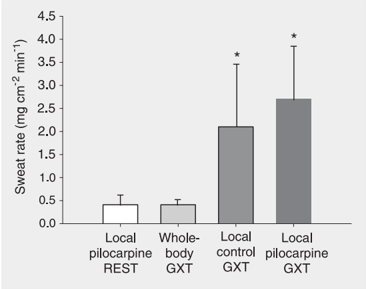
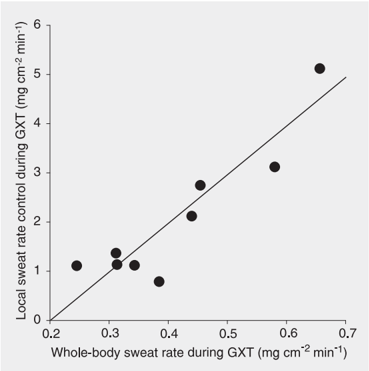
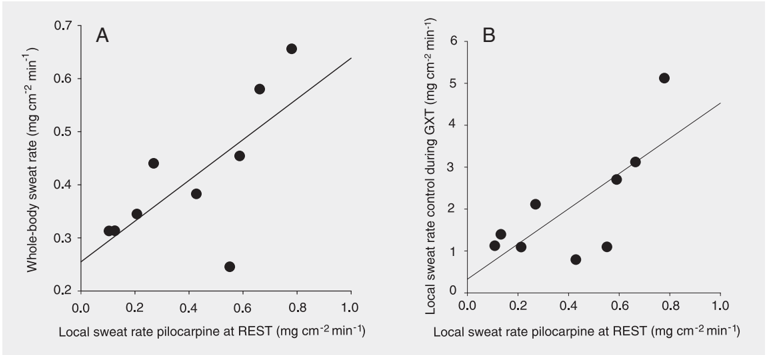
Centrally stimulated sweat rate produced by graded exercise until exhaustion was compared to the local sweat rate induced by pilocarpine, often used as a sweating index for healthy individuals. Nine young male volunteers (22 +/- 4 years) were studied in temperate environment in two situations: at rest and during progressive exercise with 25 W increases every 2 min until exhaustion, on a cycle ergometer. In both situations, sweating was induced on the right forearm with 5 ml 0.5% pilocarpine hydrochloride applied by iontophoresis (1.5 mA, 5 min), with left forearm used as control. Local sweat rate was measured for 15 min at rest. During exercise, whole-body sweat rate was calculated from the body weight variation. Local sweat rate was measured from the time when heart rate reached 150 bpm until exhaustion and was collected using absorbent filter paper. Pharmacologically induced local sweat rate at rest (0.4 +/- 0.2 mg cm-2 min-1) and mean exercise-induced whole-body sweat rate (0.4 +/- 0.1 mg cm-2 min-1) were the same (P > 0.05) but were about five times smaller than local exercise-induced sweat rate (control = 2.1 +/- 1.4; pilocarpine = 2.7 +/- 1.2 mg cm-2 min-1), indicating different sudorific mechanisms. Both exercise-induced whole-body sweat rate (P < 0.05) and local sweat rate (P < 0.05) on control forearm correlated positively with pilocarpine-induced local sweat rate at rest. Assuming that exercise-induced sweating was a result of integrated physiological mechanisms, we suggest that local and whole-body sweat rate measured during graded exercise could be a better sweating index than pilocarpine.
Overview
The claims and statistics of this paper haven’t been checked yet.
Free: it reads the open-access text and checks the first 5 claims that cite a source we can check. Create a free account to check every claim.
Integrity signals
Registry
Cites
Statistics
Figures
Verification
Claims the paper makes
The claims and statistics of this paper haven’t been checked yet.
Free: it reads the open-access text and checks the first 5 claims that cite a source we can check. Create a free account to check every claim.
Claims other papers make about this one
Each is checked against this paper’s own text: does it say what the citing paper says it does?
The source backs part of the claim, not all of it — or backs it for a different population, condition or comparison.
In the citing paper
“Assuming a single-centred flow model13, the best-case sampling interval can be calculated to be less than 1 min, based on the sweat rate (~3–4 mg min−1 cm−2)39 and the pad size (1.5 cm × 2 cm × 50 μm).”
From Fully integrated wearable sensor arrays for multiplexed in situ perspiration analysis (2016) · cites this paper as [39]
Experimental — accuracy not yet measuredThe source backs part of the claim, not all of it — or backs it for a different population, condition or comparison.
In the citing paper
“Forearm sweating rate has been reported to be higher with exercise and/or thermal stress compared with pilocarpine iontophoresis (Hjortskov et al. 1995; Vimieiro-Gomes et al. 2005).”
From Physiological mechanisms determining eccrine sweat composition (2020) · cites this paper as Vimieiro-Gomes et al. 2005
Experimental — accuracy not yet measured
Self-check
Percentages, sums and reported differences re-computed from the paper’s own numbers.
The self-check needs the paper’s full text.
Citations
Cites
(2014) · Medical Entomology and Zoology · Cited by 9,400
A formula to estimate the approximate surface area if height and weight be known. 1916.
Bois, D. D., & Bois, E. F. D. (1989) · PubMed · Cited by 5,706
A new weighting system for mean surface temperature of the human body
Ramanathan, N. L. (1964) · Journal of Applied Physiology · doi:10.1152/jappl.1964.19.3.531 · Cited by 1,883
Gibson, L. E., & Cooke, R. E. (1959) · Pediatrics · doi:10.1542/peds.23.3.545 · Cited by 1,434 · cited 2×
“5 mA, 60 μA cm-2, 5 min) as described by Gibson and Cooke (12) and Buono and Sjoholm (3).”
MethodInfluentialReflex control of the circulation during exercise: chemoreflexes and mechanoreflexes
Rowell, L. B., & O'Leary, D. S. (1990) · Journal of Applied Physiology · doi:10.1152/jappl.1990.69.2.407 · Cited by 725 · cited 3×
“This HR was chosen to permit the observation of sweating during a phase of the exercise when the sympathetic nervous system is activated (10).”
BackgroundMethodBiology of sweat glands and their disorders. I. Normal sweat gland function
Sato, K., Kang, W. H., Saga, K., & Sato, K. T. (1989) · Journal of the American Academy of Dermatology · doi:10.1016/s0190-9622(89)70063-3 · Cited by 717 · cited 2×
“Thus, sweat production is essential for heat tolerance, which prevents hyperthermia and influences performance during physical activity (1).”
BackgroundImportance of skin temperature in the regulation of sweating.
Nadel, E. R., Bullard, R. W., & Stolwijk, J. A. (1971) · Journal of Applied Physiology · doi:10.1152/jappl.1971.31.1.80 · Cited by 545 · cited 1×
“Hypothalamic stimuli increase sweat production, which is proportional to the internal body temperature (as a result of body metabolism) and skin temperature (as a result of thermal environmental stress) (15,16).”
BackgroundPeripheral modifications to the central drive for sweating
Nadel, E. R., Mitchell, J. W., Saltin, B., & Stolwijk, J. A. (1971) · Journal of Applied Physiology · doi:10.1152/jappl.1971.31.6.828 · Cited by 234
Acute and adaptive responses in humans to exercise in a warm, humid environment
Nielsen, B., Strange, S., Christensen, N. J., Warberg, J., & Saltin, B. (1997) · Pfl�gers Archiv European Journal of Physiology · doi:10.1007/s004240050361 · Cited by 228
Armstrong, L. E., Maresh, C. M., Gabaree, C. V., Hoffman, J. R., Kavouras, S. A., Kenefick, R. W., Castellani, J. W., & Ahlquist, L. E. (1997) · Journal of Applied Physiology · doi:10.1152/jappl.1997.82.6.2028 · Cited by 201 · cited 1×
“Sweat production stimulated by the sympathetic system has been measured during prolonged exercise and/or exposure to different thermal environments to evaluate the acclimation status and to establish rehydration protocols according to water losses caused by sweating (7-9).”
Background
Research works printed but not linked: 1
- American College of Sports Medicine (2000). Guidelines for Exer- cise Testing and Prescription. 6th edn. Lippincott Williams & Wilkins, Philadelphia, PA, USA.
Cited by
Fully integrated wearable sensor arrays for multiplexed in situ perspiration analysis
Gao, W., Emaminejad, S., Nyein, H. Y. Y., Challa, S., Chen, K., Peck, A., Fahad, H. M., Ota, H., Shiraki, H., Kiriya, D., et al. (2016) · Nature · doi:10.1038/nature16521 · Cited by 5,087
“Assuming a single-centred flow model 13 , the best-case sampling interval can be calculated to be less than 1 min, based on the sweat rate ( ∼ 3–4 mg min − 1 cm − 2 ) 39 and the pad size (1.5 cm × 2 cm × 50 µ m).”
BackgroundInfluentialPhysiology of sweat gland function: The roles of sweating and sweat composition in human health
Baker, L. B. (2019) · Temperature · doi:10.1080/23328940.2019.1632145 · Cited by 732
Baker, L. B. (2017) · Sports Medicine · doi:10.1007/s40279-017-0691-5 · Cited by 403
“Most notably, LSR is consistently higher with exercise and thermal stress compared with pilocarpine iontophoresis [19, 102, 103].”
BackgroundPhysiological mechanisms determining eccrine sweat composition
Baker, L. B., & Wolfe, A. S. (2020) · European Journal of Applied Physiology · doi:10.1007/s00421-020-04323-7 · Cited by 367
Eyeglasses based wireless electrolyte and metabolite sensor platform
Sempionatto, J. R., Nakagawa, T., Pavinatto, A., Mensah, S. T., Imani, S., Mercier, P., & Wang, J. (2017) · Lab on a Chip · doi:10.1039/c7lc00192d · Cited by 311
Zhong, B., Jiang, K., Wang, L., & Shen, G. (2022) · Advanced Science · doi:10.1002/advs.202103257 · Cited by 164
Drug-Induced Hyperhidrosis and Hypohidrosis: Incidence, Prevention and Management
Cheshire, W. P., & Fealey, R. D. (2008) · Drug Safety · doi:10.2165/00002018-200831020-00002 · Cited by 161
Barnes, K. A., Anderson, M. L., Stofan, J. R., Dalrymple, K. J., Reimel, A. J., Roberts, T. J., Randell, R. K., Ungaro, C. T., & Baker, L. B. (2019) · Journal of Sports Sciences · doi:10.1080/02640414.2019.1633159 · Cited by 132
“Studies comparing pharmacological (pilocarpine iontophoresis) versus thermal (exercise/heat induced) sweating have found that local sweating rates are often higher in thermal sweating (Hjortskov, Jepsen, Nielsen, Juul, & Skakkebæk, 1995; Verde, Shephard, Corey, & Moore, 1982; Vimieiro-Gomes et al., 2005).”
BackgroundBaker, L. B., De Chavez, P. J. D., Ungaro, C. T., Sopeña, B. C., Nuccio, R. P., Reimel, A. J., & Barnes, K. A. (2019) · European Journal of Applied Physiology · doi:10.1007/s00421-018-4048-z · Cited by 110
Shi, X., Zhu, N., & Zheng, G. (2013) · Building and Environment · doi:10.1016/j.buildenv.2013.07.016 · Cited by 114
Morris, N. B., Cramer, M. N., Hodder, S. G., Havenith, G., & Jay, O. (2013) · Journal of Applied Physiology · doi:10.1152/japplphysiol.01088.2012 · Cited by 91
Kenefick, R. W., Cheuvront, S. N., Elliott, L. D., Ely, B. R., & Sawka, M. N. (2012) · American Journal of Physiology-Regulatory, Integrative and Comparative Physiology · doi:10.1152/ajpregu.00456.2011 · Cited by 49
Yin, S., Liu, X., Kobayashi, Y., Nishina, Y., Nakagawa, R., Yanai, R., Kimura, K., & Miyake, T. (2020) · Biosensors and Bioelectronics · doi:10.1016/j.bios.2020.112287 · Cited by 51
A wearable sweat rate sensor to monitor the athletes’ performance during training
Salvo, P., Pingitore, A., Barbini, A., & Francesco, F. D. (2017) · Science & Sports · doi:10.1016/j.scispo.2017.03.009 · Cited by 52
Brown, M. B., Haack, K. K. V., Pollack, B. P., Millard-Stafford, M., & McCarty, N. A. (2011) · American Journal of Physiology-Regulatory, Integrative and Comparative Physiology · doi:10.1152/ajpregu.00660.2010 · Cited by 45
“Despite controlling for factors known to influence sweat electrolyte concentration such as acclimation status (3), sweat stimulation technique (41, 65, 82), and collection technique (38, 74), the excreted sweat can vary greatly between individuals (50, 70, 76).”
BackgroundSweat Gland‐Like Fabric for Personal Thermal‐Wet Comfort Management
Zhang, Q., Wang, M., Chen, T., Chen, Z., Liu, D., Zhang, Z., Lei, Z., Wang, Y., Xiao, X., Zhu, B., et al. (2024) · Advanced Functional Materials · doi:10.1002/adfm.202409807 · Cited by 48
Madeira, L. G., da Fonseca, M. A., Fonseca, I. A. T., de Oliveira, K. P., Passos, R. L. D. F., Machado-Moreira, C. A., & Rodrigues, L. O. C. (2009) · European Journal of Applied Physiology · doi:10.1007/s00421-009-1262-8 · Cited by 43
“…iontophoresis has been successfully used as a standard, non-invasive procedure to locally induce sweating (Buono et al. 1992; Hjortskov et al. 1995; Vimieiro-Gomes et al. 2005) since this cholinergic agonist binds directly to muscarinic receptors on the gland, and its action occurs independently…”
MethodSelf-citationThermoregulatory Efficiency is Increased after Heat Acclimation in Tropical Natives
Magalhães, F. D. C., Passos, R. L. F., da Fonseca, M. A., Oliveira, K. P. M., Ferreira‐Júnior, J. B., Martini, A. R. P., Lima, M. R. M., Guimarães, J. B., Baraúna, V. G., Garcia, E. S., et al. (2010) · Journal of PHYSIOLOGICAL ANTHROPOLOGY · doi:10.2114/jpa2.29.1 · Cited by 46
Self-citationRisk assessment of soils identified on firefighter turnout gear
Easter, E. P., Lander, D., & Huston, T. N. (2016) · Journal of Occupational and Environmental Hygiene · doi:10.1080/15459624.2016.1165823 · Cited by 30
“4 mg/cm2/min.[26] This results in a volume of approximately 50μL/cm2.”
BackgroundEvaluation of the Megaduct sweat collector for mineral analysis
Ely, M. R., Ely, B. R., Chinevere, T. D., Lacher, C. P., Lukaski, H. C., & Cheuvront, S. N. (2012) · Physiological Measurement · doi:10.1088/0967-3334/33/3/385 · Cited by 28
Passively Addressable Ultra-Low Volume Sweat Chloride Sensor
Ganguly, A., & Prasad, S. (2019) · Sensors · doi:10.3390/s19204590 · Cited by 23
Effects of heat acclimation on sweating during graded exercise until exhaustion
Machado-Moreira, C. A., Magalhães, F. D. C., Gomes, A. C. V., Lima, N. R. V., & Rodrigues, L. O. C. (2005) · Journal of Thermal Biology · doi:10.1016/j.jtherbio.2005.05.002 · Cited by 28
Self-citationGuan, M., Zhang, H., Li, J., Spano, F., Camenzind, M., Annaheim, S., & Rossi, R. M. (2019) · Applied Thermal Engineering · doi:10.1016/j.applthermaleng.2019.114642 · Cited by 18
Wearable Sweat Management Technologies
Wei, L., Li, Z., Dai, Z., Ding, L., Wei, H., Li, J., Zhu, H., & Zhu, Y. (2024) · Advanced Materials Technologies · doi:10.1002/admt.202301812 · Cited by 21
Is sweat rate during steady state exercise related to maximum oxygen uptake?
Amorim, F. T., Gomes, A. C. V., Machado-Moreira, C. A., Magalhães, F. D. C., Rosa, M. S., Prado, L. S., & Rodrigues, L. O. C. (2006) · Journal of Thermal Biology · doi:10.1016/j.jtherbio.2006.05.006 · Cited by 13
“In our previous study, we observed a correlation between SRpilo and whole-body sweat rate induced by graded exercise until exhaustion (Vimieiro-Gomes et al., 2005).”
BackgroundSelf-citationExercise heat acclimation causes human responses and safety performance improvements
Zhang, S., & Zhu, N. (2021) · Journal of Thermal Biology · doi:10.1016/j.jtherbio.2021.103042 · Cited by 12
Zhang, W., Su, Y., & Li, J. (2023) · International Journal of Thermal Sciences · doi:10.1016/j.ijthermalsci.2023.108401 · Cited by 8
Béliveau, J., Perreault-Briere, M., Jeker, D., Deshayes, T. A., Suárez, A. D., Baker, L. B., & Goulet, E. D. B. (2020) · European Journal of Applied Physiology · doi:10.1007/s00421-020-04350-4 · Cited by 10
Fonsêca, V. D. F. C., da Silva, R. G., Moura, G. A. B., Snelling, E. P., Fuller, A., Mitchell, D., Costa, C. C. D. M., Milan, H. F. M., & Maia, A. S. C. (2021) · Journal of Experimental Zoology Part A Ecological and Integrative Physiology · doi:10.1002/jez.2572 · Cited by 6
Comparative methods analysis on rates of cutaneous evaporative water loss (CEWL) in cattle
Castro, P. A., Maia, A. S. C., Fonsêca, V. D. F. C., Moura, G. A. B., Costa, C. C. D. M., Nascimento, S. T., Simão, B. R., Ruggieri, A. C., & da Silva, R. G. (2021) · Journal of Thermal Biology · doi:10.1016/j.jtherbio.2021.102879 · Cited by 6
A 32-day long fieldwork in Antarctica improves heat tolerance during physical exercise
Martins, Y. A. T., Passos, R. L. F., Marques, A. L., Gonçalves, D. A. P., Mendes, T. T., Núñez-Espinosa, C. A., Rodrigues, L. O. C., Wanner, S. P., Moraes, M. M., Arantes, R. M. E., et al. (2022) · Anais da Academia Brasileira de Ciências · doi:10.1590/0001-3765202220210593 · Cited by 6
Self-citationAmano, T., Ichinose‐Kuwahara, T., Ueda, H., Kondo, N., Wang, H., & Inoue, Y. (2025) · American Journal of Physiology-Regulatory, Integrative and Comparative Physiology · doi:10.1152/ajpregu.00131.2025 · Cited by 5
Eccrine sweat response in children with asthma
Oflu, A. T., Soyer, O. U., Tuncer, A., Saçkesen, C., & Kalaycı, Ö. (2009) · Allergy · doi:10.1111/j.1398-9995.2009.02226.x · Cited by 5
“(14) showed that exercise induced a higher local sweat rate than pilocarpine in healthy volunteers.”
BackgroundZhang, W., Su, Y., & Li, J. (2023) · Journal of Industrial Textiles · doi:10.1177/15280837231177870 · Cited by 5
“Based on the relationship between the local sweat rate and the whole-body sweat rate, we estimated the maximum local sweat rate to be 25.5 mg/(cm 2 (cid:1) min), 40,41 corresponding to a 3 L/h maximum whole-body sweat rate 46 (assuming a 1.80 m 2 body surface area).”
BackgroundInfluentialZhang, W., Su, Y., Wang, Y., & Li, J. (2024) · Textile Research Journal · doi:10.1177/00405175231225975 · Cited by 5
“8,35 The peristaltic pump was connected to the thermostatic water tank, and the temperature in the water tank was constant at 32.5 C. 36,37 The exposure intensity was calibrated before mounting the testing sample.”
InfluentialBiochemistry & Physiology: Open Access
(2019) · Biochemistry & Physiology Open Access · doi:10.4172/2168-9652 · Cited by 5
Harris, C., Hunt, L. A., Shepherd, S. O., Hew‐Butler, T., & Blow, A. V. (2026) · Physiological Reports · doi:10.14814/phy2.70724 · Cited by 4
Keyes, D. M., Brown, S. D., King, M. A., Engel, M. D., Ciciora‐Gold, M., Chavez, P. J. D. D., & Baker, L. B. (2022) · European Journal of Applied Physiology · doi:10.1007/s00421-022-04989-1 · Cited by 6
Fluid Balance, Sodium Losses and Hydration Practices of Elite Squash Players during Training
Turner, O., Mitchell, N., Ruddock, A. D., Purvis, A. J., & Ranchordas, M. K. (2023) · Nutrients · doi:10.3390/nu15071749 · Cited by 6
Shen, H., Pang, Y., Yuan, D., Zhang, J., Guo, H., Wang, C., He, H., Ling, M., Chen, L., & Huang, H. (2024) · Advanced Materials Technologies · doi:10.1002/admt.202301803 · Cited by 3
Rocha, C. M., Madeira, L. G., Sá, K. R., Lopes, L. N., de Albuquerque, D. P., Diniz, L. M., & Rodrigues, L. O. C. (2009) · Revista Brasileira de Medicina do Esporte · doi:10.1590/s1517-86922009000100005 · Cited by 3
Self-citationSweat Electrolyte Loss in Asthmatic Children during Exercise in the Heat
Laitano, O., Martins, J. B., Mattiello, R., Perrone, C., Fischer, G. B., & Meyer, F. (2008) · Pediatric Exercise Science · doi:10.1123/pes.20.2.121 · Cited by 4
Effects Of Menstrual Cycle On Sweating During Exercise Performed In Hot And Dry Environment
dos Reis, F. M. (2015) · Biochemistry & Physiology Open Access · doi:10.4172/2168-9652.s3-001 · Cited by 3
“[11] was used in this work for measurement of sweat rate.”
MethodAssessment of Sweat Rate in Different Sports
Das, A., & Ramesh, V. (2025) · Methods and protocols in food science · doi:10.1007/978-1-0716-4370-9_15 · Cited by 1
Distribuição regional do suor durante exercício progressivo até a fadiga
Ferreira‐Júnior, J. B., Oliveira, K. P. M., da Fonseca, M. A., Coelho, L. G. M., Magalhães, F. D. C., Costa, V. F., Martini, A. R. P., Passos, R. L. D. F., Coelho, F. T., & Rodrigues, L. O. C. (2009) · Revista Brasileira de Educação Física e Esporte · doi:10.1590/s1807-55092009000400009 · Cited by 1
“Para prevenir a evaporação do suor, o papel fi ltro absorvente foi coberto com pedaço de plástico de 64 cm2 fi xado na pele com fi ta adesiva impermeável (VIMIEIRO-GOMES et al., 2005).”
BackgroundSelf-citationComparação entre duas técnicas de coleta regional de suor durante o exercício no calor
Laitano, O., Martins, J. B., Reischak-Oliveira, Á., & Meyer, F. (2013) · LA Referencia (Red Federada de Repositorios Institucionales de Publicaciones Científicas)
Coelho, L. G. M., Ferreira‐Júnior, J. B., Borba, D. D. A., Fortunato, A. K., & Coelho, D. B. (2018) · Revista Brasileira de Saúde Ocupacional · doi:10.1590/2317-6369000015317
Béliveau, J. (2020) · Knowledge UdeS (Institutional Deposit of the University of Sherbrooke)
Wearable Sweat Sensors: A Review
Chowdhury, I., Ali, M. Y., & Howlader, M. M. R. (2024) · Elsevier eBooks · doi:10.1016/b978-0-323-95478-5.00015-7 · Cited by 2
Electrochemical Paper Fluidic Device for Extended Real-time Cocaine Monitoring in Simulated SweatPreprint
Hoilett, O. S., Foust, J., Davé, N., Balash, B. M., Moryl, D. L., Kumar, A., & Linnes, J. C. (2025) · bioRxiv (Cold Spring Harbor Laboratory) · doi:10.1101/2025.03.13.643163 · Cited by 1
“The physiologically relevant concentrations of cocaine hydrochloride in sweat are closer to 10 nM [15], [28], [30], [63], which is much lower than the concentrations tested here.”
InfluentialDeveloping Nutritional Considerations for Elite Squash Players Through a Performance Problems Lens
Turner, O. J. (2024) · Sheffield Hallam University · doi:10.7190/shu-thesis-00748
Metadata
- Authors
- Vimieiro-Gomes, A. C., Magalhães, F. C., Amorim, F. T., Machado-Moreira, C. A., Rosa, M. S., Lima, N. R. V., & Rodrigues, L. O. C.
- Affiliations
- Universidade Federal de Minas Gerais, Brasil
- Universidade Federal de Minas Gerais (BR)
- Venue
- Brazilian Journal of Medical and Biological Research
- Publisher
- FapUNIFESP (SciELO)
- Published
- 2005-07
- Volume
- 38
- Issue
- 7
- Pages
- 1133-1139
- ISSN
- 0100-879X (ISSN-L)
- OpenAlex
- W2074448281
- Semantic Scholar
- 49ef9eb8b5388ccb2278a5ee81ea39ab0881999c
- Cited by
- 49
- References
- 24
- Citations by year
- 2026: 1 · 2025: 3 · 2024: 5 · 2023: 3 · 2022: 2 · 2021: 4 · 2020: 3 · 2019: 5 · 2018: 2 · 2017: 3 · 2016: 2 · 2015: 1 · 2013: 3 · 2012: 1
- FWCI
- 0.80
- Type
- journal article
- Language
- en
- Open access
- gold
- doi.org
- Licence
- cc-by
- Locations
- Brazilian Journal of Medical and Biological Research (publishedVersion, cc-by)
- PubMed (publishedVersion)
- LA Referencia (Red Federada de Repositorios Institucionales de Publicaciones Científicas) (publishedVersion, other-oa)
- Americanae (AECID Library) (submittedVersion, cc-by-nc)
- DOAJ (DOAJ: Directory of Open Access Journals) (submittedVersion, cc-by-sa)
- Funders
- Coordenação de Aperfeiçoamento de Pessoal de Nível Superior
- Conselho Nacional de Desenvolvimento Científico e Tecnológico
- Fundação de Amparo à Pesquisa do Estado de Minas Gerais
- Universidade Federal de Minas Gerais
- Topics
- Health Sciences › Medicine › Physiology (medical) › Thermoregulation and physiological responses
- Health Sciences › Medicine › Physiology (medical) › Cardiovascular and exercise physiology
- Health Sciences › Medicine › Physiology (medical) › Exercise and Physiological Responses
- Keywords
- sweat rate, graded exercise, pilocarpine, local sweat rate, iontophoresis, exercise-induced sweating, thermoregulation
- MeSH terms
- Adult, Analysis of Variance, Body Temperature Regulation, Humans, Iontophoresis, Male, Pilocarpine, Sweating, Exercise, Muscarinic Agonists
About these checks
Registry, retraction, Cites and statistics results are computed, not judged, with one exception: a printed reference that no index lists is read once by a model before it counts as a citation error. Claims are extracted by a model and kept only when their quote appears verbatim in the text; each cited source is then checked, with a model’s help, for whether it says what the claim relies on. Those verdicts can be wrong — read the claim’s quote and the cited source before relying on one.
Statistics and arithmetic are recomputed, not judged.
Confidence bands are shown only for fields calibrated on our annotated test set. None is calibrated yet, so no band is shown.
What counts as a claim ›How we measure confidence ›How we check this ›
Are you an author, or do you see a problem with this page? Request a review
Data sources
Bibliographic data: Semantic Scholar, OpenAlex, Crossref.
Contains information from the Semantic Scholar Academic Graph Datasets, made available under the ODC Attribution License (ODC-BY 1.0).
Semantic Scholar’s data is described in: Kinney, R., et al. (2023). The Semantic Scholar Open Data Platform. arXiv:2301.10140.
