

Long-term potentiation and long-term depression: a clinical perspective
Open accessThe DOI matches its Crossref record; 167 of the 171 references it cites were found in a registry or an index.
Abstract
Long-term potentiation and long-term depression are enduring changes in synaptic strength, induced by specific patterns of synaptic activity, that have received much attention as cellular models of information storage in the central nervous system. Work in a number of brain regions, from the spinal cord to the cerebral cortex, and in many animal species, ranging from invertebrates to humans, has demonstrated a reliable capacity for chemical synapses to undergo lasting changes in efficacy in response to a variety of induction protocols. In addition to their physiological relevance, long-term potentiation and depression may have important clinical applications. A growing insight into the molecular mechanisms underlying these processes, and technological advances in non-invasive manipulation of brain activity, now puts us at the threshold of harnessing long-term potentiation and depression and other forms of synaptic, cellular and circuit plasticity to manipulate synaptic strength in the human nervous system. Drugs may be used to erase or treat pathological synaptic states and non-invasive stimulation devices may be used to artificially induce synaptic plasticity to ameliorate conditions arising from disrupted synaptic drive. These approaches hold promise for the treatment of a variety of neurological conditions, including neuropathic pain, epilepsy, depression, amblyopia, tinnitus and stroke.
Overview
The claims and statistics of this paper haven’t been checked yet.
Free: it reads the open-access text and checks the first 5 claims that cite a source we can check. Create a free account to check every claim.
Integrity signals
Registry
Cites
Statistics
Figures
Verification
Claims the paper makes
The claims and statistics of this paper haven’t been checked yet.
Free: it reads the open-access text and checks the first 5 claims that cite a source we can check. Create a free account to check every claim.
Claims other papers make about this one
Each is checked against this paper’s own text: does it say what the citing paper says it does?
The cited source says what the claim attributes to it.
In the citing paper
“Beside neurogenesis, it is also rather well-established that LTP can be induced in the human CNS with similar molecular mechanisms than those observed in rodent models (Bliss and Cooke 2011).”
From Neurotrophic factors and neuroplasticity pathways in the pathophysiology and treatment of depression (2018) · cites this paper as Bliss and Cooke 2011
Self-check
Percentages, sums and reported differences re-computed from the paper’s own numbers.
The self-check needs the paper’s full text.
Citations
Cites
Hebb, D. O. (2005) · doi:10.4324/9781410612403 · Cited by 9,825
Glutamate neurotoxicity and diseases of the nervous system
CHOI, D. (1988) · Neuron · doi:10.1016/0896-6273(88)90162-6 · Cited by 7,972
Bliss, T. V. P., & Gardner‐Medwin, A. R. (1973) · The Journal of Physiology · doi:10.1113/jphysiol.1973.sp010274 · Cited by 7,437 · cited 1×
“Experiments in intact animals allow for assessment of the longevity of LTP in the hippocampus using chronically implanted recording and stimulating electrodes.(17) Under these conditions, and using multiple induction tetani, LTP has been observed to last for a year in rats.”
MethodSelf-citationindicated, N. A. (1950) · Journal of Consulting Psychology · doi:10.1037/h0049612 · Cited by 6,923
Bi, G.-Q., & Poo, M.-M. (1998) · The Journal of Neuroscience · doi:10.1523/jneurosci.18-24-10464.1998 · Cited by 4,744 · cited 11×
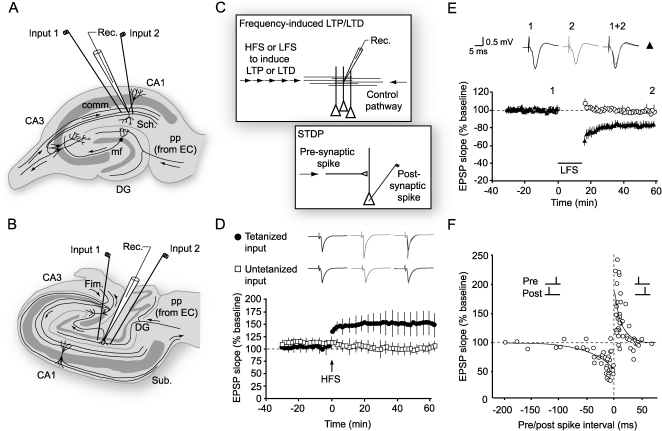
“Repeated activation of a presynaptic spike followed by post-synaptic spike, within a brief time window of approximately 50 ms, leads to LTP, while the reverse order leads to LTD.21,22 The transverse slice allows for easy placement of stimulating electrodes in clearly defined afferent fibre populations because the dend…”
BackgroundInfluentialMagnesium gates glutamate-activated channels in mouse central neurones
Nowak, L., Bregestovski, P., Ascher, P., Herbet, A., & Prochiantz, A. (1984) · Nature · doi:10.1038/307462a0 · Cited by 4,043 · cited 2×
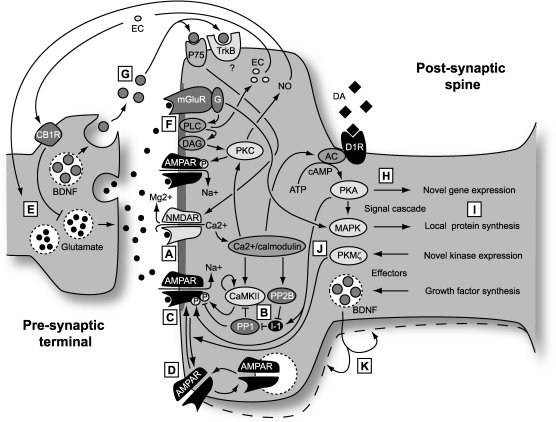
“It is now known that coincidence detection is accomplished through the NMDA receptor (NMDAR), a voltage-dependent subtype of glutamate receptor that allows permeation of calcium and other cations only when two criteria are satisfied: neurotransmitter is bound following release of glutamate from the presynaptic termina…”
BackgroundInfluentialRegulation of Synaptic Efficacy by Coincidence of Postsynaptic APs and EPSPs
Markram, H., Lübke, J., Frotscher, M., & Sakmann, B. (1997) · Science · doi:10.1126/science.275.5297.213 · Cited by 3,832 · cited 11×
“Repeated activation of a presynaptic spike followed by post-synaptic spike, within a brief time window of approximately 50 ms, leads to LTP, while the reverse order leads to LTD.21,22 The transverse slice allows for easy placement of stimulating electrodes in clearly defined afferent fibre populations because the dend…”
BackgroundInfluentialThe period of susceptibility to the physiological effects of unilateral eye closure in kittens
Hubel, D. H., & Wiesel, T. N. (1970) · The Journal of Physiology · doi:10.1113/jphysiol.1970.sp009022 · Cited by 3,030
Synaptic Plasticity and Memory: An Evaluation of the Hypothesis
Martin, S. J., Grimwood, P. D., & Morris, R. G. M. (2000) · Annual Review of Neuroscience · doi:10.1146/annurev.neuro.23.1.649 · Cited by 2,794 · cited 1×
“learning and memory, as most neuroscientists believe, has not yet been definitively resolved.(5,6) However, at the”
BackgroundNeurodegenerative Disorders: Parkinson's Disease and Huntington's Disease
Hague, S., Klaffke, S., & Bandmann, O. (2006) · IMPERIAL COLLEGE PRESS eBooks · doi:10.1142/9781860948961_0007 · Cited by 2,766
Research works printed but not linked: 1
- Heynen A Bear MF Abraham WC Low-frequency stimulation of the Schaffer collaterals produces homosynaptic LTD in area CA1 of the adult rat hippocampus in vivo Soc Neurosci Abstr 1995
Cited by
Items 301–400 of 444
Spalek, K. (2014) · edoc (University of Basel) · doi:10.5451/unibas-006273552
“Finally, BDNF, encoded by the BDNF gene, is suggested to be involved in synaptic plasticity (Bliss & Cooke, 2011; Lu, Christian, & Lu, 2008; Martin & Kosik, 2002).”
BackgroundTheta Burst Stimulation of the Human Cerebellum
Harrington, A. (2015) · Otago University Research Archive (University of Otago)
Investigations of learning induced changes in corticospinal excitability in healthy human
Mathias, J. P. (2014) · University of Birmingham Institutional Research Archive (University of Birmingham)
Reducing Subjectivity: Meditation and Implicit Bias
Ciuca, D. M. (2015) · Scholarship @ Claremont (The Claremont Colleges)
Dervola, K.-S. N. (2015) · NVA (Nasjonalt vitenarkiv)
Compressed Sensing of Excitatory Postsynaptic Potential Bio-Signals
An, H., & Shin, H. (2016) · doi:10.5121/csit.2016.60301
“Although in-vitro or ex-vivo experiments are important in studying the neurological mechanism and biosignals recorded from these experiments require a large storage space [6-9], no study on the compression of EPSPs has been done.”
BackgroundNorbom, L. B. (2013) · NVA (Nasjonalt vitenarkiv)
An investigation into the role of TLR3 activation on hippocampal function
Ritchie, L. (2015) · STAX · doi:10.48730/t659-vj95
Metabolic modifications associated with memory deficits
Rial, A. C. F. D. L. (2016) · Portuguese National Funding Agency for Science, Research and Technology (RCAAP Project by FCT)
Nielsen, R. K. (2016) · VBN Forskningsportal (Aalborg Universitet) · doi:10.5278/vbn.phd.med.00068
Resting state fMRI study of brain activation using rTMS in rats
Seewoo, B. J. (2016) · Murdoch University Research Portal
Whissell, P. D. (2014) · TSpace (University of Toronto)
Dopaminergic Modulation of Neuroplasticity in Humans- Contribuition of Receptor Subtypes and Dosage
Fresnoza, S. M. (2014) · eDiss (Georg-August-Universität Göttingen) · doi:10.53846/goediss-4702
Involvement of the endogenous opioid and cannabinoid systems in addictive like behaviours
Mancino, S. (2015) · Tesis Doctorals en Xarxa (Consorci de Serveis Universitaris de Catalunya)
Welcome, M. O., Dane, Ş., Mastorakis, N. E., & Pereverzev, V. A. (2017) · AIP conference proceedings · doi:10.1063/1.5018506
Funció del factor d'elongació eEF1A2 en plasticitat sinàptica
Fernández, S. G. (2018) · Dipòsit Digital de la Universitat de Barcelona (Universitat de Barcelona)
Investigando os aprendizados subsequentes : mecanismos plásticos e dependência temporal
Crestani, A. P. (2018) · Americanae (AECID Library)
Ribeiro, D. E., Müller, H. K., Elfving, B., Joca, S. R. L., & Wegener, G. (2018) · bioRxiv (Cold Spring Harbor Laboratory) · doi:10.1101/395194
Dwyer, H. (2018) · Murdoch University Research Portal
Murovec, N. (2018) · Repository of the University of Primorsk (University of Primorska)
Shirrafiardekani, A., Frauendiener, J., Moustafa, A. A., & Beňušková, Ľ. (2018) · Springer series in computational neuroscience · doi:10.1007/978-3-319-99103-0_20
Kuc, C. (2018) · The Atrium (University of Guelph)
Davila-Pérez, P. (2018) · LA Referencia (Red Federada de Repositorios Institucionales de Publicaciones Científicas)
Haug, C. J. (2018) · mediaTUM (Technical University of Munich)
The role of the Calcium-binding of Copine-6 in synapse function and plasticity
Flores-Dominguez, D. (2019) · edoc (University of Basel) · doi:10.5451/unibas-007087434
Skaug, K. A. (2018) · NVA (Nasjonalt vitenarkiv)
Hilar parvalbumin interneurons control functional connectivity associated to spatial memory encoding
Tejedor, C., & María, J. (2018) · LA Referencia (Red Federada de Repositorios Institucionales de Publicaciones Científicas)
Denby, E. (2019) · Kent Academic Repository (University of Kent)
Bergeron, Y. (2019) · Le dépôt institutionnel (Université du Québec à Trois-Rivières)
강석재 (2016) · Seoul National University Open Repository (Seoul National University)
En VEP-studie av LTP-liknende plastisitet, læring og hukommelse
Lengali, L. (2020) · NVA (Nasjonalt vitenarkiv)
Fatakdawala, I. (2020) · UWSpace (University of Waterloo)
Evaluation of the antidepressant potential of dextromethorphan
Nguyen, L. (2015) · The Research Repository @ WVU (West Virginia University) · doi:10.33915/etd.6309
The role of TMS in brain plasticity in health and disease
Dionísio, A. (2020) · Portuguese National Funding Agency for Science, Research and Technology (RCAAP Project by FCT)
The NMDA Receptor System and Developmental Neurotoxicity
Wang, C., Liu, S., Liu, F., Patterson, T. A., & Slikker, W. (2021) · Springer eBooks · doi:10.1007/978-3-030-71519-9_194-1
Halawa, I. (2020) · eDiss (Georg-August-Universität Göttingen) · doi:10.53846/goediss-7620
Alzheimer’s disease as a syndrome of overloaded amyloidic synaptic tagging in memory networksPreprint
Murphy, N. (2021) · OSF Preprints (OSF Preprints) · doi:10.31219/osf.io/7gsaz
Seven properties of self-organization in the human brain
Dresp, B. (2022) · HAL
A Computational Model for Storing Memories in the Synaptic Structures of the BrainPreprint
George, V. K., Morar, V., & SILVA, G. H. D. O. (2022) · bioRxiv (Cold Spring Harbor Laboratory) · doi:10.1101/2022.10.21.513291
New Horizons of Non-Invasive Brain Stimulation in Clinical Medicine
Poydasheva, A. G., Bakulin, I. S., Suponeva, N. A., Troshina, E. A., Tanashyan, M. М., Dedov, I. I., & Пирадов, М. А. (2022) · Human Physiology · doi:10.1134/s0362119722080102
Janjua, T. A. M., Nielsen, T. N., Andreis, F. R., Meijs, S., & Jensen, W. (2023) · International IEEE/EMBS Conference on Neural Engineering · doi:10.1109/ner52421.2023.10123841
“For examples the spared nerve injury model [4], and spinal long-term potentiation (LTP) of pain [5].”
BackgroundБочарова, А. В., & Степанов, В. А. (2023) · Russian Journal of Genetics · doi:10.1134/s1022795423020035
Noninvasive Brain Stimulation as a Potential Therapeutic Procedure in Drug-Resistant Epilepsy
Chacón, L. M. M., & Gómez-Fernández, L. (2023) · Springer eBooks · doi:10.1007/978-3-031-36526-3_25
Model Following Adaptive Control of Links for the Complex Dynamical Network via the State Observer
Li, X., & Wu, C. (2023) · Communications in computer and information science · doi:10.1007/978-981-99-8018-5_19
George, V. K., Morar, V., & Silva, G. A. (2023) · Research Square · doi:10.21203/rs.3.rs-3576634/v1
Bioinformatics Analysis of Disc Large Homolog-4 (DLG-4) As Parameters in Neuroplasticity
Zulissetiana, E. F., & Irfannuddin, I. (2023) · SRIWIJAYA JOURNAL OF MEDICINE · doi:10.32539/sjm.v6i3.206
EXPLORING THE LINK BETWEEN SYNAPTIC PLASTICITY AND COLLABORATIVE LEARNING FOR ENHANCED COGNITION
Oh, H. K., Rodrigues, F. D. A. A., Demekhin, E., Lopes, G. C. D., & Oh, H. V. (2024) · COGNITIONIS Scientific Journal · doi:10.38087/2595.8801.354
Perbet, L. D. (2014) · theses.fr (ABES) · doi:10.70675/7d6b5377zcf31z4b51z85e2z573e98b9911d
Бочарова, А. В., & Степанов, В. А. (2023) · Генетика · doi:10.31857/s0016675823020030
Adeniji, T., Nadasan, T., Olagbegi, O. M., & Dada, O. O. (2024) · Babcock University Medical Journal · doi:10.38029/babcockuniv.med.j..v7i1.333
Exogenous induction of neuroplasticity: Non-invasive neurostimulation
Pape, T., Barrington, N. M., Webber, E. K., & Stutzmann, G. E. (2024) · Elsevier eBooks · doi:10.1016/b978-0-12-820480-1.00217-5
Estimulação transcraniana por corrente contínua em crianças e adolescentes com TDAH: ensaio clínico
de Sá, M. L. O., Collange, L. A., Muszkat, M., & Rizzutti, S. (2024) · Contribuciones a las Ciencias Sociales · doi:10.55905/revconv.17n.9-202
A contemporary analysis of the effects of neuroplasticity on well-being
(2024) · Armenian Journal of Health & Medical Sciences · doi:10.54235/27382737-2024.v4.1-46
“Further research in this area can potentially lead to advancements in areas such as cognitive enhancement, neurorehabilitation, and the treatment of neurological disorders associated with impaired synaptic plasticity [4,5].”
Pulsed Radiofrequency Stimulation for Radicular Pain
Lee, D. G. (2024) · Clinical Pain · doi:10.35827/cp.2024.23.2.79
Vints, W. A. J. (2025) · Research Publications (Maastricht University) · doi:10.26481/dis.20250522wv
A Mechanical Theory Explaining Neural Function, Alzheimer's Disease, and EpilepsyPreprint
Moneymaker, V. (2025) · SSRN Electronic Journal · doi:10.2139/ssrn.5237631
Bhatia, D., Das, K., Acharjee, T., & Nongrum, H. B. (2025) · AIMS Biophysics · doi:10.3934/biophy.2025013
The Endocannabinoid System and Postnatal Neurodevelopment
Sisk, L. M., Meyer, H. C., Martinez-Garcia, A., & Gee, D. G. (2025) · Springer eBooks · doi:10.1007/978-3-031-87990-6_5
Impacto da privação auditiva precoce na memória e na potenciação a longo prazo do hipocampo
Migliaccio, M. M. (2025) · Digital Library of Theses and Dissertations (Universidade de São Paulo) · doi:10.11606/d.17.2025.tde-24062025-112213
A valuation based theory of learning’s origin and development
Moneymaker, V. (2025) · Frontiers in Systems Neuroscience · doi:10.3389/fnsys.2025.1649748
Modeling homosynaptic and heterosynaptic plasticity with a single neuromemristive synapse
Mannan, Z. I., Azam, S., Budhathoki, R. K., Alam, M. N., & Kim, H. (2025) · Journal of Advanced Research · doi:10.1016/j.jare.2025.10.031
da Conceição, N. R., Vitório, R., Morya, E., Beretta, V. S., Mezêncio, B., Monteiro, P. H. M., & Teixeira, L. A. (2025) · The Cerebellum · doi:10.1007/s12311-025-01925-9
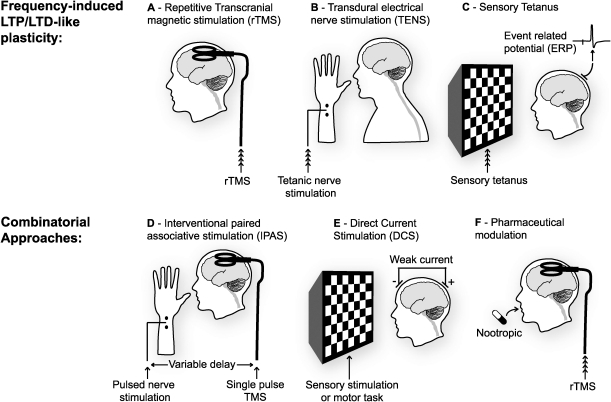
“These com - bined interventions may potentiate synaptic strength and specificity [ 13, 14 ], amplifying neurophysiological effects and promoting more stable and long-lasting improvements in cortical excitability [ 13].”
Svejgaard, B. (2025) · VBN Forskningsportal (Aalborg Universitet) · doi:10.54337/aau805587500
Rodrigues, P. H. R. E., Júnior, W. R. D. S., Araújo, I. D. S., Leony, L. M., Gomes, F. A. A. C. P., Junior, T. M. D. L., Moreira, L. F. F., Santana, R. T., Santos, M. C. M., & Silva, R. D. B. (2025) · DELOS Desarrollo Local Sostenible · doi:10.55905/edicon.978-65-83115-47-8_8
Woźniak-Kwaśniewska, A. (2013) · theses.fr (ABES) · doi:10.70675/fffacdfazde5dz47c5z921az07d659488e48
Figueiredo de Melo, L. (2023) · Dokumentenrepositorium der RUB (Ruhr University Bochum) · doi:10.13154/294-10445
Abbott, P. W. (2024) · Iowa Research Online (The University of Iowa) · doi:10.25820/etd.007792
Murphy, R. J., Godfrey, K., Shaw, A. D., Muthukumaraswamy, S., & Sumner, R. L. (2024) · Figshare · doi:10.6084/m9.figshare.25150540
Modulations of visual cortex organization investigated with 7 Tesla fMRI
Abd Hamid, A. I. B. (2016) · Digitalen Hochschulbibliothek Sachsen-Anhalt (Universitäts- und Landesbibliothek Sachsen-Anhalt) · doi:10.25673/4369
Design, manufacturing, and characterization of advanced ceramics
Shakib, M. A. (2025) · Iowa Research Online (The University of Iowa) · doi:10.25820/etd.007835
Robertson, S. (2025) · University Libraries (University of Maryland) · doi:10.13016/27tt-kdoq
Proulx-Bégin, L. (2024) · Papyrus : Institutional Repository (Université de Montréal) · doi:10.71781/19119
Evaluating Modern STDP Rules and Their Role in Embedding Information in the Brain
Morar, V. (2023) · eScholarship (California Digital Library)
Moret, B. (2019) · Padua@research (University of Padova)
Stimulation corticale transcrânienne et réponse inhibitrice à la douleur
Fontoura Motta, A. (2015) · Knowledge UdeS (Institutional Deposit of the University of Sherbrooke)
Leung, A. J., & Leung, A. J. (2024) · UA Campus Repository (The University of Arizona)
O papel dos receptores A2A para a adenosina do hipocampo na generalização do medo condicionado
Ribeiro, A. M. P. D. F. A. (2018) · Portuguese National Funding Agency for Science, Research and Technology (RCAAP Project by FCT)
Radar Signal Processing with Spiking Neural Networks and Resonate-and-Fire Encoding
Hille, J., Knoll, A., & München, T. U. (2023)
Effects of neonatal hypoxia on cortical circuits and cognitive functions
Lee, K. K. Y. (2024) · Papyrus : Institutional Repository (Université de Montréal) · doi:10.71781/28075
Fritsch, J. (2019) · mediaTUM (Technical University of Munich)
Smith, C. M. (2025) · Nottingham ePrints (University of Nottingham)
Synaptic Zinc Changes in Hippocampal CA3 Area
Neves, F. M. C. B. D. S. (2019) · Portuguese National Funding Agency for Science, Research and Technology (RCAAP Project by FCT)
dos Reis, S. C. L. (2017) · Portuguese National Funding Agency for Science, Research and Technology (RCAAP Project by FCT)
Wolter, M. (2021) · The Atrium (University of Guelph) · doi:10.1016/j.euroneuro.2020.01.010
Cairney, P., Vasconcelos, E. J. R., & McConkey, G. A. (2026) · Extracellular Vesicles and Circulating Nucleic Acids · doi:10.20517/evcna.2025.34
Kempfer, M. (2025) · Common Library Network (Der Gemeinsame Bibliotheksverbund) · doi:10.22032/dbt.68725
Lind, A. (2024) · Tuwhera (Auckland University of Technology)
Mete, E. (2024) · Dspace Repository (Marmara Üniversitesi)
Metadata
- Authors
- Bliss, T. V. P., & Cooke, S. F.
- Venue
- Clinics
- Publisher
- Elsevier BV
- Published
- 2011-01
- Volume
- 66
- Pages
- 3-17
- ISSN
- 1807-5932 (ISSN-L)
- PMC
- PMC3118435
- OpenAlex
- W2149900811
- Semantic Scholar
- 3f55637a5a4c2d949d80d95f8acb1dc061f7780c
- Cited by
- 333
- References
- 171
- Citations by year
- 2026: 13 · 2025: 39 · 2024: 37 · 2023: 36 · 2022: 35 · 2021: 33 · 2020: 26 · 2019: 25 · 2018: 21 · 2017: 10 · 2016: 19 · 2015: 12 · 2014: 10 · 2013: 9 · 2012: 7
- Type
- journal article
- Language
- en
- Open access
- gold
- doi.org
- Licence
- cc-by-nc
- www.elsevier.com/tdm/userlicense/1.0/ (tdm)
- www.elsevier.com/legal/tdmrep-license (tdm)
- creativecommons.org/licenses/by-nc/3.0/ (vor, 191 d)
- Locations
- Clinics (publishedVersion, cc-by-nc)
- PubMed Central (publishedVersion, cc-by-nc)
- PubMed (publishedVersion)
- LA Referencia (Red Federada de Repositorios Institucionales de Publicaciones Científicas) (publishedVersion, other-oa)
- LA Referencia (Red Federada de Repositorios Institucionales de Publicaciones Científicas) (submittedVersion, cc-by)
- Americanae (AECID Library) (submittedVersion, cc-by-nc)
- DOAJ (DOAJ: Directory of Open Access Journals) (submittedVersion, cc-by-sa)
- Topics
- Life Sciences › Neuroscience › Cellular and Molecular Neuroscience › Neuroscience and Neuropharmacology Research
- Life Sciences › Neuroscience › Cognitive Neuroscience › Memory and Neural Mechanisms
- Life Sciences › Neuroscience › Cognitive Neuroscience › Neural dynamics and brain function
- Keywords
- long-term potentiation, long-term depression, synaptic plasticity, synaptic efficacy, information storage, non-invasive brain stimulation, neuropathic pain, epilepsy, depression, amblyopia, tinnitus, stroke
- MeSH terms
- Animals, Central Nervous System Diseases, Electric Stimulation, Humans, Photic Stimulation, Long-Term Potentiation, Long-Term Synaptic Depression
About these checks
Registry, retraction, Cites and statistics results are computed, not judged, with one exception: a printed reference that no index lists is read once by a model before it counts as a citation error. Claims are extracted by a model and kept only when their quote appears verbatim in the text; each cited source is then checked, with a model’s help, for whether it says what the claim relies on. Those verdicts can be wrong — read the claim’s quote and the cited source before relying on one.
Statistics and arithmetic are recomputed, not judged.
Confidence bands are shown only for fields calibrated on our annotated test set. None is calibrated yet, so no band is shown.
What counts as a claim ›How we measure confidence ›How we check this ›
Are you an author, or do you see a problem with this page? Request a review
Data sources
Bibliographic data: Semantic Scholar, OpenAlex, Crossref.
Contains information from the Semantic Scholar Academic Graph Datasets, made available under the ODC Attribution License (ODC-BY 1.0).
Semantic Scholar’s data is described in: Kinney, R., et al. (2023). The Semantic Scholar Open Data Platform. arXiv:2301.10140.
